Updated on: October 16, 2026
Written and source checked by: Adel Galal, Founder and Lead Writer at NextFitLife
Medical review status: This article has not been medically reviewed by a dermatologist, gynecologist, pharmacist, endocrinologist, or other licensed healthcare professional.
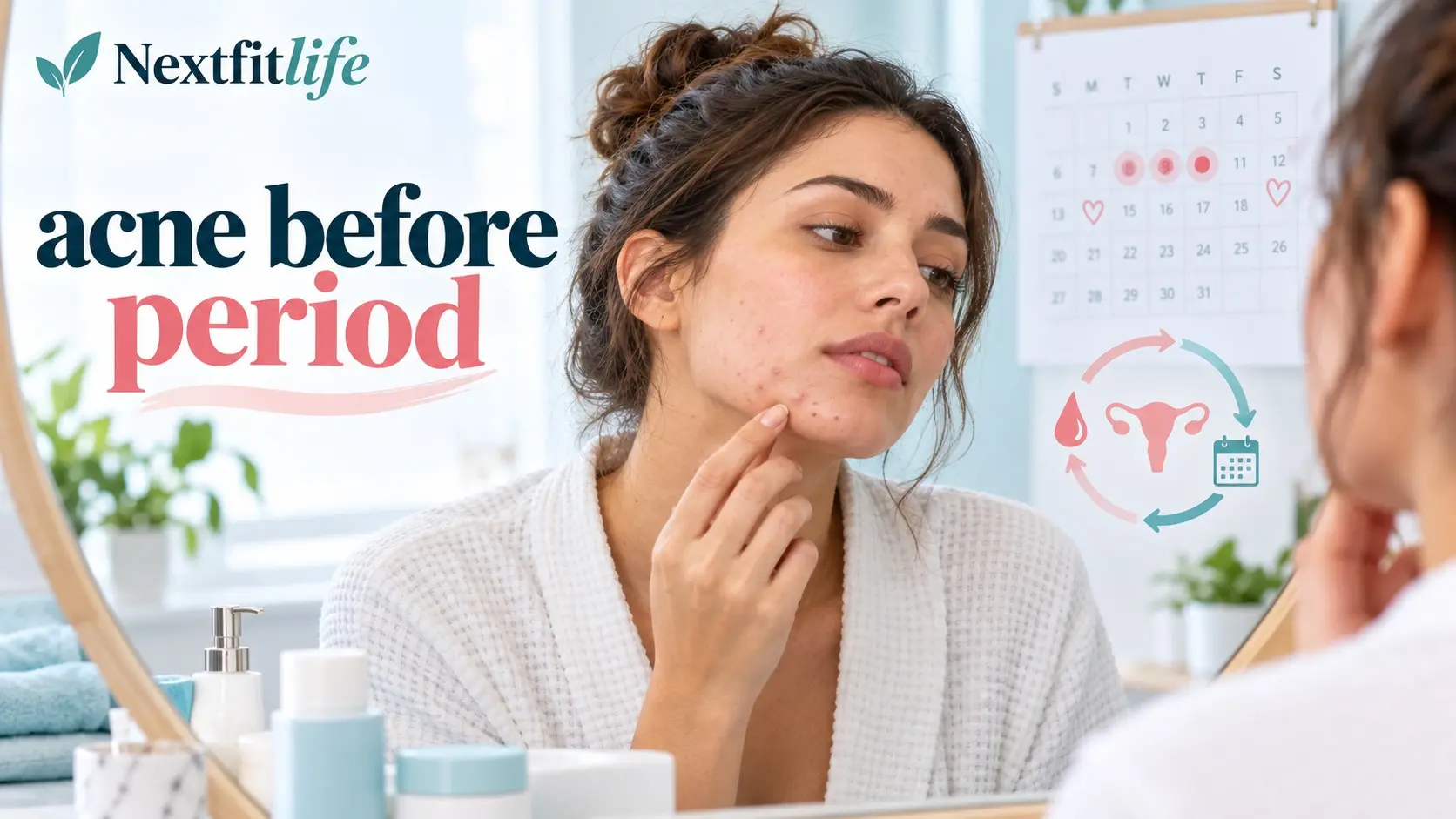
Acne before period usually happens because hormone changes around the menstrual cycle affect oil production, clogged pores, and inflammation. The breakouts often appear around the chin, jawline, lower cheeks, neck, chest, or back.
The best approach is not to wait until the pimples appear and then attack them with several strong products. A simple routine used consistently through the month usually makes more sense.
This article is for general information and education. It does not replace medical advice, diagnosis, or treatment.
If you want a broader daily skin routine, visit the NextFitLife Healthy Skin Guide.
Table of Contents
- Why acne appears before a period
- What hormonal acne looks like
- 9 smart ways to break the monthly cycle
- Treat acne all month
- Cleanse gently
- Use benzoyl peroxide
- Use salicylic acid wisely
- Consider a retinoid
- Try azelaic acid
- Track your cycle
- Stop picking
- Know when hormones need checking
- Birth control and spironolactone
- Food and supplements
- Pregnancy safe choices
- PCOS warning signs
- When to see a dermatologist
- Frequently asked questions
Why Does Acne Appear Before Your Period?
Your skin is not suddenly dirty.
Acne forms when pores become blocked with sebum, dead skin cells, and other material. Inflammation and acne related bacteria then contribute to blackheads, whiteheads, red pimples, pustules, nodules, and cysts.
The menstrual cycle changes the hormonal environment around those pores.
Estrogen, progesterone, and androgen activity shift during the cycle. Some people's oil glands are more sensitive to those changes, so breakouts become more noticeable around menstruation.
This is why one person can have clear skin for most of the month and then develop several sore chin spots before each period.
What Does Hormonal Period Acne Usually Look Like?
The classic pattern is acne around the lower face.
You may notice:
- Tender chin pimples
- Jawline acne
- Deep bumps under the skin
- Red inflamed pimples
- Pustules
- Several spots appearing around the same time
- Breakouts that repeat at a similar point in the cycle
Hormonal acne can also appear on the cheeks, neck, chest, shoulders, or back.
The location alone does not prove that hormones are the cause. The timing pattern gives you more useful information.
1. Treat Acne All Month, Not Only Before Your Period
This is the biggest change I would make.
If acne returns every month, waiting until the spots are large and painful puts you behind the problem.
Many acne medicines work by preventing clogged pores and reducing inflammation before the next breakout develops.
AAD guidance advises giving an acne treatment several weeks to show improvement rather than switching products every few days.
A practical pattern looks like this:
Simple routine → consistent treatment → fewer blocked pores → smaller monthly flare.
Compare that with changing cleansers, acids, masks, and spot treatments every time menstruation approaches. That often produces irritated skin on top of acne.
2. Keep Cleansing Gentle
Hormonal acne is not caused by failing to scrub your face hard enough.
Use a mild cleanser and lukewarm water.
Wash gently rather than scrubbing with rough brushes, abrasive cloths, or grainy exfoliants.
If you wear makeup, sunscreen, or heavier skin products, remove them properly at the end of the day.
Look for noncomedogenic products when possible. This means they are designed to be less likely to clog pores.
How often should you wash?
For most people, cleansing morning and evening is enough.
You may also want to wash after heavy sweating.
Repeatedly washing your face through the day will not stop your ovaries from producing hormones. It can simply make irritated skin feel worse.
3. Benzoyl Peroxide Helps Inflamed Period Pimples
Benzoyl peroxide is one of the best established acne ingredients for inflamed pimples.
It reduces acne related bacteria and is strongly recommended in current American Academy of Dermatology acne guidance.
You can find it in:
- Cleansers
- Gels
- Creams
- Combination acne medicines
Start with a product your skin can tolerate rather than automatically choosing the strongest percentage.
Benzoyl peroxide can cause dryness and irritation. It can also bleach fabric, including pillowcases, towels, and clothing.
That second lesson is usually learned once.
4. Salicylic Acid Makes More Sense for Clogged Pores
If your monthly flare includes blackheads, whiteheads, and blocked pores, salicylic acid can help.
It exfoliates inside the pore and is included as an acne treatment option in current AAD guidance.
The common mistake is using salicylic acid in everything.
You do not need a salicylic cleanser, toner, serum, exfoliating pad, mask, and spot treatment at the same time.
That is more likely to produce irritation than faster clearing.
Choose one role for it
For example, you might use a salicylic acid cleanser or leave on product according to its directions and build the rest of the routine around gentler products.
5. A Topical Retinoid Can Prevent Repeated Clogged Pores
Topical retinoids are among the strongest long term treatments for acne because they help stop pores from becoming clogged.
Examples include:
- Adapalene
- Tretinoin
- Tazarotene
- Trifarotene
Current AAD guidelines strongly recommend topical retinoids for acne.
They are not instant spot treatments.
A retinoid works better as part of a consistent routine applied as directed over time.
Start slowly if your skin is sensitive
Retinoids can cause dryness, peeling, redness, and irritation, especially at the beginning.
Use a small amount, moisturize, and follow the directions given with the product or by your dermatologist.
6. Azelaic Acid Is Useful for Acne and Dark Marks
Azelaic acid deserves more attention than it usually gets.
It can help unclog pores, reduce inflammation, affect acne related bacteria, and improve the dark spots that can remain after a pimple heals.
This makes it especially useful for someone dealing with both acne and post inflammatory hyperpigmentation.
AAD includes azelaic acid among recommended topical acne options.
ACOG also lists azelaic acid among OTC acne ingredients that can be used during pregnancy.
7. Track Your Cycle for Two or Three Months
If you think your acne follows your menstrual cycle, prove the pattern to yourself.
You do not need a complicated health app.
Write down:
- The first day of your period
- The day new acne starts
- Where the spots appear
- Whether they are small, inflamed, or deep
- The skin products you used
- Any major medicine changes
- Whether your cycle was regular
After several cycles, you may see a clear pattern.
This also gives your dermatologist or gynecologist better information than saying, “My skin gets bad sometimes.”
Do you need to start treatment exactly seven days before your period?
No universal rule says everyone should start acne medicine on one exact cycle day.
Most topical treatments work better when they are used consistently through the month rather than added as an emergency treatment just before menstruation.
8. Stop Squeezing Deep Jawline Pimples
I understand why people do it.
A large sore bump feels as if it needs to be emptied.
Deep hormonal lesions often do not have material close enough to the surface to squeeze safely. Pressing them can increase inflammation and raise the chance of:
- Skin injury
- Dark marks
- Longer healing
- Scarring
Leave the lesion alone and treat the acne process rather than trying to perform surgery with your fingernails.
What about pimple patches?
Hydrocolloid patches can help cover superficial spots and keep your fingers away from them.
They do not fix the hormonal trigger behind deep nodules or cysts.
9. Know When Hormonal Acne Needs a Medical Check
Acne around menstruation is common.
Acne plus several other hormonal symptoms is different.
Talk with a healthcare professional if acne comes with:
- Irregular periods
- Very infrequent periods
- Absent periods
- New coarse facial hair
- Increased body hair
- Scalp hair thinning
- Fertility concerns
- Sudden severe acne
These symptoms can occur with conditions involving excess androgen activity, including polycystic ovary syndrome.
Acne alone does not diagnose PCOS.
Period Acne vs Possible PCOS Acne
| Pattern | Ordinary Premenstrual Acne | Worth Medical Evaluation |
|---|---|---|
| Cycle | Periods remain fairly predictable | Periods are irregular, absent, or very infrequent |
| Hair growth | No major change | New coarse facial or body hair |
| Scalp hair | No clear hormonal change | Noticeable thinning |
| Acne pattern | Monthly flare with otherwise manageable acne | Persistent or severe hormonal acne with other symptoms |
Can Spironolactone Help Acne Before Period?
For appropriate patients with persistent hormonal acne, spironolactone can be a useful prescription treatment.
It reduces androgen effects that contribute to oil production.
AAD includes spironolactone among systemic acne treatment options, and its patient guidance discusses it specifically for stubborn lower face, chin, and jawline acne.
It is not right for everyone.
Possible side effects can include:
- Irregular periods
- Breast tenderness
- Headache
- Dizziness
- Fatigue
- Increased urination
Your clinician will consider your health history and other medicines before prescribing it.
Can Birth Control Help Period Acne?
Yes, for some people.
Certain combined oral contraceptives reduce androgen effects and are included in current AAD acne recommendations.
This can make them useful when contraception is also wanted.
But birth control should not be chosen like a skin serum.
Combined hormonal contraception is not appropriate for everyone. Your clinician will review factors such as:
- History of blood clots
- Smoking
- Age
- Migraine with aura
- Blood pressure
- Heart disease
- Some liver conditions
- Pregnancy plans
Different hormonal contraceptives can affect acne differently, so ask about the exact method rather than assuming every type of birth control improves the skin.
Does Diet Cause Acne Before Period?
Hormone changes are the more obvious explanation when acne returns at the same point in the menstrual cycle.
Diet research is more complicated.
Some studies have linked high glycemic eating patterns and certain dairy products with acne in some populations, but diet is not simple enough to blame one food for every monthly breakout.
Current AAD guidelines found insufficient evidence to make formal acne treatment recommendations for dietary changes or vitamins and plant based therapies.
That means I would not react to period acne by suddenly removing dairy, gluten, fruit, carbohydrates, and chocolate at the same time.
You would make your diet harder without learning which change mattered.
Instead, follow a balanced eating pattern built around vegetables, fruit, whole grains, useful protein foods, and healthy fats.
See the Healthy Eating Lifestyle Guide for a practical framework.
Can Stress Make Period Acne Worse?
Stress is not the only cause of hormonal acne, but it can make an existing acne pattern harder to manage.
Stress may overlap with:
- Poor sleep
- More face touching
- Skipped skin care
- Diet changes
- Reduced exercise
The answer is not “relax and your acne disappears.”
Treat the acne directly and reduce avoidable triggers where you can.
Do Hormone Balancing Supplements Work?
Be skeptical of products that promise to “balance hormones” and clear monthly acne.
Current AAD guidance says there is not enough evidence to make acne treatment recommendations for vitamins or plant based alternative therapies.
That does not prove every supplement has zero biological effect.
It means the evidence is not strong enough to put supplements ahead of established treatments such as:
- Benzoyl peroxide
- Topical retinoids
- Azelaic acid
- Salicylic acid
- Prescription hormonal therapy when appropriate
Supplements can also interact with medicines and are not automatically safe during pregnancy.
A Simple Cycle Aware Acne Routine
Morning
Wash with a gentle cleanser.
Use the acne treatment that fits your skin, such as benzoyl peroxide or azelaic acid if appropriate.
Apply a noncomedogenic moisturizer.
Finish with sunscreen.
Evening
Cleanse gently and remove makeup or sunscreen.
If a topical retinoid is appropriate for you, apply it according to its directions or your dermatologist's plan.
Use moisturizer as needed.
Before Your Usual Flare
Do not suddenly double the strength or frequency of every product.
Keep your regular routine steady.
The prevention came from being consistent before this week arrived.
During an Active Breakout
Do not pick or squeeze.
Keep using your established plan instead of adding several new acids or spot treatments at once.
How Long Does Acne Treatment Take to Work?
Longer than most people want.
AAD patient guidance advises allowing about six to eight weeks to judge improvement from an over the counter acne treatment.
Some prescription routines can take longer before their full effect becomes clear.
This is why switching every week makes it difficult to know what is helping.
If your acne is deep, painful, scarring, or seriously affecting your confidence, you do not need to wait months before seeing a dermatologist.
Pregnancy Changes the Acne Treatment Plan
If you are pregnant, trying to become pregnant, or could become pregnant, review your skin routine.
ACOG lists these OTC ingredients as options that can be used during pregnancy:
- Benzoyl peroxide
- Azelaic acid
- Topical salicylic acid
- Glycolic acid
ACOG advises against hormonal acne therapies and isotretinoin during pregnancy and generally recommends avoiding topical retinoids.
This is one area where guessing is unnecessary.
Show your complete product list to your obstetrician, dermatologist, or pharmacist.
What if the Bumps Are Not Acne?
Not every red bump on the lower face is acne.
Conditions that can look similar include:
- Rosacea
- Perioral dermatitis
- Folliculitis
- Skin irritation
- Contact dermatitis
If your “acne” is very itchy, looks unusually uniform, clusters tightly around the mouth, or does not respond to standard acne treatment, get the diagnosis checked.
When Should You See a Dermatologist?
Book an appointment if:
- Your acne is deep or painful
- You are developing scars
- You have persistent dark marks
- Over the counter treatment has not helped
- Your acne suddenly becomes severe
- Your chest or back is heavily affected
- Your skin cannot tolerate the products you try
- Your periods are irregular
- You have excess facial hair or scalp hair loss
- The acne is affecting your mood or confidence
A dermatologist can build a plan around the type of acne you actually have instead of forcing you through another cycle of trial and error.
Common Mistakes That Keep Monthly Acne Going
| Mistake | Why It Backfires | Better Move |
|---|---|---|
| Treating acne only before your period | Clogged pores have already been developing | Use a consistent routine |
| Scrubbing harder | Adds irritation | Cleanse gently |
| Using several acids at once | Raises dryness and irritation | Choose a simple treatment plan |
| Squeezing deep lesions | Raises inflammation and scar risk | Leave them alone and treat the acne |
| Changing products every week | No treatment gets enough time | Track results over several weeks |
| Ignoring irregular periods | A hormonal condition may be missed | Discuss the pattern with a clinician |
Conclusion: Break the Pattern, Not Your Skin Barrier
If acne before period returns every month, the answer is not stronger scrubbing or a new emergency spot treatment every cycle.
Use a simple routine consistently, choose evidence based ingredients that match your acne, avoid picking, and give treatment enough time to work.
If the breakouts are deep, painful, scarring, or linked with irregular periods, excess facial hair, or scalp hair loss, make your next step a dermatologist or gynecology appointment rather than another skin care purchase.
References and Sources
- American Academy of Dermatology. Acne Clinical Guideline.
Current recommendations covering benzoyl peroxide, topical retinoids, salicylic acid, azelaic acid, combined oral contraceptives, spironolactone, antibiotics, and isotretinoin.
https://www.aad.org/member/clinical-quality/guidelines/acne - American Academy of Dermatology. Updated Guidelines for Acne Management.
Summarizes the 2024 evidence based acne recommendations and notes that evidence is insufficient for formal dietary, vitamin, and plant based acne recommendations.
https://www.aad.org/news/updated-guidelines-acne-management - American Academy of Dermatology. Acne Diagnosis and Treatment.
Explains topical therapies, hormonal treatment, oral contraceptives, spironolactone, isotretinoin, and other prescription options.
https://www.aad.org/public/diseases/acne/derm-treat/treat - American Academy of Dermatology. Hormonal Therapy for Stubborn Acne.
Discusses jawline and lower face acne, combined oral contraceptives, spironolactone, benefits, risks, and pregnancy precautions.
https://www.aad.org/public/diseases/acne/derm-treat/hormonal-therapy - American College of Obstetricians and Gynecologists. Skin Conditions During Pregnancy.
Lists acne ingredients that can be used during pregnancy and medicines that should be avoided or reviewed.
https://www.acog.org/womens-health/faqs/skin-conditions-during-pregnancy - Cleveland Clinic. Hormonal Acne.
Covers hormonal acne causes, common locations, menstrual changes, stress, sleep, and treatment options.
https://my.clevelandclinic.org/health/diseases/21792-hormonal-acne - NHS. Combined Pill: Who Can Take It.
Explains when combined hormonal contraception may not be suitable because of factors such as smoking, migraine with aura, clot history, cardiovascular disease, and other conditions.
https://www.nhs.uk/contraception/methods-of-contraception/combined-pill/who-can-take-it/
Internal Links and Helpful NextFitLife Guides
- Healthy Skin 101
- Healthy Eating Lifestyle
- Nutrition and Vitamins Hub
- Weight Management and Metabolism Hub
- Diabetes and Blood Sugar Management
- Healthy Lifestyle Roadmap
About the Author
Adel Galal is the Founder and Lead Writer at NextFitLife. He researches skin health, nutrition, fitness, women's wellness, metabolic health, and healthy lifestyle topics and turns current medical and public health guidance into clear practical information for everyday readers.
I am not a doctor or licensed healthcare professional, and this content does not replace professional medical advice, diagnosis, or treatment. I share information based on extensive research, real life experience, and consultation with healthcare providers. Always consult a qualified healthcare professional for diagnosis, treatment, or guidance about any health condition.
Learn more about Adel, NextFitLife, and the site's editorial approach on the About Us page.
Frequently Asked Questions
Why do I get acne before my period?
Hormone changes around the menstrual cycle can increase oil production and inflammation, making clogged pores more likely to become visible pimples before menstruation.
How many days before a period does acne start?
There is no exact day that applies to everyone. Some people notice breakouts several days before menstruation, while others flare closer to the start of bleeding. Tracking two or three cycles can reveal your own pattern.
Where does hormonal period acne appear?
It commonly appears on the chin, jawline, lower cheeks, neck, chest, shoulders, or back. Location alone does not prove the acne is hormonal.
How can I prevent acne before my period?
Use a consistent acne routine throughout the month instead of waiting for the flare. Proven options can include benzoyl peroxide, topical retinoids, salicylic acid, or azelaic acid depending on your skin and medical situation.
Is benzoyl peroxide good for period acne?
Yes. Benzoyl peroxide is strongly recommended in current acne guidelines and can be particularly useful for inflamed pimples.
Does salicylic acid help hormonal acne?
Salicylic acid can help unclog pores and treat blackheads, whiteheads, and some pimples. It does not change the hormonal trigger itself.
Can adapalene prevent monthly acne?
Adapalene is a topical retinoid that helps prevent clogged pores and is useful for ongoing acne treatment. Retinoids are generally avoided during pregnancy.
Does spironolactone help acne before a period?
Spironolactone can be effective for appropriate patients with stubborn hormonal acne, especially lower face and jawline acne. It requires a prescription and should not be used during pregnancy.
Can birth control stop period acne?
Certain combined oral contraceptives can improve hormonal acne, but they are not suitable for everyone. A clinician should review your health history and pregnancy goals before prescribing them.
Does period acne mean I have PCOS?
No. Acne before menstruation is common and does not diagnose PCOS. Medical evaluation becomes more important when acne occurs with irregular periods, excess facial or body hair, scalp hair thinning, or fertility concerns.
What acne treatments are safer during pregnancy?
ACOG lists benzoyl peroxide, azelaic acid, topical salicylic acid, and glycolic acid among OTC ingredients that can be used during pregnancy. Retinoids and hormonal acne medicines require avoidance or medical review.
How long should I try an acne treatment?
Many acne treatments need several weeks. AAD advises giving an over the counter treatment about six to eight weeks to judge improvement unless irritation or another problem means you should stop sooner.
When should I see a dermatologist for period acne?
See a dermatologist if acne is deep, painful, scarring, persistent despite treatment, suddenly severe, or affecting your quality of life. Also seek evaluation if you have irregular periods or other signs of excess androgen activity.

Health & wellness writer with 30+ years of experience in nutrition, fitness, and healthy aging. Founder of NextFitLife.com — evidence-based health guidance.