Updated on: October 16, 2026
Written and source checked by: Adel Galal, Founder and Lead Writer at NextFitLife
Medical review status: This article has not been medically reviewed by a doctor, registered dietitian, pharmacist, or other licensed healthcare professional.
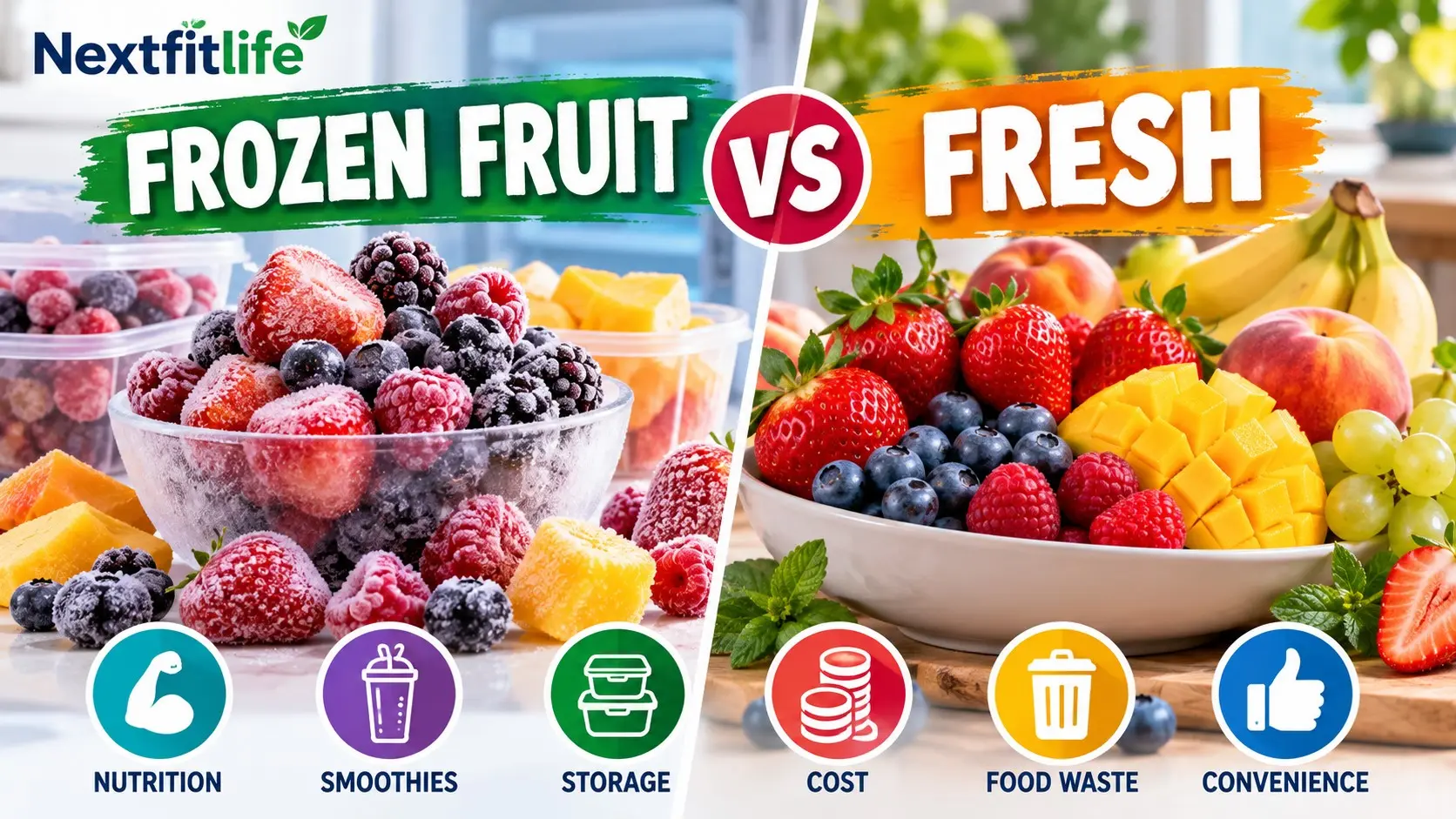
Frozen fruit vs fresh is not a contest with one permanent winner. Plain frozen fruit can be nutritionally similar to fresh fruit, while fresh usually wins for texture and easy snacking. Frozen wins for smoothies, longer storage, meal prep, and reducing food waste.
For most people, the smartest answer is simple: use both.
This article is for general information and education. It does not replace medical advice, diagnosis, or treatment.
If you want a broader guide to building meals around fruit, vegetables, whole grains, protein foods, and healthy fats, visit the Healthy Eating Lifestyle Guide.
Table of Contents
- The quick verdict
- Does frozen fruit lose nutrients?
- 9 smart ways to choose
- Nutrition
- Texture
- Smoothies
- Weight goals
- Blood sugar
- Cost
- Food waste
- Storage
- Food safety
- Frozen berries versus fresh berries
- Added sugar and labels
- Best fruit by use
- How to shop smarter
- Frequently asked questions
Frozen Fruit vs Fresh: Which Is Better?
If both choices are plain fruit, I would not choose based on tiny nutrient differences.
I would choose based on how I plan to eat it.
Fresh fruit is the better choice when you want crisp texture, ripe flavor, and something easy to eat by hand.
Frozen fruit is the better choice when you want convenience, longer storage, less waste, or fruit for smoothies, oatmeal, yogurt, sauces, and baking.
That is more useful than pretending every fresh strawberry is automatically healthier than every frozen one.
Research comparing refrigerated and frozen produce has found broadly similar retention of vitamins, minerals, fiber, and plant compounds, although the result varies by food and nutrient.
Does Frozen Fruit Lose Nutrients?
No. Freezing does not wipe out the nutrition in fruit.
Fruit begins changing after harvest. Fresh produce may spend time in transport, storage, the supermarket, and your refrigerator before you eat it.
Frozen fruit is commonly picked when ripe and frozen relatively soon afterward.
The American Heart Association notes that frozen produce is picked near peak ripeness and frozen to preserve nutrition.
A UC Davis study comparing refrigerated and frozen produce found that vitamin retention was often similar. In some foods, the frozen samples retained more of specific vitamins than the refrigerated samples.
Another UC Davis analysis found that minerals, fiber, and total phenolic compounds were generally similar between frozen and refrigerated produce.
The practical lesson is not that frozen is always better.
It is that fresh does not automatically mean more nutritious.
Vitamin C is more sensitive than fiber
Vitamin C can change during storage and processing.
In the UC Davis vitamin comparison, vitamin C levels were similar in several foods and higher in frozen samples for some others.
Another strawberry study found higher bioaccessible micronutrients in fresh strawberries than frozen strawberries.
Both can be true because storage time, fruit type, freezing method, ripeness, and testing methods differ.
This is why I would not choose your fruit based on one vitamin measurement.
1. Fresh Fruit Wins for Texture
Freezing changes fruit structure.
Water inside the fruit forms ice crystals, which can damage some cell walls. After thawing, the fruit may become softer and release more juice.
That is not a nutrition problem.
It is a texture problem.
Fresh is usually better for:
- Fruit salads
- Lunch boxes
- Eating by hand
- Fresh garnishes
- Recipes where firm texture matters
A fresh apple, grape, peach, or pear is simply more pleasant to bite into than the same fruit after freezing and thawing.
2. Frozen Fruit Wins for Smoothies
This one is easy.
I would usually choose frozen fruit for smoothies.
Frozen berries, mango, pineapple, cherries, and banana make a smoothie thick and cold without requiring a large amount of ice.
There is one catch.
A smoothie can become much more calorie dense than expected when you keep adding ingredients.
Frozen fruit is not the problem. The total recipe matters.
A smoothie that includes fruit, plain yogurt, and a suitable liquid is very different from one loaded with fruit juice, honey, sweetened yogurt, syrups, and several large scoops of calorie dense extras.
For broader nutrition planning, see 24 Proven Nutrition Tips for Better Health.
3. Frozen Fruit Can Reduce Food Waste
This is one of its biggest advantages.
Fresh berries can spoil quickly.
Frozen fruit waits.
You can use one handful and keep the rest frozen.
This makes frozen fruit useful for:
- Small households
- People living alone
- Busy families
- Occasional smoothie drinkers
- Fruit that is expensive out of season
A nutritious food you actually eat is more useful than fresh fruit that turns moldy in the refrigerator.
4. Fresh Fruit Usually Wins for Easy Snacking
Try eating a frozen apple on your way out the door.
Fresh fruit is hard to beat for convenience when the goal is a simple snack.
Good examples include:
- Apples
- Bananas
- Oranges
- Pears
- Grapes
- Peaches
- Plums
They require little or no preparation and are easy to portion naturally.
5. Frozen Fruit Is Not Automatically Higher in Sugar
Plain frozen fruit does not suddenly gain sugar because it was frozen.
A frozen strawberry is still a strawberry.
The issue is what manufacturers add.
Check the ingredient list.
Ingredients: Strawberries.
Or blueberries. Mango. Cherries. Pineapple.
You do not need syrup or added sugar for ordinary frozen fruit.
The American Heart Association recommends checking frozen fruit products for added sugars.
6. Both Fresh and Frozen Fruit Still Provide Fiber
Freezing does not remove the fiber from whole fruit.
That matters.
Fiber supports digestion and helps whole fruit behave differently from fruit juice.
The UC Davis storage comparison found fiber retention was generally similar between frozen and refrigerated produce.
This is one reason I would choose plain frozen berries over berry juice for everyday use.
Both fresh and frozen whole fruit preserve the food structure much better than juice.
7. Neither Form Automatically Wins for Weight Loss
If your goal includes weight management, focus less on freezer versus refrigerator and more on the total eating pattern.
Both forms can fit.
Fresh fruit has an advantage as a simple snack because you chew it and eat a clear portion.
Frozen fruit has an advantage because you can keep nutritious fruit available without worrying about rapid spoilage.
The main trap is blending huge portions without noticing how much fruit and other ingredients went into the drink.
For a wider strategy, visit the Weight Management and Metabolism Hub.
8. Fresh vs Frozen Matters Less Than the Whole Meal for Blood Sugar
People sometimes ask whether frozen fruit raises blood sugar more than fresh fruit.
That is usually the wrong comparison.
If both products contain only the same whole fruit, focus on:
- The type of fruit
- Your portion
- Whether sugar was added
- Whether you eat it whole or blend it
- The rest of the meal
Whole fruit still contains fiber whether it started fresh or frozen.
If you manage diabetes or prediabetes, the amount you eat and your overall meal matter more than whether berries came from a freezer.
For detailed guidance, visit Diabetes and Blood Sugar Management.
9. Frozen Fruit Usually Wins for Long Storage
Fresh fruit has a limited window.
Frozen fruit lasts much longer when it stays properly frozen.
This makes it useful as a backup food.
You can keep fresh fruit for immediate eating and frozen fruit for the days when the fruit bowl is empty.
That combination works better than treating the two forms as enemies.
Frozen Fruit vs Fresh by Goal
| Goal | Better Choice | Why |
|---|---|---|
| Snacking | Fresh | Better texture and easy to eat by hand |
| Smoothies | Frozen | Creates a thicker cold texture without much ice |
| Reducing food waste | Frozen | Use only what you need |
| Seasonal flavor | Fresh | Ripe seasonal fruit usually has better texture |
| Out of season berries | Frozen | Easy year round access and good nutrient retention |
| Fruit salad | Fresh | Thawed fruit can become soft |
| Oatmeal | Either | Frozen berries work especially well when heated |
| Baking | Either | Frozen fruit can release more moisture |
| Keeping fruit available | Frozen | Long storage makes consistency easier |
Fresh vs Frozen Berries Deserves Its Own Answer
Berries are one of the strongest reasons to use your freezer.
Fresh strawberries, blueberries, raspberries, and blackberries are excellent when they are ripe and you plan to eat them quickly.
They are also delicate.
Frozen berries are easier to keep around for:
- Smoothies
- Oatmeal
- Yogurt
- Baking
- Fruit sauces
Nutrition is not the main reason to avoid frozen berries.
Food safety deserves more attention.
Frozen Does Not Mean Sterile
Freezing slows or stops microbial growth while food remains frozen, but it does not reliably destroy every microorganism.
USDA explains that freezing does not sterilize food.
FDA has investigated foodborne illness outbreaks linked with berries and notes that freezing does not reliably inactivate viruses that may contaminate berries during growing, harvesting, processing, or handling.
The lesson is simple.
Do not fear frozen fruit, but do not treat it as sterile either.
Follow package instructions
Frozen fruit products differ.
If the package gives preparation or cooking instructions, follow them.
Check food recalls when relevant.
Should You Wash Frozen Fruit?
Follow the instructions on the package.
For fresh fruit, FDA recommends washing produce under running water before eating or preparing it.
Do not wash fruit with soap, detergent, or household cleaning products.
Some frozen fruit is sold ready to use, while other products may include specific preparation directions.
Is Frozen Fruit Cheaper?
Sometimes.
But not always.
Price depends on:
- The fruit
- The season
- The country
- The store
- The package size
- Local supply
Fresh bananas may be cheaper than almost any frozen fruit.
Frozen berries may be a better value when fresh berries are out of season.
The more useful question is how much of the food you actually eat.
If half the fresh berries end up moldy, their real value is worse than the shelf price suggests.
Does Frozen Fruit Contain Preservatives?
Plain frozen fruit does not need preservatives simply because it is frozen.
Freezing itself preserves the food.
But products vary.
Read the label.
A simple product may contain only:
- Strawberries
- Blueberries
- Mango
- Cherries
- Peaches
If the ingredient list includes syrup, sugar, or other sweeteners, that changes the product.
Fresh vs Frozen Fruit for Specific Fruits
| Fruit | Best Choice | Why |
|---|---|---|
| Blueberries | Both | Fresh for snacking, frozen for oatmeal and smoothies |
| Strawberries | Both | Fresh texture is better, frozen reduces spoilage |
| Mango | Frozen for convenience | Already peeled and cut |
| Banana | Fresh, then freeze ripe extras | Fresh for snacking, frozen for smoothies |
| Peaches | Fresh in season | Ripe fresh texture is hard to match |
| Cherries | Frozen for recipes | Convenient when already pitted |
| Apples | Fresh | Better crunch and already stores well |
| Pineapple | Depends on use | Fresh for eating, frozen for blending |
How to Buy Better Frozen Fruit
Check the Ingredient List
Plain fruit is the simplest choice.
Look for Added Sugar
Do not assume every frozen fruit blend is unsweetened.
Check the Package
Avoid packages that are badly damaged or open.
Use Fruit You Actually Enjoy
A freezer full of “healthy” foods that nobody eats is still wasted food.
Keep Variety
No fruit provides every nutrient.
Rotate berries, citrus fruit, bananas, apples, mango, peaches, melons, and other fruits that fit your needs and budget.
How to Use Frozen Fruit Without Making a Smoothie Every Day
Frozen fruit does more than smoothies.
Try it in:
- Oatmeal
- Plain yogurt
- Overnight oats
- Homemade fruit sauces
- Baked oatmeal
- Muffins
- Warm fruit desserts
- Breakfast bowls
Frozen berries can go straight into hot oatmeal.
Frozen cherries can thaw overnight in oats.
Mango can be partly thawed and added to yogurt.
This is one reason frozen fruit works well in a realistic eating routine.
Can Frozen Fruit Be Part of a Healthy Eating Lifestyle?
Yes.
A healthy eating pattern does not require every food to be fresh.
Fruit can be fresh, frozen, or in other suitable forms depending on how it is prepared.
The bigger picture matters more:
- Eat a variety of fruit
- Choose whole fruit often
- Check added sugar
- Eat enough vegetables too
- Include useful protein foods
- Choose whole grains and other fiber rich foods
- Use healthy fats
For a complete framework, use the Healthy Eating Lifestyle: 16 Simple Habits That Last.
Frozen Fruit vs Juice Is an Easier Decision
Whole frozen fruit keeps its fiber.
Fruit juice does not provide the same intact fruit structure.
That makes whole fruit, whether fresh or frozen, the stronger everyday choice for most people.
Juice can still fit some diets, but it is much easier to drink a large amount of fruit quickly than to chew the same quantity whole.
What About Dried Fruit?
Dried fruit is nutritious, but drying removes much of the water.
This makes the fruit smaller and more concentrated.
That means it is easier to eat a large amount quickly.
Frozen fruit behaves much more like fresh whole fruit because its water has not been removed.
The better choice depends on what you need.
Dried fruit is useful when portability matters. Frozen fruit works better when volume and fresh fruit style eating matter.
My Practical Shopping Strategy
I would not fill the entire kitchen with one form.
Keep fresh fruit that is easy to snack on.
Then keep one or two bags of plain frozen fruit as backup.
A simple mix might look like this:
- Fresh bananas
- Fresh apples
- Fresh oranges
- Seasonal fresh fruit
- Frozen blueberries
- Frozen mango or cherries
This gives you texture, portability, storage, and convenience without making nutrition more complicated than it needs to be.
Conclusion: Choose the Fruit You Will Actually Eat
The real answer to frozen fruit vs fresh is not “one is healthier.”
Fresh wins for crisp texture, seasonal eating, fruit salads, and easy snacks. Frozen wins for smoothies, storage, convenience, out of season fruit, and reducing waste.
Nutrition is strong on both sides when you choose plain whole fruit.
Your next step is simple: keep fresh fruit you enjoy eating now and one or two bags of unsweetened frozen fruit for later. That gives you the advantages of both without turning a basic food choice into a nutrition argument.
References and Sources
- Bouzari A, Holstege D, Barrett DM. Vitamin Retention in Eight Fruits and Vegetables: A Comparison of Refrigerated and Frozen Storage.
Compares vitamin retention in fresh refrigerated and frozen produce, including strawberries and blueberries.
https://pubmed.ncbi.nlm.nih.gov/25526594/ - Bouzari A, Holstege D, Barrett DM. Mineral, Fiber, and Total Phenolic Retention in Eight Fruits and Vegetables.
Reports generally similar retention of minerals, fiber, and total phenolic compounds between frozen and refrigerated produce.
https://pubmed.ncbi.nlm.nih.gov/25525668/ - American Heart Association. Fresh, Frozen or Canned Fruit and Vegetables: All Can Be Healthy Choices.
Explains that frozen produce can retain nutrition well and recommends checking frozen fruit for added sugar.
https://www.heart.org/en/healthy-living/healthy-eating/eat-smart/nutrition-basics/fresh-frozen-or-canned-fruits-and-vegetables-all-can-be-healthy-choices - Harvard Health. Are Certain Fruits Healthier Than Others?
Covers whole fruit, frozen fruit, juice, added sugar, fiber, and practical fruit choices.
https://www.health.harvard.edu/blog/are-certain-fruits-healthier-than-others-202201312677 - USDA Food Safety and Inspection Service. Freezing and Food Safety.
Explains that freezing slows microbial activity but does not sterilize food.
https://www.fsis.usda.gov/food-safety/safe-food-handling-and-preparation/food-safety-basics/freezing-and-food-safety - FDA. Selecting and Serving Produce Safely.
Provides safe washing and handling guidance for fresh produce.
https://www.fda.gov/food/buy-store-serve-safe-food/selecting-and-serving-produce-safely - FDA. FDA Works to Enhance the Safety of Berries.
Explains food safety concerns associated with fresh and frozen berries and why freezing does not reliably eliminate viruses.
https://www.fda.gov/food/hfp-constituent-updates/fda-works-enhance-safety-berries
Internal Links and Helpful NextFitLife Guides
- Healthy Eating Lifestyle Guide
- Healthy Eating Lifestyle: 16 Simple Habits That Last
- 24 Proven Nutrition Tips for Better Health
- Weight Management and Metabolism Hub
- Weight Loss and Metabolism Food Guide
- Diabetes and Blood Sugar Management
- Healthy Lifestyle Roadmap
About the Author
Adel Galal is the Founder and Lead Writer at NextFitLife. He researches nutrition, healthy eating, fitness, vitamins, weight management, metabolic health, wellness, and healthy aging and turns current medical and public health guidance into clear practical information for everyday readers.
I am not a doctor or licensed healthcare professional, and this content does not replace professional medical advice, diagnosis, or treatment. I share information based on extensive research, real life experience, and consultation with healthcare providers. Always consult a qualified healthcare professional for diagnosis, treatment, or guidance about any health condition.
Learn more about Adel and the NextFitLife editorial approach on the About Us page.
Frequently Asked Questions
Is frozen fruit as healthy as fresh fruit?
Plain frozen fruit can be nutritionally similar to fresh fruit. Freezing preserves fiber, minerals, and many vitamins well. The exact nutrient levels vary by fruit, storage time, ripeness, and processing.
Does frozen fruit lose vitamins?
Some nutrients can change during processing and storage, but freezing preserves many nutrients well. Research comparing frozen and refrigerated produce has found similar vitamin retention for many foods.
Is frozen fruit higher in sugar?
Plain frozen fruit is not automatically higher in sugar than fresh fruit. Check the ingredient list because some frozen fruit products contain added sugar or syrup.
Does frozen fruit still have fiber?
Yes. Whole frozen fruit still contains fiber. Freezing does not remove fiber in the way that juicing removes much of the intact fruit structure.
Is frozen fruit good for weight loss?
Frozen fruit can fit a weight management plan just as fresh fruit can. Choose plain fruit without added sugar and pay attention to portions, especially when blending large smoothies.
Is fresh or frozen fruit better for blood sugar?
For the same plain whole fruit, portion size, fruit type, added ingredients, and the rest of the meal usually matter more than whether the fruit was fresh or frozen.
Is frozen fruit good for smoothies?
Yes. Frozen fruit works very well in smoothies because it creates a cold, thick texture without requiring much ice.
Do I need to wash frozen fruit?
Follow the package directions. Frozen products differ in how they are processed. For fresh fruit, wash it under running water before eating or preparing it.
Is frozen fruit cheaper than fresh?
Sometimes. Prices vary by fruit, season, location, store, and package size. Frozen fruit can also reduce waste because you can use only the amount you need.
Does frozen fruit contain preservatives?
Plain frozen fruit does not need preservatives simply because it is frozen. The cold is the preservation method. Always check the ingredient list because individual products can differ.
Are frozen berries safe to eat?
Frozen berries can be part of a healthy diet, but freezing does not sterilize food. Follow package instructions and current food recall advice.
Which fruits are best bought frozen?
Berries, mango, cherries, peaches, and pineapple are especially convenient frozen for smoothies, oatmeal, baking, and cooking. Apples, bananas, oranges, pears, and grapes are usually more enjoyable fresh for snacking.
Which is better overall, frozen fruit vs fresh?
Neither wins overall. Fresh is better for texture and easy snacking, while frozen is better for storage, smoothies, convenience, and reducing waste. Using both is the most practical choice for many people.

Health & wellness writer with 30+ years of experience in nutrition, fitness, and healthy aging. Founder of NextFitLife.com — evidence-based health guidance.