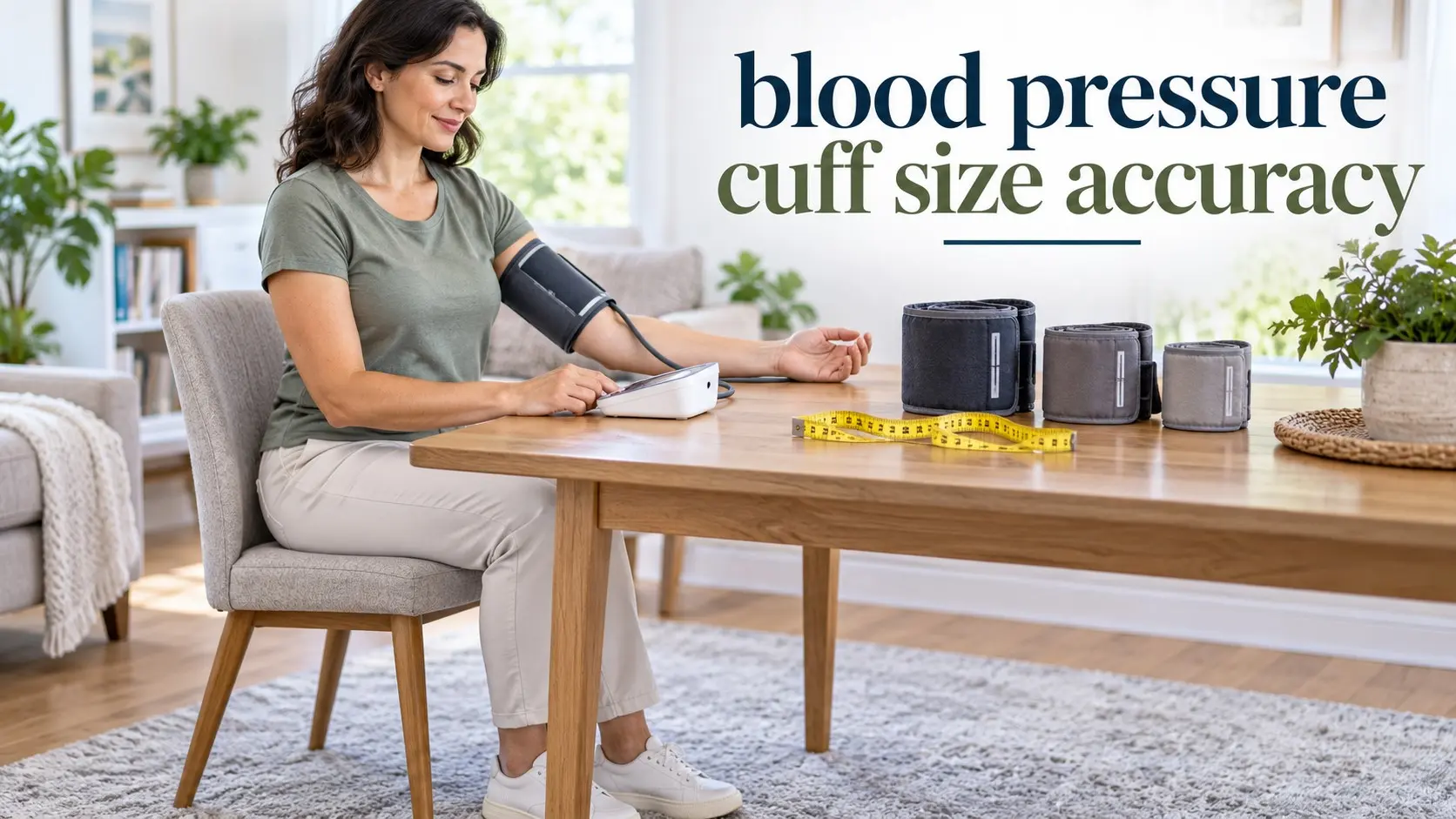
Last Updated: September 8, 2026
Topic: Blood Pressure Cuff Size Accuracy
Reading Time: About 17 minutes
Written and Source-Checked by: Adel Galal, Founder and Lead Writer at NextFitLife
Review Status: This article is educational and source-checked. A doctor, cardiologist, nurse, pharmacist, or other licensed healthcare professional has not medically reviewed it.
A blood pressure cuff can give you the wrong number if it does not fit your arm.
A cuff that is too small tends to push the reading higher.
A cuff that is too large can push it lower.
But cuff size is only one part of the measurement.
Your chair matters.
Your arm position matters.
Talking matters.
Recent exercise matters.
And the monitor itself matters.
Quick answer: Blood pressure cuff size accuracy depends on matching the cuff to your upper arm circumference. A cuff that is too small can give a falsely high reading. A cuff that is too large can give a falsely low reading. Use a validated upper arm monitor, measure on bare skin, support your arm at heart level, rest first, and repeat the reading correctly.
Medical safety note: This page helps you understand blood pressure measurement. It cannot diagnose hypertension or tell you whether a high or low reading is safe for you. Do not stop or change blood pressure medicine because of a home reading or because you think your cuff is wrong.
For more information, visit the NextFitLife Heart and Cardiovascular Health Hub.
You can also explore the NextFitLife Health Hub and Medical Tests and Screenings Hub.
Why does blood pressure cuff size matter?
The cuff must press on your arm in a controlled way.
If the cuff does not match the arm, the pressure estimate can be wrong.
This problem is called mis-cuffing.
The direction matters.
| Cuff problem | Potential effect |
|---|---|
| Cuff is too small | Blood pressure can read falsely high |
| Cuff is too large | Blood pressure can read falsely low |
| Cuff fits correctly | Removes one major source of measurement error |
This is why correct blood pressure cuff size matters before you start worrying about one surprising number.
How much can the wrong cuff change blood pressure?
Sometimes by enough to matter.
A randomized crossover study included 195 adults.
Researchers compared readings taken with the correct cuff and readings taken with a regular adult cuff when another size was actually needed.
When a small cuff was needed, using a regular cuff produced an average systolic reading 3.6 mm Hg lower.
When a large cuff was needed, using a regular cuff produced an average systolic reading 4.8 mm Hg higher.
When an extra-large cuff was needed, using a regular cuff produced an average systolic reading 19.5 mm Hg higher.
That last difference is enormous.
But there is a warning here.
Do not use these numbers as a correction formula.
If your cuff is too small, do not subtract 5, 10, or 20 points from your result.
Those numbers are averages from a research study.
Your personal error cannot be calculated that way.
Use the correct cuff and measure again.
The 7 critical checks for an accurate reading
1. Measure your upper arm
Do not guess your cuff size.
Measure your arm.
You need your mid-upper arm circumference.
Use a soft measuring tape.
- Let your arm hang in a relaxed position.
- Find the top of your shoulder.
- Find the point of your elbow.
- Find the midpoint between them.
- Wrap the tape around the arm at that point.
- Keep the tape flat against the skin.
- Do not pull it painfully tight.
- Write down the measurement in centimetres.
Now compare that number with the range printed on your cuff or in your monitor instructions.
That is more useful than guessing whether your arm looks small, normal, or large.
Should you choose a cuff by the words small, medium, or large?
No.
Use the actual arm range.
A cuff may say, adult.
Another may say, large adult.
Another may say wide range.
The useful information is the centimetre range approved for that cuff and device.
Your blood pressure cuff fit should be based on your measured arm.
Not the name on the box.
2. Match the arm measurement to the cuff range
Look for a range on the cuff.
It may look something like:
Fits arm circumference from X cm to Y cm.
Your arm measurement should fall inside the range listed for that exact cuff.
Do not force a cuff closed around an arm that is outside its range.
Do not assume the cuff that came with a monitor fits every adult.
What if your arm is too large for the cuff?
Do not squeeze your arm into it.
Check the monitor manufacturer.
Look for a larger compatible cuff.
Compatibility matters.
A random cuff from another monitor may not work correctly with your device.
If the manufacturer does not offer a cuff that fits your arm, a different validated monitor may be needed.
What if your arm is smaller than the cuff range?
The same rule applies.
Use a smaller compatible cuff.
A cuff that is too large can make pressure look lower than it really is.
Small arms deserve the same attention as large arms.
Does the inflatable part of the cuff matter?
Yes.
Mayo Clinic explains that the inflatable portion of a blood pressure cuff should cover about 75 to 100 percent of the distance around the upper arm.
The cuff width should also suit the arm.
For a normal home user, there is a simpler rule.
Measure your arm.
Use the circumference range supplied by the manufacturer.
You usually do not need to open the cuff or measure its internal bladder yourself.
3. Put the cuff on correctly
The cuff belongs on bare skin.
Not over a shirt.
Not over a sweater.
Do not roll up a tight sleeve until it forms a band around the upper arm.
That can also interfere with the measurement.
If needed, take the arm out of the sleeve.
The cuff should feel snug.
It should not slide down.
Follow the placement marks printed on your cuff.
Many cuffs include an artery guide or alignment mark.
Use it as the manufacturer directs.
How tight should the blood pressure cuff be?
Snug is the goal.
It should sit flat against the arm.
It should not be loose.
It should not feel painfully tight before the monitor starts inflating.
If the cuff barely closes, check the size again.
If it slides around the arm, check the size and placement.
4. Use a validated upper arm monitor
The correct cuff cannot fix an inaccurate device.
Blood pressure monitor accuracy matters too.
The 2025 high blood pressure guideline recommends a device that has been validated for accuracy.
It also says to use the correct cuff size for the arm.
An automatic upper arm monitor is the preferred home option for most people.
If you are shopping for a monitor in the United States, you can check the exact model at ValidateBP.org.
Search for the exact model.
Do not assume every monitor made by the same company has the same validation status.
This is a key part of validated blood pressure monitor selection.
What about a wrist blood pressure monitor?
Upper arm monitors are preferred when a suitable cuff is available.
Wrist devices are more sensitive to position.
The wrist must be held at heart level.
A small positioning error can change the reading.
A wrist device may still be useful in selected situations.
Ask your healthcare professional whether it is suitable if an upper arm cuff cannot fit you correctly.
What about smartwatches that estimate blood pressure?
Be careful.
The 2025 high blood pressure guideline says cuffless devices should not yet be relied on for accurate blood pressure measurement until they show greater precision and reliability.
A smartwatch reading should not replace a validated cuff-based monitor for medical decisions.
5. Fix your body position before measuring
You can have the perfect cuff and still get a poor reading.
Blood pressure measurement technique matters.
Before you start:
- Sit quietly for at least 5 minutes.
- Support your back.
- Put both feet flat on the floor.
- Keep your legs uncrossed.
- Support your arm.
- Keep the cuff near heart level.
- Relax your hand.
- Do not talk.
- Do not use your phone during the reading.
This should feel boring.
That is good.
A resting blood pressure reading should be taken while you are actually resting.
Why does arm position matter?
Your arm should be supported near heart level.
Do not let it hang by your side.
Do not hold it in the air using your shoulder muscles.
Rest it on a table.
Use a pillow if the table is too low.
You want the same position each time.
Can crossed legs change blood pressure?
Yes.
Keep your feet flat.
Keep your legs uncrossed.
Sit in a chair with back support.
Do not sit on the edge of a bed if a proper chair is available.
Should you talk while checking blood pressure?
No.
Stay quiet during the measurement.
Talking is another avoidable source of error.
Finish the measurement first.
Then talk.
Can stress make a home reading high?
Yes.
Blood pressure changes.
Stress can affect it.
Pain can affect it.
Anxiety can affect it.
This does not mean every high reading is “just stress.”
Use good technique.
Repeat the measurement.
Look at the pattern.
Should you measure right after exercise?
No, not for a normal resting home measurement.
The American Heart Association recommends avoiding exercise during the 30 minutes before checking.
Also avoid smoking and caffeine during the 30 minutes before the measurement.
If you just climbed several flights of stairs, rest first.
Should you empty your bladder first?
Yes.
Use the bathroom before taking a resting blood pressure measurement.
A full bladder is another unnecessary variable.
6. Repeat the reading correctly
One reading is a snapshot.
Do not diagnose yourself from one number.
For home blood pressure monitoring, the American Heart Association recommends taking two readings about one minute apart.
Write both down.
Do not choose only the lower one.
Do not choose only the higher one.
Your healthcare professional needs the pattern.
Why is my second blood pressure reading lower?
This happens often.
You may have relaxed after the first measurement.
You may have been tense.
Your position may have changed slightly.
Record both.
Do not keep measuring again and again until you get a number you like.
How many home readings should you keep?
Follow the schedule your healthcare professional gives you.
If you have been asked to monitor at home, keep a log.
Write down:
- Date
- Time
- Systolic pressure
- Diastolic pressure
- Pulse if your monitor shows it
- Any unusual symptoms
- Anything that may have affected the reading
Your systolic blood pressure is the top number.
Your diastolic blood pressure is the bottom number.
A series of good readings is more useful than one number taken under poor conditions.
Should you compare your home monitor with the doctor's monitor?
Yes.
Bring your monitor and cuff to an appointment.
Show your healthcare professional how you use it.
They can check:
- Your cuff size
- Your cuff position
- Your sitting position
- Your device
- Your measurement method
This can find mistakes that are hard to notice at home.
The American Heart Association also recommends taking your monitor to appointments so the care team can check that it gives suitable readings.
7. Know when a high number still needs medical care
This is the most important check.
Do not blame the cuff when a reading may be dangerous.
If your blood pressure is higher than 180 over 120 mm Hg, wait at least one minute.
Measure again correctly.
If the second reading remains that high, contact a healthcare professional promptly.
If the reading is higher than 180 over 120 mm Hg and you have new concerning symptoms, this can be a hypertensive emergency.
Symptoms may include:
- Chest pain
- Shortness of breath
- Back pain
- Numbness
- Weakness
- Change in vision
- Difficulty speaking
Call your local emergency service immediately.
In the United States, call 911.
Do not keep changing cuffs and retesting while serious symptoms are present.
Do not wait for the number to fall by itself.
What if the reading is above 180 over 120 but you feel normal?
Repeat the reading after at least one minute using correct technique.
If it is still that high, contact your healthcare professional immediately.
The absence of symptoms does not mean the number should be ignored.
The healthcare professional should decide what happens next.
What about high blood pressure during pregnancy?
Pregnancy needs separate care.
Blood pressure problems during pregnancy and after delivery can become serious.
Do not use this page to decide whether a pregnancy-related reading is safe.
If you are pregnant or recently gave birth and have a high or concerning blood pressure reading, contact your maternity or obstetric care team promptly.
Seek urgent care for severe symptoms.
Can the wrong cuff make blood pressure look 20 points too high?
It can happen in a major cuff mismatch.
In the randomized cuff study, people who required an extra-large cuff but were measured with a regular cuff had systolic readings averaging 19.5 mm Hg higher.
Again, that is a study average.
It does not mean your reading is exactly 19.5 points wrong.
Never subtract a research average from your reading.
Measure with the correct cuff instead.
What other things can make a reading look wrong?
| Potential problem | What to check |
|---|---|
| Cuff too small | Measure the arm and use a larger compatible cuff if needed |
| Cuff too large | Check whether your arm falls below the cuff range |
| Clothing under cuff | Place cuff on bare skin |
| Arm unsupported | Rest arm near heart level |
| Legs crossed | Keep feet flat and legs uncrossed |
| Talking | Stay quiet during measurement |
| Recent exercise | Wait at least 30 minutes |
| Recent caffeine | Wait at least 30 minutes |
| Recent smoking | Wait at least 30 minutes |
| Full bladder | Use the bathroom first |
| Device not validated | Check the exact model |
Can blood pressure vary even when everything is correct?
Yes.
Blood pressure is not fixed.
It changes through the day.
Activity changes it.
Sleep changes it.
Stress can change it.
Pain can change it.
Some medicines can change it.
Illness can change it.
This is why a blood pressure diagnosis is based on proper assessment and repeated measurements.
One home number cannot diagnose or rule out hypertension.
What if home blood pressure is high but the clinic reading is normal?
Do not simply choose the normal reading.
Bring your home record to your healthcare professional.
Home and clinic readings can differ for several reasons.
These include:
- Cuff size
- Measurement technique
- Different devices
- Stress
- Timing
- Real blood pressure patterns
Some people have blood pressure that is higher outside the clinic.
Others have readings that rise during office visits.
Your healthcare professional may use home monitoring or ambulatory monitoring to understand the pattern.
What if the clinic reading is high but home readings are normal?
Bring your monitor to the appointment.
Let the care team compare your technique and equipment.
Do not stop medicine because your home readings look better.
Better readings may mean treatment is working.
For blood pressure treatment and lifestyle questions, read How to Lower Blood Pressure Safely.
Can you change blood pressure medicine after fixing your cuff?
No.
Not by yourself.
Do not:
- Stop medicine
- Skip doses
- Take an extra dose
- Cut a tablet
- Change timing
because of one home reading.
Fix the measurement problem.
Record your readings.
Then contact the clinician who manages your blood pressure.
Can obesity make blood pressure measurement harder?
Arm shape and circumference can make cuff selection more difficult.
The answer is not to squeeze a standard cuff around a larger arm.
Use a cuff whose approved arm range fits.
If a normal upper arm cuff cannot fit correctly, ask a healthcare professional about suitable equipment.
The person's body is not the error.
The wrong equipment is.
Does cuff shape matter with a tapered arm?
It can.
Some upper arms are more cone-shaped than cylindrical.
This can make fitting a standard cuff harder.
If your cuff slips, gaps badly, or repeatedly gives error messages despite being within the stated circumference range, show the cuff and monitor to a healthcare professional.
Do not keep tightening it until it hurts.
Should you use a public pharmacy blood pressure machine?
A public machine can provide useful information.
But cuff fit still matters.
Mayo Clinic warns that the fixed cuff on a public machine may be too small or too large for some users.
The machine may also use a wrist measurement or another design.
If a public machine gives a concerning number, get a properly measured reading rather than assuming the kiosk is right or wrong.
What about low blood pressure?
A cuff that is too large can make pressure look lower.
But do not assume every low reading is a cuff problem.
Low blood pressure matters more when it comes with symptoms.
Get medical help if a low reading occurs with symptoms such as:
- Fainting
- Severe dizziness
- Confusion
- Severe weakness
- Chest pain
- Serious shortness of breath
- Heavy bleeding
- Signs of severe dehydration
The right action depends on the person and the cause.
A simple blood pressure accuracy checklist
| Check | Done |
|---|---|
| I measured my upper arm circumference | □ |
| My arm fits the cuff range | □ |
| My monitor is validated | □ |
| The cuff is on bare skin | □ |
| I rested for 5 minutes | □ |
| My back is supported | □ |
| My feet are flat | □ |
| My legs are uncrossed | □ |
| My arm is supported near heart level | □ |
| I did not talk during the reading | □ |
| I avoided exercise, caffeine, and smoking for 30 minutes | □ |
| I emptied my bladder | □ |
| I took two readings about one minute apart | □ |
| I recorded both readings | □ |
What should you take to your next appointment?
Bring:
- Your blood pressure monitor
- Your cuff
- Your home reading log
- Your medicine list
- Your arm circumference if you measured it
- Questions about readings that concern you
This lets the healthcare team see the same equipment you use at home.
It is much easier to fix a measurement problem when they can see it.
Questions to ask your healthcare professional
- Does this cuff fit my arm?
- Is my monitor validated?
- Am I positioning my arm correctly?
- How often should I measure at home?
- What time of day should I measure?
- Should I measure before or after my medicine?
- Which readings should make me call you?
- Do I need ambulatory blood pressure monitoring?
- When should I bring the monitor back for another comparison?
Common blood pressure cuff mistakes
Guessing cuff size
Measure your arm.
Using the cuff that came in the box without checking
Read its range.
Putting the cuff over clothes
Use bare skin.
Letting the arm hang down
Support it near heart level.
Talking during the reading
Stay quiet.
Testing every few seconds again
Give the measurement time.
Buying a new monitor before checking technique
Fix the simple errors first.
Subtracting points because the cuff looks small
Never do this.
Ignoring a dangerously high number because the cuff may be wrong
Repeat correctly and follow urgent care guidance.
Conclusion
Blood pressure cuff size accuracy matters because the wrong cuff can make a real reading look higher or lower than it is.
Measure your upper arm.
Match it to the cuff range.
Use a validated upper arm monitor.
Sit correctly.
Keep the cuff on bare skin.
Support your arm.
Take two readings.
Then look at the pattern.
Your next step: Measure your upper arm today and compare the number with the circumference range printed on your cuff. If they do not match, do not try to calculate a correction. Use the proper cuff and check your blood pressure again.
References and Sources
These five high-authority sources are publicly accessible and support the measurement, cuff sizing, device, and emergency guidance in this article.
- American Heart AssociationPage: Home Blood Pressure MonitoringLast Reviewed: August 14, 2025
Use: Home measurement technique, upper arm monitor preference, correct cuff size, bare skin, resting, positioning, two measurements, device checks, and severe blood pressure guidance.
Website: Heart.org
- Mayo ClinicPage: Blood Pressure Cuff Does Size Matter?Updated: February 25, 2025
Use: Cuff sizing, cuff length and width, repeated measurements, and checking home equipment with a healthcare team.
Website: MayoClinic.org
- JAMA Internal Medicine and National Library of MedicineStudy: Effects of Cuff Size on the Accuracy of Blood Pressure ReadingsPublished: August 7, 2023
Study Type: Randomized crossover trial
Use: Direct evidence showing how a cuff that is too small or too large can change automated blood pressure readings.
Website: PMC.NCBI.NLM.NIH.gov
- American Heart Association and American College of CardiologyResource: 2025 High Blood Pressure GuidelinePublished: August 14, 2025
Use: Validated blood pressure devices, home monitoring, standardized measurement, severe hypertension, and caution about cuffless devices.
Website: Professional.Heart.org
URL: https://professional.heart.org/en/science-news/2025-high-blood-pressure-guideline/top-things-to-know
- American Heart AssociationPage: When To Call 911 About High Blood PressureLast Reviewed: August 14, 2025
Use: Blood pressure above 180 over 120, repeat measurement, severe hypertension, emergency symptoms, and when urgent medical action is needed.
Website: Heart.org
Related NextFitLife Guides and Hubs
- NextFitLife Health Hub
- Heart and Cardiovascular Health Hub
- Medical Tests and Screenings Hub
- How to Lower Blood Pressure Safely
- What Causes High Blood Pressure
- Heart Health After 50
- General Wellness and Lifestyle Guide
Author Bio
Adel Galal is the founder and lead writer of NextFitLife.
He has maintained a personal interest in health, fitness, nutrition, sleep, wellness, and healthy aging for more than 30 years.
His health and wellness writing experience spans more than 15 years.
Before founding NextFitLife, Adel spent 29 years working as an IT Manager for the Nestlé Egypt Region.
His professional background involved information systems, data, planning, problem-solving, structured review, and information management.
He now uses those research and communication skills to compare medical and public health sources and explain complex health topics in clear language.
These are research and communication skills.
They are not medical credentials.
For medical topics such as blood pressure, NextFitLife aims to separate measurement facts from diagnosis, explain uncertainty, highlight urgent warning signs, and direct treatment decisions back to qualified healthcare professionals.
This content is for general educational purposes and does not replace professional medical advice, diagnosis, or treatment. Consult an appropriately qualified healthcare professional for personal medical concerns. This article explains published guidance and does not provide a personal clinical assessment. Always consult qualified medical professionals for diagnosis and treatment of any health condition.
For this topic, Adel Galal is also not a physician, cardiologist, registered nurse, pharmacist, paramedic, medical technician, or other licensed healthcare professional.
Blood pressure interpretation depends on age, pregnancy, symptoms, medical history, kidney disease, heart disease, diabetes, medicines, treatment goals, and properly measured repeated readings.
Do not start, stop, reduce, increase, or change prescription blood pressure medicine based on this article.
Learn more about Adel Galal, NextFitLife, sourcing, review standards, corrections, and editorial policies on the About Us page.
Frequently Asked Questions
Does blood pressure cuff size affect accuracy?
Yes. A cuff that does not fit the arm can produce an inaccurate reading. A cuff that is too small tends to read high. A cuff that is too large can read low.
How do I know what blood pressure cuff size I need?
Measure around the midpoint of your upper arm with a flexible tape. Compare that measurement with the arm circumference range printed on the cuff or listed by the manufacturer.
Can a blood pressure cuff that is too small give a high reading?
Yes. Research shows that using a cuff that is too small can overestimate blood pressure. The amount of error varies, so do not subtract a fixed number from your result.
Can a blood pressure cuff that is too large give a low reading?
Yes. A cuff that is too large can underestimate blood pressure, especially when the size mismatch is meaningful.
Can the wrong cuff change systolic blood pressure by 20 points?
A large mismatch can create a large error. In one randomized study, people who needed an extra large cuff but were measured with a regular cuff had systolic readings averaging 19.5 mm Hg higher. This is a study average and not a personal correction formula.
Should I put the blood pressure cuff over clothing?
No. Place the cuff directly on bare skin. Avoid a tight rolled sleeve around the upper arm.
How tight should a blood pressure cuff be?
The cuff should be snug and flat against the skin. It should not slide down or feel painfully tight before inflation. Follow the fitting instructions for your exact cuff.
Where should my arm be during a blood pressure reading?
Support your arm on a table or another surface so the cuff is near heart level. Keep the arm relaxed.
Should my feet be flat during a blood pressure test?
Yes. Sit with your back supported, feet flat on the floor, and legs uncrossed.
How long should I rest before checking blood pressure?
Rest quietly for at least 5 minutes before taking a normal home blood pressure measurement.
Can I check blood pressure after coffee or exercise?
For a resting home reading, the American Heart Association recommends avoiding caffeine, smoking, and exercise for at least 30 minutes beforehand.
How many blood pressure readings should I take?
The American Heart Association recommends taking two readings about one minute apart when checking at home. Record both readings.
How do I know if my home blood pressure monitor is accurate?
Use a validated upper arm monitor with a cuff that fits your arm. Check the exact model on a recognized validation list and take your monitor to a healthcare appointment for comparison.
Are wrist blood pressure monitors accurate?
They can be harder to use correctly because wrist position matters greatly. An upper arm monitor is preferred when a suitable cuff is available.
Should I trust blood pressure from a smartwatch?
Current 2025 AHA and ACC guidance says cuffless blood pressure devices should not yet be relied on for accurate medical measurement until they show greater precision and reliability.
What should I do if my blood pressure is over 180 over 120?
Wait at least one minute and measure again correctly. If the reading remains that high, contact a healthcare professional immediately. If it is accompanied by new symptoms such as chest pain, shortness of breath, weakness, numbness, vision change, back pain, or difficulty speaking, call your local emergency service immediately.
Can I change my blood pressure medicine if my cuff was the wrong size?
No. Correct the measurement problem and contact the clinician managing your blood pressure. Do not stop, increase, reduce, or otherwise change prescription medicine on your own.

Health & wellness writer with 30+ years of experience in nutrition, fitness, and healthy aging. Founder of NextFitLife.com — evidence-based health guidance.