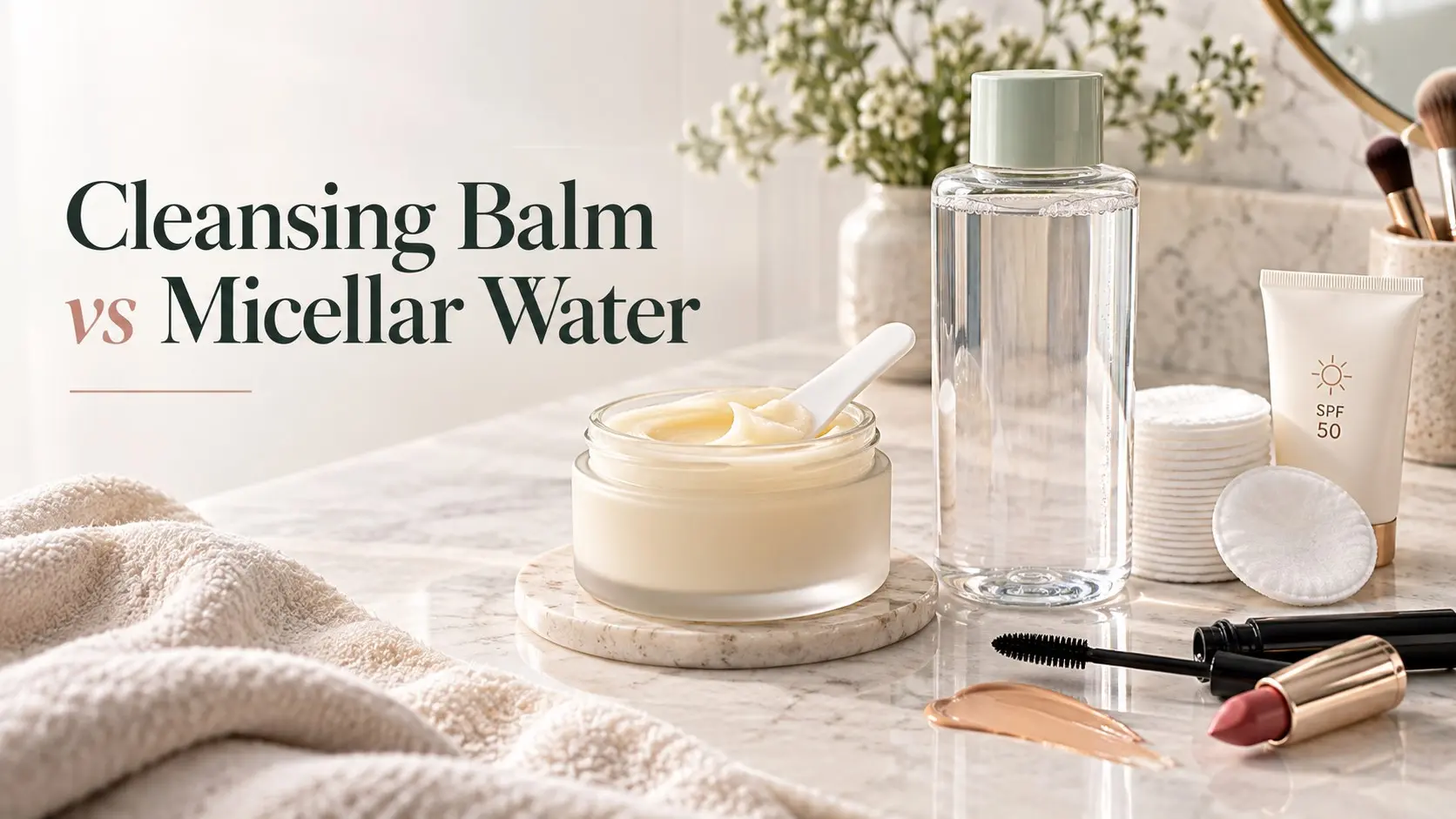
Published on:September 14, 2026
Last updated: September 14, 2026
Next review: September 2027, or sooner if major dermatology or cleansing evidence changes
Written and source-checked by: Adel Galal, Founder and Lead Writer at NextFitLife
Medical review status: This article has not been medically reviewed by a dermatologist, doctor, pharmacist, or other licensed healthcare professional.
If you wear waterproof mascara, long-wear makeup, or water-resistant sunscreen, I would reach for a cleansing balm first.
If your face is lightly made up and you want something fast, light, and easy to use, micellar water is often the simpler choice.
Neither product wins every night.
The better question is not which cleanser sounds more luxurious.
It is this:
Which one removes what is on your face with the least rubbing and irritation?
Quick answer: In the Cleansing Balm vs Micellar Water comparison, cleansing balm is usually the stronger first choice for stubborn makeup and water-resistant sunscreen. Micellar water is better for quick cleansing, light makeup, travel, and low-effort routines. Skin type matters, but the amount of rubbing, product formula, and what you need to remove matter more.
Important health note: I am not a dermatologist or A doctor, and this content does not replace professional medical advice. What I share comes from real-life experience, extensive research, and consultation with healthcare providers. Always consult qualified medical professionals for diagnosis and treatment of any health condition.
Stop a cleanser that causes persistent burning, swelling, rash, cracking, or worsening eczema. Severe or persistent skin symptoms deserve assessment by a dermatologist or another qualified healthcare professional.
Cleansing Balm vs Micellar Water at a Glance
| Feature | Cleansing Balm | Micellar Water | My Pick |
|---|---|---|---|
| 1. Heavy makeup | Very good for dissolving long wear and oily cosmetic films | Can work but may need several passes | Balm |
| 2. Water-resistant sunscreen | Oil-rich cleansing system is a logical first choice | Performance varies by formula and sunscreen | Balm |
| 3. Light makeup | Effective but may be more than you need | Fast and practical | Micellar |
| 4. Friction | Good slip can reduce rubbing | Depends on cotton pad pressure and number of passes | Whichever requires less rubbing |
| 5. Dry skin feel | Usually richer and more cushioned | Usually lighter | Often balm |
| 6. Oily skin | Can work if it emulsifies and rinses well | Light texture may feel more comfortable | Formula dependent |
| 7. Sensitive skin | Good when fragrance-free and easy to rinse | Good when mild and used without repeated wiping | Least irritating formula |
| 8. Travel | Requires rinsing and usually sink access | Fast and convenient | Micellar |
| 9. Double cleansing | Useful first cleanse when needed | Can also act as a first cleanse | Not required every night |
What Is a Cleansing Balm?
A cleansing balm starts as a solid or soft, buttery cleanser.
Once you massage it onto dry skin, it melts into an oily layer.
The oil phase helps loosen makeup, sunscreen, sebum, and other oily material.
Then comes the part that matters.
You add water.
A properly formulated balm contains emulsifiers that allow the oily mixture to disperse into water.
The product becomes milky.
Then it rinses away.
If you skip that step, some balms can feel much heavier.
The point of balm is not to scrub harder.
The point is to make removal easier.
For the bigger picture on gentle cleansing and the skin barrier, read the NextFitLife Complete Skin Health Guide.
What Is Micellar Water?
Micellar water looks like ordinary water.
It is not just water.
It contains cleansing agents called surfactants.
Surfactant molecules interact with both water and oily material.
Under suitable conditions, they arrange into structures called micelles.
These cleansing systems help lift makeup, oil, and debris so they can be transferred to a cotton pad.
This explains one major difference.
Micellar cleansing involves both chemistry and wiping.
If the liquid loosens makeup easily, that works well.
If you need pass after pass, friction becomes part of the routine.
1. Cleansing Balm Is My Pick for Heavy Makeup
Waterproof mascara is stubborn for a reason.
Long-wear foundation is stubborn for a reason.
Products made to survive sweat, water, and normal touching should not be expected to disappear after one light swipe with every cleanser.
This is where balm makes sense.
The oily texture helps dissolve oily cosmetic films while giving your fingers plenty of slip.
That can reduce the temptation to scrub.
A small clinical trial in women with mild facial atopic dermatitis also supports the idea that easier makeup removal with less rubbing matters.
The study used a cleansing oil rather than a balm.
Thirty-five women switched to a higher-cleansing-ability oil that required less rubbing to remove.
After four weeks, investigators reported improvements in dryness, scaling, irritation, redness, itching, moisture retention, and transepidermal water loss.
The study was supported by Kao Corporation, so it should not be treated as final proof for every cleansing product.
Still, the friction lesson is useful.
2. Balm Makes More Sense for Water-Resistant Sunscreen
This is the place where many online comparisons overstate the research.
A clinical study tested sunscreen removal using:
- Water
- A foaming cleanser
- A cleansing oil
For waterproof sunscreen, cleansing oil left much less residue than either water or the foaming cleanser.
That supports an oil-based removal strategy when sunscreen is designed to resist water.
But there is a limitation.
The study did not test cleansing balm.
It also did not test micellar water.
So I would not tell you that science has proven every balm beats every micellar formula.
It has not.
What the evidence supports is narrower.
An oil-based cleanser can be highly effective for stubborn waterproof sunscreen.
Since a cleansing balm is also an oil-based cleanser once melted, choosing one for a difficult water-resistant sunscreen is reasonable.
3. Micellar Water Wins for a Fast Light Cleanse
This is where micellar water earns its bathroom shelf space.
If you have light makeup, a lightly tinted product, or simply want to clean the face without a long sink routine, micellar water is convenient.
It is also useful while travelling.
Some formulas are designed to be left on the skin.
Others are used before a second cleanser.
Always follow the directions for the product you buy.
Convenience becomes less convincing if you need four or five soaked pads to get the face clean.
At that point, the easier product is probably the balm.
4. Friction Matters More Than Most Comparisons Admit
This is the part I would pay attention to first if your skin is sensitive.
A mild product used aggressively is no longer a mild routine.
Repeated wiping can irritate skin.
Hard rubbing can irritate skin.
Trying to remove waterproof mascara with pressure instead of giving the cleanser time to dissolve it is unnecessary.
The American Academy of Dermatology advises gentle cleansing and warns against scrubbing the face.
That is why I do not automatically give micellar water the sensitive skin trophy.
If a saturated pad removes everything with one gentle pass, fine.
If you keep wiping until the cheeks look pink, switch methods.
For a simple barrier-friendly routine, read Healthy Skin 101.
5. Dry Skin Usually Favours Balm
My first choice for dry skin would usually be a simple fragrance-free balm that emulsifies cleanly.
The reason is practical.
You get slip.
You avoid repeated cotton pad movement.
And the texture usually feels less stark than repeated wiping with a watery cleanser.
That does not mean every cleansing balm is good for dry or sensitive skin.
Fragrance can irritate some people.
Essential oils can irritate some people.
Botanical extracts can cause contact reactions.
A simple ingredient list is easier to troubleshoot.
Your skin should not burn after cleansing.
6. Oily Skin Does Not Have to Avoid Cleansing Balm
Oil on the ingredient list does not automatically mean clogged pores.
A cleansing balm is a rinse-off product.
What matters is whether it emulsifies, rinses well, and agrees with your skin.
If you are acne-prone, choose a simple product and consider a noncomedogenic formula when available.
Do not keep using a balm that repeatedly leaves a heavy film and seems to coincide with new clogged pores.
Likewise, do not use aggressive cleansing because your skin is oily.
The goal is to remove excess oil and products.
The goal is not to strip every trace of sebum.
For more acne and pore guidance, read NextFitLife Whiteheads and Clogged Pores Guide.
7. Sensitive Skin Needs the Product That Requires Less Work
Forget the front label for a moment.
Pay attention to what happens while you cleanse.
Does the cleanser sting?
Do you need to scrub?
Does the skin feel painfully tight afterward?
Does repeated cotton pad use make you red?
Does fragrance trigger itching?
Those answers tell you more than the words balm or micellar.
Modern cleanser research also shows why product formulation matters.
Different surfactants interact with skin proteins and lipids differently.
A 2025 review found that surfactant structure, charge, micelle behaviour, and formulation all influence irritation potential.
A 2026 review of newer gentle cleansing technologies reached the same broad conclusion.
Good formulation matters.
The category name alone is not enough.
8. Micellar Water Wins for Travel and Convenience
Micellar water does not require you to scoop a balm from a jar.
Many formulas are designed for quick cleansing without immediate rinsing.
That is useful on:
- Flights
- Road trips
- Gym visits
- Late nights
- Situations where a sink is inconvenient
I would still choose a properly sized travel bottle rather than carrying an oversized bottle around.
And if your makeup is truly waterproof, convenience can disappear quickly once multiple cotton pads are involved.
9. Double Cleansing Is Useful, Not Mandatory
You do not earn extra skincare points for washing twice.
Double cleansing means using one product to remove makeup or sunscreen, followed by a second water based facial cleanser.
It makes sense when the first step leaves something behind.
It makes sense after heavy makeup.
It makes sense after stubborn water-resistant sunscreen.
It does not have to happen every single night.
If one gentle cleanser removes everything and your skin feels clean and comfortable, stop there.
Research on cleansing shows that surfactants can interact with skin proteins and lipids.
Modern mild cleansers are designed to reduce those effects.
That does not mean more cleansing is automatically better.
Which One Fits Your Skin and Routine?
| Situation | First Choice | Why |
|---|---|---|
| Heavy makeup | Cleansing balm | Better slip and easier dissolution of stubborn makeup |
| Water-resistant sunscreen | Cleansing balm | An oil-based removal step is a sensible option for resistant films |
| Minimal makeup | Micellar water | Quick and convenient |
| Very dry skin | Usually balm | More slip and less wiping |
| Sensitive skin | Whichever is gentler | Formula and friction matter more than category |
| Oily skin | Either | Choose a product that cleans without stripping or leaving an uncomfortable film |
| Acne-prone skin | Either | Use a gentle formula and stop products that consistently worsen congestion |
| Travel | Micellar water | Faster and does not always require sink access |
Do You Need to Rinse Micellar Water?
Follow the directions on your product.
Many micellar waters are designed and marketed as no-rinse cleansers.
That does not create a rule that every person must leave every micellar formula on their face.
If your skin feels comfortable and the instructions say no rinse, fine.
If it leaves your face sticky, itchy, tight, or irritated, rinse it.
If you plan to use a second cleanser anyway, the second cleanse will remove remaining micellar product.
I would avoid turning this into another skincare commandment.
Your formula and your skin response matter.
How to Use Cleansing Balm Properly
- Start with dry hands and a dry face. Follow your product instructions if they say otherwise.
- Use enough balm to create slip. Too little product encourages pulling at the skin.
- Massage gently. Focus on sunscreen, foundation, eye makeup, and lip products.
- Add a little lukewarm water. Massage again so the balm emulsifies and turns milky.
- Rinse thoroughly. Do not use very hot water.
- Use a second gentle cleanser only when needed.
You should not need hard rubbing.
That defeats the main advantage of the balm.
How to Use Micellar Water With Less Friction
- Saturate the cotton pad. A nearly dry pad creates unnecessary drag.
- Press before wiping. Hold the pad briefly over eye or lip makeup so the formula has time to loosen it.
- Wipe gently. Do not scrub back and forth.
- Change the pad when it is dirty.
- Stop if removal requires repeated hard passes. Use a stronger remove instead.
- Rinse or follow with another cleanser when needed.
Common Cleansing Balm Mistakes
Using Too Little
The balm needs enough slip to move easily.
Skipping Emulsification
If you never add water and work the balm into a milky emulsion, rinsing can be poor.
Scrubbing Waterproof Mascara
Give the cleanser time to dissolve the product.
Assuming Natural Ingredients Cannot Irritate
Fragrance, essential oils, and botanical ingredients can cause irritation or allergy in some people.
Keeping a Balm That Does Not Suit Your Skin
If it causes repeated burning, itching, rash, or persistent congestion, stop using it.
Common Micellar Water Mistakes
Using an Almost Dry Pad
The pad should be properly saturated.
Rubbing the Same Area Repeatedly
More friction is not better cleansing.
Trying to Remove Heavy Waterproof Makeup With a Weak Formula
Use the right tool for the job.
Assuming Sensitive Skin Means Micellar Water Must Win
A cleanser is only gentle if your skin tolerates both the formula and the removal technique.
Ignoring Irritation Because the Bottle Says Gentle
Your skin response matters more than marketing language.
What About the Skin Barrier?
Your outer skin layer is called the stratum corneum.
It contains skin cells surrounded by organized lipids.
This structure forms much of the skin barrier.
Cleanser ingredients have to remove unwanted material without causing unnecessary disruption to that barrier.
Research shows that surfactants differ in how strongly they interact with skin proteins and lipids.
That is why two facial cleansers that both contain surfactants can feel completely different.
A 2025 review found that anionic surfactants such as sodium lauryl sulphate tend to have greater irritation potential, while many nonionic and amphoteric surfactants are better tolerated.
A 2026 laboratory study also found that surfactant micellar behaviour and structure were linked with irritation potential.
This does not mean you need to become a cosmetic chemist before washing your face.
It means the finished formulation matters.
Do not judge a cleanser from one ingredient alone.
Can Cleansing Balm Cause Acne?
A cleansing balm does not automatically cause acne because it contains oil.
It is a rinse-off cleanser.
Still, individuals react differently to products.
If you repeatedly notice new congestion after adding one balm, remove it from your routine and see what happens.
Acne-prone skin should also avoid aggressive scrubbing.
AAD guidance recommends gentle cleansing rather than repeatedly washing or irritating acne-prone skin.
If acne is painful, deep, scarring, or persistent, see a dermatologist.
Can Micellar Water Irritate Sensitive Skin?
Yes.
Anything that touches the skin can be poorly tolerated by someone.
The issue could be:
- The surfactant system
- Fragrance
- A preservative
- Another ingredient
- Repeated cotton pad friction
There is some clinical evidence that specific micellar formulations can be well tolerated by people reporting sensitive skin.
One published study followed 400 people using a Bioderma micellar solution and found improvement in reported itching, tightness, tingling, and burning sensations.
But the study evaluated one branded product and included company employees among the authors.
That does not prove all micellar waters are ideal for all sensitive skin.
I would judge the product in front of you.
Does Micellar Water Clean Pores?
It cleans the skin surface and helps remove oil and makeup.
It is not a medical treatment for clogged pores.
If you have persistent whiteheads or acne, the relevant treatment may involve ingredients such as salicylic acid, benzoyl peroxide, azelaic acid, or a retinoid depending on the acne type and your skin.
A makeup remover should not be expected to treat acne by itself.
Does Cleansing Balm Need a Second Cleanser?
Not automatically.
If your balm emulsifies well, rinses cleanly, removes your products, and leaves your skin comfortable, you may not need another wash.
If residue remains, or if you have removed a full face of makeup and sunscreen, a gentle second cleanse can be useful.
This is a practical decision.
It is not a rule.
Should You Double Cleanse Every Night?
No.
I would double cleanse when there is something difficult to remove.
That includes heavy makeup and some water-resistant sunscreen.
I would not automatically double cleanse bare skin simply because a social media routine says everyone should.
More washing means more cleanser contact.
If your face already feels dry or irritated, adding another cleansing step without a reason is unlikely to help.
What I Would Choose for Each Routine
Heavy foundation and waterproof mascara: cleansing balm.
Water-resistant sunscreen after a long outdoor day: cleansing balm.
Light makeup before bed: micellar water is convenient.
Dry skin plus makeup: I would start with a fragrance-free balm.
Sensitive skin: whichever product removes everything with the least irritation and rubbing.
Oily skin: either one can work.
Acne prone skin: either one can work if the formula agrees with you and you cleanse gently.
Travel: micellar water.
No makeup and a light routine: you may not need either.
Three Buying Rules I Would Use
First, buy for what you actually wear.
A person using waterproof mascara every day has different removal needs from someone wearing only moisturizer.
Second, sensitive skin should favour simple, fragrance-free formulas when possible.
Third, test how much work the cleanser requires.
If you have to scrub, drag, or repeatedly wipe the same area, that product is not doing enough of the work.
Do You Really Need Both?
No.
But owning both is reasonable.
I would use micellar water on light days.
I would use balm when makeup or sunscreen is difficult to remove.
The skincare routine does not need loyalty to one product category.
It needs the right tool for the job.
When Should You Stop Experimenting and See a Dermatologist?
Makeup removal should not cause a medical problem.
Seek professional advice if you develop:
- Persistent burning
- Facial swelling
- Blistering
- Repeated eczema flares
- A spreading rash
- Painful or scarring acne
- Cracked or bleeding skin
- Persistent eye irritation
Severe swelling, trouble breathing, or swelling of the mouth or throat requires urgent medical attention.
Conclusion
The practical answer to Cleansing Balm vs Micellar Water is simple.
Choose to cleanse balm when the job is difficult.
Choose micellar water when the job is light and convenience matters.
Do not judge either product only by skin type.
Watch how much friction it takes.
Watch how the skin feels after cleansing.
And do not double cleanse simply because someone else's routine says you should.
Your next step: Tonight, notice how many passes or how much rubbing your current remover requires. If removal feels like work, switch to a method that dissolves what you are wearing more easily.
References and Sources
- American Academy of Dermatology. Face Washing 101.AAD recommends gentle facial cleansing, lukewarm water, fingertips, and avoiding scrubbing. Read the AAD Face Washing Guide
- Chen W, He M, Xie L, Li L. The Optimal Cleansing Method for the Removal of Sunscreen. This clinical study compared water, foaming cleanser, and cleansing oil for removal of waterproof and non-waterproof sunscreen. Read the PubMed Sunscreen Removal Study
- Hosokawa K and colleagues. Rubbing the Skin When Removing Makeup Cosmetics Is a Major Factor That Worsens Skin Conditions in Atopic Dermatitis Patients. The study examined reduced rubbing during makeup removal in 35 women with mild facial atopic dermatitis. Read the PubMed Makeup Removal Study
- Ananthapadmanabhan KP and colleagues. Cleansing Formulations That Respect Skin Barrier Integrity. This review explains how cleanser surfactants interact with skin proteins and lipids and how formulation can improve mildness. Read the PubMed Skin Barrier Cleansing Review
- Draelos Z and colleagues. Advances in Gentle Polymeric Cleansing Technologies. 2026.This updated review discusses modern facial cleansing systems, surfactants, skin barrier support, and sensitive skin tolerability. Read the 2026 PubMed Cleanser Review
Continue Reading on NextFitLife
- Complete Skin Health Guide. Learn how the skin barrier, gentle cleansing, moisturizing, sunscreen, acne care, eczema care, and warning signs fit together.
- Healthy Skin 101: Build a simple daily skin routine using gentle cleansing, moisturizer, sunscreen, and targeted treatment only when needed.
- Whiteheads and Clogged Pores Guide: Understand closed comedones, acne treatments, pore care, and when persistent breakouts need professional treatment.
- Lip Eczema Guide: Learn how fragrance, flavouring, skincare, makeup, saliva, and other irritants can affect sensitive lip skin.
Main skin health hub: Visit the NextFitLife Complete Skin Health Guide for evidence-based guides on cleansing, acne, eczema, sensitive skin, sunscreen, aging skin, and barrier care.
About the Author
Adel Galal is the Founder and Lead Writer at NextFitLife.
Adel has maintained a personal interest in health, fitness, nutrition, sleep, wellness, healthy aging, and practical skincare for more than 30 years.
His health and wellness writing experience spans more than 15 years.
NextFitLife launched in January 2022.
His role is to research topics, compare reputable sources, organize evidence, identify limitations, and explain complex information in language ordinary readers can use.
For skincare articles, Adel compares current dermatology guidance, peer-reviewed studies, cleanser research, ingredient evidence, and safety information. He separates evidence about a specific product type from broader claims that have not been directly tested.
For example, the sunscreen removal research discussed in this article tested cleansing oil rather than cleansing balm or micellar water. That limitation is stated clearly instead of turning a related study into a stronger claim than it supports.
Adel is not a dermatologist, physician, pharmacist, cosmetic chemist, or other licensed healthcare professional.
This article provides general education only. It does not diagnose acne, eczema, allergic contact dermatitis, rosacea, infection, or another skin condition and does not prescribe medical treatment.
Learn more about Adel Galal, NextFitLife, and the site's editorial standards on the About Us page.
Frequently Asked Questions
Is cleansing balm better than micellar water?
For heavy makeup, waterproof mascara, or water-resistant sunscreen, cleansing balm is usually the more practical first choice. Micellar water is often better for light makeup and convenience.
Is micellar water better for sensitive skin?
Not automatically. A mild micellar formula can work well, but repeated cotton pad rubbing can irritate sensitive skin. Choose the method that removes products with the least friction.
Is cleansing balm good for dry skin?
It can be. Balm provides good slip and can reduce repeated wiping. Choose a simple formula that emulsifies well and does not irritate your skin.
Can oily skin use cleansing balm?
Yes. A rinse-off cleansing balm can suit oily skin if it emulsifies well, rinses cleanly, and does not cause persistent congestion or irritation.
Can acne-prone skin use cleansing balm?
Yes, but choose a gentle formula and stop using it if you consistently notice worsening clogged pores or irritation.
Does cleansing balm remove sunscreen?
Oil-based cleansers are useful for removing resistant sunscreen films. A clinical study found cleansing oil was very effective at removing waterproof sunscreen, although the study did not directly test cleansing balm.
Does micellar water remove sunscreen?
It can remove some sunscreen, but effectiveness depends on the sunscreen and the micellar formula. Water-resistant sunscreen may require a stronger first cleanse.
Does micellar water remove waterproof mascara?
Some formulas do. If removal requires repeated rubbing, use a stronger eye makeup remover or cleansing balm instead.
Do you need to rinse micellar water?
Follow the product directions. Many micellar waters are designed as no-rinse products, but you can rinse if the formula feels sticky or irritating or if you are using another cleanser afterward.
Do you need a second cleanser after cleansing balm?
Not always. If the balm emulsifies well, rinses cleanly, and removes everything comfortably, a second cleanser may not be necessary.
What is double cleansing?
Double cleansing means using a makeup or sunscreen removal step first, followed by a second water-based facial cleanser.
Should I double cleanse every night?
No. Double cleansing is useful when one cleanse does not remove heavy makeup or resistant sunscreen. It is not mandatory every night.
Can cleansing balm clog pores?
A cleansing balm does not automatically clog pores because it contains oil, but individual formulas can suit some people better than others. Stop using a product if congestion repeatedly worsens after you introduce it.
Can micellar water damage the skin barrier?
A well-formulated micellar water can be gentle. Irritation can still occur from a poorly tolerated formula or from repeated rubbing with cotton pads.
What is a micelle?
A micelle is an organized structure formed by surfactant molecules. Surfactants help interact with oily material and water so dirt, makeup, and oil can be removed from the skin.
What are surfactants?
Surfactants are cleansing ingredients that reduce surface tension and help remove oils and debris. Their irritation potential depends on the surfactant and the full formulation.
Which is better for travel?
Micellar water is usually more convenient for travel because many formulas can be used quickly without a full sink cleansing routine.
Which is better for waterproof makeup?
Cleansing balm is usually the better first choice because its oil-rich texture helps loosen waterproof cosmetic films with less rubbing.
Can I use micellar water and cleansing balm together?
You can, but most people do not need both in the same cleansing session. Choose the simplest routine that removes everything comfortably.
How do I know if my cleanser is too harsh?
Persistent burning, painful tightness, itching, cracking, redness, or worsening irritation are signs to stop and reassess the product or cleansing technique.

Health & wellness writer with 30+ years of experience in nutrition, fitness, and healthy aging. Founder of NextFitLife.com — evidence-based health guidance.