Last Updated: August 4, 2026
Next Review: August 2027, or sooner if major exercise or weight guidance changes
Review Status: Fully rewritten and checked against current physical activity guidance, core training advice, weight management information, and spot reduction research
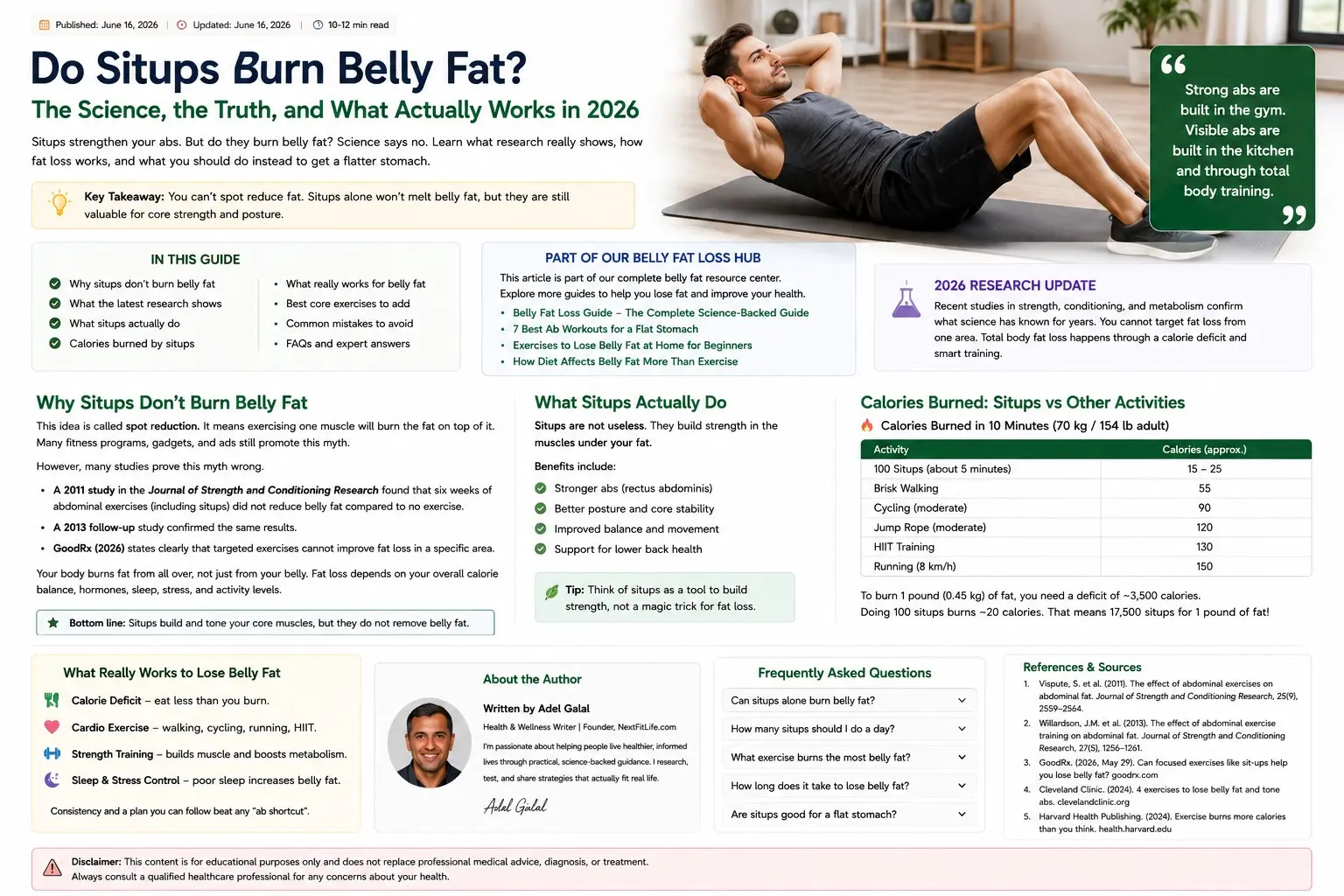
Do situps burn belly fat?
Not in a useful or reliable way.
Situps train the muscles under the belly.
They do not tell your body to remove the fat above those muscles.
This does not make situps useless.
They can improve core strength. They can support balance, lifting, sport, posture, and daily movement. They can be one small part of a complete fitness plan.
But a smaller waist comes mainly from reducing total body fat.
That needs regular movement, full body strength work, a food plan you can repeat, enough sleep, and time.
This guide explains the evidence, including a newer study that makes the spot reduction debate more complex. It also shows safer situp form, useful alternatives, and a complete plan for belly fat loss.
Quick answer
Situps strengthen the abdomen, but situps alone are not a reliable belly fat treatment. A 2011 trial found better abdominal endurance but no meaningful abdominal fat loss after six weeks of abdominal exercise. A small 2023 trial in men reported a modest local trunk fat effect after very high-volume abdominal endurance training. That result is interesting, but it does not show that normal sit-up routines flatten the stomach. Use aerobic activity, full-body strength work, balanced food, and core training together.
Exercise safety warning
Stop and seek urgent medical help for chest pain, fainting, severe shortness of breath, sudden weakness, confusion, or signs of stroke. Speak with a qualified professional before starting a new exercise plan if you have heart disease, uncontrolled blood pressure, pregnancy, recent surgery, severe back pain, a hernia, osteoporosis, repeated dizziness, or another condition that affects safe movement.
Medical note: This content is for general educational purposes and does not replace professional medical advice, diagnosis, or treatment. Consult an appropriately qualified healthcare professional for personal medical concerns. This article explains published guidance and does not provide a personal clinical assessment. Always consult qualified medical professionals for diagnosis and treatment of any health condition.
What you will learn
- What situps train
- Why belly fat does not leave one chosen spot
- What the 2011 and 2023 studies found
- How situps differ from crunches
- How to perform a safer situp
- Who should avoid traditional situps
- Which core exercises can replace them
- What actually reduces belly fat
- A four week starting plan
- How to track real progress
What Is a Situp?
A situp is a floor exercise.
You begin on your back with the knees bent.
You lift the upper body toward the thighs.
The movement uses several muscles.
- Rectus abdominis
- Oblique muscles
- Hip flexors
- Smaller muscles that help control the trunk
A situp uses a larger range than a crunch.
A crunch lifts the head and shoulders only.
A situp lifts more of the trunk.
This makes the hip flexors work more.
What Belly Fat Is
There are two major forms of belly fat.
Subcutaneous fat
Subcutaneous fat sits under the skin.
This is the soft fat you can pinch.
Visceral fat
Visceral fat sits deeper inside the abdomen around organs.
A high amount is linked with health risks such as type 2 diabetes and heart disease.
You cannot tell the exact amount by looking in a mirror.
Waist size can help estimate risk, but the meaning differs by sex, ethnicity, age, and health history.
Read the Complete Belly Fat Loss Guide for a full explanation.
Why People Expect Situps to Burn Belly Fat
The idea feels logical.
You feel the stomach muscles working.
The muscles may burn.
You may sweat.
The area may feel tighter after exercise.
It is easy to believe that the fat above the muscle is also burning.
Fitness advertising has repeated this message for years.
Words such as “belly burner” and “waist blaster” make the claim sound real.
But a working muscle does not simply pull all its fuel from the nearest fat layer.
What Spot Reduction Means
Spot reduction means losing fat from one chosen area by exercising the nearby muscle.
Examples include situps for stomach fat, arm exercises for upper arm fat, and inner thigh exercises for thigh fat.
Most fat loss happens across the body.
The order is affected by genetics, hormones, age, sex, and starting body shape.
You can choose which muscle to train.
You cannot fully choose which fat store changes first.
What the Classic Situp Study Found
A 2011 randomized study followed 24 adults.
The abdominal exercise group trained five days each week for six weeks.
They completed seven abdominal exercises.
Their abdominal endurance improved.
But the study found no significant change in abdominal fat, waist circumference, or other body composition measures compared with the control group.
This study supports a simple lesson.
Abdominal training can make the abdominal muscles better at work.
It does not guarantee local fat loss.
The 2023 Study That Complicates the Answer
Science should change when new evidence appears.
A small 2023 study in adult men reported more trunk fat loss in a group that performed high volume abdominal endurance exercise than in a treadmill group with matched energy use.
The abdominal group trained for ten weeks.
The protocol involved long abdominal sessions, not a few daily situps.
The study suggests that a small local fat effect may be possible under special conditions.
It does not prove that spot reduction is a useful strategy for most people.
Important limits include:
- The study was small
- The participants were adult men
- The exercise volume was high
- The result needs replication
- Total fat also fell in both groups
The practical answer remains the same.
Do not build a belly fat plan around situps.
Use a full body plan.
So, Do Situps Burn Belly Fat?
The most accurate answer is this.
Situps use energy.
They may contribute a very small amount to total energy use.
They train the core.
But they are not a reliable way to reduce abdominal fat.
A normal situp workout uses less total muscle than walking, cycling, swimming, rowing, or full body strength training.
The main value of situps is muscle training.
What Situps Can Do
Improve abdominal endurance
You may complete more controlled repetitions over time.
Strengthen trunk movement
Situps train the ability to bend the trunk.
Support some sports and activities
A stronger core can support throwing, running, lifting, and getting up from the floor.
Improve muscle definition after fat loss
Stronger abdominal muscles may become more visible when body fat falls.
Add variety
Some people enjoy situps.
An exercise you enjoy can help consistency.
What Situps Cannot Do
- Choose where fat leaves first
- Replace a full body workout
- Offset unlimited food intake
- Guarantee a flat stomach
- Diagnose the cause of a large waist
- Remove loose skin
- Treat a hernia or abdominal separation
Situps Versus Crunches
| Feature | Situp | Crunch |
|---|---|---|
| Range | Lifts most of the trunk | Lifts the head and shoulders |
| Hip flexor work | More | Less |
| Difficulty | Often harder | Often easier |
| Belly fat loss | Not reliable | Not reliable |
Neither is automatically better.
Choose the movement that feels safe and controlled.
How to Perform a Situp With Better Control
- Lie on a firm, comfortable surface.
- Bend the knees.
- Keep the feet on the floor.
- Cross the arms over the chest.
- Gently tighten the stomach.
- Breathe out as you lift.
- Move without pulling the head.
- Stop before the back or neck loses control.
- Lower slowly.
- Rest when form changes.
Begin with five controlled repetitions.
Add repetitions only when the movement feels comfortable.
Do not force the chest to the knees.
Common Situp Mistakes
Pulling the head
Hands behind the neck can lead to pulling.
Keep the hands on the chest or beside the head without pulling.
Moving too fast
Speed can hide poor control.
Use a slow lift and slow return.
Holding the breath
Breathe out during the lift.
Breathe in during the return.
Using too much range
A smaller controlled movement is better than a large painful movement.
Doing situps every day
The core needs recovery like other muscles.
Two or three training days can be enough.
Using situps as the whole workout
The body also needs aerobic activity, leg work, pushing, pulling, balance, and recovery.
Who Should Avoid Traditional Situps?
People with osteoporosis
Strong forward bending can raise spinal fracture risk in some people with osteoporosis.
Mayo Clinic lists situps among movements that may need to be avoided.
Ask a physical therapist for safer core training.
People with active back or neck pain
Situps may irritate symptoms.
Use a pain free alternative and seek advice when pain continues.
People with a hernia
A new lump, pain, or pressure needs medical assessment.
People after abdominal surgery
Follow the surgeon or physical therapist plan.
Pregnant and recently pregnant people
Core training needs change during pregnancy and recovery.
Pelvic floor symptoms or abdominal separation may require a personal plan.
People with pelvic pressure or urine leakage
Stop or modify the movement.
A pelvic health physical therapist can help.
Core Exercises That Can Replace Situps
Dead bug
Lie on the back.
Lift the knees and arms.
Move one heel toward the floor.
Return and switch.
This trains control with the back supported.
Bird dog
Start on hands and knees.
Reach one arm and the opposite leg.
Keep the hips level.
Glute bridge
Lie on the back with the knees bent.
Press the feet down.
Lift the hips.
Lower slowly.
Side plank with the knee down
Support the body on one forearm and the lower knee.
Lift the hips.
Keep breathing.
Standing band press
Stand beside a safely anchored band.
Press the hands forward.
Resist turning.
Farmer carry
Hold light weights.
Stand tall.
Walk slowly.
Read the Five Minute Ab Workout for a short routine.
What Actually Reduces Belly Fat?
Regular aerobic activity
Walking, cycling, swimming, dancing, and rowing raise energy use.
Current guidance recommends 150 to 300 minutes of moderate aerobic activity each week for the greatest health benefit.
Start below this amount when you are inactive.
Full body strength training
Strength training helps protect muscle.
Train the major muscle groups at least two days each week.
Use squats, hinges, pushes, pulls, carries, and core work.
A food plan you can repeat
Weight loss usually requires a lower energy intake over time.
Use protein, vegetables, fruit, beans, whole grains, and useful portions.
Reduce sugary drinks and frequent high calorie snacks.
Daily movement
Walk while taking a call.
Use stairs when safe.
Stand and move during the day.
Housework and gardening count.
Sleep
Short sleep can affect hunger, energy, and food choices.
Most adults need at least seven hours.
Stress care
Stress can affect eating and sleep.
Use walking, breathing, counseling, journaling, prayer, or social support.
Read Cortisol and Belly Fat.
A Simple Weekly Belly Fat Plan
| Day | Activity | Purpose |
|---|---|---|
| Monday | Brisk walk and short core routine | Aerobic fitness and core control |
| Tuesday | Full body strength | Muscle and function |
| Wednesday | Easy walk, cycling, or swimming | Movement and recovery |
| Thursday | Rest or gentle mobility | Recovery |
| Friday | Full body strength and core | Muscle and trunk strength |
| Saturday | Longer enjoyable activity | Weekly aerobic activity |
| Sunday | Rest and planning | Consistency |
A Four Week Beginner Plan
Week 1
- Walk for ten minutes on four days
- Do one core session
- Use dead bugs, bridges, and bird dogs
Week 2
- Walk for fifteen minutes on four days
- Do one full body strength session
- Try one set of controlled situps only if comfortable
Week 3
- Build aerobic activity to twenty minutes
- Do two strength sessions
- Use two different core exercises
Week 4
- Build toward twenty five or thirty minutes of aerobic activity
- Keep two strength sessions
- Add a second core set when form stays good
Use the Home Exercises for Beginners Guide when you want a complete no equipment plan.
A Ten Minute Core Routine Without Situps
Complete two rounds.
- Dead bug for six repetitions on each side
- Bird dog for six repetitions on each side
- Glute bridge for ten repetitions
- Side plank with the knee down for ten seconds on each side
- March in place for one minute
Rest when needed.
Stop when pain appears.
A Ten Minute Core Routine With Situps
Use this only when situps feel comfortable.
Complete two rounds.
- Five to ten controlled situps
- Eight bridges
- Six bird dogs on each side
- Ten seconds of side plank on each side
- One minute of easy walking
Quality matters more than repetition count.
Do Situps Burn Many Calories?
Not compared with full body activity.
The exact number depends on body size, speed, range, fitness, and rest.
Online claims that 100 situps always burn a fixed number are not reliable.
A short situp set uses some energy.
But walking, cycling, swimming, rowing, or full body circuits use more muscle and usually more energy over time.
Do not calculate how many thousands of situps equal one pound of fat.
The body does not change in such a simple fixed equation.
Does High Intensity Training Work Better?
High intensity interval training can improve fitness and may reduce abdominal fat.
It is not required.
Walking and moderate activity can also work.
Choose high intensity work only when your health, joints, fitness, and recovery allow it.
Do not assume harder is always better.
What to Eat With Your Exercise Plan
A simple plate can help.
- Half vegetables or fruit
- One quarter protein
- One quarter beans, oats, potatoes, rice, or whole grains
- A small amount of olive oil, nuts, seeds, or avocado
Drink water based on your needs.
Reduce sugary drinks and heavy alcohol use.
Do not use food as punishment or reward for situps.
Read the Complete Weight Loss Guide.
How Long Does Belly Fat Loss Take?
There is no honest fixed promise.
The timeline depends on starting weight and waist size, food intake, activity, sleep, age, menopause, medicine, health conditions, genetics, and consistency.
Fitness may improve before the waist changes.
Water, salt, bowel changes, and exercise soreness can affect the scale.
Look at trends over several weeks.
How to Track Progress
- Weekly aerobic minutes
- Strength sessions
- Core exercise quality
- Weight trend
- Monthly waist measurement
- Walking distance
- Sleep
- Energy
Do not measure the waist every day.
Do not let one scale reading change the whole plan.
How Situps Fit Into a Complete Core Program
A good core plan does more than bend the trunk.
The core also resists movement.
It helps stop the body from twisting, arching, or leaning when you walk, lift, carry, and exercise.
Use four simple movement types.
Trunk bending
Situps and crunches train the body to bend forward.
Use a small range when the neck or back feels sensitive.
Anti extension
Dead bugs and planks train the core to stop the lower back from arching too much.
Anti rotation
Bird dogs and standing band presses train the body to resist twisting.
Anti side bending
Side planks and farmer carries train the core to resist leaning.
A balanced core plan may include one exercise from each group.
You do not need a long session.
Ten minutes two or three times each week can be useful.
How to Know Whether Situps Suit Your Body
Use this simple check.
- You can breathe during the movement
- You do not pull the head
- Your neck stays comfortable
- Your lower back does not hurt
- You do not feel pelvic pressure
- You do not leak urine
- You can lower with control
- You recover by the next day
Situps may not suit you when pain, pressure, dizziness, or poor control appears.
Choose a different core exercise.
An alternative is not a weaker choice.
It is a better match.
How to Progress Situps Without Chasing High Repetitions
More repetitions are not always better.
Progress can come from better control.
Try these steps:
- Begin with five slow repetitions.
- Pause briefly at the top.
- Lower for two or three seconds.
- Add one or two repetitions when form stays good.
- Stop the set before the neck or back takes over.
- Use a harder variation only when the basic version feels easy.
Do not add a weight behind the head.
Do not perform hundreds of fast repetitions.
A controlled set gives the core a clearer training signal.
Situps After Age 50
Age alone does not ban situps.
But bone health, joint history, back pain, balance, and recovery matter more after 50.
Many adults over 50 benefit from a wider core program that includes walking, strength training, carries, bridges, bird dogs, and balance work.
People with known osteoporosis should ask about safer spinal movement.
People with new back pain should not force the exercise.
Read How to Get Fit at 50 and Lifetime Fitness for a broader plan.
What a Flatter Stomach Can and Cannot Mean
A flatter stomach is not always the same as better health.
The abdomen can change because of:
- Body fat
- Bloating
- Constipation
- Posture
- Muscle tone
- Loose skin
- Pregnancy changes
- Abdominal separation
- A hernia
Core training may improve posture and control.
It cannot remove loose skin or treat a hernia.
See a clinician for a new lump, severe pain, vomiting, a rigid abdomen, or a bulge that becomes painful.
A Simple Realistic Goal
Do not make “100 situps every day” the goal.
Use a goal that includes the whole plan.
For example:
- Walk for twenty minutes on four days
- Complete two full body strength sessions
- Do two short core sessions
- Prepare balanced meals most days
- Protect a regular sleep time
This plan gives the body more reasons to change than situps alone.
Common Myths
Myth: Feeling a burn means stomach fat is burning
False.
The feeling comes from working muscle.
Myth: More situps always give faster results
False.
High volume can add pain without meaningful fat loss.
Myth: Situps are required for a flat stomach
False.
They are optional.
Myth: Situps are bad for everyone
False.
Some people can use them safely.
Others need a different exercise.
Myth: One study proves perfect spot reduction
False.
The 2023 result is interesting but limited.
Myth: Core work does not matter
False.
Core strength supports movement and function.
When to See a Doctor or Physical Therapist
Arrange professional advice for back or neck pain that keeps returning, a new abdominal lump, pelvic pressure, urine leakage during exercise, numbness or weakness, osteoporosis, recent abdominal surgery, pregnancy or recent birth, repeated dizziness, or unexplained rapid weight change.
My Research and Experience
I have studied health, fitness, nutrition, weight management, and healthy aging for more than thirty years.
At 59, I value safe exercise that people can repeat.
I also value honest answers.
Choose core exercises that feel comfortable and combine them with a sustainable overall activity plan.
Conclusion
The answer to do situps burn belly fat is still no for practical planning.
Situps can strengthen the core.
They cannot reliably choose where body fat leaves.
Use them when they feel comfortable. Replace them when they cause pain. Build the main plan around walking or another aerobic activity, full body strength work, balanced food, sleep, and consistency.
Choose one action today. Take a ten minute walk, try the situp free core routine, or schedule two full body strength sessions for this week.
Explore Related NextFitLife Guides
- Fitness Hub
- Weight Management and Metabolism Health Hub
- Complete Belly Fat Loss Guide
- Twenty Exercises to Lose Belly Fat
- Home Exercises for Beginners
- Exercises for Belly Fat Over 50
- Does Walking Burn Belly Fat?
- Does Skipping Reduce Belly Fat?
- Five Minute Ab Workout
- Lower Ab Exercises
- Weighted Ab Exercises
- Ab Workouts for Men
- Cortisol and Belly Fat
- Complete Weight Loss Guide
- Lifetime Fitness
High Authority References and Sources
- PubMed: The 2011 randomized trial on abdominal exercise and abdominal fat. Open source
- PubMed Central: The 2023 study of abdominal endurance exercise and local trunk fat in adult men. Open source
- Centers for Disease Control and Prevention: Current adult aerobic and muscle strengthening activity guidance. Open source
- National Institute of Diabetes and Digestive and Kidney Diseases: Eating and physical activity for weight loss and maintenance. Open source
- Mayo Clinic: Core exercise benefits, situps, bridges, and the role of aerobic activity in reducing stomach fat. Open source

Adel Galal has more than thirty years of personal experience with health, fitness, nutrition, weight management, and healthy aging. At 59, he writes from lived experience, careful research, and consultation with qualified healthcare providers.
He is not a doctor, physical therapist, registered dietitian, certified athletic trainer, or licensed fitness professional. This article was source-checked against current activity, core training, weight management, and spot reduction research. It was not medically reviewed by a named clinician.
Frequently Asked Questions About Situps and Belly Fat
Do situps burn belly fat?
Situps strengthen the abdominal muscles, but they are not a reliable way to remove fat from the stomach. Belly fat falls when total body fat falls through a suitable food plan, regular aerobic activity, strength training, sleep, and consistent habits.
Can you lose fat from one body part?
You cannot choose exactly where fat leaves first. A small 2023 study in men found a modest local effect after high volume abdominal endurance training, but this does not show that normal situp routines remove belly fat for most people. Whole body fat loss remains the practical goal.
How many situps should I do each day?
There is no required daily number. Start with one or two sets of five to ten controlled repetitions if situps feel comfortable. Train the core two or three days each week and include other movements such as bridges, bird dogs, dead bugs, and side planks.
Are situps good for the core?
Yes. Situps train the abdominal muscles and hip flexors. A strong core supports balance, posture, lifting, sport, and daily movement. Situps are one option, not a required exercise.
Are crunches better than situps?
Crunches use a smaller range and may feel easier for some people. Situps use more hip flexor work. Neither exercise directly burns belly fat. Choose the movement that feels controlled and does not cause neck, back, or pelvic symptoms.
Can I get a flatter stomach without situps?
Yes. Walking, cycling, swimming, full-body strength training, balanced food, and other core exercises can support a smaller waist. Situps are optional.
What exercise is best for belly fat?
There is no single best exercise. A strong plan includes at least 150 minutes of moderate aerobic activity each week, muscle strengthening on at least two days, and daily movement. Walking is a useful starting point.
Should people with osteoporosis do situps?
Traditional situps and strong forward bending may raise spinal fracture risk in people with osteoporosis. Ask a clinician or physical therapist for safer core work such as supported balance, gentle bracing, bird dogs, or other personalized movements.
Why does my neck or back hurt during situps?
Pain may come from pulling the head, moving too fast, using a range that is too large, fatigue, weak control, or an existing condition. Stop when pain is sharp or continues. Use a smaller crunch, dead bug, bird dog, or bridge and seek professional advice when symptoms persist.
How long does belly fat loss take?
There is no fixed timeline. Progress depends on the starting point, food intake, activity, sleep, medicine, health, and consistency. Track weight and waist trends over several weeks rather than expecting one exercise to change the stomach quickly.

Health & wellness writer with 30+ years of experience in nutrition, fitness, and healthy aging. Founder of NextFitLife.com — evidence-based health guidance.