
Published on: May 6, 2024
Last Updated: October 30, 2026
If you are looking for the Top Exercises for Belly Fat, start with one important fact.
No single exercise can reliably force fat to leave only your stomach.
Crunches can strengthen your abs. Planks can improve core strength. Walking, cycling, running, resistance training, and interval work can help reduce body fat and visceral fat.
The most useful plan combines those jobs instead of expecting one ab exercise to do everything.
This article is for general information and education. It does not replace medical advice, diagnosis, or treatment.
Quick answer: The best exercises for reducing belly fat are exercises you can perform consistently enough to improve fitness, use energy, and maintain muscle. Brisk walking, cycling, jogging, rowing, squats, Romanian deadlifts, rows, presses, step ups, and other full body exercises are strong choices. Add core exercises for strength, not because they magically burn stomach fat.
Table of Contents
- Can exercise really reduce belly fat?
- What type of belly fat matters?
- 18 effective exercises
- Brisk walking
- Incline walking
- Cycling
- Jogging
- Swimming
- Rowing
- Goblet squat
- Romanian deadlift
- Reverse lunge
- Step up
- Dumbbell row
- Chest press
- Farmer carry
- Mountain climber
- Interval training
- Plank
- Dead bug
- Bird dog
- Best weekly belly fat routine
- Cardio versus strength
- Do ab exercises burn belly fat?
- HIIT versus walking
- Exercise intensity
- Nutrition and fat loss
- Sleep and stress
- Common mistakes
- Frequently asked questions
Can Exercise Really Reduce Belly Fat?
Yes.
Regular exercise can help reduce total body fat, waist size, and abdominal fat.
This includes deeper visceral fat, which sits around organs inside the abdomen.
Aerobic exercise has strong evidence behind it. Resistance training can also reduce body fat and visceral fat while helping you keep or build muscle.
Combined exercise gives you the benefits of both.
What exercise cannot reliably do is tell your body, “Burn the fat from this exact area first.”
Where fat comes off depends partly on genetics, sex, hormones, age, and your individual fat distribution.
If you want a wider overview, visit the NextFitLife Fitness Hub.
Visceral Fat Versus Subcutaneous Belly Fat
Not all abdominal fat is the same.
Subcutaneous Fat
This is the fat beneath your skin.
It is the softer fat you may be able to pinch around your stomach.
Visceral Fat
Visceral fat sits deeper in the abdomen around internal organs.
High levels are linked with greater metabolic and cardiovascular risk.
Exercise can reduce visceral fat even when changes on the scale look modest.
This is one reason fitness progress should not be judged only by body weight.
What Makes an Exercise Good for Belly Fat Loss?
A useful exercise for weight loss does at least one of these jobs well:
- Uses meaningful energy
- Improves aerobic fitness
- Builds or protects muscle
- Allows progressive training
- Can be repeated safely
- Helps you become more active overall
The exercise does not need to make your stomach burn.
A hard set of squats may support your fat loss plan far more than 100 easy crunches.
18 Top Exercises for Belly Fat
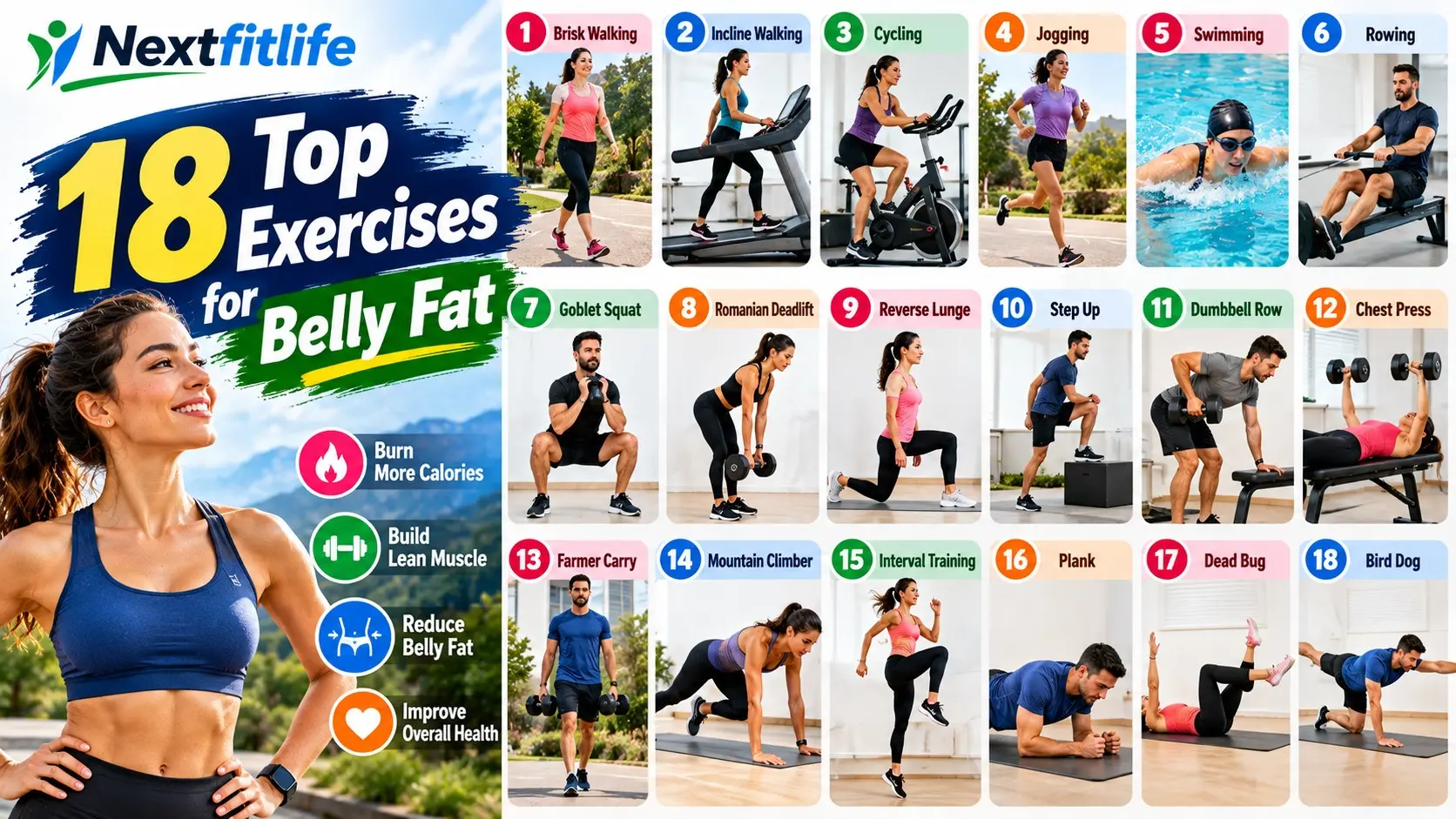
1. Brisk Walking
Walking for weight loss deserves a place near the top because it is simple, repeatable, and easy to recover from.
Walk fast enough that your breathing increases, but you can still speak.
A beginner might start with 15 to 20 minutes.
Over time, build toward 30 minutes or more.
Walking also works well on days between harder strength sessions.
2. Incline Walking
An incline makes walking harder without requiring you to run.
You can use a treadmill or choose a hilly outdoor route.
Start with a modest incline and keep your posture natural.
Do not hold the treadmill rails and lean backward just to use a steeper setting.
3. Cycling
Cycling is a useful form of cardio for belly fat because intensity is easy to adjust.
You can use:
- An outdoor bicycle
- A stationary bike
- A recumbent bike
It may also feel more comfortable than running for people who prefer lower impact exercise.
4. Jogging
Jogging uses more energy per minute than easy walking for many people, but you do not need to run to lose abdominal fat.
If you are new to running, combine short jogging periods with walking.
Our Run Walk Method explains how to build running time gradually.
5. Swimming
Swimming works much of the body while providing aerobic exercise.
It can be a useful choice if you enjoy water based activity or want an alternative to repeated impact on land.
The best swimming workout is one you can sustain with good technique.
6. Rowing
A rowing machine combines cardiovascular work with repeated use of the legs, hips, back, and arms.
Good rowing technique begins with the legs rather than pulling only with the arms.
Start at a controlled pace before trying hard intervals.
7. Goblet Squat
The goblet squat trains large muscle groups in the legs and hips.
Hold one dumbbell close to your chest, sit down between your hips, then stand tall.
A chair can help beginners control depth.
Large muscle exercises are useful in a full body workout because they let you train a lot of muscle efficiently.
8. Romanian Deadlift
The Romanian deadlift trains the hips, hamstrings, glutes, and back muscles.
Push your hips backward while keeping the weights close to your legs.
Stop when you feel a strong stretch in the back of your thighs without losing control of your spine.
If this movement is new to you, read our Hip Hinge Exercises guide.
9. Reverse Lunge
Step one foot backward and lower under control.
Push through the front leg to return.
Reverse lunges train the legs and hips while also asking for balance and trunk control.
Hold onto a stable support if balance is limiting the exercise.
10. Step Up
Step ups are simple, practical, and easy to scale.
Start with a low stable step.
Drive through the working leg rather than jumping from the trailing foot.
Add dumbbells only after the bodyweight version feels controlled.
11. Dumbbell Row
A row strengthens your back and arms.
Support one hand on a bench if that helps you maintain a stable position.
Pull the dumbbell toward your side, pause briefly, then lower it under control.
Rows help make a fat loss program a real strength program rather than a collection of calorie burning drills.
12. Chest Press
The chest press trains the chest, shoulders, and triceps.
You can use dumbbells, a machine, or another suitable resistance.
Pairing pressing and pulling movements helps create a more balanced routine.
13. Farmer Carry
Hold a weight in each hand and walk with controlled posture.
Farmer carries train grip, trunk stability, shoulders, and whole body control.
Start with a weight you can carry without leaning or rushing.
14. Mountain Climbers
Mountain climbers combine upper body support with fast leg movement.
They can raise heart rate quickly.
Use them as optional conditioning rather than assuming they have a special belly fat effect.
A slower version is fine if fast repetitions make your technique collapse.
15. Interval Training
Interval training alternates harder work with easier recovery.
For example:
- 30 seconds of faster cycling
- 90 seconds of easy cycling
- Repeat for several rounds
Intervals can improve cardiovascular fitness and may help reduce visceral fat.
However, you do not need all out sprints.
Harder is not always better.
16. Plank
A plank is a core exercise, not a belly fat melting exercise.
It trains your trunk to resist movement.
Keep your body controlled and breathe normally.
Start with a shorter hold and increase the time only while posture remains good.
17. Dead Bug
Lie on your back with your arms raised and your knees bent.
Slowly move the opposite arm and leg away from the body while keeping your trunk controlled.
Return and switch sides.
The dead bug is useful because it teaches abdominal control without needing fast movement.
18. Bird Dog
Begin on your hands and knees.
Extend one arm and the opposite leg while keeping your trunk stable.
Return slowly and switch sides.
Bird dogs train trunk control and coordination rather than directly burning abdominal fat.
18 Exercises at a Glance
| Exercise | Main Role | Beginner Friendly |
|---|---|---|
| Brisk walking | Aerobic fitness | Yes |
| Incline walking | Aerobic fitness | Yes |
| Cycling | Aerobic fitness | Yes |
| Jogging | Aerobic fitness | With progression |
| Swimming | Aerobic fitness | If swimming skills allow |
| Rowing | Aerobic conditioning | With technique practice |
| Goblet squat | Strength | Yes |
| Romanian deadlift | Strength | With technique practice |
| Reverse lunge | Strength and balance | Use support if needed |
| Step up | Strength | Yes |
| Dumbbell row | Strength | Yes |
| Chest press | Strength | Yes |
| Farmer carry | Whole body strength | Yes |
| Mountain climber | Conditioning | Modify speed |
| Intervals | Aerobic conditioning | Start conservatively |
| Plank | Core strength | Yes |
| Dead bug | Core control | Yes |
| Bird dog | Core control | Yes |
Best Weekly Exercise Plan for Belly Fat
You do not need to perform all 18 exercises in one workout.
Use them as a menu.
| Day | Training | Main Goal |
|---|---|---|
| Monday | Full body strength | Maintain muscle |
| Tuesday | 30 minute brisk walk | Aerobic fitness |
| Wednesday | Easy walking plus core | Movement and trunk strength |
| Thursday | Full body strength | Maintain or build muscle |
| Friday | Cycling, walking, swimming, or rowing | Aerobic fitness |
| Saturday | Longer easy cardio or short intervals | Build weekly activity |
| Sunday | Rest or easy movement | Recovery |
Adjust this routine to your fitness level.
If six active days feels unrealistic, use four.
If three days is all you can manage now, start there.
Consistency matters more than making the calendar look perfect.
Simple Full Body Strength Workout
This routine gives you a useful starting point.
| Exercise | Sets | Repetitions |
|---|---|---|
| Goblet squat | 2 to 3 | 8 to 12 |
| Romanian deadlift | 2 to 3 | 8 to 12 |
| Dumbbell row | 2 to 3 | 8 to 15 |
| Chest press | 2 to 3 | 8 to 12 |
| Step up | 2 | 8 to 12 each side |
| Farmer carry | 2 to 3 | Controlled walks |
Choose weights that make the last few repetitions challenging while your technique stays controlled.
You do not need to reach complete muscular failure.
Our Reps in Reserve guide explains how to judge training effort without guessing from soreness.
Cardio or Strength Training for Belly Fat?
Both are useful, but they do different jobs.
Aerobic Exercise
Aerobic exercise is especially useful for increasing weekly energy use and improving cardiovascular fitness.
Research supports aerobic exercise for reducing abdominal and visceral fat.
Resistance Training
Resistance training helps preserve and build muscle.
Research also shows that resistance training can reduce body fat percentage, fat mass, and visceral fat.
Combined Training
For many people, the practical answer is not cardio versus weights.
It is cardio plus weights.
This gives you a broader mix of cardiovascular, muscular, and body composition benefits.
Do Crunches Burn Belly Fat?
Crunches train your abdominal muscles.
They should not be treated as a primary fat loss method.
The same is true for:
- Sit ups
- Leg raises
- Russian twists
- Planks
- Ab wheel exercises
These movements can make the core stronger.
If enough total fat is lost, stronger abdominal muscles may become more visible.
But doing more crunches does not guarantee that your body will remove fat from the stomach first.
Is Spot Reduction Completely Impossible?
The science deserves a little more care than a simple yes or no.
Most practical fitness advice says you cannot reliably choose where fat is lost.
That remains the safest message for planning a workout.
However, a small randomized study in men found a greater reduction in trunk fat after abdominal endurance exercise compared with matched treadmill exercise.
That result is interesting, but one small study is not enough to replace the larger practical strategy.
Do not build your fat loss plan around hundreds of ab repetitions.
Build it around total activity, aerobic training, resistance exercise, and nutrition.
Is HIIT the Best Exercise for Belly Fat?
HIIT can be effective.
Recent analyses suggest interval training can reduce visceral fat, and in some comparisons it ranks highly.
That does not mean everyone should do HIIT.
HIIT is harder to recover from than an easy walk.
It may also be unsuitable for some beginners or people with certain health or joint problems.
You can reduce abdominal fat without doing a single burpee.
Walking Versus HIIT for Belly Fat
| Feature | Walking | HIIT |
|---|---|---|
| Beginner friendly | Usually high | Lower |
| Recovery demand | Low | Higher |
| Time efficient | Moderate | High |
| Can support visceral fat reduction | Yes | Yes |
| Easy to do frequently | Usually yes | Not usually |
Use the option that fits your health, fitness, preferences, and schedule.
Some people do best with mostly walking and one interval session.
Others never need interval training.
How Much Exercise Should You Do?
For general health, adults should work toward at least 150 minutes of moderate intensity aerobic activity each week.
An alternative is 75 minutes of vigorous activity, or a suitable mix of both.
Adults should also perform muscle strengthening activity on at least two days each week.
More aerobic activity can provide additional health benefits.
You do not need to reach the full target in your first week.
Some activity is better than none.
How Hard Should Cardio Feel?
For moderate exercise, use the talk test.
Your breathing should be faster, but you should still be able to talk.
Vigorous exercise feels harder and makes speaking more difficult.
Do not assume that maximum effort burns the most belly fat in real life.
A workout only works when you can recover and repeat it.
Do You Need a Calorie Deficit?
If the goal is to lose body fat, including belly fat, an overall calorie deficit usually matters.
Exercise increases energy use.
Food intake affects the other side of the equation.
You can create a moderate deficit through simple changes such as:
- Reducing oversized portions
- Replacing sugary drinks
- Eating more vegetables
- Choosing filling protein foods
- Reducing frequent high calorie snacks
- Limiting excess alcohol
- Increasing daily activity
You do not have to starve yourself.
A sustainable eating plan is more useful than an extreme short term diet.
See our Healthy Eating Lifestyle guide for a practical food framework.
Does Protein Help?
Protein helps support muscle.
That becomes useful when you are losing weight and strength training.
Good options include:
- Eggs
- Fish
- Chicken
- Greek yogurt
- Beans
- Lentils
- Tofu
- Tempeh
You do not need a protein shake if normal meals meet your needs.
Sleep Matters More Than Most Workout Lists Admit
Fat loss is harder when poor sleep affects hunger, energy, activity, and food choices.
Protect sleep with simple habits:
- Use a regular bedtime
- Keep a regular wake time
- Reduce late caffeine
- Keep the bedroom dark
- Give yourself enough time to sleep
Do not add harder workouts to compensate for chronic sleep loss.
What About Stress Belly?
Stress may affect appetite, eating patterns, sleep, activity, and hormones.
But “stress belly” is not a formal medical diagnosis.
Do not assume all abdominal fat comes from cortisol.
If stress is making healthy habits harder, deal with the stress as part of the plan.
Read How to Get Rid of Stress Belly for a deeper explanation.
Do You Need Burpees?
No.
Burpees can be demanding conditioning exercises, but there is nothing magical about them.
If you enjoy them and tolerate them well, use them.
If they hurt your wrists, knees, back, or motivation, choose cycling, rowing, incline walking, or another form of conditioning.
Do You Need Mountain Climbers?
No.
Mountain climbers are another optional conditioning exercise.
They can raise your heart rate and challenge your trunk, but they are not required for abdominal fat loss.
Do You Need Russian Twists?
No.
Russian twists are one way to train trunk rotation.
They are not required to make your waist smaller.
Planks, carries, bird dogs, and dead bugs are often easier to control.
How Fast Can Belly Fat Go Away?
There is no safe fixed timeline.
Changes depend on:
- Your starting body composition
- Food intake
- Exercise
- Daily movement
- Sleep
- Medicines
- Health conditions
- Genetics
CDC guidance notes that people who lose weight gradually, around 1 to 2 pounds per week, are more likely to maintain that loss than people who lose weight faster.
Your own rate may be slower.
You do not need to force that full amount every week.
Can You Lose Belly Fat Without Losing Weight?
Sometimes body composition can improve while body weight changes very little.
This is more likely when a person starts resistance training, gains some muscle, and loses some fat.
Look at more than the scale.
You can track:
- Waist circumference
- Strength
- Walking or running fitness
- How clothes fit
- Training consistency
- Body weight trend
Common Belly Fat Exercise Mistakes
Doing Only Ab Exercises
Your core needs training, but your fat loss plan needs more than abdominal work.
Making Every Cardio Session HIIT
Hard intervals require recovery.
Moderate cardio and walking are easier to repeat frequently.
Skipping Strength Training
Resistance work helps protect muscle during fat loss.
Ignoring Daily Movement
A workout does not erase the other 23 hours of the day.
Walk, move, take stairs when practical, and break up long sitting periods.
Trying to Burn Off Every Meal
Exercise should not become punishment for eating.
Train to improve health and fitness while using sustainable food habits for body fat goals.
Changing the Program Every Week
You need enough repetition to improve.
Use progressive overload rather than replacing every exercise as soon as it feels familiar.
For a simple strength framework, see Minimum Effective Dose Strength Training.
A Simple Starting Plan
- Walk briskly for 20 to 30 minutes three times this week.
- Complete two full body strength sessions.
- Add two short core exercises after strength training.
- Keep at least one easy recovery day.
- Increase normal daily movement.
- Build meals around protein, vegetables, fruit, and filling whole foods.
- Protect sleep.
- Review progress after four weeks rather than four days.
When Should You Get Medical Advice Before Exercising?
Many healthy adults can begin light to moderate exercise without special testing.
Talk with a healthcare professional if you have concerns such as:
- Known heart disease
- Exercise related chest pain
- Repeated fainting
- Severe unexplained breathlessness
- Uncontrolled high blood pressure
- A major recent injury
- Recent surgery
- A serious lung condition
- A condition that affects safe movement
Your doctor may still encourage exercise, but the type or intensity may need adjustment.
Stop Exercise for These Warning Signs
Stop exercising and seek appropriate medical help for:
- Chest pain or pressure
- Fainting
- Severe unusual shortness of breath
- Sudden weakness
- New numbness
- Severe dizziness
- A serious acute injury
Do not try to push through a serious symptom just to finish the workout.
Conclusion
The Top Exercises for Belly Fat are not a secret set of ab moves.
The strongest routine combines aerobic exercise, full body resistance training, daily movement, and a small amount of core work. Nutrition, sleep, and recovery help turn those workouts into lasting results.
Use crunches or planks if you enjoy them, but do not make them responsible for your fat loss.
Your next step: choose one form of cardio and five strength exercises from this guide. Schedule them for the coming week and build from a level you can repeat.
References and Sources
- Centers for Disease Control and Prevention. Adult Activity: An Overview.
https://www.cdc.gov/physical-activity-basics/guidelines/adults.html - Centers for Disease Control and Prevention. Steps for Losing Weight.
https://www.cdc.gov/healthy-weight-growth/losing-weight/ - American College of Sports Medicine. Resistance Training Guidelines Update 2026.
https://acsm.org/resistance-training-guidelines-update-2026/ - Chen X, He H, Xie K, Zhang L, Cao C. Effects of Various Exercise Types on Visceral Adipose Tissue in Individuals With Overweight and Obesity: A Systematic Review and Network Meta Analysis.
https://pubmed.ncbi.nlm.nih.gov/38031812/ - Igarashi Y, Akazawa N, Maeda S. An Exercise Program to Reduce Abdominal Visceral and Subcutaneous Fat in Adults With Overweight and Obesity: A Systematic Review and Meta Analysis.
https://pubmed.ncbi.nlm.nih.gov/41109785/ - Wewege MA, et al. The Effect of Resistance Training in Healthy Adults on Body Fat Percentage, Fat Mass and Visceral Fat: A Systematic Review and Meta Analysis.
https://pubmed.ncbi.nlm.nih.gov/34536199/ - World Health Organization. Physical Activity Recommendations.
https://www.who.int/initiatives/behealthy/physical-activity
Internal Links + Hub
- NextFitLife Fitness Hub
- 20 Exercises to Lose Belly Fat
- Fitness Program Guide
- Minimum Effective Dose Strength Training
- Reps in Reserve
- Hip Hinge Exercises
- Run Walk Method
- Healthy Eating Lifestyle
- How to Get Rid of Stress Belly
About the Author
Adel Galal is the founder and lead writer of NextFitLife.com and the founder of Parnthub.com.
He is a father of four, three sons and a daughter, and a grandfather of four, with more than 33 years of hands on family experience. He is based in Cairo, Egypt.
Adel has maintained a personal interest in health, fitness, nutrition, sleep, wellness, and healthy aging for more than 30 years and has more than 15 years of health and wellness writing experience.
His work focuses on reviewing trusted health and fitness sources, separating established guidance from uncertain claims, and explaining practical information in clear language.
Adel is not a doctor, physical therapist, exercise physiologist, registered dietitian, or certified personal trainer. NextFitLife content is for general information and education and does not replace individual medical or professional fitness advice.
Learn more about Adel and NextFitLife on the About Us page.
Frequently Asked Questions
What are the best exercises for belly fat?
The best exercises are those that support overall fat loss and fitness. Brisk walking, cycling, jogging, swimming, rowing, full body strength training, and suitable interval training are useful choices. Core exercises can strengthen the abdomen but should not be the main fat loss strategy.
Can exercise reduce belly fat?
Yes. Regular aerobic exercise, resistance training, combined training, and interval training can reduce total body fat and abdominal or visceral fat. The exact amount varies between people.
Which exercise burns belly fat the fastest?
There is no single fastest belly fat exercise. Hard interval training may use more energy per minute, but walking, cycling, resistance training, and other activities can work when they are performed consistently and paired with suitable nutrition.
Do crunches burn belly fat?
Crunches strengthen abdominal muscles, but they should not be relied on to remove belly fat. Overall fat loss depends more on total activity, nutrition, energy balance, sleep, genetics, and other factors.
Do planks reduce belly fat?
Planks improve core strength and trunk control. They do not provide a reliable way to selectively remove stomach fat.
Is walking good for belly fat?
Yes. Brisk walking increases physical activity and energy use and can support overall and abdominal fat loss when performed consistently. It is also easy to combine with strength training.
Is HIIT better than walking for belly fat?
HIIT can reduce visceral fat and is time efficient, but it is more demanding. Walking is easier to recover from and can be performed more often. The better choice is the one that fits your health and can be repeated consistently.
Does strength training help reduce belly fat?
Yes. Resistance training can reduce body fat and visceral fat while helping maintain or build muscle. It works well as part of a plan that also includes aerobic activity and suitable nutrition.
How many days a week should I exercise to lose belly fat?
A practical starting plan may include two full body strength sessions and three or more aerobic activity days. Adults should work toward at least 150 minutes of moderate aerobic activity weekly plus strength work on at least two days.
Can I lose belly fat in seven days?
Meaningful abdominal fat loss usually takes longer than seven days. Early scale changes often include water and digestive changes. Focus on a sustainable trend rather than a one week transformation.
Can I lose belly fat in two weeks?
You may begin making progress in two weeks, but large reductions in abdominal fat should not be expected that quickly. Sustainable changes in nutrition, activity, strength, and sleep matter more than a short deadline.
Should I do ab exercises every day?
No. Your abdominal muscles do not require daily training for most fitness goals. Two or three focused core sessions each week can be enough when combined with a balanced full body program.
Do I need burpees to lose belly fat?
No. Burpees are optional conditioning exercises. Walking, cycling, rowing, swimming, running, or other activities can provide effective cardiovascular training without burpees.
What should I eat while exercising to lose belly fat?
Build meals around vegetables, fruit, protein rich foods, whole grains or other suitable carbohydrate foods, and healthy fats. If fat loss is the goal, overall calorie intake still matters.
How long does it take to lose belly fat?
There is no fixed timeline. Progress depends on starting body composition, food intake, exercise, daily movement, sleep, health, medicines, and genetics. Look for changes across weeks and months rather than days.

Health & wellness writer with 30+ years of experience in nutrition, fitness, and healthy aging. Founder of NextFitLife.com — evidence-based health guidance.

