
Published on: Aug 7, 2024
Updated: November 2, 2026
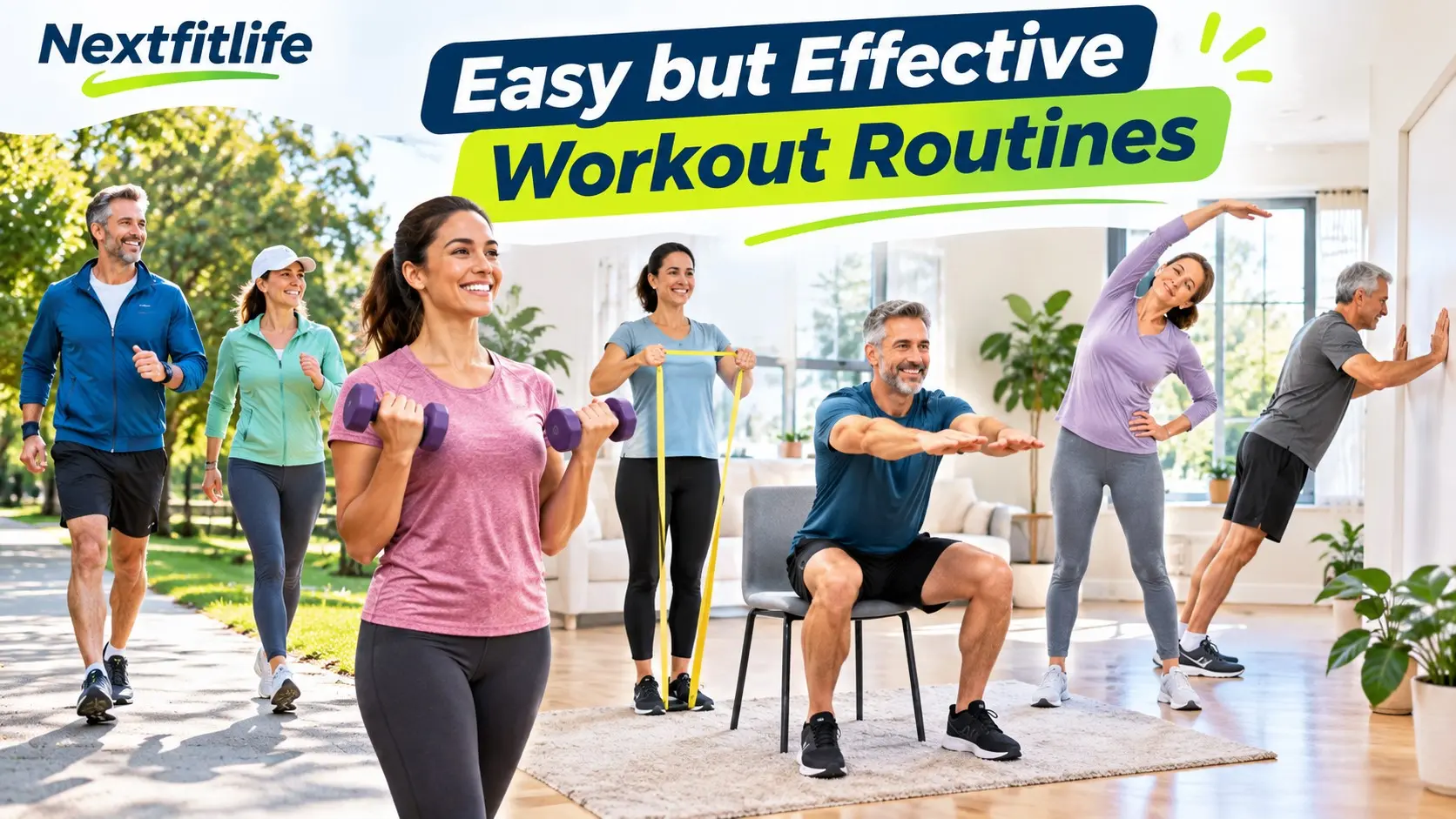
Easy but Effective Workout Routines do not need burpees, all-out intervals, long gym sessions, or enough sweat to soak your shirt.
A useful workout gives your body a reason to adapt, but it also needs to be simple enough that you will do it again.
That means walking can count. Ten minutes can count. Resistance bands can count. A short strength circuit can count, and an easier recovery day can be part of a good plan too.
This article is for general information and education. It does not replace medical advice, diagnosis, or treatment.
Quick answer: Easy but Effective Workout Routines combine simple aerobic activity, strength training, mobility, and balance without making every session exhausting. Start with short workouts you can repeat, build toward about 150 minutes of moderate activity each week, and include muscle strengthening on at least two days.
Remember: Sweat is not a score. Heat, clothing, genetics, humidity, and workout type all affect sweating. A workout can be useful even when you do not sweat much.
Table of Contents
- What makes a workout effective?
- Do short workouts really count?
- 21 easy but effective workout routines
- Brisk walking routine
- Walking interval routine
- Ten minute bodyweight routine
- Chair strength routine
- Resistance band routine
- Dumbbell full body routine
- Squat push row routine
- Low impact cardio routine
- Indoor walking routine
- Stair walking routine
- Exercise snack routine
- Lunch break routine
- Strength and walk routine
- Simple core routine
- Mobility routine
- Balance routine
- Yoga recovery routine
- Active commute routine
- Long easy walk routine
- Three day beginner plan
- Five day balanced plan
- Ten minute workout
- Twenty minute workout
- Thirty minute workout
- How hard should you exercise?
- Common workout mistakes
- Frequently asked questions
What Makes a Workout Effective?
An effective workout does not need to feel brutal.
It needs to match your goal and provide enough challenge to help your body adapt.
A balanced routine usually includes:
- Aerobic exercise for heart and lung fitness
- Strength training for muscles and daily function
- Mobility for comfortable movement
- Balance training when appropriate
Adults should aim for at least 150 minutes of moderate aerobic activity each week and strength work on at least two days.
You do not need to complete all of those minutes in one workout.
Do Short Workouts Really Count?
Yes.
Current physical activity guidance no longer requires exercise to happen in long blocks.
Short activity periods can add to your weekly total.
Recent research on exercise snacks also suggests that brief bouts may improve cardiorespiratory fitness in inactive adults.
But short workouts are not magic.
They work best when repeated often enough to create a meaningful total amount of activity.
21 Easy but Effective Workout Routines
1. Brisk Walking Routine
Walking is one of the simplest ways to build aerobic fitness.
Try:
- 5 minutes easy walking
- 15 minutes brisk walking
- 5 minutes easy walking
A brisk pace should make you breathe harder while still allowing you to talk.
Explore Daily Walking Challenge if you want a longer progression.
2. Walking Interval Routine
You do not need running to use intervals.
- Walk easily for 5 minutes.
- Walk briskly for 1 minute.
- Walk comfortably for 2 minutes.
- Repeat 4 to 5 times.
- Finish easily.
This lets you work harder for short periods without making the entire workout hard.
3. Ten Minute Bodyweight Routine
Perform these moves slowly:
- 8 to 12 chair squats
- 8 to 12 wall push ups
- 8 to 12 glute bridges
- 10 heel raises
- 20 seconds of easy marching
Repeat the sequence if time allows.
4. Chair Strength Routine
This routine works well for beginners or anyone who wants extra stability.
- Chair sit to stand: 8 to 12 reps
- Seated knee extension: 8 to 12 each side
- Wall push up: 8 to 12 reps
- Heel raise while holding chair: 10 to 15 reps
- Seated march: 30 seconds
Rest as needed.
5. Resistance Band Routine
Resistance bands are light, portable, and easy to adjust.
Try:
- Band squat
- Band row
- Band chest press
- Band hip abduction
- Band biceps curl
Do 8 to 15 controlled repetitions of each.
6. Dumbbell Full Body Routine
A pair of light dumbbells can train the whole body.
- Goblet squat: 8 to 12 reps
- Dumbbell row: 8 to 12 each side
- Dumbbell floor or bench press: 8 to 12 reps
- Romanian deadlift: 8 to 12 reps
- Farmer carry: 20 to 40 seconds
Use a weight that allows good form.
7. Squat Push Row Routine
This is a simple three movement strength workout.
- Squat or sit to stand
- Wall or counter push up
- Resistance band row
Do 2 to 3 rounds of 8 to 12 repetitions.
Three useful patterns can cover a lot without creating a complicated program.
8. Low Impact Cardio Routine
Try this when jumping does not feel good.
- 1 minute marching
- 1 minute side steps
- 1 minute step touch
- 1 minute low knee lifts
- 1 minute easy walking
Repeat two to four times.
9. Indoor Walking Routine
Bad weather does not have to stop your walking habit.
Move through:
- Walking in place
- Hallway laps
- Side steps
- Brisk marching
- Easy recovery walking
See Indoor Walking Exercise for more options.
10. Stair Walking Routine
Stairs can make walking more demanding without requiring a long workout.
- Walk easily for 5 minutes.
- Climb one flight of stairs.
- Walk easily for 2 minutes.
- Repeat 3 to 5 times.
Use the rail and skip this routine if stairs are unsafe for your joints or balance.
11. Exercise Snack Routine
An exercise snack is a very short bout of activity done during the day.
Try three separate mini sessions:
- Morning: 1 to 3 minutes of brisk stairs or marching
- Afternoon: 1 to 3 minutes of squats and wall push ups
- Evening: 1 to 3 minutes of brisk walking
2026 reviews suggest this format may improve fitness and has high adherence in inactive adults.
It should complement, not automatically replace, your full weekly activity plan.
12. Lunch Break Routine
You can use part of a lunch break without turning it into a hard gym session.
- 5 minute brisk walk
- 10 chair squats
- 10 wall push ups
- 10 heel raises
- 5 minute walk
This is simple enough to repeat on busy days.
13. Strength and Walk Routine
Combine the two main parts of a balanced fitness plan.
- 10 minutes brisk walking
- 2 sets of squats
- 2 sets of rows
- 2 sets of wall push ups
- 5 minutes easy walking
This covers aerobic activity and basic strength in one session.
14. Simple Core Routine
Core exercise should train control, not just create a burning feeling.
Try:
- Dead bug
- Bird dog
- Side plank from knees
- Farmer carry
Use slow, controlled movement.
15. Mobility Routine
A short mobility routine can help you move comfortably after sitting for a long time.
- Shoulder circles
- Seated or standing cat cow
- Hip hinge practice
- Gentle calf stretch
- Thoracic rotation within a comfortable range
Mobility does not need to hurt.
16. Balance Routine
Balance becomes more important with age.
Try these beside a stable support:
- Tandem stand
- Single leg stand
- Heel to toe walking
- Side stepping
Keep a counter or wall within reach.
17. Yoga Recovery Routine
Yoga can work well on an easier day.
Try:
- Seated mountain
- Cat cow
- Gentle side stretch
- Supported bridge
- Relaxed breathing
See Best Yoga Moves for Beginners.
18. Active Commute Routine
Exercise does not have to happen inside a workout window.
You might:
- Walk part of your commute
- Park farther away
- Cycle when the route is safe
- Get off public transport one stop earlier
This can raise total daily movement without creating another scheduled workout.
19. Long Easy Walk Routine
Not every workout needs intensity.
One longer easy walk each week can increase your activity total while keeping effort manageable.
Start with 30 to 40 minutes and build only when that feels comfortable.
20. Three Day Beginner Plan
| Day | Workout |
|---|---|
| Day 1 | 25 minute brisk walk |
| Day 2 | 20 minute full body strength routine |
| Day 3 | 25 minute walk plus mobility |
Add easy movement on the other days if you want.
21. Five Day Balanced Plan
| Day | Workout |
|---|---|
| Monday | 30 minute brisk walk |
| Tuesday | 20 to 30 minute strength routine |
| Wednesday | 20 minute easy walk plus mobility |
| Thursday | 20 to 30 minute strength routine |
| Friday | 30 minute walking intervals |
The weekend can include easy movement, a longer walk, or rest.
21 Workout Ideas at a Glance
| Routine | Main Goal | Time |
|---|---|---|
| Brisk walk | Aerobic fitness | 20 to 30 min |
| Walking intervals | Fitness | 20 to 30 min |
| Bodyweight | Strength | 10 min |
| Chair strength | Beginner strength | 10 to 15 min |
| Resistance bands | Full body strength | 15 to 25 min |
| Dumbbells | Progressive strength | 20 to 30 min |
| Squat push row | Simple strength | 15 min |
| Low impact cardio | Cardio | 10 to 20 min |
| Indoor walk | Daily movement | 15 to 30 min |
| Stairs | Cardio challenge | 10 to 20 min |
| Exercise snacks | Busy day fitness | 1 to 10 min |
| Lunch routine | Movement break | 10 to 15 min |
| Walk plus strength | Balanced fitness | 25 to 35 min |
| Core | Control | 10 min |
| Mobility | Movement quality | 5 to 15 min |
| Balance | Stability | 5 to 10 min |
| Yoga recovery | Mobility and relaxation | 10 to 20 min |
| Active commute | Daily activity | Varies |
| Long easy walk | Weekly activity | 30+ min |
| Three day plan | Beginner routine | 3 days |
| Five day plan | Balanced week | 5 days |
A Simple 10 Minute Workout
When time is tight, use this:
- 2 minutes brisk walking or marching
- 10 chair squats
- 10 wall push ups
- 10 band or towel rows if available
- 10 heel raises
- 2 minutes brisk walking
Repeat the strength moves once if time remains.
A Simple 20 Minute Workout
- 5 minutes brisk walking
- 10 squats
- 10 wall or counter push ups
- 10 band rows
- 10 glute bridges
- Repeat the strength circuit once
- Finish with easy walking
A Simple 30 Minute Full Body Workout
- 5 minutes easy walking
- 10 minutes brisk walking
- 2 sets of squats
- 2 sets of rows
- 2 sets of push ups
- 2 sets of hip hinges
- 3 to 5 minutes easy walking
Do Workouts Need to Make You Sweat?
No.
Sweat mainly helps cool your body.
How much you sweat depends on:
- Temperature
- Humidity
- Clothing
- Genetics
- Fitness
- Exercise intensity
A strength workout may be effective even when you barely sweat.
Does More Sweat Mean More Calories Burned?
No.
Sweating more mainly means losing more water.
It does not prove that you burned more body fat.
Does a Workout Need to Hurt?
No.
Muscles can feel challenged or tired, but sharp or worsening pain is not a sign of a better workout.
Stop and modify the exercise if something feels wrong.
How Hard Should a Beginner Workout Be?
Start at a level that feels manageable.
During moderate aerobic exercise, your breathing should become faster while you can still talk.
Strength exercises should feel challenging near the end of a set without causing your form to fall apart.
What Is Progressive Overload?
Progressive overload means gradually making strength exercise harder as your body adapts.
You can progress by:
- Adding a little weight
- Adding repetitions
- Adding another set
- Using a stronger resistance band
- Using a harder exercise variation
You do not have to increase something every week.
Do Beginners Need HIIT?
No.
HIIT can improve fitness, but it is not the foundation of every beginner plan.
Walking, cycling, swimming, and moderate circuits can build fitness without all out exercise.
If you enjoy intervals, start with short brisk walking intervals.
Is Tabata Necessary?
No.
True Tabata uses very high intensity effort and was developed from a specific research protocol.
Many online “Tabata” workouts are simply 20 second exercise intervals.
You do not need this format to get fit.
Are Burpees Necessary?
No.
There is nothing magical about burpees.
You can train similar fitness qualities through walking intervals, squats, push ups, rows, stairs, and other simpler exercises.
Can You Get Fit Without a Gym?
Yes.
You can build a useful home program with:
- Walking
- Bodyweight exercises
- Resistance bands
- A pair of dumbbells
- Stairs
See Strength Training Exercises at Home for Beginners.
Can Short Exercise Snacks Replace a Workout?
Sometimes they can help you accumulate useful activity, especially when a normal workout is difficult to fit into your day.
Recent 2026 reviews found that exercise snacks may improve cardiorespiratory fitness and can have high adherence.
However, effects on body composition, strength, and metabolic outcomes are less consistent.
Use them as a practical tool rather than a miracle method.
Are Exercise Snacks Good for Older Adults?
They may be.
A 2026 systematic review of home based exercise snacks in adults aged 60 and older found generally high adherence and reported improvements in some measures of strength, balance, and mobility.
The evidence base is still small.
For an age specific program, see Strength Training Exercises for Seniors.
How Often Should You Work Out?
You do not need a hard workout every day.
A simple week can include:
- 3 to 5 aerobic sessions
- 2 strength sessions
- Mobility as needed
- Balance work if useful
- Easy recovery days
The exact schedule depends on your goals and fitness.
Do You Need a Rest Day?
You may not need a completely inactive day, but hard sessions need recovery.
An easier day can include:
- Walking
- Gentle cycling
- Mobility
- Easy yoga
Recovery does not mean you failed to train.
Can Easy Workouts Help With Weight Loss?
They can contribute by increasing activity and energy use.
But weight loss also depends strongly on food intake.
A workout does not need to be punishing to support weight management.
See Walking Techniques for Weight Loss for a walking based approach.
Can Easy Exercise Build Muscle?
Yes, if the muscles are challenged enough.
A beginner can gain strength using bodyweight, bands, or light weights.
As you get stronger, resistance should gradually increase.
How Do You Know When a Workout Is Too Easy?
If you can complete every repetition with little effort for several sessions, it may be time to progress.
Add a little resistance, another repetition, or a slightly harder exercise.
How Do You Know When It Is Too Hard?
A workout may be too hard if:
- Your form breaks down early
- You feel sharp pain
- You need several days to recover every time
- You dread every session
- You cannot maintain the plan
A useful program challenges you without constantly draining you.
Common Workout Mistakes
1. Thinking Harder Is Always Better
Consistency is more useful than constant exhaustion.
2. Starting With HIIT
Moderate exercise is a better entry point for many beginners.
3. Doing Only Cardio
Include strength work too.
4. Doing Only Strength Training
Aerobic activity supports heart and lung fitness.
5. Ignoring Progression
Gradually increase challenge as you improve.
6. Using Sweat as the Goal
Sweat is not a fitness score.
7. Copying Advanced Workouts
Your starting point matters.
8. Skipping Recovery
Adaptation happens between workouts too.
9. Doing Random Exercises Every Day
A simple repeatable plan makes progress easier to track.
10. Waiting for the Perfect Workout
A short session today is often better than a perfect plan that never starts.
Easy Workout Checklist
- Choose a simple plan.
- Start with manageable sessions.
- Include aerobic activity.
- Strength train at least twice each week.
- Use short workouts when time is limited.
- Add resistance gradually.
- Keep good exercise form.
- Use easier recovery days.
- Do not measure quality by sweat.
- Track consistency over several weeks.
- Change the plan when it becomes too easy.
- Stop for sharp or unusual pain.
Conclusion
Easy but Effective Workout Routines work because they remove unnecessary barriers.
You do not need to train until you collapse. You do not need burpees, Tabata, expensive equipment, or a one hour gym session every day.
Walking, strength training, resistance bands, mobility work, and short exercise breaks can build a solid fitness routine when you use them consistently and gradually increase the challenge.
Your next step: choose one 10 to 20 minute routine from this guide and repeat it two or three times this week. Make the habit easy first, then make the workout stronger.
References and Sources
- Centers for Disease Control and Prevention. Adult Activity: An Overview.
https://www.cdc.gov/physical-activity-basics/guidelines/adults.html - Centers for Disease Control and Prevention. What Counts as Physical Activity for Adults.
https://www.cdc.gov/physical-activity-basics/adding-adults/what-counts.html - U.S. Department of Health and Human Services. Physical Activity Guidelines for Americans, Second Edition.
https://www.cdc.gov/physical-activity/media/pdfs/Physical_Activity_Guidelines_2nd_edition.pdf - Effect of Exercise Snacks on Fitness and Cardiometabolic Health in Physically Inactive Individuals: Systematic Review and Meta Analysis, 2026.
https://pubmed.ncbi.nlm.nih.gov/41057224/ - The Effect of Exercise Snacks on Cardiorespiratory Fitness, Body Composition, Metabolic Health, and Muscle Strength in Sedentary Individuals, 2026.
https://pubmed.ncbi.nlm.nih.gov/42865602/ - Effects of Exercise Snacks on Cardiorespiratory Fitness, Body Composition, and Blood Lipids in Adults Across Different Age Groups, 2026.
https://pubmed.ncbi.nlm.nih.gov/42571752/ - The Safety, Acceptability, and Effectiveness of Home Based Exercise Snacking for Older Adults: Systematic Review, 2026.
https://pubmed.ncbi.nlm.nih.gov/42295664/ - Exercise Snacks as a Strategy to Interrupt Sedentary Behavior: Systematic Review.
https://pubmed.ncbi.nlm.nih.gov/41464286/
Internal Links + Hub
- NextFitLife Fitness Hub
- Fitness Program Guide
- Quick Effective Workout Routines
- Workout Routines for Women
- Effective Workout Routines for Men
- Strength Training Exercises at Home for Beginners
- Simple Strength Training Exercises at Home
- Daily Walking Challenge
- Indoor Walking Exercise
- Best Exercises to Do While Walking
- Best Yoga Moves for Beginners
- Getting Fit at 60
- How to Maintain Muscle Mass
- Fitness Journey
About the Author
Adel Galal is the founder and lead writer of NextFitLife.com and the founder of Parnthub.com.
He is a father of four, three sons and a daughter, and a grandfather of four, with more than 33 years of hands on family experience. Adel is based in Cairo, Egypt.
He has maintained a personal interest in health, fitness, nutrition, walking, strength training, sleep, wellness, and healthy aging for more than 30 years and has more than 15 years of health and wellness writing experience.
His work focuses on reviewing trusted sources, separating useful fitness guidance from exaggerated workout claims, and turning research into simple routines that fit real life.
Adel is not a doctor, physical therapist, exercise physiologist, certified personal trainer, or other licensed healthcare professional. NextFitLife content is for general information and education and does not replace individual medical or exercise advice.
Learn more about Adel and NextFitLife on the About Us page.
Frequently Asked Questions
What are Easy but Effective Workout Routines?
Easy but Effective Workout Routines are simple workouts that provide enough cardio, strength, mobility, or balance work to improve fitness without making every session exhausting.
Can an easy workout really be effective?
Yes. Exercise does not need to feel extreme. Regular moderate activity and progressive strength training can provide major health and fitness benefits.
Is 10 minutes of exercise enough?
Ten minutes is useful, especially when it helps you move more consistently. Several short sessions can add to your weekly activity total.
Do 5 minute workouts count?
Yes. Short movement sessions count toward total physical activity, although longer or repeated sessions may be needed to reach weekly exercise goals.
What is an exercise snack?
An exercise snack is a short bout of activity performed during the day, often lasting one to ten minutes.
Do exercise snacks improve fitness?
Recent systematic reviews suggest exercise snacks may improve cardiorespiratory fitness, especially in inactive adults, although effects on body fat and strength are less certain.
Do workouts need to make me sweat?
No. Sweat is mainly a cooling response and does not measure workout quality.
Does sweating more burn more fat?
No. More sweating mainly means greater fluid loss, not necessarily greater fat loss.
Do workouts need to hurt?
No. Muscles may feel challenged, but sharp or worsening pain is not a sign of an effective workout.
Do beginners need HIIT?
No. Walking, cycling, moderate cardio, and basic strength work are excellent starting choices.
Is Tabata necessary for fitness?
No. Tabata is only one interval format. You can improve fitness without using it.
Do I need burpees?
No. Walking intervals, squats, push ups, rows, and stairs can train similar fitness qualities without burpees.
Can I get fit at home?
Yes. Walking, bodyweight exercises, resistance bands, dumbbells, and stairs can create a complete home fitness routine.
How many days per week should beginners exercise?
Three structured exercise days can be a good starting point, with easy movement on other days.
How much cardio do adults need?
Adults should work toward at least 150 minutes of moderate aerobic activity each week or an equivalent amount of vigorous activity.
How often should adults strength train?
Adults should include muscle strengthening activity on at least two days each week.
Is walking enough exercise?
Walking can provide excellent aerobic activity, but adding strength training creates a more complete fitness plan.
Can resistance bands build strength?
Yes. Bands can provide useful resistance and can be progressed as you become stronger.
Can bodyweight exercises build muscle?
Yes, especially for beginners. The exercise must become challenging enough as strength improves.
What is progressive overload?
Progressive overload means gradually increasing resistance, repetitions, sets, or exercise difficulty as your body adapts.
Do I have to progress every week?
No. Progress when the current workout feels consistently manageable with good form.
Can easy workouts help with weight loss?
They can increase daily energy use, but food intake and total activity also strongly affect weight loss.
Should I exercise every day?
You can move every day, but hard workouts do not need to happen daily. Easier activity and recovery days are useful.
What is the easiest full body workout?
A simple routine can combine squats or sit to stands, wall push ups, rows, hip hinges, and walking.
What is the best workout for a busy person?
Short walks, exercise snacks, and brief full body strength routines are practical because they can fit into small blocks of time.

Health & wellness writer with 30+ years of experience in nutrition, fitness, and healthy aging. Founder of NextFitLife.com — evidence-based health guidance.

