
Published on: Jun 8, 2024
Published on: Jun 8, 2024
Updated: October 30, 2026
Effective Workout Routines for Men do not need endless HIIT, six gym days, or brutal workouts that leave you exhausted.
A good plan is much simpler.
Train the major muscles. Get stronger over time. Add enough cardio for heart health and fitness. Move during the day. Recover well. Then use nutrition to support your goal.
If your goal is fat loss, workouts can help you keep muscle and improve fitness, but exercise does not replace an appropriate calorie deficit.
If your goal is muscle gain, you still need enough food, protein, sleep, and progressive resistance.
This article is for general information and education. It does not replace medical advice, diagnosis, or treatment.
Quick answer: A strong men's workout plan can use three full-body or upper and lower strength sessions each week, two or three cardio or brisk walking sessions, and at least one easier recovery day. Train all major muscle groups at least twice weekly. HIIT is optional. For fat loss, keep resistance training in the plan while nutrition creates a sustainable energy deficit.
Safety note: Stop exercising and seek urgent medical care for chest pain or pressure, fainting, sudden weakness, severe, unusual shortness of breath, or another serious symptom. If you have heart disease, diabetes, uncontrolled blood pressure, a serious joint problem, or another condition that affects exercise, ask a healthcare professional what level of training is suitable for you.
Table of Contents
- What makes a good men's workout plan?
- How much exercise do men need?
- Why strength training matters for fat loss
- 14 strong exercises for men
- Squat
- Romanian deadlift
- Deadlift
- Reverse lunge
- Bench press
- Push up
- Row
- Pull-up or pull down
- Overhead press
- Farmer carry
- Hip thrust
- Step up
- Dead bug
- Side plank
- Simple weekly plan
- Beginner version
- Home workout version
- Cardio and HIIT
- Progressive overload
- Fat loss and belly fat
- Protein and nutrition
- Common mistakes
- Frequently asked questions
What Makes an Effective Workout Routine for Men?
A good program trains several parts of fitness across the week.
- Strength
- Muscle
- Cardiovascular fitness
- Mobility
- Balance
- Daily movement
- Recovery
You do not need to train every quality in every session.
Spread the work across the week.
Current CDC guidance says adults should get at least 150 minutes of moderate aerobic activity each week, or 75 minutes of vigorous activity, plus muscle strengthening on at least two days. ([cdc.gov](https://www.cdc.gov/physical-activity-basics/guidelines/index.html))
ACSM's 2026 resistance training guidance also emphasizes training all major muscle groups at least twice weekly and keeping the plan simple enough to follow consistently.
For a broader framework, see the NextFitLife Fitness Program Guide.
Men Do Not Need to Train Like Bodybuilders
Many men copy advanced bodybuilding splits before they have built basic strength.
That is usually unnecessary.
You do not need a separate day for chest, arms, shoulders, back, and legs to make progress.
Most beginners and intermediate lifters can do very well with:
- Full body training
- Upper and lower splits
- Three-day strength plans
- Four-day strength plans
The best split is the one that lets you train the major muscles often enough while recovering well.
Why Strength Training Matters During Fat Loss
Weight loss is not only about making the number on the scale smaller.
You want as much of that loss as practical to come from fat rather than useful lean tissue.
A recent systematic review found that adding resistance exercise to dietary weight loss helped preserve fat-free mass, increased fat mass loss, and improved strength compared with dieting alone.
A 2026 study including men and women found a similar pattern. Weight loss was similar across exercise groups, but resistance training produced the best fat mass reduction and was the only training type linked with an increase in fat-free mass.
This is why resistance training should remain in the program when your goal is getting leaner.
14 Strong Exercises for Men
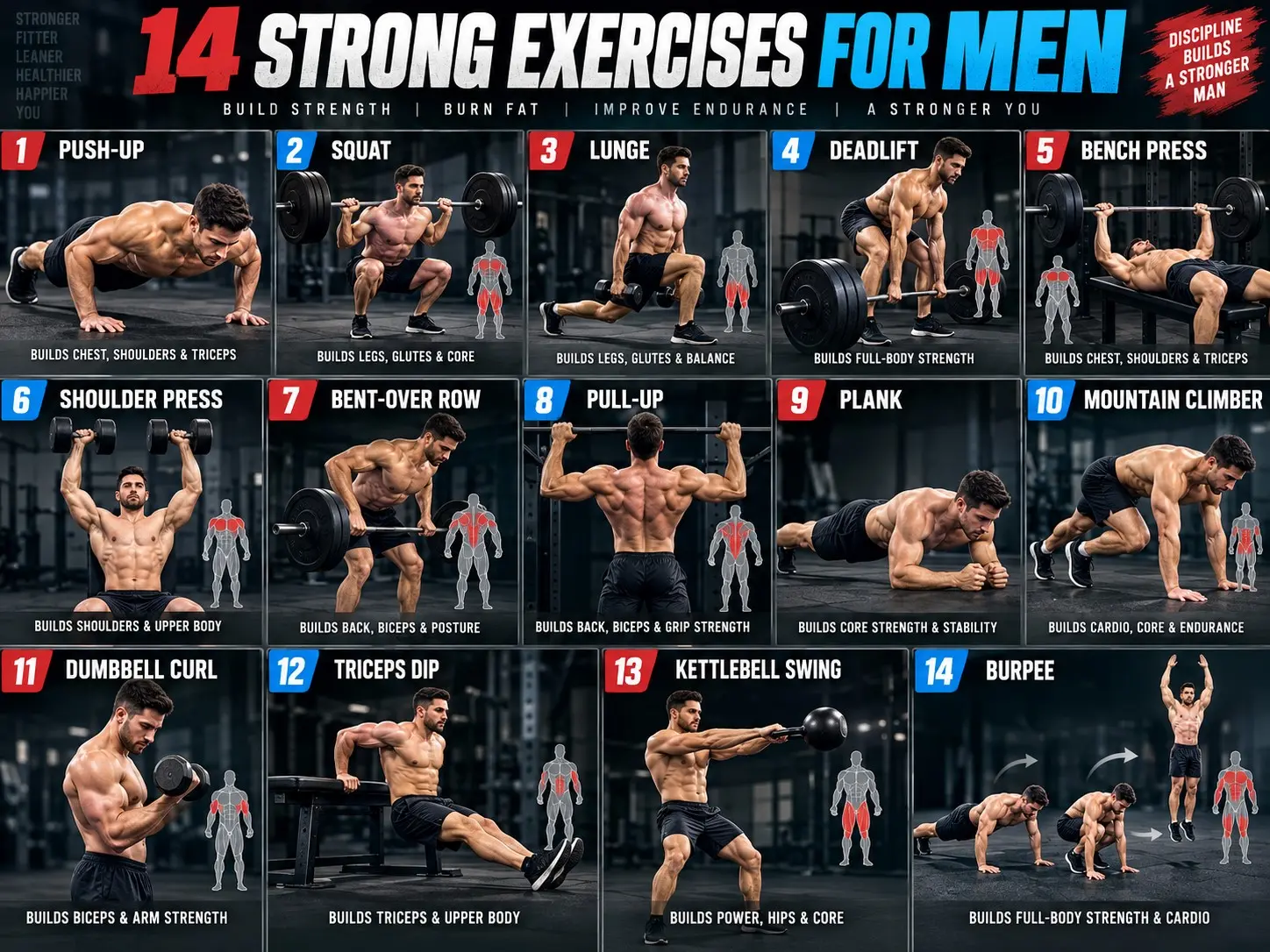
1. Squat
Squats train the thighs, hips, and trunk.
Useful versions include:
- Chair squat
- Goblet squat
- Front squat
- Back squat
- Hack squat
Choose the version that lets you train through a comfortable range with control.
2. Romanian Deadlift
The Romanian deadlift trains the hamstrings, glutes, and hip hinge pattern.
Keep the load close to your body and avoid turning every repetition into a lower back movement.
3. Deadlift
Deadlifts can train the hips, back, grip, and legs together.
They are useful, but they are not mandatory.
If a conventional deadlift does not suit you, trap bar deadlifts, Romanian deadlifts, machines, or other hip hinge options can work well.
4. Reverse Lunge
Reverse lunges train each leg separately and can help develop strength and control.
Hold a support if balance is difficult.
5. Bench Press
The bench press trains the chest, shoulders, and triceps.
Dumbbells or machines are also good options.
You do not need one specific version for results.
6. Push Up
Push-ups are an effective bodyweight pressing movement.
Use:
- Wall push-ups
- Incline push-ups
- Floor push-ups
- Weighted push-ups
Progress gradually.
7. Row
Rows train the upper back and arms.
Good versions include:
- Dumbbell row
- Cable row
- Machine row
- Chest supported row
- Resistance band row
8. Pull-up or Lat Pulldown
Both train the back and arms.
If bodyweight pull-ups are too hard, use a pull-down machine or assisted pull-up.
You do not need to perform sets to total failure.
9. Overhead Press
The overhead press trains the shoulders and triceps.
Use dumbbells, a machine, or a barbell according to comfort and experience.
10. Farmer Carry
Farmer carries train grip, trunk control, and total body strength.
Pick up a manageable load, stand tall, and walk with control.
11. Hip Thrust
The hip thrust places strong demand on the glutes.
A floor glute bridge is an easy beginner option.
12. Step Up
Step ups train the legs and hips while using a movement that transfers well to daily life.
Use a stable step and start at a comfortable height.
13. Dead Bug
The dead bug trains trunk control without requiring repeated spinal flexion.
Move slowly and keep the movement controlled.
14. Side Plank
The side plank trains lateral trunk stability.
Use a bent knee version if needed.
For more direct ab work, see Ab Workouts for Men.
14 Exercises at a Glance
| Exercise | Main Area | Beginner Option |
|---|---|---|
| Squat | Legs and hips | Chair squat |
| Romanian deadlift | Hamstrings and glutes | Light dumbbells |
| Deadlift | Hips and back | Trap bar or hinge drill |
| Reverse lunge | Legs | Supported lunge |
| Bench press | Chest and arms | Machine press |
| Push up | Chest and arms | Incline push up |
| Row | Back and arms | Band row |
| Pulldown | Back and arms | Band pulldown |
| Overhead press | Shoulders | Light dumbbells |
| Farmer carry | Grip and trunk | Light carry |
| Hip thrust | Glutes | Glute bridge |
| Step up | Legs and balance | Low step |
| Dead bug | Core | One limb at a time |
| Side plank | Core | Bent knee version |
Simple Weekly Workout Plan for Men
This plan gives you three resistance sessions while leaving room for cardio and recovery.
| Day | Main Training | Extra Movement |
|---|---|---|
| Monday | Full body strength A | Easy walk |
| Tuesday | Brisk cardio | Normal daily movement |
| Wednesday | Full body strength B | Easy walking |
| Thursday | Moderate cardio or recovery | Mobility |
| Friday | Full body strength C | Short walk |
| Saturday | Longer walk, bike, swim, or optional intervals | Normal movement |
| Sunday | Rest | Gentle movement |
Strength Workout A
- Goblet or barbell squat: 2 to 3 sets of 6 to 12
- Bench press: 2 to 3 sets of 6 to 12
- Dumbbell or cable row: 2 to 3 sets of 8 to 12
- Romanian deadlift: 2 to 3 sets of 8 to 12
- Dead bug: 2 sets per side
Strength Workout B
- Reverse lunge: 2 to 3 sets of 8 to 12 per leg
- Overhead press: 2 to 3 sets of 6 to 12
- Lat pulldown or pull up: 2 to 3 sets of 6 to 12
- Hip thrust: 2 to 3 sets of 8 to 15
- Side plank: 2 sets per side
Strength Workout C
- Deadlift or trap bar deadlift: 2 to 3 sets of 5 to 8
- Step up: 2 to 3 sets of 8 to 12 per leg
- Incline dumbbell press: 2 to 3 sets of 8 to 12
- Chest supported row: 2 to 3 sets of 8 to 12
- Farmer carry: 2 to 4 controlled walks
You do not need every exercise listed above in one week.
Choose a small group of useful movements and repeat them long enough to improve.
Beginner Workout Routine for Men
A beginner can start with only two strength days.
- Monday: Full body strength
- Tuesday: 20- to 30-minute brisk walk
- Wednesday: Rest or normal activity
- Thursday: Full body strength
- Friday: Walk
- Saturday: Optional bike, swim, or longer walk
- Sunday: Rest
Start with one or two sets per exercise if needed.
The goal is to learn the movements and return next week.
Home Workout Routine for Men
You can train effectively without a gym.
Use:
- Bodyweight squats
- Split squats
- Push ups
- Resistance band rows
- Glute bridges
- Dumbbell Romanian deadlifts
- Band pulldowns
- Farmer carries
- Dead bugs
Current ACSM guidance specifically supports bodyweight, elastic band, and home based resistance training as effective options.
For short sessions, see Quick Effective Workout Routines.
How Much Cardio Should Men Do?
Cardio supports heart health, fitness, and energy use.
Current CDC guidance recommends at least 150 minutes of moderate aerobic activity each week or 75 minutes of vigorous activity, plus strength work on at least two days.
Moderate choices include:
- Brisk walking
- Cycling
- Swimming
- Rowing
- Elliptical training
You can divide the minutes across the week.
Walking counts.
Do Men Need HIIT for Fat Loss?
No.
The old article treated HIIT almost like a requirement.
It is not.
HIIT can improve fitness efficiently, but it is demanding and may be hard to recover from when combined with heavy lifting and a calorie deficit.
Moderate cardio and walking can work very well.
Use HIIT because you enjoy it or because it suits your schedule, not because you think fat loss is impossible without it.
Is HIIT Better Than Steady Cardio?
Not for every goal.
HIIT is time efficient.
Moderate cardio is easier to recover from and may be easier to repeat.
For most men, a mix works well.
You do not need to choose one forever.
How Hard Should HIIT Be?
You do not need to sprint at your absolute maximum.
A hard interval should feel clearly harder than normal cardio while still allowing safe movement.
A beginner can use:
- Fast walking uphill
- Stationary bike intervals
- Rowing intervals
- Step intervals
There is no need to start with all out treadmill sprints or repeated burpees.
Do Compound Exercises Burn More Fat?
Compound lifts use several muscle groups at once, which makes them efficient for building strength and muscle.
But they do not directly “target” body fat.
A heavy squat can use energy.
It does not pull fat specifically from your thighs, stomach, or lower back.
The main reason to use compound movements is that they train a lot of muscle efficiently.
Can You Target Belly Fat?
Not reliably in the way most people mean.
Overall fat loss is still the main route to reducing abdominal fat.
A recent meta analysis found that exercise programs can reduce both visceral and subcutaneous abdominal fat in adults with overweight or obesity.
There is also a small randomized trial suggesting local abdominal endurance work may influence local fat loss, but that finding is not strong enough to replace the larger body of evidence favoring overall training and energy balance.
So do not build your program around hundreds of crunches.
Train your abs for strength and your whole body for fitness and body composition.
For more detail, see Top Exercises for Belly Fat.
What Is Progressive Overload?
Progressive overload means gradually making your training more challenging.
You can progress by:
- Adding a little weight
- Adding one or two repetitions
- Improving technique
- Using a harder variation
- Improving range of motion
Do not increase everything at once.
Small progress works.
How Heavy Should Men Lift?
The correct load depends on your goal and experience.
ACSM's current guidance notes that heavier loads can be useful for maximizing strength, while higher weekly training volume is important for muscle growth.
For most general training, use a load that makes the last few repetitions challenging while your technique remains controlled.
Do Men Need to Train to Failure?
No.
Current ACSM evidence does not show that complete momentary failure is required for the average healthy adult to make useful strength or muscle gains.
Leaving one to three good repetitions in reserve works well for many exercises.
How Many Sets Do Men Need?
There is no one perfect number.
Beginners can progress with a small amount of work.
For muscle growth, ACSM's 2026 guidance notes that higher weekly volume, around ten sets per muscle group, can be useful.
You do not need to begin there.
Start with less and build when needed.
Should Men Use a Bro Split?
You can.
It is not automatically better.
A chest day, back day, arm day, shoulder day, and leg day can work if total weekly training is appropriate.
However, many recreational lifters find it easier to train major muscles often enough with full body or upper and lower routines.
Can You Build Muscle While Losing Fat?
Sometimes.
This is often called body recomposition.
It is more likely in:
- Beginners
- People returning after a break
- People with higher body fat
- People improving a poor training program
Resistance training and enough protein are especially important.
Experienced, lean lifters may find simultaneous muscle gain and fat loss much harder.
Protein for Men Who Want to Lose Fat
Protein helps support muscle during a calorie deficit.
A 2026 International Society of Sports Nutrition position stand recommends roughly 1.2 to 1.6 grams of protein per kilogram of body weight per day for the general population pursuing weight and fat loss while active.
Higher intakes may be useful for resistance trained people, especially when they are lean and dieting.
You do not need to obsess over exact numbers if that makes eating harder.
A simple strategy is to include a solid protein food at three meals.
Good choices include:
- Fish
- Chicken
- Eggs
- Greek yogurt
- Lean meat
- Cottage cheese
- Beans
- Lentils
- Tofu
See High Protein Foods for Weight Loss.
Do Men Need Carb Cycling?
No.
The old article recommended eating more carbohydrates on hard training days and less on rest days.
You can do that if you enjoy it.
It is not required for fat loss.
Current evidence supports flexibility in the carbohydrate-to-fat ratio as long as the overall diet supports the calorie target, protein needs, training, and health.
Do Men Need Intermittent Fasting?
No.
Fasting can help some people reduce food intake because it limits eating time.
It is not mandatory.
A 2026 meta analysis in resistance trained adults found small reductions in body fat with time restricted eating, but the studies were small and short.
Use fasting only if it helps your routine.
Do Fat Burning Supplements Help?
Be cautious.
The old article suggested caffeine, green tea extract, and yohimbine.
That is not a good default recommendation.
Supplements can have side effects, interact with medicines, or contain unclear ingredients.
Yohimbine in particular can affect heart rate and blood pressure.
You do not need a fat burner to lose fat.
Do Cold Showers Burn Meaningful Fat?
No.
Cold exposure can affect brown fat and energy use in research settings, but a cold shower is not a meaningful replacement for diet, movement, strength training, or cardio.
Use cold showers if you enjoy them.
Do not treat them as a fat loss method.
Do You Need One Gallon of Water a Day?
No universal gallon rule exists.
Fluid needs vary with:
- Body size
- Climate
- Activity
- Sweat rate
- Diet
- Health conditions
Drink regularly and pay attention to thirst unless your healthcare professional has given you different advice.
Does Alcohol Stop Fat Loss?
Alcohol does not make fat loss biologically impossible.
But it can make the process harder.
Alcohol adds calories and can also affect sleep, food choices, and recovery.
If fat loss is important to you, keeping alcohol modest or absent can make the plan easier.
How Much Sleep Do Men Need?
Most adults need about seven to nine hours of sleep.
Sleep supports recovery, training quality, appetite control, and daily energy.
One poor night does not ruin progress.
Chronic sleep loss can make the whole plan harder to follow.
Can Men Over 40 Use the Same Plan?
Yes, with sensible adjustments.
After 40, preserving muscle and strength becomes especially useful.
You may also need more attention to recovery, joint comfort, sleep, and medical conditions.
See Strength Training After 40.
Can Men Over 60 Still Build Strength?
Yes.
Older adults can still improve strength and function with resistance training.
The program may need more balance work, slower progression, and exercise choices that fit current mobility and health.
See Getting Fit at 60.
Simple Fat Loss Framework for Men
- Use a sensible calorie deficit.
- Eat protein at main meals.
- Eat vegetables and fiber rich foods.
- Strength train two to four days per week.
- Accumulate regular aerobic activity.
- Walk and move outside workouts.
- Sleep about seven to nine hours when possible.
- Limit liquid calories and excess alcohol.
- Track progress across weeks, not one day.
- Adjust slowly when progress truly stalls.
Common Workout Mistakes Men Make
1. Treating Every Session Like a Fat-Burning Contest
Your workout should build fitness and strength.
Nutrition handles much of the calorie deficit.
2. Doing HIIT Too Often
Hard intervals can interfere with recovery if you already lift several days each week.
3. Skipping Strength Training
Resistance training helps protect lean tissue during weight loss.
4. Training Every Set to Failure
You do not need to exhaust every muscle on every set.
5. Changing Programs Every Week
Give a good program enough time to work.
6. Ignoring Cardio
Strength training is not a complete replacement for aerobic activity.
7. Trying to Burn Belly Fat With Ab Circuits
Core work improves trunk strength, but overall fat loss matters more.
8. Using Supplements Instead of Fixing the Basics
Training, nutrition, sleep, and consistency matter much more.
9. Cutting Calories Too Hard
An extreme deficit can make training and recovery worse and may increase lean mass loss.
10. Ignoring Recovery
Muscle and fitness adapt between workouts too.
Conclusion
Effective Workout Routines for Men should do more than make you sweat.
A strong plan combines resistance training, aerobic activity, daily movement, and recovery. Squats, hinges, presses, rows, lunges, carries, and core work cover most of what you need.
If fat loss is your goal, use nutrition to create an appropriate calorie deficit while keeping resistance training in the plan to protect muscle.
HIIT can be useful, but it is optional. Carb cycling is optional. Fat burners are optional. Consistent training is not.
Your next step: choose two or three strength days from the weekly plan above, schedule your cardio or walking, and track one main lift for the next four weeks so you can see real progress.
References and Sources
- American College of Sports Medicine. Updated Resistance Training Guidelines, 2026.
https://acsm.org/resistance-training-guidelines-update-2026/ - Centers for Disease Control and Prevention. Physical Activity Recommendations for Adults.
https://www.cdc.gov/physical-activity-basics/guidelines/index.html - Effect of Resistance Exercise on Body Composition, Muscle Strength and Cardiometabolic Health During Dietary Weight Loss. Systematic Review and Meta Analysis.
https://pubmed.ncbi.nlm.nih.gov/40909191/ - Resistance Training as a Key Strategy for High Quality Weight Loss in Men and Women. 2026.
https://pubmed.ncbi.nlm.nih.gov/41625248/ - International Society of Sports Nutrition. Position Stand: Diets for Body Weight Reduction, 2026.
https://pubmed.ncbi.nlm.nih.gov/42867412/ - An Exercise Program to Reduce Abdominal Visceral and Subcutaneous Fat in Adults With Overweight or Obesity. Systematic Review and Meta Analysis.
https://pubmed.ncbi.nlm.nih.gov/41109785/ - Time Restricted Eating Shows a Modest Reduction in Fat Mass in Resistance Trained Individuals. Systematic Review and Meta Analysis, 2026.
https://pubmed.ncbi.nlm.nih.gov/41687432/
Internal Links + Hub
- NextFitLife Fitness Hub
- Fitness Program Guide
- Quick Effective Workout Routines
- Minimum Effective Dose Strength Training
- Strength Training After 40
- Best Compound Leg Exercises
- Ab Workouts for Men
- Top Exercises for Belly Fat
- High Protein Foods for Weight Loss
- Complete Weight Loss Guide
- Getting Fit at 60
About the Author
Adel Galal is the founder and lead writer of NextFitLife.com and the founder of Parnthub.com.
He is a father of four, three sons and a daughter, and a grandfather of four, with more than 33 years of hands-on family experience. Adel is based in Cairo, Egypt.
He has maintained a personal interest in health, fitness, nutrition, sleep, wellness, and healthy aging for more than 30 years and has more than 15 years of health and wellness writing experience.
His work focuses on reviewing trusted fitness and nutrition sources, separating proven training principles from exaggerated fat loss claims, and turning research into practical guidance for everyday readers.
Adel is not a doctor, registered dietitian, exercise physiologist, physical therapist, certified personal trainer, or other licensed healthcare professional. NextFitLife content is for general information and education and does not replace individual medical, nutrition, or exercise advice.
Learn more about Adel and NextFitLife on the About Us page.
Frequently Asked Questions
What is the best workout routine for men?
A strong routine combines resistance training at least twice each week with regular aerobic activity, daily movement, and enough recovery. The exact split depends on your goals and schedule.
How many days a week should men work out?
Many men do well with two to four strength sessions plus aerobic activity across the week. You do not need hard workouts every day.
What is a good three-day workout routine for men?
A simple three-day plan can use full-body strength on Monday, Wednesday, and Friday, with walking or cardio on the days between.
What is a good five-day workout routine for men?
You can use strength on Monday, Wednesday, and Friday, with cardio on Tuesday and Saturday. Thursday and Sunday can be easier activity or rest.
Should men lift heavy to lose fat?
Heavy lifting is not required for fat loss. Resistance training helps preserve muscle, while fat loss mainly depends on maintaining an appropriate calorie deficit over time.
Is HIIT required for fat loss?
No. HIIT can improve fitness and save time, but moderate cardio, walking, resistance training, and nutrition can support fat loss without repeated high-intensity sessions.
Is HIIT better than steady cardio?
Neither is always better. HIIT is time-efficient, while moderate cardio is easier to recover from. Both can fit a healthy plan.
How much cardio should men do?
Adults should work toward at least 150 minutes of moderate aerobic activity per week or 75 minutes of vigorous activity, plus muscle strengthening on at least two days.
Can men lose fat with strength training alone?
Strength training can support fat loss and protect muscle, but food intake and total activity still matter. A calorie deficit is usually needed for meaningful fat loss.
Can you build muscle while losing fat?
Yes, especially for beginners, people returning after a break, and people with higher body fat. Resistance training and adequate protein improve the chances.
Can men target belly fat?
Overall fat loss remains the key strategy for reducing abdominal fat. Ab exercises strengthen the core but should not replace full-body training and nutrition.
Do compound lifts burn more fat?
Compound lifts train several muscle groups efficiently, but they do not directly target body fat. Their intrinsic value is strength and muscle development.
Should men train to failure?
No. Complete muscle failure is not required for useful strength and muscle gains. Leaving one to three good repetitions in reserve is practical for many sets.
How many sets should men do for muscle growth?
Training needs vary. Current ACSM guidance notes that higher weekly volume, around ten sets per muscle group, can help maximize hypertrophy, but beginners can start with less.
How heavy should men lift?
Use a load that makes the planned repetition range challenging while you can still control the movement. Heavier loads are especially useful when strength is the main goal.
Is a bro split effective?
It can work, but it is not automatically better than full body or upper and lower training. The important issue is total weekly training and consistency.
How much protein should men eat for fat loss?
A 2026 sports nutrition position stand suggests about 1.2 to 1.6 grams per kilogram of body weight daily for active people pursuing weight and fat loss, with higher amounts sometimes useful for trained individuals.
Do men need carb cycling?
No. Carbohydrate and fat intake can be adjusted to preference as long as total nutrition supports the calorie goal, protein needs, training, and health.
Does intermittent fasting burn more fat?
It can help some people reduce calorie intake, but it is not required. In resistance trained adults, recent evidence suggests only modest fat loss effects and the studies are still limited.
Do fat burner supplements work?
Most are not necessary, and some can cause side effects or interact with medicines. Training, nutrition, sleep, and consistent activity matter much more.
Do cold showers help men lose fat?
Not in a meaningful practical way. Cold exposure is not a substitute for nutrition, exercise, and daily movement.
Do men need one gallon of water every day?
No. Fluid needs vary with body size, climate, activity, sweat rate, diet, and health conditions.
Does alcohol stop fat loss?
No, but alcohol adds calories and can affect sleep, food choices, and recovery, which can make fat loss harder.
What is the best workout for men over 40?
Prioritize regular resistance training, aerobic activity, daily movement, and recovery while choosing exercises that fit your joint health and experience.
Can men over 60 still build strength?
Yes. Older men can improve strength and function with properly scaled resistance training and regular activity.
What should a beginner man do first?
Start with two full body strength sessions and regular walking. Learn a squat, hip hinge, push, pull, single leg movement, and simple core exercise before making the plan more complex.

Health & wellness writer with 30+ years of experience in nutrition, fitness, and healthy aging. Founder of NextFitLife.com — evidence-based health guidance.

