
Published on: March 15, 2024
Updated on: October 26, 2026
If your grip gives out before your back, arms, or legs, your forearms may need more direct work. The good news is that you do not need special machines. A pair of dumbbells can train your hands, wrists, and forearms in several useful ways.
The best forearm workouts with dumbbells combine wrist curls, reverse wrist curls, hammer curls, carries, static holds, and controlled forearm rotation. These moves train different parts of your grip instead of repeating the same motion again and again.
This guide gives you 16 exercises, clear form tips, beginner friendly sets and reps, home and gym routines, progression ideas, and common mistakes to avoid.
This article is for general information and education. It does not replace medical advice, diagnosis, or treatment.
Quick Answer: What Are the Best Forearm Workouts With Dumbbells?
The most useful forearm workouts with dumbbells include seated wrist curls, reverse wrist curls, hammer curls, reverse curls, Zottman curls, farmer carries, suitcase carries, static holds, finger curls, and controlled pronation and supination.
Use several movement types because your forearms do more than bend your wrist. They also help close your fingers, stabilize your wrist, rotate your forearm, and hold weight for time.
Table of Contents
- Why train your forearms
- What muscles dumbbell forearm exercises work
- How often to train forearms
- How heavy your dumbbells should be
- 16 forearm workouts with dumbbells
- Exercise comparison table
- Beginner dumbbell forearm workout
- Grip strength workout
- Muscle building workout
- Home workout
- How to progress
- Common mistakes
- Wrist and elbow safety
- Internal links and fitness hubs
- About the author
- Frequently asked questions
- References and Sources
Why Train Your Forearms?
Your forearms connect your hands to your elbows. They play a role whenever you grip, carry, pull, rotate, squeeze, or stabilize something with your hands.
Strong forearm muscles can make many daily tasks easier. Think about carrying shopping bags, opening a jar, lifting a suitcase, holding tools, or moving furniture.
They also matter in the gym. Your grip is active during rows, pull ups, deadlifts, curls, carries, and many other pulling movements.
Harvard Health notes that many of the muscles involved in gripping extend through the forearm, which helps explain why forearm training can support everyday grasping and holding tasks.
If you want a wider overview of grip work, visit our Best Forearm Workouts guide.
What Muscles Do Dumbbell Forearm Exercises Work?
Your forearms contain many small muscles, but you do not need to memorize every name to train them well.
A practical way to think about them is by movement.
Wrist Flexors
The wrist flexors help bend the wrist toward the palm and support gripping. Palms up wrist curls train this area directly.
Wrist Extensors
The wrist extensors help lift the back of the hand toward the forearm. Reverse wrist curls are a simple way to train them.
Brachioradialis
The brachioradialis is a large upper forearm muscle that helps bend the elbow. Hammer curls and reverse curls give it plenty of work.
Finger and Grip Muscles
Your fingers and hand work with muscles and tendons that extend into the forearm. Carries, static holds, and finger curls train your ability to keep the dumbbell in your hand.
Forearm Rotators
Your forearm also rotates your palm upward and downward. This is called supination and pronation. A light dumbbell can train this motion when used with care.
How Often Should You Train Forearms?
Two direct sessions each week are a simple starting point for most people. Some experienced lifters may use three shorter sessions when recovery is good.
Remember that your forearms already work during back, biceps, and pulling workouts. You may need less direct volume than you think.
Current public health guidance recommends muscle strengthening activity at least two days each week as part of a complete fitness program. Forearm work should support that plan, not replace full body training.
Explore the NextFitLife Strength Training Hub for broader strength programming.
How Heavy Should Your Dumbbells Be?
Use a weight you can control through the full movement. Your wrist is small compared with your hips, back, or legs, so a light dumbbell may be enough for direct wrist exercises.
For wrist curls and rotations, begin lighter than you expect. For carries and static holds, you can usually use much heavier dumbbells because the wrist stays closer to a neutral position.
A good set should feel challenging near the end without forcing you to swing, twist, or lose control.
The goal is progressive overload, which means slowly making the exercise harder over time. You can add a small amount of weight, one or two reps, a longer hold, or another set when your form stays strong.
16 Best Forearm Workouts With Dumbbells
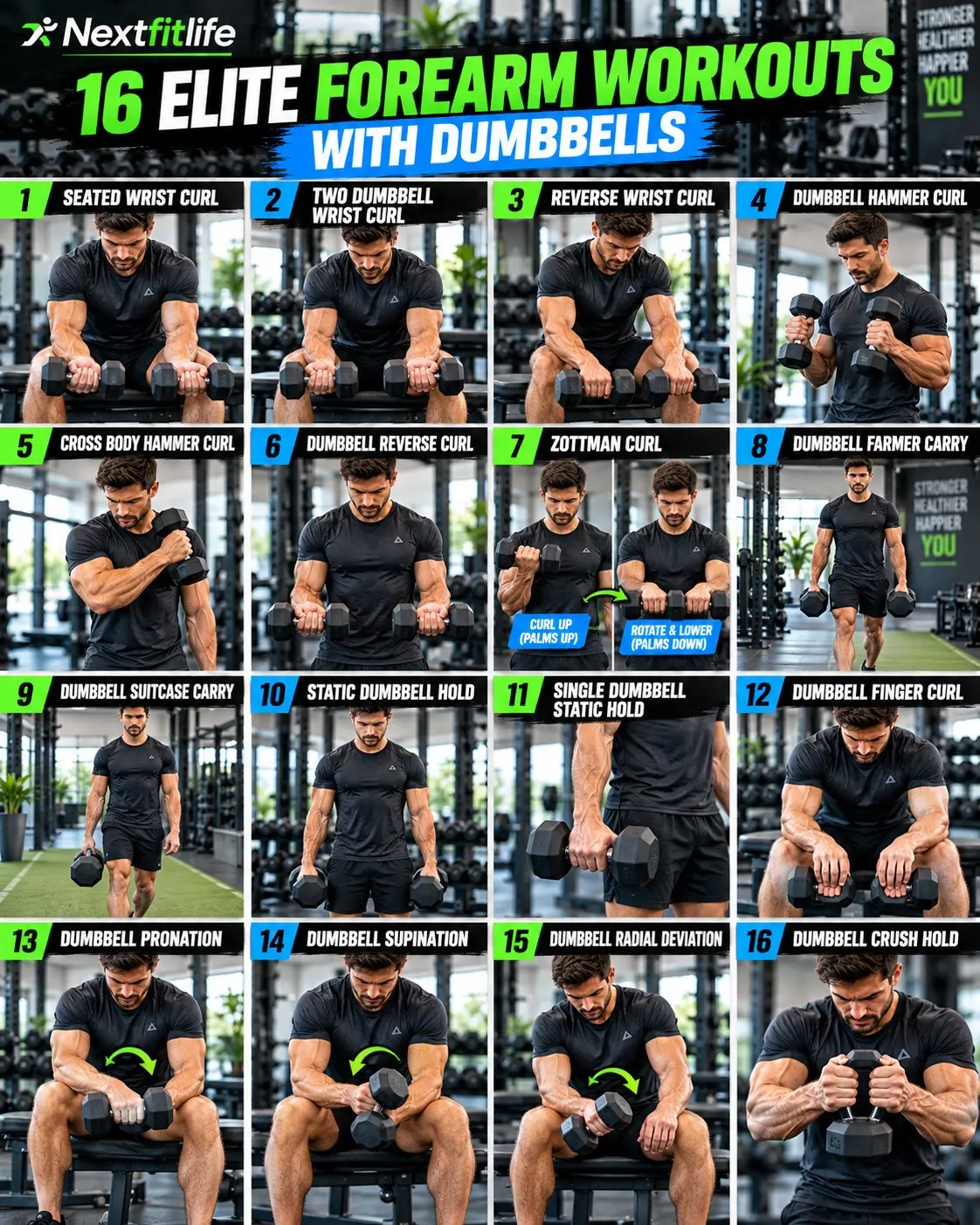
1. Seated Dumbbell Wrist Curl
This classic move trains the wrist flexors.
- Sit on a bench or chair.
- Hold a dumbbell with your palm facing up.
- Rest your forearm on your thigh or a bench.
- Let your hand move below the edge.
- Curl the dumbbell upward using only your wrist.
- Lower it slowly.
Start with: 2 to 3 sets of 10 to 15 reps per side.
Keep your forearm still. The movement should come from your wrist.
2. Two Dumbbell Wrist Curl
This version trains both arms together and can save time.
- Sit with one dumbbell in each hand.
- Rest both forearms on your thighs.
- Face your palms upward.
- Lower your hands slowly.
- Curl both wrists upward.
- Pause briefly before lowering.
Start with: 2 to 3 sets of 12 to 15 reps.
3. Reverse Dumbbell Wrist Curl
This movement shifts the focus toward the wrist extensors.
- Sit and support your forearm.
- Hold a light dumbbell with your palm facing down.
- Lower your hand slightly.
- Lift the back of your hand upward.
- Pause for a moment.
- Lower under control.
Start with: 2 to 3 sets of 12 to 20 reps.
This exercise often needs less weight than a palms up wrist curl.
4. Dumbbell Hammer Curl
The hammer curl is an excellent upper forearm exercise because the neutral grip places useful work on the brachioradialis.
- Stand with one dumbbell in each hand.
- Face your palms toward your body.
- Keep your elbows near your ribs.
- Curl the dumbbells upward.
- Pause near the top.
- Lower slowly.
Start with: 3 sets of 8 to 12 reps.
For more curl options, see our Bicep Workouts With Dumbbells guide.
5. Cross Body Hammer Curl
This variation keeps the neutral grip but changes the path of the dumbbell.
- Stand tall with a dumbbell in each hand.
- Keep your palms facing inward.
- Curl one dumbbell toward the opposite side of your chest.
- Keep your shoulder relaxed.
- Lower slowly.
- Switch sides.
Start with: 2 to 3 sets of 8 to 12 reps per side.
6. Dumbbell Reverse Curl
The reverse curl uses a palms down grip and places more demand on the upper forearm than a standard curl.
- Hold one dumbbell in each hand.
- Face your palms behind you or slightly downward.
- Keep your wrists firm.
- Curl the dumbbells toward your shoulders.
- Keep your elbows close to your body.
- Lower slowly.
Start with: 2 to 3 sets of 8 to 12 reps.
7. Zottman Curl
The Zottman curl combines a standard curl with a palms down lowering phase.
- Start with your palms facing forward.
- Curl the dumbbells toward your shoulders.
- Turn your palms downward at the top.
- Lower the dumbbells slowly.
- Turn back to the starting grip.
Start with: 2 to 3 sets of 8 to 12 reps.
Use less weight than you would use for a normal curl. The slow lowering phase is the important part.
8. Dumbbell Farmer Carry
Farmer carries build support grip and grip endurance while also challenging your posture and trunk.
- Hold one heavy dumbbell in each hand.
- Stand tall.
- Keep your shoulders level.
- Squeeze the handles firmly.
- Walk with short, controlled steps.
- Set the weights down before your grip opens.
Start with: 2 to 4 sets of 20 to 40 seconds.
9. Dumbbell Suitcase Carry
The suitcase carry uses one dumbbell and makes your body resist leaning to one side.
- Hold one dumbbell beside your body.
- Stand tall.
- Keep both shoulders level.
- Walk slowly.
- Do not lean away from the weight.
- Switch hands after the set.
Start with: 2 to 3 sets of 20 to 40 seconds per side.
10. Static Dumbbell Hold
This simple movement trains grip strength without walking.
- Choose two heavy dumbbells.
- Stand tall with one in each hand.
- Hold them beside your thighs.
- Squeeze the handles firmly.
- Keep breathing normally.
- Set the dumbbells down before your grip fails completely.
Start with: 3 holds of 15 to 30 seconds.
11. Single Dumbbell Static Hold
This version lets you work one hand at a time and compare sides.
- Hold a heavy dumbbell in one hand.
- Stand upright.
- Keep your wrist neutral.
- Squeeze the handle.
- Hold for time.
- Switch hands.
Start with: 2 to 3 holds of 15 to 30 seconds per side.
12. Dumbbell Finger Curl
Finger curls train the muscles involved in closing your fingers around a handle.
- Sit and support your forearm.
- Hold a light dumbbell with your palm upward.
- Let the dumbbell roll slowly toward your fingers.
- Close your fingers to pull it back into your hand.
- Keep the movement controlled.
Start with: 2 sets of 10 to 15 reps.
Do not let the dumbbell roll out of your hand.
13. Dumbbell Pronation
Pronation turns your palm downward. This small movement needs a light dumbbell and slow control.
- Sit with your elbow bent about 90 degrees.
- Hold one end of a very light dumbbell.
- Support your forearm.
- Rotate your palm slowly downward.
- Return to the starting position.
Start with: 2 sets of 10 to 15 reps per side.
Harvard Health includes controlled forearm rotation as a simple way to work the muscles that turn the forearm.
14. Dumbbell Supination
Supination turns your palm upward. It works the opposite direction of pronation.
- Sit with your elbow close to your body.
- Hold a light dumbbell securely.
- Start with your palm facing inward.
- Rotate the palm upward slowly.
- Return with control.
Start with: 2 sets of 10 to 15 reps per side.
Use a very light load. Rotation exercises are about control, not heavy weight.
15. Dumbbell Radial Deviation
This small wrist movement brings the thumb side of the hand toward the forearm.
- Stand or sit with your arm beside your body.
- Hold a light dumbbell in a neutral grip.
- Keep the forearm still.
- Lift the thumb side of your hand gently upward.
- Lower slowly.
Start with: 2 sets of 10 to 15 reps.
Keep the range small and comfortable.
16. Dumbbell Crush Hold
This exercise uses both hands to squeeze one dumbbell and creates a strong isometric grip challenge.
- Stand or sit tall.
- Hold one dumbbell vertically with both hands around one end.
- Press your palms and fingers firmly against the dumbbell.
- Keep your wrists straight.
- Hold the squeeze without holding your breath.
Start with: 2 to 3 holds of 15 to 30 seconds.
Make sure the dumbbell is secure. Do not use a grip position that could let the weight slip.
Forearm Dumbbell Exercise Comparison
| Exercise | Main Focus | Starting Range | Level |
|---|---|---|---|
| Seated wrist curl | Wrist flexors | 10 to 15 reps | Beginner |
| Reverse wrist curl | Wrist extensors | 12 to 20 reps | Beginner |
| Hammer curl | Brachioradialis | 8 to 12 reps | Beginner |
| Cross body hammer curl | Upper forearm | 8 to 12 reps | Beginner |
| Reverse curl | Brachioradialis | 8 to 12 reps | Intermediate |
| Zottman curl | Forearm and biceps | 8 to 12 reps | Intermediate |
| Farmer carry | Support grip | 20 to 40 sec | Beginner |
| Suitcase carry | Grip and trunk control | 20 to 40 sec | Beginner |
| Static hold | Grip endurance | 15 to 30 sec | Beginner |
| Finger curl | Finger flexion | 10 to 15 reps | Intermediate |
| Pronation | Forearm rotation | 10 to 15 reps | Intermediate |
| Supination | Forearm rotation | 10 to 15 reps | Intermediate |
| Radial deviation | Wrist control | 10 to 15 reps | Intermediate |
| Crush hold | Grip squeeze | 15 to 30 sec | Intermediate |
Beginner Forearm Workout With Dumbbells
If you are new to direct forearm work, do not use all 16 exercises. Start with four movements.
| Exercise | Sets | Reps or Time | Rest |
|---|---|---|---|
| Hammer curl | 2 | 10 reps | 60 sec |
| Wrist curl | 2 | 12 reps | 60 sec |
| Reverse wrist curl | 2 | 15 reps | 60 sec |
| Farmer carry | 2 | 20 to 30 sec | 60 to 90 sec |
Train this routine two times each week. Increase the challenge slowly when the sets become easy.
If you are new to resistance exercise, also read our Fitness for Beginners Hub.
Dumbbell Workout for Stronger Grip
If your main goal is grip strength, use exercises that make you hold the dumbbells for time.
- Farmer carry: 3 sets of 30 to 40 seconds.
- Suitcase carry: 3 sets of 30 seconds per side.
- Static dumbbell hold: 3 sets of 20 to 30 seconds.
- Hammer curl: 3 sets of 8 to 12 reps.
- Reverse wrist curl: 2 sets of 15 reps.
Do not take every hold to complete grip failure. Leave enough control to set the dumbbells down safely.
Dumbbell Workout for Bigger Forearms
If your goal is muscle growth, combine upper forearm curls with direct wrist work.
- Reverse curl: 3 sets of 8 to 12 reps.
- Zottman curl: 3 sets of 8 to 12 reps.
- Wrist curl: 3 sets of 10 to 15 reps.
- Reverse wrist curl: 3 sets of 12 to 20 reps.
- Farmer carry: 2 sets of 30 seconds.
Current ACSM resistance training guidance emphasizes that muscle growth is strongly influenced by enough weekly training volume and consistent resistance work. Advanced techniques are optional for most people.
Forearm Workout at Home With Dumbbells
One of the biggest advantages of forearm workouts with dumbbells is that they need very little space.
Try this home session:
- Hammer curl, 3 sets of 10 reps.
- Seated wrist curl, 2 sets of 15 reps.
- Reverse wrist curl, 2 sets of 15 reps.
- Suitcase carry, 2 sets of 30 seconds per side.
- Static hold, 2 sets of 20 seconds.
You can do the wrist exercises from a strong chair and use a short clear path for carries.
For more home training ideas, visit our Home Workouts and Equipment Hub.
How to Progress Your Forearm Workouts
Progress does not mean adding weight every workout.
You can use progressive overload in several simple ways:
- Add one or two reps.
- Hold a carry for five seconds longer.
- Increase the dumbbell weight slightly.
- Add one extra set.
- Use slower lowering.
- Improve your range of motion.
- Use better control with the same weight.
Change only one or two things at a time. This makes progress easier to measure and helps your wrists and elbows adapt.
Should You Train Forearms Before or After Back Work?
Usually, do direct forearm exercises after your important pulling exercises.
If you fatigue your grip before rows, pull ups, or deadlifts, your hands may give out before your back muscles get enough work.
A simple order is:
- Main compound exercise.
- Back or biceps work.
- Direct forearm exercise.
- Grip finisher.
There are exceptions. If grip is your highest priority, you may sometimes train it earlier. Just remember that it can reduce performance on later exercises.
Common Forearm Training Mistakes
Using Too Much Weight
A heavy dumbbell is not useful if your wrist moves without control. Start light on wrist curls and rotation exercises.
Training Only Wrist Flexion
Many people perform palms up wrist curls and stop there. Add reverse wrist curls and rotation work for a broader routine.
Swinging Hammer and Reverse Curls
Momentum makes the movement easier but reduces control. Keep your torso quiet and let your arms do the work.
Holding Your Breath
Breathe normally during carries and static holds. A hard grip does not require you to stop breathing.
Training to Failure Every Day
Your hands and forearms need recovery too. More fatigue does not always mean better results.
Ignoring Pain
A working muscle may feel tired or warm. Sharp wrist, elbow, or hand pain is different. Stop the exercise if pain appears.
Wrist and Elbow Safety
Good wrist stability starts with control. Keep the weight manageable and stay inside a comfortable range.
Stop training and seek professional advice if you develop:
- Sharp wrist pain.
- Persistent elbow pain.
- New numbness or tingling.
- Sudden loss of hand strength.
- Swelling that keeps increasing.
- Pain after a recent injury.
- Symptoms that do not improve when you reduce training.
Seek urgent care after a serious injury if there is major swelling, obvious deformity, severe pain, loss of circulation, or sudden major weakness.
Do Forearm Workouts Prevent Injury?
Stronger muscles can support better control, but no exercise can promise to prevent every injury.
Risk depends on many things, including technique, load, fatigue, sport demands, past injury, recovery, and health history.
It is better to say that forearm training may improve strength and control than to promise that it will stop injuries.
How Long Does It Take to Build Stronger Forearms?
There is no exact timeline. Beginners may notice better grip control before they notice a visible change in forearm size.
Track useful numbers such as:
- Farmer carry weight.
- Carry time.
- Static hold time.
- Hammer curl weight and reps.
- Wrist curl weight and reps.
Compare several weeks of training, not one workout.
Do You Need Wrist Straps?
Straps can be useful when your goal is training a larger muscle group and your hands fail first.
For example, if your grip limits a heavy row, straps may help you continue training your back. You can then train grip separately with carries or static dumbbell holds.
You do not have to avoid straps to build strong forearms. Use them when they support the goal of the main exercise.
How Forearm Training Fits Into a Full Program
Your forearms are one part of your strength program. A complete routine should also train your legs, hips, back, chest, shoulders, arms, and core.
The CDC recommends muscle strengthening work for all major muscle groups on at least two days each week for adults, along with regular aerobic activity.
You can explore more complete programs through our Fitness Hub.
Internal Links and Hub
Continue your training with these related NextFitLife guides:
- NextFitLife Fitness Hub for strength, cardio, recovery, and fitness guidance.
- Strength Training Hub for resistance training, form, and progression.
- Best Forearm Workouts for dumbbell, body weight, grip, and gym exercises.
- Forearm Exercises for more grip and wrist training options.
- Arm Workouts With Weights for biceps, triceps, and forearm training.
- Arm Workouts for complete arm strength ideas.
- Bicep Workouts With Dumbbells for more dumbbell curl variations.
- Upper Body Workout for arms, shoulders, chest, and back.
- Home Workouts and Equipment Hub for practical home training.
- Recovery and Injury Prevention Hub for training recovery and safer exercise guidance.
Conclusion
The best forearm workouts with dumbbells train more than one movement. Wrist curls work the flexors, reverse curls and hammer curls target the upper forearm, carries build grip endurance, and controlled rotation exercises train movements that normal curls often miss.
You do not need all 16 exercises at once. Pick four or five that match your goal, use good form, and make small improvements over time.
Your next step: choose the beginner, grip, muscle building, or home routine above. Record your starting weights and reps today, then compare your progress after several weeks of consistent training.
About the Author
Adel Galal is a father of four (three sons and a daughter) and a grandfather of four, with 33 years of hands-on parenting experience. He is the founder of Parnthub.com, based in Cairo, Egypt, where he shares practical guidance on feeding, development and family life from newborns to teenagers. Adel is not a medical professional; health articles cite trusted sources and are for general information only.
Learn more on the NextFitLife About Us page.
Frequently Asked Questions
What are the best forearm workouts with dumbbells?
The best forearm workouts with dumbbells include wrist curls, reverse wrist curls, hammer curls, reverse curls, Zottman curls, farmer carries, suitcase carries, static holds, and controlled forearm rotation exercises.
How often should I train forearms with dumbbells?
Two direct forearm sessions each week are a practical starting point. Some people may use three shorter sessions if recovery is good and the wrists and elbows stay comfortable.
Can I do forearm workouts with dumbbells every day?
Hard forearm training every day is usually not needed. Your forearms also work during rows, curls, pull ups, deadlifts, and carries, so they need time to recover.
What dumbbell weight should I use for forearm exercises?
Use a weight you can control through the full movement. Wrist curls and rotations often need light dumbbells, while carries and static holds can usually use heavier weights.
Do dumbbell wrist curls make your grip stronger?
Wrist curls strengthen part of the forearm, but grip also depends on the fingers, thumb, wrist stabilizers, and other forearm muscles. Combine wrist curls with carries, holds, and other grip exercises.
Are hammer curls good for forearms?
Yes. Hammer curls use a neutral grip and place useful work on the brachioradialis, which is a large muscle on the upper forearm.
Can I build forearms with only dumbbells?
Yes. Dumbbells can train wrist flexion, wrist extension, forearm rotation, elbow flexion, static grip, and loaded carries. Other equipment can add variety, but it is not required.
Should I train forearms before or after back workouts?
Most people should train forearms after important back exercises so tired hands do not limit rows, pull ups, or deadlifts. Grip focused athletes may sometimes train them earlier.
References and Sources
- American College of Sports Medicine. ACSM Publishes Updated Resistance Training Guidelines.
https://acsm.org/resistance-training-guidelines-update-2026/ - Harvard Health Publishing. Forearm workouts: Strengthening grip for everyday function.
https://www.health.harvard.edu/healthy-aging-and-longevity/forearm-workouts-strengthening-grip-for-everyday-function - Centers for Disease Control and Prevention. Adult Activity: An Overview.
https://www.cdc.gov/physical-activity-basics/guidelines/adults.html - MedlinePlus. Exercise and Physical Fitness.
https://medlineplus.gov/exerciseandphysicalfitness.html - American Heart Association. American Heart Association Recommendations for Physical Activity in Adults.
https://www.heart.org/en/healthy-living/fitness/fitness-basics/aha-recs-for-physical-activity-in-adults

Health & wellness writer with 30+ years of experience in nutrition, fitness, and healthy aging. Founder of NextFitLife.com — evidence-based health guidance.

