
Published on: January 14, 2024
Updated on: October 24, 2026
Best Forearm Exercises should train more than wrist curls. Your forearms help bend and extend the wrist, rotate the forearm, move the hand side to side, flex the fingers, hold weights, and support elbow flexion.
A balanced forearm workout can include wrist curls, reverse wrist curls, hammer curls, reverse curls, pronation, supination, farmer carries, and pinch holds. You do not need all of them in one session.
This updated guide gives you 18 useful exercises, a 10 minute workout, a beginner plan, grip training options, and a clearer way to build stronger forearms without chasing pain or endless repetitions.
This article is for general information and education. It does not replace medical advice, diagnosis, or treatment.
For broader upper body training, visit the NextFitLife Fitness Hub, Arm Workouts, and Bicep Workouts with Dumbbells.
Table of Contents
- Best Forearm Exercises: Quick Answer
- Forearm Muscles Explained
- What Grip Strength Really Means
- 18 Best Forearm Exercises
- Wrist flexion
- Wrist extension
- Rotation
- Brachioradialis
- Grip and carries
- Best Exercises by Goal
- Beginner Forearm Workout
- 10 Minute Forearm Workout
- How Often to Train
- Sets, Reps, and Weight
- Grip Types Explained
- Do Forearm Exercises Prevent Injury?
- Common Mistakes
- Frequently Asked Questions
- References and Sources
Best Forearm Exercises: Quick Answer
A simple Best Forearm Exercises routine can use five movements:
- Wrist curl
- Reverse wrist curl
- Hammer curl
- Farmer carry
- Plate pinch or dumbbell pinch hold
This covers wrist flexion, wrist extension, brachioradialis work, sustained grip, and thumb plus finger strength.
If you have more time, add pronation and supination work so the forearm also trains rotation.
What Muscles Do the Best Forearm Exercises Train?
Your forearm contains many muscles rather than one simple muscle group.
Wrist Flexors
The wrist flexors sit mainly on the palm side of the forearm. They bend the wrist and also help your fingers grip objects.
Wrist Extensors
The wrist extensors sit mainly on the back side of the forearm. They extend and stabilize the wrist.
Brachioradialis
The brachioradialis crosses the elbow and contributes strongly to elbow flexion, especially with a neutral grip.
Pronators and Supinators
These muscles rotate your forearm so the palm turns downward or upward.
Finger and Thumb Muscles
Your fingers and thumb create several kinds of grip. Pinching a plate is different from squeezing a handle, and carrying a heavy dumbbell challenges grip differently again.
What Does Current Research Say About Forearm Training?
The research base for direct forearm muscle growth is smaller than the evidence for larger muscles such as the quads, chest, or biceps.
That does not mean forearm training is guesswork.
Resistance training studies show that wrist and grip strength can improve when the forearm and hand muscles are progressively loaded.
A 2025 systematic review and meta-analysis also found that hand-focused strength and proprioceptive training can improve grip strength and manual dexterity in healthy adults.
The practical message is simple: train the functions you want to improve, add resistance over time, and do not rely on one exercise for the entire forearm.
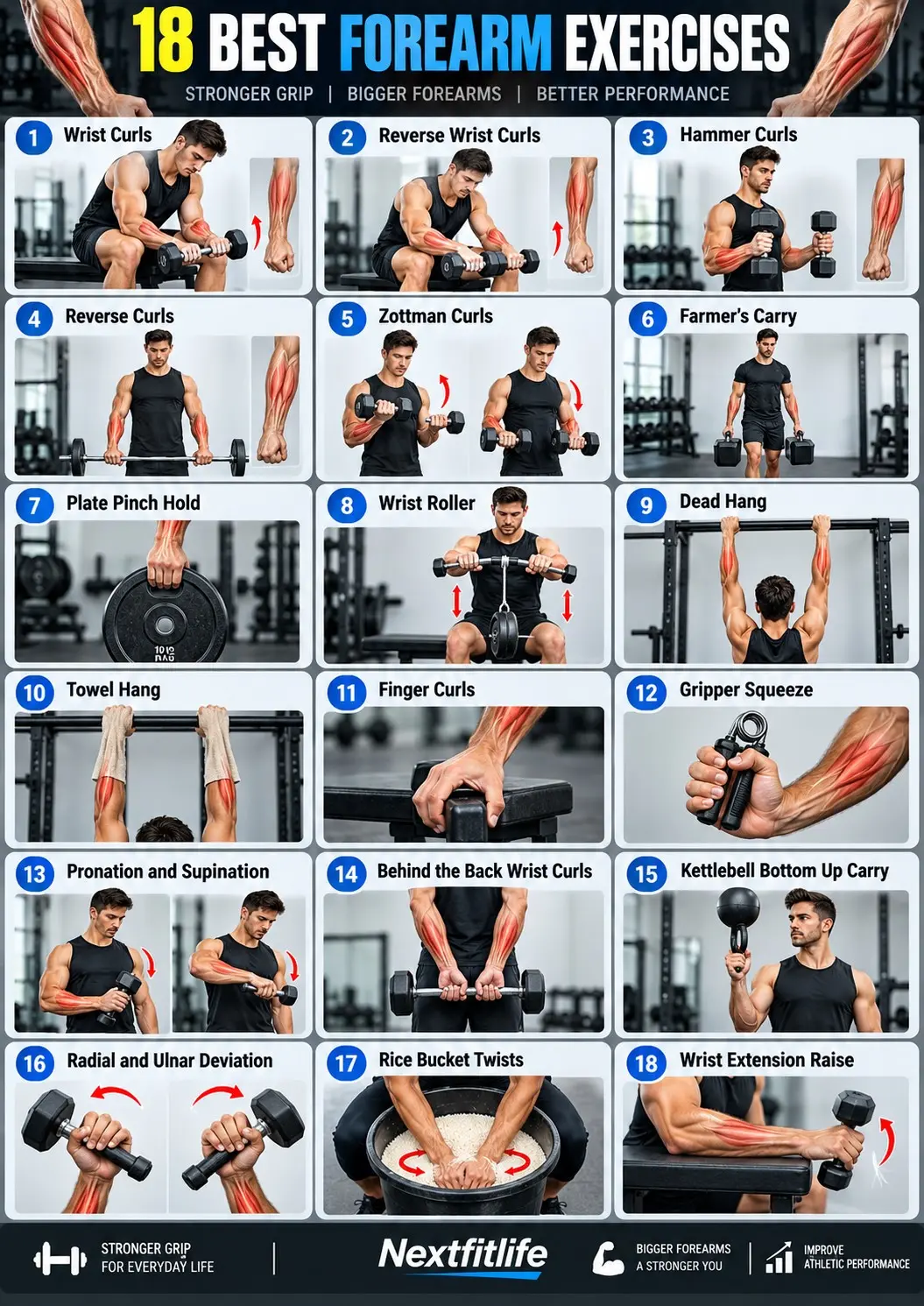
1. Dumbbell Wrist Curl
The wrist curl directly trains the wrist flexors.
- Sit and rest your forearms on your thighs or a bench.
- Turn your palms upward.
- Hold light dumbbells.
- Bend the wrists upward.
- Lower under control.
Keep the forearms supported so the movement comes mainly from the wrist.
Use a comfortable range rather than forcing the wrist into a deep stretch.
2. Reverse Wrist Curl
This trains the wrist extensors.
- Support your forearms.
- Turn your palms downward.
- Lift the backs of your hands upward.
- Lower slowly.
You will normally need much less weight than during normal wrist curls.
3. Hammer Curl
Hold the dumbbells with your palms facing each other.
The hammer curl trains elbow flexion while placing strong demand on the brachialis and brachioradialis.
This makes it useful for both the upper arm and outer forearm.
4. Reverse Dumbbell Curl
This exercise was described incorrectly in the old article.
A reverse curl uses an overhand grip with your palms facing downward.
- Stand tall with light dumbbells.
- Keep your palms facing the floor.
- Curl the weights upward.
- Keep your wrists controlled.
- Lower slowly.
This places more demand on the brachioradialis and forearm than a normal palms-up curl.
5. Zottman Curl
Curl upward with your palms facing you.
At the top, rotate your hands so the palms face downward, then lower the dumbbells slowly.
This combines biceps work during the lifting phase with greater forearm demand during the lowering phase.
6. Dumbbell Pronation
Pronation means turning the forearm so your palm faces downward.
Hold one end of a light dumbbell or small adjustable handle so the weight creates leverage.
Rotate slowly into pronation, then return.
Use very light resistance because rotational torque can rise quickly when the load sits far from your hand.
7. Dumbbell Supination
Supination turns the palm upward.
Use the same light lever setup as pronation.
Rotate slowly and keep your elbow bent near your side.
This trains a movement that standard wrist curls miss.
8. Radial Deviation
Radial deviation moves your hand toward the thumb side.
Hold a very light dumbbell or hammer-style handle vertically and move the wrist through a small controlled range.
This is a small movement. Heavy weight is unnecessary.
9. Ulnar Deviation
Ulnar deviation moves the hand toward the little finger side.
Use light resistance and keep your forearm still.
This movement helps complete wrist training beyond simple flexion and extension.
10. Farmer Carry
The farmer carry trains sustained grip while your shoulders and trunk stabilize the load.
- Hold a dumbbell or kettlebell in each hand.
- Stand tall.
- Grip firmly.
- Walk under control.
- Stop before your fingers begin slipping.
This is one of the simplest ways to train support grip.
11. Suitcase Carry
Hold one weight at your side and walk without leaning.
Your grip and forearm work to hold the weight while your trunk resists the uneven load.
Switch hands for the same distance or time.
12. Plate Pinch
Hold one or more plates between your fingers and thumb without wrapping your fingers around a handle.
This trains pinch grip.
If plates are not safe or practical, pinch a light hex dumbbell head with your fingers and thumb.
13. Dumbbell Head Pinch Hold
Stand a hex dumbbell upright and grip the head using your fingertips and thumb.
Lift it only slightly from a safe surface and hold.
Start very light. A dropped dumbbell can injure your foot.
14. Towel Hold
Wrap a towel around a secure dumbbell handle, cable attachment, or stable object and grip the towel.
The thicker grip makes the fingers and forearms work harder.
A static towel hold is a safer starting option than jumping immediately into towel pull ups.
15. Dead Hang
Hang from a secure pull up bar with your hands around the bar.
This challenges grip endurance and shoulder tolerance.
Start with short holds.
If hanging causes shoulder pain, skip this exercise.
16. Finger Curl
Hold a light dumbbell with your palm facing upward.
Let the handle roll gently toward the fingers, then close the fingers and return it into your palm.
Use light loads and move slowly.
17. Hand Gripper Squeeze
A hand gripper trains crush grip.
Squeeze the handles together, pause briefly, then release under control.
Choose a resistance you can close without twisting the wrist or shoulder.
18. Rice Bucket Hand Training
A rice bucket can provide light resistance for the fingers and wrist in several directions.
You can:
- Open and close your fingers
- Turn the forearm
- Flex the wrist
- Extend the wrist
- Move the hand side to side
This works well as light accessory training, but it is not a replacement for progressively loaded resistance exercises.
Best Forearm Exercises by Goal
| Goal | Good Choice | Main Focus |
|---|---|---|
| Wrist flexion | Wrist curl | Wrist flexors |
| Wrist extension | Reverse wrist curl | Wrist extensors |
| Outer forearm | Hammer curl | Brachioradialis |
| Support grip | Farmer carry | Sustained holding strength |
| Pinch grip | Plate pinch | Thumb and fingers |
| Crush grip | Hand gripper | Finger flexors |
| Rotation | Pronation and supination | Forearm rotation control |
Beginner Best Forearm Exercises Workout
Beginners do not need 18 exercises in one session.
| Exercise | Sets | Target |
|---|---|---|
| Wrist curl | 2 | 10 to 15 reps |
| Reverse wrist curl | 2 | 10 to 15 reps |
| Hammer curl | 2 | 8 to 12 reps |
| Farmer carry | 2 | 20 to 40 seconds |
| Plate pinch | 2 | 10 to 30 seconds |
10 Minute Best Forearm Exercises Workout
| Time | Exercise |
|---|---|
| Minute 1 | Easy wrist and hand warm-up |
| Minutes 2 and 3 | Wrist curls |
| Minutes 4 and 5 | Reverse wrist curls |
| Minutes 6 and 7 | Hammer or reverse curls |
| Minute 8 | Farmer carry |
| Minute 9 | Plate pinch |
| Minute 10 | Easy hand opening and wrist movement |
The clock is only a guide. Rest whenever your grip or wrist control starts to fade.
How Often Should You Train Your Forearms?
One or two direct forearm sessions each week are enough for many beginners.
Your forearms already work during:
- Rows
- Pull ups
- Deadlifts
- Dumbbell curls
- Farmer carries
- Kettlebell exercises
People who do a lot of pulling or climbing may need less extra forearm work than someone whose main program uses machines and straps.
How Many Reps Should the Best Forearm Exercises Use?
There is no magic forearm rep range.
Small wrist movements often feel more comfortable with moderate or higher repetitions because the loads are relatively light.
Hammer curls and reverse curls can use the same general rep ranges as other resistance exercises.
Carries and pinch exercises work better with time rather than a repetition count.
A practical starting point is:
- Wrist curls: 10 to 20 reps
- Reverse wrist curls: 10 to 20 reps
- Hammer curls: 8 to 15 reps
- Reverse curls: 8 to 15 reps
- Carries: 20 to 60 seconds
- Pinch holds: 10 to 30 seconds
These are starting ranges, not biological rules.
How Heavy Should Forearm Exercises Be?
Start lighter than you think for wrist rotation and small wrist movements.
The wrist has a shorter range and smaller muscles than your hips or legs, so there is no reason to copy the weight you use for curls.
Increase resistance only when you can complete the movement without:
- Jerking
- Twisting the elbow
- Dropping the wrist suddenly
- Feeling sharp joint pain
- Losing grip unexpectedly
How to Progress Forearm Training
Use progressive overload just as you would for other muscles.
You can:
- Add one or two repetitions
- Use a slightly heavier dumbbell
- Hold a carry longer
- Walk farther
- Use a thicker handle
- Increase pinch hold time
- Add one extra set when recovery is good
Change one thing at a time.
What Is the Difference Between Grip Types?
Support Grip
This is your ability to hold an object for time.
Farmer carries, dead hangs, and heavy dumbbell holds train it well.
Crush Grip
This is the force you create when closing your hand around an object.
Hand grippers are a direct example.
Pinch Grip
This uses the thumb against the fingers.
Plate pinches and dumbbell head pinches train it.
Open Hand Grip
Thick handles, towels, and large objects force the fingers to work from a more open position.
You do not need every grip style in every session.
Do Best Forearm Exercises Improve Your Deadlift?
They can help if grip is what limits your deadlift.
Farmer carries, holds, and other support grip exercises can improve your ability to keep hold of a heavy object.
But stronger forearms cannot fix every deadlift problem.
Leg strength, hip strength, technique, trunk strength, and programming still matter.
Do Best Forearm Exercises Help Pull-Ups?
Grip endurance matters during pull ups, especially when the hands fatigue before the back or arms.
Dead hangs, carries, towel holds, hammer curls, and pulling exercises can all contribute.
If you already perform plenty of pull ups and rows, you may not need much extra grip volume.
Do Best Forearm Exercises Prevent Tennis Elbow?
Do not make that promise.
Progressive wrist and forearm strengthening can be part of rehabilitation or conditioning, but pain around the elbow has many possible causes.
Training does not guarantee that tennis elbow or golfer's elbow will never occur.
If you already have persistent elbow pain, use an appropriate rehabilitation plan rather than assuming more wrist curls will solve it.
Can Forearm Exercises Make Your Wrists Bigger?
Your wrist joint itself will not become dramatically wider from exercise.
Muscle growth happens mainly farther up the forearm where there is more muscle tissue.
Stronger forearms can make the lower arm look more developed, but bone structure and tendon size strongly influence wrist appearance.
Can Best Forearm Exercises Reduce Arm Fat?
No forearm exercise can choose where your body removes fat.
Resistance training can build muscle in your forearms and arms, which can change their shape.
Fat loss depends on overall nutrition, energy balance, physical activity, genetics, and time.
For realistic fat loss guidance, visit Weight Loss Immediately.
10 Best Forearm Exercises Mistakes
1. Training Only Wrist Flexion
Add extension, rotation, and grip work for a more complete program.
2. Using Too Much Weight
Small wrist movements rarely need large dumbbells.
3. Letting the Wrist Collapse
Control both directions of each repetition.
4. Confusing Reverse Curls With Normal Curls
A reverse curl uses a palms down grip.
5. Ignoring Rotation
Pronation and supination train functions that wrist curls miss.
6. Doing Too Much Grip Work
Your grip also works during rows, deadlifts, curls, and carries.
7. Using Straps for Every Pull
Straps can be useful, but always removing grip demand means your hands never receive that training stimulus.
8. Chasing Pain
A burning muscle is different from sharp wrist or elbow pain.
9. Dropping Pinch Weights Near Your Feet
Use light weights, clear space, and safe positioning.
10. Assuming Bigger Forearms Mean Better Wrist Health
Muscle size and joint health are not the same thing.
When Should You Stop a Forearm Exercise?
Stop and seek appropriate medical assessment if you have:
- Sudden severe wrist or elbow pain
- A pop followed by weakness or swelling
- Persistent numbness or tingling
- Sudden loss of grip
- Visible deformity
- Major swelling
- Hand weakness that is getting worse
- Pain after a significant fall or impact
Conclusion: Best Forearm Exercises
The Best Forearm Exercises do more than make you squeeze a gripper or perform endless wrist curls.
Train wrist flexion, wrist extension, rotation, the brachioradialis, support grip, pinch grip, and finger strength. Keep the loads controlled and progress slowly because your wrists and elbows do not need reckless resistance to get stronger.
Your next step is simple: choose five exercises from this guide and complete one short forearm session this week.
References and Sources
- American College of Sports Medicine. Resistance Training Guidelines Update. 2026.
https://acsm.org/resistance-training-guidelines-update-2026/ - American College of Sports Medicine. Resistance Training Position Stand. 2026.
https://pmc.ncbi.nlm.nih.gov/articles/PMC12965823/ - Hand-Focused Strength and Proprioceptive Training for Improving Grip Strength and Manual Dexterity in Healthy Adults: Systematic Review and Meta-Analysis. 2025.
https://www.mdpi.com/2077-0383/14/19/6882 - Comparative Effects of Low Load Blood Flow Restriction Versus High Load Resistance Training on Wrist and Grip Strength and Forearm Hypertrophy. 2025.
https://www.jhwcr.com/index.php/jhwcr/article/view/2105 - Unilateral Strength Training Leads to Muscle Specific Sparing Effects During Opposite Homologous Limb Immobilization.
https://journals.physiology.org/doi/full/10.1152/japplphysiol.00971.2017 - Centers for Disease Control and Prevention. Physical Activity Guidelines for Adults.
https://www.cdc.gov/physical-activity-basics/guidelines/adults.html
Internal Links + Hub
- NextFitLife Fitness Hub for strength, cardio, home workouts, and mobility guidance.
- Strength Training and Muscle Building for progressive resistance and muscle growth guidance.
- Arm Workouts for biceps, triceps, forearms, and grip training.
- Arm Workouts with Weights for a broader weighted arm program.
- Bicep Workouts with Dumbbells for curls, hammer curls, and elbow flexor training.
- Rear Delt Exercises Dumbbell for posterior shoulder strength.
- Chest Exercises With Dumbbells for pressing strength.
- Dumbbell Workouts at Home for complete home resistance training.
- Kettlebell Workouts for Men for carries, grip, full body strength, and conditioning.
- Strength Training Exercises at Home for Beginners for simple beginner resistance training.
- Recovery and Injury Prevention for soreness, pain awareness, and training recovery.
- Healthy and Active Lifestyle for sustainable movement, food, sleep, and recovery habits.
About the Author
Adel Galal is a father of four, three sons and a daughter, and a grandfather of four, with 33 years of hands on parenting experience. He is the founder of Parnthub.com, based in Cairo, Egypt, where he shares practical guidance on feeding, development and family life from newborns to teenagers.
Adel is not a medical professional. Health articles cite trusted sources and are for general information only.
On NextFitLife, Adel researches and writes about strength training, home workouts, grip training, fitness, healthy aging, nutrition, and practical wellness habits with a focus on current evidence, safe progression, and realistic expectations.
Learn more about Adel and NextFitLife on the About Us page.
Best Forearm Exercises: Frequently Asked Questions
What are the Best Forearm Exercises?
The Best Forearm Exercises include wrist curls, reverse wrist curls, hammer curls, reverse curls, pronation, supination, farmer carries, pinch holds, and finger or gripper exercises.
How often should I train forearms?
One or two direct forearm sessions per week are enough for many beginners. Your forearms also work during rows, deadlifts, curls, pull ups, carries, and kettlebell training.
Do wrist curls build forearms?
Yes. Wrist curls directly load the wrist flexor muscles, but a complete forearm program should also include wrist extension, rotation, grip, and brachioradialis work.
Are reverse curls good for forearms?
Yes. Reverse curls use a palms-down grip and place strong demand on the brachioradialis and other forearm muscles while also training elbow flexion.
Are hammer curls good for forearms?
Yes. Hammer curls use a neutral grip and strongly involve the brachioradialis along with the biceps and brachialis.
What is the best exercise for grip strength?
There is no single best exercise because grip has several forms. Farmer carries train support grip, grippers train crush grip, and plate pinches train pinch grip.
Do farmer carries build forearms?
Yes. Farmer carries require sustained grip and can strengthen the fingers and forearms while also training the shoulders and trunk.
Can I train forearms every day?
Daily hard forearm training is not necessary for most people. Your grip already works during many upper body exercises, so direct sessions should account for that total workload.
How many reps should I use for forearm exercises?
Wrist exercises often work well with moderate or higher reps, while hammer and reverse curls can use standard resistance training rep ranges. Carries and pinch holds are easier to measure by time.
Do Best Forearm Exercises prevent tennis elbow?
No exercise guarantees injury prevention. Progressive wrist and forearm strengthening may improve capacity, but persistent elbow pain should be assessed and managed according to its cause.
Can forearm exercises make wrists thicker?
They can increase muscle farther up the forearm, but the wrist itself contains relatively little muscle. Bone structure and tendons strongly influence wrist size.
Do grip trainers make forearms bigger?
Grip trainers can strengthen the finger flexors and contribute to forearm development, but they do not train every forearm function. Add wrist extension and other movements for a more balanced program.
Can Best Forearm Exercises improve pull ups?
They may help when grip endurance is the limiting factor. Dead hangs, farmer carries, rows, and grip work can improve your ability to stay attached to the bar.
When should I stop a forearm exercise?
Stop for sharp pain, sudden weakness, major swelling, a pop followed by pain, persistent numbness or tingling, visible deformity, or a sudden loss of grip strength.

Health & wellness writer with 30+ years of experience in nutrition, fitness, and healthy aging. Founder of NextFitLife.com — evidence-based health guidance.

