Published: August 29, 2026
Last Updated: August 29, 2026
Next Review: August 2027, or sooner if major blood pressure guidance changes
Written and Source Checked by: Adel Galal, Founder of NextFitLife
Review Status: Fully source checked using current American Heart Association guidance, CDC guidance, Cleveland Clinic clinical information, and open cardiovascular research
High diastolic blood pressure means the bottom number on your blood pressure reading is too high.
If your blood pressure keeps reading 118/85, 125/92, or 128/100, the top number may look reassuring.
The bottom number still matters.
Under current United States guidelines, a diastolic pressure from 80 to 89 mm Hg falls into Stage 1 hypertension. A diastolic pressure of 90 mm Hg or higher falls into Stage 2 hypertension.
One high reading does not diagnose hypertension.
You need repeated, accurate measurements.
Quick Answer: What Does High Diastolic Blood Pressure Mean?
High diastolic blood pressure means the pressure in your arteries between heartbeats is above the healthy range. A bottom number of 80 to 89 is Stage 1 hypertension under current United States guidance, while 90 or higher is Stage 2. Repeated readings, your systolic pressure, age, health history, and overall cardiovascular risk all affect what happens next.
Global reader note: This article uses the 2025 American Heart Association and American College of Cardiology blood pressure categories. Some countries use different thresholds for diagnosing hypertension. Always follow the guidance used by your healthcare system.
Medical note: This content is for general educational purposes and does not replace professional medical advice, diagnosis, or treatment. Consult an appropriately qualified healthcare professional for personal medical concerns. This article explains published guidance and does not provide a personal clinical assessment. Always consult qualified medical professionals for diagnosis and treatment of any health condition.
What Does the Bottom Blood Pressure Number Measure?
Blood pressure has two numbers.
Take 120/80.
The top number is the systolic blood pressure.
It shows the pressure in your arteries when your heart contracts.
The bottom number is the diastolic blood pressure.
It shows the pressure that remains in your arteries while your heart relaxes between beats.
Your arteries do not lose all pressure between heartbeats.
Blood still needs to move through your body.
That resting pressure is what the bottom number helps measure.
If you also want to understand the gap between the two numbers, read Pulse Pressure Meaning.
When Is Diastolic Blood Pressure Too High?
Current United States guidance uses these categories for nonpregnant adults.
| Category | Systolic Pressure | Diastolic Pressure |
|---|---|---|
| Normal | Below 120 | Below 80 |
| Elevated | 120 to 129 | Below 80 |
| Stage 1 hypertension | 130 to 139 | 80 to 89 |
| Stage 2 hypertension | 140 or higher | 90 or higher |
The word "or" matters.
A blood pressure of 118/86 still has a high diastolic number under United States guidance.
You do not need both numbers to be high.
What Is Isolated Diastolic Hypertension?
Isolated diastolic hypertension means the bottom number is high while the top number remains below the hypertension threshold.
Examples include:
- 118/82
- 124/88
- 126/94
The systolic pressure is below 130.
The diastolic pressure is 80 or higher.
Cleveland Clinic notes that this blood pressure pattern is seen most often in adults younger than 55.
That makes age an important part of the interpretation.
A Diastolic Pressure of 82 Is Not the Same as 102
This deserves a direct answer.
Both numbers are above the healthy range.
They do not carry the same meaning.
118/82
The bottom number falls into Stage 1 hypertension under current United States guidance.
That deserves confirmation and attention to cardiovascular health.
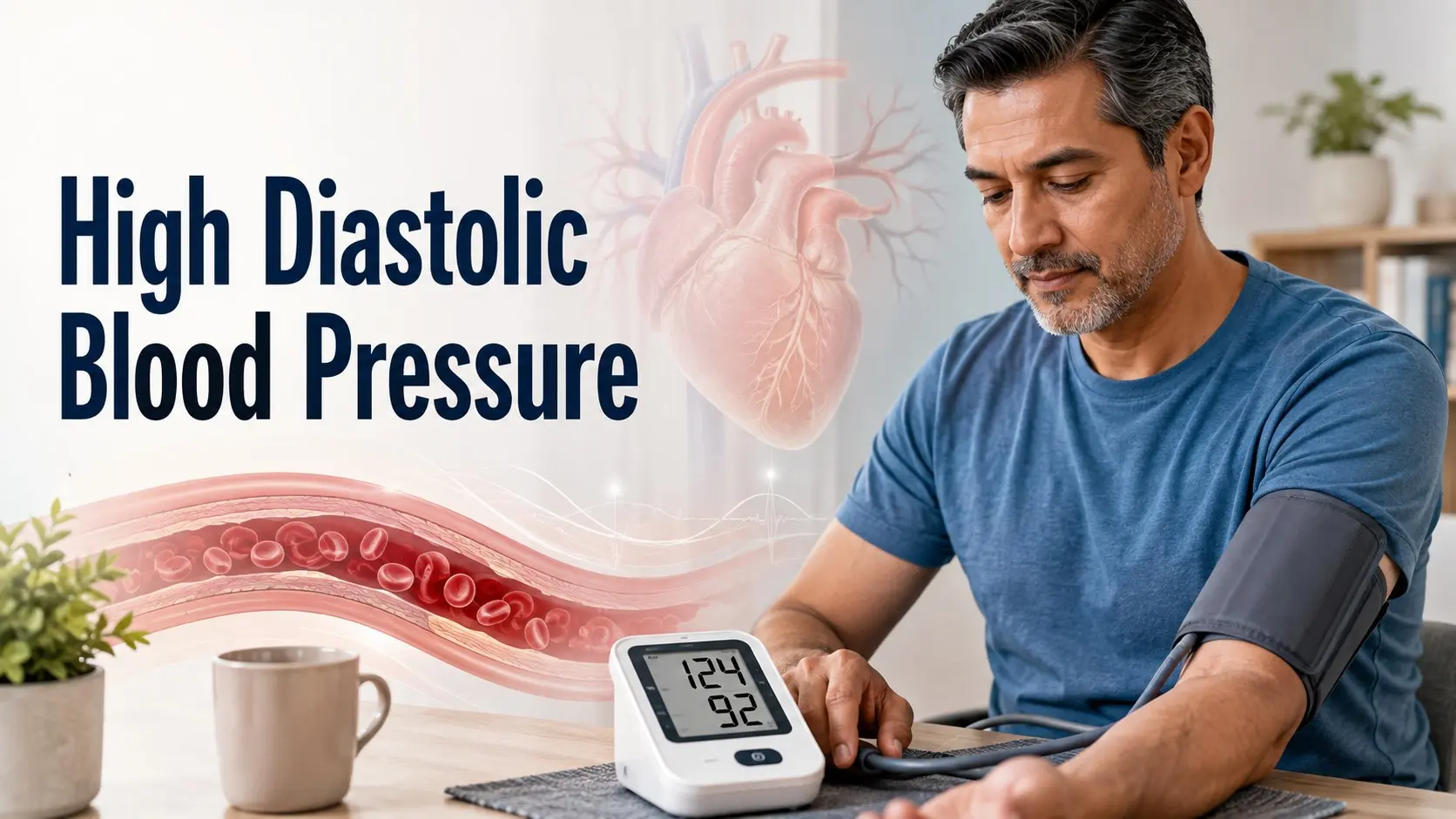
124/92
The bottom number falls into Stage 2 hypertension.
If readings like this continue, arrange medical assessment.
125/102
This is a much larger diastolic elevation.
Do not dismiss repeated readings above 100 simply because the systolic number looks normal.
Research also shows that the cardiovascular risk signal becomes clearer when higher diastolic thresholds are used.
This is one reason I would not put every reading above 80 into one risk bucket.
How Certain Is the Risk From Isolated Diastolic Hypertension?
Less certain than many articles suggest.
That is especially true when the diastolic number is only mildly elevated.
A 2024 systematic review found that isolated diastolic hypertension was associated with higher cardiovascular risk overall.
But the association was weaker when researchers used the newer American threshold of 80 mm Hg.
The risk signal was stronger when higher diastolic thresholds were used.
More recent trial data also support blood pressure lowering in people with isolated diastolic hypertension when treatment is clinically indicated.
The practical lesson is straightforward.
Do not panic over one reading of 82.
Do not ignore months of readings in the 80s either.
And take repeated readings in the 90s or above more seriously.
Why Is High Diastolic Blood Pressure More Common in Younger Adults?
Blood pressure patterns change with age.
In younger adults, increased resistance in the smaller arteries can contribute more to the bottom number.
Later in life, large arteries become stiffer.
Systolic pressure then becomes more likely to rise.
This is one reason isolated systolic hypertension is common in older adults while isolated diastolic hypertension is seen more often in younger adults.
For age related cardiovascular guidance, read Heart Health After 50.
What Causes High Diastolic Blood Pressure?
Usually there is no single cause.
Most hypertension is called primary hypertension.
It develops from a combination of genetics, lifestyle, vascular function, weight, sleep, diet, and other influences.
Factors linked with high blood pressure include:
- Excess body weight
- Sleep apnea
- Smoking
- High sodium intake
- Low physical activity
- Heavy alcohol use
- Family history
- Diabetes
- Kidney disease
Cleveland Clinic specifically highlights excess weight, sleep apnea, and smoking as major risk factors for isolated diastolic hypertension.
Can Weight Affect the Bottom Blood Pressure Number?
Yes.
Excess body weight is strongly linked with high blood pressure.
Your body may need to circulate blood through more tissue.
Kidneys, hormones, the nervous system, sodium balance, and blood vessel resistance can all be affected.
This does not mean every person with a larger body has hypertension.
It also does not mean a thin person cannot develop it.
Weight is one risk factor.
It is not the whole diagnosis.
Sleep Apnea Can Be an Overlooked Cause
I would pay attention to sleep when blood pressure stays high.
Obstructive sleep apnea repeatedly interrupts breathing during sleep.
Possible signs include:
- Loud snoring
- Breathing pauses
- Gasping during sleep
- Morning headaches
- Dry mouth on waking
- Severe daytime sleepiness
- Sleep that never feels refreshing
You may have sleep apnea without remembering waking up.
If you have repeated high blood pressure plus these symptoms, ask whether sleep apnea testing makes sense.
Read Sleep and Heart Health for a deeper explanation.
Does Salt Raise Diastolic Blood Pressure?
Too much dietary sodium can raise blood pressure.
Some people respond to sodium more strongly than others.
Most sodium does not come from the salt shaker.
It often comes from:
- Packaged foods
- Restaurant meals
- Processed meats
- Fast food
- Sauces
- Salty snacks
- Prepared meals
Current blood pressure guidance recommends reducing sodium as part of hypertension care.
You do not need flavorless food.
You need to know where most of your sodium is coming from.
Does Alcohol Affect Diastolic Blood Pressure?
Yes.
Drinking too much alcohol can raise blood pressure.
If your numbers are already high, alcohol is worth reviewing honestly.
Do not start drinking because you have heard that alcohol protects the heart.
Current American Heart Association guidance supports reducing or eliminating alcohol as part of blood pressure management.
Smoking Adds Risk Even Beyond the Blood Pressure Reading
Nicotine raises blood pressure temporarily.
Tobacco also damages the heart and blood vessels.
That creates a larger cardiovascular problem than one number on the monitor.
If you smoke and have high diastolic blood pressure, stopping tobacco is one of the most useful changes you can make for cardiovascular health.
Could Another Medical Condition Be Raising the Bottom Number?
Yes.
This is called secondary hypertension.
It means another condition or substance is contributing to high blood pressure.
Possible causes include:
- Chronic kidney disease
- Sleep apnea
- Thyroid problems
- Hormone disorders
- Problems affecting blood flow to the kidneys
- Certain medicines
Doctors are more likely to investigate secondary causes when hypertension appears unexpectedly, begins at a young age, becomes severe, or is difficult to control.
For kidney warning signs, read Kidney Disease Symptoms.
Can Medicines Raise Blood Pressure?
Yes.
Some medicines and substances can push blood pressure upward.
Examples can include:
- Some anti inflammatory pain medicines
- Some decongestants
- Some stimulants
- Some hormonal medicines
- Certain immunosuppressive medicines
Do not stop a prescribed medicine on your own.
Ask a doctor or pharmacist whether one of your medicines could be affecting your readings.
Does High Diastolic Blood Pressure Cause Symptoms?
Usually not.
This is why hypertension is easy to miss.
You can feel completely normal while your blood pressure is high.
Headaches, dizziness, fatigue, or nosebleeds do not reliably tell you whether your blood pressure is elevated.
Those symptoms have many possible causes.
The only way to know your blood pressure is to measure it.
High Diastolic Blood Pressure Is Not Diastolic Dysfunction
The names sound similar.
They describe different problems.
High diastolic blood pressure means the bottom number on your blood pressure measurement is elevated.
Diastolic dysfunction describes a problem with how the heart relaxes and fills with blood.
Doctors use tests such as an echocardiogram to assess diastolic heart function.
You cannot diagnose diastolic dysfunction from a blood pressure reading of 120/90.
Before You Worry About an 88, Make Sure the Reading Is Real
Blood pressure is easy to measure badly.
A rushed reading can mislead you.
Before checking your blood pressure:
- Avoid caffeine for about 30 minutes
- Avoid smoking for about 30 minutes
- Avoid exercise for about 30 minutes
- Empty your bladder
- Sit quietly for at least five minutes
Then sit with:
- Your back supported
- Your feet flat on the floor
- Your legs uncrossed
- Your arm supported at heart level
- The cuff on bare skin
Do not talk.
Take two readings about one minute apart.
Write them down.
Home blood pressure monitoring works best when you look at patterns rather than one number.
Use a Validated Upper Arm Monitor
I would choose an automatic upper arm cuff.
Make sure the cuff fits your arm.
A cuff that is too small or too large can affect the reading.
The American Heart Association recommends validated upper arm devices for home monitoring.
Bring your monitor to medical appointments from time to time.
Your healthcare professional can compare it with clinic equipment and review how you use it.
Why One High Reading Does Not Diagnose Hypertension
Blood pressure changes minute by minute.
Stress can move it.
Activity can move it.
Caffeine can move it.
Pain can move it.
Poor measurement can move it.
Diagnosis depends on repeated readings.
Home measurements or 24-hour monitoring may also help identify:
White Coat Hypertension
Your blood pressure is high in a clinic but lower at home.
Masked Hypertension
Your clinic blood pressure looks acceptable, but readings outside the clinic are high.
This is why a blood pressure log can be more useful than one office reading.
What Should You Do With a Diastolic Reading of 80 to 89?
Confirm it first.
Measure correctly.
Repeat it on multiple occasions.
If your average stays in this range, United States guidance classifies it as Stage 1 hypertension.
Lifestyle changes are recommended.
These include:
- A heart-healthy eating pattern
- Lower sodium intake
- Regular physical activity
- Healthy weight management
- Stress management
- Reducing or avoiding alcohol
- Stopping smoking
Whether you need medicine depends on more than the bottom number.
Your overall cardiovascular risk matters too.
What Should You Do With a Diastolic Reading of 90 or Higher?
Take it more seriously.
A repeated diastolic pressure of 90 or higher falls into Stage 2 hypertension under current United States guidance.
Confirm the measurement.
If repeated readings remain in the 90s or above, arrange medical evaluation.
Bring your home blood pressure log.
Bring your monitor if possible.
Your healthcare professional may recommend lifestyle treatment, medication, or further tests based on the full pattern.
What If Your Diastolic Pressure Is Above 100?
Do not treat repeated readings above 100 as a minor variation.
One reading still needs confirmation.
But repeated values this high deserve prompt medical assessment.
The clinician will look at:
- Your systolic pressure
- Your age
- Your symptoms
- Your medicines
- Your kidney health
- Your cardiovascular risk
- Whether another condition could be causing the hypertension
Do not try to lower a very high number quickly with supplements or home remedies.
Can You Lower Only the Diastolic Number?
Not neatly.
Blood pressure treatments affect the cardiovascular system as a whole.
Exercise, diet, weight management, stress reduction, and blood pressure medicines can influence both numbers.
This matters if the systolic pressure is already low.
The goal is safe overall blood pressure control.
It is not simply to force the bottom number as low as possible.
What Eating Pattern Helps High Blood Pressure?
I would focus on the whole diet rather than one miracle food.
The DASH eating plan is one of the best studied approaches for blood pressure.
It emphasizes foods such as:
- Vegetables
- Fruit
- Whole grains
- Beans
- Lentils
- Nuts
- Seeds
- Low-fat dairy
- Fish
- Lean protein
It also limits excess sodium and heavily processed foods.
No tea, herb, vitamin, or single food replaces proper hypertension care.
What About Potassium?
Potassium helps regulate blood pressure.
Current American Heart Association guidance supports adequate dietary potassium when medically appropriate.
Food sources include:
- Beans
- Potatoes
- Leafy vegetables
- Yogurt
- Fruit
But more potassium is not always safe.
People with kidney disease and people taking certain medicines may need limits.
Do not start high-dose potassium supplements without professional advice.
How Much Does Exercise Matter?
Regular activity helps lower blood pressure and supports heart health.
Walking counts.
Cycling counts.
Swimming counts.
Strength training can be useful too.
Consistency matters more than finding a perfect workout.
If you have very high uncontrolled blood pressure, chest pain, fainting, or known cardiovascular disease, ask for medical advice before starting intense exercise.
Do Not Blame Every High Reading on Stress
Stress can raise blood pressure temporarily.
It can also affect sleep, eating, smoking, alcohol use, and physical activity.
But stress should not become an excuse to ignore repeated hypertension.
If your bottom number repeatedly reads 95, confirm the measurements and get it checked.
Do not assume relaxation alone will solve it.
What Tests Might a Doctor Order?
There is no single test for a high diastolic number.
The evaluation depends on your age and health history.
Possible checks include:
- Repeat blood pressure measurements
- Home blood pressure monitoring
- 24-hour ambulatory monitoring
- Kidney function tests
- Blood glucose
- Cholesterol testing
- Urine testing
- Electrolytes
- Thyroid testing when indicated
- ECG
- Sleep apnea assessment when symptoms fit
A younger person with sudden severe hypertension may need a different workup from someone whose pressure has risen slowly over many years.
When Should You Make a Medical Appointment?
I would arrange follow-up if properly measured readings repeatedly show a diastolic pressure of 80 or higher.
I would be more proactive if:
- Your diastolic pressure is repeatedly 90 or higher
- Your readings suddenly changed
- You are young, and hypertension appeared unexpectedly
- You have kidney disease
- You have diabetes
- You have heart disease
- You have sleep apnea symptoms
- You are already taking blood pressure medicine
- High blood pressure runs strongly in your family
When Does High Diastolic Blood Pressure Become an Emergency?
At very high levels, stop thinking about categories and look at the actual number and symptoms.
The American Heart Association advises immediate attention when blood pressure is higher than 180/120 mm Hg.
If you get a reading above this level:
- Wait at least one minute.
- Measure again.
If it remains very high, contact a healthcare professional immediately.
Call emergency services if the reading is above 180/120 and you also have symptoms such as:
- Chest pain
- Shortness of breath
- Back pain
- Weakness
- Numbness
- Vision changes
- Difficulty speaking
Do not wait for it to come down on its own when emergency symptoms are present.
Pregnancy Needs Different Blood Pressure Guidance
Pregnancy has separate blood pressure definitions and treatment pathways.
If you are pregnant or recently gave birth, do not rely only on the general adult categories in this article.
Contact your maternity team about new high blood pressure.
Seek urgent care for high blood pressure with symptoms such as:
- Severe headache
- Vision changes
- Severe upper abdominal pain
- Chest pain
- Shortness of breath
- Sudden serious illness
Five Example Readings and What I Would Do
| Reading | What It Shows | Practical Next Step |
|---|---|---|
| 118/82 | Isolated mild diastolic elevation under United States criteria | Confirm with good home measurements and track the pattern |
| 124/88 | Stage 1 diastolic hypertension under United States criteria | Confirm, address lifestyle factors, and discuss persistent readings |
| 126/94 | Stage 2 diastolic hypertension | Confirm and arrange medical evaluation if repeated |
| 145/95 | Both systolic and diastolic pressures are high | This is not isolated diastolic hypertension and needs hypertension management |
| 118/105 | Large isolated diastolic elevation | Confirm promptly and seek medical assessment |
Common High Diastolic Blood Pressure Myths
Myth: The Bottom Number Does Not Matter
False.
Diastolic pressure carries useful cardiovascular information.
Myth: A Normal Top Number Means Everything Is Fine
False.
You can have isolated diastolic hypertension.
Myth: Every Reading Above 80 Is Dangerous
False.
The lower Stage 1 range deserves attention, but risk depends on age, repeated readings, cardiovascular history, and the size of the elevation.
Myth: High Blood Pressure Always Causes Headaches
False.
Most hypertension has no reliable symptoms.
Myth: One High Reading Means You Have Hypertension
False.
Repeated, accurate measurements are needed.
Myth: You Can Lower Only the Bottom Number
Not usually.
Blood pressure treatment affects the cardiovascular system as a whole.
My Approach to High Diastolic Blood Pressure
I do not think blood pressure numbers should be made frightening.
They should be made useful.
The difference between an isolated reading of 82 and repeated readings of 100 matters.
The difference between 118/92 and 160/92 matters too.
Context changes the meaning.
My background in information technology management trained me to review data, compare patterns, check sources, and avoid drawing large conclusions from one data point.
I now apply those same skills to NextFitLife health research.
For this guide, I compared current American Heart Association guidance, CDC information, Cleveland Clinic clinical guidance, and open research on isolated diastolic hypertension.
My recommendation is simple.
Measure well.
Look for a pattern.
Then act on the pattern rather than one scary number.
Conclusion: High Diastolic Blood Pressure Deserves Confirmation and Context
High diastolic blood pressure should not be ignored just because the top number looks normal.
Confirm the reading first.
Use a validated upper arm monitor.
Take repeated readings correctly.
If your average stays in the 80s, address it early.
If it repeatedly reaches 90 or higher, arrange medical evaluation.
If blood pressure rises above 180/120 with emergency symptoms, call emergency services.
Your next step: Take two careful blood pressure readings about one minute apart, record both numbers, and start a short home log that you can show your healthcare professional.
References and Sources
This article was checked against current publicly accessible cardiovascular guidance and research.
- American Heart Association and American College of Cardiology. 2025 High Blood Pressure Guideline.This current guideline defines normal blood pressure, elevated blood pressure, Stage 1 hypertension, and Stage 2 hypertension. It also explains lifestyle treatment, cardiovascular risk assessment, and when medication is recommended.Read the 2025 High Blood Pressure Guideline Summary
- American Heart Association. Home Blood Pressure Monitoring.This guidance explains how to select an upper arm monitor, position the cuff, take repeated readings, keep a blood pressure log, and respond to very high blood pressure readings.Read the American Heart Association Home Monitoring Guide
- Cleveland Clinic. Isolated Diastolic Hypertension.This medically reviewed guide explains isolated diastolic hypertension, its definition, age pattern, possible risk factors, diagnosis, home monitoring, and treatment.Read Cleveland Clinic Isolated Diastolic Hypertension Guidance
- Centers for Disease Control and Prevention. About High Blood Pressure.The CDC reviews high blood pressure, cardiovascular and kidney risks, lifestyle management, physical activity, smoking, diet, sodium, alcohol, and the role of medication when needed.Read CDC High Blood Pressure Guidance
- Egyptian Heart Journal. Isolated Diastolic Hypertension and Cardiovascular Outcomes Across Different Diagnostic Guidelines.This open-access 2024 systematic review and meta-analysis compared cardiovascular outcomes using different definitions of isolated diastolic hypertension. It found that higher diastolic thresholds showed stronger cardiovascular risk associations than the lower American threshold.Read the Open Access Systematic Review
Source Review Date: August 29, 2026
Continue Reading on NextFitLife
Heart and Cardiovascular Health Hub: Heart and Cardiovascular Health
Main Health Hub: NextFitLife Health
About the Author
Adel Galal is the founder and health and wellness writer at NextFitLife.
Before focusing on NextFitLife, Adel spent 29 years working in information technology management.
That background developed his skills in data review, structured analysis, source comparison, problem-solving, and clear communication.
He now uses those skills to review health guidance, compare medical sources, challenge exaggerated claims, and explain health numbers in simple language.
For this article, his focus is on separating one unusual blood pressure reading from a confirmed pattern and explaining why a diastolic pressure in the low 80s should not be treated as though it carries the same meaning as repeated readings in the 90s or above.
This content is for general educational purposes and does not replace professional medical advice, diagnosis, or treatment. Consult an appropriately qualified healthcare professional for personal medical concerns. This article explains published guidance and does not provide a personal clinical assessment. Always consult qualified medical professionals for diagnosis and treatment of any health condition.
Read the full Adel Galal author profile and NextFitLife editorial approach.
Frequently Asked Questions About High Diastolic Blood Pressure
What does high diastolic blood pressure mean?
It means the bottom number on your blood pressure reading is above the healthy range. Under current United States guidance, 80 to 89 is Stage 1 hypertension and 90 or higher is Stage 2.
Is a diastolic pressure of 80 high?
A diastolic pressure of 80 meets the Stage 1 hypertension threshold under current United States guidelines. One reading does not diagnose hypertension, so repeated accurate measurements matter.
Is a diastolic pressure of 85 dangerous?
A single reading of 85 is not usually an emergency. Repeated readings in the 80s deserve confirmation, cardiovascular risk review, and lifestyle attention.
Is a diastolic pressure of 90 high?
Yes. A diastolic pressure of 90 or higher falls into Stage 2 hypertension under current United States guidance. Repeated readings should be medically evaluated.
What does a blood pressure of 120/90 mean?
The systolic number is below 130, but the diastolic number is high. Under United States criteria, this is isolated diastolic hypertension in the Stage 2 diastolic range.
What causes isolated diastolic hypertension?
The exact cause is not always clear. Risk factors include excess body weight, sleep apnea, smoking, family history, diet, inactivity, alcohol, and some medical conditions.
Is isolated diastolic hypertension common in young adults?
It is more common in younger adults than older adults. Cleveland Clinic notes that it typically affects people younger than 55.
Can high diastolic pressure damage the heart?
Persistent hypertension contributes to cardiovascular risk over time. The amount of risk depends on the degree of elevation, age, systolic pressure, other health conditions, and overall cardiovascular risk.
Can stress cause high diastolic blood pressure?
Stress can temporarily raise blood pressure. Repeated high readings should still be confirmed and evaluated rather than blamed entirely on stress.
Can sleep apnea cause high diastolic pressure?
Sleep apnea is associated with hypertension and is an important possible contributor when high blood pressure appears with loud snoring, breathing pauses, or severe daytime sleepiness.
Can kidney disease raise diastolic blood pressure?
Yes. Kidney disease can contribute to high blood pressure, and uncontrolled high blood pressure can also damage the kidneys.
How can I lower high diastolic blood pressure?
Management can include a heart healthy diet, less sodium, regular activity, weight management when appropriate, stopping smoking, reducing alcohol, managing sleep problems, and medication when clinically indicated.
Should I take medicine if my diastolic pressure is 85?
Not everyone with a reading in the 80s needs medication. Treatment depends on repeated average blood pressure, cardiovascular risk, diabetes, kidney disease, previous cardiovascular disease, and other factors.
When should I see a doctor about high diastolic blood pressure?
Arrange medical follow-up when repeated correctly measured readings remain 80 or higher. Repeated readings of 90 or higher deserve more prompt assessment.
When is high diastolic blood pressure an emergency?
If blood pressure is above 180/120 and you have chest pain, shortness of breath, weakness, numbness, vision changes, difficulty speaking, or other emergency symptoms, call emergency services.

Health & wellness writer with 30+ years of experience in nutrition, fitness, and healthy aging. Founder of NextFitLife.com — evidence-based health guidance.