Published: August 28, 2026
Last Updated: August 28, 2026
Next Review: August 2027, or sooner if major blood pressure guidance changes
Written and Source Checked by: Adel Galal, Founder of NextFitLife
Review Status: Source checked using current American Heart Association guidance, Mayo Clinic, Cleveland Clinic, and open cardiovascular physiology references
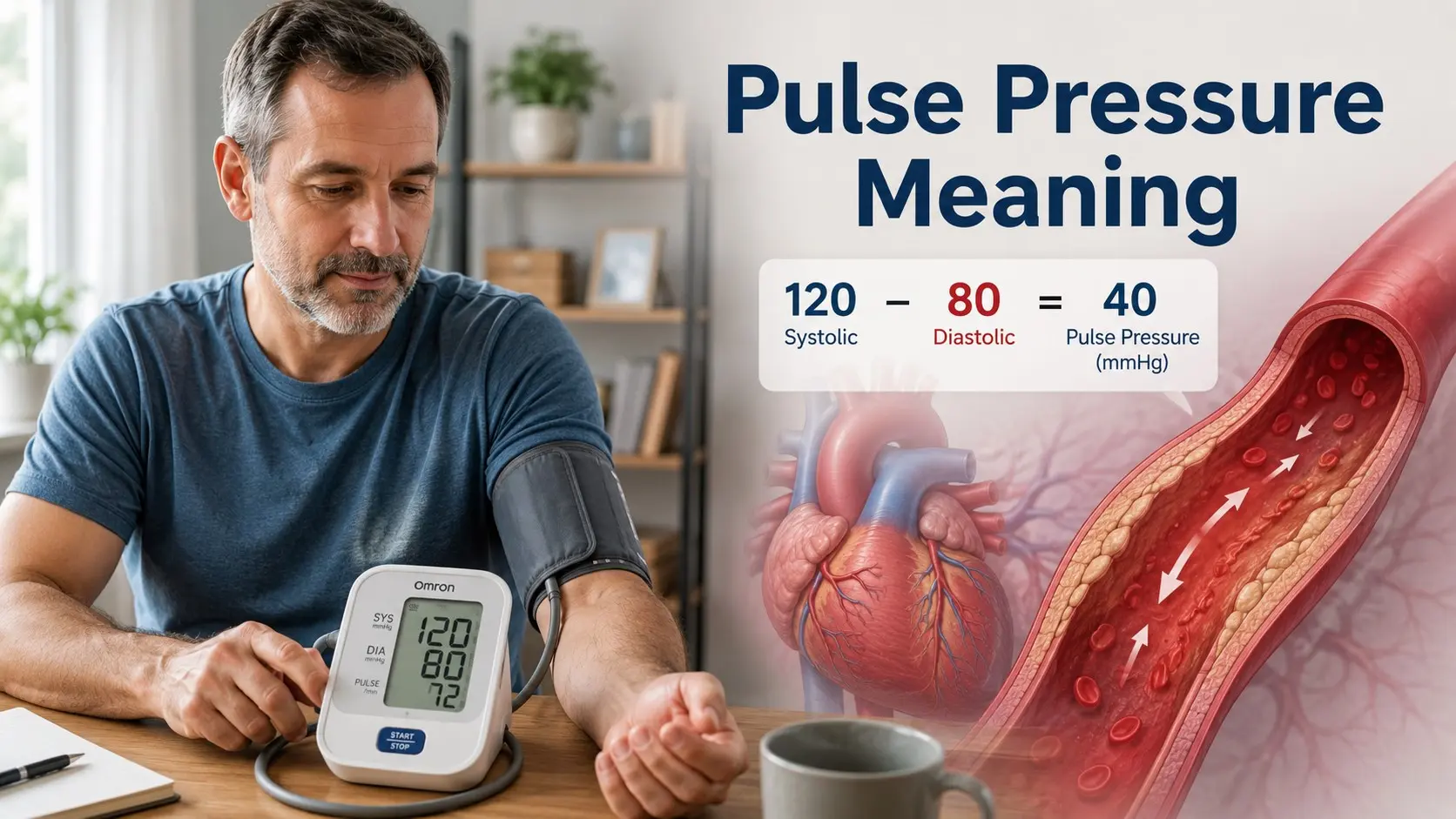
Pulse pressure meaning is simple at first: subtract the bottom blood pressure number from the top number.
If your blood pressure is 120/80, your pulse pressure is 40 mm Hg.
But the number 40 does not tell the whole story.
The actual systolic and diastolic readings matter first.
A blood pressure of 120/80 and a blood pressure of 130/90 both produce a pulse pressure of 40.
Those blood pressure readings do not mean the same thing.
That is the key idea.
Pulse pressure gives extra information about the relationship between your two blood pressure numbers. It does not replace them.
Quick Answer: What Does Pulse Pressure Mean?
Pulse pressure is the difference between systolic and diastolic blood pressure. A reading of 120/80 gives a pulse pressure of 40 mm Hg. Around 40 is a common reference value, but age, artery stiffness, the actual blood pressure numbers, symptoms, and repeated readings matter more than one calculation.
Medical note: This content is for general educational purposes and does not replace professional medical advice, diagnosis, or treatment. Consult an appropriately qualified healthcare professional for personal medical concerns. This article explains published guidance and does not provide a personal clinical assessment. Always consult qualified medical professionals for diagnosis and treatment of any health condition.
How Do You Calculate Pulse Pressure?
The calculation is easy.
Pulse Pressure = Systolic Blood Pressure − Diastolic Blood Pressure
The systolic blood pressure is the top number.
It is the pressure in your arteries when your heart contracts.
The diastolic blood pressure is the bottom number.
It is the pressure in your arteries between heartbeats.
Example 1
Blood pressure: 120/80
120 minus 80 = 40 mm Hg
Example 2
Blood pressure: 140/60
140 minus 60 = 80 mm Hg
Example 3
Blood pressure: 160/100
160 minus 100 = 60 mm Hg
The arithmetic is simple.
The meaning depends on the whole reading.
What Is a Normal Pulse Pressure?
A pulse pressure around 40 mm Hg is commonly used as a reference value.
That comes from a typical blood pressure example of 120/80.
But I would not treat 40 as a pass or fail number.
Look at this table.
| Blood Pressure | Pulse Pressure | What Matters |
|---|---|---|
| 120/80 | 40 | The blood pressure itself is in the normal range |
| 130/90 | 40 | The pulse pressure is still 40, but the diastolic pressure is high |
| 140/60 | 80 | The gap is much wider and the systolic pressure is high |
| 100/60 | 40 | The same pulse pressure occurs with a much lower blood pressure |
This is why normal pulse pressure should never be interpreted alone.
A normal-looking gap does not cancel an abnormal systolic or diastolic reading.
Read the Two Blood Pressure Numbers Before the Gap
This is the order I recommend.
First, look at the systolic number.
Then look at the diastolic number.
Only after that should you calculate pulse pressure.
Current American Heart Association and American College of Cardiology categories for nonpregnant adults are:
| Category | Systolic | Diastolic |
|---|---|---|
| Normal | Below 120 | Below 80 |
| Elevated | 120 to 129 | Below 80 |
| Stage 1 hypertension | 130 to 139 | 80 to 89 |
| Stage 2 hypertension | 140 or higher | 90 or higher |
If either number is in a higher category, that matters even when the pulse pressure looks ordinary.
For more cardiovascular guidance, visit the Heart and Cardiovascular Health Hub.
What Does a Wide Pulse Pressure Mean?
A wide pulse pressure means there is a larger gap between systolic and diastolic blood pressure.
For example:
140/60 = 80 mm Hg
A wider pulse pressure becomes more common with age.
One major reason is arterial stiffness.
Your large arteries are meant to stretch when the heart pumps blood.
That stretch helps absorb part of the pressure from each heartbeat.
As arteries become stiffer, they stretch less.
Systolic pressure tends to rise.
The gap between systolic and diastolic pressure can become wider.
Mayo Clinic identifies pulse pressure above 60 mm Hg as a cardiovascular risk marker, especially in older adults.
Cleveland Clinic also advises discussing a persistent pulse pressure of 60 mm Hg or more with a healthcare professional.
I would not use 60 as a diagnosis.
It is a reason to look more closely at the full blood pressure pattern.
Why Can Two People With a Pulse Pressure of 60 Have Different Problems?
Because the subtraction does not tell you which number caused the gap.
Compare:
160/100
Pulse pressure = 60.
Both numbers are high.
140/80
Pulse pressure = 60.
The systolic pressure is high.
120/60
Pulse pressure = 60.
The systolic pressure is much lower than in the other examples.
The same pulse pressure can therefore appear in very different situations.
That is why doctors do not treat pulse pressure as a stand-alone diagnosis.
Why Does Pulse Pressure Increase With Age?
Blood vessels change over time.
Large arteries can become less flexible.
This reduces arterial compliance.
When the heart pumps against a stiffer artery, systolic pressure tends to rise more.
Later in life, diastolic pressure may rise less or even fall.
The result can be a wider pulse pressure.
This pattern helps explain why isolated systolic hypertension is common in older adults.
Age gives the number context.
It does not make a wide pulse pressure harmless.
For age-specific cardiovascular guidance, read Heart Health After 50.
Does Wide Pulse Pressure Mean Your Arteries Are Blocked?
No.
That is too simple.
A wide pulse pressure can reflect stiff arteries.
But stiff arteries and blocked arteries are not the same thing.
Pulse pressure is affected by:
- Stroke volume, which is the amount of blood pumped with each heartbeat
- Arterial compliance, which describes how easily arteries stretch
- The way pressure waves move through the arterial system
A pulse pressure calculation cannot tell you whether an artery contains plaque.
It is a cardiovascular clue.
It is not a scan.
What Else Can Cause a Wide Pulse Pressure?
Age related arterial stiffness is common.
Other situations can also widen pulse pressure.
Medical references list causes that include:
- Aortic valve regurgitation
- Some forms of arteriosclerosis
- Severe anemia
- Hyperthyroidism
- Exercise
The number does not tell you which cause is present.
A healthcare professional uses your symptoms, medical history, examination, and other tests when needed.
Do not try to diagnose a heart valve or thyroid problem from pulse pressure alone.
What Is a Narrow Pulse Pressure?
A narrow pulse pressure means the two blood pressure numbers are closer together.
For example:
110/90 = 20 mm Hg
One clinical reference defines a narrow pulse pressure as less than about 25 percent of the systolic pressure.
That is not a home diagnosis.
A narrow gap can occur when the heart is pumping less blood forward.
Medical causes can include:
- Heart failure
- Significant blood loss
- Aortic stenosis
- Cardiac tamponade
Those conditions need medical assessment.
A single unusual home reading does not prove any of them.
When Does Narrow Pulse Pressure Matter More?
Symptoms change the picture.
A narrow pulse pressure deserves faster attention when it appears with:
- Fainting
- Severe dizziness
- Weakness
- Cold or clammy skin
- Chest pain
- Shortness of breath
- Major blood loss
- Confusion
Do not focus on calculating percentages during a medical emergency.
Get help for the symptoms.
Why Can Your Pulse Pressure Change Within Minutes?
Blood pressure moves all day.
It is not a fixed number.
Your reading can change with:
- Movement
- Stress
- Talking
- Caffeine
- Exercise
- Body position
- A full bladder
- Incorrect cuff position
Because pulse pressure is calculated from two changing values, it changes too.
That makes one rushed measurement a poor basis for conclusions.
Measure Blood Pressure Properly Before Calculating Pulse Pressure
This step matters more than most people think.
The American Heart Association recommends careful home measurement.
Before checking:
- Avoid exercise for 30 minutes
- Avoid caffeine for 30 minutes
- Avoid smoking for 30 minutes
- Empty your bladder
- Sit quietly for at least five minutes
During the reading:
- Sit with your back supported
- Keep both feet flat on the floor
- Do not talk
- Place the cuff on bare skin
- Use the correct cuff size
- Support your arm at heart level
Take two readings about one minute apart.
Record both.
A pattern over time gives more useful information than one measurement.
Why Cuff Size Matters
A blood pressure cuff that does not fit properly can distort the reading.
If the systolic or diastolic number is wrong, your pulse pressure calculation will also be wrong.
Do not buy a monitor only because it looks convenient.
Use a validated upper arm device with a cuff that fits your arm.
Current American Heart Association guidance also warns against relying on cuffless devices such as smartwatches for accurate blood pressure measurement until their precision improves.
Can Exercise Increase Pulse Pressure?
Yes.
During dynamic exercise, your heart pumps more blood with each beat.
Systolic pressure normally rises.
Diastolic pressure usually changes much less.
This can temporarily create a wider pulse pressure.
That is different from a wide pulse pressure found repeatedly while you are resting.
Do not compare a blood pressure measured during or immediately after exercise with a resting target.
Is Pulse Pressure More Important Than Systolic Blood Pressure?
For most people managing hypertension, no.
This is worth being clear about.
Pulse pressure contains useful information.
But current blood pressure treatment is based mainly on the actual systolic blood pressure, diastolic blood pressure, overall cardiovascular risk, and health conditions.
The 2025 American Heart Association and American College of Cardiology guideline does not tell people to chase a specific pulse pressure target.
If your reading is 150/90, do not ask only how to reduce the 60 point gap.
Ask why your blood pressure is 150/90 and how it should be managed.
Can Wide Pulse Pressure Raise Heart Risk?
A persistently wide pulse pressure has been associated with higher cardiovascular risk, especially in older adults.
It can reflect increased arterial stiffness.
Stiff large arteries place a different pressure load on the heart and smaller blood vessels.
But pulse pressure does not calculate your personal heart attack risk by itself.
A complete cardiovascular assessment can include:
- Age
- Blood pressure
- Cholesterol
- Smoking
- Diabetes
- Kidney disease
- Existing heart disease
- Family history
Pulse pressure is one piece of that picture.
For another blood vessel topic, read Poor Circulation in Feet.
Does Sleep Affect Pulse Pressure?
Sleep affects overall cardiovascular health and blood pressure.
Short sleep, poor sleep quality, and obstructive sleep apnea can contribute to blood pressure problems.
But I would not use pulse pressure as a sleep test.
If you snore loudly, stop breathing during sleep, or feel very sleepy during the day, discuss those symptoms directly with a healthcare professional.
Read Sleep and Heart Health for more detail.
Should You Try to Lower Pulse Pressure?
Do not chase the calculated number by itself.
Address the condition that is affecting your blood pressure.
The 2025 blood pressure guideline supports heart-healthy habits such as:
- Maintaining an appropriate body weight
- Eating a heart-healthy diet
- Reducing excess sodium
- Eating adequate potassium when medically appropriate
- Getting regular physical activity
- Managing stress
- Reducing or avoiding alcohol
- Taking prescribed blood pressure medicine when needed
Do not change medication because your pulse pressure looks wide or narrow.
Medication decisions should be based on your complete blood pressure pattern and medical history.
For broader daily habits, use the Healthy Lifestyle Roadmap.
When Should You Ask a Doctor About Pulse Pressure?
I would discuss it when properly measured resting readings repeatedly show a large or very narrow gap.
Cleveland Clinic advises discussing persistent pulse pressure of 60 mm Hg or more with a healthcare professional.
A narrow value below roughly one quarter of systolic pressure is another clinical reference that deserves context.
Speak with a clinician sooner if you also have:
- Known heart disease
- Heart failure
- Kidney disease
- Diabetes
- Heart valve disease
- Difficult to control hypertension
- Fainting
- Chest symptoms
- Unexplained shortness of breath
When Does Blood Pressure Become an Emergency?
Sometimes the pulse pressure becomes irrelevant because the actual blood pressure is dangerous.
For a nonpregnant adult, the American Heart Association defines severe hypertension as blood pressure higher than 180/120 mm Hg.
If you get a reading in that range, wait at least one minute and measure again.
If it remains that high, contact a healthcare professional promptly.
Call emergency services if blood pressure above 180/120 occurs with symptoms such as:
- Chest pain
- Shortness of breath
- Back pain
- Numbness
- Weakness
- Vision changes
- Difficulty speaking
Do not spend time calculating pulse pressure when emergency symptoms are present.
A Better Way to Read Your Blood Pressure Monitor
Use this order.
- Read the systolic number.
- Read the diastolic number.
- Check whether either number is high or unusually low.
- Ask whether you measured correctly.
- Repeat the reading when appropriate.
- Record the result.
- Then calculate the pulse pressure.
This prevents a common mistake.
You will not become falsely reassured by a normal pulse pressure when the blood pressure itself is abnormal.
Pulse Pressure Examples That Make the Meaning Clear
| Reading | Pulse Pressure | Simple Interpretation |
|---|---|---|
| 120/80 | 40 | Common reference example |
| 130/90 | 40 | Normal-looking gap but abnormal diastolic pressure |
| 140/80 | 60 | Wider gap with high systolic pressure |
| 140/60 | 80 | Clearly wider gap that deserves context if persistent |
| 110/90 | 20 | Narrow gap that needs interpretation with symptoms and repeated readings |
Common Pulse Pressure Myths
Myth: A Pulse Pressure of 40 Means Your Blood Pressure Is Healthy
No.
A reading of 130/90 still gives 40.
The diastolic pressure is high.
Myth: A Wide Pulse Pressure Means You Have Blocked Arteries
No.
It can reflect arterial stiffness, stroke volume, valve problems, exercise, or other factors.
Myth: Everyone Over 60 Should Have a Wide Pulse Pressure
No.
Pulse pressure tends to widen with age, but persistent abnormal blood pressure still deserves attention.
Myth: You Need Medicine Specifically for Pulse Pressure
No.
Treatment targets the underlying blood pressure and medical condition.
Myth: One Wide Reading Means Heart Disease
No.
Measurement errors and normal blood pressure variation can produce one unusual result.
Repeated properly measured readings matter more.
My Approach to Pulse Pressure Meaning
I prefer to make health numbers useful rather than frightening.
Pulse pressure is a good example.
The subtraction is easy.
The context is what matters.
My background in information technology management trained me to compare numbers, look for patterns, check sources, and question conclusions that are built from one data point.
I use the same approach when researching health information for NextFitLife.
For this guide, I compared current American Heart Association blood pressure guidance with clinical information from Cleveland Clinic, Mayo Clinic, and open cardiovascular physiology references.
The practical lesson is simple.
Do not let one calculated number distract you from the two blood pressure numbers that created it.
Conclusion: Pulse Pressure Meaning Makes More Sense in Context
Pulse pressure meaning becomes useful when you treat it as extra information, not a diagnosis.
Subtract the diastolic number from the systolic number.
A value around 40 mm Hg is a common reference.
A persistent wider gap can deserve attention, especially with age or high blood pressure.
A very narrow gap can also matter in the right clinical setting.
But always read the systolic and diastolic pressures first.
Your next step: Take two careful resting blood pressure readings about one minute apart, record both numbers, calculate the pulse pressure, and discuss repeated abnormal readings with your healthcare professional.
References and High Authority Sources
This article was checked against current cardiovascular guidance and publicly accessible medical sources.
- American Heart Association and American College of Cardiology. 2025 High Blood Pressure Guideline.This updated guideline defines current adult blood pressure categories, emphasizes accurate measurement and home monitoring, and explains when lifestyle changes and medicines are used to manage hypertension.Read the 2025 High Blood Pressure Guideline Summary
- American Heart Association. Home Blood Pressure Monitoring.This public guidance explains correct home blood pressure measurement, repeated readings, cuff selection, blood pressure categories, and when very high blood pressure needs urgent medical attention.Read AHA Home Blood Pressure Monitoring Guidance
- Cleveland Clinic. Pulse Pressure.This medically reviewed resource explains how to calculate pulse pressure, why values can widen or narrow, the role of age and arterial stiffness, and when repeated unusual values should be discussed with a healthcare professional.Read Cleveland Clinic Pulse Pressure Guidance
- Mayo Clinic. Pulse Pressure: An Indicator of Heart Health?Mayo Clinic explains systolic and diastolic pressure, the pulse pressure calculation, the common 40 mm Hg reference value, and why wider pulse pressure can be a cardiovascular risk marker in older adults.Read Mayo Clinic Pulse Pressure Guidance
- National Library of Medicine. Physiology, Pulse Pressure.This open StatPearls reference explains how pulse pressure relates to stroke volume and arterial compliance, how aging affects the value, and medical conditions associated with unusually wide or narrow pulse pressure.Read the NCBI Pulse Pressure Physiology Reference
Source Review Date: August 28, 2026
These organizations and authors do not endorse NextFitLife.
Continue Reading on NextFitLife
Heart and Cardiovascular Health Hub: Heart and Cardiovascular Health
Health Hub: NextFitLife Health
About the Author
Adel Galal is the founder and health and wellness writer at NextFitLife.
Before focusing on NextFitLife, Adel spent 29 years working in information technology management.
That background developed his skills in data review, structured analysis, source comparison, problem-solving, and clear communication.
He now uses those skills to compare public health guidance, review scientific sources, question exaggerated claims, and explain medical numbers in simple language.
For this article, his focus is on helping readers understand pulse pressure without turning one blood pressure calculation into a diagnosis.
This content is for general educational purposes and does not replace professional medical advice, diagnosis, or treatment. Consult an appropriately qualified healthcare professional for personal medical concerns. This article explains published guidance and does not provide a personal clinical assessment. Always consult qualified medical professionals for diagnosis and treatment of any health condition.
Read the full Adel Galal author profile and NextFitLife editorial approach.
Frequently Asked Questions About Pulse Pressure Meaning
What does pulse pressure mean?
Pulse pressure is the difference between systolic and diastolic blood pressure. If your blood pressure is 120/80, your pulse pressure is 40 mm Hg.
What is a normal pulse pressure?
Around 40 mm Hg is commonly used as a reference value. There is no single number that should be interpreted without considering age, the actual blood pressure readings, symptoms, and repeated measurements.
Is a pulse pressure of 60 high?
A persistent pulse pressure of 60 mm Hg or more deserves context, especially in older adults. Cleveland Clinic recommends discussing repeated values in this range with a healthcare professional.
Is a pulse pressure of 80 dangerous?
A pulse pressure of 80 is wide. It does not prove that you have heart disease, but repeated resting readings should be discussed with a healthcare professional, especially if your blood pressure is also high.
What causes wide pulse pressure?
Common causes include age-related arterial stiffness. Other causes can include exercise, aortic valve problems, severe anemia, hyperthyroidism, and changes in stroke volume.
Does wide pulse pressure mean clogged arteries?
No. Wide pulse pressure can reflect arterial stiffness, but it cannot diagnose blocked arteries or atherosclerosis by itself.
What is narrow pulse pressure?
Narrow pulse pressure means the systolic and diastolic numbers are unusually close together. One clinical reference uses less than about 25 percent of systolic pressure as a narrow value.
What causes narrow pulse pressure?
Medical causes can include low stroke volume, heart failure, major blood loss, aortic stenosis, and cardiac tamponade. One home reading cannot diagnose these conditions.
Does pulse pressure increase with age?
Yes. Pulse pressure commonly becomes wider as large arteries become stiffer with age.
Can exercise widen pulse pressure?
Yes. Exercise raises stroke volume and systolic pressure, so pulse pressure can temporarily widen during physical activity.
Is pulse pressure more important than systolic blood pressure?
No. Pulse pressure provides extra cardiovascular information, but current hypertension treatment focuses mainly on systolic pressure, diastolic pressure, overall risk, and medical conditions.
Can I lower pulse pressure naturally?
Do not target pulse pressure alone. Manage the blood pressure or health condition behind it through appropriate lifestyle changes and medical treatment when needed.
Should I calculate pulse pressure every time I check my blood pressure?
You can, but it is not necessary for everyone. The systolic and diastolic numbers remain the main readings to track.
When should I see a doctor about pulse pressure?
Discuss repeated unusually wide or narrow resting pulse pressure readings, especially if you also have high blood pressure, heart disease, kidney disease, diabetes, fainting, chest symptoms, or shortness of breath.
When is high blood pressure an emergency?
For nonpregnant adults, blood pressure above 180/120 mm Hg with symptoms such as chest pain, shortness of breath, weakness, numbness, vision changes, or difficulty speaking is a medical emergency.

Health & wellness writer with 30+ years of experience in nutrition, fitness, and healthy aging. Founder of NextFitLife.com — evidence-based health guidance.