Published on: November 18, 2026
A good high porosity hair routine should make your hair easier to detangle, softer, and less likely to snap.
It should not leave you with layers of heavy butter, oil, masks, and protein treatments that make the hair harder to manage.
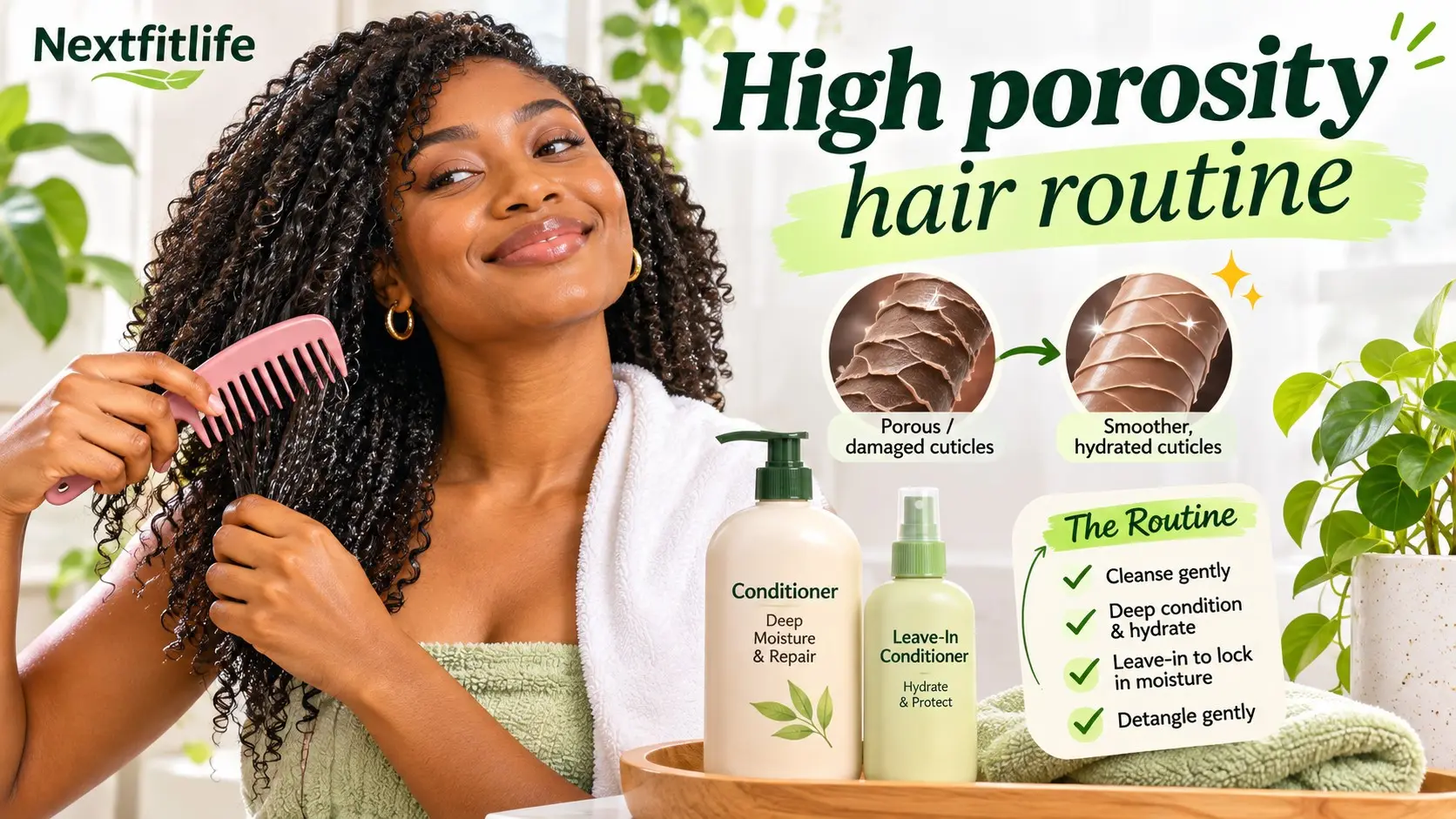
Quick answer: High porosity hair takes up and loses water more easily, especially when the hair cuticle has been damaged by bleach, heat, chemical processing, or normal wear. A useful routine focuses on gentle cleansing, conditioner, optional leave in care, low friction, limited heat, and enough protection to reduce more damage.
Health note: This article is for general information and education. It does not replace medical advice, diagnosis, or treatment.
See a dermatologist if you have sudden heavy shedding, bald patches, rapid thinning, a widening part, scalp pain, pus, scarring, severe redness, or eyebrow or eyelash loss. High porosity describes the hair shaft. It does not explain every type of hair loss.
For broader hair care guidance, start with the NextFitLife Healthy Hair Guide. It covers washing, conditioning, heat, breakage, nutrition, and the difference between hair shaft damage and true shedding.
Table of Contents
- What high porosity hair means
- How damage changes porosity
- 9 smart routine steps
- A complete wash day routine
- Curly, straight, and fine hair
- Protein and deep conditioning
- LOC and LCO methods
- Bleach, heat, and hard water
- Hygral fatigue and repeated wetting
- Common routine mistakes
- A simple four week test
- When to see a dermatologist
- References and Sources
- Internal Links and NextFitLife Hubs
- About the Author
- Frequently Asked Questions
What Does High Porosity Hair Mean?
Hair porosity describes how easily water and other substances move into and out of the hair fiber.
The outside of each strand is covered by overlapping cuticle cells. When that outer surface becomes more damaged or disrupted, water can move through the fiber more easily.
You may notice that high porosity hair:
- Gets wet quickly
- Dries quickly
- Feels rough
- Frizzes easily
- Tangles often
- Looks dull
- Breaks more easily
- Feels dry again soon after washing
These signs are useful, but they are not a medical diagnosis.
Different parts of the same head can also behave differently. New root growth may feel smooth while older bleached ends act much more porous.
Why Does Hair Become More Porous?
Some hair may naturally behave as if it is more porous.
But damage matters a lot.
Porosity can rise after repeated exposure to:
- Bleaching
- Permanent coloring
- Chemical straightening
- Relaxers
- High heat
- Frequent rough brushing
- Sun exposure
- Normal weathering over time
Recent laboratory research has shown that chemical and physical damage can increase porosity and weaken the hair fiber.
This is one reason I would not treat high porosity as a fixed hair identity.
Sometimes it is mainly a damage pattern.
Can You Trust the Hair Float Test?
Not completely.
The popular float test asks you to put a clean hair strand in water and see whether it floats or sinks.
People are often told that a fast sinking strand means high porosity.
The problem is that surface oil, conditioner residue, styling products, trapped air, strand thickness, and surface tension can affect what happens.
Laboratory porosity testing uses controlled methods that are much more precise.
For home care, I would pay more attention to what your hair does during and after washing.
Ask:
- Does the hair soak up water very quickly?
- Does it dry unusually fast?
- Are the ends rougher than the roots?
- Did the change begin after bleach or heat?
- Does conditioner improve detangling?
- Does the hair snap during styling?
9 Smart High Porosity Hair Routine Steps
1. Clean the Scalp Without Scrubbing the Lengths
High porosity hair still needs shampoo.
Your scalp collects oil, sweat, skin cells, pollution, and styling residue. These need to be removed.
The lengths may already be fragile, so the goal is simple:
Clean the scalp without rough handling of the hair shaft.
Apply shampoo mainly to the scalp and roots. Massage gently with your fingertips, then let the lather move through the lengths as you rinse.
Do not aggressively pile the hair on top of your head and scrub it.
2. Condition Every Time You Shampoo
This is the step I would rarely skip for damaged, porous hair.
Conditioner helps reduce friction, improve slip, smooth the hair surface, and make detangling easier.
Apply it mainly to the middle and ends.
Use enough that your fingers or comb can move through the hair with less resistance.
Then rinse according to the product directions.
Conditioner does not permanently rebuild a damaged strand, but it can make the existing fiber much easier to manage.
3. Use a Leave In Conditioner When You Need More Slip
A leave in conditioner can help if rinse out conditioner is not enough.
It is especially useful when the hair:
- Tangles after washing
- Feels rough while drying
- Frizzes quickly
- Breaks during styling
- Feels dry again soon after washing
Start with a small amount on damp hair.
Fine hair may need very little. Thick, curly, or heavily damaged hair may tolerate more.
4. Add Oil or Serum Only if It Helps
Many high porosity routines make oil sound mandatory.
It is not.
Oil and serum can reduce friction, improve shine, and slow water movement at the surface.
That can be useful, but too much can make the hair greasy, heavy, or dull.
Use a small amount on the lengths and ends.
Then judge the result the next day.
If the hair feels softer and easier to manage, keep it. If it feels sticky or flat, use less or skip it.
5. Use Coconut Oil Only if Your Hair Likes It
Coconut oil for hair has more research behind it than many popular oils.
Studies have found that coconut oil can enter the hair fiber and reduce protein loss under tested conditions.
That makes it a reasonable option for some damaged hair.
Still, it is not required.
Try a small amount.
If your hair becomes softer and easier to detangle, it may suit you. If it feels stiff, greasy, or coated, stop using it.
6. Use Protein Based on Hair Response
High porosity hair is often damaged hair, so protein treatment products are frequently recommended.
Protein derived conditioning ingredients can temporarily improve damaged areas and make weak hair feel stronger.
But protein does not rebuild a dead hair fiber into new hair.
You also do not need a fixed weekly schedule.
Consider a strengthening treatment when the hair feels:
- Weak
- Overly stretchy
- Mushy when wet
- Easy to snap
- Very damaged after chemical processing
Use less if the hair becomes hard, stiff, rough, or difficult to detangle.
If this happens, read the Protein Overload Hair Symptoms Guide.
7. Deep Condition When Normal Conditioner Is Not Enough
A deep conditioner can help very dry or chemically damaged hair.
But a weekly mask is not a biological rule.
Use one when your regular conditioner no longer gives enough softness or slip.
If the hair becomes heavy or coated after every mask, use the product less often or switch to a lighter formula.
8. Reduce Heat and Chemical Damage
This is the step that matters most over time.
No conditioner can keep up with constant new damage forever.
Repeated bleach, chemical straightening, and high heat can damage the cuticle and deeper parts of the hair fiber.
If you use heat:
- Choose the lowest useful temperature
- Reduce repeated passes
- Let hair partly air dry when practical
- Use a heat protectant
- Avoid flat ironing the same section again and again
The goal is not perfect avoidance.
The goal is less repeated damage.
9. Reduce Friction During Drying and Styling
Rough handling matters when the hair surface is already damaged.
Do not rub wet hair hard with a towel.
Blot or squeeze out extra water instead.
A soft towel, microfiber towel, or smooth cotton T shirt can work well.
When detangling, start at the ends and work upward slowly.
Good hair care is often less about adding another product and more about removing unnecessary friction.
A Simple High Porosity Wash Day
| Step | What to Do | Main Goal |
|---|---|---|
| 1. Shampoo | Focus cleansing on the scalp | Remove oil and buildup |
| 2. Condition | Apply to middle and ends | Reduce friction and tangles |
| 3. Detangle | Work gently from ends upward | Reduce snapping |
| 4. Rinse | Follow conditioner directions | Leave hair manageable |
| 5. Blot | Remove water without rubbing | Reduce friction |
| 6. Leave In | Apply a small amount to damp hair | Improve softness and slip |
| 7. Seal | Add a small serum or oil if useful | Reduce friction and improve feel |
| 8. Dry | Air dry or use lower heat | Limit more damage |
That is already a complete routine.
You do not need several oils, two masks, a cream, butter, spray, serum, and protein treatment every wash.
High Porosity Curly Hair Routine
Curly and coily hair may need more lubrication because strands can rub, twist, and tangle around each other.
A useful routine may include:
- Gentle shampoo
- A conditioner with good slip
- Leave in conditioner
- Gel or cream for definition
- A small amount of oil if needed
Do not assume every curl needs heavy butter.
If your curls become dull, sticky, flat, or stretched out, simplify the styling layers.
High Porosity Straight or Fine Hair Routine
Fine hair can be highly porous too.
This is where heavy routines often go wrong.
Try:
- Gentle shampoo
- Rinse out conditioner
- Light leave in if needed
- A small serum on the ends if useful
That may be enough.
You do not need thick cream or butter simply because the hair is porous.
How Often Should High Porosity Hair Be Washed?
There is no universal wash schedule based on porosity alone.
Wash frequency should match:
- Scalp oil
- Sweat
- Exercise
- Styling product use
- Hair texture
- Chemical damage
An oily scalp may need more frequent washing.
Dry, tightly curled hair may need less frequent washing.
Your scalp and hair shaft do not always need exactly the same thing.
Should High Porosity Hair Be Clarified?
Sometimes.
Heavy oils, butter, silicone products, gels, and styling creams can build up.
Consider a stronger wash when hair becomes:
- Sticky
- Dull
- Flat
- Hard to style
- Coated after washing
But do not turn clarifying into constant aggressive cleansing.
Already damaged lengths can become even rougher if they are repeatedly stripped.
Does High Porosity Hair Need LOC or LCO?
Not automatically.
LOC means liquid, oil, cream.
LCO means liquid, cream, oil.
These are styling methods, not rules of hair biology.
If three layers help coarse, dry, curly hair stay manageable, use them.
If those same layers make fine hair greasy and flat, stop.
The result matters more than the acronym.
Does Cold Water Close the Hair Cuticle?
This claim gets repeated a lot.
A cool rinse may feel pleasant, but a quick blast of cold water does not permanently rebuild a damaged cuticle.
Conditioning, reducing friction, limiting chemical damage, and using less heat matter far more.
You can use cool water if you like it.
You do not need freezing water to care for porous hair.
Can High Porosity Hair Be Permanently Repaired?
Damaged hair does not heal like skin.
The visible hair shaft is a nonliving fiber.
Conditioners, proteins, oils, silicones, and bond focused products can improve feel and manageability.
Some can temporarily strengthen damaged areas.
They cannot turn severely damaged old hair back into virgin hair.
The long term strategy is:
Manage old damage and protect new growth.
What About Bond Repair Products?
Bond repair is a broad product category.
Different formulas use different ingredients and mechanisms.
Some products can improve the feel and strength of chemically damaged hair.
That does not mean every product labeled “bond repair” completely rebuilds the hair.
Judge it by results:
- Less snapping
- Easier detangling
- Better feel
- Better manageability
If none of those improve, the marketing name is not enough reason to keep buying it.
How Should You Detangle High Porosity Hair?
High porosity hair can tangle easily because a rougher surface creates more friction.
Use conditioner or detangler first.
Then:
- Start at the ends.
- Work upward slowly.
- Use your fingers or a wide tooth comb.
- Hold the hair above a knot when needed.
- Stop pulling if the knot will not move.
Repeated tugging turns a detangling problem into a breakage problem.
Does Silk or Satin Help?
A smooth sleep surface can reduce rubbing.
That may help if your hair tangles, frizzes, or breaks overnight.
A satin bonnet, scarf, or smooth pillowcase is optional.
It does not change the underlying porosity.
Think of it as friction control rather than repair.
Can Repeated Wetting Make Fragile Hair Worse?
Hair swells when it gets wet and contracts as it dries.
Damaged hair can take up water more easily, so repeated soaking and drying may add stress to an already weak fiber.
This is one reason constantly spraying hair with water is not always useful.
If your hair becomes very soft, stretchy, weak when wet, or prone to breaking after repeated soaking, read the Hygral Fatigue Hair Guide.
High Porosity Hair After Bleaching
Bleaching can strongly affect the hair shaft.
It changes the structure of the fiber and can increase porosity.
If your hair became rougher, faster drying, or easier to snap after bleaching, focus on:
- Gentle shampoo
- Conditioner every wash
- Leave in care
- Less heat
- Less overlapping bleach
- Strengthening products only when helpful
- Trimming badly split ends
More bleach followed by more heat is not simply a moisture problem.
It is ongoing structural damage.
High Porosity Hair After Heat Damage
Repeated high temperature can damage both the cuticle and deeper parts of the hair fiber.
The risk becomes more concerning when the hair is already chemically processed.
If hair became rough and fragile after repeated flat ironing, do not respond only by adding heavier conditioner.
Reduce the heat first.
Then use conditioning products to make the existing damage easier to manage.
Could Hard Water Be Making Things Worse?
Yes.
Hard water deposits calcium and magnesium on or within hair.
That can make damaged strands feel rougher, duller, coated, or harder to detangle.
If your hair changed after moving, traveling, or switching water supplies, do not assume porosity is the only issue.
Read the Hard Water Hair Damage Guide for testing, washing, and chelating guidance.
Can High Porosity Hair Still Be Healthy?
Yes.
Porosity does not tell you everything about hair health.
The more useful questions are:
- Does the hair break easily?
- Does it tangle badly?
- Does normal conditioner help?
- Can you style it without constant snapping?
- Is the scalp healthy?
- Are you shedding hair from the root?
Porosity is one clue.
It is not the whole diagnosis.
High Porosity Hair vs Hair Loss
These are not the same problem.
| Problem | What You May Notice | Main Area Involved |
|---|---|---|
| High porosity | Roughness, fast wetting, tangling, breakage | Hair shaft |
| Hair breakage | Short broken pieces, uneven length, split ends | Hair shaft |
| Hair shedding | Full strands leaving the scalp | Hair growth cycle or follicle |
| Alopecia | Thinning or bald areas | Follicle or scalp |
Hair masks can improve the feel of a damaged shaft.
They cannot treat a follicle disorder.
Common High Porosity Hair Routine Mistakes
Using Heavy Products Just Because Hair Is Porous
Hair texture and density still matter.
Fine porous hair may need lightweight products.
Skipping Conditioner
Conditioner helps reduce friction and makes damaged hair easier to handle.
Using Protein on a Fixed Schedule
Your hair response matters more than a weekly calendar.
Using Oil Instead of Conditioner
Oil can reduce friction and improve feel.
It does not replace conditioner.
Constantly Rewetting the Hair
More water does not always mean healthier hair.
Using High Heat to Seal Products
High heat can add more damage rather than fixing it.
Repeatedly Bleaching Fragile Hair
More chemical damage can increase porosity faster than products can hide it.
Expecting Products to Permanently Repair Split Ends
Products can temporarily smooth the appearance of split ends.
Trimming is the way to remove the split section.
A Simple 4 Week Routine Test
| Week | What to Do | What to Watch |
|---|---|---|
| Week 1 | Use gentle shampoo, conditioner, one leave in, and one styler | Softness, tangles, breakage |
| Week 2 | Keep products the same and add a tiny serum only if needed | Do the ends feel better or coated? |
| Week 3 | Use strengthening treatment only if hair feels weak or overly stretchy | Does it improve strength without stiffness? |
| Week 4 | Keep only the steps that clearly helped | Is the routine easier and more predictable? |
This test is more useful than changing five products every wash day.
When Should You See a Dermatologist?
High porosity and hair breakage concern the hair shaft.
See a dermatologist if you notice:
- Sudden heavy shedding
- Round bald patches
- Rapid thinning
- A widening part
- Scalp pain or burning
- Pus or open sores
- Scarring
- Severe redness or scaling
- Eyebrow or eyelash loss
A hair mask cannot treat an underlying scalp or follicle disorder.
Conclusion
The best high porosity hair routine is not about piling more and more moisture onto the hair.
It is about reducing friction, conditioning consistently, protecting fragile lengths, using strengthening products only when they help, and stopping the bleach, high heat, or rough handling that keeps adding damage.
Your next step: simplify your next wash day to shampoo, conditioner, one leave in, and one styler. Keep the routine steady for several washes, then add only the step your hair clearly needs.
References and Sources
- Cosmetics, MDPI. Porosity and Resistance of Textured Hair: Assessing Chemical and Physical Damage Under Consumer Relevant Conditions.
https://www.mdpi.com/2079-9284/12/3/93 - National Library of Medicine, PubMed Central. Shampoo and Conditioners: What a Dermatologist Should Know.
https://pmc.ncbi.nlm.nih.gov/articles/PMC4458934/ - American Academy of Dermatology. Hair Loss: Tips for Managing.
https://www.aad.org/public/diseases/hair-loss/treatment/tips - National Library of Medicine, PubMed Central. Thermal Induced Changes in Cuticle and Cortex to Chemically Treated Hair.
https://pmc.ncbi.nlm.nih.gov/articles/PMC12701549/ - PubMed. Methods Adapted to Evaluate Products for Textured Hair: Shine, Curl Shrinkage, Flexibility and Consumer Perceived Hair Porosity.
https://pubmed.ncbi.nlm.nih.gov/42971783/
Internal Links and NextFitLife Hubs
- Healthy Hair Care Guide
- Low Porosity Hair Routine
- Protein Overload Hair Symptoms
- Hygral Fatigue Hair Guide
- Hard Water Hair Damage Guide
- Best Foods for Hair Growth
- Biotin Rich Foods
- About NextFitLife
Frequently Asked Questions
What is the best high porosity hair routine?
A simple routine is gentle shampoo, conditioner every wash, a small amount of leave in conditioner, one styling product, and lower heat. Add oil, deep conditioner, or protein only when each one clearly improves the hair.
How do I know if my hair is high porosity?
High porosity hair may wet quickly, dry quickly, feel rough, tangle easily, and break more often. Bleached or heat damaged ends may behave differently from newer root growth.
Does high porosity hair need protein?
Not on a fixed schedule. Protein based products may help weak or chemically damaged hair, but use them less often if the hair becomes stiff, hard, rough, or difficult to detangle.
Should high porosity hair use oil?
Oil is optional. A small amount can reduce friction and improve feel, but too much can make fine or straight hair greasy and flat.
Is coconut oil good for high porosity hair?
Coconut oil has evidence for entering the hair fiber and reducing protein loss under tested conditions. It can still feel heavy or stiff on some hair, so use a small amount and judge the result.
Does high porosity hair need deep conditioner?
A deep conditioner can help when normal conditioner is not providing enough softness or slip. It does not need to be used every week if your hair already feels manageable.
Can high porosity hair be repaired permanently?
Products can improve the feel, friction, and strength of damaged hair, but they cannot fully turn severely damaged old hair back into virgin hair. Protecting new growth and trimming badly damaged ends are part of long term care.
Does cold water close high porosity hair?
A cold rinse does not permanently rebuild a damaged cuticle. Conditioning, gentle handling, less heat, and reducing chemical damage matter more.
Should I use LOC or LCO for high porosity hair?
You can if the layers improve your hair, but neither method is required. Fine high porosity hair may become greasy or flat with several heavy layers.
Can bleaching cause high porosity hair?
Yes. Bleaching can damage the cuticle and deeper hair structure, which can increase porosity and make hair more vulnerable to tangling and breakage.