Last Updated: August 5, 2026
Next Review: August 2027, or sooner if major anatomy, exercise, cosmetic safety, or body image guidance changes
Review Status: Fully rewritten and source checked against current anatomy guidance, exercise research, FDA safety information, plastic surgery risk guidance, and NHS mental health information
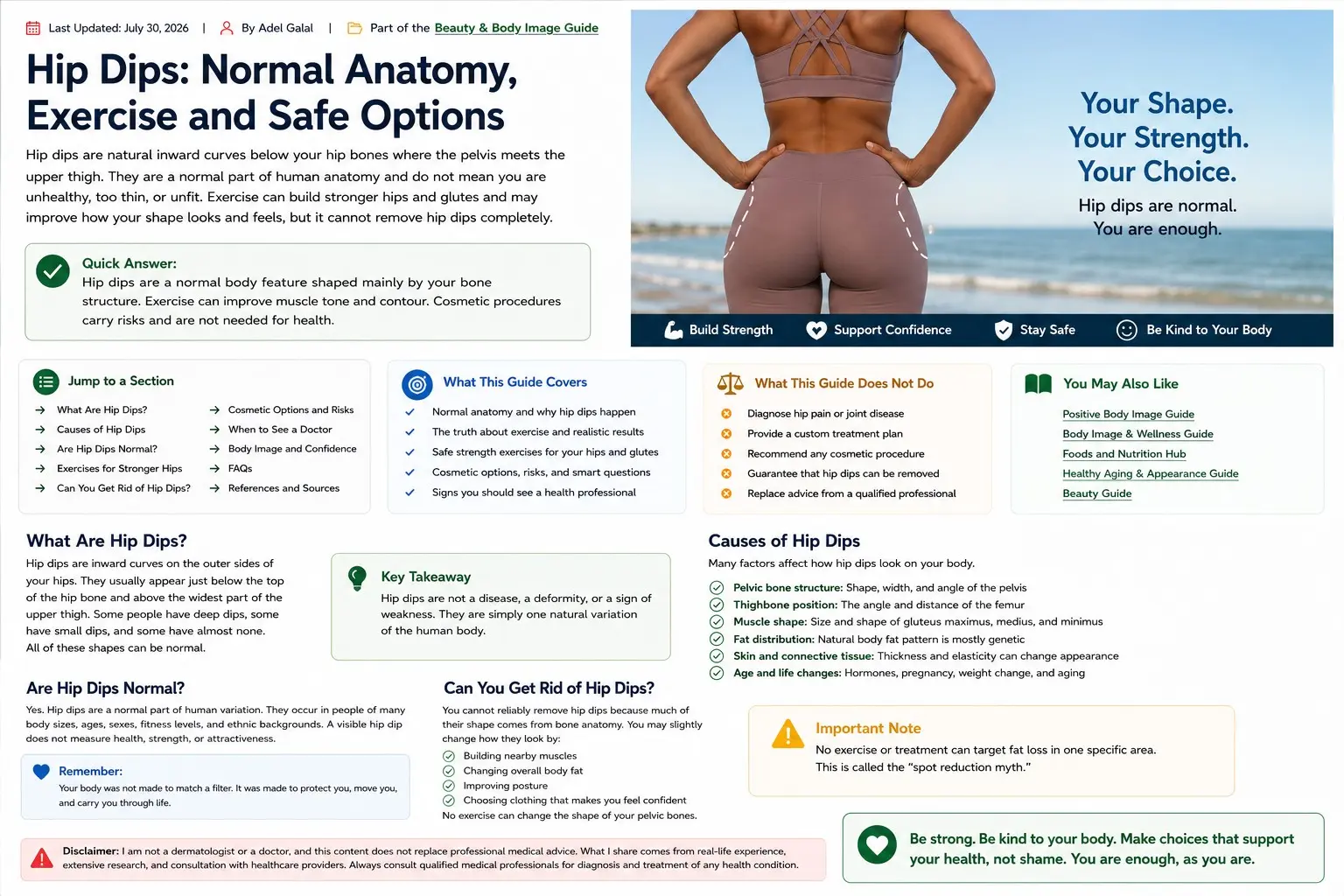
Hip dips are natural inward curves between the upper thigh and the side of the pelvis.
They are also called violin hips or hip indentations.
They are not a disease.
They are not a deformity.
They do not prove that you are too thin, too heavy, weak, or unfit.
The shape mainly comes from your bones.
Muscle, fat, skin, posture, clothing, light, and camera angles can make the curves look deeper or softer.
Exercise can build glute strength.
It may change the nearby contour a little.
It cannot reshape your pelvis.
It cannot promise a perfectly round hip line.
This guide explains normal anatomy, safe exercise, realistic results, body image support, cosmetic treatment risks, and signs that need medical care.
Quick answer
Hip dips are a normal result of pelvic shape, thighbone position, muscle, fat distribution, skin, and connective tissue. Exercise can strengthen the hips and glutes. It cannot remove a normal anatomical curve. No medical treatment is needed when the area causes no symptoms.
Important safety note
A visible indentation without pain is usually a normal body feature. Seek medical assessment for pain, sudden swelling, warmth, redness, weakness, numbness, limping, reduced movement, difficulty walking, or a sudden change after an injury or procedure.
Cosmetic procedure warning
The United States Food and Drug Administration recommends against injectable fillers for large body contouring. Never accept liquid silicone, unapproved filler, or body injections in a home, hotel, salon, party, or unlicensed setting.
Medical note: This content is for general educational purposes and does not replace professional medical advice, diagnosis, or treatment. Consult an appropriately qualified healthcare professional for personal medical concerns. This article explains published guidance and does not provide a personal clinical assessment. Always consult qualified medical professionals for diagnosis and treatment of any health condition.
What Are Hip Dips?
Hip dips are shallow or deep curves on the outer sides of the hips.
They usually appear below the top of the pelvis and above the widest part of the upper thigh.
Some people have clear dips.
Some have small dips.
Some have almost none.
All of these shapes can be normal.
The medical term is not hip dips.
The phrase is a popular description of a normal outer hip contour.
Cleveland Clinic explains that the feature mainly reflects skeletal anatomy rather than body weight or fitness.
This is the most important fact.
There is no defect to repair.
Why Hip Dips Form
Pelvic shape
Your pelvis creates the frame of the hip area.
The width, angle, height, and curve differ between people.
This pelvic anatomy affects the line from the waist to the upper thigh.
Upper thighbone position
The femur is the thighbone.
Its upper outer area includes the greater trochanter.
The position and angle of this area affect the outer hip line.
Your hip is a ball and socket joint made by the pelvis and femur.
Normal differences in these bones create normal differences in body shape.
Glute muscle shape
The buttock area contains three main gluteal muscles:
- Gluteus maximus
- Gluteus medius
- Gluteus minimus
The gluteus maximus creates much of the buttock shape.
The gluteus medius and minimus help move the leg outward and stabilize the pelvis.
Muscle size can change the contour.
It does not change the bone frame.
Natural fat distribution
Your body decides where it stores fat.
Genes, hormones, age, health, pregnancy, menopause, and total body fat can affect body fat distribution.
You cannot choose exactly where fat is stored.
You cannot choose exactly where fat is lost.
Skin and connective tissue
Skin thickness and connective tissue may affect the surface shape.
Cellulite can also change texture.
Cellulite and hip dips are not the same thing.
Posture and movement
Pelvic tilt, leg position, and where you place your weight can change the way the contour looks.
This is an appearance change.
It does not mean the anatomy changed.
Are Hip Dips Normal?
Yes.
Side hip curves are part of normal body diversity.
They appear in people of many:
- Body sizes
- Ages
- Sexes
- Fitness levels
- Ethnic backgrounds
A person can have low body fat and visible dips.
A person can have more body fat and visible dips.
A person can have strong glutes and visible dips.
The shape is not a health score.
It does not measure beauty, fertility, strength, or athletic ability.
Do Hip Dips Affect Health?
Ordinary hip dips do not usually affect:
- Walking
- Running
- Strength
- Balance
- Fertility
- Pregnancy
- Joint health
They do not cause arthritis.
They do not prove that the hips are weak.
They do not need to be filled.
A visible indentation differs from hip pain, weakness, limping, or a movement problem.
Why Hip Dips Look Different in Photos
The same body can look different in two photos.
Common reasons include:
- Lighting
- Camera angle
- Lens distortion
- Pose
- Foot position
- Pelvic tilt
- Clothing
- Shapewear
- Filters
- Image editing
Placing weight on one leg can deepen the curve on one side.
Turning the feet can change the line.
Strong side lighting can create a shadow.
A single image is not a complete view of your body.
Can You Get Rid of Hip Dips?
You cannot reliably remove them with diet or exercise.
Much of the shape comes from bone anatomy.
You may change the appearance a little by:
- Building nearby muscle
- Changing overall body fat
- Changing posture
- Changing clothing
Results differ.
They may be small.
A program that promises to erase hip dips is making an unrealistic claim.
Can You Lose Fat From Hip Dips Only?
No.
No exercise or diet can force fat loss from one exact spot.
This is the spot reduction myth.
Exercise can train a nearby muscle.
It does not control where fat leaves first.
Weight loss may make hip dips look deeper in one person.
It may soften them in another.
Do not use severe weight loss to change a normal body feature.
Read How to Lose Fat From Hips Safely for a realistic fat loss plan.
What Exercise Can Change
Exercise can improve:
- Glute strength
- Hip stability
- Balance
- Walking control
- Sport performance
- Muscle size
- Posture awareness
A 2025 systematic review found that resistance training can increase gluteus maximus muscle size.
Exercises using hip extension with resistance can support growth over time.
Muscle growth may soften part of the contour.
It cannot change the pelvis.
Visible results take time.
Training quality, food, sleep, age, hormones, and genes all affect the result.
Eight Exercises for Stronger Hips and Glutes
These exercises are for health and function.
They are not a promise to erase hip dips.
Start with body weight.
Use slow control.
Stop for sharp pain.
1. Glute bridge
- Lie on your back
- Bend your knees
- Place your feet flat
- Tighten the abdomen gently
- Lift the hips
- Squeeze the glutes
- Lower slowly
Starting amount: Eight to twelve repetitions.
Easier option: Use a smaller lift.
Progression: Add a pause at the top.
2. Side leg raise
- Stand beside a wall or lie on your side
- Keep the leg long
- Lift it to the side slowly
- Keep the body steady
- Lower with control
Side leg raises train hip abduction.
Starting amount: Eight repetitions on each side.
3. Clamshell
- Lie on your side
- Bend both knees
- Keep the feet together
- Lift the top knee
- Do not roll backward
- Lower slowly
Starting amount: Ten repetitions on each side.
4. Supported squat
- Stand in front of a stable chair
- Use the chair for support when needed
- Move the hips backward
- Bend the knees
- Keep the feet flat
- Stand with control
Starting amount: Eight repetitions.
5. Step up
- Use a low, stable step
- Place one foot on the step
- Push through the foot
- Stand tall
- Lower slowly
Starting amount: Six to eight repetitions on each side.
6. Lateral band walk
- Place a light band above the knees
- Bend the knees slightly
- Take small steps to one side
- Keep the knees aligned with the feet
- Return in the other direction
Lateral band walks challenge the side hip muscles.
Starting amount: Six steps each way.
7. Supported split squat
- Hold a chair
- Place one foot in front
- Keep the feet apart for balance
- Lower both knees a little
- Push back to standing
Starting amount: Five repetitions on each side.
Alternative: Repeat the supported squat when balance is difficult.
8. Hip hinge
- Stand tall
- Soften the knees
- Move the hips backward
- Keep the spine long
- Return to standing
Starting amount: Eight to twelve repetitions.
Progression: Hold two light water bottles.
A Simple Two-Day Strength Plan
| Day | Exercise | Starting amount |
|---|---|---|
| Day 1 | Glute bridge | 2 sets of 8 |
| Day 1 | Supported squat | 2 sets of 8 |
| Day 1 | Side leg raise | 2 sets of 8 each side |
| Day 2 | Step up | 2 sets of 6 each side |
| Day 2 | Clamshell | 2 sets of 10 each side |
| Day 2 | Hip hinge | 2 sets of 8 |
Leave recovery time between sessions.
Add resistance only when technique is steady.
A physical therapist can adjust the plan for pain, injury, pregnancy, disability, or joint disease.
A Four Week Beginner Plan
Week 1
- Complete one set of four exercises on two days
- Use slow movement
- Stop before fatigue changes your form
Week 2
- Complete two sets of four exercises
- Add the side leg raise or clamshell
- Walk on two or three other days
Week 3
- Complete two full sessions
- Add the step up
- Add one or two repetitions when form stays good
Week 4
- Keep two strength days
- Add a light band to one exercise
- Review strength, balance, and comfort
Do not judge success only by the mirror.
Notice whether walking, stairs, balance, and daily movement feel easier.
What Exercise Cannot Promise
Exercise cannot promise:
- A perfectly round hip line
- Removal of bone-based curves
- Equal changes on both sides
- A fixed result in thirty days
- Fat loss from one exact area
Online before and after images may use different poses, light, clothing, pumps, filters, and editing.
Can Diet Change Hip Dips?
No food targets hip dips.
A balanced diet supports health and exercise recovery.
Choose:
- Vegetables
- Fruit
- Whole grains
- Beans
- Lentils
- Fish
- Eggs
- Lean meat
- Tofu
- Nuts
- Seeds
- Healthy oils
Do not use detox drinks, fat-burning supplements, or severe diets to change the hip line.
Read the Foods and Nutrition Hub.
Clothing and Comfort
You do not need to hide your body.
You may still choose clothes that help you feel comfortable.
Options include:
- Seamless underwear
- Softer fabrics
- High waist trousers
- Straight-leg trousers
- Loose skirts
- Longer tops
- Structured activewear
There is no correct hip shape for clothing.
Wear what supports your comfort and style.
Hip Dips and Body Image
Social media can turn a normal feature into a problem.
Repeated exposure to edited bodies can change what looks normal.
You may compare your relaxed body with:
- A posed image
- A filtered photo
- Cosmetic surgery results
- Professional lighting
- Shapewear
- A person with different bone anatomy
Try these steps:
- Unfollow accounts that increase shame
- Follow people with varied natural body shapes
- Reduce repeated mirror checking
- Choose movement for strength and enjoyment
- Wear comfortable clothes
- Talk to someone you trust
- Focus on what your body helps you do
Read the Positive Body Image Guide.
When Appearance Worry Becomes Too Strong
Most people worry about appearance sometimes.
Professional support may help when the worry:
- Takes up a large part of the day
- Causes strong shame
- Stops you leaving home
- Affects school or work
- Causes constant comparison
- Causes repeated mirror checking
- Makes you avoid every mirror
- Leads to repeated cosmetic consultations
These can be signs of body dysmorphic disorder.
BDD is a real mental health condition.
It is not vanity.
NHS guidance says treatment can include cognitive behavioural therapy and, for some people, medicine.
A doctor or mental health professional can help.
Cosmetic Options for Hip Dips
No cosmetic treatment is medically required for normal hip dips.
Some people still consider procedures.
Options advertised may include:
- Fat transfer
- Buttock implants
- Injectable fillers
- Noninvasive body contouring
These options differ in evidence, cost, durability, recovery, and risk.
They should not be treated like simple beauty products.
Hip Fillers and Injectable Products
Some clinics advertise fillers to change the outer hip contour.
Extensive areas require a large product volume.
This raises cost and risk.
Potential complications include:
- Pain
- Swelling
- Bruising
- Infection
- Lumps
- Granulomas
- Uneven results
- Scarring
- Tissue damage
- Blocked blood vessels
- Permanent disfigurement
- Death
FDA warning: Injectable fillers are not approved for large body contouring or increasing buttock size. Injectable silicone can migrate and cause embolism, stroke, infection, tissue death, disfigurement, and death.
Needle-free devices are not a safe shortcut.
Never accept injections from an unlicensed person.
Fat Transfer Surgery
Fat transfer surgery removes fat from one area and injects it into another.
Buttock or hip fat grafting may change contour.
It is major surgery.
Possible risks include:
- Anesthesia complications
- Bleeding
- Infection
- Blood clots
- Fat necrosis
- Fluid collection
- Uneven results
- Loss of transferred fat
- Poor wound healing
- Scarring
- Revision surgery
- Fat embolism
- Death
The American Society of Plastic Surgeons lists serious surgical risks and notes that revision surgery may be needed.
Use a properly licensed surgeon and an accredited facility.
Implants
Implants can add volume.
They do not match every body or goal.
Risks can include:
- Infection
- Implant movement
- Wound problems
- Pain
- Scarring
- Asymmetry
- Implant rupture
- Removal or replacement
An implant is not a lifetime guarantee.
Noninvasive Body Contouring
Some devices use heat, cold, ultrasound, or electromagnetic energy.
They may change small areas of fat or muscle appearance.
They cannot reshape the pelvis.
Potential side effects can include pain, swelling, bruising, numbness, burns, lumps, and uneven contour.
Ask which device is being used.
Ask whether it is cleared for that exact purpose and body area.
Questions to Ask Before a Cosmetic Procedure
- What are your qualifications?
- Are you licensed here?
- Where will the procedure take place?
- Is the facility accredited?
- Is this product approved for this body area?
- What complications have you treated?
- What happens during an emergency?
- How many treatments may be needed?
- How long may the result last?
- What is the total cost?
- What happens if I dislike the result?
- Will I need future surgery?
Do not choose a provider only because of price or followers.
Do not accept pressure to pay immediately.
When to See a Doctor or Physical Therapist
Hip dips alone do not need treatment.
Seek assessment for:
- Hip pain
- Sudden swelling
- Heat or redness
- Weakness
- Numbness
- Difficulty walking
- A new limp
- Hip locking
- Painful clicking
- Pain after a fall
- Reduced movement
- Pain that affects sleep
A clinician may check the joint, muscles, tendons, nerves, back, and walking pattern.
When Hip Symptoms Are Urgent
Seek urgent care for:
- Severe pain after an injury
- Inability to stand or walk
- A visibly deformed hip
- Sudden weakness or numbness
- Fever with a hot swollen joint
- Chest pain or breathing trouble after surgery
- Sudden leg swelling after a procedure
- Signs of a severe injection reaction
Why One Side May Look Different
Perfect symmetry is not normal.
One hip dip may look deeper than the other.
Possible reasons include:
- Normal bone differences
- Where you place your weight
- Leg dominance
- Muscle size
- Old injury
- Pelvic position
- Camera angle
A small difference without pain is usually not a problem.
A new difference with weakness, pain, swelling, or limping needs assessment.
Hip Dips During Pregnancy and After Birth
Pregnancy can change posture, muscle function, body fat, skin, and pelvic position.
The hip contour may look different during pregnancy or after birth.
This does not mean the pelvis has become damaged.
Do not begin a hard strength plan after birth without considering healing, pelvic floor symptoms, abdominal separation, sleep, and delivery complications.
Start with walking and gentle strength when your healthcare team says activity is safe.
Seek help for pelvic pressure, urine leakage, pain, a heavy feeling, or symptoms that affect daily life.
Hip Dips During Menopause and Healthy Aging
Muscle mass and fat distribution can change with age.
Menopause may also change where body fat is stored.
The outer hip line may become more or less visible.
Strength training remains useful because it supports muscle, balance, bone loading, and daily function.
The goal should be healthy movement rather than forcing the body into one outline.
How to Progress the Exercises Safely
Use the easiest version first.
Add one challenge at a time.
You can add:
- One or two repetitions
- A second set
- A light resistance band
- A small hand weight
- A slower lowering phase
- A short pause
Do not add more weight when the knees collapse inward, the back arches, or balance is lost.
Muscle effort is expected.
Sharp joint pain is not.
How to Judge Online Hip Dip Claims
Use caution when a post promises:
- Complete removal in seven days
- A secret exercise
- Local fat burning
- A detox drink
- A supplement that changes pelvic shape
- A permanent result from one treatment
- A risk free injection
Check whether the person explains bone anatomy.
Check whether risks are clear.
Check whether the source is a medical organization, research paper, or licensed professional.
Before and after images are not enough evidence.
What a Physical Therapist Can Help With
A physical therapist does not treat a normal hip dip.
They can help when you have pain, weakness, balance trouble, or movement limits.
An assessment may include:
- Walking pattern
- Hip strength
- Back movement
- Joint range
- Balance
- Exercise technique
The exercise plan should match your symptoms and goals.
A Health Focused Progress Checklist
Use this checklist instead of judging the mirror every day.
- I completed two strength sessions
- I used controlled movement
- I recovered without joint pain
- Stairs feel easier
- My balance is improving
- I compare my body less often
- I choose clothes for comfort
- I know when to ask for help
These changes are meaningful even when the hip contour stays the same.
Common Myths
Myth: Hip dips mean you are unhealthy
False.
They are usually normal anatomy.
Myth: Only thin people have hip dips
False.
People at many body sizes have them.
Myth: Hip dips mean weak glutes
False.
Healthy people can have visible dips.
Myth: One exercise can remove them
False.
Exercise cannot reshape pelvic bones.
Myth: Losing weight always removes them
False.
Weight loss may make them more or less visible.
Myth: Gaining weight always fills them
False.
The body decides where fat is stored.
Myth: Hip dips affect fertility
False.
Normal hip indentations do not determine fertility.
Myth: Fillers are risk-free
False.
Large body filler injections can cause serious harm.
A Seven Day Body Confidence Reset
Day 1
Remove one account that makes you feel ashamed.
Day 2
Wear an outfit that feels comfortable.
Day 3
Move for strength, energy, or enjoyment.
Day 4
Reduce repeated checking of the hip line.
Day 5
Write three things your body helps you do.
Day 6
Follow people with varied natural body shapes.
Day 7
Choose one health goal that is not based on appearance.
Conclusion
Hip dips are a normal result of bone shape, muscle, fat, skin, and connective tissue.
They are not a health problem.
Exercise can improve strength, balance, and hip stability.
It cannot promise to erase a normal anatomical curve.
Cosmetic procedures are optional and can carry serious risks.
Choose one action today. Complete one safe strength exercise, unfollow one account that creates body shame, or seek professional advice when you have pain or intense appearance worry.
Explore Related NextFitLife Guides and Hubs
References and Sources
- Cleveland Clinic: Medical explanation of hip dips as normal anatomy and why weight or fitness does not cause them. Open source
- PubMed Central: 2025 systematic review of resistance training and gluteus maximus muscle growth. Open source
- United States Food and Drug Administration: Official warning against injectable fillers for large body contouring and buttock enhancement. Open source
- American Society of Plastic Surgeons: Buttock enhancement risks, including bleeding, blood clots, infection, fat necrosis, poor healing, and revision surgery. Open source
- NHS: Symptoms and treatment information for body dysmorphic disorder. Open source

Adel Galal has more than fifteen years of experience writing health and wellness content. His professional background also includes twenty-nine years in information technology management, data analysis, structured research, source comparison, and clear communication.
His expertise is in checking health and beauty claims, comparing reliable sources, identifying unsafe treatment promises, and turning complex information into practical guidance. He is not a doctor, dermatologist, physical therapist, mental health professional, registered dietitian, or plastic surgeon. This article was not medically reviewed by a named clinician.
Frequently Asked Questions About Hip Dips
What are hip dips?
Hip dips are natural inward curves between the upper thigh and the side of the pelvis. Their appearance reflects bone shape, muscle, fat distribution, skin, and connective tissue.
Are hip dips normal?
Yes. Hip dips are a common normal body feature. They are not a disease, deformity, or reliable sign of health, fitness, weight, or strength.
What causes hip dips?
The main causes are pelvic shape, the position of the upper thighbone, the shape of the glute muscles, natural fat distribution, skin, connective tissue, posture, and age.
Can exercise remove hip dips?
Exercise can strengthen and build nearby muscles. It may change the surrounding contour a little. It cannot reshape the pelvis or guarantee that hip dips disappear.
Which exercises strengthen the side hips?
Useful choices include side leg raises, clamshells, lateral band walks, step-ups, supported squats, split squats, bridges, and hip hinges.
Do hip dips mean weak glutes?
No. A person can have strong glute muscles and visible hip dips. Hip dips mainly reflect normal anatomy rather than a strength score.
Does losing weight remove hip dips?
Not reliably. Weight loss may make hip dips more visible or less visible because fat distribution differs between people.
Are hip fillers safe?
The FDA recommends against injectable fillers for large body contouring. Risks can include infection, pain, scarring, tissue damage, blocked blood vessels, disfigurement, and death.
Can fat transfer fill hip dips?
Fat transfer may change the contour, but it is surgery. Risks include bleeding, infection, blood clots, fat necrosis, uneven results, revision surgery, fat embolism, and death.
When should I see a doctor about my hip?
Seek assessment for pain, swelling, weakness, numbness, a limp, reduced movement, locking, painful clicking, injury, or difficulty walking.
When should body image worry get professional help?
Get help when appearance worry takes up a large part of the day, causes strong shame, stops normal activities, or leads to repeated checking, concealment, or cosmetic consultations.

Health & wellness writer with 30+ years of experience in nutrition, fitness, and healthy aging. Founder of NextFitLife.com — evidence-based health guidance.