Last Updated: September 7, 2026
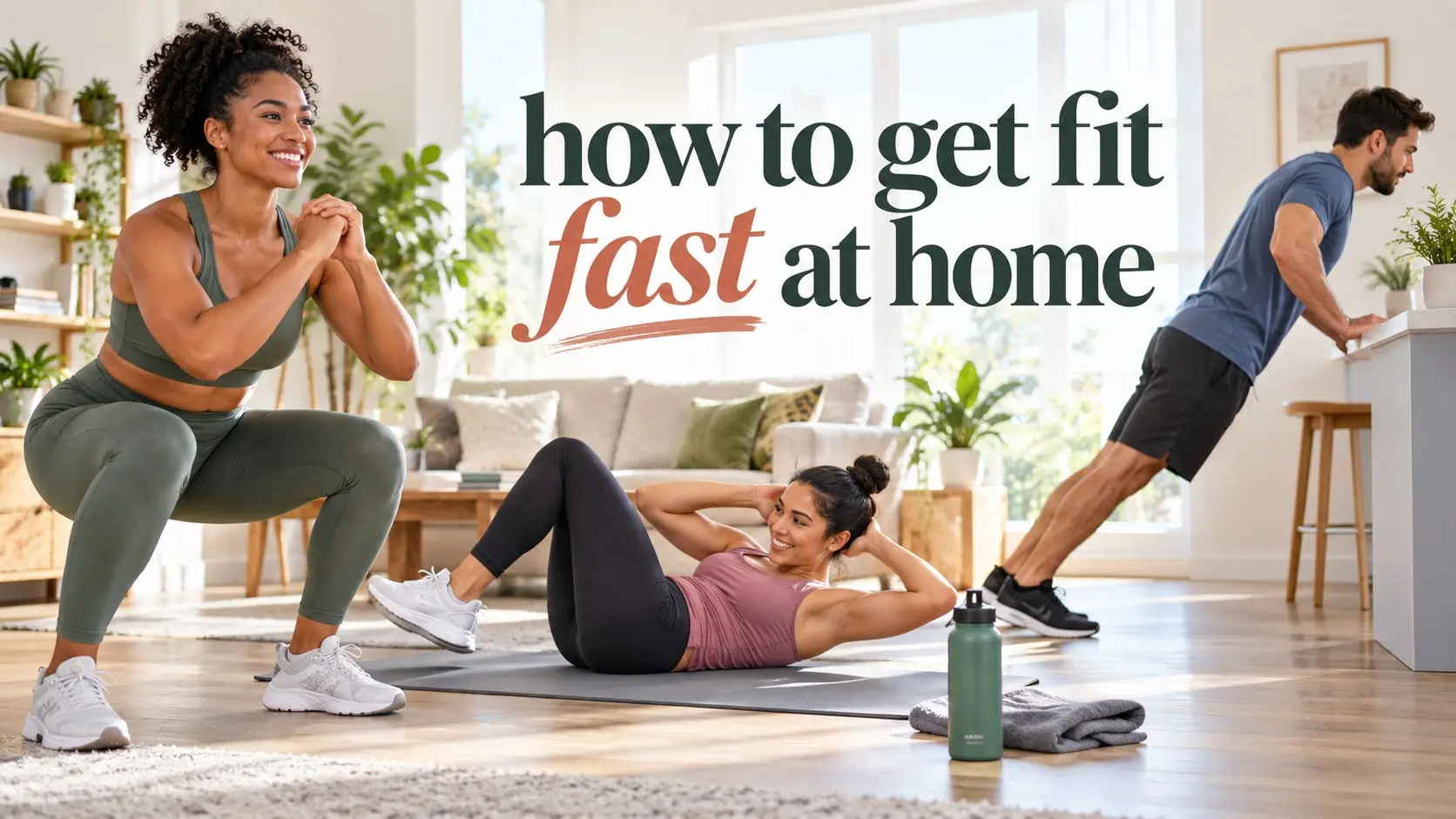
Topic: How to Get Fit Fast at Home
Reading Time: About 17 minutes
Written and Source-Checked by: Adel Galal, Founder and Lead Writer at NextFitLife
Review Status: This article is educational and source-checked. It has not been individually reviewed by a doctor, physical therapist, certified personal trainer, or sports medicine professional.
You do not need a gym.
You do not need dumbbells.
You do not need a brutal workout every day.
If you want to get fitter at home, focus on the things that give you the most return.
Move often.
Train your muscles.
Raise your heart rate.
Recover.
Then make the exercises harder as your body adapts.
Quick answer: If you want to know how to get fit fast at home, start with 2 or 3 full body bodyweight workouts each week, walk or do simple home cardio on other days, train all major muscle groups, progress gradually, sleep well, and eat a balanced diet. You can improve fitness without equipment, but large body changes take time.
For the full exercise library, visit the NextFitLife Fitness Hub.
If you are starting from zero, use the Fitness for Beginners Guide first.
Can you really get fit at home with no equipment?
Yes.
Your body can provide resistance.
You can squat.
Push.
Bridge.
Step.
Hold.
Walk.
Climb stairs.
Move faster.
The American College of Sports Medicine reported in its 2026 resistance training update that bodyweight exercise, elastic bands, and home-based training can produce meaningful improvements in strength, muscle growth, and physical function.3
A gym gives you more equipment.
It does not own fitness.
What does getting fit fast actually mean?
Fast should not mean extreme.
Getting fitter means your body becomes better at physical work.
You may notice:
- Walking feels easier
- You can do more squats
- You can hold a plank variation longer
- You recover faster after activity
- Stairs feel easier
- You can do a harder push up version
- You have better balance and control
Visible body changes are different.
They depend on your starting point, food intake, training, sleep, genetics, and time.
Do not use a mirror as your only fitness test.
Can you transform your body in 2 weeks?
Do not build your plan around that promise.
You can start a habit in two weeks.
You can practice exercises.
You can move more.
You may feel better at certain activities.
But a major change in muscle or body fat usually needs more time.
The faster goal should be momentum.
Not a fake transformation deadline.
The 7 steps for getting fitter at home
| Step | Main job |
|---|---|
| 1 | Start with a simple baseline |
| 2 | Train your whole body |
| 3 | Add regular cardio |
| 4 | Make exercises harder slowly |
| 5 | Use mobility and balance |
| 6 | Recover and sleep |
| 7 | Support the plan with food and tracking |
1. Find your starting point
Do not copy an advanced workout.
Test what you can do now.
You might check:
- How long you can walk comfortably
- How many chair squats you can do with good control
- Whether you can do a wall push up
- Whether stairs make you very tired
- How your balance feels
This is your starting point.
It is not a score.
You simply need something to improve.
What if you have not exercised for years?
Start very small.
Walk for 5 or 10 minutes.
Use a chair for squats.
Use a wall for push ups.
Do one set instead of three.
MedlinePlus advises people to build activity slowly rather than pushing too hard too soon.4
2. Use a full-body no-equipment workout
Your no-equipment workout does not need 20 exercises.
Use movements that train the main parts of the body.
Chair squat
Stand in front of a stable chair.
Sit back slowly.
Touch the chair lightly.
Stand again.
This trains your legs and hips.
Wall push up
Place your hands on a wall.
Keep your body straight.
Bend your elbows.
Move your chest toward the wall.
Push away.
This trains the chest, shoulders, and arms.
Glute bridge
Lie on your back.
Bend your knees.
Keep your feet on the floor.
Lift your hips with control.
Lower slowly.
This trains the hips and glutes.
Bird dog
Start on your hands and knees.
Extend one arm and the opposite leg.
Stay controlled.
Switch sides.
This trains control around the trunk.
Calf raise
Stand near support.
Rise onto your toes.
Lower slowly.
This trains the calves.
March in place
Stand tall.
Lift one knee.
Then the other.
Keep moving at a pace you can control.
This adds simple cardio.
A simple beginner home workout
This is an educational example.
It is not a personal exercise prescription.
| Exercise | Starting amount |
|---|---|
| Chair squat | 8 to 12 reps |
| Wall push up | 8 to 12 reps |
| Glute bridge | 8 to 12 reps |
| Bird dog | 6 to 10 each side |
| Calf raise | 8 to 15 reps |
| March in place | 1 to 3 minutes |
Start with one round.
If that feels comfortable, build to two rounds.
Then three if needed.
For more home training options, visit the Home Workouts and Equipment Guide.
Should beginners train every day?
No.
Your muscles need recovery.
You can move every day if the movement is comfortable.
But hard full-body strength sessions do not need to happen daily.
Current public guidance recommends strength work on at least 2 days each week.1
A beginner might start with:
Monday: Full body strength.
Tuesday: Walk.
Wednesday: Easy movement.
Thursday: Full body strength.
Friday: Walk.
Saturday: Longer walk or easy cardio.
Sunday: Recovery.
You can change the days.
3. Add cardio without turning every session into HIIT
You need cardiovascular fitness too.
Cardio can happen at home.
You can:
- Walk outdoors
- Walk indoors
- March in place
- Climb stairs when suitable
- Dance
- Use low impact step patterns
CDC recommends that adults build toward at least 150 minutes of moderate intensity aerobic activity each week.
Another option is 75 minutes of vigorous activity or a mix of both.1
WHO recommends 150 to 300 minutes of moderate activity for substantial health benefits.2
If you are inactive now, begin below those numbers.
Some movement is better than none.
What is moderate cardio?
You breathe faster.
Your heart beats faster.
You can still speak.
A brisk walk is a common example.
You do not need to be gasping.
Do you need HIIT to get fit fast?
No.
High intensity interval training is one option.
It is not the fastest answer for every person.
It is also not required for fat loss.
If you are new, normal walking and simple cardio are easier places to start.
Build a fitness base first.
Then decide whether harder intervals fit your goals.
A simple home cardio interval
Try this if normal walking is already comfortable.
- March easily for 2 minutes.
- March faster for 1 minute.
- Return to easy pace for 2 minutes.
- Repeat.
That is an interval.
You do not need jumping.
You do not need burpees.
4. Use progressive overload without weights
Eventually your workout becomes easy.
That is good.
It means your body adapted.
Now you need a little more challenge.
This is progressive overload.
You can progress a bodyweight exercise by:
- Adding repetitions
- Adding another set
- Moving more slowly
- Using a bigger safe range of motion
- Reducing support
- Moving to a harder exercise version
How do you make squats harder?
Start with a chair squat.
Then use less help from the chair.
Then use a normal bodyweight squat.
Later, try a split squat if it is suitable.
How do you make push-ups harder?
Start at a wall.
Then use a stable high surface.
Then use a lower stable surface.
Later, work toward the floor.
You do not need to jump straight from wall push ups to floor push ups.
Can bodyweight exercise build muscle?
Yes.
Muscles respond to resistance.
ACSM's 2026 evidence review states that bodyweight exercise and home-based training can produce meaningful gains in muscle strength, muscle size, and physical function.3
The exercise still needs to become challenging enough.
If you can do 50 easy repetitions, you may need a harder version.
For deeper strength guidance, use the Strength Training and Muscle Building Guide.
Do you need to train to failure?
No.
You do not need every set to end when another repetition is impossible.
ACSM's 2026 review found that training to momentary failure did not consistently improve results for the average healthy adult.3
Your repetitions should become challenging.
But you should still control your movement.
5. Add mobility and balance
Fitness is not only strength and cardio.
You also need to move well.
A short home mobility routine can include:
- Gentle shoulder circles
- Hip movement
- Calf stretching
- Chest opening
- Easy trunk rotation
Do not force a stretch.
More range is not always better.
For simple mobility ideas, use the Yoga and Flexibility Guide.
Do younger adults need balance training?
Balance is useful at any age.
Older adults have an extra reason to train it because balance work can help reduce fall risk.
A simple balance drill is standing on one foot near a wall or sturdy chair.
Do not close your eyes or use an unstable surface just to make the drill look harder.
6. Recovery can make your plan faster, not slower
This sounds strange.
But endless hard workouts do not create endless progress.
Your body needs time to adapt.
Workout recovery includes:
- Sleep
- Enough food
- Fluids
- Rest
- Easy movement
- Time between harder strength sessions
MedlinePlus lists inadequate rest and pushing too hard or too quickly among common causes of exercise injuries.5
Recovery is part of getting fit.
It is not wasted time.
Visit the Recovery and Injury Prevention Guide for more detail.
How do you know you are doing too much?
Watch for:
- Performance getting worse
- Constant heavy fatigue
- Pain that changes your movement
- Soreness that never settles
- Sleep getting worse
- Dreading every session
One tired day happens.
A pattern deserves attention.
Use an easier session or rest when needed.
7. Eat in a way that supports the goal
You cannot out-train every eating pattern.
Food matters for energy.
It matters for recovery.
It matters for body composition.
Build most meals around:
- Vegetables
- Fruit
- Protein foods
- Whole grains or other suitable carbohydrate foods
- Healthy fat sources
Examples of protein foods include:
- Eggs
- Fish
- Poultry
- Beans
- Lentils
- Yogurt
- Tofu
You do not need a detox.
You do not need a fat-burning drink.
You do not need a special home workout diet.
Can you burn fat and build muscle at home?
It is possible to improve both body fat and muscle in some situations.
But do not promise fast results.
Fat loss needs an energy deficit over time.
Muscle growth needs resistance, recovery, and enough nutrition.
A beginner may be able to improve muscle and lose body fat at the same time.
The amount and speed vary.
Does cardio burn belly fat?
Cardio uses energy.
That can support fat loss.
But you cannot choose where body fat leaves first.
Doing crunches does not force fat to leave the stomach.
Walking does not choose the thighs.
Fat distribution is influenced by biology.
Do you need to count calories?
No.
Calorie tracking is a tool.
It is not required for fitness.
If fat loss is a goal, portions and total food intake matter.
You can start by:
- Reducing high calorie drinks
- Watching portions
- Eating more meals built around whole foods
- Including protein and produce
- Limiting mindless snacking
If food tracking makes you fearful, obsessive, or distressed, stop and seek professional guidance.
What is the fastest useful home workout?
If you only have 15 minutes, use the time.
Minute 1 to 3
Walk or march.
Minute 4 to 6
Chair squats and wall push ups.
Minute 7 to 9
Glute bridges and bird dogs.
Minute 10 to 12
March faster.
Minute 13 to 15
Easy walking and gentle mobility.
A short workout still counts.
You do not need 60 minutes every time.
A simple 7 day home fitness plan
| Day | Plan |
|---|---|
| Monday | Full body strength plus easy walking |
| Tuesday | 20 to 30 minutes of walking or home cardio |
| Wednesday | Easy movement and mobility |
| Thursday | Full body strength plus easy walking |
| Friday | 20 to 30 minutes of walking or home cardio |
| Saturday | Longer enjoyable activity |
| Sunday | Rest or gentle movement |
This is a starting example.
Your week does not have to look exactly like this.
Can you use stairs for a home workout?
Yes, if stairs are safe for you.
Stair climbing can raise heart rate and train the legs.
Use the handrail when needed.
Do not sprint stairs if you are new to exercise or have balance problems.
A flat walk is a better start for many beginners.
What about burpees and jump squats?
You do not need them.
They are advanced compared with a chair squat or normal march.
Jumping increases impact.
Burpees combine several movements quickly.
If you are new, build strength and control first.
Do not choose an exercise because it looks harder.
Should home workouts make you very sore?
No.
Some muscle soreness can happen when you do something new.
Severe soreness is not proof of a good workout.
You should be able to recover and train again.
If pain is sharp, sudden, or changes how you move, stop the exercise.
Do you need a warm-up?
Yes, especially before harder activity.
Your warm-up can be simple.
Walk.
March.
Practice an easier version of the exercise.
Move your joints gently.
MedlinePlus lists exercising before warming up among common causes of exercise injury.5
What is a good cool down?
Slow down.
Walk gently.
Let your breathing settle.
You can add gentle stretching if it feels good.
You do not need a long routine.
How should you track progress?
Track performance.
Write down:
- How many workouts you completed
- How long you walked
- How many controlled squats you did
- Which push up version you used
- How many rounds you completed
- How your energy felt
A simple fitness tracker can be a notebook.
You do not need an expensive watch.
What happens when bodyweight exercises become too easy?
You have options.
Use a harder variation.
Add repetitions.
Add another round.
Slow the lowering part.
Eventually, adding resistance can make sense.
You might use:
- Resistance bands
- Dumbbells
- A backpack loaded carefully
But no equipment is required for your first phase.
Can you get fit without running?
Yes.
Running is optional.
You can build cardio with:
- Brisk walking
- Dancing
- Marching
- Low impact cardio
- Stairs when suitable
- Cycling if available
Choose something you can repeat.
What if you live in a small apartment?
You do not need much space.
A space long enough to lie down is enough for many movements.
Use:
- Chair squats
- Wall push ups
- Glute bridges
- Bird dogs
- Calf raises
- Marching
- Standing mobility
Be considerate with jumping if people live below you.
Low impact training works.
Can older adults get fit at home?
Yes.
But the exercise should match the person.
Good starting options can include:
- Walking
- Chair stands
- Wall push-ups
- Calf raises
- Supported balance work
Older adults should also include balance activity when appropriate.
If you have repeated falls, major balance problems, osteoporosis, severe joint pain, or another condition that changes safe movement, ask a healthcare professional or physical therapist for guidance.
Can you get fit after age 40 or 50 at home?
Yes.
The basic principles do not disappear with age.
You still need:
Movement.
Strength.
Cardio.
Recovery.
Progression.
The exercises and pace may need to change.
That is normal.
What are the biggest mistakes when trying to get fit fast at home?
Doing hard HIIT every day
You do not need it.
Starting with burpees and jump workouts
Learn simple movement first.
Training strength every day
Your muscles need recovery.
Doing only cardio
Strength matters too.
Doing only strength
Your heart and endurance need activity.
Changing your routine every few days
Repeat exercises long enough to improve them.
Training through pain
Pain is not a progress test.
Expecting visible results in one week
Build fitness first.
Using exercise to punish yourself for eating
Exercise should support health.
When should you talk with a healthcare professional first?
Many healthy adults can begin with light activity.
But get individual advice if you have a condition or symptom that may affect exercise safety.
Examples include:
- Heart disease
- Chest symptoms
- Repeated fainting
- Severe dizziness
- Major balance problems
- Recent surgery
- Severe joint pain
- Neurological symptoms
- Pregnancy concerns
- A medical condition that changes exercise tolerance
MedlinePlus also advises people who have been inactive for a long time or who have health concerns to discuss exercise with a healthcare provider when needed.4
When should you stop exercising?
Stop and seek urgent medical help for symptoms such as:
- Chest pain
- Severe shortness of breath
- Fainting
- Sudden severe dizziness
- Sudden weakness
- Confusion
- Signs of stroke
- Seizure
- Severe injury
Do not finish the workout just because the plan says you should.
What is the simplest rule for getting fitter quickly?
Use this:
Start easy.
Train often enough.
Make the work harder slowly.
Recover.
Repeat.
That is faster than starting an extreme plan and quitting after four days.
Conclusion
If you want to know how to get fit fast at home, forget the search for one killer workout.
Use your body.
Train your whole body.
Walk.
Add simple cardio.
Progress each exercise slowly.
Recover.
Support the routine with normal healthy food.
Your next step: Do one round of chair squats, wall push ups, glute bridges, bird dogs, calf raises, and marching today. Write down what you can do with good control. Repeat the same workout later this week.
References and Sources
These five high-authority sources are open and publicly accessible.
- Centers for Disease Control and PreventionPage: Adult Activity An OverviewUse: Current adult aerobic activity target, 150 minutes each week, 75 minutes vigorous option, muscle strengthening on 2 days, and the guidance that some activity is better than none.
Website: CDC.gov
URL: https://www.cdc.gov/physical-activity-basics/guidelines/adults.html
- World Health OrganizationPage: Physical ActivityUse: Adult aerobic activity guidance, 150 to 300 minutes of moderate activity, muscle strengthening, and general health benefits.
Website: WHO.int
URL: https://www.who.int/news-room/fact-sheets/detail/physical-activity
- American College of Sports MedicinePage: ACSM Unveils Landmark 2026 Resistance Training GuidelinesPublished: March 17, 2026
Use: Current resistance training evidence, bodyweight exercise, home-based training, muscle growth, strength, progression, consistency, and training to failure.
Website: ACSM.org
URL: https://acsm.org/resistance-training-guidelines-update-2026/
- MedlinePlusPage: Exercise and Physical FitnessUse: Home exercise, gradual progression, aerobic exercise, strength, habit building, exercise safety, and when health concerns need professional advice.
Website: MedlinePlus.gov
URL: https://medlineplus.gov/exerciseandphysicalfitness.html
- MedlinePlusPage: How to Avoid Exercise InjuriesUse: Warming up, gradual progression, proper form, rest, pain warning signs, overtraining, and exercise injury prevention.
Website: MedlinePlus.gov
URL: https://medlineplus.gov/ency/patientinstructions/000859.htm
Related NextFitLife Guides and Hubs
- NextFitLife Fitness Hub
- Fitness for Beginners Guide
- Home Workouts and Equipment Guide
- Strength Training and Muscle Building Guide
- Cardio and Endurance Guide
- Yoga and Flexibility Guide
- Recovery and Injury Prevention Guide
- Safe Beginner Guide to Getting Fit Fast
- Physical Fitness Guide
- Fitness Regime Guide
Author Bio
Adel Galal is the founder and lead writer of NextFitLife.
He has maintained a personal interest in health, fitness, nutrition, sleep, wellness, and healthy aging for more than 30 years.
His health and wellness writing and research communication experience spans more than 15 years.
NextFitLife launched in January 2022.
Before focusing full time on publishing, Adel spent 29 years working as an IT Manager for the Nestlé Egypt Region.
His background in data, information systems, planning, research organization, and structured problem-solving now supports his work in health and wellness research communication.
These are not medical or professional fitness credentials.
For fitness content, Adel reviews public health guidance, exercise science sources, safety recommendations, and current research before turning the information into simple educational guides.
NextFitLife aims to avoid extreme workout claims, guaranteed transformations, unsafe fast fitness promises, and advice that ignores pain, illness, pregnancy, injury, or medical conditions.
This content is for general educational purposes and does not replace professional medical advice, diagnosis, or treatment. Consult an appropriately qualified healthcare professional for personal medical concerns. This article explains published guidance and does not provide a personal clinical assessment. Always consult qualified medical professionals for diagnosis and treatment of any health condition.
For this topic, Adel Galal is also not a physician, physical therapist, certified personal trainer, certified strength coach, athletic trainer, registered dietitian, or sports medicine professional.
Exercise needs change with age, current fitness, injuries, pain, pregnancy, medical history, medicines, balance, and exercise experience.
Learn more about Adel Galal, NextFitLife, sourcing, review policies, corrections, and editorial standards on the About Us page.
Frequently Asked Questions
How can I get fit fast at home?
Use full body bodyweight strength training at least twice each week, add regular walking or cardio, increase the challenge slowly, recover well, and eat in a way that supports your goal.
Can I get fit at home without equipment?
Yes. Bodyweight exercises, walking, marching, stairs when safe, and mobility work can build fitness without gym equipment.
Can bodyweight workouts build muscle?
Yes. Current ACSM guidance supports bodyweight exercise and home based resistance training as effective ways to improve strength, muscle size, and physical function.
How many days a week should I exercise at home?
There is no one schedule for everyone. Adults should build toward regular aerobic activity and at least 2 days of muscle strengthening each week.
Do I need HIIT to get fit fast?
No. HIIT is optional. Walking, normal cardio, and strength training can build fitness without high-intensity intervals.
What is the best no equipment exercise?
There is no single best exercise. A balanced home workout uses several movements such as squats, push ups, bridges, core exercises, and walking.
Can I get fit in 2 weeks?
You can start building a routine and improving exercise skills in two weeks, but major changes in muscle or body fat usually take longer.
Can I get fit in 30 days?
You can make useful progress in a month if you train consistently, but the amount varies by starting level, health, training, food, sleep, and recovery.
Can I lose fat with home workouts?
Home workouts can support fat loss by increasing activity and building muscle. Fat loss still requires an energy deficit over time.
Can I build muscle and lose fat at home?
Some people can build muscle and reduce body fat, especially some beginners. The amount and speed differ between people.
Is walking enough to get fit?
Walking is excellent for aerobic fitness. A balanced program should also include muscle strengthening.
How can I make bodyweight exercises harder?
Add repetitions, add sets, use slower control, increase the safe range of motion, or move to a harder exercise version.
Do I need to train every day?
No. Daily movement can be useful, but hard strength workouts need recovery. Two or three strength sessions can be enough for many beginners.
Should I exercise if I am very sore?
Gentle movement can be fine with mild soreness. Severe soreness or pain that changes your movement is a reason to rest or seek professional advice.
When should I stop a home workout?
Stop for chest pain, severe shortness of breath, fainting, severe dizziness, sudden weakness, confusion, seizure, signs of stroke, severe injury, or other dangerous symptoms.

Health & wellness writer with 30+ years of experience in nutrition, fitness, and healthy aging. Founder of NextFitLife.com — evidence-based health guidance.