Life Cycle of Lice — these four words can instantly make any parent worry. I’ve been there. Lice feel overwhelming at first, but once you understand how they grow, how long they live, and when they hatch, you suddenly have a huge advantage. In fact, learning the life cycle was the turning point that finally ended the lice problem in my home.
Lice don’t go away by luck. They go away when you time your treatment to their exact growth stages. In this guide, I’ll explain every part of the Life Cycle of Lice, in simple words, with real-life experience, expert tips, and steps that work.
My Personal Experience (Why This Guide Matters)
A few years ago, my daughter came home scratching her head. I checked her scalp and saw something tiny move. My heart sank. I recall wondering to myself, “Just how much worse could this possibly become?”
I treated it once, thought I had solved it … and then a week later, the itching started again. I felt frustrated because I didn’t know what I was doing wrong.
Then I learned something important:
Most people don’t remove lice completely because they don’t understand its life cycle.
I changed my approach — timing each step to match the egg hatching timeline, the nymph stage, and the adult lifespan. And suddenly, it worked.
This guide is what I wish I had had the first time.
Early-Stage Head Lice: How It Starts and What You Should Look For
Most lice infestations start quietly. Early-stage head lice are small, fast, and hard to spot — and this is when they spread the most.
Here’s what usually happens:
Early-Stage Signs (Often Missed)
- Light itching near the neck hairline
- Tiny white or yellow dots glued to hair (these are nits)
- A tickling feeling when hair moves
- More itching at night (lice are more active in warmth)
I’ve seen many parents confuse early lice eggs with dandruff, but here’s an easy trick:
Dandruff moves. Nits don’t.
Nits are cemented to the hair strand and won’t slide off.
What Early Lice Look Like
- Nits look like tiny sesame seeds, but lighter.
- Baby lice (nymphs) look like white dots that move.
- They are swift and avoid light.
If you catch lice at this stage, you can stop a full infestation before it becomes a nightmare. This is why knowing the Life Cycle of Lice is so important — you treat at the right time instead of treating repeatedly.
What Is the Full Life Cycle of Lice? (Simple Explanation)
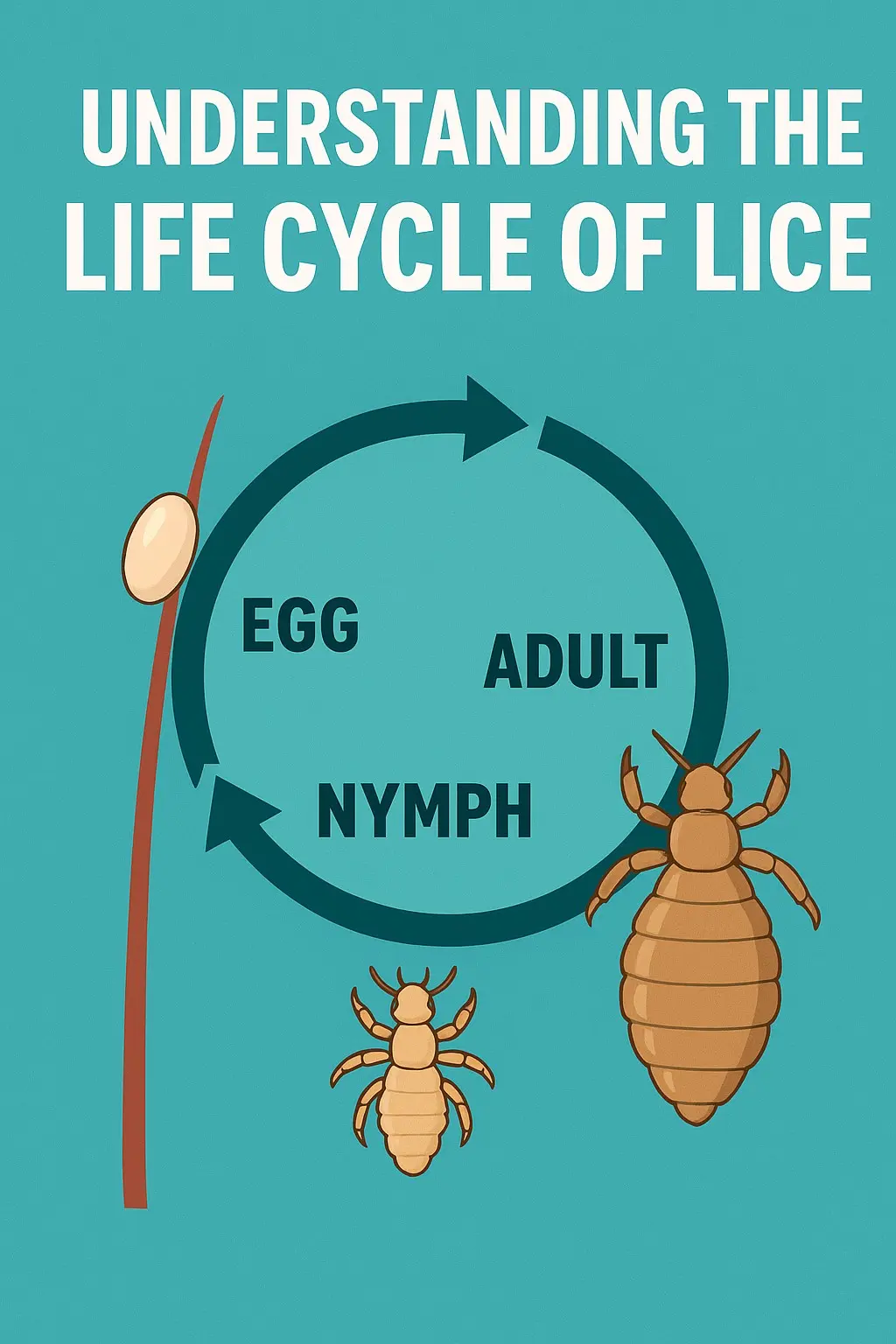
According to CDC and health experts, the Life Cycle of Lice has three stages:
- Egg (Nit)
- Nymph
- Adult Louse
Understanding each stage lets you break the cycle completely.
Stage 1 – Eggs (Nits)
Nits are the starting point of every infestation.
What Nits Look Like
- Small (0.8 mm)
- Oval
- White, yellow, or tan
- Glued onto the hair near the scalp
- Do not fall off because of shaking
Nit Hatching Timeline
Nits hatch in 6–9 days, depending on the heat from the scalp.
(If a nit is farther from the scalp, it usually won’t hatch.)
Why this matters
Most treatments don’t kill all eggs.
This means:
You MUST treat it a second time when the eggs hatch.
If you don’t, all the new nymphs survive and the infestation returns.
Stage 2 – Nymph (Young Lice)
Once the nit hatches, we enter the nymph stage of lice development.
What Nymphs Look Like
- Smaller versions of adults
- Off-white or gray
- Move quickly
- Must eat every few hours
- Hard to see because they’re tiny
How Long Nymphs Grow
Nymphs pass through three moults
This is called the lice moulting process, and it lasts around:
7 days
By the end of the week, they become full adults ready to lay eggs.
Stage 3 – Adult Lice
Now we have reached the stage that causes the biggest problems.
What Adult Lice Look Like
- The size of a sesame seed
- Six legs
- Darker after feeding
- Strong claws to grip hair
- Hard to shake off
Adult Lice Lifespan
- Up to 30 days on the scalp
- Only 1–2 days off the head
(because they need warmth and blood)
Adult Lice Reproduction
This is where infestations explode.
One female can lay:
6–8 eggs per day
Up to 150 eggs in her lifetime
This is why catching lice early matters so much.
Full Life Cycle Timeline (Egg → Adult)
Here’s a simple table to understand how fast lice develop:
| Stage | Duration | Notes |
| Egg (Nit) | 6–9 days | Hatches near scalp warmth |
| Nymph | ~7 days | 3 moulting stages |
| Adult Louse | Up to 30 days | Lays 6–8 eggs daily |
| Off the head | 1–2 days | Dies without blood |
Why Lice Spread So Easily (And What People Miss)
Lice do not fly or jump.
They crawl, quickly and effectively.
They spread mainly through:
- Head-to-head contact
- Sharing pillows
- Sharing hats
- Using the same brushes
- Sleeping close to someone with lice
Early-stage head lice are especially contagious because they’re small and go unnoticed.
How Long Do Lice Live on Pillows or Furniture?
Adult lice die after 1–2 days without feeding.
Nits on your pillow rarely hatch because they lack heat.
BUT…
Hair strands with eggs can fall onto:
- Bedding
- Sofas
- Car seats
This is why cleaning is still important.
Actionable Plan to Break the Life Cycle of Lice
I’ve tested this method myself, and it works.
Step 1 – First Treatment (Day 1)
Use a lice-killing product
AND
Start wet combing immediately.
Wet combing helps remove:
- Live lice
- Nits
- Newly hatched nymphs
Step 2 – Combining Schedule (Critical)
Comb every 2–3 days for two weeks.
This catch:
- Hatching nymphs
- Missed eggs
- Surviving adults
I like this step because it makes me feel in control.
Step 3 – Second Treatment (Day 7–10)
This is where most people fail.
Why day 7–10?
Because:
This is when most eggs hatch.
Nymphs are vulnerable.
You kill them BEFORE they lay new eggs.
Step 4 – Clean the Environment
Clean the things that touch the head:
- Pillowcases (hot wash)
- Bedsheets
- Hats
- Combs
- Hair ties
- Hoodies
- Scarves
For items you cannot wash:
Seal them in a bag for 48 hours.
Since lice die in 1–2 days, this is enough.
Step 5 – Prevent Reinfestation
- Avoid head-to-head contact
- Do not share pillows
- Train children not to lean their heads together
- Store hats separately
- Regularly check all family members
Early-Stage Head Lice vs Full Infestation (Comparison Table)
| Feature | Early-Stage | Full Infestation |
| Itching | Light | Strong |
| Number of lice | Few | Many |
| Number of nits | Small amount | Hundreds |
| Crawling feeling | Rare | Frequent |
| Chances of spreading | High | Very high |
| Treatment difficulty | Easy | Harder |
Myths vs Facts
| Myth | Truth |
| Only dirty hair gets lice | Anyone can get lice |
| Lice jump or fly | They crawl |
| You need to bag items for weeks | 48 hours is enough |
| Pets can spread head lice | They cannot |
| Nits far from the scalp are healthy | They rarely hatch |
Expert Tips I Learned from Experience
- The lice reproduction cycle is your enemy — time your treatments to stop it.
- Don’t rely only on shampoo. Combing is mandatory.
- Check behind the ears and the nape —
This is where lice love to hide. - Early-stage lice are tiny; use bright light when checking.
- Tie long hair up to prevent spread.
- Keep calm — lice are annoying, not dangerous.
Key Takeaways
- The Life Cycle of Lice has 3 stages: egg → nymph, → adult.
- Eggs hatch in 6–9 days.
- Nymphs grow into adults in 7 days.
- Adults lay 6–8 eggs daily and live 30 days on the scalp.
- Always treat lice twice, 7–10 days apart.
- Combining every few days is essential.
- Clean only the items that touch the head.
- Understanding the life cycle = fast, effective control.
FAQs About the Life Cycle of Lice
How long is a lice life cycle?
About 3–4 weeks from egg to adult.
How fast do lice multiply?
A single adult can lay 6–8 eggs daily, up to 150 eggs in a lifetime.
Can head lice live in pillows?
Only 1–2 days, but hair with eggs can fall onto pillows.
Wash pillowcases in hot water.
How long does it take to get rid of lice infestation?
Usually, 2 weeks with proper timing, but check hair weekly for a month.
Can you sleep next to someone with lice and not get it?
Yes, but the risk is high.
Lice spread mainly through head-to-head contact, not casual closeness.
Conclusion: Your Path Forward
Knowing the life cycle of lice isn’t just biology — it’s your map to control. When you understand how lice grow, when they hatch, and where they can survive, you can build a strong, effective plan that breaks their cycle for good.
From my experience, treating without timing was the mistake. But once I understood the life cycle, everything changed: fewer surprises, less stress, and no wild chase after re-emerging lice.
So take a deep breath. Use this guide. Timed treatment, smart combing, and environmental steps can give you peace of mind — and help put an end to lice.
Reference
- Centers for Disease Control and Prevention (CDC) – Pediculosis
https://www.cdc.gov/dpdx/pediculosis/ - CDC – Head Lice Information
https://www.cdc.gov/lice/about/head-lice.html - EPA – About Lice and Their Control
https://www.epa.gov/ipm/about-lice-and-their-control - NIH / PubMed – Lice Development & Temperature
https://pmc.ncbi.nlm.nih.gov/articles/PMC1070891/

Adel Galal is a health and wellness writer with over 30 years of experience studying and writing about health, fitness, nutrition, and healthy living. He is the founder of NextFitLife.com, where he shares practical, evidence-based guidance to support long-term health at any age. Adel’s mission is simple:
to help people make smarter health choices that fit real life, at any age.