Home
Published:
Nov 23, 2025
Last Updated:
August 18, 2026
Next Review:
August 2027, or sooner if major treatment guidance changes
Written and source checked by:
Adel Galal,
Founder and Lead Writer of NextFitLife
Medical Review Status:
This article has not been formally reviewed by a dermatologist, pediatrician, infectious disease specialist, pharmacist, or another licensed healthcare professional.
Then you see something move.
It may be head lice.
The discovery can feel upsetting.
But head lice are common.
They do not mean that a person is dirty.
They do not mean that a home is dirty.
And head lice do not spread disease.
They are small insects that live on the scalp and feed on human blood.
They move by crawling.
They cannot fly.
They cannot jump.
The main way they spread is close head to head contact.
This guide explains how to recognize head lice symptoms, how to tell nits from dandruff, how lice spread, what treatment involves, what you really need to clean, how schools should handle lice, and when to ask a healthcare professional for help.
Quick Answer: What Are Head Lice?
Head lice are tiny parasitic insects that live mainly on the human scalp.
Their medical name is Pediculus humanus capitis.
Adult lice are about the size of a sesame seed.
They feed on small amounts of blood from the scalp.
Common signs include:
- Scalp itching
- A tickling or crawling feeling
- Live lice moving in the hair
- Nits attached firmly to hair shafts
- Sores caused by scratching
The best evidence of an active infestation is finding a live crawling louse.
Head lice are treatable with approved medicines, careful combing, or other treatment methods recommended in your country.
Medical note:
This content is for general educational purposes and does not replace professional medical advice, diagnosis, or treatment. Consult an appropriately qualified healthcare professional for personal medical concerns. This article explains published guidance and does not provide a personal clinical assessment. Always consult qualified medical professionals for diagnosis and treatment of any health condition.
Head Lice at a Glance
- Head lice live mainly on the scalp.
- They crawl.
- They do not jump or fly.
- Head to head contact is the main way they spread.
- Getting head lice has nothing to do with poor hygiene.
- Pets do not give people head lice.
- Head lice do not transmit disease.
- Scalp itching is common but may take weeks to start.
- Finding a live louse is the best way to confirm an active infestation.
- Nits can be confused with dandruff or hair debris.
- Treatment depends on the product and the person's age and health.
- Not every lice treatment requires automatic retreatment.
- Extensive house cleaning is usually unnecessary.
- Children do not normally need to be sent home from school early.
What Do Head Lice Look Like?
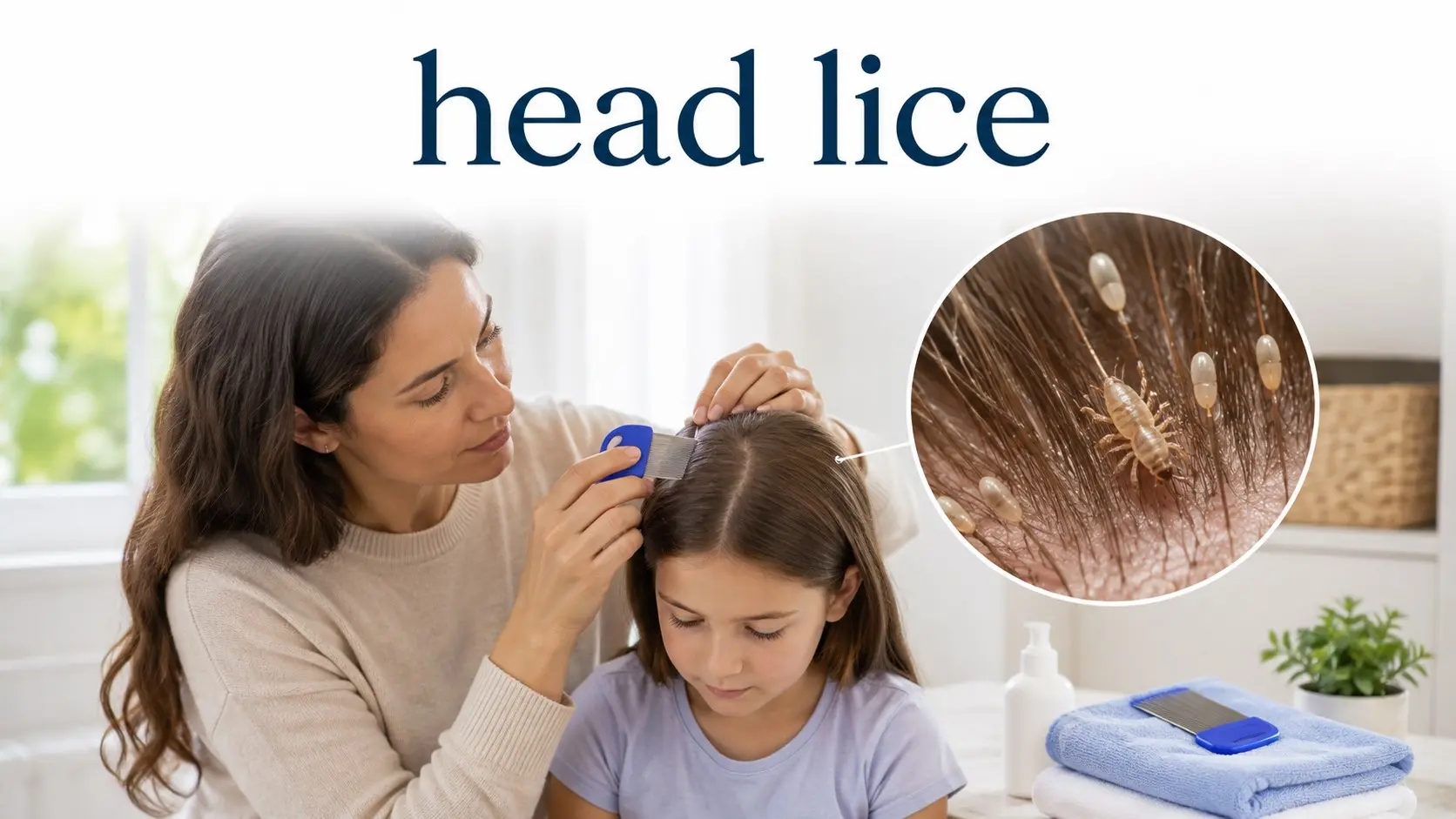
Adult head lice are very small.
They are about 2 to 3 millimeters long.
That is roughly the size of a sesame seed.
Their color can vary.
They may look tan, gray, or brown.
They move quickly through the hair.
Young lice are called nymphs.
They look like smaller adult lice.
The eggs are called nits.
Nits are attached firmly to individual hairs.
You often find them close to the scalp.
Common areas include:
- Behind the ears
- Near the back of the neck
- Close to the scalp
What Are the Symptoms of Head Lice?
Not everyone with head lice has symptoms right away.
A light infestation may cause very little discomfort.
During a person's first infestation, itching can take several weeks to appear.
1. Itchy Scalp
Scalp itching is the most common symptom.
The itch is caused by a reaction to lice bites.
Itching alone does not prove that lice are present.
Dandruff, eczema, dry skin, and other scalp problems can also itch.
2. A Crawling or Tickling Feeling
Some people feel movement in their hair.
They may describe it as tickling or crawling.
3. Live Lice
Seeing live lice provides the clearest sign of an active infestation.
They can be hard to find because they are small and move quickly.
4. Nits Attached to Hair
You may see tiny oval objects attached firmly to individual hairs.
These may be lice eggs.
5. Sores From Scratching
Repeated scratching can break the skin.
These areas can sometimes become infected with bacteria.
6. Trouble Sleeping
Itching and scalp irritation may make sleep difficult for some people.
What Are Nits?
Nits are lice eggs or empty egg shells.
They are very small.
They are attached to hair with a strong substance that helps hold them in place.
This makes them difficult to brush away.
A nit close to the scalp is more useful when assessing whether an infestation may still be active.
CDC guidance says that nits found more than about one-quarter inch from the scalp are almost always hatched or dead.
That means finding an old nit far from the scalp does not automatically mean that a person still has active lice.
Head Lice Versus Dandruff: How Can You Tell?
| Feature | Nits | Dandruff |
|---|---|---|
| Attachment | Firmly attached to one hair | Usually loose |
| Removal | Hard to slide off | Often brushes away |
| Location | Often close to the scalp | Can be spread through the hair |
| Movement | Nits do not move by themselves | Flakes may move or fall easily |
Hair spray, dirt, lint, dried products, and skin flakes can also look like nits.
This is one reason lice are often misdiagnosed.
How Do You Check for Head Lice?
Use bright light.
A fine-tooth lice comb can help.
Work slowly.
- Separate the hair into small sections.
- Look closely at the scalp.
- Check behind both ears.
- Check the hair near the back of the neck.
- Look for moving lice.
- Look for nits stuck firmly to hairs close to the scalp.
- Use the lice comb from the scalp toward the end of the hair.
A magnifying lens may help.
The best confirmation of active head lice is finding a live nymph or adult louse.
If you are not sure what you found, ask a healthcare professional or pharmacist.
How Do Head Lice Spread?
The main route is direct head-to-head contact.
One louse crawls from one person's hair to another person's hair.
This can happen when children:
- Play closely together
- Hug
- Lean their heads together
- Share a bed
- Take part in close group activities
Lice cannot jump.
They cannot fly.
They crawl.
Can Head Lice Spread Through Hats, Brushes or Bedding?
It is possible.
But direct hair contact is the main route.
Less common routes can include recently shared:
- Combs
- Brushes
- Hats
- Scarves
- Towels
- Pillows
A louse that falls off the human head does not survive for long because it can no longer feed.
This is why the risk from furniture and household surfaces is much smaller than the risk from direct head contact.
Can Dogs or Cats Spread Head Lice?
No.
Human head lice live on humans.
Dogs, cats, and other household pets do not carry or spread human head lice.
You do not need to treat a pet because a child has head lice.
Does Head Lice Mean Poor Hygiene?
No.
This myth causes shame.
Head lice do not care whether hair is clean or dirty.
Anyone can get them.
Children get lice often because they spend time close to other children.
Do not shame a child or family because of lice.
Treat the infestation.
That is what matters.
Can Head Lice Spread Disease?
Head lice do not transmit disease.
They are different from body lice.
Head lice can still cause problems.
Severe itching may lead to scratching.
Scratching can break the skin.
Broken skin can sometimes develop a bacterial infection.
What Is the Life Cycle of Head Lice?
The lice life cycle has three main stages.
Egg
The female louse attaches eggs to hair.
Eggs usually hatch in about 6 to 9 days.
Nymph
The young louse is called a nymph.
It looks like a smaller adult.
It usually takes about another week to become an adult.
Adult Louse
Adult lice live on the scalp and feed on human blood.
The life cycle matters because some treatments kill crawling lice but do not kill every egg.
For the full biology and treatment timing, read
Life Cycle of Lice
.
How Are Head Lice Treated?
Head lice treatment should begin only after an active infestation has been identified.
Treatment options vary by country.
They can include:
- Approved medicines available without prescription
- Prescription lice medicines
- Careful combing
- Wet combing in health systems that recommend it
The correct choice can depend on:
- The person's age
- Pregnancy or breastfeeding
- Previous treatment
- Local treatment resistance
- Other health conditions
Always follow the instructions for the exact product being used.
For detailed treatment steps, read
How to Get Rid of Head Lice
.
What Medicines Are Used for Head Lice?
Both nonprescription and prescription treatments are available in some countries.
Common active ingredients can include medicines such as:
- Permethrin
- Pyrethrins with piperonyl butoxide
- Spinosad
- Ivermectin lotion
- Malathion in selected cases
Availability and approved ages differ by country.
Some products kill live lice but not all eggs.
Some products affect both lice and eggs.
This changes whether a second treatment is needed.
Use only one treatment product at a time unless a healthcare professional tells you otherwise.
Do not use more medicine than the label recommends.
Do You Always Need a Second Head Lice Treatment?
No.
This is an important point.
Retreatment depends on the medicine.
If a product kills live lice but does not reliably kill eggs, another treatment may be needed after the eggs hatch.
If the medicine kills both lice and eggs, routine retreatment may not be necessary.
Follow the instructions for your exact product.
If you are unsure, ask a pharmacist or healthcare professional before treating again.
What Is a Nit Comb?
A nit comb is a fine-tooth comb designed to remove lice and nits from hair.
It can help:
- Find live lice
- Remove crawling lice
- Remove nits
- Check whether treatment is working
Work in small sections.
Start close to the scalp.
Pull the comb through the full length of the hair.
Clean the comb between passes.
Does Wet Combing Work for Head Lice?
Wet combing is used as a treatment method in some health systems.
It involves wetting the hair and carefully combing the full scalp and hair with a fine detection comb on repeated days.
This approach takes time and needs careful repetition.
If you choose wet combing instead of medicine, follow a recognized local health service method.
Do not mix several home methods and medicines without guidance.
Should Everyone in the Family Be Treated?
Do not automatically use lice medicine on everyone.
First check household members and close contacts.
Treat people who have an active infestation.
CDC also advises treating people who share a bed with the infested person at the same time.
Checking the whole household helps reduce the chance that lice will move back to someone who has already been treated.
How Much House Cleaning Is Needed for Head Lice?
Less than many people think.
Lice need human blood.
They do not live well away from the scalp.
CDC says spending large amounts of time and money cleaning the house is not necessary.
Focus on items that recently touched the person's hair or head.
Wash Recent Clothing and Bedding
CDC advises washing clothing, towels, bedding, and similar items used during the two days before treatment.
Use hot water and high heat drying when the item allows it.
Clean Combs and Brushes
Soak recently used combs and brushes in hot water according to public health guidance.
Vacuum Main Areas
Vacuum places where the person recently sat or lay.
You do not need to disinfect every surface in the house.
Do Not Use Fumigant Sprays
Do not use insect foggers or fumigant sprays for head lice.
They are unnecessary and can be harmful.
Do You Need to Bag Everything in the House?
No.
There is no reason to put the whole house into plastic bags.
For a recently used item that cannot be washed or dry cleaned, CDC guidance allows sealing the item in a bag for two weeks.
Focus only on relevant recent items.
Do not turn lice treatment into a full home decontamination project.
Do Home Remedies Kill Head Lice?
Be careful.
Many online remedies have little evidence.
CDC states that there is no scientific evidence that substances such as mayonnaise, olive oil, butter, or margarine reliably suffocate head lice.
Never use dangerous substances such as:
- Gasoline
- Kerosene
- Household insecticides
- Animal flea treatments
- Toxic sprays
Use treatments designed for human head lice.
What About Essential Oils for Head Lice?
Do not assume an essential oil is safe because it is natural.
Some oils can irritate the skin.
Some can cause allergic reactions.
Evidence for many essential oil lice treatments is limited.
Do not use them instead of an effective treatment plan without professional advice.
Why Does Head Lice Treatment Sometimes Fail?
Treatment failure does not always mean that the lice are unusually strong.
Common reasons include:
- The problem was not lice in the first place
- The product was used incorrectly
- Not enough product was used for the amount of hair
- The treatment was rinsed too early
- Retreatment was needed but was missed
- The lice were resistant to the medicine
- The person got lice again from another person
If lice appear as active as before several hours after treatment, do not repeatedly apply more medicine.
Ask a healthcare professional what to do next.
What Are Resistant Head Lice?
Some lice populations can become resistant to certain older insect killing medicines.
People sometimes call these resistant lice or super lice.
Resistance is only one reason treatment may fail.
Incorrect diagnosis and incorrect product use are also common problems.
A healthcare professional can recommend another treatment when an appropriate first treatment fails.
How Can You Prevent Head Lice From Spreading?
There is no perfect way to prevent every infestation.
You can reduce opportunities for lice to crawl between people.
Useful lice prevention habits include:
- Avoid direct hair contact with a person who has active lice
- Teach children not to put their heads together during an active outbreak
- Do not share combs and brushes during an infestation
- Avoid sharing recently used hats and hair items
- Check close household contacts
- Treat confirmed infestations correctly
Routine pesticide use to prevent lice is not appropriate.
Can a Child With Head Lice Go to School?
Yes, after appropriate treatment has begun.
CDC says a child found to have head lice does not need to be sent home early.
The child can finish the school day.
Treatment can begin at home.
The child can return to class after beginning appropriate treatment.
The American Academy of Pediatrics also says head lice are not a reason for a child to miss unnecessary school.
Does a Child Need to Be Nit Free Before Returning to School?
Usually, no.
Old nits can remain attached to hair even after successful treatment.
The presence of a nit does not prove that a live louse is still present.
Public health and pediatric guidance does not support keeping children away from school simply because nits remain.
Follow your local school policy while discussing outdated policies with your pediatrician or school health staff when needed.
Why Are Head Lice Common in Children?
Head lice are especially common in preschool and elementary age children.
It is not because children are less clean.
Children often:
- Play close together
- Hug
- Lean their heads together
- Share sleeping spaces
Close hair contact gives lice a chance to crawl from one head to another.
Can Any Hair Type Get Head Lice?
Yes.
Head lice can affect people with many hair types.
Treatment technique may need to be adjusted for:
- Very long hair
- Very thick hair
- Curly hair
- Coily hair
- Braided hair
The main goal is to make sure the selected treatment reaches the areas required by the product instructions.
You may need more product for long or thick hair.
Do not increase the strength or concentration.
Can Adults Get Head Lice?
Yes.
Adults can get lice through close contact with someone who has them.
Parents and caregivers may be exposed while caring for children.
The same basic rules apply.
Confirm the infestation before treating.
Use an appropriate product correctly.
Check close contacts.
What About Head Lice During Pregnancy or Breastfeeding?
Do not assume every lice medicine is appropriate during pregnancy or breastfeeding.
Ask a healthcare professional or pharmacist before choosing a product.
Tell them:
- That you are pregnant or breastfeeding
- How old the child is if treating a child
- Which products have already been tried
- Whether you have allergies or medical conditions
What About Head Lice in Babies and Young Children?
Treatment choices can be different for very young children.
Do not use an adult lice product on a baby without professional advice.
CDC recommends talking with a healthcare professional before treating young children.
A pediatrician or pharmacist can help you choose an age-appropriate method.
Can You Catch Head Lice in a Swimming Pool?
Swimming is not considered a common way to spread head lice.
Lice hold tightly to hair.
They do not normally swim from one person's head to another.
Close head contact around the pool is more relevant than the water itself.
Do You Need to Cut or Shave Hair to Get Rid of Lice?
No.
Most people can treat head lice without cutting or shaving their hair.
Long or thick hair can make treatment and combing take longer.
But shaving is not normally required.
How Do You Know If Head Lice Treatment Worked?
Look for live crawling lice.
Follow the treatment instructions about when to check the hair.
Some lice may move slowly for several hours after treatment.
Do not apply another dose immediately unless the instructions or a healthcare professional tell you to.
Continue checking and combing according to the treatment plan.
Old nits can remain attached even after the live infestation has ended.
When Should You See a Healthcare Professional?
Ask for professional help if:
- You are not sure that the problem is head lice
- A treatment does not work when used correctly
- Live lice continue after appropriate treatment
- The scalp becomes very red or painful
- You see pus or signs of skin infection
- The person has a severe reaction to a treatment
- You need to treat a very young child
- You are pregnant or breastfeeding and need treatment advice
A dermatologist or pediatrician can also help when lice keep returning.
Can Head Lice Cause an Emergency?
Head lice themselves are rarely an emergency.
Get urgent medical care for a severe allergic reaction to a treatment.
Warning signs can include:
- Severe trouble breathing
- Swelling of the face or throat
- Fainting
- Another severe reaction after applying a product
Stop using any product that causes a severe reaction and seek appropriate medical care.
Common Head Lice Myths
Myth: Head Lice Mean Dirty Hair
False.
Cleanliness does not determine who gets lice.
Myth: Head Lice Jump
False.
They crawl.
They do not jump or fly.
Myth: Pets Give Children Head Lice
False.
Human head lice are not spread by household pets.
Myth: Every White Speck Is a Nit
False.
Dandruff, lint, dried hair products, and dirt can look like nits.
Myth: Nits Alone Always Mean Active Lice
False.
Old or hatched nits may stay attached to hair after the infestation has ended.
Myth: Every Head Lice Medicine Needs a Second Treatment
False.
Retreatment depends on the medicine.
Follow the instructions for the exact product.
Myth: You Must Spray the Whole House With Insecticide
False.
Fumigant sprays are unnecessary and can be toxic.
Myth: A Child With Nits Must Stay Home From School
False.
Public health and pediatric guidance does not support unnecessary exclusion because nits remain after treatment.
Myth: Mayonnaise Is a Proven Head Lice Treatment
False.
There is not good scientific evidence that mayonnaise reliably kills head lice.
A Simple Head Lice Action Plan
Step 1: Confirm It
Look for a live crawling louse.
Use bright light and a lice comb.
Step 2: Check Close Contacts
Check people living in the same home and other close contacts.
Step 3: Choose the Right Treatment
Use an approved treatment or a recognized combing method.
Follow the instructions exactly.
Step 4: Check Again
Follow the product instructions about combing, monitoring, and retreatment.
Step 5: Clean Only What Matters
Focus on recently used bedding, clothing, towels, combs, and brushes.
Step 6: Reduce Head Contact
Avoid close hair contact until treatment is underway and lice are controlled.
Step 7: Get Help If Treatment Fails
Do not keep applying the same medicine again and again.
Ask a healthcare professional about the next option.
How I Approach Head Lice Research
I have spent more than fifteen years researching and writing about health, infections, fitness, nutrition, sleep, and everyday wellness.
I also bring more than thirty years of personal experience with fitness, nutrition, sleep habits, and general wellness.
For a topic like head lice, my first goal is to remove fear and bad information.
Lice are small.
That makes them easy to misidentify.
Treatment instructions can also vary by product.
So I do not think a reader should treat every white speck as a live infestation.
I also do not think families should cover a whole home with pesticides because one child has lice.
When I research this topic, I compare guidance from public health agencies, dermatology organizations, pediatric sources, and medical references.
I pay special attention to diagnosis, treatment safety, children's needs, resistance, school advice, and claims about home remedies.
Before focusing on NextFitLife, I spent twenty nine years in information technology management.
That background taught me to work through problems step by step.
I use the same process here.
First confirm the problem.
Then use the correct treatment.
Then check the result.
Then change the plan only when the evidence says you need to.
That approach is simpler and safer than panic.
References and Sources
The main facts and treatment guidance in this article were checked against these five high-authority and publicly accessible sources.
- Centers for Disease Control and Prevention.
About Head Lice.This resource explains what head lice are, symptoms, spread, diagnosis, prevention, nits, household cleaning, and school guidance.
Open CDC Head Lice Guidance
. - Centers for Disease Control and Prevention.
Treatment of Head Lice.This resource explains treatment options, retreatment, combing, household measures, treatment failure, and unsafe fumigant sprays.
Open CDC Head Lice Treatment Guidance
. - MedlinePlus, U.S. National Library of Medicine.
Head Lice.This public medical resource explains head lice, symptoms, spread, diagnosis, treatment, prevention, and important safety information.
Open MedlinePlus Head Lice Guidance
. - American Academy of Dermatology.
Head Lice: Diagnosis and Treatment.
Updated September 3, 2025.This dermatology resource explains how to identify lice and nits, use a lice comb, apply treatment correctly, manage treatment failure, and know when professional care is needed.
Open AAD Head Lice Guidance
. - American Academy of Pediatrics through HealthyChildren.org.
Controlling Head Lice and Reducing Stigma.This resource explains treatment, school attendance, stigma, screening policies, and why head lice are not a sign of poor hygiene.
Open AAP Head Lice Guidance
.
These organizations do not endorse NextFitLife.
Conclusion
Head lice are common.
They are irritating.
But they are treatable.
They do not mean someone is dirty.
They do not jump.
They do not come from pets.
And head lice do not spread disease.
The most important step is correct identification.
Find live lice when possible.
Use the right treatment.
Follow the instructions.
Check close contacts.
Clean only the items that matter.
Do not panic over old nits.
Your next step:
If you think you have head lice, use bright light and a fine-tooth lice comb to confirm live lice before starting treatment.
Editorial Policies and Trust
About the Author

Frequently Asked Questions About Head Lice
What are head lice?
Head lice are small parasitic insects that live mainly on the scalp and feed on human blood.
Their medical name is Pediculus humanus capitis.
What are the main symptoms of head lice?
Common symptoms include an itchy scalp, a crawling or tickling feeling, live lice in the hair, nits close to the scalp, and sores caused by scratching.
Can you have head lice without itching?
Yes.
Some people have few symptoms.
During a first infestation, itching can take several weeks to appear.
How do I know if I really have head lice?
Finding a live crawling nymph or adult louse is the best way to confirm an active infestation.
Use bright light and a fine tooth lice comb.
What do head lice look like?
Adult head lice are small crawling insects about the size of a sesame seed.
They may look tan, gray, or brown.
What do lice eggs look like?
Lice eggs are called nits.
They are small oval objects attached firmly to individual hair shafts, often close to the scalp.
How can I tell nits from dandruff?
Dandruff usually moves or brushes away easily.
Nits are attached firmly to a hair and can be difficult to slide off.
Do nits always mean active head lice?
No.
Old or hatched nits can remain attached after lice are gone.
Nits found far from the scalp are often old, hatched, or dead.
How do head lice spread?
Head lice mainly spread through direct head-to-head or hair-to-hair contact with a person who has an active infestation.
Can head lice jump or fly?
No.
Head lice move by crawling.
They cannot jump or fly.
Can you catch head lice from a pillow?
It is possible but much less common than direct head contact.
Head lice do not survive well away from the human scalp.
Can pets give people head lice?
No.
Dogs, cats, and other pets do not carry or spread human head lice.
Does having head lice mean you are dirty?
No.
Head lice are not related to poor hygiene or how clean a person's hair or home is.
Do head lice carry disease?
No.
Head lice are not known to transmit disease.
Scratching can sometimes cause sores that become infected.
How are head lice treated?
Treatment can include approved nonprescription or prescription lice medicines and careful combing.
The exact method depends on age, health, local recommendations, and the product used.
Do you always need to treat head lice twice?
No.
Some medicines require retreatment because they do not kill all eggs.
Other treatments may not need routine retreatment.
Follow the instructions for the exact product.
How does a nit comb help?
A nit comb can help find live lice and remove lice and eggs from the hair.
It can also help monitor treatment.
Do I need to treat everyone in my house?
Check household members and close contacts first.
Treat people with an active infestation and follow public health advice for people who share a bed with the affected person.
Do I need to clean my whole house?
No.
Focus on recently used clothing, bedding, towels, brushes, and combs.
Extensive house cleaning is normally unnecessary.
Should I use insect spray in my house for lice?
No.
CDC advises against fumigant sprays and fogs because they are unnecessary and can be toxic.
Can mayonnaise kill head lice?
There is not good scientific evidence that mayonnaise, olive oil, butter, or similar products reliably kill head lice.
Can a child with head lice go to school?
Yes.
CDC says children do not need to be sent home early.
They can return to class after beginning appropriate treatment.
Does a child need to have every nit removed before returning to school?
Public health and pediatric guidance does not support keeping children out of school simply because nits remain after treatment.
When should I see a doctor about head lice?
Get professional help if you are unsure of the diagnosis, treatment fails, live lice persist, the scalp looks infected, a severe treatment reaction occurs, or you need treatment advice for a very young child or pregnancy.
Medical Disclaimer
NextFitLife provides general educational information.
It does not provide medical advice, diagnosis, treatment, emergency care, or personal medical recommendations.
Always speak with an appropriately qualified healthcare professional about uncertain diagnosis, treatment failure, young children, pregnancy, breastfeeding, severe scalp irritation, medicines, or treatment decisions.
Do not delay medical care because of information you read online.

Health & wellness writer with 30+ years of experience in nutrition, fitness, and healthy aging. Founder of NextFitLife.com — evidence-based health guidance.