Published: February 6, 2023
Last updated: July 28, 2026
Written and source checked by: Adel Galal
Clinical review status: This article has not been reviewed by a dermatologist.
People often compare natural and cosmetic acne scar treatments. They may hope that a home mask will remove a scar. They may also feel unsure about needles, lasers, peels, or other procedures.
The key fact is simple. Home care and cosmetic treatment do different jobs.
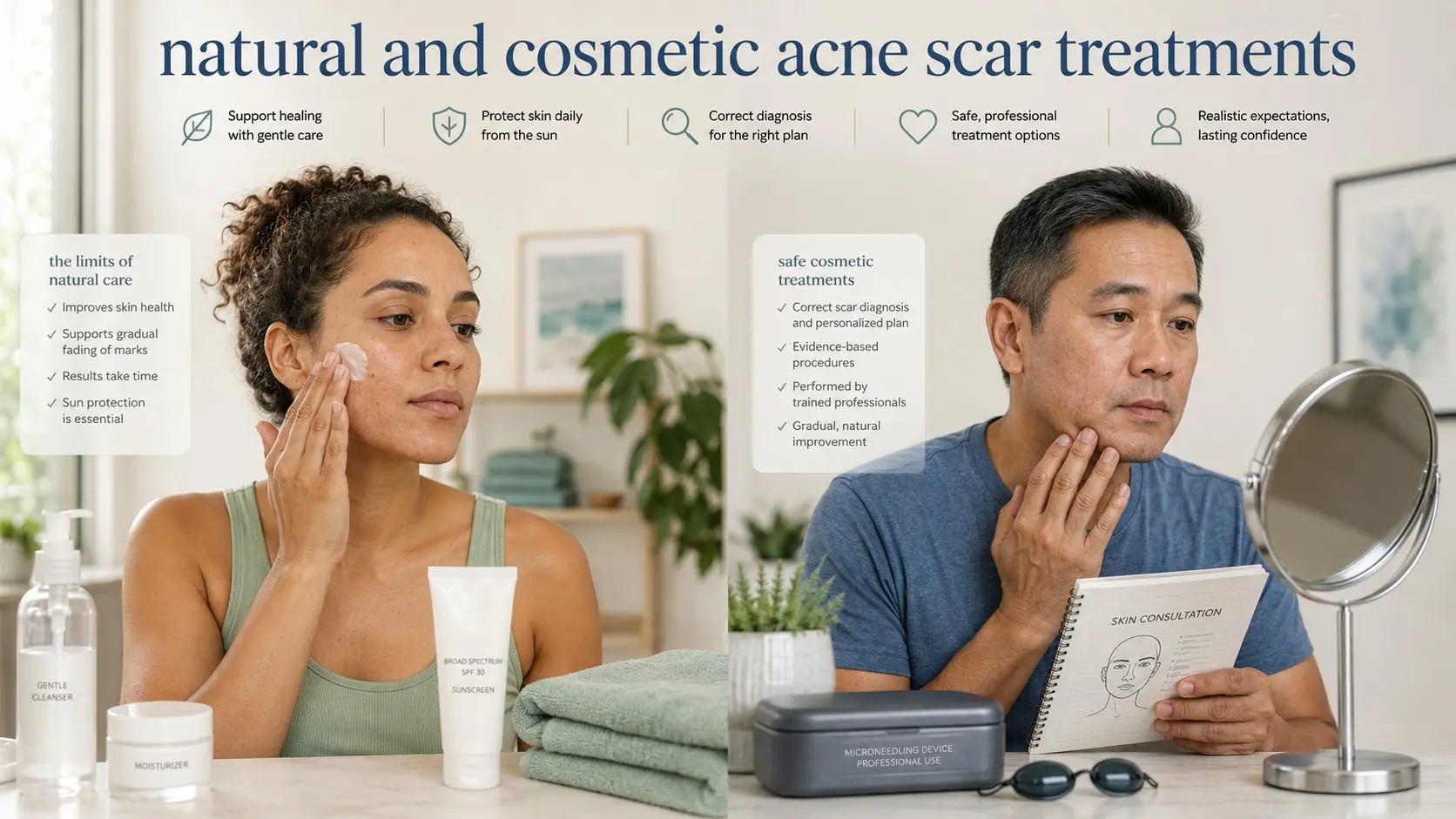
Gentle home care can help prevent new acne. It can protect the skin. It may also help flat dark marks fade. It cannot lift a deep scar or release scar tissue below the skin.
For a detailed guide to five professional procedures, read our Acne Scar Removal Methods Guide. You can also visit the Acne, Whiteheads and Pores Hub.
Do not perform microneedling, strong chemical peeling, subcision, filler injection, or laser treatment at home. These methods can cause burns, infection, pigment changes, nerve damage, and new scars.
Quick Answer
Natural and cosmetic acne scar treatments are not equal options for the same problem. Gentle home care may fade flat acne marks and help prevent new scars. True pits, dents, waves, and raised scars often need a dermatologist. Treatment may include microneedling, a peel, laser care, subcision, scar surgery, filler, or injections.
Is It a Scar or a Flat Acne Mark?
This question comes first.
Flat Acne Marks
A flat brown, gray, red, or pink area may be a color change left after acne.
Brown or gray marks are often called post inflammatory hyperpigmentation.
These marks do not create a hole, dent, wave, or raised area. They often fade with time.
True Acne Scars
A true scar changes the shape of the skin.
It may look:
- Deep and narrow
- Wide and sunken
- Wavy
- Round with clear edges
- Firm and raised
True scars may become less visible. They rarely disappear fully without treatment.
See our Complete Whiteheads Guide to learn how clogged pores differ from scars and marks.
Main Types of Acne Scars
Ice Pick Scars
Ice pick scars are small, narrow, and deep. A cream cannot fill the missing tissue.
Rolling Scars
Rolling scars are broad dents. Bands below the skin may pull the surface downward.
Boxcar Scars
Boxcar scars are round or oval dents with clearer edges.
Raised Scars
Raised acne scars form when the skin makes too much scar tissue. A keloid may grow past the original acne area.
Ice pick, rolling, and boxcar scars are types of depressed acne scars.
What Does Natural Acne Scar Treatment Mean?
The word natural can mean many things.
It may refer to:
- Gentle cleansing
- Moisturizer
- Sunscreen
- Time
- Not picking the skin
- Treatment that supports the skin barrier
- Kitchen ingredients
- Plant oils
- Supplements
These choices do not have the same safety or evidence.
Natural does not always mean gentle. Lemon juice, vinegar, spices, and essential oils can burn or irritate skin.
A safer meaning of natural care: protect the skin, treat new acne, prevent injury, and allow flat marks time to fade.
What Safe Home Care Can Do
1. Control Active Acne
New deep pimples can create new scars.
A simple active acne treatment may include:
- A gentle cleanser
- Salicylic acid
- Benzoyl peroxide
- Adapalene when suitable
- Azelaic acid
- A light moisturizer
- Sunscreen
Use one main treatment first. Give it time.
Read our Safe Home Care for Whiteheads Guide for a simple routine.
Do not use adapalene or another topical retinoid during pregnancy unless a qualified healthcare professional recommends a safe option.
2. Stop Picking and Squeezing
Picking causes more inflammation. It can push damage deeper into the skin.
It may lead to:
- New scars
- Dark marks
- Bleeding
- Infection
- Longer healing
Cover a spot with a suitable acne patch if touching it is hard to stop.
3. Use Sunscreen
Sunlight can make flat dark marks look deeper.
Use broad spectrum SPF 30 or higher.
Choose a light product labelled noncomedogenic when possible.
Sunscreen does not fill scars. It supports a more even skin tone and protects skin before and after treatment.
4. Protect the Skin Barrier
Use a mild cleanser. Wash with lukewarm water.
Use your fingertips. Do not scrub.
Add a light moisturizer when the skin feels dry.
Visit the Skincare Basics and Routines Guide for a simple daily plan.
Our Moisturizer for Oily Skin Guide can help when acne products cause dryness.
5. Ask About Proven Topical Products
A dermatologist may suggest a retinoid or salicylic acid for mild scarring or uneven texture.
Azelaic acid and a retinoid may also help some flat acne marks.
These products cannot release tethered scars or fill deep pits.
Stop a product and seek advice if it causes severe pain, swelling, blisters, or a strong rash.
6. Allow Time
Flat marks can fade slowly.
True scars may soften or become less red with time. The change may be small.
Take one photo each month in the same light. Daily mirror checks can make progress hard to see.
What Natural Care Cannot Do
Home care cannot reliably:
- Fill an ice pick scar
- Cut scar bands below rolling scars
- Raise a deep boxcar scar
- Flatten a keloid
- Replace missing skin tissue
- Remove every colour change
- Create flawless skin
These limits do not mean that skin care has failed. A cream works on the surface. A deep scar changes tissue below the surface.
Natural Remedies to Avoid
Lemon Juice
Lemon is acidic. It can sting and irritate skin. Sun exposure can make the reaction worse.
Apple Cider Vinegar
Vinegar can cause irritation or a chemical burn. It does not rebuild scar tissue.
Baking Soda
Baking soda can disrupt the skin barrier. Scrubbing can make redness and dark marks worse.
Tea Tree Oil
Tea tree oil may cause irritation or allergy. It is not a treatment for deep acne scars.
Vitamin E Oil
Vitamin E oil does not erase deep scars. It may cause irritation or a rash in some people.
Vitamin E Supplements
Do not take a supplement to treat acne scars without medical advice. More is not always safer.
Honey Masks
Honey may feel soothing. It does not fill lost tissue or release a rolling scar.
Harsh Scrubs
Hard scrubbing creates irritation. It cannot polish away a deep scar.
Does Microdermabrasion Remove Acne Scars?
Microdermabrasion gently removes surface skin cells.
It may make skin tone look more even. It may help another treatment produce a more even result.
It does not treat true depressed acne scars.
Microdermabrasion is also different from dermabrasion. Dermabrasion is a deeper medical procedure.
What Cosmetic Acne Scar Treatments Can Do
A cosmetic acne scar treatment should match the type and depth of each scar.
A dermatologist may combine several methods.
| Treatment | What it may help | Main limit or risk |
|---|---|---|
| Microneedling | Selected rolling and boxcar scars through collagen remodelling | Redness, bleeding, infection, pigment change, and new scars are possible |
| Chemical peels | Selected shallow scars, uneven tone, and some marks | Burns, infection, pigment change, and scarring can occur |
| Laser resurfacing | Selected depressed scars, texture, and some raised scars | Recovery, pigment change, burns, and more than one session may be needed |
| Subcision | Rolling scars pulled down by bands below the skin | Bruising, bleeding, infection, and uneven results are possible |
| Punch procedures | Selected ice pick and boxcar scars | The procedure replaces one scar with a smaller surgical scar |
| Dermal fillers | Selected depressed scars that need added volume | Results may be temporary and injections have medical risks |
| Scar injections | Raised scars and keloids | Several sessions may be needed and scars can return |
For full details about these methods, visit our Five Acne Scar Treatment Methods Guide.
Microneedling Safety
Microneedling creates many small punctures in living skin.
The United States Food and Drug Administration has authorized selected medical devices for improving facial acne scars in adults aged 22 and older.
Risks can include:
- Redness
- Dryness
- Peeling
- Bleeding
- Bruising
- Infection
- Dark spots
- Light spots
- An unwanted result
Choose a licensed healthcare provider with training and experience.
Ask whether a new sterile cartridge will be used for your session.
Do not use a medical microneedling pen or dermaroller at home. Do not buy a device because a social media creator calls it safe.
Radiofrequency Microneedling Warning
Radiofrequency microneedling sends heat below the skin through needles.
In October 2025, the FDA reported serious problems with some uses.
Reported problems included:
- Burns
- New scars
- Fat loss
- Nerve damage
- Disfigurement
- The need for medical or surgical repair
This is a medical procedure. It should not be used at home.
Ask the provider which device will be used and why it fits your scar and skin tone.
Acne Scar Treatment for Skin of Colour
People of every skin tone can develop scars.
Darker skin may be more likely to develop long-lasting dark marks after inflammation or injury.
Some people may also have a greater risk of raised scars.
Before a procedure, ask:
- How often do you treat my skin tone?
- How will you reduce pigment change?
- Will you use a test area?
- What skin care should I use before treatment?
- How long must I avoid strong sunlight?
- What should I do if the area becomes darker?
The provider should choose the device, strength, and settings for your skin.
Natural Care or Cosmetic Treatment?
Use this simple guide.
| Your concern | A sensible first step |
|---|---|
| New active acne | Begin an acne treatment plan and prevent more scars |
| Flat brown or red marks | Use sunscreen, gentle care, and ask about proven topical treatment |
| Mild uneven texture | Ask a dermatologist whether topical care or a procedure may help |
| Rolling scars | Ask about subcision, microneedling, laser care, or combined treatment |
| Ice pick scars | Ask about a punch method or another treatment made for deep narrow scars |
| Boxcar scars | Ask about microneedling, laser care, punch elevation, peels, or combined care |
| Raised scars | Ask about prescription injections, laser care, silicone, or other specialist treatment |
| Scars affecting confidence | Discuss both skin treatment and emotional support |
What a Scar Consultation Should Include
A proper scar consultation should not begin with selling one machine.
The provider should:
- Check whether you still have acne
- Separate marks from scars
- Name each scar type
- Ask about past skin treatments
- Ask about keloids
- Check your skin tone
- Discuss your health and medicines
- Explain realistic results
- Explain possible side effects
- Discuss recovery time
- Explain the full cost
Tell the dermatologist about acne medicine used during the past two years.
Questions to Ask a Cosmetic Provider
- What type of scars do I have?
- Is my acne controlled?
- Why does this treatment fit my scars?
- Are there safer choices?
- How many sessions may I need?
- What change is realistic?
- What are the risks for my skin tone?
- What device or product will you use?
- Is the device authorized for this use?
- Who will perform the procedure?
- What training does that person have?
- What care will I need later?
- Who will help if a problem occurs?
- What is the full cost?
Do not let a discount, timer, or social media offer rush you.
Care After a Cosmetic Procedure
Follow the provider’s instructions.
Common advice may include:
- Wash gently
- Use the recommended moisturizer
- Apply broad-spectrum SPF 30 or higher
- Avoid picking or peeling skin
- Avoid makeup until advised
- Pause strong active products until advised
- Avoid tanning
- Keep every follow-up visit
- Continue acne prevention when advised
Results may take time. The skin needs time to make new collagen.
Seek medical advice promptly for severe pain, pus, fever, fast-spreading redness, blisters, black skin, loss of feeling, growing swelling, or a wound that is getting worse.
Set Realistic Expectations
Acne scar treatment can improve skin texture.
It cannot promise:
- Perfect skin
- Complete scar removal
- One session for every person
- The same result on every skin tone
- No recovery time
- No side effects
Results depend on:
- Scar type
- Scar depth
- Skin tone
- Active acne
- Provider skill
- Chosen treatment
- Healing response
- Aftercare
A combined plan may work better than one treatment.
Acne Scars and Confidence
Scars can affect how a person feels.
You may avoid photos, bright rooms, social events, or close conversations.
You do not need to wait for smooth skin before taking part in life.
Read our Positive Body Image Guide for support with appearance worries.
Speak with a qualified mental health professional if appearance concerns take over your day or cause strong distress.
Five High Authority References and Sources
American Academy of Dermatology: Acne Scar Overview
Open dermatologist guidance on true scars, flat pigment marks, early acne treatment, picking, prevention, and realistic improvement.
American Academy of Dermatology: Acne Scar Consultation and Treatment
Open guidance on chemical peels, fillers, lasers, microneedling, scar surgery, subcision, dermabrasion, raised scars, and combined treatment.
American Academy of Dermatology: Skin Care After Acne Scar Treatment
Open guidance on gentle care, sunscreen, aftercare, follow up visits, realistic expectations, and preventing new acne.
United States Food and Drug Administration: Microneedling Devices
Open safety guidance on authorized uses, age limits, infection, bleeding, pigment changes, sterile cartridges, provider training, and device limits.
United States Food and Drug Administration: Radiofrequency Microneedling Safety Warning
Open October 2025 warning about reported burns, new scars, fat loss, nerve damage, disfigurement, and the need for medical treatment.
Conclusion
Natural and cosmetic acne scar treatments serve different goals. Home care can protect skin, control active acne, and help some flat marks fade. It cannot rebuild tissue lost in a deep scar.
Cosmetic procedures may improve true scars, but the scar type, skin tone, risks, cost, and provider skill all matter.
Call to action: Stop unsafe home remedies. Take clear photos of your skin. List your past acne treatments. Then book a dermatologist consultation for a plan based on your actual scar types.
Related NextFitLife Guides and Hubs
Medical Disclaimer
This article gives general education. It does not diagnose acne marks or scars. It does not replace a skin examination, prescription, procedure consultation, treatment plan, or emergency medical care.
Always consult a qualified dermatologist or licensed healthcare professional before microneedling, radiofrequency treatment, chemical peeling, laser treatment, subcision, scar surgery, filler injection, or another procedure.
About the Author
Frequently Asked Questions
Can natural remedies remove acne scars?
No natural home remedy can reliably fill a deep scar, release scar bands, or flatten a keloid. Gentle care may help flat marks fade and prevent recent scars.
What is the best natural treatment for acne scars?
Use sunscreen, gentle skin care, proven acne treatment, and avoid picking. These steps protect skin but do not remove deep scars.
Does lemon juice remove acne scars?
No. Lemon can irritate skin and cause a harmful reaction with sunlight. It does not rebuild lost scar tissue.
Does vitamin E remove acne scars?
Vitamin E cannot fill deep acne scars. Topical vitamin E may also irritate some skin.
Are dark acne marks true scars?
Flat brown, gray, red, or pink marks are often colour changes rather than true scars. They may fade with time and suitable care.
Does microdermabrasion remove acne scars?
Microdermabrasion may improve surface tone. It does not treat true depressed acne scars.
Which cosmetic treatment is best for acne scars?
The best treatment depends on whether the scar is an ice pick, rolling, boxcar, or raised scar. A dermatologist may combine methods.
Can I use a derma roller at home?
Do not use a medical derma roller or microneedling pen at home. It can cause bleeding, infection, pigment change, and new scars.
Is radiofrequency microneedling safe?
It has possible benefits and serious risks. The FDA has reported burns, scars, fat loss, nerve damage, and disfigurement with some uses.
When should I see a dermatologist?
Seek professional care for deep scars, raised scars, painful acne, fresh scarring, strong pigment changes, or any planned cosmetic procedure.

Health & wellness writer with 30+ years of experience in nutrition, fitness, and healthy aging. Founder of NextFitLife.com — evidence-based health guidance.