Published: September 25, 2026
Last updated: September 25, 2026
Next review: September 2027, or sooner if major dermatology guidance changes
Written and source checked by: Adel Galal, Founder and Lead Writer at NextFitLife
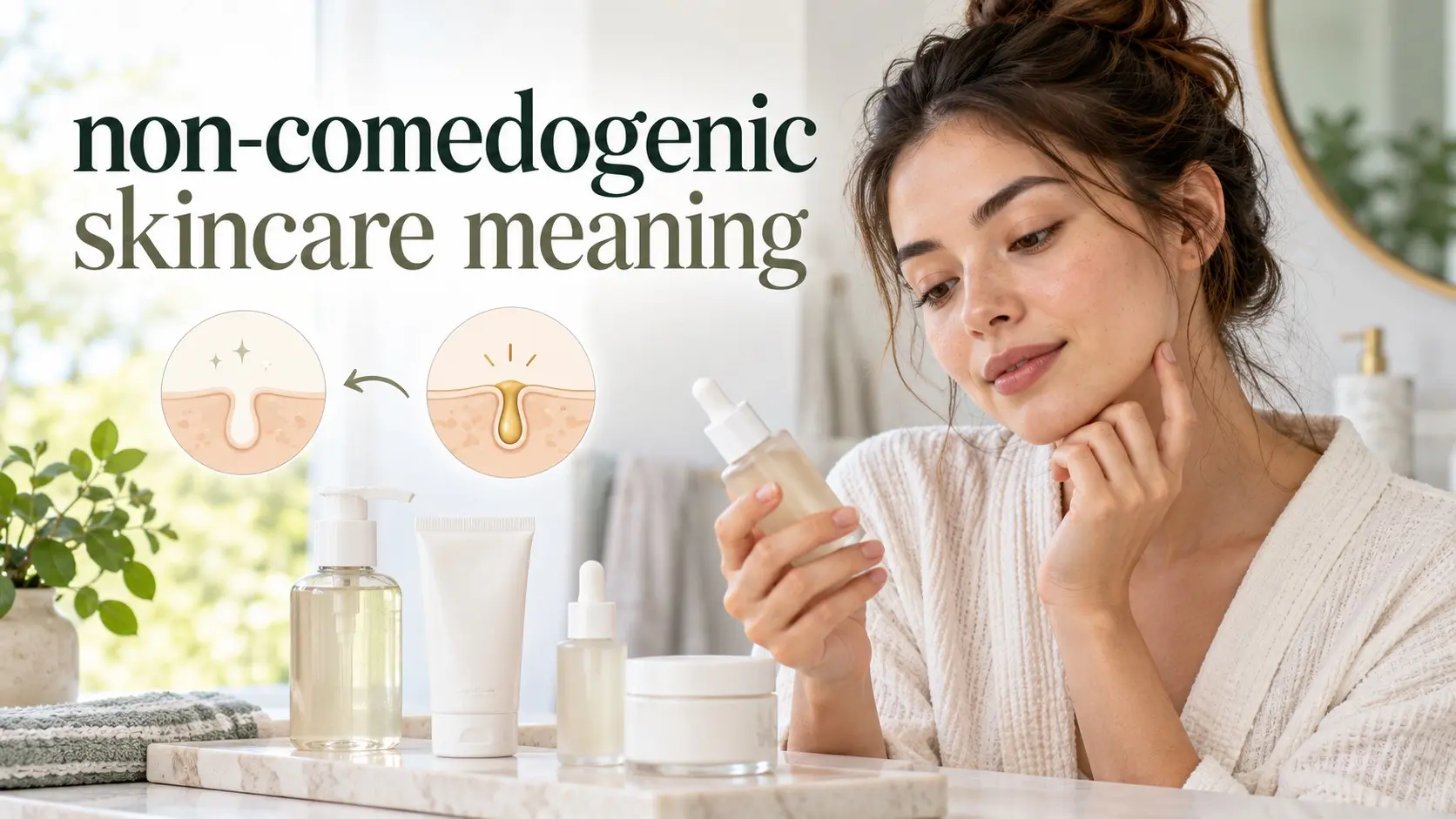
If a skincare product says “noncomedogenic,” it is intended to be less likely to clog pores and form comedones such as blackheads and whiteheads.
That makes the label useful for acne prone skin.
It does not make the product breakout proof.
The more useful way to understand the non-comedogenic skincare meaning is this: treat the label as a screening clue, then judge the complete formula, your skin type, and what actually happens after you use it.
A 2025 dermatology review made this distinction especially clear. The review found that noncomedogenic claims are not backed by one standardized test that every manufacturer must use, and isolated ingredient ratings do not always predict how a complete product behaves on human skin.
That is why an ingredient checker can call one ingredient a problem while the finished moisturizer works perfectly well for you.
Medical notice: I am not a dermatologist or A doctor, and this content does not replace professional medical advice. This article explains published guidance and does not provide a personal clinical assessment. Always consult qualified medical professionals for diagnosis and treatment of any health condition.
Quick Answer: What Does Noncomedogenic Mean?
Noncomedogenic means a skincare or cosmetic product is intended to be less likely to clog pores and form comedones.
The label can help people who develop clogged pores, blackheads, whiteheads, or acne choose products with a lower intended clogging risk.
It is not a guarantee. Testing methods differ, finished formulas behave differently from isolated ingredients, and one person's skin may react differently from another person's skin.
Use the label as a useful first filter, not as proof that a product can never contribute to a breakout.
For a wider look at acne, oily skin, sensitive skin, sunscreen, moisturizers, and simple routines, visit the NextFitLife Skin Health Guide.
Table of Contents
- What a comedone actually is
- Why the label is useful but imperfect
- 9 smart truths about noncomedogenic skincare
- Noncomedogenic versus oil free
- Why ingredient blacklist scores can mislead
- A simple routine for clog prone skin
- How to tell a breakout from irritation
- What to avoid
- When acne treatment is needed
- When to see a dermatologist
- References and Sources
- Continue Reading on NextFitLife
- About the Author
- Frequently Asked Questions
What Is a Comedone?
A comedone is a clogged hair follicle.
Oil and dead skin cells can collect inside the follicle and form a plug.
If the opening stays closed, you see a closed comedone, better known as a whitehead.
If the opening remains open, the material at the surface darkens and forms a blackhead.
The dark color of a blackhead is not simply dirt.
Scrubbing harder does not remove the underlying acne process and can irritate the skin.
You can read more about closed comedones in the NextFitLife Whiteheads Guide.
Why Is the Noncomedogenic Label Useful but Imperfect?
The label solves a real problem.
If you regularly develop clogged pores, choosing a noncomedogenic moisturizer, sunscreen, foundation, and other leave on products is a sensible place to start.
The American Academy of Dermatology recommends looking for terms such as “noncomedogenic,” “oil free,” or “won't clog pores” when acne prone skin is choosing skincare and cosmetics.
But here is the part marketing rarely explains.
A 2025 review in JAAD Reviews found no standardized testing framework or regulatory oversight that forces every manufacturer to prove a noncomedogenic claim using the same method.
The review also pointed to another problem: much of the old discussion about pore clogging ingredients grew out of tests on isolated materials rather than complete products used on real human faces.
Those are very different questions.
9 Smart Truths About Noncomedogenic Skincare
1. Noncomedogenic Does Not Mean Breakout Proof
You can still break out after using a noncomedogenic product.
Your acne may be driven by hormones, your normal tendency to form comedones, medication, friction, another skincare product, hair products, makeup, or the complete formula you just introduced.
A label cannot promise that every user will respond the same way.
What it can do is tell you that the product was designed or marketed with pore clogging risk in mind.
2. A Comedogenic Ingredient Does Not Automatically Make the Whole Product Comedogenic
This is one of the most useful facts in the entire topic.
A human study published in the Journal of the American Academy of Dermatology tested finished cosmetic formulas containing ingredients that had been considered comedogenic.
The researchers concluded that finished products containing those ingredients were not necessarily comedogenic.
Why?
A finished moisturizer is not one ingredient sitting alone on the skin.
Concentration matters. The vehicle matters. Other ingredients matter. The amount applied matters. Your skin matters.
This is why I would not reject an otherwise suitable product because an ingredient checker highlighted one ingredient halfway down the list.
3. Ingredient Checker Scores Are Less Precise Than They Look
A score of 0, 2, or 4 looks wonderfully exact.
The underlying science is not that tidy.
Older comedogenicity ratings were partly built from methods such as the rabbit ear assay. Later research found differences between animal testing, human testing, isolated ingredients, and finished formulas.
The newer 2025 review argues that better human testing on finished products is needed.
That does not make ingredient lists useless.
It means the score should be one clue rather than the judge and jury.
4. Noncomedogenic and Oil Free Do Not Mean the Same Thing
Oil free skincare describes whether the formula contains oils.
Noncomedogenic describes the intended tendency of a product to avoid clogging pores.
An oil free product is not automatically noncomedogenic.
An oil containing product is not automatically pore clogging.
This matters most when someone has acne but also has dry or irritated skin.
You do not need to strip every trace of oil from your face to treat acne.
5. Oily Skin Still Needs Moisturizer
Oily skin and hydrated skin are not opposites.
Acne treatments such as benzoyl peroxide, salicylic acid, adapalene, tretinoin, tazarotene, and isotretinoin can dry or irritate the skin.
The American Academy of Dermatology specifically recommends moisturizer when acne treatment causes dryness and suggests choosing products labeled noncomedogenic, oil free, or unlikely to clog pores.
The texture is where you can adjust.
Oily skin may prefer a light lotion or gel. Drier acne prone skin may feel better with a cream.
For a broader routine, see Healthy Skin 101.
6. A Noncomedogenic Product Does Not Treat Acne by Itself
A moisturizer can help your skin barrier.
A noncomedogenic sunscreen can reduce the chance that your sunscreen contributes to clogged pores.
Neither automatically treats existing acne.
Proven acne treatments do a different job.
Depending on the type of acne, options can include benzoyl peroxide, salicylic acid, adapalene, azelaic acid, prescription treatments, or combinations chosen by a clinician.
Salicylic acid helps unclog pores. Adapalene is a topical retinoid that helps prevent clogged pores and treat several forms of acne.
Supporting skincare and acne treatment should work together.
7. Sunscreen Matters Too
Do not spend twenty minutes choosing the perfect moisturizer and then ignore the sunscreen you wear for hours every day.
The American Academy of Dermatology recommends a broad spectrum, water resistant sunscreen with SPF 30 or higher for sun protection and advises acne prone people to look for formulas described as noncomedogenic or unlikely to clog pores.
A noncomedogenic sunscreen is especially useful when heavier products repeatedly seem to worsen your breakouts.
The best sunscreen is still the one you can tolerate and use consistently.
8. Makeup and Hair Products Belong in the Investigation
Sometimes the moisturizer gets blamed for a breakout caused by something else.
AAD describes acne cosmetica, in which cosmetics or skincare products contribute to acne.
Foundation, concealer, blush, sunscreen, hair styling creams, pomades, oils, and leave in products can all touch acne prone areas.
If small bumps appear mostly along the forehead or hairline, look at what touches that area.
If cheek breakouts began after a new foundation, include the foundation in your review.
Do not investigate only products with the word skincare printed on the bottle.
9. Your Own Repeat Pattern Matters More Than Marketing
If the same product repeatedly seems to give you clogged pores, stop trying to make it work because the package says noncomedogenic.
That does not prove the product is universally comedogenic.
It tells you something more useful: it may not suit your skin.
Introduce new leave on products one when possible.
If five new products enter the routine on the same night and your skin reacts, identifying the cause becomes guesswork.
Noncomedogenic, Oil Free, Hypoallergenic, or Fragrance Free?
These words describe different concerns.
| Label | What It Tries to Tell You | What It Does Not Promise |
|---|---|---|
| Noncomedogenic | Designed to be less likely to clog pores | That you will never break out |
| Oil free | The formula is marketed without oils | That it cannot clog pores or irritate skin |
| Fragrance free | No added fragrance in the usual sense | That the product cannot cause irritation or allergy |
| Hypoallergenic | Marketed as having a lower allergy risk | That no allergic or irritant reaction can occur |
You can need more than one quality at the same time.
Someone with acne and easily irritated skin may prefer a simple, fragrance free, noncomedogenic formula.
Should You Avoid Coconut Oil, Shea Butter, or Other Famous “Pore Clogging” Ingredients?
I would not build skincare around a universal deny list.
This is where online skincare advice becomes unnecessarily rigid.
An ingredient can behave differently depending on its concentration, chemical form, the rest of the formulation, how much you apply, where you apply it, and the skin using it.
That does not mean every rich oil or butter is a good choice for every acne prone face.
It means one ingredient name cannot reliably tell you what the complete product will do.
If an oil repeatedly gives you closed comedones, you have a practical reason to avoid that product.
If another formula containing a small amount of the same ingredient works well for months, an internet score alone is a weak reason to throw it away.
The NextFitLife Prickly Pear Oil Guide uses the same approach: an oil is not an acne treatment simply because it contains interesting fatty acids, and people can respond differently.
What Does a Simple Routine for Clog Prone Skin Look Like?
Your skincare routine does not need ten steps.
Morning
- Use a gentle cleanser if your skin needs one.
- Apply acne treatment when appropriate and advised for your routine.
- Use a light noncomedogenic moisturizer when needed.
- Finish with broad spectrum SPF 30 or higher sunscreen that your skin tolerates.
Evening
- Remove makeup and sunscreen gently.
- Cleanse without harsh scrubbing.
- Use one appropriate acne treatment if needed.
- Apply moisturizer.
That is enough for many people.
More products create more chances for irritation and more variables to investigate when something goes wrong.
How Can You Tell a Breakout From Irritation?
Every bump after a new product is not automatically a clogged pore.
This distinction saves a lot of unnecessary product switching.
| What You Notice | What It Could Suggest | Useful Next Step |
|---|---|---|
| Blackheads or small skin colored bumps | Comedonal acne or clogged pores | Review new leave on products and consider proven acne treatment |
| Burning, stinging, redness, or peeling | Irritation or barrier damage | Stop the likely irritant and simplify the routine |
| Itchy rash or swelling | Possible irritant or allergic reaction | Stop the product and seek medical advice if significant or persistent |
| Deep painful lumps | Nodular or cystic acne | See a dermatologist because scarring risk is higher |
If you are unsure whether a bump is a whitehead, the Whiteheads Guide explains what closed comedones look like and how they differ from inflamed pimples.
What About Skin Purging?
“Purging” gets blamed for almost every new breakout online.
That is too broad.
A product that speeds skin cell turnover, such as a retinoid or some exfoliating treatments, can change acne patterns early in treatment.
A plain moisturizer does not get a free pass because someone calls the reaction purging.
If a basic moisturizer, sunscreen, or foundation repeatedly causes new clogged bumps in areas where you usually break out, investigate the product rather than telling yourself the skin must purge for months.
Strong burning, swelling, intense itching, or a rash is not something to push through.
What Should You Avoid if Your Pores Clog Easily?
Harsh Scrubbing
Blackheads are not dirt.
Scrubbing can irritate the skin barrier without fixing the follicle blockage.
Sleeping in Makeup
AAD recommends removing makeup before sleep and cleansing gently afterward.
This is especially relevant if you already develop acne cosmetica.
Changing the Entire Routine at Once
If you add six products at once, you lose the ability to learn from the result.
Add new leave on products gradually.
Continuing a Product That Repeatedly Breaks You Out
The package does not outrank your skin.
If the pattern repeats, stop the product and simplify.
Overwashing
Acne is not caused by dirty skin.
Washing repeatedly throughout the day can increase dryness and irritation.
AAD generally recommends gentle cleansing up to twice daily and after sweating for acne prone skin.
Does Natural or Organic Mean Noncomedogenic?
No.
“Natural” tells you something about how an ingredient is marketed or sourced.
It does not tell you whether the finished formula will form comedones.
The same problem applies to words such as “clean,” “green,” or “botanical.”
Those terms are not a substitute for how a product behaves on your skin.
Does Expensive Skincare Clog Pores Less?
Price does not tell you that either.
An expensive cream can clog your pores.
A simple low cost moisturizer can work beautifully.
You are paying for a formula, packaging, branding, distribution, marketing, ingredients, and many other things.
The price tag does not measure comedogenicity.
Can You Patch Test for Clogged Pores?
A small area test is useful for spotting some early irritation or allergy problems.
It is much less useful for proving that a product will never form comedones across your face.
Comedones develop over time.
The cheek, forehead, chin, and back also do not behave exactly the same way.
If you are concerned about clogging, introduce a new leave on a product without changing five other things then watch the normal acne prone areas of your face.
This gives you cleaner information than a complicated home experiment.
When Do You Need an Acne Treatment Rather Than Better Product Labels?
If you already have persistent acne, buying only noncomedogenic products may reduce one trigger, but it may not clear the acne.
Evidence based treatments include options such as salicylic acid, benzoyl peroxide, topical retinoids, azelaic acid, and prescription therapies depending on the acne type and severity.
AAD notes that salicylic acid helps open clogged pores and that retinoids are widely used to help keep pores clear.
For teenagers, the NextFitLife Teen Acne Treatment Guide explains how to keep the routine simple and introduce proven acne ingredients gradually.
When Should You See a Dermatologist?
Product detective work eventually reaches a limit.
See a dermatologist or another qualified healthcare professional if:
- You have deep painful nodules or cysts
- Acne is leaving scars
- Dark marks keep accumulating after breakouts
- Your skin has a persistent painful or itchy rash
- You develop marked swelling or blistering after a product
- You cannot tell whether the bumps are acne
- A consistent over the counter acne plan is not helping enough
- Acne is affecting your confidence, sleep, school, work, or mental wellbeing
Pregnancy and plans for pregnancy also change which acne treatments are suitable. Ask a qualified healthcare professional before using topical retinoids or prescription acne treatments during pregnancy.
My Practical Rule for Choosing a Product
I would make the decision in this order.
- Check the job. Is this a cleanser, moisturizer, sunscreen, makeup product, or acne treatment?
- Check your skin. Is it oily, dry, sensitive, acne prone, or a mix?
- Use the label. Choose noncomedogenic when you tend to clog easily.
- Ignore panic scores. Do not reject an entire formula because one ingredient has a scary online rating.
- Introduce it simply. Avoid changing the whole routine at once.
- Watch the pattern. Your repeat skin response matters.
This is less exciting than an ingredient blacklist.
It is also more useful.
Conclusion
The practical non-comedogenic skincare meaning is simple: the product is intended to be less likely to clog pores, but the label is not a guarantee.
Use noncomedogenic products as a smart first filter if you develop blackheads, whiteheads, or acne. Then look at the complete formula, introduce products carefully, and pay attention to what repeatedly happens on your own skin.
Do not let one ingredient checker score turn a simple routine into a chemistry investigation.
Your next step: look at the leave on products you use every day. If one product repeatedly seems linked with new clogged pores, simplify the routine and remove that product before buying three new treatments.
References and Sources
- JAAD Reviews.
Comedogenicity in Cosmeceuticals: A Review of Clinical Relevance, Regulatory Gaps, and Future Directions. 2025.
Read the open access dermatology review. - Draelos ZD, DiNardo JC.
A Re Evaluation of the Comedogenicity Concept. Journal of the American Academy of Dermatology. 2006.
Read the PubMed abstract. - American Academy of Dermatology.
I Have Acne. Is It Okay to Wear Makeup?
Read the AAD guidance. - American Academy of Dermatology.
Moisturizer: Why You May Need It if You Have Acne.
Read the AAD moisturizer guidance. - American Academy of Dermatology.
Acne: Tips for Managing.
Read the AAD acne skin care guidance.
Continue Reading on NextFitLife
- Skin Health Guide for acne, oily skin, dry skin, sensitive skin, sunscreen, active ingredients, and simple routines
- Healthy Skin 101 for a simple cleanser, moisturizer, treatment, and sunscreen routine
- Whiteheads Guide for closed comedones, clogged pores, salicylic acid, retinoids, and gentle treatment
- Best Acne Treatment for Teens for a simple acne prone routine using evidence based ingredients
- Prickly Pear Oil for Skin for a practical example of why oils and individual ingredients should not be treated as guaranteed acne treatments
About the Author
Adel Galal is the founder and lead writer at NextFitLife. He has more than 30 years of personal interest in health, fitness, nutrition, wellness, healthy aging, and skin care, along with more than 15 years of health and wellness writing experience.
His professional background includes information technology management, data analysis, structured research, planning, and information management. He uses those skills to compare health claims with current medical guidance, identify limitations in the evidence, and explain complex topics in simple language.
For this guide, Adel reviewed current American Academy of Dermatology guidance, an open access 2025 dermatology review of comedogenicity testing, and human research examining the difference between isolated comedogenic ingredients and finished cosmetic formulas.
Adel is not a dermatologist, doctor, pharmacist, cosmetic chemist, or other licensed healthcare professional. NextFitLife content is educational and does not diagnose acne, allergy, dermatitis, or another skin condition.
Learn more about Adel Galal, NextFitLife, and the site's editorial standards on the About Us page.
Frequently Asked Questions
What does noncomedogenic skincare mean?
It means a product is intended to be less likely to clog pores and form comedones such as blackheads and whiteheads. The label is useful for acne prone skin, but it does not guarantee that every person will avoid breakouts.
Can a noncomedogenic product still cause acne?
Yes. Acne has many causes, and individual skin responses vary. A product labeled noncomedogenic can still be unsuitable for your skin or become one part of a routine that contributes to breakouts.
Is noncomedogenic the same as oil free?
No. Oil free refers to whether a product contains oils. Noncomedogenic describes the intended tendency of the finished formula to avoid clogging pores. One label does not automatically guarantee the other.
Are comedogenic ingredient lists accurate?
They have limitations. Some ratings come from older testing methods and isolated ingredient testing. Modern dermatology literature emphasizes that finished formulas can behave differently from individual ingredients and that skin responses vary between people.
Should I avoid every ingredient with a high comedogenic rating?
No. A finished product containing an ingredient previously considered comedogenic is not automatically comedogenic. Concentration, formulation, ingredient interactions, amount used, and individual skin response matter.
Do I need moisturizer if I have oily acne prone skin?
Yes, oily skin can still benefit from moisturizer. Acne treatments can cause dryness and irritation. A lightweight noncomedogenic moisturizer can help support the skin barrier and improve treatment tolerance.
Does noncomedogenic moisturizer treat acne?
No. It is intended to reduce the chance that the moisturizer contributes to clogged pores. Acne itself may need treatments such as salicylic acid, benzoyl peroxide, adapalene, azelaic acid, or prescription therapy depending on the acne type.
Should sunscreen be noncomedogenic if I have acne?
It is a useful choice for acne prone skin. Look for broad spectrum SPF 30 or higher sunscreen that is comfortable to use and labeled noncomedogenic or unlikely to clog pores.
Can makeup cause clogged pores?
Yes. Some cosmetics can contribute to acne cosmetics. Look for noncomedogenic makeup when you are acne prone, remove makeup before bed, and pay attention to whether a new product repeatedly matches the timing and location of new breakouts.
Does natural skincare mean noncomedogenic?
No. Natural, botanical, organic, and clean are not the same as noncomedogenic. A natural ingredient can still irritate skin or contribute to clogged pores in some people.
How do I know if a new product is breaking me out?
Introduce new leave on products one at a time when possible. If the same product repeatedly matches new clogged pores in your usual acne prone areas, stop it and simplify your routine. Burning, itching, redness, or swelling may suggest irritation or allergy rather than simple clogged pores.
When should I see a dermatologist for acne?
Seek professional care for deep painful acne, scars, persistent dark marks, severe or widespread breakouts, significant rashes, or acne that is not improving with a consistent over the counter plan.

Health & wellness writer with 30+ years of experience in nutrition, fitness, and healthy aging. Founder of NextFitLife.com — evidence-based health guidance.