First published: Jun 12, 2023
Last updated: July 30, 2026
Written and source checked by: Adel Galal
Clinical review status: This article has not been reviewed by a dermatologist.
The right moisturizer for oily skin adds water without leaving the face feeling thick, sticky, or greasy.
Oily skin still needs moisture.
Oil and water are not the same thing.
The skin may produce a large amount of sebum while still lacking enough water.
This is often called dehydrated oily skin.
Acne treatment, strong cleansers, hot water, scrubbing, dry air, and frequent washing can all damage the barrier.
The result may be shine, tightness, burning, peeling, and breakouts at the same time.
A light moisturizer can help the skin feel more comfortable and make acne treatment easier to continue.
It will not stop every breakout or permanently switch off the oil glands.
This guide explains which textures and ingredients may work, which labels matter, how to build an oily skin care routine, and when to see a dermatologist.
For more help, visit the Healthy Skin Guide, the Acne, Whiteheads and Pores Guide, and the Skincare Basics Guide.
Important: Sudden severe oiliness, painful acne, scarring, missed periods, excess facial hair, or rapid hair loss may need medical assessment.
Quick Answer
Choose a moisturizer for oily skin that is:
- Lightweight
- Fragrance free when sensitive
- Oil free when preferred
- Labelled noncomedogenic
- Comfortable under sunscreen
Useful ingredients may include:
- Glycerin
- Hyaluronic acid
- Ceramides
- Niacinamide
- Dimethicone
- Squalane
Apply a small amount after cleansing while the skin is slightly damp.
Use more only when the skin remains tight or flaky.
Why Does Oily Skin Need Moisturizer?
Sebum is the oil made by sebaceous glands.
It helps coat the skin and reduce water loss.
A person can make excess sebum and still have a damaged barrier.
Moisturizer may help by:
- Adding water to the outer skin
- Reducing tightness
- Reducing flaking
- Supporting the skin barrier
- Making acne products easier to tolerate
- Reducing the urge to scrub or over-cleanse
Moisturizer does not feed the oil glands.
The wrong product may feel heavy or clog pores, but this does not mean every moisturizer causes acne.
Oily Skin or Dehydrated Oily Skin?
| Feature | Oily skin | Dehydrated oily skin |
|---|---|---|
| Shine | Common across the forehead, nose, chin, or complete face | May be present with tightness and flaking |
| Skin feel | Greasy or slippery | Greasy on top but tight below |
| Texture | May have visible pores and clogged pores | May feel rough, sensitive, or uneven |
| After washing | Oil may return quickly | Skin may sting or feel stretched |
| Common triggers | Genes, hormones, climate, medicine | Harsh products, over cleansing, acne treatment, low humidity |
Both skin states can benefit from a light moisturizer.
Why Does Skin Become Oily?
Common causes include:
- Genes
- Hormones
- Puberty
- Menstrual cycle changes
- Pregnancy
- Polycystic ovary syndrome
- Warm humid weather
- Stress
- Some medicines
- Heavy skin care products
Oiliness is not caused by poor hygiene.
Washing the face many times does not correct the underlying cause.
Which Moisturizer Texture Is Best?
Gel
A gel moisturizer feels cool and light.
It may suit very oily skin and warm weather.
Some gels contain large amounts of alcohol or fragrance.
Read the label.
Gel Cream
A gel cream combines a light texture with more moisture than a clear gel.
It may suit combination skin or acne treatment dryness.
Lotion
A light lotion spreads easily and may work for daily use.
It often feels more comfortable than a heavy cream.
Cream
A cream may still be useful when oily skin is peeling, irritated, or being treated with isotretinoin.
Use it on the driest areas or at night.
Ointment
Ointments are usually too heavy for the whole oily face.
A small amount may help the lips, eyelids, or cracked areas when appropriate.
Useful Ingredients in Moisturizer for Oily Skin
Glycerin
A glycerin moisturizer attracts water into the outer skin.
It can hydrate without adding a heavy oil layer.
Hyaluronic Acid
A hyaluronic acid moisturizer helps bind water.
It works best inside a complete formula rather than as a single sticky serum.
Ceramides
A ceramide moisturizer may help support the fats in the skin barrier.
This can be useful when acne products cause peeling.
Niacinamide
A niacinamide moisturizer may support the barrier and reduce visible redness.
Some studies suggest it may influence surface oil, but it does not permanently stop sebum production.
High concentrations may sting sensitive skin.
Dimethicone
Dimethicone gives slip and helps reduce moisture loss.
It often feels lighter than thick plant butter.
Squalane
Squalane for oily skin may suit some people because it has a light texture.
It can still feel greasy or trigger breakouts in some users.
Panthenol
Panthenol may add hydration and soothe a dry feeling.
Allantoin
Allantoin is often included to improve comfort in sensitive formulas.
Ingredients and Products That May Cause Problems
Not every person reacts to the same ingredient.
Common problems may come from:
- Strong fragrance
- Essential oils
- Harsh drying alcohol
- Heavy hair oils touching the face
- Thick pomades
- Rich plant butter
- Coconut oil on acne prone facial skin
- Scrubs
- Peel masks
- Several active ingredients together
Do not rely on online comedogenic rating charts alone.
The complete formula, amount, body area, and individual skin response all matter.
What Does Noncomedogenic Mean?
A noncomedogenic moisturizer is designed to be less likely to clog pores.
This is useful for acne-prone skin.
It is not a guarantee.
A product may still cause:
- Whiteheads
- Blackheads
- Inflamed pimples
- Allergy
- Irritation
Stop a product when breakouts repeatedly appear after starting it and improve after stopping it.
Does the moisturizer need to be oil-free?
An oil-free moisturizer may feel lighter and is often a good starting point.
Oil-free does not automatically mean better.
Some oils may be tolerated.
Some oil-free products may still feel heavy or irritate the skin.
Choose based on comfort and skin response.
Why Choose Fragrance Free?
Fragrance can trigger irritation or allergy.
A fragrance-free moisturizer is often the safer choice for:
- Sensitive skin
- Eczema
- Rosacea
- Acne treatment dryness
- Repeated product reactions
Unscented does not always mean fragrance-free.
An unscented product may contain ingredients that hide another smell.
Simple Oily Skin Care Routine
Morning Routine
- Wash with a gentle cleanser.
- Apply acne medicine when directed.
- Apply a light moisturizer.
- Apply broad-spectrum sunscreen.
Evening Routine
- Remove makeup and sunscreen.
- Wash gently.
- Apply acne treatment.
- Apply moisturizer.
Use clean fingertips.
Do not scrub.
Do not wash more than needed.
How to Apply Moisturizer Correctly
- Wash the skin gently.
- Pat it dry.
- Leave it slightly damp.
- Use a pea sized amount for the face.
- Spread it gently.
- Add a little more to dry areas.
- Allow it to settle before sunscreen.
More product is not always better.
A thick layer may feel sticky and make sunscreen or makeup move.
Moisturizer With Benzoyl Peroxide
Benzoyl peroxide can help treat acne.
It may also cause:
- Dryness
- Peeling
- Redness
- Burning
- Fabric bleaching
Use a light moisturizer after treatment unless your clinician gives different instructions.
Reduce frequency when irritation becomes strong and seek professional advice.
Moisturizer With Salicylic Acid
Salicylic acid helps loosen material inside clogged pores.
It may also dry or irritate the skin.
Do not combine several salicylic acid products without a clear reason.
A separate plain moisturizer is often easier to control than a moisturizer containing many active ingredients.
Moisturizer With Adapalene or Retinoids
Adapalene, tretinoin, and other retinoids may cause early dryness and peeling.
A moisturizer can be applied:
- Before the retinoid
- After the retinoid
- Before and after it
The method depends on skin tolerance and professional advice.
Applying moisturizer first may reduce irritation.
Retinoids also increase the need for daily sun protection.
Moisturizer During Isotretinoin Treatment
Isotretinoin often makes the skin and lips very dry.
A gel may no longer be enough.
You may need:
- A richer cream
- A gentle cleanser
- Lip ointment
- Hand cream
- Noncomedogenic sunscreen
Follow the prescribing clinician’s instructions.
Do not add strong acids, scrubs, waxing, or irritating treatments without approval.
Moisturizer for Combination Skin
Combination skin may be oily across the forehead, nose, and chin but dry on the cheeks.
Try:
- Use a light lotion over the whole face.
- Add a richer cream only to dry areas.
- Use less product on the oily center.
You do not always need separate products for every area.
Moisturizer for Sensitive, Oily Skin
Sensitive oily skin may sting, flush, itch, or react easily.
Choose:
- Fragrance-free formulas
- Short ingredient lists
- A simple lotion or gel cream
- No essential oils
- No strong exfoliating acids
Introduce one new product at a time.
Does Men’s oily skin need a different moisturizer?
No special gender formula is required.
Choose by skin type and concern.
After shaving, avoid products with strong fragrance or alcohol when they sting.
A light noncomedogenic moisturizer may reduce post-shave tightness.
Moisturizer for Teen Oily Skin
Teen skin often becomes oily during puberty.
A simple routine is enough:
- Gentle cleanser
- Suitable acne medicine
- Light moisturizer
- Sunscreen
Do not copy long adult routines from social media.
Severe, painful, or scarring acne needs professional care.
Oily Skin Moisturizer in Hot Weather
Warm humid weather may increase shine.
Try:
- A gel or light lotion
- A smaller amount
- Blotting paper during the day
- Light noncomedogenic sunscreen
- Removing sweaty clothing
Do not wash the face every time it feels oily.
Oily Skin Moisturizer in Winter
Cold air and indoor heating may dry oily skin.
You may need:
- A gel cream instead of a gel
- A second layer on dry areas
- Less frequent acid use
- A gentler cleanser
Adjust the texture instead of abandoning moisturizer.
Sunscreen for Oily Skin
Choose broad-spectrum SPF 30 or higher.
Look for:
- Noncomedogenic
- Oil free when preferred
- Water resistant for sweat or swimming
- A texture you will use every day
Noncomedogenic sunscreen may reduce the risk of clogged pores but cannot guarantee zero breakouts.
Moisturizer Under Makeup
Use a thin layer.
Allow it to settle before applying makeup.
Choose makeup labelled noncomedogenic.
Remove makeup before sleep.
Wash brushes and sponges regularly.
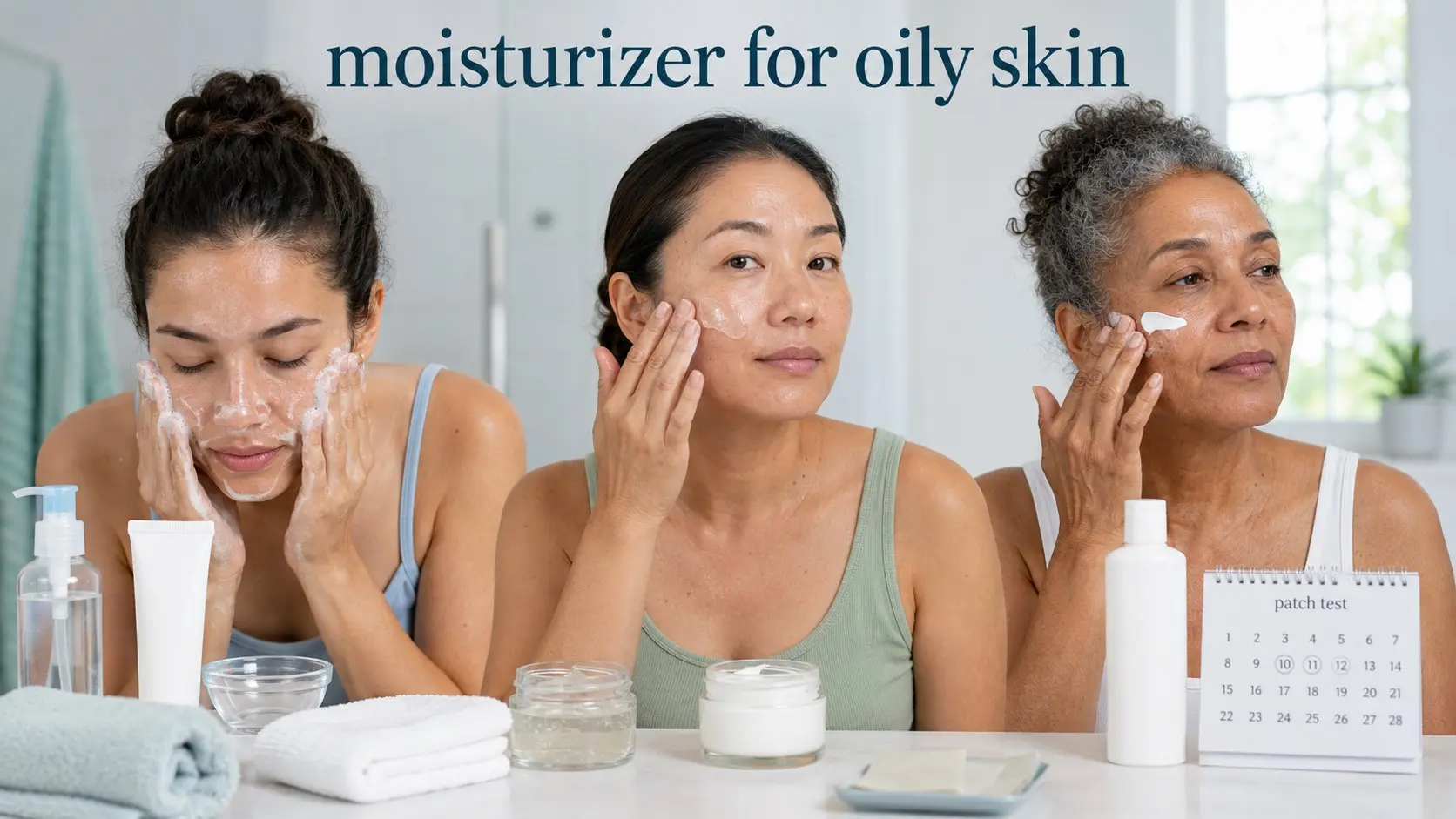
How to Test a New Moisturizer
- Apply it to a small area near the jaw or inner arm.
- Use it twice daily for seven to ten days.
- Test one new product at a time.
- Watch for itching, burning, swelling, bumps, or acne.
- Stop when a reaction develops.
A home test cannot rule out every future reaction.
A dermatologist can perform formal allergy testing when needed.
Common Oily Skin Moisturizer Mistakes
- Skipping moisturizer after harsh treatment
- Using too much product
- Applying several active ingredients together
- Choosing strong fragrance
- Scrubbing away shine
- Washing many times each day
- Using alcohol toner to dry the skin
- Applying heavy hair products near the forehead
- Changing products every few days
- Expecting moisturizer to cure acne
Common Oily Skin Moisturizer Myths
Myth: Oily skin does not need Moisturizer
Oily skin can still lose water and become irritated.
Myth: Moisturizer makes every person more Oily
A light product may hydrate without creating a greasy feel.
Myth: Oil Free Means It Cannot cause acne
Any complete formula may still irritate or clog a person’s skin.
Myth: Noncomedogenic Guarantees No Breakouts
It means the product is designed to be less likely to clog pores.
Myth: Skin Should Feel Tight After Washing
Tightness may mean that the cleanser is too harsh.
Myth: Alcohol Toner Controls Oil Safely
Strong alcohol products may increase dryness and irritation.
Myth: Heavy cream is never suitable
A cream may help when acne treatment causes strong dryness.
Myth: Moisturizer can shrink Pores
It may improve texture, but it cannot permanently change pore structure.
Myth: Natural oils are always Better
Plant oils may clog pores or cause an allergy in some people.
Myth: More products create clearer skin
A simple routine is often easier to tolerate.
When to See a Dermatologist
Arrange professional care for:
- Deep painful acne
- Acne scars
- Sudden severe oiliness
- Persistent facial redness
- A burning rash
- Repeated product reactions
- Acne that affects confidence
- Missed periods with acne
- New excess facial hair
- Rapid scalp hair loss
- Acne that does not improve
A dermatologist can identify acne, rosacea, seborrheic dermatitis, contact allergy, or another condition.
When a reaction is urgent
Seek urgent help for:
- Trouble breathing
- Swelling of the lips, tongue, or throat
- Fast facial swelling
- Fainting
- A widespread blistering rash
- Skin peeling with fever
- Severe eye pain after product exposure
Stop the product and bring its container or full ingredient list to the medical appointment.
References and Sources
American Academy of Dermatology: Why You May Need Moisturizer When You Have Acne
Open dermatologist guidance on acne treatment, dryness and choosing oil-free and noncomedogenic moisturizer.
American Academy of Dermatology: How to Control Oily Skin
Open guidance on gentle washing, oil-free products, noncomedogenic labels, moisturizer, blotting paper, and avoiding scrubbing.
American Academy of Dermatology: Skin Care Habits That Can Worsen Acne
Open guidance on washing, scrubbing, product switching, drying the skin, makeup, and acne friendly product labels.
NHS: Acne
Open guidance on acne causes, daily care, water based noncomedogenic products, washing, makeup removal, and when to seek help.
United States Food and Drug Administration: Cosmetic Labeling Claims
Official information about cosmetic claims, labeling responsibilities, and the limits of product marketing statements.
Conclusion
The best moisturizer for oily skin is light, comfortable, and easy to use every day.
Look for fragrance free, oil free, and noncomedogenic labels when they suit your skin.
Useful ingredients may include glycerin, hyaluronic acid, ceramides, niacinamide, dimethicone, and squalane.
Apply a small amount after cleansing.
Adjust the texture when acne treatment or weather makes the skin drier.
Call to action: Check your current moisturizer today. Choose one simple product, patch test it, and use it for several weeks before deciding whether it suits your oily skin.
Related NextFitLife Guides and Hubs
Medical and Cosmetic Disclaimer
This article provides general education about oily skin and cosmetic moisturizer.
It does not diagnose acne, rosacea, contact dermatitis, hormonal disease, polycystic ovary syndrome, or another medical condition.
It does not replace a skin examination, diagnosis, prescription, pregnancy assessment, treatment plan, or emergency medical care.
I am not a dermatologist or a doctor, and this content does not replace professional medical advice. This article explains published guidance and does not provide a personal clinical assessment. Always consult qualified medical professionals for diagnosis and treatment of any health condition.
About the Author
Frequently Asked Questions
Does oily skin need moisturizer?
Yes. Oily skin may still lack water or become dry and irritated from acne treatments, weather, or harsh cleansing.
What moisturizer is best for oily skin?
Choose a light gel, gel cream, or lotion that is fragrance free, oil free when preferred, and labelled noncomedogenic.
Will moisturizer make oily skin more greasy?
A heavy product may feel greasy, but a small amount of lightweight moisturizer can hydrate without adding a thick layer.
What does noncomedogenic mean?
It means the product is designed to be less likely to clog pores. It does not guarantee that no person will break out.
Should oily skin use an oil-free moisturizer?
Oil-free products are a useful starting point, but the full formula and your skin response matter more than one label.
Is gel moisturizer good for oily skin?
Yes. Gel moisturizer often feels light and may work well in warm weather or on very oily skin.
Is hyaluronic acid good for oily skin?
Hyaluronic acid can add water without feeling very heavy. It works best in a complete moisturizer.
Is niacinamide good for oily skin?
Niacinamide may support the barrier and reduce redness. Some people find it helps visible oil, but high levels may irritate.
Can moisturizer help acne?
Moisturizer does not cure acne, but it can reduce treatment dryness and help you continue an effective acne routine.
Should I moisturize after benzoyl peroxide?
Yes, unless your clinician gives different instructions. Benzoyl peroxide commonly causes dryness and peeling.
Should I moisturize before or after adapalene?
Either can work. Applying moisturizer before adapalene may reduce irritation, while applying it after can replace lost moisture.
How much moisturizer should oily skin use?
Begin with about a pea-sized amount for the entire face. Add more only where the skin remains dry.
Can I skip moisturizer in summer?
You can use a smaller amount or lighter gel, but oily skin may still need hydration and sunscreen.
Why is my face oily and flaky?
You may have dehydrated oily skin, irritation from acne treatment, seborrheic dermatitis, eczema, or another skin condition.
When should oily skin be checked by a dermatologist?
Seek care for painful or scarring acne, sudden severe oiliness, repeated rashes, or oiliness linked with hormonal symptoms.

Health & wellness writer with 30+ years of experience in nutrition, fitness, and healthy aging. Founder of NextFitLife.com — evidence-based health guidance.