Published on: July 13, 2025
Updated on: October 17, 2026
Written and source checked by: Adel Galal, Founder and Lead Writer at NextFitLife
Medical review status: This article has not been medically reviewed by a dermatologist, pharmacist, pediatrician, obstetric clinician, or other licensed healthcare professional.
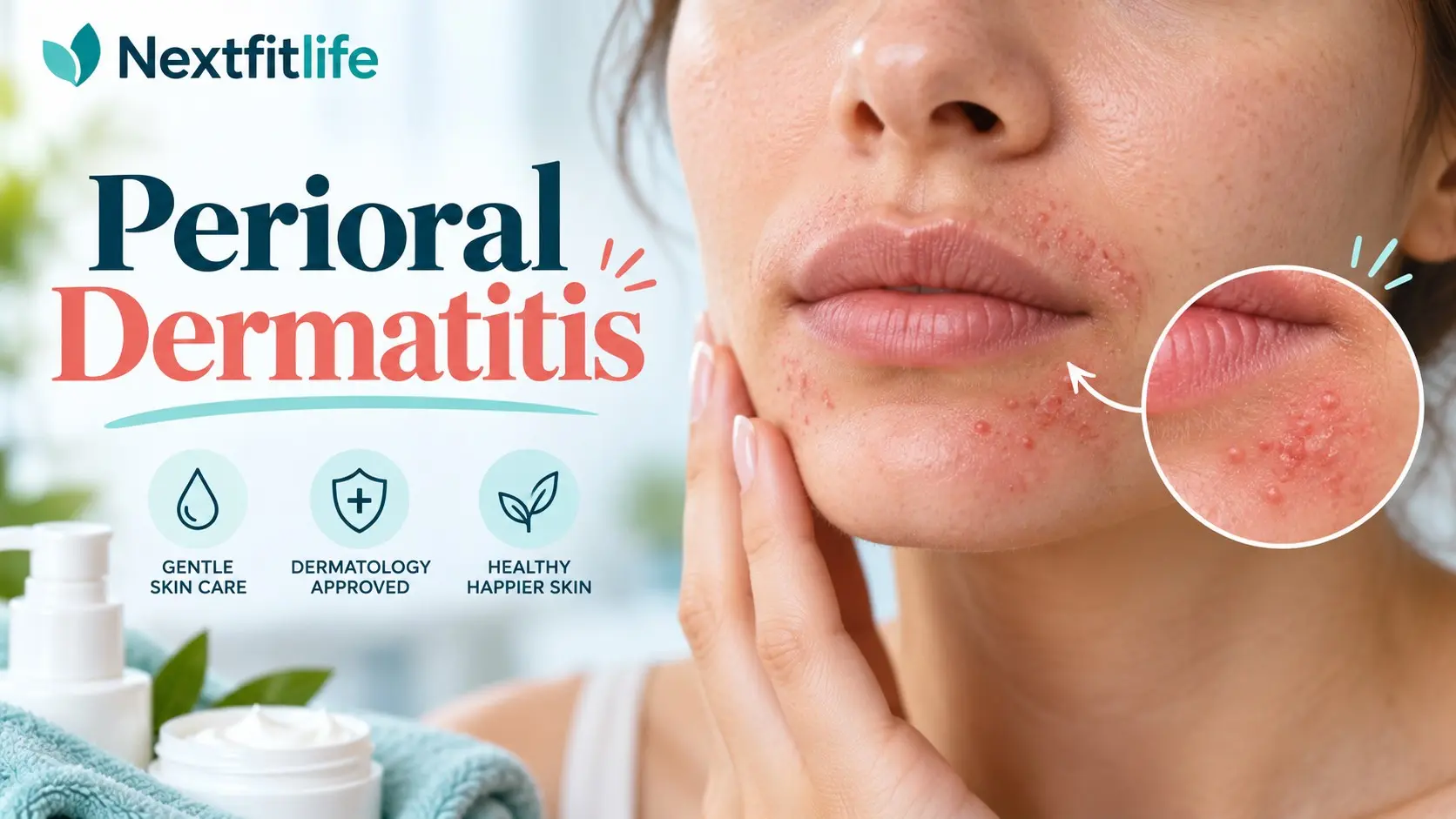
Perioral dermatitis is an inflammatory facial rash that usually causes clusters of small bumps around the mouth. It can also appear beside the nose or around the eyes, which is why doctors often use the broader name periorificial dermatitis.
One of the most important clues is its relationship with topical corticosteroids. Steroid cream can make the rash look better for a short time, then cause it to return or flare when the steroid is stopped.
The safest plan is not to keep chasing the rash with stronger creams. It is to confirm the diagnosis, remove likely triggers, simplify skin care, and use appropriate treatment when needed.
This article is for general information and education. It does not replace medical advice, diagnosis, or treatment.
If your rash is mainly dry, cracked, and itchy rather than bumpy, also read Eczema Around Mouth and Dermatitis on Lips.
Table of Contents
- What perioral dermatitis is
- How to recognize it
- Small clustered bumps
- Clear lip border
- Burning or tightness
- Dryness and fine scale
- Nose and eye involvement
- How it differs from similar rashes
- Acne
- Rosacea
- Eczema
- Contact dermatitis
- Angular cheilitis
- Seborrheic dermatitis
- 11 proven treatment steps
- Confirm the diagnosis
- Review steroid use
- Expect possible rebound
- Simplify skin care
- Use gentle cleansing
- Use lightweight products when needed
- Consider topical medicines
- Consider oral treatment for wider disease
- Protect the skin from sun gently
- Reintroduce products slowly
- Prevent recurrence
- Pregnancy and children
- Toothpaste, food, stress, and common myths
- Realistic recovery expectations
- When to see a dermatologist
- Frequently asked questions
What Is Perioral Dermatitis?
Perioral dermatitis is an inflammatory skin condition that creates small bumps around facial openings.
The mouth is the most familiar location, but the rash can also appear:
- Around the nose
- Beside the nostrils
- Around the eyes
- On the chin
When more than the mouth is involved, periorificial dermatitis is the more accurate term.
It is not a form of acne, even though the bumps can look similar.
It is also not classic eczema, despite the word dermatitis in its name.
What Does Perioral Dermatitis Look Like?
The typical rash consists of small inflammatory bumps called papules.
Some bumps may contain a small amount of fluid or pus.
The skin can also look dry or finely scaly.
Common features include:
- Clusters of small bumps
- Red, pink, brown, or skin colored inflammation depending on skin tone
- Fine flaking
- Burning
- Stinging
- Tightness
- Mild itching
Unlike many eczema rashes, intense itching is not always the main symptom.
The clear lip border clue
A classic feature is a narrow strip of relatively normal skin immediately beside the lips.
This is sometimes called vermillion sparing.
It is a useful clue, but it is not present in every patient.
Diagnosis should use the complete pattern rather than one feature alone.
Can Perioral Dermatitis Appear Around the Eyes?
Yes.
When similar bumps occur around the eyelids or eyes, the condition may be called periocular dermatitis.
Some people have bumps around the mouth, nose, and eyes at the same time.
If the skin near your eyes is involved, treatment needs extra care because many products that are acceptable elsewhere on the face should not be placed close to the eye.
Eye pain, vision changes, severe eye redness, or significant light sensitivity deserves prompt medical evaluation rather than ordinary skin self care.
Who Gets Perioral Dermatitis?
It is commonly diagnosed in women, particularly younger and middle aged adults.
But it is not limited to women.
Men can develop it.
Children can develop it too.
Children may show a variant called granulomatous periorificial dermatitis, which can look somewhat different from the classic adult pattern.
What Causes Perioral Dermatitis?
The exact cause is not fully understood.
Instead of one cause, dermatologists recognize several associations and triggers.
The strongest and most useful association is topical corticosteroid exposure.
Facial steroid creams
Topical steroids include:
- Prescription corticosteroid creams
- Prescription steroid ointments
- Over the counter hydrocortisone
A steroid can temporarily suppress inflammation, so the rash appears better.
When the steroid is stopped, the bumps can return.
The person then applies more steroid because it seemed to work before.
This creates a frustrating cycle.
Inhaled and nasal corticosteroids
Inhaled or nasal steroids are medically important medicines for conditions such as asthma and allergic rhinitis.
They should not simply be stopped because of a skin rash.
DermNet notes that these medicines may contribute to periorificial dermatitis in some people, and recovery can take longer when they remain necessary.
Good technique and rinsing the face or mouth after use may reduce unwanted skin exposure.
Cosmetics and skin care
Heavy creams, cosmetics, and some skin care products can aggravate susceptible skin.
The solution is not to blame every moisturizer.
Instead, use fewer products during an active flare and pay attention to what your skin tolerates.
Perioral Dermatitis vs Acne
These conditions can look similar, but one clue is particularly useful.
Acne commonly produces comedones.
These are:
- Blackheads
- Whiteheads
Classic perioral dermatitis does not usually produce comedones.
Acne also commonly appears across the:
- Forehead
- Cheeks
- Jawline
- Back
- Chest
Perioral dermatitis has a more characteristic distribution around facial openings.
Perioral Dermatitis vs Eczema
Eczema around the mouth often looks dry, itchy, cracked, or rough.
Perioral dermatitis more often has many small inflammatory bumps.
Another important difference is steroid response.
A correctly prescribed topical steroid can help selected true eczema.
Repeated steroid use can worsen perioral dermatitis.
This distinction is one reason self diagnosing facial rashes can be risky.
For the eczema pattern, read Eczema Around Mouth.
Perioral Dermatitis vs Rosacea
Rosacea can also cause inflammatory facial bumps.
Rosacea more often centers on the:
- Cheeks
- Nose
- Central forehead
- Chin
Other rosacea clues can include:
- Facial flushing
- Persistent background redness
- Visible small blood vessels
- Eye symptoms
There can be overlap, so a dermatologist may be needed when the pattern is not clear.
Perioral Dermatitis vs Contact Dermatitis
Contact dermatitis can develop wherever an irritant or allergen touches the skin.
It often causes more:
- Itching
- Dryness
- Scaling
- Cracking
- Sometimes weeping
Contact dermatitis may follow a clear product exposure.
Perioral dermatitis usually has a more papular, bumpy appearance.
Perioral Dermatitis vs Angular Cheilitis
Angular cheilitis affects the mouth corners.
It causes:
- Cracks
- Pain
- Crusting
- Moist or softened skin
Perioral dermatitis usually sits around the mouth while leaving the immediate lip border relatively clear.
If only the mouth corners are affected, angular cheilitis is more likely.
Perioral Dermatitis vs Seborrheic Dermatitis
Seborrheic dermatitis often produces greasy or flaky scale.
Typical locations include:
- Scalp
- Eyebrows
- Sides of the nose
- Behind the ears
- Beard area
The two conditions can both involve the folds around the nose, but the texture and broader distribution often differ.
For scalp disease, see Scalp Treatment for Dermatitis.
How the Main Facial Rashes Compare
| Condition | Typical Clue | Useful Difference |
|---|---|---|
| Perioral dermatitis | Clusters of small papules around mouth, nose, or eyes | Often spares a narrow strip beside the lips |
| Acne | Pimples plus blackheads or whiteheads | Comedones are a useful clue |
| Eczema | Dry, rough, itchy or cracked skin | Usually more eczematous than papular |
| Rosacea | Central facial redness, flushing, papules | Cheeks and nose commonly dominate |
| Contact dermatitis | Itch, scaling, exposure pattern | Often linked to something touching the skin |
| Angular cheilitis | Cracked mouth corners | Centered directly at the corners |
1. Confirm the Diagnosis
A dermatologist can often diagnose perioral dermatitis by examining the rash.
Testing is not always necessary.
The clinician may ask:
- When the rash started
- Whether you use facial steroids
- Whether you use inhaled or nasal steroids
- Which cosmetics and creams you use
- Whether the rash burns or itches
- Whether acne or rosacea is present elsewhere
When another condition is possible, testing may include:
- Bacterial testing
- Fungal testing
- Patch testing
- Skin biopsy in unusual cases
2. Review All Facial Steroid Use
This is often the most important part of treatment.
If you have been applying nonprescription hydrocortisone to an unexplained perioral rash, continuing it can prolong the problem.
If a doctor prescribed a facial corticosteroid for another condition, contact that clinician before changing the treatment.
The safest plan depends on:
- Which steroid you use
- Its strength
- How long you have used it
- Why it was originally prescribed
Some people can simply stop a low potency product.
Others who have used stronger corticosteroids for longer periods may need a supervised reduction in potency or frequency.
3. Expect a Possible Flare After Steroid Withdrawal
This is where many treatment attempts fail.
The rash may become more noticeable after a facial corticosteroid is stopped.
That temporary worsening can make it feel as though the steroid was treating the disease.
Restarting it may give temporary relief, but can keep the cycle going.
Do not assume every rebound means you need more steroid.
If the flare is severe, painful, or difficult to manage, contact the clinician treating you.
4. Strip Skin Care Back to the Basics
Perioral dermatitis usually benefits from a simple routine.
During an active flare, pause nonessential products such as:
- Facial scrubs
- Peels
- Retinoids
- Strong acids
- Fragranced products
- Heavy makeup directly over the rash
- Multiple serums
The goal is not to find the perfect ten step routine.
The goal is to reduce unnecessary contact while the inflammation settles.
5. Cleanse Gently
AAD recommends gentle skin care.
Use lukewarm water.
If you need cleanser, choose a mild fragrance free product that your skin tolerates.
Avoid:
- Harsh foaming cleansers
- Scrubbing brushes
- Washcloth friction
- Hot water
- Physical exfoliation
Pat the face dry rather than rubbing.
6. Use Moisturizer Only If You Need It and Keep It Simple
Some people with active perioral dermatitis feel better using almost no product on the affected area.
Others become uncomfortably dry and need a light moisturizer.
There is no rule that every patient must avoid all moisturizer.
If you need one, look for:
- Fragrance free formula
- Light texture
- Few unnecessary ingredients
- Good personal tolerance
If a heavy or very occlusive product clearly makes the bumps worse, stop it.
The best routine is the simplest one your skin can tolerate.
7. Topical Prescription Medicines Can Help Mild Disease
A dermatologist may prescribe a topical treatment when disease is mild or localized.
Commonly used options include:
- Metronidazole
- Erythromycin
- Pimecrolimus
Other topical medicines are sometimes used depending on the patient and local practice.
These can include:
- Azelaic acid
- Clindamycin
- Tacrolimus
Facial skin with perioral dermatitis can be sensitive, so even useful medicines can sting at first.
Tell your clinician if irritation is severe rather than simply adding more products.
8. Oral Treatment Can Help Moderate or Widespread Disease
When the rash is more widespread, persistent, or strongly inflamed, doctors often use an oral tetracycline class antibiotic.
Examples include:
- Doxycycline
- Tetracycline
- Other tetracycline class medicines according to local practice
These medicines are used partly for their anti inflammatory effect, not because perioral dermatitis is simply a bacterial infection.
The dose and treatment length should be prescribed individually.
DermNet notes that treatment commonly lasts several weeks and may need extension when disease is slow to respond.
9. Protect Your Skin From the Sun Without Overloading It
Sun protection still matters.
If your usual sunscreen burns or makes the rash worse, look for a simpler formula rather than abandoning sun protection entirely.
A lightweight fragrance free sunscreen may be easier to tolerate.
Mineral sunscreen can be useful for some people, but there is no universal rule that everyone with perioral dermatitis must use mineral filters only.
Choose the product your skin tolerates and that you will actually use.
10. Reintroduce Skin Care Products Slowly
Once the rash is stable, do not immediately restart every serum, acid, retinoid, oil, foundation, and cream you previously used.
Add products back one at a time.
Give your skin time before introducing the next one.
This has two advantages:
- It reduces irritation
- It makes a reaction easier to identify
11. Prevent Recurrence by Avoiding the Trigger You Actually Found
There is no useful reason to maintain a huge permanent avoidance list when only one or two things caused your problem.
Your prevention plan may include:
- Avoiding unnecessary facial steroids
- Using correct technique with medically necessary inhaled steroids
- Keeping skin care simple
- Avoiding a cosmetic that repeatedly triggers the rash
- Using gentle cleansing
- Restarting treatment early if your dermatologist advised a relapse plan
The goal is not to make your skin afraid of every product.
The goal is to identify what matters for you.
Perioral Dermatitis Treatment at a Glance
| Situation | Typical Treatment Direction | Key Point |
|---|---|---|
| Steroid related disease | Stop inappropriate topical steroid use with medical guidance when needed | Temporary rebound can occur |
| Mild localized disease | Gentle skin care plus topical prescription treatment when needed | Metronidazole, erythromycin, or pimecrolimus are commonly used options |
| Moderate or widespread disease | Oral anti inflammatory antibiotic treatment | Treatment often continues for several weeks |
| Pregnancy | Pregnancy compatible treatment selected by clinician | Tetracyclines are generally avoided in pregnancy |
| Childhood disease | Age appropriate topical or systemic treatment | Do not copy an adult antibiotic plan |
| Unclear diagnosis | Dermatology assessment and selective testing | Acne, rosacea, eczema, and contact dermatitis can mimic it |
How Long Does Perioral Dermatitis Take to Clear?
Think in weeks rather than days.
AAD says the rash tends to clear slowly and may take a few weeks or a few months to disappear completely.
DermNet commonly describes treatment courses of around four to eight weeks, with longer treatment sometimes required.
Your timeline depends on:
- How long the rash has been present
- Whether steroids were used
- How widespread it is
- Which treatment you use
- Whether triggering products continue
- How your skin responds
Do not judge a treatment after two or three days unless it is clearly causing a bad reaction.
Will It Get Worse Before It Gets Better?
It can, especially after stopping a topical steroid.
The skin may temporarily look:
- Redder
- Bumpier
- Drier
- More irritated
The severity and length of that flare vary.
There is no reliable universal rule that everyone rebounds for a fixed number of days or weeks.
If the reaction is severe, get medical help rather than guessing whether it is “normal withdrawal.”
Should You Stop Steroid Cream Immediately?
It depends on the situation.
AAD advises stopping over the counter hydrocortisone being used without medical direction.
For prescription corticosteroids, contact the clinician who prescribed the medicine before stopping it.
DermNet notes that some people who have used stronger facial steroids benefit from gradual reduction in potency or frequency.
This is more accurate than a blanket rule telling every person to stop every steroid immediately.
What About Steroid Inhalers for Asthma?
Do not stop medically necessary asthma treatment because of perioral dermatitis.
Asthma control is more important than experimenting with prescribed medication.
If your inhaled steroid seems related to facial irritation:
- Review inhaler technique
- Avoid unnecessary medicine contact with facial skin
- Rinse the mouth after use when your treatment instructions recommend it
- Wash residue from surrounding facial skin
- Discuss concerns with your asthma clinician
Does Fluoride Toothpaste Cause Perioral Dermatitis?
Toothpaste has been reported as a possible trigger in some patients, but this does not mean fluoride causes perioral dermatitis in everyone.
The evidence is not strong enough to tell every patient to stop fluoride toothpaste routinely.
Fluoride is important for preventing tooth decay.
If brushing clearly triggers or worsens the rash, discuss:
- Toothpaste ingredients
- Flavorings
- Foaming agents
- Dental care needs
with a dermatologist or dentist.
A targeted change makes more sense than giving up fluoride without a reason.
Can Heavy Moisturizer Make It Worse?
Some patients find thick, occlusive facial products aggravate the rash.
That does not make petrolatum or moisturizer universally bad.
People have different skin needs.
During an active flare, simpler and lighter products are often easier to tolerate.
If your skin feels better with no moisturizer on the affected area, that may be reasonable temporarily.
If your skin becomes painfully dry, a light fragrance free product can be considered.
Can You Wear Makeup?
You can sometimes wear makeup, but active inflamed skin may tolerate less product.
Heavy foundation directly over the rash can add occlusion and irritation.
If possible, reduce makeup over active areas until the rash settles.
When you restart makeup:
- Choose fragrance free products when possible
- Use clean applicators
- Introduce one product at a time
- Stop a product that clearly causes burning or more bumps
Can Retinol Make Perioral Dermatitis Worse?
Retinoids can irritate sensitive skin.
During an active flare, strong retinoids, exfoliating acids, and acne treatments can make burning and dryness worse.
That does not mean retinoids caused every case.
Pause irritating actives until the rash is controlled, then discuss reintroduction if needed.
Can Benzoyl Peroxide Help?
Benzoyl peroxide treats acne, but perioral dermatitis is not acne.
It can be irritating to already sensitive skin around the mouth.
MedlinePlus lists it among treatments that may sometimes be used, but it is not a universal first choice.
Do not automatically treat every group of facial bumps with an acne routine.
Can Azelaic Acid Help?
Azelaic acid is sometimes used as an alternative topical treatment.
Evidence is less established than for the most commonly recommended therapies, and irritated facial skin can sting when it is applied.
If a dermatologist recommends it, introduce it according to their instructions rather than layering it with several other active products.
Does Perioral Dermatitis Need Antibiotics?
Not every case does.
Mild disease may improve after triggers are removed and with topical treatment.
Moderate, widespread, or stubborn disease often responds to oral tetracycline class medicines.
These medicines help partly because of their anti inflammatory action.
This does not mean the rash is a bacterial infection that can spread to other people.
Is Perioral Dermatitis Contagious?
No.
You cannot catch perioral dermatitis from:
- Kissing
- Touching someone's face
- Sharing towels
- Sharing a room
However, if a rash has been misdiagnosed and is actually infectious, that answer could change.
Pus, rapidly spreading crust, pain, or fever deserves reassessment.
Is Perioral Dermatitis a Fungal Infection?
No established evidence shows that ordinary perioral dermatitis is simply a fungal infection.
Microorganisms have been studied as possible contributors, but the cause remains uncertain.
That is why antifungal treatment should not be used automatically unless another fungal condition has actually been diagnosed.
Does Diet Cause Perioral Dermatitis?
There is no established perioral dermatitis diet.
No food has been proven to universally cause the disease.
That means routine elimination of:
- Dairy
- Gluten
- Sugar
- Eggs
- Nuts
is not standard treatment.
Focus first on the factors with stronger clinical relevance, especially steroid exposure and facial skin care.
Does Spicy Food Make It Worse?
Some people feel that hot or spicy foods make facial warmth or burning more noticeable.
That does not mean spicy food causes perioral dermatitis.
If you notice a consistent personal pattern, avoiding that trigger during an active flare is reasonable.
There is no need for every patient to follow a bland diet.
Can Stress Cause Perioral Dermatitis?
Stress can worsen many inflammatory skin conditions and may influence how a flare feels.
But it is too simplistic to call stress the cause of perioral dermatitis.
Useful stress care can include:
- Regular sleep
- Exercise
- Time outdoors
- Relaxation exercises
- Reducing repetitive face touching
These habits support general health but do not replace medical treatment when it is needed.
Perioral Dermatitis During Pregnancy
Pregnancy changes the treatment options.
Some medicines commonly used outside pregnancy are not appropriate during pregnancy.
DermNet lists erythromycin as one systemic option used when treatment is needed in pregnancy.
Tetracycline class medicines are generally avoided.
Do not self treat with leftover antibiotics or another person's medication.
If you are pregnant or breastfeeding, tell the prescribing clinician before starting any topical or oral medicine.
Perioral Dermatitis in Children
Children can develop periorificial dermatitis too.
The diagnosis can be harder because eczema, saliva irritation, lip licking dermatitis, and infection are also common around a child's mouth.
Do not apply an adult acne or antibiotic routine to a child.
Treatment depends on:
- Age
- Severity
- Body area
- Previous steroid use
- Other health conditions
DermNet notes that macrolide antibiotics such as erythromycin can be used instead of tetracyclines in younger children when systemic treatment is necessary.
What Is Granulomatous Periorificial Dermatitis?
Children can develop a variant with firm papules that may look yellowish, brown, or skin colored rather than bright red.
This is often called granulomatous periorificial dermatitis.
Because it can resemble other childhood facial conditions, professional diagnosis is useful.
Can Perioral Dermatitis Leave Dark Marks?
Yes.
Inflammation can leave temporary post inflammatory hyperpigmentation, especially in deeper skin tones.
The bumps may disappear before the skin color fully returns to normal.
Do not keep adding aggressive treatment only because a flat dark mark remains.
First determine whether active inflammation is still present.
Can It Leave Scars?
Ordinary perioral dermatitis usually does not cause the deep scarring seen with severe acne.
Picking, squeezing, or scratching the bumps can increase inflammation and pigment changes.
Avoid trying to “pop” the papules.
Can Perioral Dermatitis Come Back?
Yes.
Recurrence can happen, especially if a trigger returns.
Common reasons include:
- Restarting facial steroid cream
- Stopping prescribed treatment too early
- Returning to a product that irritates the skin
- Incorrect diagnosis
A repeat flare does not mean the condition is untreatable.
It means the plan may need adjustment.
A Simple Daily Routine During a Flare
Morning
- Wash gently with lukewarm water or a mild fragrance free cleanser.
- Apply prescribed topical medicine if your treatment plan uses one.
- Use a light moisturizer only if your skin needs it.
- Apply a sunscreen you tolerate.
During the day
- Avoid picking or squeezing bumps.
- Do not keep adding creams when the skin feels irritated.
- Avoid unnecessary facial steroid use.
- Keep medically necessary inhaler treatment unchanged unless your clinician advises otherwise.
Evening
- Remove makeup gently if you wear it.
- Cleanse without scrubbing.
- Apply prescribed treatment.
- Keep the rest of the routine simple.
This routine is intentionally boring.
That is often useful when irritated facial skin needs time to settle.
What Should You Avoid During an Active Flare?
Things worth pausing or reviewing include:
- Unnecessary topical steroids
- Harsh facial scrubs
- Strong chemical peels
- Multiple acids
- Strong retinoids over the affected skin
- Fragranced skin products
- Heavy makeup directly over active inflammation
- Picking and squeezing the bumps
Do not turn this into a permanent ban list.
Once the skin settles, products can often be reintroduced carefully.
Common Perioral Dermatitis Mistakes
| Mistake | Why It Can Backfire | Better Approach |
|---|---|---|
| Treating it like acne | Strong acne products can irritate already sensitive skin | Confirm whether comedones are actually present |
| Using hydrocortisone repeatedly | Steroids can temporarily suppress then perpetuate the rash | Review steroid use with the appropriate clinician |
| Stopping a prescription steroid without checking | Longer or stronger steroid use may need a supervised taper | Contact the prescriber |
| Using ten new skin products | Makes irritation and triggers harder to identify | Simplify the routine |
| Assuming fluoride is always the problem | Evidence does not support blanket fluoride avoidance for everyone | Investigate toothpaste only when the pattern supports it |
| Stopping antibiotics as soon as skin looks better | The prescribed treatment course may not be complete | Follow the clinician's prescribed duration |
| Squeezing the bumps | Adds inflammation and pigment change | Leave papules alone |
When Should You See a Dermatologist?
Arrange medical assessment when:
- You are not sure the rash is perioral dermatitis
- The rash is spreading
- It involves the eyes
- You have used facial steroids for a long time
- The rebound after stopping steroids is severe
- Gentle skin care is not helping
- The rash repeatedly returns
- You are pregnant or breastfeeding and need treatment
- A child has persistent perioral bumps
- The rash is painful, infected looking, or unusually severe
A dermatologist can distinguish perioral dermatitis from acne, rosacea, eczema, contact dermatitis, infection, and other facial conditions and build a treatment plan that fits your situation.
Conclusion: Stop the Steroid Cycle and Simplify the Routine
Perioral dermatitis can be stubborn, but it is treatable.
The most useful steps are to confirm the diagnosis, review facial steroid use carefully, strip skin care back to gentle basics, and use the right prescription treatment when necessary.
Your next step is simple: if small bumps around your mouth keep returning, especially after hydrocortisone or another facial steroid, ask a dermatologist to confirm whether perioral dermatitis is the real cause before adding another cream.
References and Sources
- American Academy of Dermatology. Red Rash Around Your Mouth Could Be Perioral Dermatitis.
Covers steroid associated perioral dermatitis, rebound after steroid withdrawal, gentle skin care, topical and oral treatment, and expected gradual recovery.
https://www.aad.org/public/diseases/a-z/perioral-dermatitis - DermNet. Periorificial Dermatitis.
Covers clinical appearance, triggers, topical steroid withdrawal, pimecrolimus, metronidazole, erythromycin, tetracyclines, pregnancy considerations, and treatment duration.
https://dermnetnz.org/topics/periorificial-dermatitis - MedlinePlus. Perioral Dermatitis.
Reviewed August 2, 2025. Covers symptoms, steroid associations, differential diagnosis, topical medicines, oral antibiotics, self care, and recurrence.
https://medlineplus.gov/ency/article/001455.htm - DermNet. Periocular Dermatitis.
Covers periorificial dermatitis around the eyes, steroid withdrawal, topical treatments, oral tetracyclines, and pediatric alternatives.
https://dermnetnz.org/topics/periocular-dermatitis - Cleveland Clinic. Perioral Dermatitis.
Covers symptoms, differential diagnosis, possible triggers, treatment options, prognosis, and recurrence.
https://my.clevelandclinic.org/health/diseases/21458-perioral-dermatitis - DermNet. Follicular Disorders: Perioral Dermatitis.
Covers why perioral dermatitis is not classic eczema, facial steroid aggravation, oral tetracyclines, topical options, and pregnancy related antibiotic selection.
https://dermnetnz.org/cme/follicular/perioral-dermatitis
Internal Links and Helpful NextFitLife Guides
- Skin Health Complete Guide
- Eczema Around Mouth: Causes, Symptoms, and Relief
- Dermatitis on Lips: Causes, Symptoms, and Relief
- Atopic Eczema: Symptoms, Causes, Treatment, and Prevention
- Dermatitis Atopica: Symptoms and Effective Treatments
- Damaged Skin Barrier: Signs and Recovery Steps
- Healthy Skin 101
- How to Care for Your Skin Daily
About the Author
Adel Galal is the Founder and Lead Writer at NextFitLife. He researches skin health, eczema, dermatitis, allergies, nutrition, healthy aging, and evidence based wellness and turns current medical and public health guidance into clear practical information for everyday readers.
I am not a doctor or licensed healthcare professional, and this content does not replace professional medical advice, diagnosis, or treatment. I share information based on extensive research, real life experience, and consultation with healthcare providers. Always consult a qualified healthcare professional for diagnosis, treatment, or guidance about any health condition.
Learn more about Adel Galal, NextFitLife, and the site's editorial approach on the About Us page.
Frequently Asked Questions
What is perioral dermatitis?
Perioral dermatitis is an inflammatory facial rash that usually causes clusters of small bumps around the mouth. It can also affect the nose and eyes and is often called periorificial dermatitis.
What does perioral dermatitis look like?
It usually causes small inflamed papules, sometimes with fine scale or pustules. A narrow strip of normal skin immediately beside the lips is often spared.
What causes perioral dermatitis?
The exact cause is not known. Facial topical corticosteroids are an important trigger, while cosmetics, heavy skin care products, inhaled or nasal steroids, and other factors may contribute.
Does hydrocortisone make perioral dermatitis worse?
Yes. Hydrocortisone can temporarily suppress the rash but can also perpetuate or worsen perioral dermatitis with repeated use.
Should I stop prescription steroid cream immediately?
Not always. If a clinician prescribed the steroid, ask that clinician before stopping it. Long term or stronger facial steroid treatment may need a supervised reduction in strength or frequency.
Can perioral dermatitis get worse after stopping steroids?
Yes. A temporary rebound flare can occur after stopping topical corticosteroids. The severity and duration vary, so severe flares should be discussed with a clinician.
Is perioral dermatitis contagious?
No. Perioral dermatitis is not contagious and cannot be spread through touching, kissing, or sharing towels.
Is perioral dermatitis acne?
No. It can resemble acne, but acne commonly includes blackheads and whiteheads, while classic perioral dermatitis does not.
Is perioral dermatitis eczema?
No. Despite its name, perioral dermatitis is not classic eczematous dermatitis. Eczema more often causes dry, itchy, cracked patches rather than clusters of small papules.
What medicines treat perioral dermatitis?
Common treatments include topical metronidazole, erythromycin, or pimecrolimus for selected cases. Moderate or widespread disease may be treated with an oral tetracycline class medicine.
How long does perioral dermatitis take to clear?
Improvement is usually gradual. It may take several weeks, and some cases take a few months to clear completely.
Does fluoride toothpaste cause perioral dermatitis?
Toothpaste has been reported as a possible trigger in some people, but there is not enough evidence to tell everyone with perioral dermatitis to stop fluoride toothpaste routinely.
Can moisturizer make perioral dermatitis worse?
Heavy or very occlusive creams can aggravate some cases. Other people need a light fragrance free moisturizer because their skin becomes too dry. Treatment should be individualized.
Can I wear makeup with perioral dermatitis?
Some people can, but heavy makeup over active inflammation can increase irritation. Keeping makeup light and reducing unnecessary products during a flare is often helpful.
Can retinol worsen perioral dermatitis?
Retinoids can irritate sensitive inflamed skin, so they are often paused over affected areas during an active flare and reintroduced later when appropriate.
Do antibiotics work because perioral dermatitis is an infection?
No. Antibiotics used for perioral dermatitis are also valued for their anti inflammatory effects. The condition is not considered a contagious bacterial infection.
Can food cause perioral dermatitis?
No specific food has been established as a universal cause. Routine dairy, gluten, or other elimination diets are not standard treatment.
Can perioral dermatitis happen during pregnancy?
Yes. Treatment choices need adjustment during pregnancy because some medicines, including tetracycline class antibiotics, are generally avoided. A clinician can select a safer option.
Can children get perioral dermatitis?
Yes. Children can develop periorificial dermatitis, but their treatment must be age appropriate and should not simply copy an adult treatment plan.
When should I see a dermatologist?
See a dermatologist if the diagnosis is uncertain, the rash spreads or repeatedly returns, steroid withdrawal is difficult, the eye area is involved, or gentle skin care and initial treatment are not helping.

Health & wellness writer with 30+ years of experience in nutrition, fitness, and healthy aging. Founder of NextFitLife.com — evidence-based health guidance.