Updated on: October 16, 2026
Written and source checked by: Adel Galal, Founder and Lead Writer at NextFitLife
Medical review status: This article has not been medically reviewed by a dermatologist, allergist, pediatrician, pharmacist, or other licensed healthcare professional.
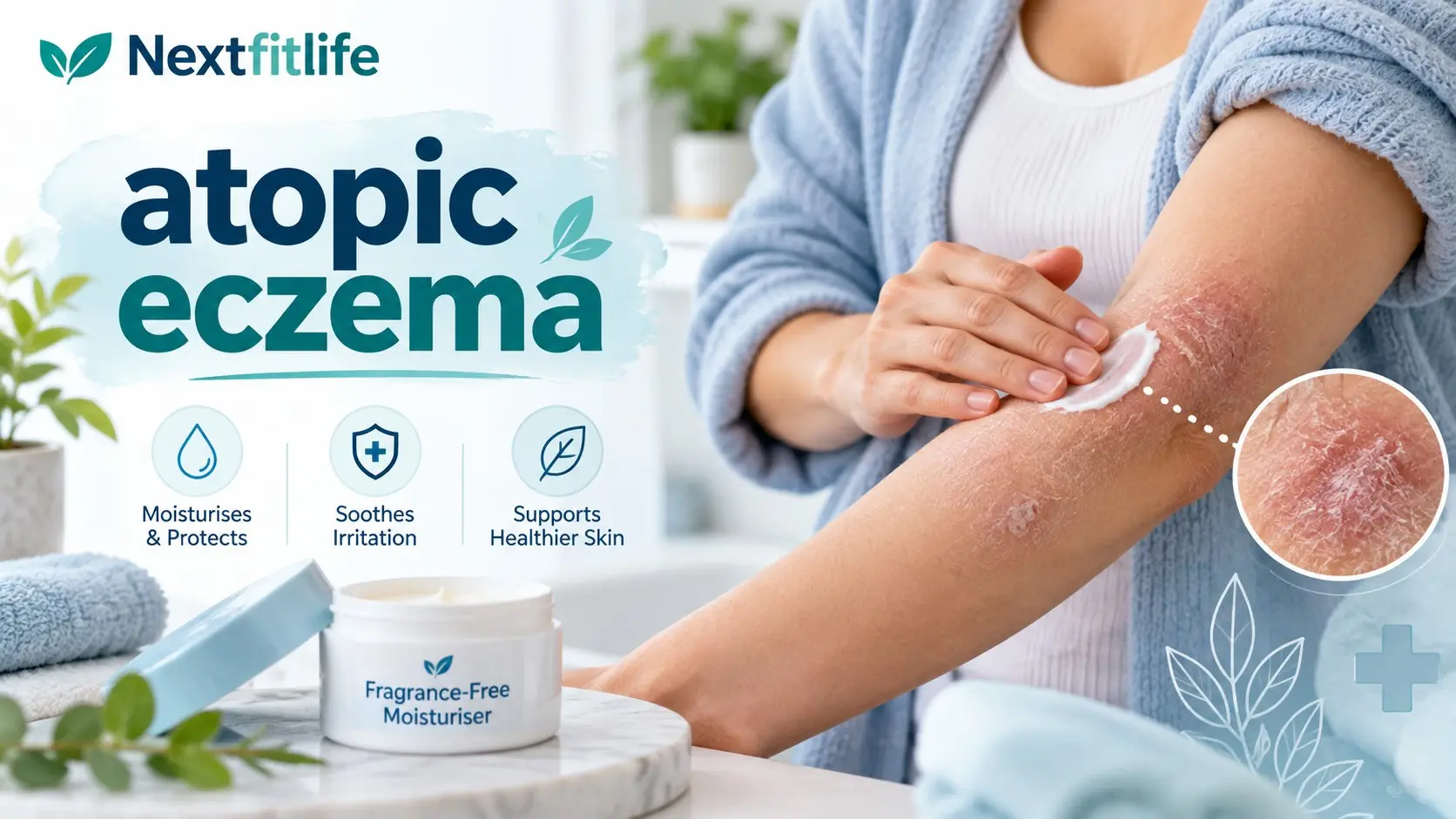
Atopic eczema, also called atopic dermatitis, is a chronic inflammatory skin condition that causes intense itching, dryness, inflammation, and repeated flares. It is not contagious, and it is not caused by poor hygiene.
The most effective plan usually combines daily skin barrier care with the right anti inflammatory treatment during flares. Moderate or severe disease may need phototherapy, biologic medicines, or other treatments that work throughout the body.
This article is for general information and education. It does not replace medical advice, diagnosis, or treatment.
For a wider guide to barrier care, sunscreen, sensitive skin, eczema, and other skin conditions, visit the NextFitLife Skin Health Guide.
Table of Contents
- What atopic eczema really is
- Common symptoms
- Intense itching
- Dry and rough skin
- Inflammation and color change
- Cracks, bumps, or weeping
- Thickened skin from scratching
- 11 proven management steps
- Moisturize every day
- Use gentle bathing
- Use topical steroids correctly
- Consider nonsteroid topical treatment
- Control the itch scratch cycle
- Use wet wraps appropriately
- Identify real triggers
- Watch for infection
- Use phototherapy when appropriate
- Consider biologics or JAK inhibitors
- Build a long term maintenance plan
- Food allergy and eczema
- Atopic eczema in babies and children
- Eczema on darker skin tones
- Common treatment mistakes
- Frequently asked questions
What Is Atopic Eczema?
Atopic eczema is the same condition many medical sources call atopic dermatitis.
It is a chronic inflammatory disease that affects the outer skin barrier and the immune system.
A healthy skin barrier helps keep water inside the skin while blocking irritants, allergens, and germs.
In atopic eczema, that barrier does not work as well.
Water escapes more easily.
The skin becomes dry and sensitive, while irritants and allergens can enter more easily and trigger inflammation.
This helps explain why moisturizer matters, but also why moisturizer alone is not enough for many active flares.
What Does Atopic Eczema Look and Feel Like?
The strongest clue is usually itching.
Atopic eczema has even been described as an “itch that rashes” because itching and scratching can drive much of the visible skin damage.
Common symptoms include:
- Very itchy skin
- Dryness
- Rough or scaly patches
- Inflammation
- Cracks
- Small raised bumps
- Oozing or weeping during some flares
- Crusting
- Thickened skin after repeated scratching
- Skin color changes after a flare heals
The appearance varies with skin tone.
Inflamed eczema may look pink or red on lighter skin. On darker skin, it can look purple, gray, brown, or simply darker than the surrounding skin.
Where Does Atopic Eczema Usually Appear?
The pattern changes with age.
Babies
Babies often develop eczema on the cheeks, forehead, scalp, arms, legs, or trunk.
Children
As children grow, eczema often affects:
- Inside the elbows
- Behind the knees
- Wrists
- Ankles
- Neck
Adults
Adults may develop eczema on:
- Hands
- Face
- Neck
- Eyelids
- Elbow folds
- Knee folds
- Other repeatedly affected areas
Persistent facial or hand eczema deserves proper diagnosis because contact allergy, irritant dermatitis, psoriasis, fungal infection, and other conditions can look similar.
What Causes Atopic Eczema?
There is no single cause.
Atopic eczema develops through a combination of:
- Genetics
- Skin barrier dysfunction
- Immune system activity
- Environmental exposure
- Personal triggers
Genetics
Eczema can run in families.
A family history of atopic dermatitis, asthma, or allergic rhinitis can raise the chance of developing it.
Skin barrier weakness
Some people with eczema have changes in proteins involved in maintaining a healthy outer skin barrier.
The result is greater water loss and easier penetration of irritants.
If you want a deeper explanation, read Damaged Skin Barrier: Signs and Recovery Steps.
Immune inflammation
Eczema also involves immune pathways that produce inflammation and itch.
This is why modern medicines can target specific inflammatory signals rather than simply coating dry skin.
What Triggers an Eczema Flare?
A trigger does not cause eczema from nothing.
It makes existing eczema more likely to flare.
Common triggers include:
- Harsh soap
- Fragrance
- Some skin care products
- Frequent handwashing
- Cleaning chemicals
- Sweat
- Heat
- Cold dry weather
- Rough fabrics
- Friction
- Stress
- Skin infection
Triggers vary from person to person.
Do not remove ten foods, replace all your clothes, or throw away every skin product just because another person with eczema did.
1. Moisturize Every Day, Even When Your Skin Looks Better
Moisturizer is basic treatment, not decoration.
It helps reduce water loss and supports the damaged skin barrier.
Creams and ointments usually hold moisture better than thin lotions.
For very dry eczema, ointments such as plain petrolatum can be useful because they create a strong protective layer.
What should you look for?
Choose a product that is:
- Fragrance free
- Comfortable on your skin
- Thick enough for your level of dryness
- Simple enough that it does not add unnecessary irritants
Ceramides can be useful ingredients, but a moisturizer does not need an impressive ingredient list to work.
When should you moisturize?
Useful times include:
- After bathing
- After washing hands
- Whenever skin feels dry
- Before bed
The National Eczema Association recommends applying moisturizer generously after bathing while the skin is still slightly damp.
2. Keep Bathing Simple and Gentle
Eczema skin does not need aggressive cleaning.
Use lukewarm water rather than very hot water.
Choose a gentle fragrance free cleanser when cleanser is needed.
Do not scrub with a rough loofah, brush, or body scrub.
A simple soak and seal routine
- Bathe or soak briefly in lukewarm water.
- Use a gentle cleanser if needed.
- Pat the skin lightly rather than rubbing hard.
- Apply prescribed topical medicine to the areas your clinician told you to treat.
- Apply moisturizer promptly to the rest of the skin.
This routine helps trap water in the skin rather than letting it evaporate after bathing.
3. Topical Corticosteroids Remain Core Flare Treatment
Topical corticosteroids are among the most established treatments for inflamed eczema.
They reduce inflammation and itching.
The right strength depends on:
- Age
- Body area
- Severity
- Skin thickness
- How long treatment is needed
A steroid that is suitable for a thick patch on the body may be too strong for eyelids or another thin skin area.
Do not copy another person's steroid cream or use a strong product indefinitely without guidance.
At the same time, fear of all steroid creams can also lead to undertreated eczema.
The safer approach is correct drug, correct strength, correct area, and correct duration.
4. Nonsteroid Topical Medicines Give More Options
Modern eczema treatment is no longer limited to moisturizer and steroid cream.
Depending on age, severity, body site, and country, clinicians may use nonsteroid topical treatments such as:
- Tacrolimus
- Pimecrolimus
- Crisaborole
- Ruxolitinib cream
- Roflumilast cream
- Tapinarof cream
Topical calcineurin inhibitors such as tacrolimus and pimecrolimus can be especially useful in selected sensitive skin areas and for maintenance treatment.
The newest options mean treatment can be tailored more precisely instead of using the same cream for every patient.
5. Break the Itch Scratch Cycle
Itching causes scratching.
Scratching damages the barrier.
Barrier damage creates more inflammation and more itch.
That loop can become relentless.
Useful strategies include:
- Treat inflammation early
- Moisturize regularly
- Keep fingernails short
- Use soft clothing
- Keep the bedroom comfortably cool
- Avoid overheating at night
- Use wet wraps when professionally recommended
Oral antihistamines are not a general anti inflammatory treatment for eczema itself.
They may have a role in selected people with allergy symptoms or sleep problems, but routine use should not replace proper eczema therapy.
6. Wet Wrap Therapy Can Help a Severe Flare
Wet wrap therapy can help rehydrate very dry skin and calm a significant flare.
A typical method uses:
- Moisturizer or prescribed topical treatment
- A damp layer of cloth or dressing
- A dry layer over it
The moist layer helps hydrate the skin and can increase the effect of topical treatment.
Do not use wet wraps over skin that looks infected unless a clinician tells you to.
7. Identify Your Real Triggers Instead of Avoiding Everything
A trigger diary can help.
Write down:
- Products used
- Work exposures
- Weather
- Sweating
- Stress
- Clothing
- Cleaning chemicals
- Where on the body the flare appears
Patterns matter more than assumptions.
For example, repeated hand eczema after cleaning could point toward irritant dermatitis or contact allergy rather than a food problem.
8. Learn the Signs of Skin Infection
Broken, scratched eczema skin is easier for germs to enter.
Possible infection signs include:
- Yellow or honey colored crust
- Pus filled bumps
- Increasing pain
- Warmth
- Swelling
- Rapidly spreading inflammation
- Fever
- Feeling generally unwell
Do not use antibiotics on ordinary eczema just in case.
Antibiotics treat bacterial infection, not the underlying atopic dermatitis.
Eczema herpeticum needs special attention
Eczema herpeticum is a potentially serious herpes simplex infection that can spread across eczema affected skin.
Possible signs include:
- Clusters of painful blisters or sores
- Rapid spread
- Fever
- Fatigue
- Swollen lymph nodes
Seek immediate medical care if eczema herpeticum is possible.
9. Phototherapy Can Help When Topical Care Is Not Enough
Phototherapy uses controlled ultraviolet light under medical supervision.
It can be an option when eczema is widespread or does not respond adequately to topical treatment.
This is different from using a tanning bed.
Do not try to reproduce medical phototherapy with tanning beds, sunlamps, or deliberate sunburn.
The dose and type of ultraviolet exposure used medically are controlled.
10. Modern Biologics and JAK Inhibitors Have Changed Severe Eczema Care
Moderate or severe atopic eczema no longer means simply cycling through stronger steroid creams.
Modern systemic treatments can target specific inflammatory pathways.
Biologic medicines
Current options include medicines such as:
- Dupilumab
- Tralokinumab
- Lebrikizumab
- Nemolizumab with topical therapy in appropriate patients
These treatments do not all work in exactly the same way.
Age approvals and indications also differ by country.
JAK inhibitors
Oral JAK inhibitors used for selected moderate or severe disease include:
- Upadacitinib
- Abrocitinib
Some countries also use baricitinib for atopic dermatitis.
JAK inhibitors need careful prescribing because they can carry important risks and monitoring requirements.
11. Build a Maintenance Plan, Not Just a Flare Plan
The goal is not to wait until the skin becomes unbearable every time.
Long term eczema care can include:
- Daily moisturizer
- Gentle cleansing
- Avoiding known irritants
- Early treatment of new inflammation
- Intermittent maintenance medicine on repeat problem areas when prescribed
- Prompt treatment of infection
- Regular review when eczema is poorly controlled
Some topical medicines are used proactively on areas that repeatedly flare.
Ask your clinician whether your plan should include maintenance treatment after visible inflammation settles.
Atopic Eczema Treatment at a Glance
| Treatment Level | Examples | Main Role |
|---|---|---|
| Daily care | Fragrance free cream or ointment, gentle bathing | Protect the skin barrier and reduce dryness |
| Topical anti inflammatory treatment | Topical corticosteroids | Control active inflammation and itch |
| Nonsteroid topical treatment | Tacrolimus, pimecrolimus, crisaborole, ruxolitinib, roflumilast, tapinarof | Control inflammation with different treatment pathways |
| Wet wraps | Damp layer plus dry covering | Help calm selected severe flares |
| Phototherapy | Controlled ultraviolet treatment | Treat widespread or harder to control eczema |
| Biologic treatment | Dupilumab, tralokinumab, lebrikizumab, nemolizumab | Target selected inflammatory pathways in moderate or severe disease |
| Oral targeted therapy | Upadacitinib, abrocitinib | Treat selected moderate or severe eczema |
Are Oral Steroids Good Treatment for Atopic Eczema?
Routine systemic corticosteroid treatment is generally discouraged.
Oral steroids can suppress eczema quickly, but disease can rebound after they are stopped, and repeated or prolonged use creates significant side effect concerns.
Current dermatology guidelines recommend against routine systemic corticosteroids for atopic dermatitis.
Specialists may use them only in unusual short term situations or as a temporary bridge while a more suitable treatment starts.
Do Antihistamines Treat Atopic Eczema?
Not in the way many people assume.
Atopic eczema itch is not simply a histamine problem.
That means ordinary antihistamines are not a core anti inflammatory treatment for eczema itself.
A clinician may still recommend an antihistamine when a person also has allergic symptoms or when a sedating medicine is being considered for a specific short term sleep problem.
Do not use antihistamines as a substitute for controlling skin inflammation.
Does Food Cause Atopic Eczema?
Usually, eczema is not caused by one food that simply needs to be removed.
Some people, especially some children, have both eczema and true food allergy.
That does not justify routine elimination of:
- Dairy
- Eggs
- Wheat
- Nuts
- Soy
- Other major foods
without a clear reason.
Unnecessary elimination diets can make nutrition harder, particularly in growing children.
Food allergy assessment makes more sense when there is a convincing history of an immediate food reaction or when a qualified clinician believes testing is appropriate.
Should Everyone With Eczema Have Allergy Testing?
No.
Atopic eczema is usually diagnosed clinically.
Allergy testing can be useful in selected situations.
Examples include:
- A clear immediate reaction after a specific food
- Persistent disease despite an optimized treatment plan
- Suspected allergic contact dermatitis
- A rash pattern suggesting a specific exposure
Patch testing is different from food allergy testing.
Patch testing looks for delayed contact allergy to ingredients such as fragrance, preservatives, metals, or chemicals.
Can Stress Cause Eczema?
Stress does not create atopic eczema from nothing.
It can trigger or worsen flares in some people.
Stress also affects sleep and can increase scratching.
Useful stress management can include:
- Regular sleep
- Walking
- Exercise when sweat is not a trigger
- Relaxation exercises
- Support for anxiety or low mood when needed
Stress care supports the eczema plan. It does not replace anti inflammatory treatment.
Can Sweat Make Atopic Eczema Worse?
Yes, for some people.
Sweat, heat, and friction can make skin sting or itch.
That does not mean people with eczema should avoid exercise.
Try:
- Cooler exercise conditions
- Loose breathable clothing
- Taking breaks before overheating
- Rinsing sweat away afterward
- Applying moisturizer after washing
If swimming dries or irritates your skin, see Skincare Routine After Swimming.
Atopic Eczema in Babies and Children
Children often need a simpler routine than adults.
Start with:
- Gentle bathing
- Regular moisturizer
- Fragrance free products
- Soft comfortable clothing
- Correct prescription medicine when needed
Do not use an adult's prescription steroid or another child's medicine.
Medicine strength, body area, age, and treatment schedule all matter.
Moderate or severe childhood eczema now has more treatment options than it did only a few years ago. Current dermatology guidelines include topical treatments, biologics, JAK inhibitors, and selected other therapies depending on age and severity.
Atopic Eczema on Darker Skin Tones
Do not rely on bright redness as the only sign of inflammation.
On deeper skin tones, eczema can appear:
- Brown
- Purple
- Gray
- Darker than the surrounding skin
- As rough raised bumps
After inflammation settles, lighter or darker marks can remain.
These color changes may take longer to fade than the active eczema itself.
What About Natural Eczema Remedies?
“Natural” does not automatically mean gentle.
Essential oils, lemon juice, baking soda, concentrated botanical products, and fragranced natural products can irritate sensitive skin or cause contact allergy.
A plain fragrance free moisturizer can be far more useful than a complicated homemade remedy.
Be particularly cautious with essential oils on children.
Can Atopic Eczema Be Cured?
There is no simple permanent cure.
Symptoms can improve greatly, and some children have much less eczema as they grow.
Other people continue to experience flares into adulthood.
Modern treatment can often achieve much better control than older eczema advice suggests.
The goal is:
When Should You See a Dermatologist?
Arrange medical assessment when:
- The diagnosis is uncertain
- Eczema is affecting sleep
- Large areas of skin are involved
- Topical treatment is not controlling the disease
- Flares keep returning quickly
- Your face or eyelids are repeatedly affected
- You have repeated skin infections
- Eczema is affecting school, work, relationships, or mental health
- You may need phototherapy or systemic treatment
Adults with treatment resistant eczema may also need the diagnosis reconsidered. Contact dermatitis, fungal infection, scabies, psoriasis, or another condition can sometimes mimic eczema.
Common Atopic Eczema Mistakes
| Mistake | Why It Fails | Better Approach |
|---|---|---|
| Moisturizing only during a flare | Barrier dryness continues between flares | Moisturize consistently |
| Using hot water | Heat can increase dryness and itching | Use lukewarm water |
| Being afraid of every topical steroid | Undertreated inflammation can prolong the flare | Use the prescribed strength correctly |
| Using strong steroid indefinitely | Potency and duration need to match the body area | Follow a clinician directed plan |
| Removing many foods without evidence | This can create nutritional problems without improving eczema | Test only when the history supports allergy assessment |
| Using antibiotics for every weeping flare | Weeping eczema is not always bacterial infection | Have suspicious infection assessed |
| Ignoring painful blisters and fever | Eczema herpeticum can become serious | Seek immediate medical care |
Conclusion: Control Inflammation and Protect the Barrier
Atopic eczema is more than dry skin. It involves a weak skin barrier and inflammatory immune activity, so the best plan tackles both.
Use a fragrance free moisturizer every day, cleanse gently, treat flares early with the medicine prescribed for your skin, and pay attention to real triggers rather than eliminating foods or products at random.
Your next step is practical: if your eczema is affecting sleep, repeatedly becoming infected, spreading despite treatment, or returning as soon as treatment stops, ask a dermatologist whether your diagnosis and maintenance plan need to be updated.
References and Sources
- American Academy of Dermatology. Atopic Dermatitis Clinical Guideline.
Current guideline hub covering 2025 updates, topical treatments, phototherapy, systemic medicines, biologics, JAK inhibitors, diagnostic testing, and pediatric treatment.
https://www.aad.org/member/clinical-quality/guidelines/atopic-dermatitis - American Academy of Dermatology. Atopic Dermatitis Diagnosis and Treatment.
Covers topical therapy, phototherapy, systemic treatment, dupilumab, tralokinumab, lebrikizumab, JAK inhibitors, and infection management.
https://www.aad.org/public/diseases/eczema/types/atopic-dermatitis/treatment - American Academy of Dermatology. Atopic Dermatitis Symptoms.
Covers itching, dryness, inflammation, skin tone differences, thickening, oozing, bacterial infection, and eczema herpeticum.
https://www.aad.org/public/diseases/eczema/types/atopic-dermatitis/symptoms - MedlinePlus. Atopic Dermatitis.
Covers causes, skin barrier problems, symptoms, diagnosis, allergy testing, topical medicines, infection, phototherapy, and systemic treatment.
https://medlineplus.gov/ency/article/000853.htm - National Eczema Association. Moisturizing for Eczema Management.
Covers skin barrier care, creams and ointments, fragrance free products, moisturizing after bathing, soak and seal, and wet wraps.
https://nationaleczema.org/treatments/moisturizing/ - NHS. Atopic Eczema.
Covers symptoms, diagnosis, treatment, self care, infection warning signs, and when urgent medical advice is needed.
https://www.nhs.uk/conditions/atopic-eczema/ - US Food and Drug Administration. Ebglyss Drug Trials Snapshot.
Covers FDA approval of lebrikizumab for selected adults and adolescents with moderate to severe atopic dermatitis.
https://www.fda.gov/drugs/drug-trials-snapshots/drug-trials-snapshots-ebglyss
Internal Links and Helpful NextFitLife Guides
- Skin Health Complete Guide
- Damaged Skin Barrier: Signs and Recovery Steps
- Healthy Skin 101
- Lip Eczema: Causes, Treatment and Triggers
- Skincare Routine After Swimming
- How to Care for Your Skin Daily
- What Causes Allergies?
About the Author
Adel Galal is the Founder and Lead Writer at NextFitLife. He researches skin health, eczema, allergies, nutrition, fitness, healthy aging, and everyday wellness and turns current medical and public health guidance into clear practical information for everyday readers.
I am not a doctor or licensed healthcare professional, and this content does not replace professional medical advice, diagnosis, or treatment. I share information based on extensive research, real life experience, and consultation with healthcare providers. Always consult a qualified healthcare professional for diagnosis, treatment, or guidance about any health condition.
Learn more about Adel, NextFitLife, and the site's editorial approach on the About Us page.
Frequently Asked Questions
What is atopic eczema?
Atopic eczema, also called atopic dermatitis, is a chronic inflammatory skin condition that causes itching, dryness, inflammation, and repeated flares. It involves both the skin barrier and the immune system.
Is atopic eczema contagious?
No. You cannot catch atopic eczema from another person through touching, sharing towels, or normal contact.
What triggers atopic eczema?
Common triggers include harsh soap, fragrance, cleaning products, sweat, heat, cold dry weather, rough fabrics, friction, stress, and skin infection. Triggers differ between people.
What is the best moisturizer for atopic eczema?
A thick fragrance free cream or ointment that feels comfortable on your skin is usually a good choice. Ointments often seal in more moisture than thin lotions.
How often should you moisturize eczema?
Moisturize at least daily and whenever skin becomes dry. Applying moisturizer after bathing or handwashing while the skin is still slightly damp can help reduce water loss.
Are topical steroids safe for eczema?
Topical corticosteroids are established eczema treatments when the correct strength is used on the correct body area for the prescribed duration. Strong products should not be used randomly or indefinitely.
Are there nonsteroid creams for atopic eczema?
Yes. Options can include tacrolimus, pimecrolimus, crisaborole, ruxolitinib, roflumilast, and tapinarof. The appropriate choice depends on age, severity, location, and local approval.
Do antihistamines treat eczema?
Antihistamines do not treat the main inflammation driving atopic eczema. They may help selected people with allergy symptoms or specific sleep problems, but they do not replace eczema treatment.
Does food cause atopic eczema?
Atopic eczema is not usually caused by one food. Some people, especially children, can have both eczema and food allergy, but broad elimination diets should not be used without a clear reason.
Should everyone with eczema get allergy testing?
No. Allergy testing is most useful when the history suggests a specific allergy, when contact dermatitis is suspected, or when a clinician believes testing could change treatment.
What is wet wrap therapy?
Wet wrap therapy uses a damp covering followed by a dry layer over moisturized or medically treated eczema. It can help severe flares but should be used with professional guidance when prescription medicine is involved.
What is eczema herpeticum?
Eczema herpeticum is a serious herpes simplex infection that can spread over eczema affected skin. Painful clusters of blisters or sores with fever or rapid spread need immediate medical care.
Can biologic medicines treat eczema?
Yes. Biologic medicines including dupilumab, tralokinumab, lebrikizumab, and nemolizumab are treatment options for selected moderate or severe atopic dermatitis.
Can atopic eczema be cured permanently?
There is no simple permanent cure. Symptoms can sometimes improve greatly, and treatment can reduce itching, inflammation, infections, and flare frequency.
When should I see a dermatologist for eczema?
See a dermatologist when eczema affects sleep, repeatedly becomes infected, covers large areas, does not respond to appropriate topical treatment, or is significantly affecting daily life.

Health & wellness writer with 30+ years of experience in nutrition, fitness, and healthy aging. Founder of NextFitLife.com — evidence-based health guidance.