Published on: September 16, 2026
Next review: September 2027, or sooner if major resistance training guidance changes
Written and source-checked by: Adel Galal, Founder and Lead Writer at NextFitLife
Review status: This fitness article is educational and source-checked. It has not been medically reviewed by a doctor, physiotherapist, exercise physiologist, or certified personal trainer.
Health and Exercise Notice
This content is for general educational purposes and does not replace professional medical advice, diagnosis, or treatment. Consult an appropriately qualified healthcare professional for personal medical concerns. This article explains published guidance and does not provide a personal clinical assessment. Always consult qualified medical professionals for diagnosis and treatment of any health condition.
I am also not a certified personal trainer, physiotherapist, or licensed exercise professional.
Exercise needs to fit your age, fitness level, health, injuries, symptoms, and ability.
Stop training and get medical help for chest pain, fainting, severe shortness of breath, sudden weakness, or another severe or unusual symptom.
Ask a qualified healthcare or exercise professional before starting a new training plan if you have a medical condition, recent surgery, major injury, severe joint pain, pregnancy, or another issue that can affect safe exercise.
Quick Answer: Push Pull Legs or Full Body?
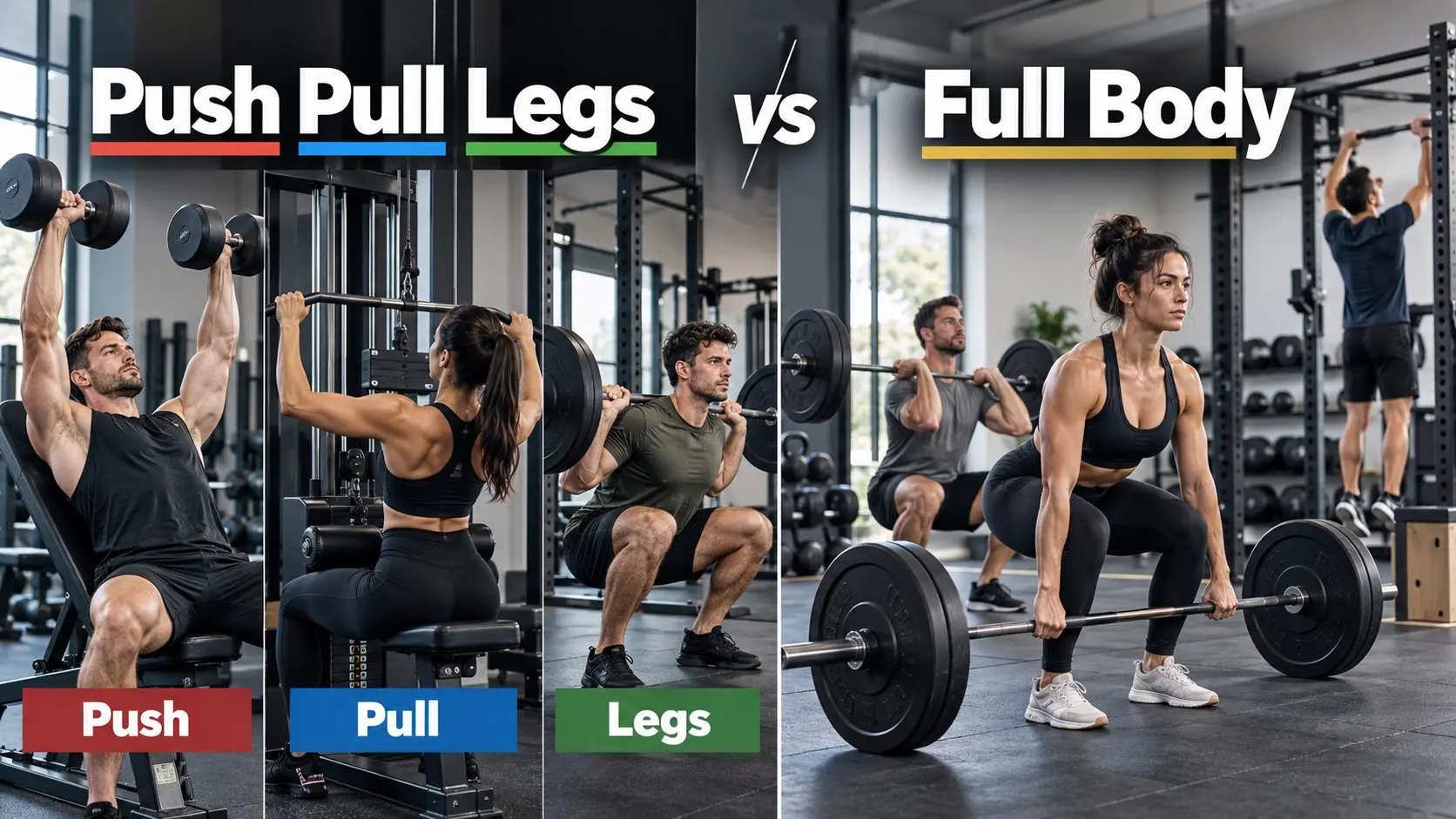
Push pull legs vs full body is mostly a scheduling choice. Full body works well for two or three training days because you train most major muscles each session. Push pull legs fits five or six days well because it spreads training across focused workouts. With matched weekly volume, neither split clearly builds more muscle or strength.1
That means you do not need to search for the perfect split.
You need the split that fits your real week.
Push Pull Legs vs Full Body at a Glance
| Question | Full Body | Push Pull Legs |
|---|---|---|
| Best fit for | Two or three training days | Five or six reliable training days |
| Muscles trained per workout | Most major muscle groups | A smaller group of related muscles |
| Missed workout impact | Usually smaller | Can remove one whole training category from the week |
| Session focus | Broad | Focused |
| Higher weekly volume | Possible but may make sessions longer | Easy to spread across more sessions |
| Beginner friendly | Very good fit | Can work but is not required |
| Muscle gain advantage | No clear advantage when volume is matched | No clear advantage when volume is matched |
What Is a Full Body Workout?
A full body workout routine trains most major muscle groups in one session.
That does not mean you need 15 exercises.
A simple workout might include:
- A squat or leg press
- A hip hinge
- A chest press or push up
- A row or pulldown
- A shoulder movement
- One or two small accessory exercises if needed
You then train again after recovery.
Monday, Wednesday, and Friday is one common pattern.
The big benefit is coverage.
If you train three days, your whole body gets attention across all three sessions.
For simple beginner strength ideas, see Strength Training Exercises at Home for Beginners.
What Is Push Pull Legs?
A push-pull-legs split divides exercises into three groups.
Push Day
Push workouts focus on muscles used in pressing.
- Chest
- Front and side shoulders
- Triceps
Common exercises include bench press, push-ups, shoulder press, and triceps work.
Pull Day
Pull training focuses on pulling muscles.
- Upper back
- Lats
- Rear shoulders
- Biceps
Rows, pull-downs, pull-ups, and curls fit here.
Leg Day
Leg training covers the lower body.
- Quadriceps
- Hamstrings
- Glutes
- Calves
Squats, lunges, leg presses, hinges, leg curls, and calf raises can fit.
A classic six day PPL workout repeats the cycle twice.
Does Research Show One Split Builds More Muscle?
No clear winner has appeared.
A 2024 systematic review and meta analysis directly compared split routines with full body training.
It included 14 studies and 392 participants.
The researchers found similar changes in bench press strength, lower body strength, measured muscle size, and lean body mass when training volume was matched.1
That is useful.
It means a full body vs split routine decision can be made around your schedule and preference instead of fear that one style wastes your effort.
The 2026 American College of Sports Medicine position statement points in the same direction.
It reviewed 137 systematic reviews with more than 30,000 participants.
The main message was not to find a fancy split.
Consistent resistance training works.
For muscle growth, useful weekly volume mattered more than simply raising training frequency when volume was equal.2
6 Week Plans Based on How Often You Train
This is the comparison that matters most.
| Training days | My starting choice | Why it fits |
|---|---|---|
| 1 day | Full body | One session can train all major areas |
| 2 days | Full body | Both sessions cover the whole body |
| 3 days | Full body | Simple schedule with repeated practice |
| 4 days | Either | Alternating full body or rolling PPL both work |
| 5 days | PPL becomes attractive | More room to spread training work |
| 6 days | PPL | Push, pull, and legs can each repeat twice |
This is a practical guide.
It is not a law of muscle biology.
1 Day a Week: Full Body Is the Clear Fit
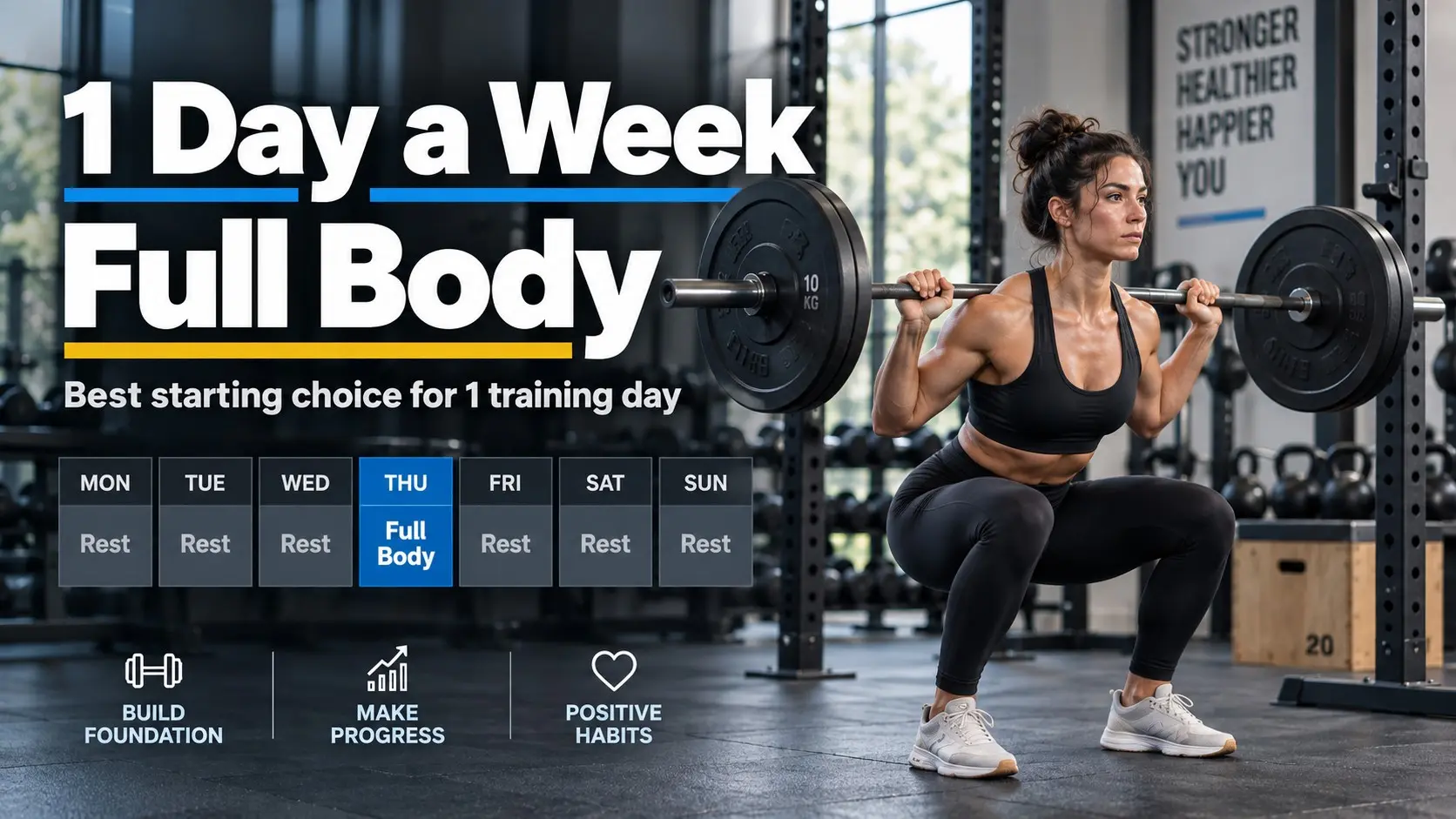
A simple session could use:
- Squat
- Chest press
- Row
- Hip hinge
- Shoulder press
- Core exercise
A PPL structure makes little sense here.
If Monday is push day, your back and legs may wait a long time.
One full- body session is not the ideal amount of training for every goal.
But it makes better use of one available day.
2 Days a Week: Full Body Keeps Everything Moving
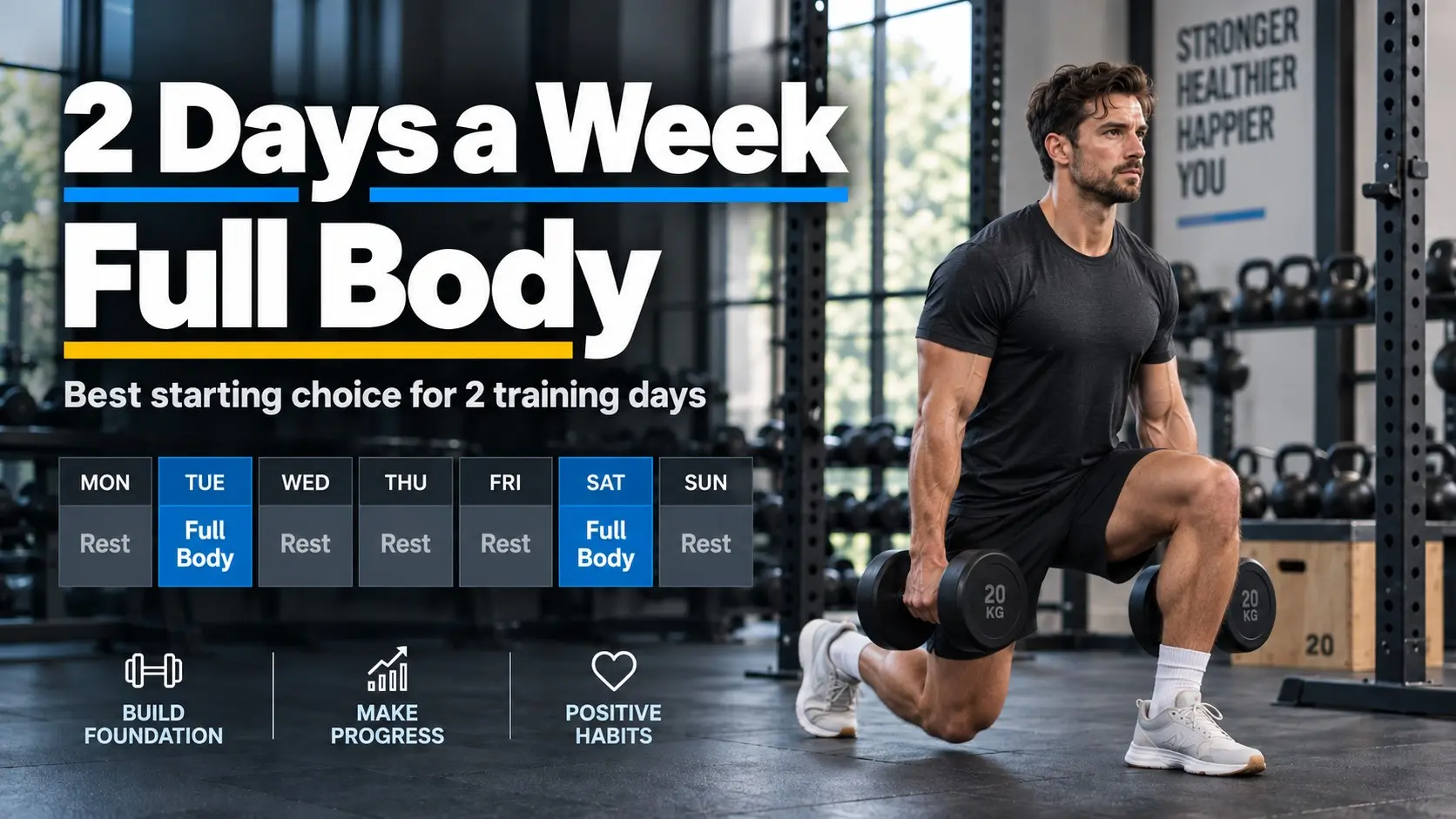
Two days also strongly favour full body.
Imagine Tuesday and Saturday.
With full body training, both sessions can cover your legs, chest, back, shoulders, and core.
With a basic PPL schedule, you may train push on Tuesday and pull on Saturday.
Legs disappear.
You can rotate PPL across weeks, but full body is much easier to organize.
Simple Two Day Example
| Workout A | Workout B |
|---|---|
| Squat | Split squat or leg press |
| Bench press or push-up | Shoulder press |
| Row | Pulldown |
| Romanian deadlift | Hip thrust or leg curl |
| Optional arms or core | Optional arms or core |
Keep the exercises simple.
Build slowly.
3 Days a Week: Full Body Is My Usual Starting Choice
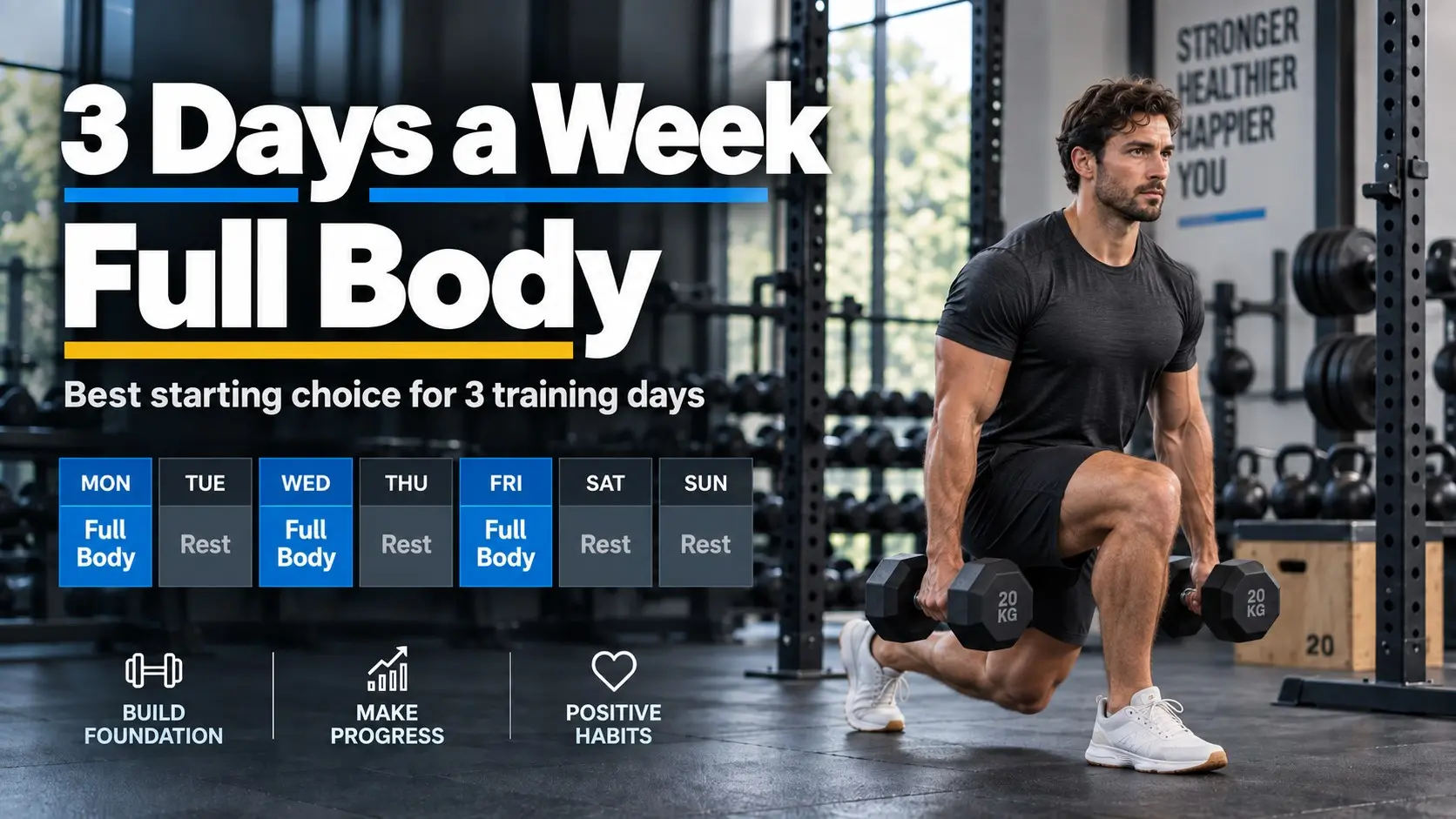
Monday.
Wednesday.
Friday.
That is a clean full-body schedule.
You train major muscles several times across the week.
You also get rest days between sessions.
A three-day push-pull-legs split can still work.
You might train push Monday, pull Wednesday, and legs Friday.
That is not useless.
Research does not support saying you cannot grow from it.
The issue is practical.
Each category gets only one dedicated day before the week repeats.
Full body spreads the work more evenly.
It is also more forgiving when life gets messy.
4 Days a Week: Both Options Can Work
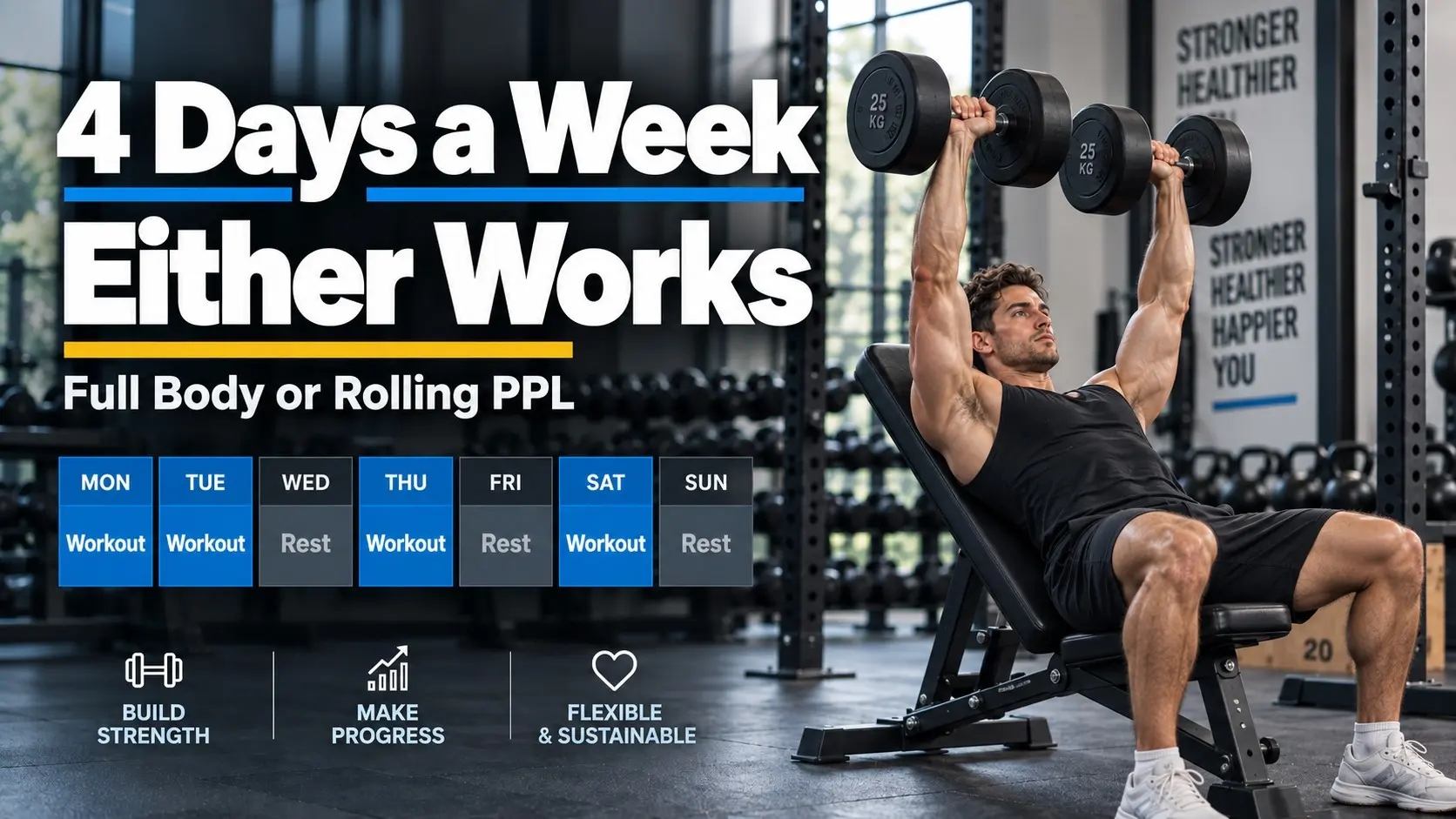
You can use full body with original emphasis each day.
For example:
- Monday: Full body with squat and chest focus
- Tuesday: Full body with hinge and back focus
- Thursday: Full body with leg and shoulder focus
- Saturday: Full body with posterior chain and pulling focus
You do not need to push every muscle hard in every session.
Or use a rolling PPL routine.
Your sessions could be:
- Push
- Pull
- Legs
- Push
The next training session starts with pull.
Then legs.
Over time, the sequence balances out.
This works well if you do not care whether your training cycle lines up perfectly with Monday through Sunday.
5 Days a Week: Push Pull Legs Gets Easier to Use
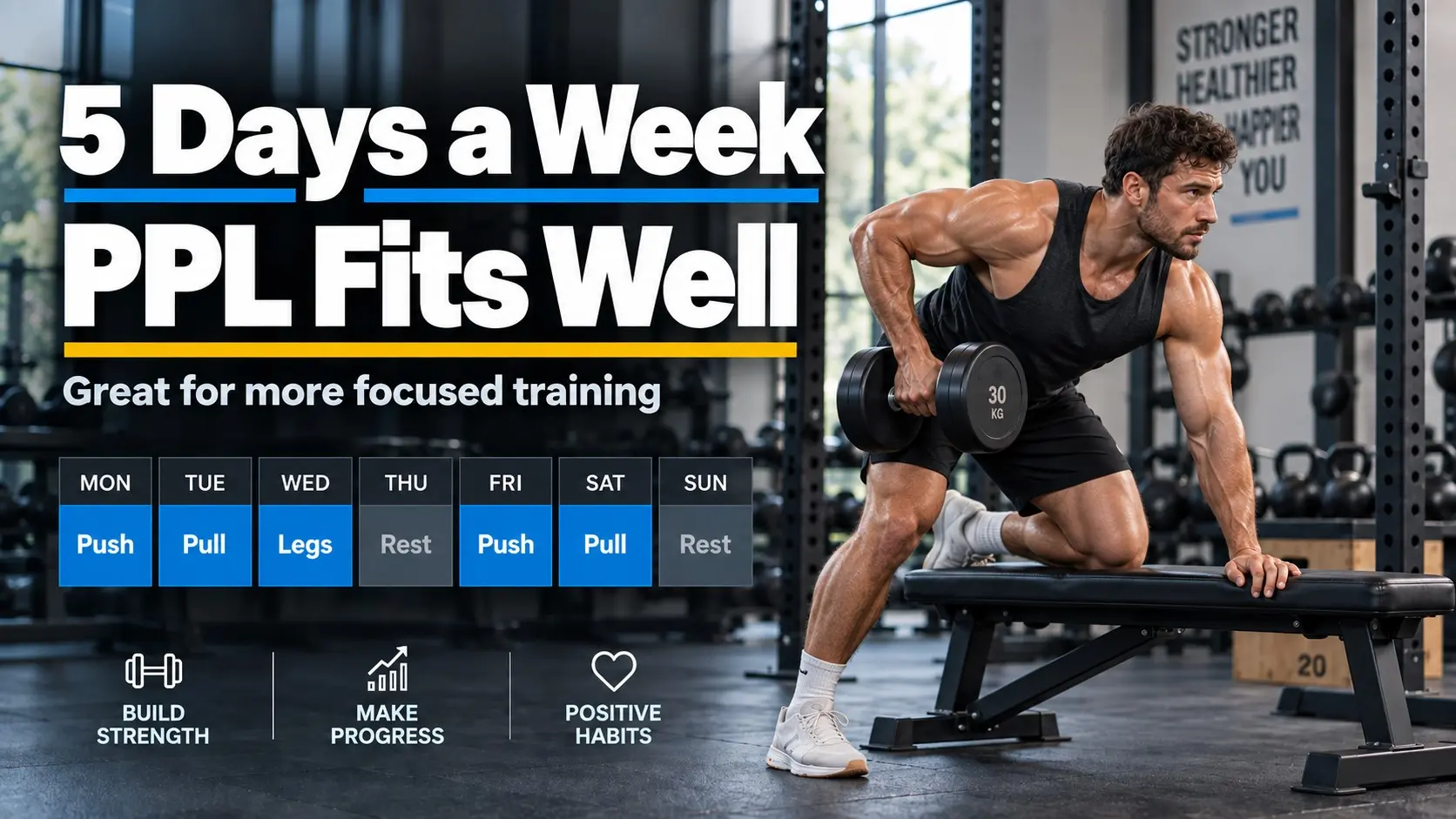
You have enough sessions to move through the cycle quickly.
One example is:
| Day | Training |
|---|---|
| Monday | Push |
| Tuesday | Pull |
| Wednesday | Legs |
| Thursday | Rest |
| Friday | Push |
| Saturday | Pull |
| Sunday | Rest |
The next workout begins with legs.
Do not worry if one calendar week has two push sessions, and the next has two leg sessions.
Your muscles do not reset every Sunday night.
6 Days a Week: PPL Fits the Calendar Very Well
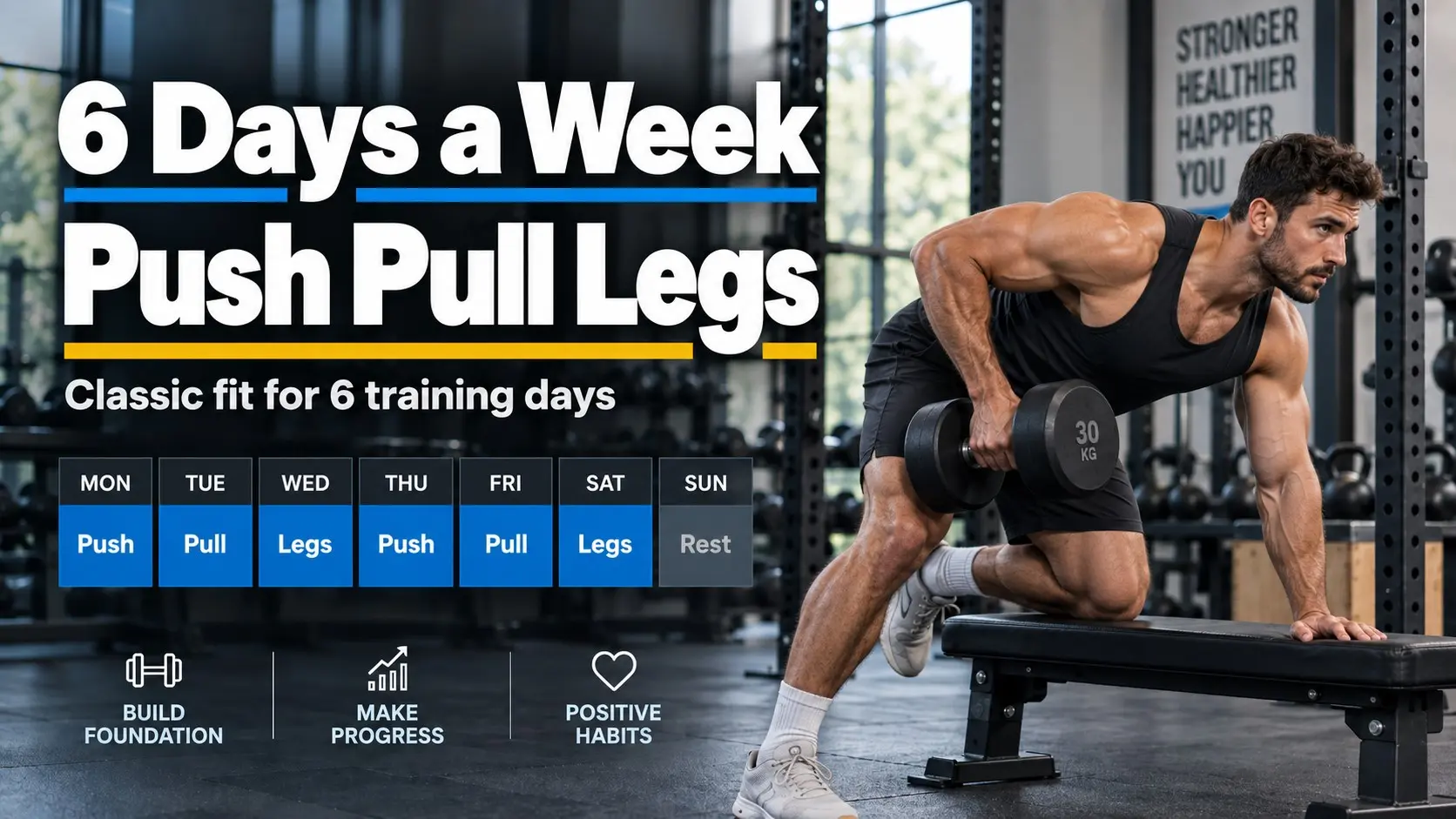
Six days is where the classic PPL structure shines.
| Day | Workout |
|---|---|
| Monday | Push |
| Tuesday | Pull |
| Wednesday | Legs |
| Thursday | Push |
| Friday | Pull |
| Saturday | Legs |
| Sunday | Rest |
The sessions can stay focused.
You also have room for more exercise choices.
Could you use full body six times a week?
Yes.
But you would need careful control of how much work you do each day.
For most recreational lifters who truly enjoy six gym days, PPL is easier to organize.
The Missed Workout Test May Decide This for You
This is one of the biggest practical differences.
Imagine two people miss Friday.
Person One Uses Full Body
They planned Monday, Wednesday, and Friday.
They completed two workouts.
Most major muscles still got trained twice.
Person Two Uses Three-Day PPL
They planned push Monday, pull Wednesday, and legs Friday.
Friday disappears.
So does leg day.
This does not make PPL bad.
It makes PPL less forgiving when you use it with very few weekly training days.
If your schedule changes all the time, I give full body extra credit.
Which Split Is Better for Muscle Growth?
Call this one a draw.
The 2024 direct comparison found similar muscle hypertrophy with split and full-body routines when training volume was equal.1
The 2026 ACSM position stand also found that higher weekly resistance training volume improved hypertrophy, while training frequency did not meaningfully change muscle growth when total volume was matched.2
That makes weekly training volume more useful to think about than the name of your split.
ACSM found evidence favouring about 10 or more weekly sets per muscle group for greater hypertrophy.
Do not turn that into a hard rule.
It is not a minimum needed to grow.
It is an evidence-based volume range linked with greater growth in the review.
Your useful volume depends on your training age, effort, recovery, exercise choice, and goals.
Does Training a Muscle More Often Build More Muscle?
Not by itself.
Training frequency helps you spread work across the week.
That can be very useful.
But a 2019 systematic review and meta-analysis found no meaningful hypertrophy difference between higher and lower frequencies when weekly volume was matched.4
The 2026 ACSM review reached the same broad conclusion.
Frequency is a tool.
It is not a magic switch.
If training a muscle twice each week helps you complete good sets without one giant session, that is a good reason to use it.
Which Routine Is Better for Strength?
Strength is a little different because lifting is also a skill.
You get better at an exercise by practicing it.
If your main goal is a stronger squat or bench press, make sure your program gives you enough good practice with that movement or a close variation.
The 2026 ACSM position stand found better strength outcomes with resistance training at least twice weekly, heavier loads, a full range of motion, and two to three sets per exercise in the evidence it reviewed.2
That does not make full body automatically better.
It means your strength training plan should give important lifts enough attention.
A full body plan makes repeated lift practice easy.
A PPL plan can do the same if you program it that way.
Your Split Matters Less if You Never Progress
A beautiful calendar cannot rescue stagnant training.
Progressive overload means your training becomes more challenging over time.
You might:
- Add a small amount of weight
- Add a repetition
- Add a set when appropriate
- Improve your range of motion
- Use better technique with the same load
You do not need to change everything at once.
Pick one small step.
Track it.
For a simple example of progression with dumbbells, see Arm Workouts With Weights.
How Many Sets Should You Do?
There is no single perfect number for every person.
Current evidence does show that volume matters.
The ACSM 2026 review found that hypertrophy improved with higher weekly volume and highlighted about 10 or more sets per muscle group each week as a useful evidence-based target for greater growth.2
Older meta-analytic work also found a dose-response between greater weekly resistance training volume and muscle growth.
Your sets per muscle per week do not need to happen in one workout.
That is one reason frequent splits can feel easier.
Ten sets of chest work in one session can feel very different from five sets on Monday and five on Thursday.
Which Is Better for Beginners?
I would usually start with full body.
Beginners need practice.
They need a plan that is easy to remember.
They also need recovery.
Two or three full body sessions give repeated practice with basic movement patterns without requiring five or six gym visits.
You can learn:
- Squat patterns
- Hip hinge patterns
- Pushing
- Pulling
- Core control
- Safe loading
The 2026 ACSM update also stresses a very useful idea.
Consistency beats unnecessary complexity.2
That is a good rule for beginners.
See How to Get Fit Fast Safely for a simple beginner fitness starting point.
Why PPL Becomes More Useful as Training Grows
As you gain experience, you may want more work for each muscle.
Now the sessions can get crowded.
Imagine doing useful work for your:
- Quads
- Hamstrings
- Glutes
- Chest
- Back
- Shoulders
- Biceps
- Triceps
- Calves
- Core
You can fit that into full body training.
But you do not have to.
PPL gives you more room to spread the work.
That can make sessions feel less crowded.
It also lets you spend more time on smaller accessory exercises.
Which Split Fits Short Workouts Better?
It depends on how many short training windows you have.
If you have six short gym visits, PPL is easy.
Each session has a smaller focus.
If you only have three short sessions, full body can still work.
Just keep it lean.
You do not need every exercise in every session.
Four or five good movements can do plenty.
What if You Hate a Big Leg Day?
Full body may feel much better.
You can spread leg work out.
For example:
- Monday: Squat
- Wednesday: Romanian deadlift
- Friday: Split squat or leg press
That feels very different from putting all lower body work into one long leg session.
Some people love leg day.
Others avoid it.
If a dedicated leg day turns into a skipped day, your split is not helping you.
For lower body exercise ideas, see Leg Exercises With Dumbbells.
Does PPL Give Better Recovery?
Not automatically.
Recovery depends on the work you did.
It depends on:
- Sets
- Effort
- Exercise choice
- Load
- Sleep
- Food
- Stress
- Your training history
A six day PPL routine can be too much if every session is huge.
A three day full body program can be easy to recover from if volume is sensible.
The split does not decide recovery by itself.
Does Full Body Mean Very Long Workouts?
No.
A full body session gets long when you refuse to leave anything for the next workout.
You do not need:
Squats, deadlifts, bench press, shoulder press, rows, pull-downs, lunges, curls, triceps work, calf work, lateral raises, and five core exercises in one day.
Alternate emphasis.
Keep the core lifts.
Move some accessory work to the next session.
For simple home training options, visit the NextFitLife Home Workouts and Equipment Guide.
Does Push Pull Legs Have to Be 6 Days?
No.
PPL describes how training is grouped.
It does not require six training days.
You can run PPL:
- Three days
- Four days
- Five days
- Six days
The difference is how often each session comes around.
Three-day PPL usually gives each category one main session per week.
Six-day PPL gives each category two sessions in a seven-day cycle.
Neither frequency guarantees more muscle if total productive work is otherwise equal.
What Is a Rolling PPL Routine?
A rolling PPL routine ignores the need to restart every Monday.
You simply continue where you stopped.
Example:
| Session | Workout |
|---|---|
| 1 | Push |
| 2 | Pull |
| 3 | Legs |
| 4 | Push |
| 5 | Pull |
| 6 | Legs |
If you train four days this week, session five simply happens next week.
This is useful for people who like PPL but do not train six days.
Do You Need 5 or 6 Gym Days for Health?
No.
You do not need a bodybuilding style schedule just to gain the health benefits of resistance training.
The World Health Organization recommends muscle strengthening activities that involve all major muscle groups on two or more days per week for adults.5
The 2026 ACSM position stand also recommends progressive resistance training with all major muscle groups engaged at least twice weekly for healthy adults.2
More training may fit a muscle or strength goal.
It is not required just to say you exercise.
Use These 6 Questions to Choose Your Split
- How many days do I really train? Use your normal month, not your perfect week.
- How long can each workout be? More days can let you use shorter sessions.
- What happens if I miss one workout? If one missed session removes legs for the week, think about a more forgiving setup.
- Do I need more weekly volume? More experienced lifters may find it easier to spread high volume across more sessions.
- Do I enjoy dedicated body part days? Preference matters because you need to keep showing up.
- Can I recover from the plan? A program you cannot recover from is too much, no matter how clever it looks.
6 Mistakes That Matter More Than the Split
1. Changing Your Program Every Few Weeks
Give a sensible plan time to work.
2. Adding More Days but Not Better Training
Six weak sessions are not automatically better than three good ones.
3. Doing Too Much Volume in One Workout
More sets become less useful as fatigue builds.
4. Ignoring Technique
Control the exercise before you chase more weight.
5. Training Through Sharp Pain
Muscle effort and joint pain are not the same thing.
6. Picking a Schedule You Cannot Maintain
A plan on paper has no effect if you rarely complete it.
My Simple Decision Rule
Choose Full Body if You
- Train one to three days most weeks
- Have an unpredictable schedule
- Are new to resistance training
- Want repeated practice with major movements
- Prefer more rest days
- Want to spread leg work across the week
Choose Push Pull Legs if You
- Reliably train five or six days
- Like focused workouts
- Want more room for accessory exercises
- Need to spread more weekly training volume
- Enjoy separate push, pull, and leg sessions
- Recover well from frequent training
At Four Days
Pick either.
This is where preference matters most.
A rolling PPL works.
A well-planned full-body routine works.
An upper and lower body split is another good option.
You are allowed to choose the structure that fits you.
Conclusion: Build the Split Around Your Week
For push-pull-legs vs full body, start with your calendar.
Two or three days?
Full body is my usual starting choice.
Five or six reliable days?
PPL fits very well.
Four days?
Either can work.
Your next step: choose the number of sessions you can complete most weeks, pick one structure, track your exercises and progress, and stay with it long enough to judge the results.
The best workout split is not the most complicated one.
It is the one you can train hard, recover from, and repeat.
References and Sources
- Ramos Campo DJ, Benito Peinado PJ, Andreu Caravaca L, Rojo Tirado MA, Rubio Arias JA. Efficacy of Split Versus Full Body Resistance Training on Strength and Muscle Growth: A Systematic Review With Meta-Analysis. Journal of Strength and Conditioning Research. 2024.PubMed study record and abstractUsed for the direct comparison of split and full-body routines and the finding that strength and hypertrophy outcomes were similar when training volume was matched.
- American College of Sports Medicine. Resistance Training Prescription for Muscle Function, Hypertrophy, and Physical Performance in Healthy Adults. 2026 Position Stand.Read the full open-access ACSM position standUsed for current resistance training guidance, strength frequency, weekly hypertrophy volume, training consistency, and the role of frequency when volume is matched.
- Schoenfeld BJ, Ogborn D, Krieger JW. Dose-Response Relationship Between Weekly Resistance Training Volume and Increases in Muscle Mass.PubMed systematic review and meta-analysisUsed for the relationship between weekly resistance training volume and muscle growth.
- Schoenfeld BJ, Grgic J, Krieger J. How Many Times Per Week Should a Muscle Be Trained to Maximize Muscle Hypertrophy?PubMed systematic review and meta-analysisUsed for the finding that higher training frequency did not produce meaningful extra hypertrophy when weekly volume was matched.
- World Health Organization. WHO Guidelines on Physical Activity and Sedentary Behaviour.World Health Organization physical activity guidanceUsed for the recommendation that adults perform muscle strengthening activity involving the major muscle groups on two or more days each week.
Continue Reading on NextFitLife
Use these guides to build the rest of your training plan.
- Home Workouts and Equipment Guide for the NextFitLife hub covering strength training, bodyweight exercise, dumbbells, kettlebells, bands, and home workout setup.
- Strength Training Exercises at Home for Beginners for a simple starting point if you are new to resistance exercise.
- How to Get Fit Fast Safely for beginner fitness planning, strength, cardio, and recovery.
- Leg Exercises With Dumbbells for lower body exercise ideas you can use on leg or full body days.
- Arm Workouts With Weights for biceps, triceps, rows, carries, and simple progression.
- Core Workouts at Home for core strength, carries, planks, and beginner friendly progression.
About the Author
Adel Galal is the founder and lead writer of NextFitLife.
He has maintained a personal interest in health, fitness, nutrition, sleep, wellness, and healthy aging for more than 30 years. His health and wellness writing experience spans more than 15 years.
Adel is not a doctor, physiotherapist, registered dietitian, certified personal trainer, or licensed exercise professional.
His role is research communication.
He compares reputable sources, checks claims against current evidence, separates strong findings from uncertain claims, and turns complex fitness research into simple steps readers can understand.
Before founding NextFitLife, Adel spent 29 years working as an IT Manager for the Nestlé Egypt Region. His work involved data, planning, information systems, structured review, problem-solving, and information management. These skills support his research process but are not medical or exercise credentials.
For this article, claims about training frequency, weekly training volume, muscle hypertrophy, strength, full body training, and split routines were checked against systematic reviews, meta-analyses, the 2026 American College of Sports Medicine position stand, and World Health Organization guidance.
Learn more about Adel, NextFitLife's research methods, editorial standards, medical review policy, and corrections process on the About NextFitLife page.
Frequently Asked Questions About Push Pull Legs vs Full Body
Is push pull legs better than full body?
No routine is always better. Full body usually fits two or three training days more easily. Push pull legs often fits five or six days better. Research shows similar strength and muscle growth when weekly volume is matched.
Is full body better for beginners?
It is often a good starting choice. Beginners can practice major movements two or three times across the week with no need to train almost every day.
Can I build muscle with three full body workouts a week?
Yes. Full body resistance training can build muscle when the program includes enough useful training, appropriate effort, progression, food, and recovery.
Can I do push pull legs only three days a week?
Yes. You can train push once, pull once, and legs once each week. It can work, but full body is often easier to organize across only three sessions.
Does PPL have to be six days?
No. PPL describes how workouts are grouped. You can run it three, four, five, or six days using a rolling sequence.
Is PPL better for muscle growth?
Not by itself. A 2024 meta-analysis found similar muscle growth from split and full-body routines when training volume was equal.
Is full body better for strength?
Neither split automatically wins. Full body can make a repeated practice of major lifts easy. PPL can also support strength if important exercises receive enough high-quality practice.
Is full body three times a week too much?
Not automatically. The answer depends on exercise selection, volume, effort, recovery, sleep, health, and training experience. The sessions do not need to be identical or maximal.
Can I train full body four days a week?
Yes. Alternate the focus of each session so every workout is not equally hard for every muscle group.
What is a rolling PPL?
A rolling push-pull-legs routine continues the sequence across calendar weeks. If your last session was push, your next one is pull. You do not restart just because Monday arrives.
How many sets per muscle should I do each week?
There is no perfect number for everyone. The 2026 ACSM position stand found more hypertrophy with higher weekly volume and highlighted about 10 or more weekly sets per muscle group as a useful evidence-based target for greater growth. Beginners may need less.
Which split is better if I miss workouts?
Full body is usually more forgiving. Missing one session still leaves other workouts where most major muscles were trained.

Health & wellness writer with 30+ years of experience in nutrition, fitness, and healthy aging. Founder of NextFitLife.com — evidence-based health guidance.