
Published on: August 29, 2024
Updated on: November 3, 2026
The best push upper body exercises train three major areas at the same time: your chest, shoulders, and triceps. These muscles work together whenever you push yourself away from the floor, press a weight overhead, or move resistance away from your chest.
You do not need a huge push day. A balanced routine can use a horizontal press, a vertical press, one or two accessory exercises, and direct triceps work. The real goal is to choose exercises you can perform well and gradually make them more challenging.
This guide gives you 12 practical pushing exercises, plus beginner and intermediate routines, home alternatives, sets and reps, progression advice, and simple ways to keep your shoulders and elbows comfortable.
Important: This article is for general information and education. It does not replace medical advice, diagnosis, or treatment.
Table of Contents
- Quick Answer
- What Push Exercises Train
- 12 Powerful Push Upper Body Exercises
- Best Push Exercises by Goal
- Beginner Push Workout
- Intermediate Push Workout
- Push Workout at Home
- Sets and Reps
- How Often to Train
- Progressive Overload
- Push Training and Fat Loss
- Shoulder and Elbow Comfort
- Push and Pull Balance
- Common Push Workout Mistakes
- 8 Week Progression
- Conclusion
- References and Sources
- Internal Links and Strength Hub
- About the Author
- Frequently Asked Questions
Quick Answer: What Are the Best Push Upper Body Exercises?
A good list of push upper body exercises should include both horizontal and vertical pressing, plus a small amount of shoulder and triceps work.
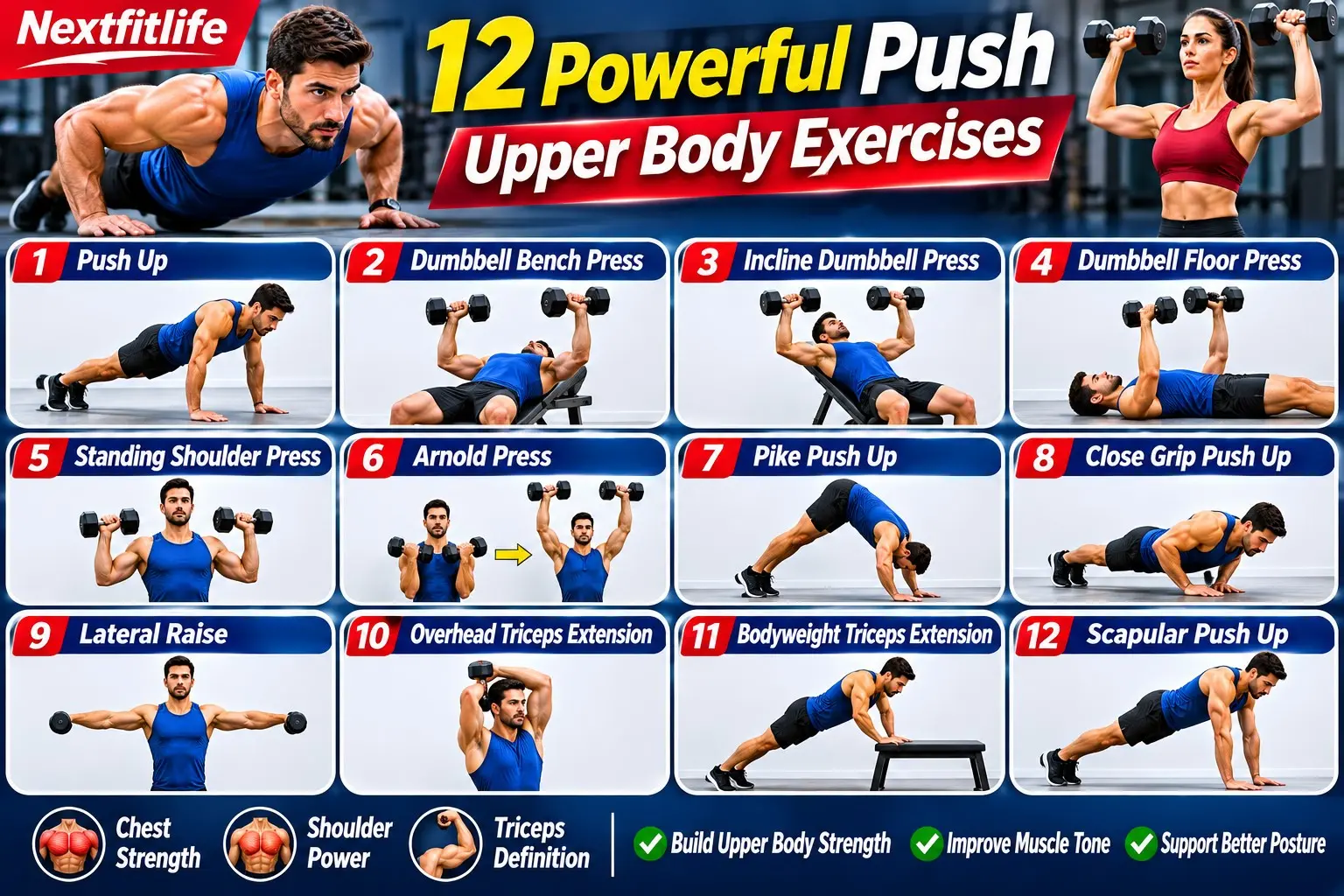
These 12 exercises cover the main needs:
- Push up
- Dumbbell bench press
- Incline dumbbell press
- Dumbbell floor press
- Standing dumbbell shoulder press
- Arnold press
- Pike push up
- Close grip push up
- Dumbbell lateral raise
- Overhead triceps extension
- Bodyweight triceps extension
- Scapular push up
You do not need all 12 exercises in one session. For most workouts, four to seven well chosen movements are enough.
For a complete push and pull program, see our Upper Body Workout guide.
What Muscles Do Push Upper Body Exercises Train?
Push training mainly works the chest, shoulders, and triceps. Several other muscles help stabilize your body during each movement.
Chest
The pectoralis major is one of the main muscles involved in push ups, bench presses, floor presses, and incline presses.
It helps bring your upper arm forward and across your body.
Shoulders
Your shoulders play an important role in both horizontal and overhead pressing.
The anterior deltoid contributes strongly to pressing movements, while the middle deltoid becomes more important during lateral raises.
Triceps
The triceps brachii straightens your elbow. It works during almost every push exercise.
Direct exercises such as overhead triceps extensions can add extra work when arm strength or size is a priority.
For more direct triceps training, visit our Best Triceps Exercises guide.
What Is the Difference Between Horizontal and Vertical Push Exercises?
A horizontal push moves resistance away from your torso in front of you.
Examples include:
- Push ups
- Bench presses
- Floor presses
A vertical press moves resistance overhead.
Examples include:
- Dumbbell shoulder presses
- Arnold presses
- Pike push-ups
A balanced push workout usually includes at least one exercise from each group.
12 Powerful Push Upper Body Exercises
1. Push Up
The push-up is one of the most useful push upper body exercises because it trains your chest, shoulders, triceps, and trunk without requiring equipment.
- Place your hands slightly wider than shoulder width.
- Keep your body in one straight line.
- Lower your chest toward the floor.
- Let your elbows follow a comfortable angle.
- Press the floor away.
Starting range: 6 to 15 repetitions.
If full push-ups are too hard, place your hands on a stable counter or bench.
Research comparing push-ups with low-load bench pressing found similar gains in pectoralis major and triceps muscle thickness when the resistance was matched appropriately.
2. Dumbbell Bench Press
The dumbbell bench press is a strong choice for building chest and pressing strength.
- Lie on a stable bench.
- Hold one dumbbell in each hand.
- Keep your feet stable.
- Lower the weights toward your chest.
- Press upward under control.
Starting range: 6 to 12 repetitions.
Dumbbells allow each arm to move independently, which can make it easier to find a comfortable shoulder path.
3. Incline Dumbbell Press
An incline changes your torso angle and shifts more work toward the upper chest and front of the shoulders.
- Set a bench to a moderate incline.
- Hold the dumbbells near your upper chest.
- Press upward.
- Keep your wrists controlled.
- Lower slowly.
Starting range: 8 to 12 repetitions.
You do not need a very steep incline. A moderate angle keeps the movement between a chest press and shoulder press.
4. Dumbbell Floor Press
The floor press is a simple home alternative when you do not have a bench.
- Lie on the floor.
- Hold a dumbbell in each hand.
- Keep your palms forward or slightly inward.
- Lower until your upper arms gently touch the floor.
- Press upward.
Starting range: 6 to 12 repetitions.
The floor naturally limits the bottom range, which some people find comfortable.
5. Standing Dumbbell Shoulder Press
This exercise builds shoulder strength while the triceps assist with elbow extension.
- Stand with your feet stable.
- Hold the dumbbells near shoulder height.
- Brace your middle gently.
- Press the weights overhead.
- Lower slowly.
Starting range: 6 to 12 repetitions.
A seated version can reduce the balance demand if you prefer more support.
6. Arnold Press
The Arnold press combines shoulder rotation with an overhead press.
- Hold the dumbbells in front of your shoulders.
- Start with your palms facing you.
- Rotate your arms as you press upward.
- Finish overhead in a comfortable position.
- Reverse the motion slowly.
Starting range: 8 to 12 repetitions.
Use lighter dumbbells than you might use for a standard shoulder press while learning the movement.
7. Pike Push-Up
The pike push-up gives you a bodyweight version of vertical pressing.
- Start with your hands and feet on the floor.
- Raise your hips.
- Keep your head between your arms.
- Bend your elbows.
- Lower your head toward the floor.
- Press back up.
Starting range: 5 to 12 repetitions.
Elevating your hands makes the movement easier. Elevating your feet makes it much harder.
8. Close Grip Push Up
Moving your hands closer can increase the demand on your triceps.
- Start in a push up position.
- Place your hands slightly narrower than normal.
- Keep your torso controlled.
- Lower slowly.
- Press upward.
Starting range: 5 to 15 repetitions.
Your hands do not have to touch. Choose a position that feels comfortable on your wrists.
For more no equipment options, visit our Bodyweight Triceps Exercises guide.
9. Dumbbell Lateral Raise
Lateral raises are not a traditional press, but they are a useful push day accessory because they train the side of your shoulders.
- Hold light dumbbells at your sides.
- Keep a soft bend in your elbows.
- Raise your arms out to the sides.
- Stop around shoulder height or sooner if needed.
- Lower slowly.
Starting range: 10 to 20 repetitions.
Use light weights. Heavy swinging usually reduces control.
10. Overhead Triceps Extension
This exercise adds direct elbow extension work and trains the long head of the triceps in an overhead position.
- Hold one dumbbell with both hands.
- Raise it overhead.
- Bend your elbows slowly.
- Lower the dumbbell behind your head.
- Extend your elbows to return.
Starting range: 8 to 15 repetitions.
For a larger home arm routine, see our Triceps Exercises With Dumbbells at Home guide.
11. Bodyweight Triceps Extension
This exercise works like a bodyweight skull crusher.
Use a sturdy counter, railing, or fixed support.
- Place your hands on the support.
- Step your feet backward.
- Keep your body straight.
- Bend your elbows.
- Move your forehead toward your hands.
- Extend your elbows to push yourself away.
Starting range: 6 to 15 repetitions.
A higher support makes the exercise easier.
12. Scapular Push Up
The scapular push up trains control around your shoulder blades while your elbows stay mostly straight.
- Start against a wall, on an incline, or in a plank.
- Keep your elbows mostly straight.
- Allow your shoulder blades to move together slightly.
- Push the surface away.
- Let your shoulder blades move around your ribs.
Starting range: 8 to 15 repetitions.
This can fit well into a warm-up or at the end of your workout.
Best Push Upper Body Exercises by Goal
| Goal | Best Choices | Main Focus |
|---|---|---|
| Chest Strength | Bench press, push up, floor press | Horizontal pressing |
| Upper Chest | Incline dumbbell press | Inclined pressing angle |
| Shoulder Strength | Shoulder press, pike push up | Vertical pressing |
| Shoulder Size | Shoulder press, lateral raise | Front and side deltoids |
| Triceps | Close grip push up, overhead extension | Elbow extension |
| No Equipment | Push up, pike push up, triceps extension | Bodyweight resistance |
Beginner Push Upper Body Workout
Beginners do not need many exercises. Start with four or five movements and learn them well.
| Exercise | Sets | Reps |
|---|---|---|
| Incline Push-Up | 2 | 8 to 12 |
| Dumbbell Floor Press | 2 | 8 to 12 |
| Seated Shoulder Press | 2 | 8 to 12 |
| Lateral Raise | 2 | 12 to 15 |
| Overhead Triceps Extension | 2 | 10 to 15 |
Rest long enough to repeat each exercise with good control.
Intermediate Push Workout for Muscle and Strength
| Exercise | Sets | Reps |
|---|---|---|
| Dumbbell Bench Press | 3 | 6 to 10 |
| Incline Dumbbell Press | 3 | 8 to 12 |
| Dumbbell Shoulder Press | 3 | 6 to 10 |
| Dumbbell Lateral Raise | 2 | 12 to 20 |
| Overhead Triceps Extension | 2 | 8 to 15 |
| Close Grip Push Up | 2 | 6 to 15 |
Push Upper Body Workout at Home
You can perform a complete push workout with very little equipment.
A simple home session can include:
- Push ups
- Dumbbell floor press
- Pike push ups
- Dumbbell shoulder press
- Lateral raises
- Overhead triceps extensions
If you have no weights, use push-ups, pike push-ups, close-grip push-ups, and bodyweight triceps extensions.
Current resistance training evidence supports bodyweight resistance, bands, and home based routines as effective ways to improve strength and muscle when the exercises remain challenging.
See our Home Workouts and Equipment Hub for more home training options.
How Many Sets and Reps Should You Do?
The ideal range depends on your goal and exercise.
A simple guide is:
- 5 to 8 reps for heavier presses focused on strength
- 8 to 15 reps for most chest, shoulder, and triceps movements
- 12 to 20 reps for lighter accessory exercises such as lateral raises
Current ACSM guidance suggests that heavier resistance is especially useful for maximizing strength, while greater weekly training volume can help maximize muscle growth.
You do not have to take every set to complete muscular failure.
How Much Weekly Volume Do You Need?
There is no single number that every person must follow.
ACSM's 2026 guidance notes that around 10 weekly sets per muscle group can be useful when the goal is maximizing muscle hypertrophy.
This is not a minimum requirement.
A beginner can improve with less, especially because pressing exercises train several muscles at once.
For example, a bench press trains:
- Chest
- Front shoulders
- Triceps
You should count this shared work when planning your total training volume.
How Often Should You Do Push Workouts?
Adults are advised to perform muscle-strengthening activity on at least two days each week and include all major muscle groups.
If you use a push-pull-legs routine, a week might look like:
- Monday: push
- Tuesday: pull
- Wednesday: legs
- Thursday: rest
- Friday: push
- Saturday: pull or legs
You do not need this exact schedule. Two full-body workouts per week can also work very well.
How to Progress Push Upper Body Exercises
Progressive overload means increasing the challenge as your body adapts.
You can progress by:
- Adding one repetition
- Adding a small amount of resistance
- Adding one set
- Improving your range of motion
- Using a harder bodyweight variation
- Improving control
You do not need to make several changes at once.
For example, suppose your dumbbell bench press looks like this:
- Week 1: 10, 9, 8 reps
- Week 2: 10, 10, 9 reps
- Week 3: 11, 10, 10 reps
- Week 4: 12, 12, 12 reps
Once you reach the top of your chosen range with good form, increase the load slightly.
Can Push Upper Body Exercises Build Muscle?
Yes.
Progressive resistance training can increase muscle size in the chest, shoulders, and triceps.
A resistance training study using the bench press found increases in the pectoralis major, pectoralis minor, anterior deltoid, and triceps after ten weeks of training.
Bodyweight exercises can work too. Research comparing push ups with a similarly loaded bench press found comparable gains in pectoralis major and triceps muscle thickness over eight weeks.
The key is not whether the resistance comes from a dumbbell, bar, machine, or your body. The exercise needs to remain challenging as you become stronger.
Do Push Exercises Burn Fat Fast?
No single push workout can make body fat disappear quickly.
Resistance training uses energy and can help preserve or build muscle, which makes it valuable during a healthy body composition plan. However, you cannot choose where fat leaves your body by training one area.
For fat loss, the bigger picture includes:
- Total food intake
- Overall physical activity
- Aerobic exercise
- Resistance training
- Sleep
- Consistency over time
Push exercises are excellent for building muscle and strength. They are not a shortcut for targeted fat loss.
Should You Train to Failure?
You do not need to take every push exercise to complete failure.
Current ACSM guidance found that training to momentary muscle failure does not consistently improve outcomes enough to make it mandatory for the average healthy adult.
A practical approach is to stop when the set becomes very difficult but you can still control your form.
Should You Feel Push Exercises in Your Shoulders?
Your shoulders normally work during pressing movements.
Feeling muscular effort is different from sharp joint pain.
If a press repeatedly causes shoulder pain, try changing:
- Your grip
- The bench angle
- The range of motion
- The load
- The exercise itself
Dumbbells can sometimes feel more comfortable because each arm can move independently.
How to Keep Your Shoulders Comfortable
Use these simple rules:
- Warm up with lighter sets.
- Increase load gradually.
- Use a comfortable grip.
- Avoid forcing an extreme range.
- Train your back as well as your pushing muscles.
- Stop exercises that create sharp or worsening pain.
You can also include our Injury Prevention Exercises as part of a broader training program.
Should Your Elbows Stay Tucked During Presses?
Your elbows do not need to stay glued against your ribs.
They should follow a comfortable path that lets you press without shoulder or wrist pain.
An extremely wide elbow position may feel uncomfortable for some people, but forcing an extremely narrow position is not necessary either.
Your anatomy and exercise choice matter.
Should You Lock Out Your Elbows?
For most healthy people, straightening the elbow under control is a normal part of a press.
The problem is not reaching a straight arm. The problem is violently snapping into the end position.
Finish each repetition smoothly.
Why Push Training Needs Pull Training Too
A push workout trains the front and pressing side of your upper body very well, but it does not replace back training.
Your weekly routine should also include horizontal pull and vertical pull exercises such as:
- Dumbbell rows
- Chest-supported rows
- Lat pulldowns
- Pull ups
- Resistance band rows
You do not need an exact one-to-one mathematical ratio, but completely ignoring pulling movements creates an incomplete upper body program.
Our Upper Body Workout guide combines both movement families.
Common Push Workout Mistakes
Doing Too Many Chest Presses
Bench press, incline press, floor press, and push-ups all train similar movement patterns.
You do not need every version in every workout.
Skipping Overhead Pressing
Horizontal and vertical pressing challenge your shoulders differently.
Using Too Much Weight
If the weight forces you to lose control on every repetition, reduce it.
Doing Too Much Triceps Work
Your triceps already work during push-ups and presses.
Direct triceps exercises are useful, but more is not always better.
Training Only Push Muscles
Your back still needs rows and pulldowns.
Changing Exercises Every Workout
Keep your main exercises long enough to measure progress.
Trying to Burn Fat From Your Arms or Chest
Training a body part does not let you choose where fat is lost.
Ignoring Pain
Normal effort and sharp joint pain are not the same thing.
A Simple 8 Week Push Workout Progression
| Weeks | Focus | Goal |
|---|---|---|
| 1 and 2 | Learn the exercises | Comfortable technique |
| 3 and 4 | Add repetitions | Build volume |
| 5 and 6 | Add small resistance | Increase challenge |
| 7 | Improve prior performance | Progress reps or load |
| 8 | Review | Adjust volume or exercises |
When Should You Stop and Get Medical Help?
Normal muscle fatigue can happen during training. Severe or unusual symptoms need more attention.
Stop exercising and seek appropriate medical care if you develop:
- Chest pain or pressure
- Fainting
- Severe unusual shortness of breath
- Sudden severe shoulder or arm pain
- Major swelling after an injury
- New numbness or significant weakness
- A visibly deformed joint
- Loss of normal arm movement after trauma
If you are recovering from shoulder, elbow, chest, or upper body surgery, follow the program provided by your healthcare professional.
Conclusion
The best push upper body exercises train your chest, shoulders, and triceps through a mix of horizontal pressing, vertical pressing, and direct arm work.
You do not need every exercise in this guide. Pick a chest press, an overhead press, one shoulder accessory, and one triceps movement, then make those exercises gradually harder as you become stronger.
Your next step: choose four to six exercises from this guide and perform them twice this week. Record your repetitions and resistance, then aim for one small improvement during your next workout.
References and Sources
- American College of Sports Medicine. Resistance Training Prescription for Muscle Function, Hypertrophy, and Physical Performance in Healthy Adults. 2026 Position Stand.
https://pubmed.ncbi.nlm.nih.gov/41843416/ - American College of Sports Medicine. Updated Resistance Training Guidelines, 2026.
https://acsm.org/resistance-training-guidelines-update-2026/ - Kikuchi N, Nakazato K. Low Load Bench Press and Push Up Induce Similar Muscle Hypertrophy and Strength Gain.
https://pubmed.ncbi.nlm.nih.gov/29541130/ - Resistance Training Study. Muscle Hypertrophy Response Across Four Muscles Involved in the Bench Press Exercise.
https://pubmed.ncbi.nlm.nih.gov/39593465/ - Centers for Disease Control and Prevention. Adult Physical Activity Guidelines. Adults should perform muscle strengthening activities for all major muscle groups on at least two days each week.
https://www.cdc.gov/physical-activity-basics/guidelines/adults.html
Internal Links + Strength Hub
- NextFitLife Fitness Hub
- Strength Training and Muscle Building Guide
- Upper Body Workout
- Best Triceps Exercises
- Triceps Exercises With Dumbbells at Home
- Bodyweight Triceps Exercises
- Injury Prevention Exercises
- Core Workouts at Home
- Home Workouts and Equipment Hub
- Fitness Program Guide
About the Author
Adel Galal is a father of four, three sons and a daughter, and a grandfather of four, with 33 years of hands on parenting experience. He is the founder of Parnthub.com, based in Cairo, Egypt, where he shares practical guidance on feeding, development and family life from newborns to teenagers.
Adel is not a medical professional. Health articles cite trusted sources and are for general information only.
Learn more on the NextFitLife About Us page.
Frequently Asked Questions
What are the best push upper body exercises?
Useful push upper body exercises include push ups, dumbbell bench presses, incline presses, shoulder presses, pike push ups, close grip push ups, lateral raises, and overhead triceps extensions.
What muscles do push upper body exercises work?
Push exercises mainly train the chest, shoulders, and triceps. Your core and other stabilizing muscles also contribute during many presses and push-ups.
Can push upper body exercises build muscle?
Yes. Progressive resistance training can increase muscle size in the chest, shoulders, and triceps when the exercises provide enough challenge and weekly training volume.
How many push exercises should I do per workout?
About four to seven push exercises are enough for many workouts. You do not need every chest, shoulder, and triceps exercise in the same session.
How often should I do a push upper body workout?
Two weekly sessions can work well for many people, provided you recover adequately. Your total training plan should also include pulling exercises and lower body training.
Can I do push upper body exercises at home?
Yes. Push ups, pike push ups, floor presses, dumbbell shoulder presses, close grip push ups, and bodyweight triceps extensions can create a complete home push workout.
Do push exercises burn chest or arm fat?
No. Push exercises strengthen muscles but cannot select where body fat is lost. Fat loss depends on overall energy balance, activity, nutrition, and other lifestyle factors.
Should beginners train to failure?
No. Beginners can make progress without taking every set to complete failure. Use a challenging resistance while keeping good technique and gradually increase the workload.
Are push ups enough for a push workout?
Push ups are excellent, but adding an overhead pressing pattern and optional direct shoulder or triceps work can give you a more complete push workout.
Do I need pull exercises if I already do push workouts?
Yes. Rows, pulldowns, and other pulling exercises train the back and biceps and help create a more complete upper body program.

Health & wellness writer with 30+ years of experience in nutrition, fitness, and healthy aging. Founder of NextFitLife.com — evidence-based health guidance.

