
Published on: Mar 28, 2023
Updated on: October 21, 2026
Regular exercise is one of the most useful things you can do for both your body and mind.
It supports your heart, muscles, bones, blood sugar, brain, sleep, mood, balance, and daily function. Over time, regular physical activity is also linked with lower risks of several chronic diseases and premature death.
You do not need a perfect workout plan. You need movement you can repeat, enough challenge to help your body adapt, and enough recovery to keep going.
Quick answer: Regular exercise improves physical and mental health by training the heart, muscles, bones, brain, and metabolism. Adults can work toward 150 to 300 minutes of moderate aerobic activity each week, or 75 to 150 minutes vigorous, plus strength training on at least two days.
Medical note: This article is for general information and education. It does not replace medical advice, diagnosis, or treatment.
I am not a dermatologist or a doctor, and this content does not replace professional medical advice. What I share comes from real-life experience, extensive research, and consultation with healthcare providers. Always consult qualified medical professionals for diagnosis and treatment of any health condition.
Stop Exercise for Warning Symptoms
Normal exercise can make you breathe faster and feel tired. Some symptoms are different.
Stop exercising and seek medical help if you develop:
- Chest pain or pressure
- Fainting or near fainting
- Severe or unusual shortness of breath
- A new racing or irregular heartbeat that does not settle
- Sudden severe dizziness
- Sudden weakness
- Severe pain after an injury
Ask a qualified healthcare professional for individual guidance if you have heart disease, serious lung disease, uncontrolled blood pressure, recent surgery, significant balance problems, severe joint disease, or another condition that changes exercise safety.
Table of Contents
- What regular exercise means
- 16 body and mind benefits
- Heart health
- Fitness
- Blood pressure
- Blood glucose
- Weight management
- Muscle strength
- Bone health
- Balance
- Mood
- Stress and anxiety
- Sleep
- Brain health
- Pain and function
- Cancer risk
- Independence
- Longevity
- Four types of exercise
- How much exercise you need
- How hard to exercise
- Beginner routine
- Exercise after age 40
- Exercise for older adults
- How to make exercise a habit
- Recovery and rest
- Common exercise myths
- Frequently asked questions
- References and Sources
What Is Regular Exercise?
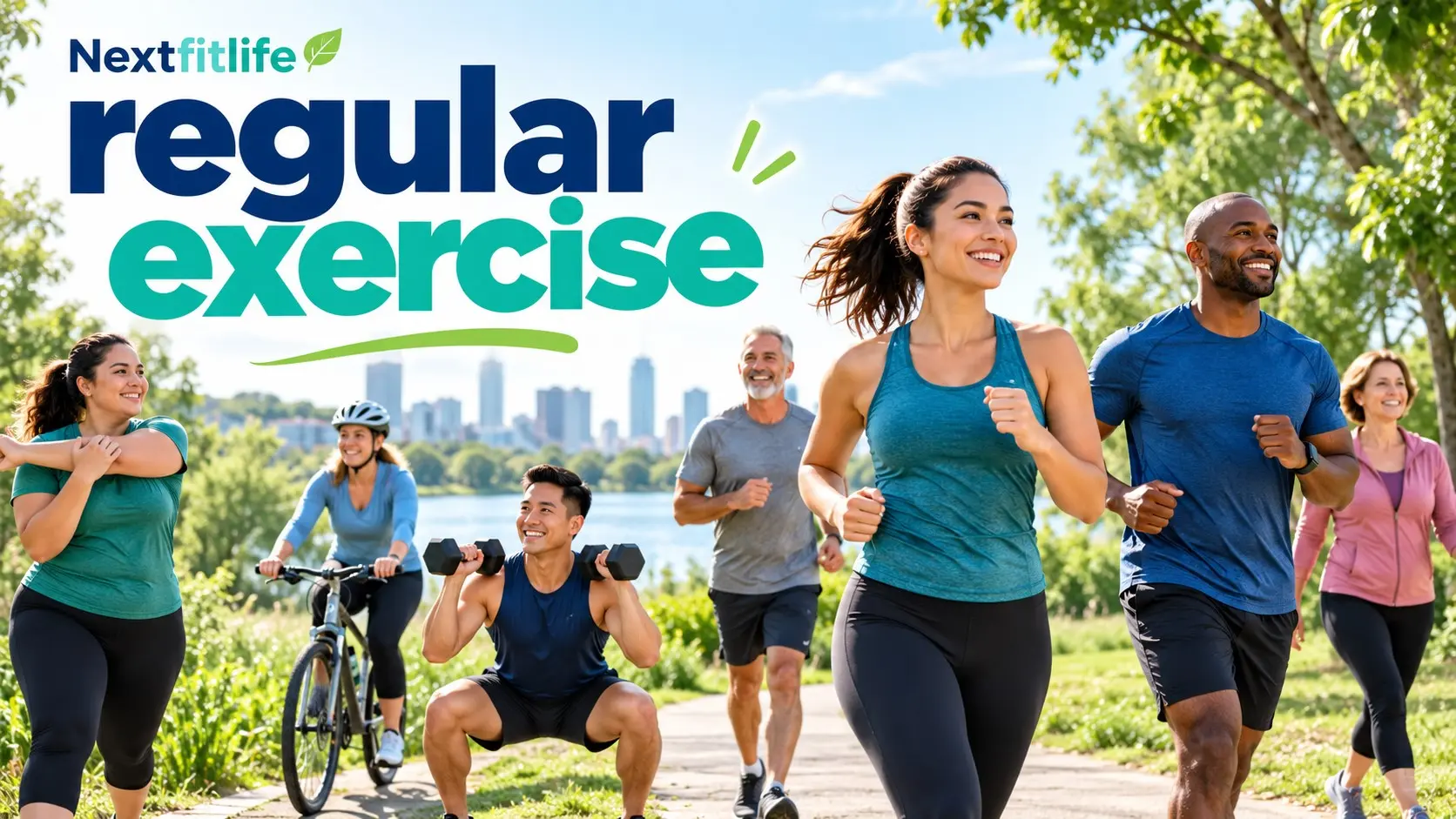
Regular exercise means planned physical activity that you repeat often enough for your body to adapt.
It does not mean doing the same workout every day.
Your routine can include:
- Walking
- Cycling
- Swimming
- Strength training
- Dancing
- Running
- Sports
- Yoga
- Balance exercises
- Home workouts
Physical activity is even broader. It also includes active transport, gardening, stairs, household tasks, and ordinary daily movement.
The most useful routine is one you can repeat safely.
For a complete starting framework, see our Fitness Program Hub.
16 Remarkable Benefits of Regular Exercise
1. Regular Exercise Supports Heart Health
Aerobic activity trains the cardiovascular system.
Your heart, circulation, and working muscles become better at handling physical effort.
Regular activity is linked with lower risk of coronary heart disease and stroke.
It can also improve several risk factors that influence heart health.
For more detail, read our Exercise and Heart Health guide.
2. Exercise Improves Cardiorespiratory Fitness
Cardiorespiratory fitness describes how well your heart, circulation, lungs, and muscles work together during activity.
Regular walking, running, cycling, swimming, and similar activities can improve it.
That can make ordinary tasks feel easier.
You may notice that:
- Stairs feel less tiring
- You can walk farther
- You recover faster after effort
- Daily tasks require less energy
This is more accurate than saying exercise simply increases lung capacity in everyone.
3. Exercise Helps Manage Blood Pressure
Regular aerobic activity can support healthier blood pressure.
Even one moderate or vigorous session can have short term effects on blood pressure, while regular activity supports longer term cardiovascular health.
Exercise does not automatically replace blood pressure medicine.
If medication is prescribed, continue treatment unless your clinician advises otherwise.
4. Exercise Supports Blood Glucose and Insulin Function
Working muscles need fuel.
Physical activity helps muscles use glucose and can improve insulin sensitivity.
That makes regular exercise useful for preventing and managing type 2 diabetes.
Walking after meals is one simple example.
See our Walking After Meals guide.
5. Regular Exercise Supports Weight Management
Exercise uses energy and can help prevent weight gain or support weight loss.
But exercise is not a free pass for unlimited food.
Weight change still depends on total energy balance, food intake, medicines, sleep, biology, and other factors.
Exercise remains valuable even when the scale moves slowly.
It can improve fitness, strength, blood sugar, and cardiovascular health without dramatic weight loss.
See our Obesity guide for a broader treatment approach.
6. Strength Exercise Builds and Protects Muscle
Strength training helps maintain or increase muscle strength.
This matters at every age, but it becomes especially useful as we get older.
Stronger muscles help you:
- Stand from a chair
- Carry groceries
- Climb stairs
- Lift objects
- Protect physical function
You do not need heavy weights to begin.
Bands, machines, dumbbells, and body weight exercises can all work.
7. Exercise Supports Bone Health
Bones respond to physical loading.
Weight bearing activity and resistance exercise can support bone health and help slow age related bone loss.
Useful activities include:
- Walking
- Stair climbing
- Dancing
- Resistance training
- Running when appropriate
People with osteoporosis or a high fracture risk may need individual advice about impact exercise.
8. Exercise Improves Balance and Helps Prevent Falls
Balance exercise becomes more important with age.
Strong legs and better balance can reduce fall risk.
Examples include:
- Tai chi
- Supported single leg stands
- Heel to toe walking
- Step exercises
- Lower body resistance training
The American Heart Association recognizes endurance, strength, balance, and flexibility as different parts of a well rounded fitness routine.
9. Exercise Can Improve Mood
Movement changes how you feel as well as how your body performs.
Regular activity is associated with better mental health and lower depression risk.
A single workout can also improve mood for some people.
Exercise does not replace therapy or prescribed mental healthcare when those are needed.
For more detail, read our Physical Fitness and Mental Health guide.
10. Exercise Can Reduce Anxiety and Help Manage Stress
Physical activity can reduce short term feelings of anxiety.
It can also provide a healthy break from work, screens, and daily pressure.
A walk, swim, bike ride, or strength session can give your attention somewhere else to go.
Avoid the oversimplified claim that exercise works only by “lowering cortisol.”
Stress physiology is more complex than one hormone.
11. Exercise Supports Better Sleep
Regular activity can improve sleep quality.
You may fall asleep more easily and feel more rested when movement becomes part of your routine.
Older advice often said evening exercise should always be avoided.
Current evidence is more nuanced.
Many people tolerate evening exercise well, while very hard training close to bedtime can disturb sleep for some.
See our Sleep for Fitness guide.
12. Exercise Supports Brain Health
The brain changes in response to movement.
Regular activity can support cognitive function, including thinking, learning, judgment, and memory.
Harvard Health notes that regular moderate exercise has been linked with changes in brain regions involved in memory and thinking.
Exercise also helps brain health indirectly through sleep, mood, cardiovascular health, and metabolic health.
13. Exercise Can Help Chronic Pain and Physical Function
Long term pain does not always improve with more rest.
For some chronic conditions, suitable activity can improve function and reduce pain.
MedlinePlus specifically notes benefits for adults with arthritis.
Mayo Clinic also includes exercise as part of care for conditions such as arthritis, back pain, diabetes, asthma, and depression.
The type and dose of exercise should match the condition.
Severe or worsening pain deserves assessment.
14. Regular Activity Is Linked With Lower Risk of Several Cancers
Regular physical activity is associated with a lower risk of several cancers.
Current public health guidance includes cancers such as:
- Breast
- Colon
- Bladder
- Endometrial
- Esophageal
- Kidney
- Lung
- Stomach
Exercise does not guarantee cancer prevention.
Smoking, alcohol, infections, genetics, screening, age, and many other factors also affect risk.
15. Exercise Supports Independence and Quality of Life
This benefit is easy to underestimate.
Fitness helps you do ordinary life more easily.
Better strength, endurance, balance, and mobility can support independent living.
That may mean:
- Walking farther
- Carrying bags
- Using stairs
- Playing with children
- Traveling
- Getting up from the floor
Exercise is therefore about function, not just appearance.
16. Regular Exercise Is Linked With a Longer Life
One of the strongest long term benefits of movement is its association with lower risk of premature death.
MedlinePlus notes that regular physical activity can improve the chance of living longer.
This does not mean exercise guarantees a specific lifespan.
It means regular activity supports many systems that influence healthy aging and longevity.
The 16 Benefits at a Glance
| Benefit | Main Effect |
|---|---|
| 1. Heart | Cardiovascular health |
| 2. Fitness | Endurance and stamina |
| 3. Blood pressure | Blood pressure control |
| 4. Blood glucose | Glucose and insulin response |
| 5. Weight | Energy use and weight management |
| 6. Muscle | Strength and physical function |
| 7. Bones | Bone loading and density |
| 8. Balance | Fall prevention |
| 9. Mood | Emotional wellbeing |
| 10. Stress | Anxiety and stress management |
| 11. Sleep | Sleep quality |
| 12. Brain | Thinking and memory |
| 13. Pain | Function in selected chronic conditions |
| 14. Cancer risk | Lower risk of several cancers |
| 15. Independence | Daily function and quality of life |
| 16. Longevity | Lower premature mortality risk |
The Four Types of Exercise Work Together
A complete routine is not just cardio.
| Type | Examples | Main Purpose |
|---|---|---|
| Endurance | Walking, cycling, swimming | Heart and aerobic fitness |
| Strength | Weights, bands, machines | Muscles and physical function |
| Balance | Tai chi, balance drills | Stability and falls |
| Flexibility | Stretching and mobility | Joint movement and comfort |
The American Heart Association recommends variety because these exercise types train different physical qualities.
How Much Regular Exercise Do Adults Need?
For general health, adults can work toward:
150 to 300 minutes of moderate aerobic activity each week
OR
75 to 150 minutes of vigorous aerobic activity each week
OR
A suitable combination of both
PLUS: muscle strengthening activity on at least 2 days each week.
The American Heart Association also recommends sitting less.
If you are not active now, start below these levels and build.
How Hard Should Exercise Feel?
You do not need complicated formulas.
Use the talk test.
At moderate intensity:
- Your heart beats faster
- You breathe harder
- You can still talk
- Singing comfortably becomes difficult
During vigorous exercise, speaking becomes much harder.
The same walking pace can feel light to one person and moderate to another.
Can Five or Ten Minutes of Exercise Help?
Yes.
MedlinePlus states that even five minutes of physical activity has health value.
Short sessions are useful if you are busy or inactive.
You can build a day like this:
- 10 minute walk in the morning
- 10 minute walk after lunch
- 10 minute walk after dinner
That is 30 minutes of movement without finding one long empty block.
A Simple Beginner Exercise Week
| Day | Activity | Goal |
|---|---|---|
| Monday | Walking | 15 to 20 comfortable minutes |
| Tuesday | Strength | Simple full body workout |
| Wednesday | Easy movement | Walk and sit less |
| Thursday | Aerobic exercise | Walking, cycling, or swimming |
| Friday | Strength | Second full body session |
| Saturday | Enjoyable activity | Longer walk, sport, or bike ride |
| Sunday | Recovery | Light movement |
This is an example, not a medical prescription.
Shorten or change it to fit your body.
Regular Exercise After Age 40
Your body still adapts after 40.
Strength training becomes increasingly useful because muscle mass and strength tend to decline with age.
Recovery also deserves more attention.
Pay attention to:
- Sleep
- Joint comfort
- Previous injuries
- Training volume
- Strength
- Nutrition
See our Strength Training After 40 guide.
Regular Exercise for Older Adults
Older adults can gain major benefits from exercise.
A good program can support:
- Heart health
- Strength
- Balance
- Walking ability
- Brain health
- Independent living
Strength and balance deserve special attention when fall risk increases.
Regular Exercise Does Not Mean Hard Exercise Every Day
You can move daily without training hard daily.
An easy walk can sit between harder workouts.
You can also alternate muscle groups or exercise types.
Recovery helps you return ready for the next useful session.
How to Make Regular Exercise a Habit
The perfect workout is less useful than the workout you actually repeat.
Try these practical steps:
- Choose an activity you enjoy
- Start smaller than your maximum
- Use a regular time when possible
- Keep walking shoes or equipment visible
- Exercise with another person
- Track consistency instead of perfection
- Keep an indoor backup plan
An exercise habit becomes easier when there are fewer barriers between you and movement.
Increase One Thing at a Time
Your body adapts to training.
When the current workload becomes easy, you can increase:
- Time
- Distance
- Speed
- Resistance
- Repetitions
- Frequency
You do not need to increase all of them at once.
Gradual progression is easier to recover from.
Does Exercise Boost Immunity?
The phrase needs care.
Exercise influences immune regulation, but the immune system is not a battery that simply gets “boosted.”
Regular moderate activity is associated with healthy immune function.
Very heavy training combined with poor sleep, inadequate nutrition, and inadequate recovery is different.
See our Exercise and Your Immune System guide for a fuller explanation.
Does Exercise Increase Lung Capacity?
Not necessarily.
Training can improve aerobic fitness and make breathing during activity more efficient.
Much of that improvement comes from the heart, circulation, muscles, and respiratory system working together more effectively.
It is too broad to promise that ordinary exercise will increase anatomical lung capacity in every healthy adult.
Does Regular Exercise Prevent Injuries?
No exercise prevents all injuries.
Appropriate training can improve strength, balance, coordination, and physical capacity.
Those improvements may reduce some avoidable risks.
But exercise and sport can also cause overuse injuries, falls, strains, and other injuries when the load exceeds what the body can currently handle.
Progress gradually and address persistent pain.
Common Regular Exercise Myths
Myth 1: You Need One Hour Every Day
Shorter sessions count too.
Myth 2: Exercise Only Works if You Sweat
Sweating depends on temperature, clothing, humidity, and individual biology.
Myth 3: Cardio Is Enough
Strength and balance train different abilities.
Myth 4: Exercise Must Hurt
Effort is normal. Severe or sharp pain is not a goal.
Myth 5: Exercise Guarantees Weight Loss
Food intake and other factors still influence weight.
Myth 6: Older Adults Should Avoid Weights
Appropriate resistance training can be especially useful with age.
Myth 7: You Need a Gym
Walking, cycling, bands, body weight exercise, stairs, swimming, and sports all count.
Myth 8: Missing a Week Means Starting From Zero
Resume at a manageable level and build again.
Conclusion: Regular Exercise Helps the Whole Person
Regular exercise benefits both your body and mind.
It can support your heart, blood pressure, blood glucose, muscles, bones, balance, sleep, mood, brain health, mobility, independence, and long term health.
You do not need to master every form of exercise at once.
Your next step: choose one activity you can repeat this week. Walk for ten minutes, do a short strength routine, ride a bike, swim, or choose another movement you enjoy. Consistency comes before complexity.
Internal Links + Hub
- Fitness Program Hub
- Benefits of Regular Exercise
- Walking
- Exercise and Heart Health
- Physical Fitness and Mental Health
- Exercise and Your Immune System
- Minimum Effective Dose Strength Training
- Strength Training After 40
- Walk Jog Intervals
- Zone 2 Cardio for Beginners
- Prediabetes Diet and Exercise
- Sleep for Fitness
About the Author
Adel Galal is a father of four (three sons and a daughter) and a grandfather of four, with 33 years of hands-on parenting experience. He is the founder of Parnthub.com, based in Cairo, Egypt, where he shares practical guidance on feeding, development and family life from newborns to teenagers. Adel is not a medical professional; health articles cite trusted sources and are for general information only.
For more information about NextFitLife and its editorial standards, visit the About Us page.
Frequently Asked Questions About Regular Exercise
What is regular exercise?
Regular exercise means planned physical activity repeated often enough to improve or maintain fitness. It can include walking, cycling, swimming, strength training, sports, dancing, balance work, and other activities.
What are the main benefits of regular exercise?
Regular exercise can support heart health, fitness, blood pressure, blood glucose, weight management, muscle, bones, balance, mood, sleep, brain health, physical function, independence, and longevity.
How much regular exercise should adults get?
Adults can work toward 150 to 300 minutes of moderate aerobic activity each week, or 75 to 150 minutes of vigorous activity, plus strength training on at least two days.
Is 10 minutes of exercise worth doing?
Yes. Short sessions contribute to total physical activity, and even small amounts of movement can provide health benefits.
Should I exercise every day?
You can move every day, but hard exercise every day is not required. Easy walking and ordinary movement can be used between harder training sessions.
Is walking enough regular exercise?
Brisk walking can provide excellent aerobic activity. A more complete routine also includes strength work and balance training when appropriate.
Can regular exercise improve mental health?
Yes. Physical activity can support mood, reduce short term anxiety, improve sleep, and lower depression risk. It does not replace professional mental healthcare when treatment is needed.
Can regular exercise improve sleep?
Yes. Regular activity is associated with better sleep quality. Very hard exercise close to bedtime can disturb sleep in some people, but evening exercise is not automatically harmful.
Does regular exercise improve brain health?
Yes. Exercise supports thinking, learning, memory, judgment, and overall cognitive health, especially when maintained across adulthood.
Does regular exercise prevent disease?
Regular physical activity is associated with lower risks of heart disease, stroke, type 2 diabetes, several cancers, dementia, and premature death. It cannot guarantee that a disease will never occur.
Does exercise increase lung capacity?
Exercise can improve cardiorespiratory fitness and make breathing during activity more efficient, but it does not necessarily increase anatomical lung capacity in every healthy adult.
Does regular exercise prevent injuries?
Exercise can improve strength, balance, coordination, and physical capacity, which may reduce some risks. Exercise can also cause injuries when training load or technique exceeds what the body can tolerate.
Is exercise still useful without weight loss?
Yes. Exercise can improve fitness, blood pressure, blood glucose, muscle strength, sleep, mood, brain health, and physical function even when body weight changes little.
Can older adults start regular exercise?
Yes. Older adults can benefit greatly from aerobic, strength, and balance exercise. People with significant medical or mobility problems may need an individualized plan.
References and Sources
- MedlinePlus, U.S. National Library of Medicine. Benefits of Exercise.https://medlineplus.gov/benefitsofexercise.html
- MedlinePlus, U.S. National Library of Medicine. Exercise and Physical Fitness.https://medlineplus.gov/exerciseandphysicalfitness.html
- MedlinePlus. How Much Exercise Do I Need?https://medlineplus.gov/howmuchexercisedoineed.html
- American Heart Association. Recommendations for Physical Activity in Adults and Kids.https://www.heart.org/en/healthy-living/exercise-and-physical-activity/fitness-basics/aha-recs-for-physical-activity-in-adults
- American Heart Association. Endurance Exercise.https://www.heart.org/en/healthy-living/exercise-and-physical-activity/fitness-basics/endurance-exercise-aerobic
- Mayo Clinic. Exercise and Chronic Disease: Get the Facts.https://www.mayoclinic.org/healthy-lifestyle/fitness/in-depth/exercise-and-chronic-disease/art-20046049
- Harvard Health Publishing. Exercise Can Boost Your Memory and Thinking Skills.https://www.health.harvard.edu/mind-and-mood/exercise-can-boost-your-memory-and-thinking-skills
Medical disclaimer: I am not a dermatologist or a doctor, and this content does not replace professional medical advice. What I share comes from real-life experience, extensive research, and consultation with healthcare providers. Always consult qualified medical professionals for diagnosis and treatment of any health condition.

Health & wellness writer with 30+ years of experience in nutrition, fitness, and healthy aging. Founder of NextFitLife.com — evidence-based health guidance.

