
Published on: July 22, 2026
Updated on: October 15, 2026
Written by: Adel Galal, Founder and Lead Writer at NextFitLife
Medical review status: This article has not been medically reviewed by a doctor, cardiologist, pulmonologist, emergency physician, or other licensed healthcare professional.
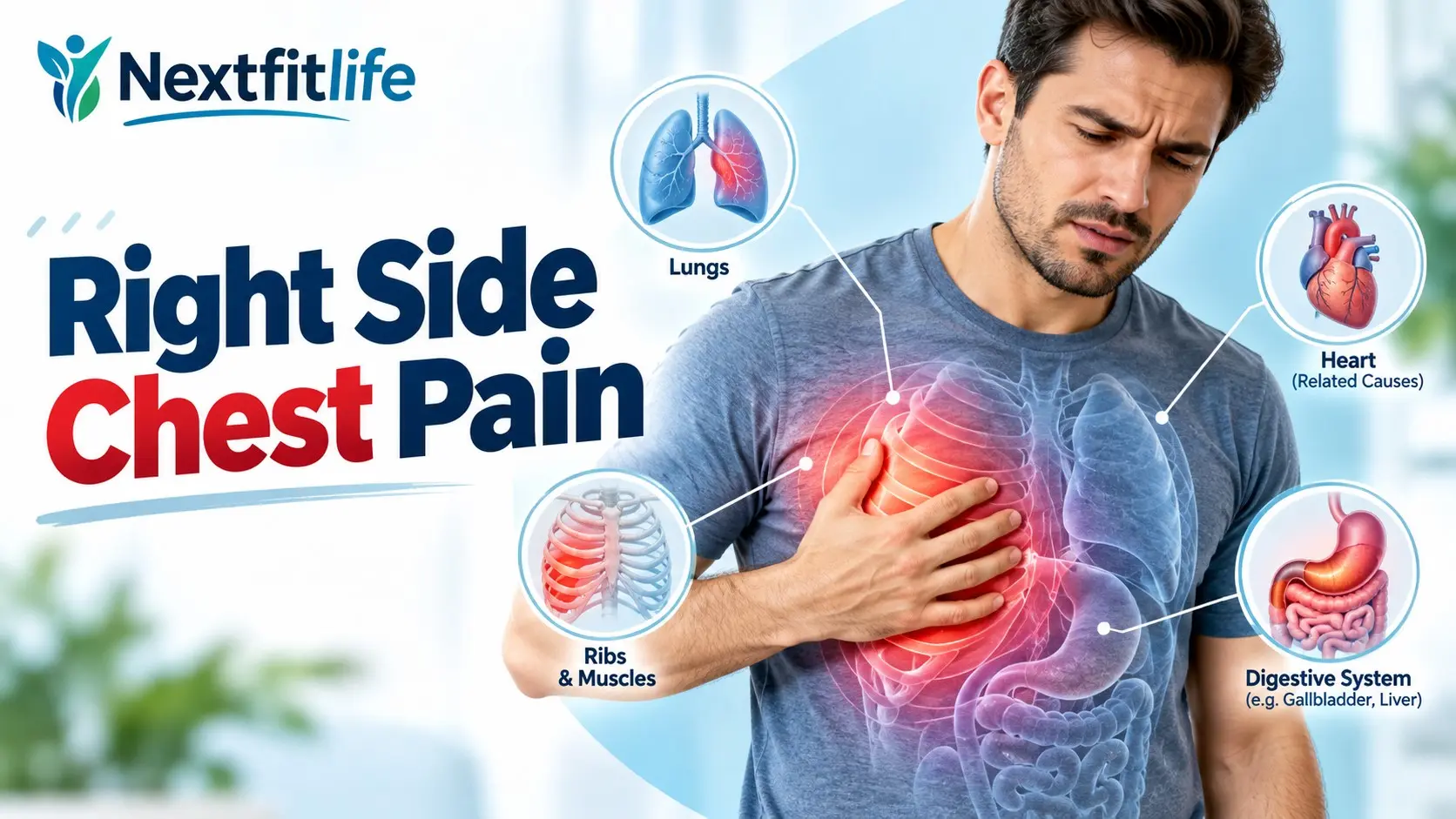
Right Side Chest Pain can come from muscles, ribs, lungs, digestion, the gallbladder, nerves, or the heart. Some causes are mild, while others can become dangerous very quickly.
The exact side of the pain does not tell you whether it is safe. Right-sided chest pain can still be caused by a heart or lung emergency.
This article is for general information and education. It does not replace medical advice, diagnosis, or treatment.
If chest pain follows exercise, read Chest Pain After Exercise: Causes and Emergency Signs.
Table of Contents
- What Right Side Chest Pain can mean
- 13 important causes
- Muscle strain
- Costochondritis
- Rib injury
- Pleurisy
- Pneumonia
- Pulmonary embolism
- Collapsed lung
- Asthma and lung disease
- Heart related causes
- Gallbladder pain
- Acid reflux and esophageal pain
- Shingles
- Anxiety and panic
- Pain patterns that give clues
- Safe quick relief tips
- What not to do
- How doctors find the cause
- When to call emergency services
- When to book a doctor visit
- Frequently asked questions
What Can Right Side Chest Pain Mean?
Your chest contains more than your heart. It also contains ribs, muscles, cartilage, lungs, nerves, major blood vessels, the esophagus, and the diaphragm. Pain can also travel upward from organs in the upper abdomen, especially the gallbladder.
This is why Right Side Chest Pain cannot be diagnosed by location alone.
A tender spot that hurts when you twist or lift may be related to muscle or rib tissue. Sharp pain that becomes worse when you breathe may come from the lungs, pleura, ribs, or a blood clot. Pressure, squeezing, or heaviness can still be heart related even when the discomfort is mainly on the right.
13 Important Causes of Right Side Chest Pain
1. Muscle Strain
A chest muscle strain is one of the more common causes of localized right side chest pain.
It may start after:
- Heavy lifting
- Push exercises
- Sports
- Hard coughing
- An awkward twist
- A new workout
Muscle pain often becomes worse when you move your arm, twist your upper body, cough, or press the sore area.
A clear movement trigger makes a muscle cause more likely, but it does not prove it. Severe or unexplained pain still needs proper assessment.
2. Costochondritis
Costochondritis is inflammation of the cartilage where the ribs join the breastbone.
It can cause sharp or aching chest pain and tenderness.
The pain may become stronger when you:
- Take a deep breath
- Cough
- Move the upper body
- Press over the sore rib joint
It can follow heavy exercise, repeated coughing, or another chest strain. Sometimes there is no obvious cause.
3. Rib Bruise or Fracture
A bruised or broken rib can cause strong pain on one side of the chest.
Common triggers include:
- A fall
- Sports injury
- A car accident
- A direct blow
- Very forceful coughing
The pain often becomes worse when you breathe deeply, laugh, cough, or move.
Breathing trouble after chest trauma needs urgent medical assessment because the lung can also be injured.
4. Pleurisy
Pleurisy is inflammation of the thin tissue layers around the lungs.
The pain is often sharp and becomes worse when you:
- Take a deep breath
- Cough
- Sneeze
- Move your chest
Pleurisy is not one single disease. It can occur with viral infection, pneumonia, pulmonary embolism, autoimmune disease, and other lung conditions.
For more respiratory information, visit the Lung and Respiratory Health Hub.
5. Pneumonia
Pneumonia can cause pain on one side of the chest, especially if infection irritates the lining around the lung.
Other symptoms may include:
- Fever
- Chills
- Cough
- Mucus
- Shortness of breath
- Weakness
- Fatigue
Severe breathing difficulty, confusion, bluish lips, fainting, or coughing blood needs urgent medical care.
6. Pulmonary Embolism
A pulmonary embolism happens when a blood clot blocks an artery in the lung.
This is an emergency.
Possible signs include:
- Sudden shortness of breath
- Sharp pain that becomes worse with breathing
- Rapid breathing
- Fast heartbeat
- Coughing blood
- Dizziness or fainting
- One swollen, painful, warm, or red leg
Risk may be higher after major surgery, long periods of immobility, long travel, pregnancy, recent childbirth, cancer, previous blood clots, or use of some estrogen containing medicines.
Do not wait for this type of pain to improve at home.
7. Collapsed Lung
A pneumothorax, or collapsed lung, occurs when air collects between the lung and chest wall.
It can cause sudden sharp pain on one side with shortness of breath.
Other symptoms may include:
- Rapid breathing
- Dry cough
- Lightheadedness
- A fast heartbeat
- Sudden worsening
A collapsed lung can happen after trauma or a medical procedure, but it can also happen without an obvious trigger.
8. Asthma or Other Lung Disease
Asthma usually causes chest tightness rather than one precise painful spot.
You may also have:
- Wheezing
- Cough
- Shortness of breath
- Symptoms after exercise
- Symptoms after cold air exposure
If you have unusual breathing symptoms, see our Unusual Asthma Symptoms Guide.
9. Heart Related Causes
Heart pain does not have to stay on the left side.
Heart related chest discomfort may feel like:
- Pressure
- Heaviness
- Squeezing
- Burning
- Tightness
The pain may spread to the neck, jaw, back, shoulder, arm, or upper abdomen.
Other warning signs can include sweating, nausea, shortness of breath, unusual weakness, dizziness, or fainting.
10. Gallbladder Problems
The gallbladder sits in the upper right abdomen, but gallbladder pain can spread toward the right lower chest, shoulder, or back.
Gallstones or gallbladder inflammation can cause:
- Pain under the right ribs
- Pain after a fatty meal
- Nausea
- Vomiting
- Pain into the right shoulder or back
Fever, severe persistent pain, or yellow skin or eyes needs prompt medical assessment.
11. Acid Reflux or Esophageal Pain
Acid reflux can cause burning chest pain that may feel central or one sided.
Clues may include:
- A sour taste
- Pain after eating
- Burning behind the breastbone
- Symptoms when lying down
- Belching
Heart and esophageal pain can overlap, so do not automatically assume a new episode of chest pain is reflux.
12. Shingles
Shingles can cause burning, tingling, or sharp pain on one side of the chest before a rash appears.
The area may become very sensitive to clothing or touch.
A blistering rash often appears later in a band along one side of the body.
Early medical treatment may be helpful, so contact a healthcare professional if shingles is possible.
13. Anxiety or Panic
Anxiety and panic attacks can cause intense chest symptoms.
Possible symptoms include:
- Chest tightness
- Rapid heartbeat
- Shortness of breath
- Dizziness
- Tingling
- Fear
But anxiety should not be your first assumption when chest pain is new, severe, or different from your usual pattern.
Right Side Chest Pain Patterns at a Glance
| Pain Pattern | Possible Cause | Best Next Step |
|---|---|---|
| Worse with movement or pressing the area | Muscle strain, rib pain, costochondritis | Rest and monitor if clearly mild |
| Sharp pain with deep breathing | Pleurisy, pulmonary embolism, pneumonia, pneumothorax, rib pain | Prompt assessment if new or unexplained |
| Pressure, squeezing, or heaviness | Possible heart cause | Emergency assessment |
| After fatty meals | Gallbladder disease | Medical review |
| Burning after meals or lying down | Reflux or esophageal irritation | Assess pattern, but do not assume if new |
| Pain with rash or skin sensitivity | Shingles | Prompt medical review |
Quick Relief Tips for Right Side Chest Pain
Quick relief is only appropriate when the pain is mild and the cause appears nonurgent.
Stop the Triggering Activity
If the pain began while lifting, exercising, or twisting, stop the activity and rest.
Use Heat or Cold Only for Clear Muscle Pain
A cold pack or warm compress may help a mild muscle strain.
Do not use heat or ice as a way to delay medical care for unexplained chest pain.
Sit Upright
Sitting upright may feel more comfortable with reflux, anxiety, or mild breathing discomfort.
If you are short of breath, dizzy, or severely unwell, get urgent medical help instead of relying on home treatment.
Eat Lightly if Digestive Pain Is Suspected
If discomfort follows a heavy meal and you otherwise feel well, avoid another large or fatty meal until symptoms settle or are assessed.
Use Pain Medicine Carefully
Over the counter pain medicine may help confirmed musculoskeletal pain.
Ask a pharmacist or clinician first if you have kidney disease, stomach ulcers, bleeding problems, take blood thinners, or are unsure which medicine is safe.
What Not to Do
- Do not ignore severe or unexplained chest pain
- Do not assume right side pain cannot come from the heart
- Do not exercise through chest pain
- Do not drive yourself during a possible emergency
- Do not assume pain with breathing is only a pulled muscle
- Do not blame anxiety before serious causes have been considered
- Do not use antacids as a test for whether chest pain is heart related
How Doctors Diagnose Right Side Chest Pain
The correct tests depend on your symptoms, medical history, age, and risk factors.
A clinician may check:
- Blood pressure
- Pulse
- Temperature
- Oxygen level
- Heart sounds
- Lung sounds
- Chest wall tenderness
- Abdominal tenderness
Tests may include:
- ECG
- Blood tests
- Chest X ray
- CT scan
- Ultrasound
- Other heart or lung tests
The goal is not simply to name the pain. It is to identify or rule out dangerous causes first.
When Should You Call Emergency Services?
Call emergency services if Right Side Chest Pain comes with:
- Shortness of breath
- Chest pressure, squeezing, or heaviness
- Pain spreading to the arm, jaw, neck, back, or upper abdomen
- Fainting or near fainting
- Profuse sweating
- Coughing blood
- Blue or gray lips
- A fast or irregular heartbeat
- One swollen or painful leg
- Severe pain after chest trauma
- Sudden severe unexplained pain
When Should You Book a Doctor Visit?
Arrange a medical visit if:
- The pain keeps returning
- It lasts more than a few days
- You have repeated pain after meals
- You have a persistent cough
- You have fever
- You think shingles may be developing
- The area stays tender after an injury
- The symptoms interfere with sleep or normal activity
Conclusion: Do Not Judge Chest Pain by the Side Alone
Right Side Chest Pain can be caused by a muscle strain, rib problem, lung inflammation, reflux, gallbladder disease, shingles, anxiety, or something more serious.
The most useful clues are how the pain started, what makes it worse, and what other symptoms appear with it.
If the discomfort is mild, clearly linked to movement, and steadily improving, simple rest may help. If it is new, severe, unexplained, or comes with shortness of breath, fainting, sweating, coughing blood, or a fast heartbeat, get urgent medical help.
References and Sources
- Mayo Clinic. Heart Attack Symptoms.
Covers chest pressure, pain patterns, shortness of breath, nausea, sweating, and other heart attack warning signs.
https://www.mayoclinic.org/diseases-conditions/heart-attack/in-depth/heart-attack-symptoms/art-20047744 - MedlinePlus. Chest Pain.
National Library of Medicine guidance covering cardiac, lung, digestive, chest wall, and other causes of chest pain.
https://medlineplus.gov/chestpain.html - NHS. Chest Pain.
Covers common chest pain causes and the warning signs that need emergency assessment.
https://www.nhs.uk/conditions/chest-pain/ - Cleveland Clinic. Pulmonary Embolism.
Explains blood clot symptoms, chest pain, shortness of breath, coughing blood, and emergency care.
https://my.clevelandclinic.org/health/diseases/17400-pulmonary-embolism - Mayo Clinic. Pneumothorax.
Covers collapsed lung symptoms, including sudden chest pain and shortness of breath.
https://www.mayoclinic.org/diseases-conditions/pneumothorax/symptoms-causes/syc-20350367 - Cleveland Clinic. Pleurisy.
Explains pleuritic chest pain, breathing related symptoms, possible causes, and treatment.
https://my.clevelandclinic.org/health/diseases/21172-pleurisy
Internal Links and Helpful NextFitLife Guides
- Chest Pain After Exercise
- Lung and Respiratory Health Hub
- Unusual Asthma Symptoms
- Coughing Only at Night
- Chest Congestion Without Cough
- How to Stop Feeling Dizzy
About the Author
Adel Galal is the Founder and Lead Writer at NextFitLife. He researches health, fitness, respiratory health, symptom based topics, nutrition, wellness, and healthy aging and turns current medical guidance into clear practical information for everyday readers.
I am not a doctor or licensed healthcare professional, and this content does not replace professional medical advice, diagnosis, or treatment. I share information based on extensive research, real life experience, and consultation with healthcare providers. Always consult a qualified healthcare professional for diagnosis, treatment, or guidance about any health condition.
Learn more about Adel and the NextFitLife editorial approach on the About Us page.
Frequently Asked Questions
Is Right Side Chest Pain serious?
It can be. Some cases come from muscles, ribs, or digestion, but right side chest pain can also happen with pulmonary embolism, pneumonia, a collapsed lung, gallbladder disease, or a heart problem.
Can gas cause Right Side Chest Pain?
Digestive gas can cause discomfort that feels like chest pain, but new or unexplained pain should not automatically be blamed on gas.
Can Right Side Chest Pain be heart related?
Yes. Heart related pain does not have to stay on the left. Pressure, squeezing, sweating, nausea, shortness of breath, or pain spreading to the jaw or arm are important warning signs.
What causes Right Side Chest Pain when breathing?
Pleurisy, pneumonia, pulmonary embolism, rib problems, and a collapsed lung can all cause chest pain that becomes worse with breathing.
Why does the right side of my chest hurt when I move?
Muscle strain, rib pain, or costochondritis can cause pain that becomes worse with twisting, lifting, coughing, or pressing the chest wall.
What can cause Right Side Chest Pain after eating?
Gallbladder disease, acid reflux, and esophageal irritation can cause chest or upper abdominal pain after meals, especially after large or fatty meals.
Can anxiety cause Right Side Chest Pain?
Yes. Panic and anxiety can cause chest tightness, pain, breathlessness, dizziness, and a fast heartbeat. New severe pain should still be checked for physical causes first.
Can pneumonia cause Right Side Chest Pain?
Yes. Pneumonia can cause one sided pain, especially when infection irritates the lining around the lung. Fever, cough, phlegm, and shortness of breath may occur too.
When should I go to the emergency room for Right Side Chest Pain?
Seek emergency help for sudden, severe, or unexplained pain, especially with shortness of breath, fainting, sweating, coughing blood, a fast heartbeat, pressure or heaviness, or one swollen leg.
How do I relieve mild Right Side Chest Pain at home?
If the pain is clearly linked to a minor muscle strain and there are no warning signs, rest and a warm or cool compress may help. Do not use home care to delay assessment of unexplained chest pain.

Health & wellness writer with 30+ years of experience in nutrition, fitness, and healthy aging. Founder of NextFitLife.com — evidence-based health guidance.

