
Published on: Aug 15, 2024
Updated: November 3, 2026
Sciatica Stretches can help some people move more comfortably, but stretching harder is not the goal.
Sciatica happens when a nerve root that contributes to the sciatic nerve becomes irritated or compressed. Pain often starts in the lower back or buttock and travels into one leg. Tingling, numbness or weakness can also occur.
That makes sciatica different from an ordinary tight hamstring.
An irritated nerve may respond well to gentle movement, but aggressive stretching can sometimes make symptoms worse.
This article is for general information and education. It does not replace medical advice, diagnosis, or treatment.
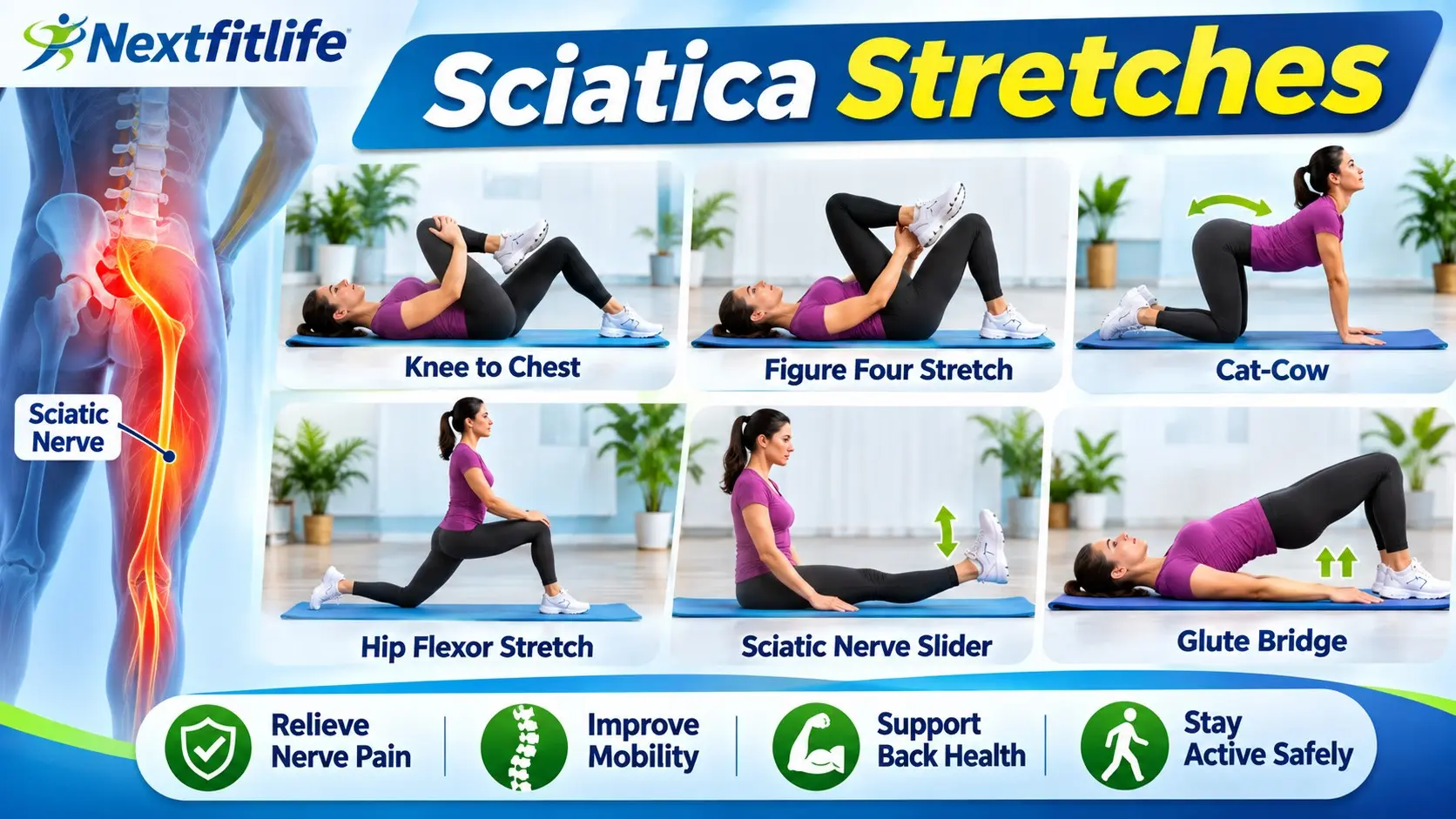
Quick answer: Useful Sciatica Stretches may include gentle walking, pelvic tilts, cat cow, knee to chest, figure four stretching, hip flexor mobility, gentle hamstring stretching and carefully performed sciatic nerve sliders. Some people also respond to gentle lumbar extension. Use the movement that makes leg symptoms stay the same or improve, and stop if pain, tingling or numbness spreads farther down the leg.
Get urgent medical help now if sciatica occurs with:
- Numbness around the genitals, anus or inner thighs
- New trouble starting or controlling urination
- Loss of bladder or bowel control
- Severe or worsening weakness in both legs
- Sciatica affecting both sides at the same time
- A sudden major loss of walking ability
These symptoms can be signs of cauda equina syndrome or another serious spinal problem and should not be treated with home stretching first.
Table of Contents
- What is sciatica?
- Why stretching needs care
- 12 smart Sciatica Stretches and movements
- Gentle walking
- Pelvic tilt
- Cat cow
- Single knee to chest
- Figure four stretch
- Supported piriformis stretch
- Hip flexor stretch
- Gentle hamstring stretch
- Sciatic nerve slider
- Prone lying
- Gentle press up when appropriate
- Glute bridge
- How to know if a movement is helping
- Nerve sliders versus stretches
- How often to practice
- Exercises that may irritate sciatica
- Walking and strength training
- When to see a clinician
- Frequently asked questions
What Is Sciatica?
Sciatica describes symptoms caused by irritation or compression of nerve roots that form the sciatic nerve.
Common symptoms include:
- Sharp or burning pain in the buttock or leg
- Electric shock like pain
- Tingling
- Numbness
- Leg or foot weakness
The pain often affects one side.
Some people also have lower back pain, but the leg symptoms are often more noticeable.
What Causes Sciatica?
A herniated or bulging lumbar disc is one common cause.
Other causes can include:
- Spinal stenosis
- Spondylolisthesis
- Age related spinal changes
- Back injury
Not every pain in the buttock or back of the thigh is true sciatica.
Hip problems, muscle pain and other nerve conditions can feel similar.
Why Sciatica Stretches Need More Care Than Normal Stretching
A muscle and a nerve behave differently.
If your hamstring muscle feels tight, a gentle hamstring stretch may feel good.
If your sciatic nerve or a lumbar nerve root is irritated, pulling strongly on the entire back of the leg may increase nerve symptoms instead.
This is why the goal is comfortable movement rather than maximum flexibility.
What Does It Mean When Pain Moves Up or Down the Leg?
This can be an important clue.
If a movement causes pain that was in the calf or foot to move closer toward the buttock or lower back, clinicians sometimes call this centralization.
That can be a useful response for some people.
If pain begins travelling farther down the leg, or tingling and numbness increase, the movement may be irritating the nerve.
Do not force through that response.
12 Smart Sciatica Stretches and Movements
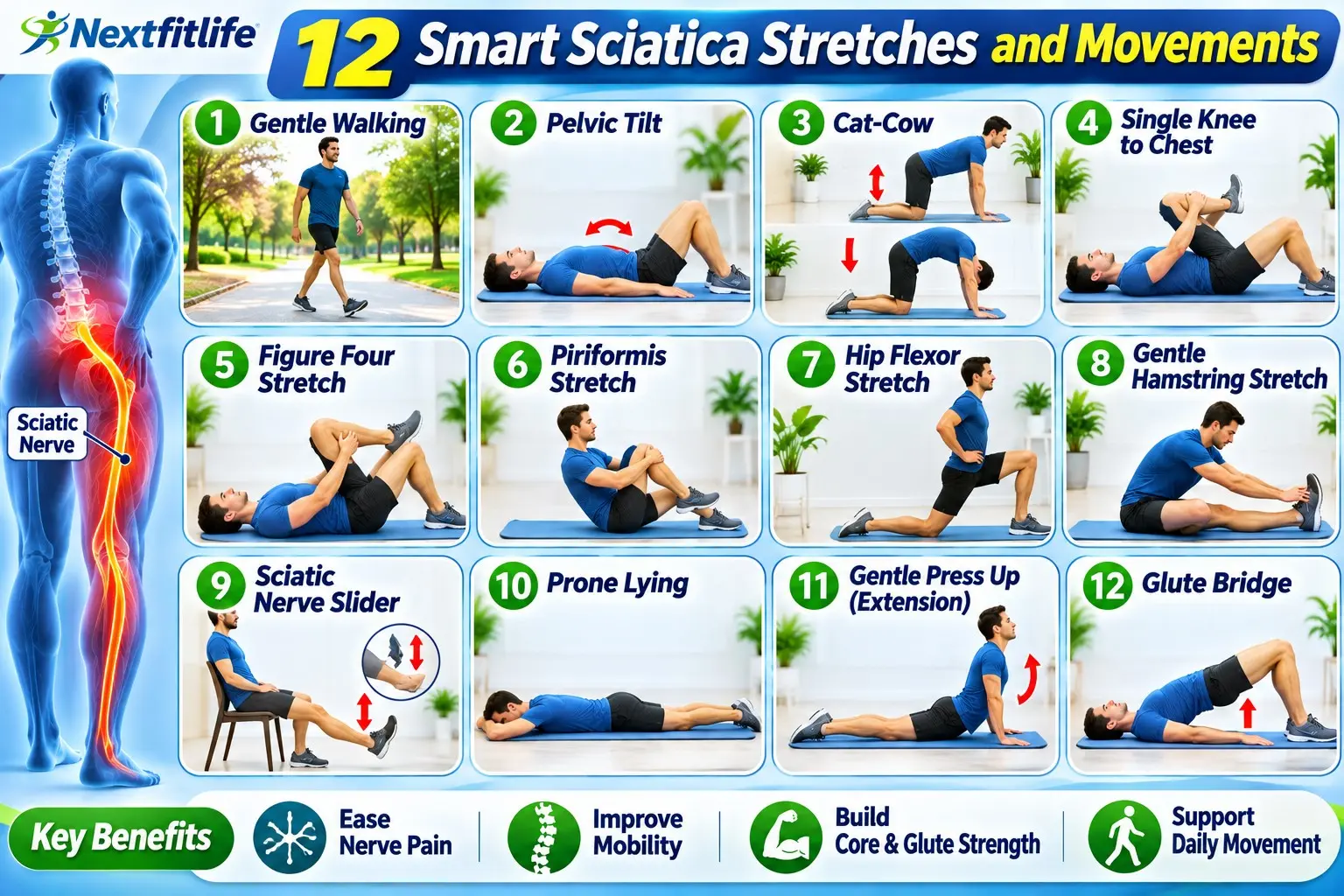
1. Gentle Walking
Walking is not technically a stretch, but it is one of the simplest ways to avoid prolonged rest.
Try a short, comfortable walk on level ground.
Start with:
- 5 to 10 minutes
- A relaxed pace
- Shorter steps if needed
Increase the duration only when your leg symptoms stay stable.
If walking makes pain spread farther down the leg, shorten the session and seek advice if this keeps happening.
2. Pelvic Tilt
This gentle movement helps you explore comfortable lower back motion.
- Lie on your back with your knees bent.
- Keep your feet on the floor.
- Gently tilt your pelvis so your lower back moves slightly toward the mat.
- Return to a relaxed neutral position.
Use a small range.
Try 8 to 12 easy repetitions.
3. Cat Cow
Cat cow moves the spine gently in both directions.
- Begin on your hands and knees.
- Slowly round your back.
- Then gently return through neutral.
- Allow a small comfortable arch.
Do not push into a position that sends pain farther down the leg.
4. Single Knee to Chest
This movement may feel comfortable for some people, especially when gentle spinal flexion reduces symptoms.
- Lie on your back.
- Bend both knees.
- Bring one knee gently toward your chest.
- Hold behind the thigh or over the shin.
- Return slowly and change sides.
Hold for about 10 to 20 seconds if comfortable.
Skip it if bending forward increases leg symptoms.
5. Figure Four Stretch
The figure four position stretches the gluteal area.
- Lie on your back with your knees bent.
- Place one ankle across the opposite thigh.
- Keep the foot relaxed.
- Gently bring the supporting leg toward you.
You should feel a mild stretch around the buttock.
Stop if it creates electric pain or tingling down the leg.
6. Supported Piriformis Stretch
The piriformis sits deep in the buttock.
Some buttock pain can involve this area, although true lumbar sciatica usually begins with a spinal nerve root problem.
Use the same figure four position but keep the stretch mild.
Do not assume that every case of sciatica is caused by a “tight piriformis.”
7. Hip Flexor Stretch
A gentle hip flexor stretch may help people who spend long periods sitting.
- Use a split stance.
- Hold a wall or chair.
- Keep your trunk tall.
- Gently move your pelvis forward.
- Feel a mild stretch at the front of the back hip.
Avoid arching the lower back aggressively.
8. Gentle Hamstring Stretch
Hamstring stretching needs special care with sciatica because the sciatic nerve travels through the back of the leg.
Use a mild version.
- Sit near the edge of a chair.
- Extend one leg slightly.
- Keep the knee soft rather than locked.
- Lean forward only a little.
Stop before you feel tingling, burning or electric pain.
A muscle stretch is acceptable. A nerve pull is not the goal.
9. Sciatic Nerve Slider
A sciatic nerve slider is different from a long static stretch.
It gently changes tension at opposite ends of the nerve so the nerve moves rather than being held at maximum tension.
Seated Nerve Slider Example
- Sit upright in a chair.
- Slowly straighten one knee as you look slightly upward.
- Then bend the knee as you gently lower your chin.
- Move smoothly between the positions.
Use only a comfortable range.
Try 5 to 10 gentle repetitions.
Do not hold the nerve in a strong stretched position.
10. Prone Lying
Some people with disc related sciatica feel better when the spine moves gently toward extension.
A simple starting position is lying on your stomach.
- Lie face down.
- Place your arms comfortably beside you or under your head.
- Relax for a short period.
If leg pain moves closer toward the back or buttock, that may be encouraging.
If symptoms move farther down the leg, stop.
11. Gentle Press Up When Appropriate
This movement is sometimes useful for people whose symptoms respond well to spinal extension.
- Lie on your stomach.
- Place your hands near your shoulders.
- Keep your hips relaxed.
- Gently raise your chest using your arms.
- Lower slowly.
Do not force the movement.
This exercise is not right for everyone with sciatica.
Stop if it makes symptoms travel farther down your leg.
12. Glute Bridge
The bridge is more of a strengthening exercise than a stretch, but strength belongs in a good sciatica recovery plan.
- Lie on your back with your knees bent.
- Place your feet on the floor.
- Gently tighten your abdomen.
- Squeeze your glutes.
- Lift your hips to a comfortable height.
- Lower slowly.
Start with 6 to 10 controlled repetitions.
12 Sciatica Moves at a Glance
| Movement | Main Goal | Key Safety Point |
|---|---|---|
| Walking | Stay active | Keep it comfortable |
| Pelvic tilt | Gentle spinal control | Use a small range |
| Cat cow | Spinal mobility | Do not force either direction |
| Knee to chest | Gentle flexion | Skip if leg pain worsens |
| Figure four | Glute mobility | No electric pain |
| Piriformis stretch | Buttock mobility | Do not assume piriformis is the cause |
| Hip flexor stretch | Hip mobility | Keep lower back controlled |
| Hamstring stretch | Posterior thigh mobility | Keep nerve tension mild |
| Nerve slider | Neural mobility | Move rather than hold |
| Prone lying | Test extension response | Stop if symptoms travel downward |
| Press up | Extension movement | Not appropriate for everyone |
| Bridge | Glute strength | Use a comfortable height |
Sciatic Nerve Slider Versus Sciatica Stretch
This difference matters.
A static stretch holds tissue near the end of its range for a period of time.
A nerve slider gently moves the nervous system through changing positions without holding strong tension.
For an irritated nerve, a slider may sometimes be better tolerated than an aggressive hamstring stretch.
Newer research on lumbar radiculopathy suggests neural mobilization may help some people, especially when combined with other rehabilitation, although the overall certainty remains limited.
Should You Stretch the Sciatic Nerve?
Think “move” rather than “stretch hard.”
Nerves need to move through the tissues around them, but maximal tension is not required.
A strong electrical, burning or tingling sensation is a reason to reduce the range.
How Can You Tell if a Sciatica Exercise Is Helping?
Good signs may include:
- Less leg pain
- Pain moving closer toward the lower back
- Easier walking
- Less tingling
- Better tolerance of daily activity
Improvement does not need to happen immediately after one repetition.
When Should You Stop an Exercise?
Stop or reduce the exercise when:
- Pain spreads farther down the leg
- Numbness increases
- Tingling becomes stronger
- Weakness appears or worsens
- You develop severe back pain
Persistent worsening deserves medical or physical therapy assessment.
Is Extension Better Than Flexion for Sciatica?
Not for everyone.
Some people with disc related symptoms improve with extension based movements.
Other people may prefer flexion or neutral positions, especially when different spinal conditions are involved.
The direction that reduces or centralizes symptoms is more useful than following one universal rule.
Does the Piriformis Cause All Sciatica?
No.
True sciatica commonly comes from irritation of a lumbar nerve root.
Piriformis related sciatic nerve irritation can occur, but it is not the explanation for every person with buttock or leg pain.
Can Tight Hamstrings Cause Sciatica?
Tight hamstrings can affect movement and can coexist with sciatica.
They do not usually explain true lumbar nerve root compression by themselves.
Aggressive hamstring stretching can also irritate an already sensitive sciatic nerve.
Should You Stay in Bed With Sciatica?
Usually no.
Current guidance encourages people to continue normal activities as much as possible.
Long periods of sitting or lying down can increase stiffness and reduce confidence in movement.
Short rest periods are reasonable when pain is severe, but complete bed rest is rarely the goal.
Is Walking Good for Sciatica?
Walking is often useful when you can do it without progressive leg symptoms.
Start small.
You might walk:
- 5 minutes several times per day
- 10 minutes once or twice per day
- Longer when symptoms improve
Use the amount that feels manageable.
For general walking progression after symptoms settle, visit the NextFitLife Fitness Hub.
Does Strength Training Help Sciatica?
Strength training can be part of rehabilitation.
A good program may gradually train:
- Glutes
- Abdominals
- Back muscles
- Legs
A 2026 exercise framework for lumbar radiculopathy included stabilization, mobility, flexibility and progressive functional exercise rather than relying on stretching alone.
Is the Dead Bug Useful for Sciatica?
The dead bug can train trunk control, but it is not a direct treatment for an irritated sciatic nerve.
It may fit into a strengthening program when it is comfortable.
See Dead Bug Exercise for correct form and progressions.
Can Yoga Help Sciatica?
Gentle yoga may help mobility and activity tolerance for some people.
However, deep forward folds, intense hamstring stretches and strong twists can aggravate nerve symptoms in some cases.
Choose movements based on your response rather than assuming every yoga stretch is helpful.
Visit Yoga and Flexibility for general mobility guidance.
How Often Should You Do Sciatica Stretches?
Gentle mobility exercises may be used once or several times during the day depending on symptoms.
There is no perfect universal schedule.
A simple starting approach is:
- 5 to 10 gentle repetitions for movement drills
- 10 to 20 seconds for mild muscle stretches
- 5 to 10 repetitions for nerve sliders
If symptoms become worse after each session, reduce the amount or change the exercise.
How Long Should You Hold a Sciatica Stretch?
A muscle stretch can often be held briefly when it feels comfortable.
A nerve slider should usually keep moving rather than being held at maximum tension.
Do not assume that holding longer will give faster relief.
Can Stretching Cure a Herniated Disc?
No.
Stretching does not push a disc back into place.
Many people with disc related sciatica improve with time and conservative care, but recovery is more complex than one stretch.
Do You Need an MRI for Sciatica?
Not always.
Clinical guidelines do not recommend routine imaging for uncomplicated sciatica in a nonspecialist setting.
Imaging becomes more useful when serious disease is suspected or when the result would change treatment decisions.
Does Massage Fix Sciatica?
Massage may temporarily reduce muscle discomfort, but it does not necessarily remove pressure from a spinal nerve root.
NICE guidance recommends manual therapy only as part of a treatment package that includes exercise rather than as a stand alone treatment.
Does Traction Help Sciatica?
Routine traction is not recommended in current NICE guidance for low back pain with or without sciatica.
That is different from an individualized clinician guided treatment plan.
Can Sitting Make Sciatica Worse?
Long periods of sitting can aggravate symptoms for some people.
Try changing position regularly.
You might stand or walk briefly every 30 to 60 minutes rather than staying in one position all day.
What Sleeping Position Is Best for Sciatica?
There is no single best position.
Common comfortable options include:
- Side lying with a pillow between the knees
- Back lying with a pillow beneath the knees
Choose the position that reduces symptoms and helps you sleep.
When Should You See a Clinician?
Arrange an assessment if:
- Pain is getting worse
- Symptoms continue for several weeks
- Pain stops you from normal activities
- You have persistent numbness
- You notice leg or foot weakness
- You repeatedly experience sciatica
More urgent assessment may also be needed with severe pain after trauma, fever, unexplained weight loss or a history that raises concern for infection, fracture or cancer.
Sciatica Stretch Safety Checklist
- Start gently.
- Do not stretch into sharp pain.
- Watch where the leg pain travels.
- Reduce movements that push symptoms farther down the leg.
- Do not force hamstring flexibility.
- Use nerve sliders rather than strong nerve tension.
- Keep walking when you can do so safely.
- Avoid prolonged bed rest.
- Add strength gradually.
- Seek help for persistent weakness or numbness.
- Treat bladder or bowel changes as urgent.
- Use an individualized plan when symptoms keep returning.
Common Sciatica Stretching Mistakes
1. Stretching Through Nerve Pain
Burning, electric pain and tingling are not signs that you need to stretch harder.
2. Pulling Hard on the Hamstrings
This may increase sciatic nerve tension.
3. Assuming Piriformis Tightness Is the Cause
Lumbar nerve root irritation is a common cause of true sciatica.
4. Doing the Same Exercise for Every Type of Sciatica
Different causes and movement responses need different programs.
5. Ignoring Increasing Numbness
Worsening sensory symptoms deserve assessment.
6. Staying in Bed All Day
Gentle activity is usually preferred when safe.
7. Stretching but Never Building Strength
Recovery often includes progressive strengthening and normal activity.
8. Forcing Spinal Twists
Strong rotation is not required for nerve recovery.
9. Ignoring Weakness
New or progressive weakness can signal significant nerve involvement.
10. Missing Emergency Symptoms
Saddle numbness and bladder or bowel changes need urgent medical care.
Conclusion
Sciatica Stretches can be useful, but the safest approach is not to stretch the nerve as hard as possible.
Use gentle movement, stay active when you can, and pay attention to what happens to the leg symptoms. Walking, pelvic movements, selected hip stretches, nerve sliders and carefully chosen spinal movements can all have a place.
Most importantly, stop movements that make symptoms spread farther down the leg and seek medical assessment for persistent weakness, numbness or severe symptoms.
Your next step: choose two or three gentle movements from this guide and test them slowly today. Keep only the movements that feel comfortable or make the leg symptoms easier.
References and Sources
- NHS. Sciatica.
https://www.nhs.uk/conditions/sciatica/ - NICE. Low Back Pain and Sciatica in Over 16s: Assessment and Management.
https://www.nice.org.uk/guidance/ng59/chapter/Recommendations - Saudi Clinical Practice Guideline for the Assessment and Management of Low Back Pain and Sciatica in Adults, 2026.
https://pubmed.ncbi.nlm.nih.gov/41598467/ - Development and Content Validation of an Exercise Based Framework for the Management of Lumbar Radiculopathy, 2026.
https://pubmed.ncbi.nlm.nih.gov/42578611/ - Evidence Based Conservative Treatment Strategies for Lumbar Radiculopathy. Systematic Review, 2026.
https://pubmed.ncbi.nlm.nih.gov/42434659/ - Effectiveness of Non Surgical Interventions for Patients With Chronic Sciatica. Systematic Review and Network Meta Analysis, 2025.
https://pubmed.ncbi.nlm.nih.gov/40373933/ - Exercise, Manipulation and Traction Physiotherapy in the Conservative Management of Lumbar Disc Herniation. Systematic Review and Meta Analysis, 2025.
https://pubmed.ncbi.nlm.nih.gov/41209688/ - Royal Dutch Society for Physical Therapy. Guideline for Low Back Pain and Lumbosacral Radicular Syndrome.
https://pubmed.ncbi.nlm.nih.gov/38407016/ - Cleveland Clinic. Sciatica: Causes, Symptoms and Treatment.
https://my.clevelandclinic.org/health/diseases/12792-sciatica
Internal Links + Hub
- NextFitLife Fitness Hub
- Fitness Program Guide
- Yoga and Flexibility Hub
- Easy but Effective Workout Routines
- Dead Bug Exercise
- Simple Strength Training Exercises at Home
- Strength Training Exercises at Home for Beginners
- Best Yoga Moves for Beginners
- Indoor Walking Exercise
- Getting Fit at 60
- Vertigo Exercises
About the Author
Adel Galal is the founder and lead writer of NextFitLife.com and the founder of Parnthub.com.
He is a father of four, three sons and a daughter, and a grandfather of four, with more than 33 years of hands on family experience. Adel is based in Cairo, Egypt.
He has maintained a personal interest in health, fitness, nutrition, walking, strength training, mobility, sleep, wellness and healthy aging for more than 30 years and has more than 15 years of health and wellness writing experience.
His work focuses on reviewing trusted sources, separating established health guidance from exaggerated exercise claims, and turning research into practical information readers can understand.
Adel is not a doctor, physical therapist, neurologist, spine specialist or other licensed healthcare professional. NextFitLife health content is for general information and education and does not replace individual diagnosis, rehabilitation or medical treatment.
Learn more about Adel and NextFitLife on the About Us page.
Frequently Asked Questions
What are the best Sciatica Stretches?
The best Sciatica Stretches depend on your symptoms. Gentle walking, pelvic tilts, cat cow, figure four stretching, selected hip stretches and nerve sliders may help, while some people also respond to gentle extension exercises.
Can stretching cure sciatica?
No. Stretching may help symptoms and mobility, but sciatica can have different causes and often needs a broader recovery plan.
Should you stretch the sciatic nerve?
A gentle nerve slider may be better than holding the sciatic nerve under strong tension. Burning, tingling or electrical pain means the range should be reduced.
What is a sciatic nerve slider?
A sciatic nerve slider gently changes the position of the leg, spine and neck to encourage nerve movement without holding the nerve at maximum tension.
Is hamstring stretching good for sciatica?
Gentle hamstring stretching may help some people, but aggressive stretching can increase sciatic nerve tension and worsen symptoms.
Is the figure four stretch good for sciatica?
It can help buttock and hip mobility when comfortable, but it should not create electric pain or increased tingling down the leg.
Does piriformis stretching cure sciatica?
No. True sciatica often begins with lumbar nerve root irritation, so piriformis stretching is not the correct treatment for every person.
Is walking good for sciatica?
Walking is often helpful when it can be done without increasing or spreading leg symptoms.
Should you stay in bed with sciatica?
Usually no. Current guidance encourages normal activity and gentle movement rather than prolonged bed rest.
Is sitting bad for sciatica?
Long periods of sitting can aggravate symptoms in some people, so changing position and taking short movement breaks may help.
Are back extensions good for sciatica?
They can help some people, especially when extension causes pain to move out of the leg, but they are not right for everyone.
What does it mean if sciatica pain moves toward my back?
When leg pain moves closer toward the buttock or lower back during a movement, clinicians may call this centralization, which can be a useful response in some cases.
What does it mean if pain moves farther down my leg?
Increasing pain, tingling or numbness farther down the leg may mean the movement is irritating the nerve and should be reduced or stopped.
Can strength training help sciatica?
Yes. Progressive strengthening can be part of a broader rehabilitation plan when exercises are chosen to match the person's symptoms.
Can bridges help sciatica?
Bridges strengthen the glutes and can fit into rehabilitation when they do not worsen leg symptoms.
Can dead bugs help sciatica?
Dead bugs train trunk control and may be useful in some rehabilitation plans, but they do not directly remove pressure from a nerve root.
Can yoga help sciatica?
Gentle yoga may help mobility, but strong forward folds, deep hamstring stretches and forceful twists can worsen symptoms in some people.
How often should I do Sciatica Stretches?
Gentle movements may be practiced daily when tolerated, but the amount should be adjusted if symptoms worsen after exercise.
How long should I hold a sciatica stretch?
Gentle muscle stretches can be held briefly, but nerve sliders are usually performed as moving repetitions rather than long holds.
Can a herniated disc heal without surgery?
Many people with disc related sciatica improve with time and conservative treatment, although severe or persistent neurological symptoms may need specialist care.
Do I need an MRI for sciatica?
Not routinely. Imaging is usually reserved for cases where serious disease is suspected or where imaging results are likely to change treatment.
When should I see a doctor for sciatica?
Seek assessment when symptoms are getting worse, last for several weeks, interfere with normal activity or cause persistent numbness or weakness.
When is sciatica an emergency?
Sciatica needs urgent assessment when it occurs with saddle numbness, new bladder or bowel problems, severe worsening weakness in both legs or major neurological changes.

Health & wellness writer with 30+ years of experience in nutrition, fitness, and healthy aging. Founder of NextFitLife.com — evidence-based health guidance.

