Published on:Sep 14, 2022
Last updated: September 16, 2026
Next review: September 2027, or sooner if major breathing, stress, anxiety, sleep, or respiratory guidance changes
Written and source checked by: Adel Galal, Founder and Lead Writer at NextFitLife
Review status: This article is educational and source checked. It has not been medically reviewed by a doctor, pulmonologist, respiratory therapist, psychologist, psychiatrist, physiotherapist, or other licensed healthcare professional.
You do not need a silent room.
But there is an important point.
Breathing exercises are not magic.
They do not cure anxiety.
They do not replace asthma treatment.
They do not replace therapy.
And forcing very deep or very fast breathing can actually make some people dizzy or uncomfortable.
The better approach is gentle.
Slow the breath.
Stay comfortable.
Do not force huge breaths.
Give the practice enough time to work.
This guide explains 16 practical breathing exercises, what current research really shows, which techniques are easiest for beginners, and when breathing practice is not enough.
Breathing Exercise Safety Notice
I am not a dermatologist or A doctor, and this content does not replace professional medical advice. What I share comes from real life experience, extensive research, and consultation with healthcare providers. Always consult qualified medical professionals for diagnosis and treatment of any health condition.
I am also not a pulmonologist, respiratory therapist, psychiatrist, psychologist, physiotherapist, or yoga therapist.
Breathing exercises are for non-emergency wellness use unless a qualified healthcare professional has given you a specific breathing treatment plan.
Stop the exercise if you feel dizzy, faint, unusually breathless, confused, numb, panicked, or unwell.
Do not use breathing exercises to delay emergency care.
Call your local emergency service for severe or rapidly worsening breathing difficulty, chest pain, blue or gray lips, collapse, confusion, inability to speak normally because of breathlessness, or another serious symptom.
If you have asthma, COPD, pulmonary fibrosis, heart disease, recurrent fainting, or another condition that affects breathing, ask your healthcare professional which techniques are appropriate for you.
Quick Answer: Do Breathing Exercises Really Reduce Stress?
Breathing exercises may reduce stress and anxiety for many adults, especially when breathing is slow, comfortable, practiced for several minutes, and repeated over time. Evidence is strongest for controlled slow breathing, diaphragmatic breathing, and structured breathwork rather than for every exact counting pattern promoted online.
A systematic review of 58 studies found that 54 of 72 breathing interventions significantly reduced stress or anxiety.
The researchers found that successful programs tended to avoid fast breathing alone and often used sessions lasting at least five minutes, repeated practice, and clear instruction.3
A separate randomized trial found that five minutes of daily breathwork improved mood and reduced anxiety over one month, with cyclic sighing showing particularly promising results.4
Why Slow Breathing Can Feel Calming
Stress changes breathing.
You may breathe faster.
Your breaths may become shallow.
Your shoulders may rise.
You may start taking repeated large breaths.
That can make you more aware of your heartbeat and body sensations.
Slow breathing changes several things at once.
It changes breathing rate.
It changes the rhythm between breathing and heart rate.
It gives your attention a simple task.
It can also support the body's relaxation response.
This is sometimes explained online as “activating the vagus nerve.”
That explanation is too simple.
Breathing interacts with the autonomic nervous system, heart rate variability, carbon dioxide, attention, emotion, and several brain networks.
One nerve does not explain the whole effect.
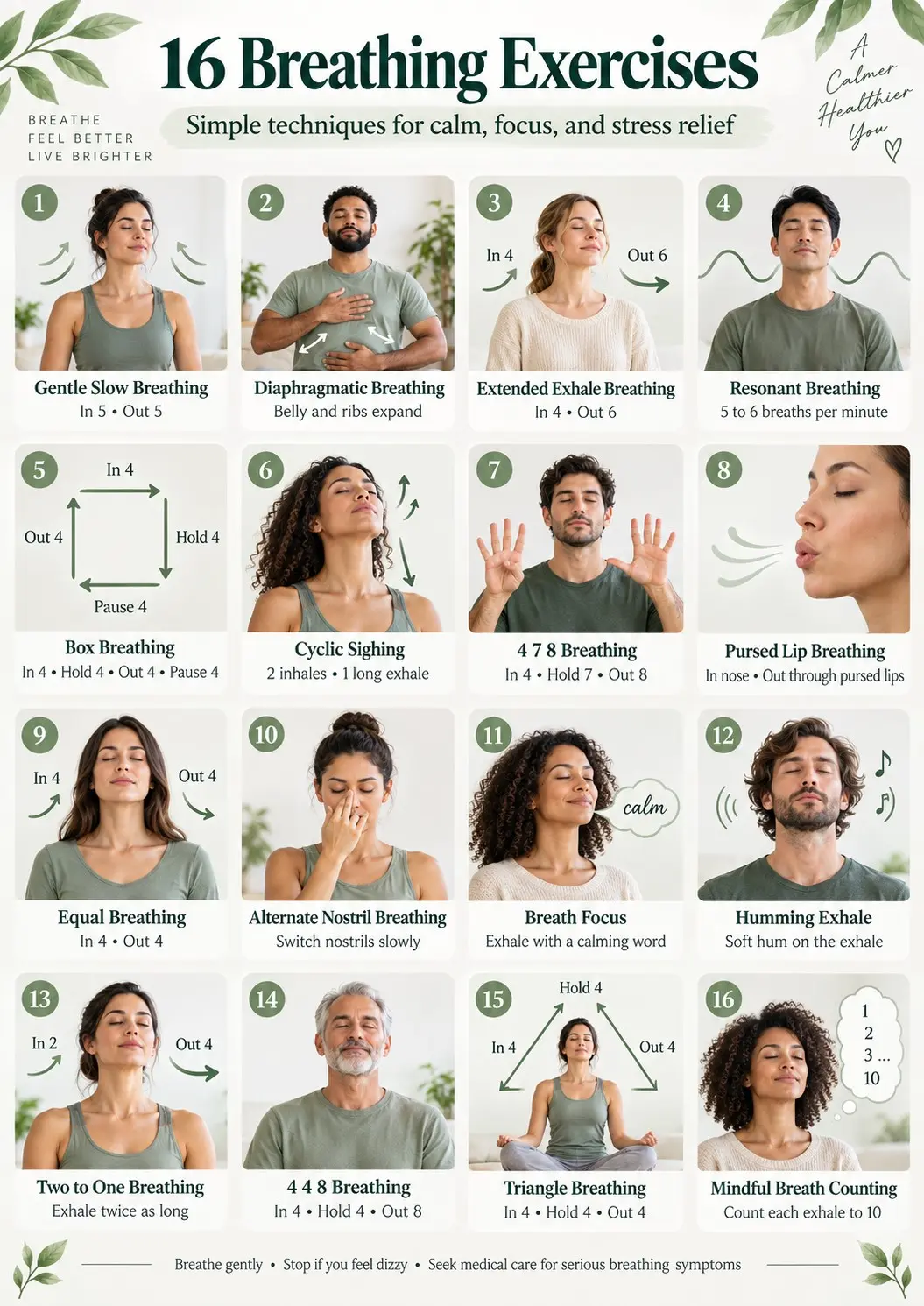
16 Breathing Exercises at a Glance
| Number | Technique | Good starting use | Evidence note |
|---|---|---|---|
| 1 | Gentle slow breathing | Beginners and daily stress | Strong support for the general slow breathing approach |
| 2 | Diaphragmatic breathing | Learning relaxed breathing | Promising stress evidence |
| 3 | Extended exhale breathing | Quick calming practice | Supported within slow breathing research |
| 4 | Resonant breathing | Regular slow breathing practice | Common research based paced breathing method |
| 5 | Box breathing | Structured stress reset | Studied directly, though exact superiority is not established |
| 6 | Cyclic sighing | Brief stress management | Direct randomized trial support |
| 7 | 4 7 8 breathing | Relaxation and bedtime routine | Popular pattern, exact ratio less studied than slow breathing overall |
| 8 | Pursed lip breathing | Breathing control and some breathlessness situations | Established respiratory technique with relaxation value |
| 9 | Equal breathing | Simple rhythm and focus | Exact count less important than slow, comfortable pacing |
| 10 | Alternate nostril breathing | Yoga-based calm practice | Promising but more limited evidence |
| 11 | Breath focus | Stress and racing thoughts | Combines breathing with focused attention |
| 12 | Humming exhale breathing | Slow relaxation practice | Specific research remains limited |
| 13 | Two-to-one breathing | Longer exhale practice | A simple extended exhale variation |
| 14 | 4 4 8 breathing | Structured slow breathing | Exact ratio is less studied than slow breathing generally |
| 15 | Triangle breathing | Structured focus | Patterned breathing variation |
| 16 | Mindful breath counting | Attention and relaxation | Uses natural breathing plus attention rather than forcing a pace |
1. Gentle Slow Breathing
This is where I would start.
It is simple.
It does not need long breath holds.
The NHS recommends letting your breath move comfortably into your belly, inhaling gently through the nose, and exhaling without forcing the breath.
You can count slowly if that helps.2
How to Do It
- Sit, stand, or lie somewhere comfortable.
- Relax your shoulders.
- Breathe in gently through your nose while slowly counting to 5 if comfortable.
- Breathe out gently while counting to 5.
- Continue for about 5 minutes.
You do not have to reach 5.
The breath should remain comfortable.
Do not take the biggest breath possible.
2. Diaphragmatic Breathing
Diaphragmatic breathing is often called belly breathing.
The goal is not to inflate your belly with force.
The goal is to allow the diaphragm to do more of the breathing work while the upper chest and shoulders stay relatively relaxed.
How to Do It
- Lie down or sit comfortably.
- Place one hand on your upper chest.
- Place the other hand below your ribs.
- Breathe in gently through your nose.
- Let the lower hand rise as your belly and lower ribs expand.
- Breathe out slowly.
- Keep the shoulders relaxed.
NCCIH reports preliminary evidence that diaphragmatic breathing may help reduce stress.1
The evidence is encouraging.
It is not proof that belly breathing cures anxiety.
3. Extended Exhale Breathing
This is one of the easiest calming breathing exercises.
The idea is simple.
Make the exhale a little longer than the inhale.
Try This
- Inhale gently for 4 counts.
- Exhale gently for 6 counts.
- Do not hold your breath.
- Repeat for 5 minutes if comfortable.
If 4 and 6 feel too long, try 3 and 4.
The number is not sacred.
Comfort matters more.
4. Resonant Breathing
Resonant breathing, sometimes called coherent breathing, uses a slow steady pace.
A common target is about 5 to 6 breaths each minute.
One easy version is:
- Inhale for about 5 seconds.
- Exhale for about 5 seconds.
Continue for several minutes.
Do not force your lungs full or empty.
Slow-paced breathing is one of the most commonly studied forms of breathwork for stress and autonomic regulation.3
5. Box Breathing
Box breathing uses four equal phases.
How to Do It
- Inhale for 4 counts.
- Hold gently for 4 counts.
- Exhale for 4 counts.
- Pause for 4 counts.
- Repeat.
If holding your breath feels uncomfortable, skip the holds and use equal breathing instead.
Box breathing was one of the structured techniques tested in a randomized breathwork trial that found improvement in mood and anxiety over one month.4
That does not mean the 4 count box is uniquely superior to every other slow breathing pattern.
6. Cyclic Sighing
Cyclic sighing has stronger direct research support than many trendy breathing patterns.
A randomized study compared cyclic sighing, box breathing, another structured breathing condition, and mindfulness meditation.
Five minutes of daily practice improved mood and reduced anxiety.
Cyclic sighing produced particularly strong improvement in positive mood and reduced breathing rate.4
How to Practice It Gently
- Take a comfortable breath in through the nose.
- Add a second smaller breath in.
- Let the breath out slowly and fully.
- Repeat gently.
The study used repeated practice for about 5 minutes.
Do not turn this into rapid hyperventilation.
7. 4 7 8 Breathing
4 7 8 breathing is one of the most popular breathing exercises for relaxation and bedtime.
The Pattern
- Inhale for 4 counts.
- Hold for 7 counts.
- Exhale slowly for 8 counts.
The long hold can be uncomfortable for beginners.
You can shorten every phase while keeping the same general idea.
For example, try 2 counts in, 3 counts holding, and 4 counts out.
The broader slow breathing principle has more evidence than the exact 4 7 8 ratio.
Do not force yourself to complete the count if you feel air hungry or dizzy.
8. Pursed Lip Breathing
Pursed lip breathing is different from most stress-focused methods.
It is also used clinically to help some people control breathing and breathlessness.
The technique can slow the exhale and help keep small airways open longer in some respiratory conditions.5
How to Do It
- Relax your neck and shoulders.
- Breathe in gently through your nose for about 2 seconds.
- Pucker your lips as if blowing on hot food.
- Breathe out slowly through the lips for about 4 seconds.
Do not force the air out.
If you have COPD, pulmonary fibrosis, asthma, or another breathing disorder, use this technique according to your healthcare professional's advice.
9. Equal Breathing
Equal breathing keeps the inhale and exhale similar in length.
It is simpler than box breathing because there are no holds.
Try This
- Inhale gently for 4 counts.
- Exhale gently for 4 counts.
- Repeat for several minutes.
If that feels easy, you can use 5 counts in and 5 counts out.
The exact number matters less than creating a comfortable slow rhythm.
10. Alternate Nostril Breathing
Alternate nostril breathing comes from yoga breathing traditions.
Research is promising, but the evidence base is smaller and less diverse than the evidence for slow breathing overall.3
A Simple Version
- Sit comfortably.
- Close the right nostril gently.
- Inhale through the left nostril.
- Close the left nostril.
- Exhale through the right nostril.
- Inhale through the right nostril.
- Switch again.
Continue slowly.
Do not force airflow through a blocked nose.
Skip this method if congestion makes it uncomfortable.
11. Breath Focus With a Calming Word
This method combines breathing with attention.
It can be useful when your mind keeps returning to the same stressful thought.
How to Do It
- Breathe slowly and comfortably.
- Choose a simple word such as “calm,” “soft,” or “easy.”
- Think of the word during each slow exhale.
- When your mind wanders, return to the breath and word.
The goal is not to stop thinking.
The goal is to give attention somewhere gentle to return.
12. Humming Exhale Breathing
This technique uses a slow exhale with a gentle humming sound.
It is related to the yoga practice known as Bhramari.
How to Try It
- Inhale gently through the nose.
- Keep the mouth closed.
- Exhale slowly while making a soft hum.
- Repeat without forcing volume or breath length.
The humming naturally encourages a longer exhale.
Specific Bhramari research is still limited and older reviews found important weaknesses in study quality.
So I would use this as an optional relaxation practice rather than claim it treats anxiety or disease.
13. Two to One Breathing
This is another form of long exhale breathing.
Your exhale lasts about twice as long as your inhale.
Example
- Inhale for 3 counts.
- Exhale for 6 counts.
- Repeat slowly.
If 6 counts feels too long, use 2 counts in and 4 counts out.
Do not squeeze every last bit of air from your lungs.
Keep the exhale easy.
14. 4 4 8 Breathing
This method combines a short breath hold with a longer exhale.
The Pattern
- Inhale for 4 counts.
- Hold gently for 4 counts.
- Exhale for 8 counts.
This is another slow breathing variation.
There is far more evidence for controlled slow breathing generally than for proving that this exact 4 4 8 ratio is best.
If the hold creates tension, remove it.
15. Triangle Breathing
Triangle breathing uses three phases rather than the four phases of box breathing.
Example
- Inhale for 4 counts.
- Hold for 4 counts.
- Exhale for 4 counts.
Then start the next inhale.
This can be useful if visual patterns help you concentrate.
Imagine tracing one side of a triangle during each phase.
Again, the pattern is a focusing tool.
The evidence supports slow controlled breathing more strongly than this exact triangle count.
16. Mindful Breath Counting
You do not have to change the breath at all.
This is a useful choice for people who become more anxious when told to take very deep breaths.
How to Do It
- Let your breathing stay natural.
- Notice each exhale.
- Count the first exhale as 1.
- Continue to 10.
- Start again at 1.
If you lose count, start again.
Nothing went wrong.
The counting simply gives your attention a place to return.
Which Breathing Exercise Should You Choose?
| Goal | Good starting choice | Why |
|---|---|---|
| New to breathing exercises | Gentle slow breathing | No complicated pattern or long holds |
| Stress during the day | Extended exhale breathing | Simple and discreet |
| Structured practice | Resonant breathing | Easy steady pace |
| Quick reset | Cyclic sighing | Direct randomized trial support |
| You dislike breath holding | Equal or extended exhale breathing | No hold required |
| Bedtime wind down | Gentle slow breathing or 4 7 8 if comfortable | Creates a slow quiet routine |
| Breathlessness with a lung condition | Pursed lip breathing when medically appropriate | Used clinically for breathing control |
| Deep breathing makes you anxious | Mindful breath counting | Does not require changing the breath much |
How Long Should Breathing Exercises Last?
You may see advice saying one minute is all you need.
A very short breathing pause can still be useful.
But research on stress reduction suggests that sessions of at least about 5 minutes are more commonly associated with success than very brief sessions.
The systematic review of 58 studies found that successful programs tended to avoid sessions shorter than 5 minutes.3
That does not mean 4 minutes is useless.
It means you should not expect a 20 second breathing trick to solve chronic stress.
A practical target is 5 minutes.
Practice regularly.
Then decide whether longer sessions feel useful.
Do You Need to Take Very Deep Breaths?
No.
This is one of the most common breathing mistakes.
Slow does not mean enormous.
Repeated huge breaths can lower carbon dioxide too much.
That can cause:
- Dizziness
- Tingling
- Lightheadedness
- Chest discomfort
- A feeling that you cannot get enough air
These sensations can be especially uncomfortable for someone prone to panic.
Use smaller, quieter breaths.
Think gentle rather than maximum.
Why I Do Not Recommend Fast Breathing for Stress Beginners
Some breathwork programs use repeated rapid breathing.
That can intentionally change carbon dioxide levels and produce strong body sensations.
It can also cause dizziness and tingling.
A major systematic review of breathing practices found that stress reducing interventions generally did better when they avoided fast breathing alone.3
For a general stress article, I therefore prefer slow comfortable techniques.
Do not deliberately hyperventilate while:
- Driving
- Standing somewhere you could fall
- Swimming
- Bathing
- Operating machinery
Loss of consciousness near water can be fatal.
Breathing Exercises for Anxiety
Breathing techniques for anxiety can be useful because anxiety often changes breathing.
But there is an important trap.
If you become obsessed with taking the “perfect” breath, breathing practice can itself become stressful.
Start gently.
Good choices include:
- Slow breathing
- Extended exhale breathing
- Resonant breathing
- Mindful breath counting
If breath holds trigger panic sensations, do not force them.
Persistent anxiety, panic attacks, avoidance, or anxiety that interferes with daily life deserves professional mental health care.
Breathing is a coping tool.
It is not the entire treatment plan.
For more, visit the NextFitLife Mental Health and Wellness Hub.
Breathing Exercises for Sleep
Breathing exercises for sleep are best viewed as part of a wind down routine.
They do not sedate you.
They do not cure insomnia.
Try:
- Gentle slow breathing
- Extended exhale breathing
- Equal breathing
- 4 7 8 breathing if breath holds feel comfortable
Use dim light.
Keep the room comfortable.
Put the phone away if scrolling keeps you alert.
Persistent insomnia needs a broader sleep assessment.
Breathing Exercises and Blood Pressure
Slow breathing may modestly reduce blood pressure in some people.
NCCIH notes research suggesting that slow deep breathing can lower blood pressure modestly.1
That does not mean breathing replaces hypertension treatment.
If you have high blood pressure:
- Keep taking prescribed medicine.
- Follow your healthcare plan.
- Use breathing as a possible supportive habit.
- Do not change treatment based on one home reading.
Breathing Exercises for Asthma and COPD
This is where wellness advice needs a firm boundary.
Breathing techniques may help some people manage breathing patterns or breathlessness.
They do not treat airway inflammation.
They do not replace inhalers.
They do not replace oxygen when oxygen is prescribed.
They do not replace pulmonary rehabilitation.
Pursed lip breathing can be especially useful for some people with chronic lung disease.5
But sudden or severe breathing difficulty requires medical assessment.
Use the NextFitLife Lung and Respiratory Health Hub for broader respiratory guidance.
Breathing Exercises and Heart Rate Variability
Slow breathing can change heart rate variability during the breathing session.
Your heart rate naturally changes as you inhale and exhale.
This is one reason breathing patterns can quickly change an HRV reading.
But a higher HRV reading during paced breathing does not mean your cardiovascular health suddenly improved in five minutes.
Breathing changed the measurement conditions.
For more context, read Heart Rate Variability Normal Range by Age.
A Simple 7 Day Breathing Practice Plan
| Day | Practice | Time |
|---|---|---|
| Monday | Gentle slow breathing | 5 minutes |
| Tuesday | Diaphragmatic breathing | 5 minutes |
| Wednesday | Extended exhale breathing | 5 minutes |
| Thursday | Resonant breathing | 5 minutes |
| Friday | Cyclic sighing or box breathing | 5 minutes |
| Saturday | Your favorite technique | 5 to 10 minutes |
| Sunday | Mindful breath counting | 5 minutes |
At the end of the week, choose one or two techniques you actually liked.
You do not need all 16.
The goal is not to become a breathing exercise collector.
The goal is to find a practice you can use.
7 Common Breathing Exercise Mistakes
1. Breathing Too Deeply
Big breaths are not always better.
2. Breathing Too Fast
Fast breathing can cause lightheadedness and uncomfortable body sensations.
3. Forcing Breath Holds
If a hold causes panic or air hunger, shorten it or remove it.
4. Expecting One Minute to Fix Chronic Stress
A short reset can help, but regular practice matters.
5. Treating Every Counting Pattern as Scientifically Unique
Many patterns are simply variations of slow controlled breathing.
6. Using Breathing Instead of Medical Care
Breathing practice should never delay care for severe symptoms.
7. Assuming Dizziness Means the Technique Is Working
Dizziness is a reason to stop and breathe normally.
When Breathing Exercises Are Not Enough
Stress has many causes.
Breathing cannot fix every one.
You may also need:
- Better sleep
- Physical activity
- Less alcohol
- Time away from work
- Social support
- Psychological therapy
- Medical treatment
- Medication when appropriate
If stress or anxiety is severe, persistent, or interfering with work, relationships, sleep, eating, or daily life, talk with a qualified mental health or healthcare professional.
You can also explore Exercise Benefits for Mental Health for another evidence-informed stress support tool.
Conclusion: Keep Your Breathing Practice Simple
Breathing exercises can be a useful way to reduce stress, slow down, focus attention, and create a short pause during a difficult day.
You do not need the most complicated technique.
Start with gentle, slow breathing.
Practice for about 5 minutes.
Keep the breath comfortable.
Stop if you feel dizzy or unwell.
Your next step: choose one technique from this guide and practice it for 5 minutes today. Repeat it for several days before deciding whether it helps you.
Simple breathing done regularly is more useful than a complicated technique you never practice.
References and Sources
- National Center for Complementary and Integrative Health. Stress.NCCIH Stress and Relaxation Guidance. Used for slow breathing, diaphragmatic breathing, relaxation techniques, stress, cortisol, and blood pressure evidence.
- National Health Service. Breathing Exercises for Stress.NHS Breathing Exercises for StressUsed for the gentle beginner breathing method, comfortable positioning, regular practice, and simple counting.
- Breathing Practices for Stress and Anxiety Reduction: Systematic Review and Implementation Framework.Read the full open access systematic reviewUsed for slow breathing, diaphragmatic breathing, alternate nostril breathing, session length, repeated practice, stress reduction, and evidence limits.
- Balban MY, et al. Brief Structured Respiration Practices Enhance Mood and Reduce Physiological Arousal. Cell Reports Medicine. Read the full open-access randomized study. Used for cyclic sighing, box breathing, daily five-minute breathwork, mood, anxiety, and respiratory rate.
- Cleveland Clinic. Pursed Lip Breathing.Cleveland Clinic Pursed Lip Breathing Guide. Updated July 8, 2026. Used for pursed lip breathing instructions, breathlessness, respiratory conditions, stress, relaxation, and safety.
Continue Reading on NextFitLife
Use these NextFitLife guides to explore breathing, stress, sleep, movement, and respiratory health.
- Lung and Respiratory Health Hub for breathing symptoms, asthma, COPD, cough, lung testing, smoking, vaping, and respiratory warning signs.
- Mental Health and Wellness Hub for stress, anxiety, depression, sleep, brain fog, self-care, and professional support.
- Exercise Benefits for Mental Health for movement, anxiety, stress, sleep, mood, and brain health.
- Physical Fitness and Mental Health for the wider link between physical activity and emotional wellbeing.
- Yoga and Flexibility Guide for gentle movement, mobility, yoga breathing, and body awareness.
- Heart Rate Variability Normal Range by Age for understanding HRV, breathing effects, wearables, and measurement limits.
- Sports and Mental Health for movement, stress, competition, recovery, and emotional wellbeing.
About the Author
Adel Galal is the founder and lead writer of NextFitLife.
He has maintained a personal interest in health, fitness, nutrition, sleep, wellness, and healthy aging for more than 30 years.
His health and wellness writing and research communication experience spans more than 15 years.
Adel is not a physician, pulmonologist, respiratory therapist, psychiatrist, psychologist, physiotherapist, yoga therapist, or other licensed healthcare professional.
His role is research communication.
He compares reputable medical and scientific sources, checks health claims, identifies evidence limits, and explains complex topics in simple language.
Before founding NextFitLife, Adel spent 29 years working as an IT Manager for the Nestlé Egypt Region.
His professional background involved data, information systems, planning, structured review, problem-solving, and information management.
Those skills support his research process.
They are not medical credentials.
For this article, the main claims about slow breathing, stress, anxiety, diaphragmatic breathing, cyclic sighing, pursed-lip breathing, breath holds, and respiratory safety were checked against NHS, NCCIH, Cleveland Clinic, and peer-reviewed research.
Learn more about Adel, NextFitLife's research process, editorial standards, medical review policy, and corrections process on the About NextFitLife page.
Frequently Asked Questions About Breathing Exercises
What are the best breathing exercises for stress?
Gentle slow breathing, diaphragmatic breathing, extended exhale breathing, resonant breathing, and cyclic sighing are practical choices. The best method is one that feels comfortable and that you can practice regularly.
How long should I do breathing exercises?
Five minutes is a practical starting point. Research on stress reduction suggests that repeated sessions lasting at least several minutes may be more useful than very brief practice alone.
Can breathing exercises stop anxiety?
Breathing exercises may reduce anxiety symptoms for some people, but they do not cure anxiety disorders. Persistent or severe anxiety may require psychological or medical treatment.
What is the easiest breathing exercise?
Gentle slow breathing is one of the easiest. Breathe in comfortably through the nose and breathe out slowly without forcing the breath. Continue for several minutes.
What is box breathing?
Box breathing uses four equal phases: inhale, hold, exhale, and pause. A common version uses four counts for each phase.
What is 4 7 8 breathing?
It uses an inhale for four counts, a hold for seven counts, and an exhale for eight counts. The exact ratio is less studied than slow breathing in general, and beginners can shorten the counts if needed.
What is diaphragmatic breathing?
Diaphragmatic breathing encourages relaxed movement of the diaphragm, lower ribs, and belly while reducing unnecessary upper chest and shoulder effort.
What is cyclic sighing?
Cyclic sighing uses a breath in, a second smaller breath in, and a long, slow exhale. A randomized study found promising mood and stress benefits from five minutes of daily practice.
Can breathing exercises help sleep?
Slow breathing can be part of a bedtime wind-down routine. It may support relaxation, but it does not cure chronic insomnia.
Can breathing exercises lower blood pressure?
Slow breathing may modestly lower blood pressure in some people. It should not replace blood pressure medicine or professional hypertension care.
Can breathing exercises help asthma?
Some breathing practices may support breathing control or relaxation, but they do not replace inhaled corticosteroids, reliever medicine, an asthma action plan, or emergency care.
Can breathing exercises help COPD?
Pursed-lip breathing can help some people with COPD manage breathlessness and breathing control. It should be used alongside the treatment plan provided by a healthcare professional.
Why do I feel dizzy during deep breathing?
Repeated large or fast breaths can lower carbon dioxide and cause dizziness, tingling, or lightheadedness. Stop the exercise and return to normal breathing.
Are fast breathing exercises good for stress?
Fast breathing is not my first choice for general stress management. Systematic review evidence suggests that successful stress reduction programs commonly used slower breathing and avoided fast breathing alone.
Should breathing exercises feel difficult?
No. Breathing practice should feel comfortable. Shorten the count, remove breath holds, or stop if you feel strained, dizzy, air hungry, or unwell.
Can breathing exercises replace therapy?
No. They can be a useful coping skill, but they do not replace psychotherapy, psychiatric care, medicine, or other professional treatment when those are needed.

Health & wellness writer with 30+ years of experience in nutrition, fitness, and healthy aging. Founder of NextFitLife.com — evidence-based health guidance.