Last Updated: August 30, 2026
Next Review: August 2027, or sooner if major HRV or wearable guidance changes
Written and Source Checked by: Adel Galal, Founder of NextFitLife
Review Status: Fully updated using 2026 cardiovascular HRV methodology guidance, population reference studies, and current medical sources
heart rate variability normal range is not one fixed number that applies to every person.
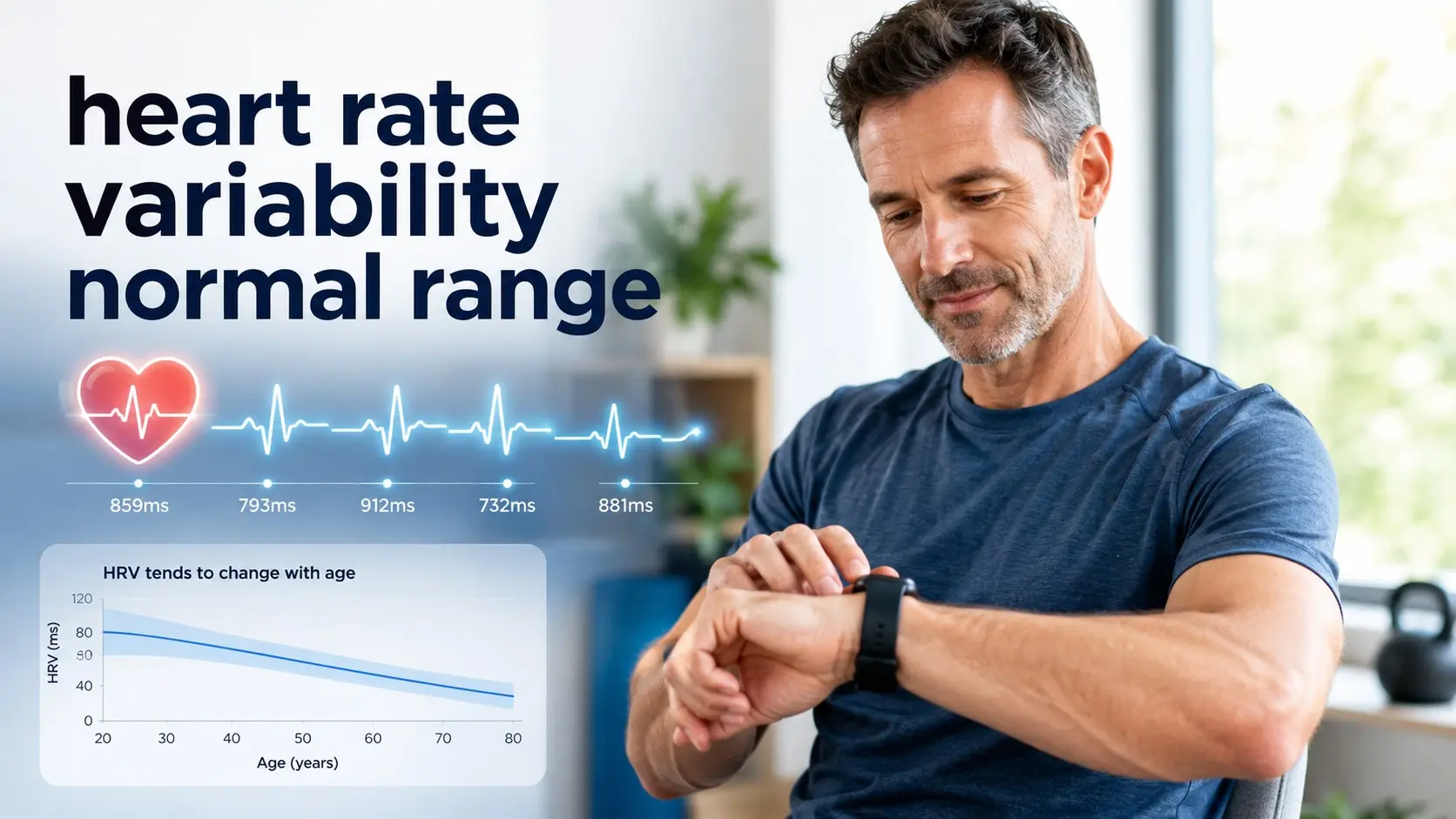
Your HRV changes with age.
It also changes with the way it is measured.
A reading of 40 milliseconds on one device may not mean the same thing as 40 milliseconds on another device.
That is because HRV can be calculated in different ways.
RMSSD and SDNN are two common examples.
Your age matters.
Your baseline matters more.
Quick Answer: What Is a Normal Heart Rate Variability Range?
Heart rate variability normal range changes with age, fitness, genetics, health, device, recording length, body position, and HRV metric. HRV usually becomes lower with age. There is no universal healthy cutoff. Your own stable baseline, measured the same way over time, is usually more useful than comparing one number with an internet chart.
Important: Check the HRV Metric Before Comparing Numbers
HRV is not one calculation.
RMSSD and SDNN are different measures.
Apple Health uses SDNN for its HRV quantity.
WHOOP uses RMSSD.
A value of 45 milliseconds from Apple Health should not automatically be compared with a 45 millisecond WHOOP value as though they are the same measurement.
Medical note: This content is for general educational purposes and does not replace professional medical advice, diagnosis, or treatment. Consult an appropriately qualified healthcare professional for personal medical concerns. This article explains published guidance and does not provide a personal clinical assessment. Always consult qualified medical professionals for diagnosis and treatment of any health condition.
What Is Heart Rate Variability?
Your heart is not meant to beat like a perfect clock.
Imagine your resting heart rate is 60 beats per minute.
That does not mean every heartbeat happens exactly one second after the previous beat.
One interval may be a little shorter.
The next may be a little longer.
Those tiny differences between normal heartbeats are called heart rate variability, or HRV.
HRV is usually measured in milliseconds.
It reflects complex regulation involving the heart, breathing, blood pressure, brain, and autonomic nervous system.
Healthy HRV is normal.
It is not the same thing as an irregular heart rhythm.
For more cardiovascular guidance, visit the Heart and Cardiovascular Health Hub.
Is There One Normal HRV Number?
No.
This is where many HRV charts become misleading.
There is no accepted rule that says:
20 milliseconds is bad.
50 milliseconds is healthy.
100 milliseconds is excellent.
Harvard Health states that there is no set definition of a high or low HRV value because many factors affect the result.
Those factors include:
- Age
- Fitness
- Genetics
- Health history
- Lifestyle
- Measurement method
Cleveland Clinic also notes that HRV is difficult to interpret because a value that is normal for one person may not be normal for another.
This is why your HRV baseline matters.
Does HRV Get Lower With Age?
Yes.
This is one of the clearest patterns in HRV research.
Large population studies show that several HRV measures tend to become lower as people move from young adulthood into middle and older age.
The decline is not perfectly smooth.
And older adults can still have high HRV values.
But average HRV by age is lower in older groups.
This does not mean aging itself is a disease.
It means age must be included when you interpret HRV.
Heart Rate Variability Normal Range by Age
The table below comes from the large Lifelines Cohort Study.
It shows median RMSSD values from short resting ECG recordings.
These numbers are research reference points.
They are not minimum health targets.
| Age | Women Median RMSSD | Men Median RMSSD |
|---|---|---|
| 20 to 24 | 52.1 ms | 47.6 ms |
| 25 to 29 | 47.5 ms | 42.3 ms |
| 30 to 34 | 42.3 ms | 36.9 ms |
| 35 to 39 | 37.9 ms | 32.8 ms |
| 40 to 44 | 33.9 ms | 29.0 ms |
| 45 to 49 | 29.2 ms | 26.0 ms |
| 50 to 54 | 26.6 ms | 23.7 ms |
| 55 to 59 | 22.5 ms | 21.0 ms |
| 60 to 64 | 20.5 ms | 19.1 ms |
| 65 to 69 | 17.8 ms | 17.7 ms |
| 70 to 74 | 18.3 ms | 16.0 ms |
| 75 and older | 16.1 ms | 14.9 ms |
Important: These are medians from 10 second resting ECG recordings using RMSSD.
They are not universal smartwatch targets.
Your wearable may use another metric, another recording length, another sensor, and another time of day.
The Age Table Has a Bigger Lesson Than the Median
Look beyond the middle number.
The research ranges were very wide.
For example, women aged 25 to 29 had a median RMSSD of 47.5 milliseconds.
But the study's broad reference range stretched from 11.5 to 180.7 milliseconds.
Men in that age group had a median of 42.3 milliseconds.
The broad reference range ran from 10.1 to 172.7 milliseconds.
That is a huge spread.
This tells you something useful.
Two healthy people of the same age can have very different HRV numbers.
A value below the median is not automatically unhealthy.
A value above the median is not automatically better.
Why You Should Not Copy the Research Table Into Your Smartwatch App
The Lifelines values came from short resting ECG recordings.
Your wearable may measure HRV:
- During sleep
- For one minute
- For several minutes
- At selected times during the day
- With a wrist optical sensor
- Using another HRV metric
The July 2026 HRV methodology guidance says several technical factors affect interpretation.
These include:
- ECG versus optical pulse measurement
- Recording duration
- Breathing rate
- Breathing depth
- Body position
- Age
- Sex
- Exercise and fitness
- Analytical method
So use population tables for perspective.
Do not treat them as a diagnosis.
What Is RMSSD?
RMSSD stands for root mean square of successive differences.
It looks closely at changes between consecutive normal heartbeat intervals.
RMSSD is commonly used for short resting measurements and recovery tracking.
WHOOP uses RMSSD for its HRV metric.
WHOOP measures HRV during sleep to improve consistency from night to night.
You can read WHOOP's own method here:
What Is SDNN?
SDNN stands for standard deviation of normal to normal heartbeat intervals.
It is another time based HRV measure.
It is not the same calculation as RMSSD.
Apple Health uses SDNN for its heart rate variability quantity.
Apple states this directly in its HealthKit documentation.
Can You Compare Apple Watch HRV With WHOOP HRV?
Not directly.
This is one of the most common HRV mistakes.
Apple Health reports SDNN.
WHOOP uses RMSSD.
Both use milliseconds.
That does not make them the same measurement.
Imagine this:
Apple Health says 45 ms.
WHOOP says 45 ms.
The matching number does not mean the two devices measured the same HRV property.
If you want to track progress, compare Apple with your previous Apple values.
Compare WHOOP with your previous WHOOP values.
Do not force the two systems into one chart.
Does Recording Length Change HRV?
Yes.
A ten second recording is not the same as a five minute recording.
A five minute measurement is not the same as an overnight measurement.
And none of these is automatically interchangeable with a 24 hour medical recording.
The open review of HRV metrics and norms specifically warns that short, very short, and 24 hour HRV values should not be treated as interchangeable.
The 2026 methodology guidance makes the same point.
Recording length changes what information the measurement captures.
Is Higher HRV Always Better?
No.
I would not chase the highest possible number.
Higher resting HRV is often associated with better cardiorespiratory fitness and greater physiological adaptability.
But there is no rule saying more is always better.
An unexpectedly extreme value can also come from:
- Poor sensor contact
- Measurement error
- Abnormal beats
- An irregular rhythm
A healthy goal is not maximum HRV.
A healthier goal is a stable personal pattern alongside good sleep, fitness, cardiovascular health, and no concerning symptoms.
HRV Is Not a Direct Stress Meter
Wearables sometimes make HRV look like a simple stress score.
The physiology is more complex.
HRV changes with stress.
But it also changes with:
- Breathing
- Heart rate
- Body position
- Exercise
- Sleep
- Alcohol
- Illness
- Temperature
- Medicines
- Age
The new 2026 cardiovascular HRV guidance warns against describing HRV as a direct measurement of cardiac sympathetic activity or a simple sympathetic versus parasympathetic balance.
HRV reflects autonomic regulation.
It is not a percentage meter for stress.
Breathing Can Change HRV Within Minutes
Your heartbeat naturally changes with breathing.
Heart rate tends to increase during inhalation.
It tends to slow during exhalation.
This normal pattern is called respiratory sinus arrhythmia.
Slow breathing can change HRV quickly.
This is one reason breathing rate and depth must be considered in careful HRV measurement.
If you measure HRV manually, breathe naturally unless paced breathing is part of your normal testing method.
Does Body Position Change HRV?
Yes.
Lying down is not the same as sitting.
Sitting is not the same as standing.
Your nervous system changes heart rate and blood vessel tone when your posture changes.
HRV changes too.
If you want a useful personal trend, use the same body position each time.
Do not measure lying down today and standing tomorrow, then assume the number changed because your health changed.
Does Time of Day Matter?
Yes.
HRV during sleep is different from a random afternoon measurement.
Activity, meals, caffeine, stress, work, temperature, and posture all change through the day.
This is one reason some wearables focus on overnight readings.
If your device gives you overnight HRV, compare it with your previous overnight measurements from the same device.
Do not compare it directly with a random daytime reading.
How Does Sleep Affect HRV?
Poor sleep can change HRV.
One low night is not very interesting.
A pattern is more useful.
For example:
You sleep badly for several nights.
Your HRV falls below your normal range.
Your resting heart rate rises.
You feel tired.
Those signals fit together.
For more detail, read Sleep and Heart Health.
Does Alcohol Lower HRV?
Alcohol can change overnight HRV in many people.
It can also disrupt sleep and change heart rate.
That does not mean HRV directly measures alcohol.
It means alcohol affects several systems that influence HRV.
If you track HRV, compare your own alcohol and non alcohol nights.
Your personal pattern tells you more than another person's average.
Can Illness Lower HRV?
Yes.
Illness can change:
- Body temperature
- Resting heart rate
- Sleep
- Hydration
- Inflammation
- Autonomic regulation
Your wearable HRV may move away from baseline when you are sick.
But a low HRV value cannot tell you which illness you have.
It is not an infection test.
If you feel sick, judge the symptoms directly.
What Does Exercise Do to HRV?
HRV usually falls during hard exercise.
Your heart rate rises.
Your cardiovascular system is working harder.
After training, HRV can remain lower for a period while your body recovers.
Regular exercise and better fitness are often associated with higher resting HRV over time.
But the response differs from person to person.
For exercise recovery, read Heart Rate Recovery After Exercise.
Should You Skip Exercise Because HRV Is Low Today?
Not because of one number.
Imagine your HRV is lower than normal this morning.
But:
- You slept well
- You feel healthy
- Your resting heart rate is normal
- You have no illness symptoms
- Your body feels recovered
I would not let one wearable score automatically control the whole day.
Now change the situation.
HRV is low for several days.
Your resting heart rate is high.
You feel ill.
Your workouts feel unusually hard.
That pattern deserves more attention.
How Much Day to Day HRV Change Is Normal?
There is no universal percentage.
HRV naturally moves from day to day.
Your usual variation matters.
Imagine your overnight RMSSD normally sits between 42 and 55.
A value of 48 is ordinary for you.
Now imagine the value falls to 22 and stays there for several nights.
That is more meaningful.
The change from your HRV baseline matters more than the fact that another person averages 70.
How Long Should You Track HRV Before Judging Your Baseline?
Give the data time.
I would look at several weeks rather than several days.
Use the same device.
Use the same measurement type.
Measure under similar conditions.
Then look at the range that naturally appears.
That is your practical baseline.
You can compare future changes with it.
What Does Low HRV Mean?
Low HRV needs context.
Low compared with what?
Your old value?
Your age group?
A friend's watch?
An internet chart?
A lower HRV has been associated with several health conditions in research populations.
But one low consumer wearable reading does not diagnose disease.
A stable personal HRV of 25 may mean something very different from a sudden fall from 65 to 25.
Change matters.
Can Low HRV Predict Heart Disease?
Research has linked lower HRV with cardiovascular risk in some populations.
The July 2026 cardiovascular guidance says HRV has some potential as a cardiovascular risk marker.
It also stresses major limits in measurement and interpretation.
That means HRV is useful research information.
It is not a home heart disease test.
A smartwatch cannot diagnose coronary artery disease because your HRV is low.
What Does High HRV Mean?
High HRV often goes with good fitness, recovery, and cardiovascular adaptability.
But I would still compare it with your baseline.
An unexpectedly huge jump deserves a second look.
Ask:
- Was the sensor fitted properly?
- Did the device record abnormal beats?
- Did the measurement method change?
- Did the software update?
- Do you have palpitations?
Do not celebrate a strange reading before checking whether the data are real.
HRV Is Not the Same as an Arrhythmia
This distinction matters.
Normal HRV means tiny changes between normal heartbeat intervals.
An arrhythmia is an abnormal heart rhythm.
They are not the same thing.
Cleveland Clinic specifically notes that HRV itself is not an arrhythmia.
If your wearable gives an irregular rhythm alert, treat that as a separate issue from the HRV score.
Can Smartwatches Measure HRV Accurately?
They can provide useful trends.
But they have limits.
A medical ECG measures the electrical activity of the heart.
Many consumer wearables use photoplethysmography, or PPG.
PPG uses light to detect pulse waves at the skin.
Validation studies show that some wrist devices can estimate resting and sleep HRV reasonably well under controlled conditions.
Accuracy can become worse with:
- Movement
- Poor sensor contact
- Irregular rhythms
- Different exercise types
- Short or noisy recordings
Use wearables for trends.
Use medical evaluation when symptoms or rhythm concerns appear.
What Is the Best Way to Measure HRV at Home?
Consistency matters most.
If your wearable measures HRV automatically during sleep, compare those overnight readings with each other.
If you take manual measurements:
- Use the same device.
- Measure around the same time.
- Use the same body position.
- Keep the recording length similar.
- Breathe naturally.
- Track the same HRV metric.
- Look at your trend rather than one day.
You do not need laboratory perfection.
You do need enough consistency for the comparison to make sense.
Can You Improve HRV?
You can support the habits that tend to go with healthier HRV patterns.
These include:
- Regular physical activity
- Adequate sleep
- Managing stress
- Good hydration
- Limiting excess alcohol
- Avoiding smoking
- Managing high blood pressure
- Managing diabetes
- Following medical treatment when needed
I would not chase HRV with supplements.
Build the healthy habit.
Let HRV respond naturally.
For broader guidance, use the Healthy Lifestyle Roadmap.
Can Breathing Exercises Raise HRV?
Slow breathing can increase HRV during the breathing session.
This does not mean your long-term cardiovascular health changed in five minutes.
Breathing exercises are also used in HRV biofeedback.
If you use paced breathing, keep that method separate from your normal resting HRV tracking.
Otherwise, you are changing the measurement conditions.
What I Would Do With Common HRV Readings
HRV of 25 ms at Age 60
This could be plausible depending on the metric and device.
Compare it with your personal baseline.
HRV of 25 ms at Age 25
It is below many young adult RMSSD population medians.
That still does not diagnose a problem.
Check the metric, device, sleep, fitness, medicines, illness, and trend.
HRV of 70 ms at Age 45
This is above many population RMSSD medians.
Good data point.
It does not prove perfect heart health.
HRV Drops From 55 to 30 for One Night
I would not worry much from that alone.
Training, alcohol, poor sleep, stress, or illness may explain it.
HRV Drops From 55 to 28 for Ten Days
Now I pay more attention.
If your resting heart rate also rises or you feel unwell, focus on the whole pattern.
My Three Layer Method for Reading HRV
I use three questions.
1. What Was Measured?
Was it RMSSD?
Was it SDNN?
Was it an ECG?
Was it a wrist sensor?
2. Is This Normal for You?
Look at your HRV baseline.
Do not start with someone else's number.
3. What Else Changed?
Look at:
- Sleep
- Illness
- Training
- Alcohol
- Stress
- Resting heart rate
- Symptoms
That gives the number meaning.
Heart Rate Recovery and HRV Are Different
The names sound related.
The measurements are different.
Heart rate recovery after exercise measures how many beats your heart rate falls after exercise stops.
Heart rate variability measures tiny differences between normal heartbeat intervals.
Different calculation.
Different meaning.
Read Heart Rate Recovery After Exercise for the full guide.
HRV and Blood Pressure Recovery Are Different Too
Your heart rate, HRV, and blood pressure all respond to exercise.
They do not measure the same thing.
Blood pressure may temporarily fall after exercise while your heart rate and HRV follow their own recovery patterns.
Read Blood Pressure After Exercise for more detail.
When Should HRV Lead to Medical Advice?
Not because the number crossed a random internet cutoff.
Medical advice becomes more important when an unusual HRV pattern appears with:
- Chest pain
- Fainting
- New strong palpitations
- An irregular pulse
- Unusual shortness of breath
- A major change in exercise tolerance
- A wearable irregular rhythm alert
- A persistent unexplained change from your normal pattern
The symptoms matter more than the HRV score.
Common Heart Rate Variability Myths
Myth: Everyone Should Have HRV Above 50
False.
Age, measurement method, metric, and individual biology change HRV.
Myth: Higher HRV Is Always Better
False.
Unexpectedly extreme values can reflect artifact or abnormal beats.
Myth: Apple HRV and WHOOP HRV Are the Same
False.
Apple Health uses SDNN.
WHOOP uses RMSSD.
Myth: A Low HRV Means Heart Disease
False.
Low HRV is associated with some health risks in populations but does not diagnose an individual disease.
Myth: HRV Measures Stress Directly
False.
Stress affects HRV, but many other factors do too.
Myth: An Age Chart Tells You Exactly What Your HRV Should Be
False.
Population charts provide context.
Your personal baseline is usually more useful.
My Approach to Heart Rate Variability Normal Range
I think HRV becomes confusing when the number is separated from the measurement method.
A value without the metric, device, timing, and baseline is incomplete data.
My background in information technology management trained me to question how data were collected before trusting a comparison.
I now use the same approach when researching health information for NextFitLife.
For this article, I compared current medical guidance, population HRV research, official wearable documentation, and the July 2026 recommendations for rigorous HRV measurement and interpretation.
The rule I would keep is simple.
Compare like with like.
Apple with Apple.
WHOOP with WHOOP.
RMSSD with RMSSD.
Your baseline with your baseline.
Conclusion: Heart Rate Variability Normal Range Is Personal
heart rate variability normal range changes with age and with the way HRV is measured.
HRV usually becomes lower as people get older.
But there is no universal number that separates healthy from unhealthy.
Check whether your device uses RMSSD or SDNN.
Measure under similar conditions.
Build a personal baseline.
Then watch the trend.
Your next step: Check which HRV metric your device reports, review several weeks of readings from the same device, and discuss a persistent major change with a healthcare professional if you also have symptoms or rhythm concerns.
References and Sources
This guide was checked against current medical guidance and open scientific research.
- Carter JR, Jenkins NDM, Bigalke JA, and colleagues. Guidelines for Rigor and Reproducibility of Heart Rate Variability Within Human Cardiovascular Research. 2026.This July 2026 review provides current guidance on HRV interpretation. It explains why age, sex, fitness, ECG versus PPG, recording length, breathing, posture, and analytical method must be considered. It also warns against treating HRV as a direct measure of cardiac sympathetic activity or simple sympathovagal balance.Read the 2026 HRV Methodology Guidance on PubMed
- Harvard Health Publishing. How Relevant Is Heart Rate Variability?Harvard Health explains that there is no set definition of a high or low HRV value because age, fitness, genetics, medical history, and lifestyle affect the result. It recommends focusing on your own baseline rather than comparing your HRV with other people.Read Harvard Health HRV Guidance
- Cleveland Clinic. Heart Rate Variability: What It Is and How You Can Track It.Cleveland Clinic explains HRV, the autonomic nervous system, age related decline, measurement methods, and why HRV values are difficult to compare between individuals.Read Cleveland Clinic Heart Rate Variability Guidance
- Tegegne BS, Man T, van Roon AM, Snieder H, and Riese H. Reference Values of Heart Rate Variability From 10 Second Resting Electrocardiograms: The Lifelines Cohort Study.This large population study provides age and sex specific RMSSD reference values and demonstrates the strong age related decline and wide range of HRV values within each age group.Read the Open Access Lifelines HRV Study
- Shaffer F and Ginsberg JP. An Overview of Heart Rate Variability Metrics and Norms.This open access review explains HRV metrics including RMSSD and SDNN and warns that short, very short, and 24 hour HRV values are not interchangeable.Read the Open Access HRV Metrics and Norms Review
Source Review Date: August 30, 2026
These organizations and researchers do not endorse NextFitLife.
Continue Reading on NextFitLife
Heart and Cardiovascular Health Hub: Heart and Cardiovascular Health
Fitness Hub: NextFitLife Fitness
Main Health Hub: NextFitLife Health
About the Author
Adel Galal is the founder and health and wellness writer at NextFitLife.
Before focusing on NextFitLife, Adel spent 29 years working in information technology management.
That background developed his skills in data review, structured analysis, measurement, source comparison, problem solving, and clear communication.
He now uses those skills to compare health guidance, review scientific research, question exaggerated claims, and explain health technology data in simple language.
For this article, his focus is on showing why HRV numbers cannot be interpreted safely without knowing the metric, recording method, age, device, and personal baseline.
This content is for general educational purposes and does not replace professional medical advice, diagnosis, or treatment. Consult an appropriately qualified healthcare professional for personal medical concerns. This article explains published guidance and does not provide a personal clinical assessment. Always consult qualified medical professionals for diagnosis and treatment of any health condition.
Read the full Adel Galal author profile and NextFitLife editorial approach.
Frequently Asked Questions About Heart Rate Variability Normal Range
What is a normal heart rate variability range?
There is no universal normal HRV range. Age, metric, fitness, genetics, health, device, and recording conditions all affect the result.
Does HRV decrease with age?
Yes. Large population studies show that average RMSSD values become lower from young adulthood into older age.
What is a good HRV for a 30 year old?
There is no single target. In the Lifelines study, median resting RMSSD was 42.3 milliseconds for women aged 30 to 34 and 36.9 milliseconds for men, but the individual ranges were very wide.
What is a good HRV for a 40 year old?
In the Lifelines study, median RMSSD for ages 40 to 44 was 33.9 milliseconds in women and 29.0 milliseconds in men. These are research medians, not required health targets.
What is a good HRV for someone over 60?
Median RMSSD values in the Lifelines study were around 20.5 milliseconds for women and 19.1 for men aged 60 to 64. Healthy individual values can be much higher or lower.
Is higher HRV always better?
No. Higher resting HRV is often associated with fitness and adaptability, but there is no reason to chase the highest possible number. Very unusual values can also result from artifact or abnormal beats.
What does low HRV mean?
Low HRV can occur with stress, poor sleep, illness, heavy training, age, medicines, or health conditions. One low reading does not diagnose disease.
What is RMSSD?
RMSSD is a time based HRV measure calculated from successive normal heartbeat interval differences. It is commonly used for short resting and recovery focused measurements.
What is SDNN?
SDNN is the standard deviation of normal heartbeat intervals. It is another HRV calculation and should not be treated as identical to RMSSD.
Does Apple Watch use RMSSD or SDNN?
Apple Health uses SDNN for its heart rate variability quantity.
Does WHOOP use RMSSD or SDNN?
WHOOP uses RMSSD for its HRV metric and measures it during sleep.
Can I compare Apple Watch HRV with WHOOP HRV?
Not directly. Apple Health uses SDNN while WHOOP uses RMSSD, so identical numbers do not mean identical measurements.
Can poor sleep lower HRV?
Poor sleep can affect HRV. A repeated trend alongside higher resting heart rate and fatigue is more informative than one low night.
Can exercise lower HRV?
Hard exercise can temporarily lower HRV during recovery. Regular training is often associated with higher resting HRV over time.
When should I see a doctor about HRV?
Seek medical advice when a major persistent HRV change occurs with chest pain, fainting, strong palpitations, an irregular pulse, unusual shortness of breath, rhythm alerts, or a large change in exercise tolerance.

Health & wellness writer with 30+ years of experience in nutrition, fitness, and healthy aging. Founder of NextFitLife.com — evidence-based health guidance.