Last Updated: September 3, 2026
Sources Checked: September 3, 2026
Next Review: September 2027, or sooner if major asthma or respiratory guidance changes
Written and Source Checked by: Adel Galal, Founder and Lead Writer at NextFitLife
Review Status: Updated using current asthma guidance, respiratory references, allergy sources, heart failure guidance, and open clinical information. This article has not been independently medically reviewed by a licensed clinician.
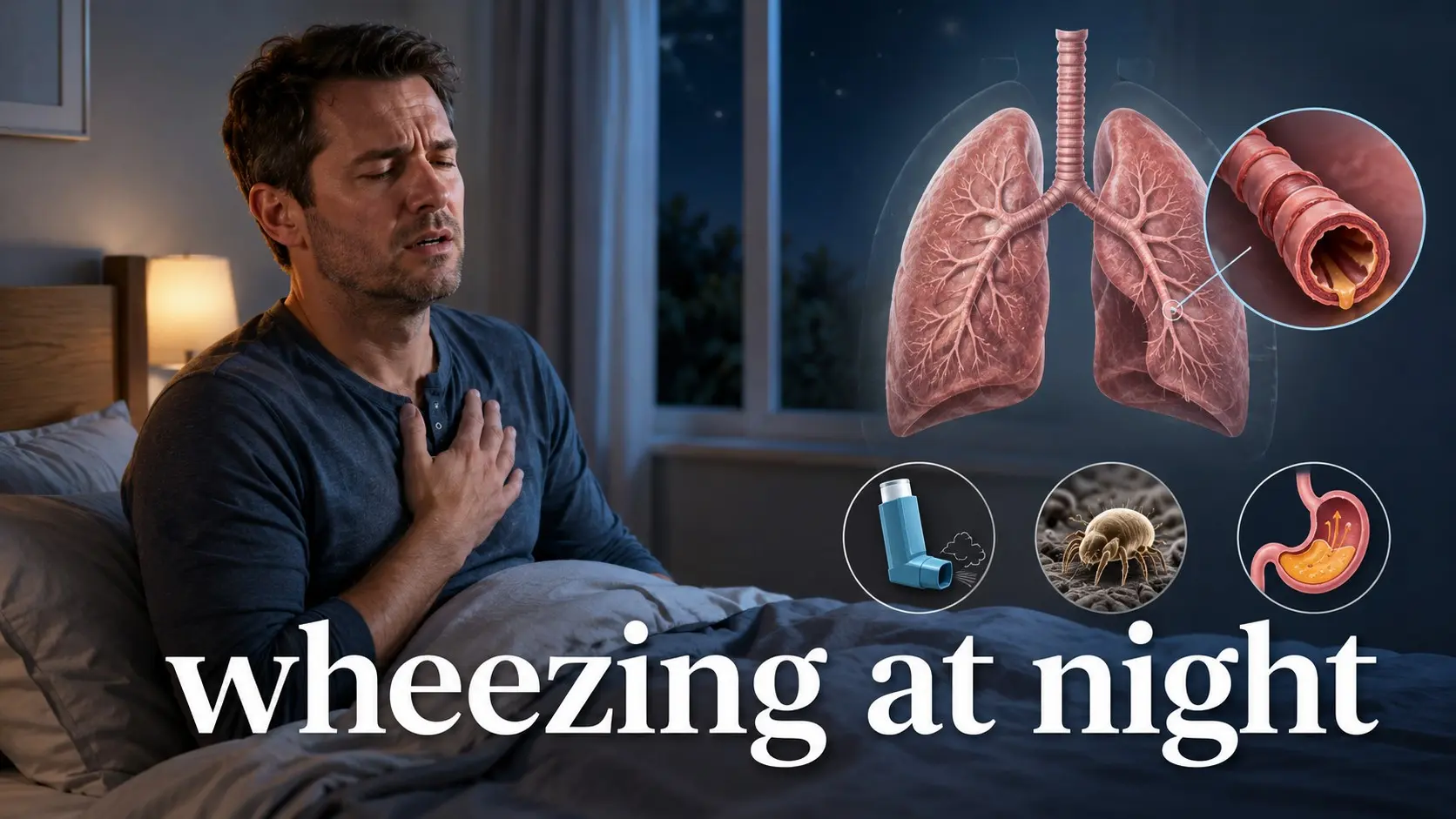
Wheezing at night usually means air is moving through narrowed airways.
Asthma is one of the first causes to consider.
But it is not the only one.
Allergies, reflux, infection, COPD, smoke, heart failure, and upper airway problems can also cause noisy breathing after you get into bed.
The first job is to work out whether the sound is really a wheeze.
Quick Answer: Why Do I Wheeze at Night?
Wheezing at night is commonly linked with asthma, but allergies, reflux, COPD, respiratory infections, smoke, and other airway irritation can also trigger it. Heart failure and severe allergic reactions are less common but important causes. Repeated nighttime wheezing deserves medical assessment, especially if breathing is getting harder.
Medical note: This content is for general educational purposes and does not replace professional medical advice, diagnosis, or treatment. Consult an appropriately qualified healthcare professional for personal medical concerns. This article explains published guidance and does not provide a personal clinical assessment. Always consult qualified medical professionals for diagnosis and treatment of any health condition.
What Does True Wheezing Sound Like?
A true wheeze is usually a musical or whistling sound.
It comes from narrowed airways inside the chest.
It is often easier to hear while breathing out.
You may hear one high sound.
Or several tones may appear together.
Merck Manual explains that wheezing happens when air moves through narrowed or compressed smaller airways.
Asthma and COPD are two of the most common adult causes.
Start with the NextFitLife Lung and Respiratory Health Hub for the wider respiratory series.
Wheezing and Stridor Are Not the Same Sound
This distinction matters.
Wheezing usually comes from the smaller airways inside the chest.
It is usually more obvious while breathing out.
Stridor is different.
It is usually a loud, high pitched sound heard more during breathing in.
It comes from narrowing higher in the airway.
Merck Manual states that stridor should raise concern for upper airway obstruction.
Sudden stridor with throat swelling, tongue swelling, severe breathing difficulty, or a severe allergic reaction needs urgent emergency care.
Do not assume every noisy breath is asthma.
Why Can Wheezing Get Worse at Night?
Your lungs do not work at the same level all day.
Your body clock affects breathing.
NIH-funded research found that lung function in people with asthma reached its lowest level during the biological night.
This helps explain why nocturnal asthma is real.
Then other nighttime factors can add to the problem.
You lie down.
You spend hours near bedding and bedroom allergens.
Reflux can become easier.
Cold air or an air conditioner can trigger sensitive airways.
These can worsen nighttime breathing.
1. Asthma Is the First Cause to Consider
Asthma inflames and narrows the airways.
The National Heart, Lung, and Blood Institute lists these common asthma symptoms:
- Wheezing
- Cough, especially at night or early morning
- Shortness of breath
- Chest tightness
The symptoms often come and go.
That pattern is useful.
They can become worse with:
- Exercise
- Cold air
- Allergies
- Respiratory infections
- Smoke
- Laughing
If your symptoms fit this pattern, asthma moves high on the list.
For less obvious presentations, read Silent Asthma: Symptoms Without Obvious Wheezing.
Nighttime Asthma Is a Real Biological Pattern
Night asthma is not simply daytime asthma that happens after dark.
Your circadian rhythm affects airway function.
NIH research found that the biological clock itself contributes to worse asthma at night.
Participants in the study had their lowest lung function during the circadian night.
This is one reason asthma symptoms can appear at 2 AM or 4 AM even when the person felt well during the afternoon.
Waking With Asthma Symptoms Means Your Control Needs Review
I would not accept repeated night waking as normal asthma.
If wheezing regularly wakes you, look at the whole treatment pattern.
Ask:
- How many nights does this happen?
- Are you using a prescribed reliever more often?
- Has your exercise tolerance fallen?
- Did you recently have a respiratory infection?
- Are allergy symptoms worse?
- Are you taking controlled medicine as prescribed?
- Is your inhaler technique correct?
If you have an asthma action plan, follow it.
If the pattern worsens, contact the healthcare professional managing your asthma.
Do not simply keep increasing medicine without guidance.
2. Allergies Can Trigger Wheezing While You Sleep
Your bedroom can contain several asthma triggers.
The American Academy of Allergy, Asthma and Immunology lists important indoor allergens such as:
- Dust mites
- Animal dander
- Mold
- Cockroach allergens
These can trigger asthma symptoms in people with allergic asthma.
Dust mites deserve special attention at bedtime.
They are commonly found in bedding, mattresses, upholstered furniture, and carpets.
You can therefore spend hours close to an allergen while sleeping.
What Does Allergic Asthma Look Like at Night?
Look for allergy clues around the breathing problem.
They can include:
- Sneezing
- Blocked nose
- Runny nose
- Itchy eyes
- Symptoms around pets
- Symptoms in dusty rooms
- Symptoms near mold
- Improvement when you sleep somewhere else
That does not prove an allergy.
But it gives you a useful pattern to discuss with a healthcare professional.
Allergic asthma should be managed by identifying the triggers that actually affect you.
Do Not Remove Every Allergen Without Knowing the Trigger
Targeted changes make more sense than buying every allergy product you can find.
If dust mites are relevant, bedroom measures can reduce exposure.
If a pet is a confirmed trigger, keeping the animal out of the bedroom may reduce overnight exposure.
If mould is present, the moisture source needs attention.
AAAAI emphasizes identifying relevant allergens and reducing exposure to those triggers.
Diagnosis first.
Targeted changes second.
3. Acid Reflux Can Trigger Cough and Wheezing After Bedtime
Reflux is not only a stomach problem.
Stomach contents moving upward can irritate the throat and airway.
That can contribute to:
- Night cough
- Throat irritation
- Hoarseness
- Wheezing
- Asthma symptoms in some people
Reflux moves higher on the list when symptoms become worse after lying down or after a late meal.
Clues can include:
- Heartburn
- Sour taste
- Regurgitation
- Morning hoarseness
- Repeated throat clearing
- Cough after lying down
Do Not Blame Every Nighttime Wheeze on Silent Reflux
This is where I think people can go too far.
Asthma and reflux can occur together.
That does not mean every unexplained wheeze comes from stomach acid.
If you clearly have reflux symptoms, tell your healthcare professional.
If you do not, avoid turning reflux into the automatic answer for every breathing symptom.
The airway still needs proper assessment.
Why Does Reflux Become Worse After Lying Down?
Gravity helps keep stomach contents lower while you are upright.
That help decreases when you lie flat.
Late meals can add another trigger.
If you have known reflux, avoiding lying down soon after eating is a sensible part of your reflux plan.
But wheezing that repeats should not be treated as reflux without considering asthma and other respiratory causes.
4. A Respiratory Infection Can Make the Airways Wheeze
A cold can do more than make your nose run.
Respiratory infections can irritate and narrow the airways.
They are also common asthma triggers.
You may notice:
- Recent sore throat
- Runny nose
- Cough
- Fever
- Chest congestion
- New wheezing during or after the illness
One infection-related episode does not automatically mean you have asthma.
But repeated wheezing every time you catch a cold deserves a closer look.
Does Bronchitis Cause Wheezing?
Yes, it can.
Inflamed bronchial tubes can cause cough and wheeze.
But the word bronchitis is sometimes used too loosely.
If you repeatedly develop wheezing after viral infections and also wheeze with cold air, exercise, or allergies, asthma should be considered.
Do not let repeated labels of bronchitis hide a recurring airway problem.
5. COPD Can Cause Persistent Wheezing
Asthma is not the only common cause.
Merck Manual lists asthma and COPD as the two most common overall adult causes of wheezing.
COPD becomes more likely when wheezing appears with:
- A current or past smoking history
- Chronic cough
- Regular mucus production
- Progressive shortness of breath
- Reduced exercise tolerance
- Repeated chest infections
NHLBI also lists wheezing, chronic cough, chest tightness, and fatigue among COPD symptoms.
New persistent wheezing in a middle-aged or older adult with a smoking history deserves medical assessment.
Asthma and COPD Are Not the Same Disease
Both can cause wheezing.
Both can make breathing difficult.
But they are not interchangeable.
Asthma symptoms often vary greatly from day to day and respond to specific triggers.
COPD tends to produce more persistent airflow limitation and is strongly linked with smoking and other long-term inhaled exposures.
Proper lung function testing helps separate them.
Do not diagnose either condition from the sound alone.
6. Smoke and Vaping Can Keep Your Airways Irritated
Your lungs still feel the effects of smoke after you get into bed.
Tobacco smoke can trigger:
- Wheezing
- Cough
- Chest tightness
- Shortness of breath
Secondhand smoke matters too.
Vaping aerosol and other inhaled irritants can also worsen respiratory symptoms.
Strong fragrances, cleaning fumes, and polluted air can irritate sensitive airways.
If smoke repeatedly triggers your breathing symptoms, removing the exposure matters more than trying to cover the wheeze with a home remedy.
7. Heart Failure Can Sometimes Sound Like Asthma
This is less common than asthma.
But it is medically important.
Heart failure can cause fluid to build up in and around the lungs.
That can cause:
- Breathlessness
- Cough
- Wheezing
The term cardiac asthma is sometimes used for this pattern.
It is not true asthma.
The problem comes from heart failure and fluid congestion.
The American Heart Association lists persistent cough or wheezing among heart failure warning symptoms.
For the wider cardiovascular cluster, visit the Heart and Cardiovascular Health Hub.
What Clues Point More Toward Heart Failure?
Look beyond the wheeze.
More concerning clues include:
- Difficulty breathing while lying flat
- Needing extra pillows to breathe comfortably
- Waking suddenly short of breath
- Swollen feet or ankles
- Unexpected weight gain from fluid
- Unusual fatigue
- Reduced ability to walk or climb stairs
That pattern needs medical assessment.
An asthma inhaler does not treat fluid buildup from heart failure.
8. A Severe Allergic Reaction Can Cause Sudden Wheezing
This situation is different from a stable nightly wheeze.
A severe allergic reaction can narrow the airways quickly.
Warning signs can include:
- Sudden wheezing
- Hives
- Face swelling
- Lip swelling
- Tongue swelling
- Throat tightness
- Difficulty swallowing
- Dizziness
- Fainting
- Severe breathing trouble
This can be anaphylaxis.
It is an emergency.
If you have prescribed emergency epinephrine, follow your emergency plan and seek emergency medical help.
9. Vocal Fold Problems Can Mimic Asthma
Some noisy breathing does not come from the lungs.
Vocal fold dysfunction can cause abnormal narrowing near the voice box.
It can look like asthma.
Clues include:
- Throat tightness
- A choking feeling
- Hoarseness
- Noise stronger during breathing in
- Symptoms that feel centered in the throat
- Poor response to asthma medicine
Merck Manual notes that vocal fold dysfunction can mimic asthma and may produce inspiratory stridor.
The two conditions can also occur together.
10. Sleep Apnea Can Be Part of the Nighttime Breathing Pattern
Sleep apnea is not one of the first causes I would choose for a true wheeze.
But it can coexist with asthma, obesity, and reflux.
Look for:
- Loud snoring
- Breathing pauses
- Gasping during sleep
- Morning headaches
- Unrefreshing sleep
- Strong daytime sleepiness
If asthma is difficult to control and these symptoms are present, mention them to your healthcare professional.
The nighttime breathing problem may involve more than one condition.
Can More Than One Cause Be Present?
Yes.
This is common enough to keep in mind.
A person can have asthma plus dust mite allergy.
Another person can have asthma plus reflux.
COPD and heart disease can coexist.
An infection can trigger a flare in someone who already has asthma.
Finding one cause does not always end the investigation.
Why Do Dust Mites Matter So Much at Night?
You spend many hours near your mattress and bedding.
AAAAI explains that dust mites thrive in warm, humid places such as bedding, upholstered furniture, and carpet.
They can trigger allergic rhinitis and asthma in people who are sensitive to them.
If dust mite allergy is confirmed, reducing bedroom exposure can help.
The useful word is confirmed.
Do not assume your mattress is the cause simply because symptoms happen in bed.
Can a Humidifier Help Nighttime Wheezing?
I would not buy one as the first treatment for wheezing.
A humidifier can soothe dry nasal passages.
It does not treat asthma.
AAAAI also warns that excess humidity can increase dust mites and mould.
Both can worsen allergy and asthma symptoms.
If your home air is dry, use humidity sensibly and keep the device clean.
More moisture is not always better.
Can Cold Bedroom Air Trigger Wheezing?
Yes.
Cold air is a recognized asthma trigger.
You may notice symptoms when:
- The air conditioner is very cold
- You sleep near an open winter window
- You go outside into cold air
- You exercise in cold conditions
This pattern supports airway sensitivity.
It does not diagnose asthma by itself.
What If Wheezing Happens Only When You Breathe Out?
That fits the classic lower airway wheeze pattern.
Merck Manual explains that wheezing is more common during expiration because the smaller airways become narrower as lung volume decreases.
Asthma and COPD commonly produce this pattern.
But the sound alone cannot tell you which condition is present.
What If You Wheeze While Breathing In and Out?
Pay more attention.
Merck Manual notes that wheezing during both inspiration and expiration can reflect more severe airway narrowing than expiratory wheeze alone.
If breathing is becoming difficult, you cannot speak normally, or symptoms are getting worse quickly, seek urgent medical help.
Do not use the sound alone as a home severity test.
What If the Noise Comes From Your Throat?
Think beyond asthma.
A loud sound during breathing in can be stridor.
Hoarseness and throat tightness can point toward a vocal fold or laryngeal problem.
Sudden throat noise plus swelling can signal a severe allergic reaction.
The location and timing of the sound are useful.
But breathing sounds can be hard to identify without a clinical examination.
What If Wheezing Happens Only in Bed?
That gives you useful questions to ask.
Does it start as soon as you lie down?
Does it happen only in one bedroom?
Does a pet sleep nearby?
Do you have a dust mite allergy?
Does eating late make the wheeze worse?
Does sitting up help?
Do you wake gasping?
Does your nose block at night?
Does exercise trigger the same sound?
The answers can help separate asthma, allergy, reflux, sleep problems, and other causes.
Wheezing Plus Heartburn Points Toward Reflux
Reflux moves higher on the list when wheezing or cough appears with:
- Heartburn
- Regurgitation
- Sour taste
- Hoarseness
- Throat clearing
- Symptoms after late meals
But reflux does not exclude asthma.
Both can exist together.
Wheezing Plus Sneezing and Itchy Eyes Points Toward Allergy
This pattern raises the chance of allergy involvement.
The next question is whether allergy is triggering asthma.
Common allergic asthma triggers include:
- Dust mites
- Mold
- Animal dander
- Pollen
- Cockroach allergens
If symptoms clearly change with exposure, write that down.
The pattern can help guide allergy assessment.
Wheezing Plus Fever and Cough Changes the Picture
Now infection becomes more likely.
Respiratory infections can cause wheezing themselves.
They can also trigger asthma attacks.
Fever does not automatically mean pneumonia.
And wheezing does not automatically mean asthma.
The combination of symptoms and examination decides what testing is needed.
Wheezing Plus Swollen Ankles Changes the Picture Again
Now the heart needs consideration.
Especially if you also have:
- Breathlessness while lying flat
- Unexpected weight gain
- Fatigue
- Reduced exercise tolerance
- Persistent cough
This pattern deserves medical assessment for possible heart failure or another cardiovascular condition.
How Is the Cause of Wheezing Diagnosed?
The pattern comes first.
A clinician will ask:
- When did the wheezing start?
- Does it happen mainly at night?
- Is lying down a trigger?
- Do you smoke or vape?
- Do you have allergies?
- Do you have reflux symptoms?
- Did it start after an infection?
- Does exercise trigger it?
- Do you have leg swelling?
- Have you already been diagnosed with asthma?
Then comes the examination.
Testing depends on the suspected cause.
What Tests Can Be Used?
Possible tests include:
- Spirometry
- Bronchodilator testing
- Peak flow monitoring
- Allergy testing
- Chest imaging
- Other lung function tests
- Heart tests when indicated
- Reflux assessment in selected people
No single test explains every wheeze.
What Is Spirometry?
Spirometry measures how much air you can blow out and how quickly you can blow it out.
It is widely used when asthma or COPD is suspected.
Asthma should not be diagnosed from wheezing alone.
The symptom pattern and objective lung function testing are used together when possible.
This matters because other conditions can imitate asthma.
Can a Pulse Oximeter Diagnose the Cause?
No.
A pulse oximeter measures oxygen saturation.
It does not tell you why you are wheezing.
A person can have meaningful asthma symptoms while oxygen remains within a normal range.
Do not use one reassuring home number to dismiss significant breathing difficulty.
Your symptoms matter more than one gadget reading.
What Can You Do Tonight if the Wheezing Is Mild?
Start with what you already know.
If you have diagnosed asthma, follow your written asthma action plan.
Use prescribed medicine exactly as directed.
Move away from smoke or a known trigger.
If reflux is a known problem, avoid lying flat immediately after a large late meal.
If a confirmed bedroom allergen triggers symptoms, reduce exposure to that allergen.
Do not borrow another person's inhaler.
And do not keep treating unexplained recurrent wheezing at home without assessment.
Should You Use an Inhaler if You Have Never Had Asthma?
Do not borrow someone else's inhaler.
Wheezing has several possible causes.
Bronchodilator medicine helps when bronchospasm is present.
But a whistling sound does not prove asthma.
Repeated wheezing needs a diagnosis and a treatment plan that fits the cause.
What If You Need Your Asthma Reliever More Often at Night?
That pattern needs review.
Increasing use of prescribed reliever medicine can be a sign that asthma control is getting worse.
Check:
- Your asthma action plan
- Medication adherence
- Inhaler technique
- Allergen exposure
- Recent infection
- Smoke or vaping exposure
- Reflux symptoms
- Sleep symptoms
Then speak with the clinician managing your asthma.
Repeated night attacks should not become your normal routine.
Can Anxiety Cause Wheezing?
Anxiety can make breathing feel tight.
It can also change the way you breathe.
But a recurrent audible wheeze should not automatically be dismissed as anxiety.
True wheezing comes from narrowed airways.
Anxiety and asthma can also occur together.
If the diagnosis is unclear, investigate the respiratory symptoms rather than assuming they are psychological.
When Should New Wheezing Be Checked?
Arrange medical assessment if:
- The wheeze is new
- It keeps returning
- It wakes you repeatedly
- You do not have an asthma diagnosis
- Your prescribed asthma treatment is no longer controlling symptoms
- You need a reliever more often
- You have a significant smoking history
- You have chronic cough or mucus
- Your exercise tolerance has fallen
- You have reflux symptoms with repeated breathing problems
- You have swelling and breathlessness when lying down
Repeated wheezing deserves a cause.
When Is Wheezing an Emergency?
Seek emergency medical help for severe or rapidly worsening breathing trouble.
Warning signs include:
- Difficulty speaking because you cannot get enough air
- Blue or grey lips or skin
- Severe chest tightness
- Confusion
- Fainting
- Face swelling
- Lip swelling
- Tongue swelling
- Throat tightness
- Stridor
- Rapid worsening despite following a prescribed asthma emergency plan
Asthma attacks, anaphylaxis, and upper airway obstruction can become life threatening.
Do not wait for morning.
For general respiratory emergency guidance, visit the Lung and Respiratory Health Hub.
Asthma, Reflux and Heart Failure Can All Feel Worse Lying Flat
This overlap makes night symptoms confusing.
Asthma causes airway narrowing and can worsen with nighttime physiology.
GERD allows stomach contents to move upward more easily while lying down.
Heart failure can cause lung congestion that makes breathing harder while flat.
Same bedtime complaint.
Different mechanism.
That is why the symptoms around the wheezing matter.
Wheezing at Night and Dry Cough at Night Are Related but Different
A person can cough at night without wheezing.
Another person can wheeze with very little cough.
Asthma often causes both.
Reflux can contribute to both.
Allergen exposure can trigger both in allergic asthma.
If coughing is the main problem, read Dry Cough at Night: 10 Causes and When to Get Help.
Common Wheezing at Night Myths
Myth: Wheezing at Night Always Means Asthma
False.
Asthma is common.
COPD, infection, allergic reactions, reflux-related airway symptoms, heart failure, and other airway disorders can also cause wheezing.
Myth: Any Whistling Breath Is Wheezing
False.
Stridor and other upper airway noises can sound similar.
Myth: Allergies and Asthma Are Separate Problems
Not always.
Allergens can trigger airway narrowing in people with allergic asthma.
Myth: Reflux Always Causes Heartburn
False.
Reflux symptoms vary.
But reflux should not be blamed for every unexplained wheeze either.
Myth: Nighttime Asthma Is Normal if You Already Have Asthma
False.
Repeated nighttime symptoms deserve review of asthma control.
Myth: A Normal Pulse Oximeter Reading Means Everything Is Fine
False.
Oxygen saturation is one measurement.
It cannot diagnose the cause of wheezing.
Myth: A Humidifier Treats Asthma
False.
Excess humidity can increase dust mites and mould in some homes.
My Approach to Wheezing at Night
I start by identifying the sound.
Is it a true expiratory wheeze?
Is it louder while breathing in?
Does it seem to come from the chest or the throat?
My background in information technology management taught me to separate signals before trying to solve a problem.
I use the same approach when researching health topics for NextFitLife.
For this article, I compared current NIH asthma guidance, research on asthma and circadian rhythm, AAAAI allergy information, the latest Merck Manual wheezing review, and American Heart Association heart failure guidance.
Then I looked at the pattern.
Sneezing and itchy eyes raise allergy.
Cold air and exercise raise asthma.
Late meals and regurgitation raise reflux.
Smoking history and chronic mucus raise COPD.
Swollen ankles and trouble breathing flat raise heart failure.
Sudden swelling and wheezing raise an allergic emergency.
That is more useful than assuming every nighttime whistle needs the same inhaler.
Conclusion: Wheezing at Night Needs the Cause
Wheezing at night is commonly linked with asthma, especially when symptoms also appear with allergies, exercise, cold air, or respiratory infections.
But asthma is not the only explanation.
Listen to the pattern around the sound.
Think about allergies, reflux, smoking exposure, infection, COPD, heart symptoms, and whether the noise is actually stridor.
Your next step: If nighttime wheezing is new, keeps returning, wakes you from sleep, or is getting worse, arrange medical assessment. Seek emergency care for severe breathing difficulty, blue or grey lips, throat swelling, stridor, fainting, or rapidly worsening symptoms.
References and Sources
This article was checked against current and publicly accessible asthma, allergy, respiratory, and cardiovascular sources.
- National Heart, Lung, and Blood Institute. Asthma Symptoms.NHLBI explains that asthma can cause wheezing, nighttime or early morning cough, shortness of breath, and chest tightness. It also lists exercise, allergies, cold air, and respiratory infections as common asthma triggers.Read NHLBI Asthma Symptoms Guidance
- National Heart, Lung, and Blood Institute. Study of Biological Clock and Nighttime Asthma.This NIH resource describes research showing an independent circadian effect on asthma. Lung function in the study reached its lowest point during the biological night.Read the NIH Nighttime Asthma Research Summary
- American Academy of Allergy, Asthma and Immunology. Asthma Triggers and Indoor Allergens.AAAAI explains that dust mites, animal dander, moulds, pollen, and cockroach allergens can trigger asthma symptoms in people with allergic asthma. It also provides practical guidance for reducing relevant indoor allergen exposure.Read AAAAI Asthma Trigger Guidance
- Merck Manual Professional Edition. Wheezing.This current medical review explains the sound of wheezing, why it is usually stronger during expiration, the distinction from stridor, and causes including asthma, COPD, allergic reactions, heart failure, infection, reflux-associated aspiration, and focal airway obstruction.Read the Merck Manual Wheezing Review
- American Heart Association. Heart Failure Signs and Symptoms.The American Heart Association lists persistent cough or wheezing, trouble breathing while lying flat, swelling, fatigue, and weight gain among heart failure signs that can reflect fluid congestion.Read American Heart Association Heart Failure Guidance
Source Review Date: September 3, 2026
These organizations and researchers do not endorse NextFitLife.
Continue Reading on NextFitLife
Main Health Hub: NextFitLife Health
Primary Sub Hub: Lung and Respiratory Health
About the Author
Adel Galal is the founder and lead writer at NextFitLife.
NextFitLife is an independent health and wellness website for adults.
Adel has maintained a personal interest in health, fitness, nutrition, sleep, wellness, and healthy aging for more than 30 years.
His health and wellness writing experience spans more than 15 years.
Before focusing on NextFitLife, Adel spent 29 years working as an IT Manager for the Nestlé Egypt Region.
His professional background developed skills in data analysis, research organization, systems thinking, information management, structured review, and problem-solving.
At NextFitLife, he uses those skills to compare reputable medical sources, check how claims are supported, distinguish established guidance from uncertain research, and explain health topics in clear language.
For this article, his focus is on separating true lower airway wheezing from upper airway noise and explaining how asthma, allergens, reflux, COPD, infection, and heart failure produce different patterns.
This content is for general educational purposes and does not replace professional medical advice, diagnosis, or treatment. Consult an appropriately qualified healthcare professional for personal medical concerns. This article explains published guidance and does not provide a personal clinical assessment. Always consult qualified medical professionals for diagnosis and treatment of any health condition.
Read more about Adel Galal, NextFitLife, and our editorial and source checking process.
Frequently Asked Questions About Wheezing at Night
What causes wheezing at night?
Asthma is a common cause. Other possibilities include allergic triggers, reflux, COPD, respiratory infection, smoke, heart failure, severe allergic reactions, and some upper airway disorders.
Why is asthma worse at night?
The body clock affects lung function and airway activity. NIH research shows that asthma can worsen during the biological night, when lung function may reach its lowest level.
Can allergies cause nighttime wheezing?
Yes. Dust mites, animal dander, mould, pollen, and cockroach allergens can trigger wheezing in people with allergic asthma.
Can dust mites make asthma worse in bed?
Yes. Dust mites commonly live in bedding, mattresses, carpets, and upholstered furniture. They can trigger asthma symptoms in people who are allergic to them.
Can acid reflux cause wheezing at night?
Reflux can irritate the throat and airway and can contribute to cough or wheezing in some people. Reflux and asthma can also occur together.
Does nighttime wheezing always mean asthma?
No. Asthma is common, but COPD, infection, severe allergic reactions, reflux-related airway symptoms, heart failure, and other airway conditions can also cause wheezing.
What is the difference between wheezing and stridor?
Wheezing usually comes from narrowed smaller airways and is often louder while breathing out. Stridor usually comes from upper airway narrowing and is often louder while breathing in.
Is stridor dangerous?
Stridor can signal serious upper airway obstruction. Sudden stridor with breathing difficulty, throat swelling, or facial swelling requires urgent emergency assessment.
Can COPD cause wheezing at night?
Yes. COPD commonly causes wheezing, cough, breathlessness, and chest tightness. Persistent symptoms are especially important in adults with a current or past smoking history.
Can heart failure cause wheezing?
Yes. Heart failure can cause wheezing when fluid congestion affects the lungs. Breathlessness while lying flat, leg swelling, fatigue, and unexpected weight gain make heart failure more concerning.
Can a cold cause wheezing?
Yes. Respiratory infections can irritate the airways and cause wheezing. Viral infections can also trigger asthma symptoms.
Can vaping cause wheezing?
Vaping aerosol can irritate the respiratory tract and can worsen breathing symptoms in susceptible people. Persistent wheezing deserves assessment rather than being ignored.
Can a humidifier help wheezing?
A humidifier is not an asthma treatment. Excess humidity can increase dust mites and mould, which may worsen allergic asthma in susceptible people.
Should I use an inhaler for unexplained wheezing?
Do not borrow another person's inhaler. Repeated wheezing has several possible causes and should be properly assessed so treatment matches the diagnosis.
When should nighttime wheezing be checked by a doctor?
Arrange medical assessment if wheezing is new, keeps returning, wakes you repeatedly, is getting worse, or occurs with chronic cough, reduced exercise tolerance, smoking history, or increasing reliever use.
When is wheezing an emergency?
Seek emergency help for severe breathing difficulty, blue or grey lips, confusion, fainting, throat swelling, face or tongue swelling, stridor, or rapidly worsening symptoms.

Health & wellness writer with 30+ years of experience in nutrition, fitness, and healthy aging. Founder of NextFitLife.com — evidence-based health guidance.