Last Updated: September 2, 2026
Sources Checked: September 2, 2026
Next Review: September 2027, or sooner if major respiratory guidance changes
Written and Source Checked by: Adel Galal, Founder and Lead Writer at NextFitLife
Review Status: Updated using current respiratory, asthma, reflux, medicine safety, and chronic cough sources. This article has not been independently medically reviewed by a licensed clinician.
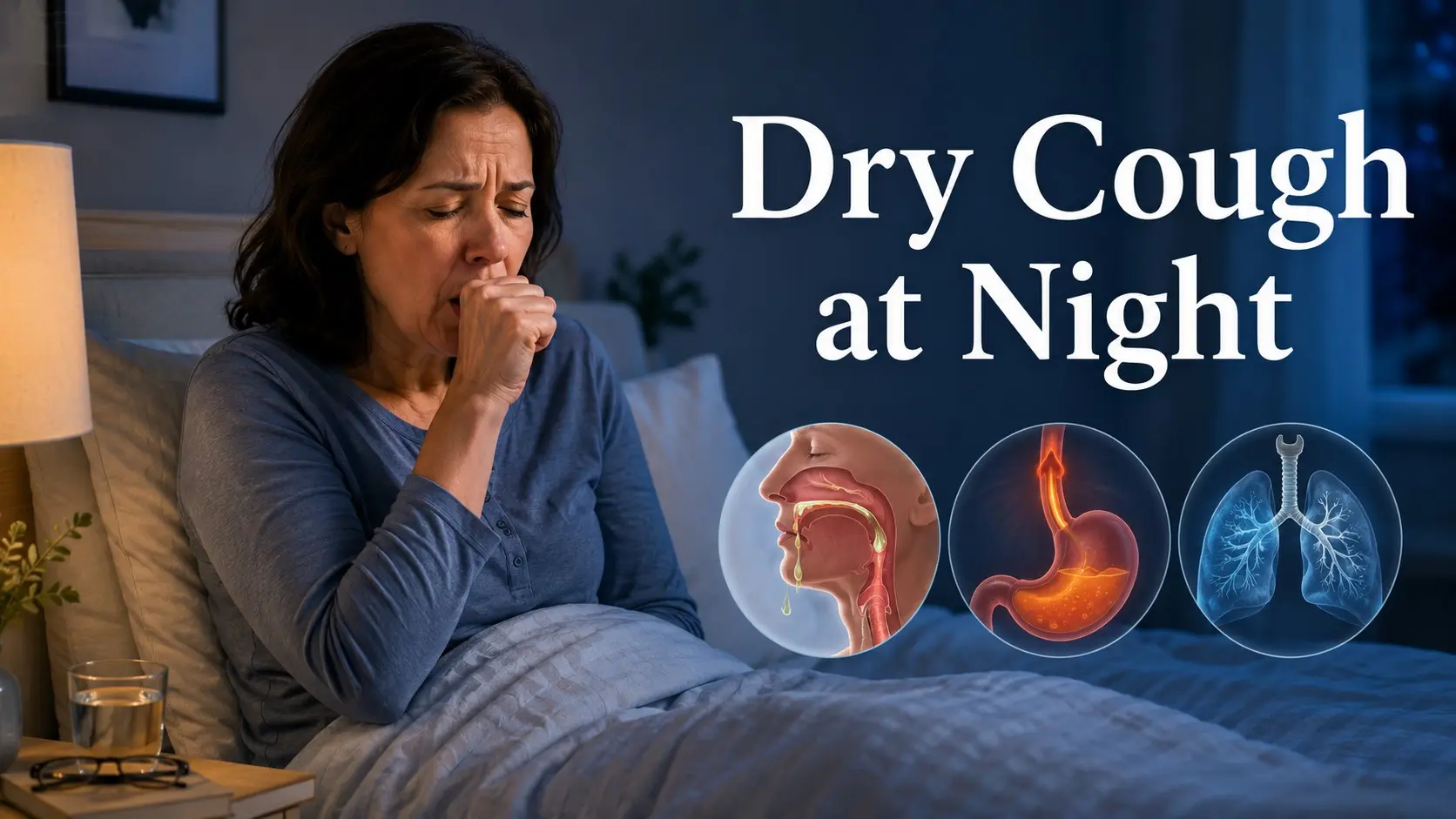
Dry Cough at Night is often caused by postnasal drip, asthma, reflux, allergies, or irritation after a respiratory infection.
Lying down can make several of these problems worse.
Medicine, smoke, dry bedroom air, and other airway conditions can also keep the cough going.
The useful question is not simply, “Why do I cough at night?”
Ask what happens just before the cough starts.
Quick Answer: Why Do I Have a Dry Cough at Night?
Dry Cough at Night commonly comes from postnasal drip, asthma, acid reflux, allergies, a recent respiratory infection, ACE inhibitor medicine, smoke, or airway irritation. Lying flat can worsen mucus drainage and reflux. A cough that lasts more than eight weeks or comes with breathing trouble, blood, chest pain, or weight loss needs medical assessment.
Medical note: This content is for general educational purposes and does not replace professional medical advice, diagnosis, or treatment. Consult an appropriately qualified healthcare professional for personal medical concerns. This article explains published guidance and does not provide a personal clinical assessment. Always consult qualified medical professionals for diagnosis and treatment of any health condition.
Why Does a Dry Cough Get Worse When You Lie Down?
Your body position changes several things at once.
While you are upright, gravity helps mucus move away from the back of your throat.
When you lie down, nasal and sinus secretions can collect closer to the throat.
Reflux can also become easier because gravity is no longer helping keep stomach contents down.
Your airways change through the night too.
Current clinical guidance on nighttime cough explains that upper airway secretions, reflux, asthma, and some heart conditions can all become more noticeable while lying flat.
For the wider respiratory cluster, visit the NextFitLife Lung and Respiratory Health Hub.
Is Your Cough Really Dry?
A dry cough does not bring up obvious mucus.
It can feel like:
- A tickle in your throat
- A scratchy feeling
- A tight cough
- A repeated urge to clear your airway
- A cough with no phlegm coming out
But this distinction is not perfect.
Postnasal drip can make a cough feel dry even though mucus is irritating the upper airway.
Asthma cough is often dry.
Reflux cough is often dry.
A cough after a virus can also stay dry for weeks.
If you are actually coughing up mucus, see White Phlegm: Causes and What the Colour Can Tell You.
How Long Has the Cough Lasted?
The clock matters.
The American Lung Association groups adult coughs by duration.
| Cough Duration | Clinical Term |
|---|---|
| Less than 3 weeks | Acute cough |
| 3 to 8 weeks | Subacute cough |
| More than 8 weeks | Chronic cough |
A cough that started four days ago with a cold differs from a persistent dry cough that has disturbed your sleep for three months.
Once a cough lasts more than eight weeks, the cause deserves a proper medical review rather than repeated home remedies.
1. Postnasal Drip Can Trigger Cough as Soon as You Lie Down
This is one of the first causes I would consider.
Upper airway cough syndrome is the term often used when nasal or sinus problems trigger coughing.
You may notice:
- Stuffy nose
- Runny nose
- Sneezing
- Throat clearing
- A tickle behind the throat
- A feeling that mucus is draining downward
- Cough that starts after lying flat
You do not always feel the drainage.
That is why people sometimes miss it.
If mucus in the throat is a bigger problem than the cough itself, read Persistent Phlegm in the Throat.
How Can You Tell If Postnasal Drip Is the Likely Cause?
Look for nose and throat clues.
The pattern becomes more convincing when coughing at night comes with congestion, sneezing, seasonal allergies, sinus pressure, or repeated throat clearing.
The cough may become stronger within minutes of lying flat.
Sitting up can make it easier.
That pattern is useful information for a clinician.
It does not prove the diagnosis by itself.
2. Asthma Can Cause Night Cough Without Obvious Wheezing
No wheeze does not rule asthma out.
This point matters.
The National Heart, Lung, and Blood Institute lists coughing, especially at night or early in the morning, as a common asthma symptom.
Asthma symptoms can also be triggered by:
- Exercise
- Cold air
- Viral infections
- Allergens
- Laughing
- Smoke
With cough variant asthma, cough can be the major symptom.
If your cough is strongest at night, after exercise, in cold air, or during allergy season, asthma deserves consideration.
NextFitLife already has a detailed guide on this pattern: Silent Asthma: Symptoms Without Obvious Wheezing.
Night Waking Can Be a Sign That Asthma Is Not Well Controlled
Asthma that repeatedly wakes you from sleep deserves attention.
NHLBI guidance says nighttime or early morning symptoms are common in asthma.
Repeated nighttime waking can also signal poor asthma control.
If you already have asthma and your night cough is increasing, follow your written asthma action plan and speak with the clinician managing your asthma.
Do not simply increase an inhaler dose without following your treatment plan.
3. Acid Reflux Can Cause Dry Cough Even Without Heartburn
This surprises many people.
You can have reflux-related cough without saying, “I have heartburn.”
The National Institute of Diabetes and Digestive and Kidney Diseases states that not every adult with GERD has classic heartburn or regurgitation.
Other symptoms can include chronic cough and hoarseness.
Clues that point toward a GERD cough include:
- Cough after lying down
- Cough after a large meal
- Late evening meals
- Sour taste in the mouth
- Morning hoarseness
- Repeated throat clearing
- Heartburn
- Regurgitation
You can have only some of these.
Why Does Reflux Cough Get Worse in Bed?
Gravity helps while you are upright.
Lie flat, and stomach contents can move upward more easily in someone who has reflux.
The throat and airway can then become irritated.
If nighttime reflux is a problem, NIDDK advises that eating at least three hours before lying down or going to bed can help some people with nighttime symptoms.
Do not assume reflux is the cause of every cough.
But do not rule it out simply because you never feel a burning chest.
4. A Postinfectious Cough Can Continue After You Feel Better
Your fever is gone.
Your sore throat is gone.
The cough is still there.
That can happen after respiratory infections.
A postinfectious cough usually refers to a cough lasting between three and eight weeks after an acute respiratory infection.
Your airway can remain sensitive after the infection itself has settled.
The cough may then be triggered by:
- Talking
- Laughing
- Cold air
- Exercise
- Dry air
- Lying down
This does not mean the infection is still active.
It also does not mean antibiotics are automatically needed.
When Does a Postinfectious Cough Need Another Look?
If the cough continues beyond eight weeks, stop treating it as a simple post-viral problem.
Other causes need to be considered.
Get checked sooner if you develop:
- Breathing trouble
- Blood with coughing
- Chest pain
- Persistent fever
- Unexplained weight loss
- Marked weakness
- Repeated pneumonia
5. Allergies Can Turn Your Bedroom Into a Cough Trigger
Look around your bed.
You spend hours there with your face close to pillows, blankets, mattresses, and nearby air.
Possible triggers include:
- Dust mites
- Pet dander
- Pollen brought indoors
- Mold
- Dust
- Fragrances
Allergies can inflame the nose.
That can lead to more mucus and more upper airway irritation.
The pattern becomes more suspicious when cough comes with:
- Sneezing
- Itchy eyes
- Runny nose
- Blocked nose
- Throat irritation
If symptoms improve when you sleep somewhere else, pay attention to that clue.
6. Dry Bedroom Air Can Irritate an Already Sensitive Airway
Dry air is real.
It is also blamed for too much.
I would not make it my first explanation for months of coughing.
Very dry air can irritate your nose, throat, and airway.
That irritation can become more noticeable when your airway is already sensitive after a cold, from allergies, or from asthma.
Other bedroom irritants include:
- Smoke
- Scented sprays
- Strong perfume
- Cleaning products
- Dust
- Pet allergens
A clean humidifier can make a genuinely dry room more comfortable.
It does not treat asthma, GERD, heart failure, or a medicine-related cough.
Can a Humidifier Help a Dry Cough at Night?
It can help when dryness is irritating your throat or airway.
Keep the machine clean.
Standing water and dirty parts can support unwanted microbial growth.
Do not assume more humidity is always better.
Too much moisture can support mould and dust mites.
The goal is comfortable indoor air.
Not maximum humidity.
7. An ACE Inhibitor Can Cause a Persistent Dry Cough
Check your medicine list.
This takes one minute and can save weeks of guessing.
ACE inhibitor cough is a known medicine side effect.
ACE inhibitors are used for conditions such as high blood pressure and heart disease.
Examples include medicines such as lisinopril and enalapril.
MedlinePlus states that an ACE inhibitor can cause dry cough.
The cough can also begin after you have been taking the medicine for some time.
Do not lower your dose or stop the medicine yourself.
Tell the clinician who prescribed it.
Why Can an ACE Inhibitor Cough Be Easy to Miss?
Because the timing is not always obvious.
You may start a medicine.
Weeks later, the cough becomes annoying.
By then you may blame:
- The weather
- Your bedroom
- A recent cold
- Allergies
A simple medication review belongs near the start of chronic cough assessment.
Not the end.
8. Smoke, Vaping, and Air Pollution Can Keep the Cough Reflex Irritated
Your airway reacts to irritants.
Tobacco smoke is one.
Secondhand smoke is another.
Vape aerosol, fumes, and polluted air can also irritate the respiratory tract.
The American Lung Association includes tobacco exposure among recognized chronic cough causes.
If you smoke or vape and have a persistent cough, do not treat the cough as an isolated bedtime problem.
The airway exposure itself deserves attention.
For related guidance, use the Lung and Respiratory Health Hub.
9. Nonasthmatic Eosinophilic Bronchitis Can Cause Chronic Dry Cough
This condition is less well known.
It belongs on the list because it can look like asthma in some ways.
Nonasthmatic eosinophilic bronchitis causes airway inflammation and chronic cough.
But it does not show the same variable airflow obstruction seen in classic asthma.
You cannot diagnose it from the sound of your cough.
Current adult chronic cough reviews include it among important causes when the more obvious explanations have not solved the problem.
This becomes more relevant when the cough has lasted more than eight weeks.
10. Heart or Lung Disease Can Sometimes Cause Nighttime Cough
This is not the most likely explanation for an otherwise healthy adult with a mild cough after a cold.
But it should not be left out.
Heart failure can cause cough and breathing symptoms when fluid builds up in the lungs.
The American Heart Association lists persistent cough or wheezing among heart failure symptoms.
The pattern becomes more concerning when cough comes with:
- Shortness of breath
- Difficulty breathing while lying flat
- Waking suddenly short of breath
- Swelling in the legs or ankles
- Unusual fatigue
- Reduced exercise ability
- Rapid weight changes from fluid buildup
If those symptoms appear, the cough needs medical assessment rather than another cough sweet.
For cardiovascular topics, visit the Heart and Cardiovascular Health Hub.
What Other Lung Conditions Can Cause a Persistent Cough?
Less common causes include:
- COPD
- Bronchiectasis
- Interstitial lung disease
- Chronic aspiration
- Tuberculosis
- Lung tumors
- Other airway disorders
These conditions are not diagnosed because you cough at bedtime.
Duration, symptoms, smoking history, examination, and testing change the level of concern.
If you have chest symptoms with the cough, see Chest Pain on the Left Side: What It Can Mean.
Can Sleep Apnea Cause Cough at Night?
Sleep apnea can be associated with nighttime coughing.
I would not put it ahead of postnasal drip, asthma, or reflux as a first explanation.
Sleep apnea also overlaps with reflux and disturbed breathing during sleep.
Clues include:
- Loud snoring
- Breathing pauses
- Gasping during sleep
- Morning headaches
- Unrefreshing sleep
- Major daytime sleepiness
If these occur with cough, tell your healthcare professional about the full sleep pattern.
Why Does Sitting Up Sometimes Stop the Cough?
Position changes several possible trigger.
Sitting upright can reduce reflux in some people.
It can change mucus drainage.
It can also make breathing feel easier in some heart and lung conditions.
That makes “better when sitting up” a useful clue.
It does not tell you the diagnosis.
Can a Dry Cough Come From Your Throat Rather Than Your Lungs?
Yes.
The cough reflex can be triggered from the upper airway and voice box.
You can therefore cough because of:
- Postnasal drip
- Reflux
- Throat irritation
- Voice box irritation
- Cough hypersensitivity
A real cough does not need to start deep inside the lungs.
What Does Each Cause Usually Look Like?
| Potential Cause | Useful Clues |
|---|---|
| Postnasal drip | Congestion, sneezing, throat clearing, worse lying down |
| Asthma | Night cough, exercise trigger, cold air trigger, chest tightness |
| GERD | After meals, after lying down, sour taste, hoarseness |
| Postinfectious cough | Started after a cold or respiratory infection |
| Allergies | Itchy eyes, sneezing, nasal symptoms, bedroom trigger |
| Dry air or irritants | Scratchy throat, smoke, dust, fragrance, dry room |
| ACE inhibitor | Persistent dry cough while taking this medicine type |
| Smoking or vaping | Repeated airway exposure and irritation |
| Eosinophilic bronchitis | Chronic cough after common causes need further assessment |
| Heart or other lung disease | Cough with breathlessness, swelling, chest symptoms, or other warning signs |
This table helps sort clues.
It does not diagnose the cause.
What Can You Do Tonight for a Dry Cough?
Match the step to the likely trigger.
If your nose is blocked, dealing with the nasal problem makes more sense than treating only the cough.
If reflux seems likely, avoid lying down soon after eating.
If the bedroom air is irritating, reduce smoke, fragrance, dust, and excessive dryness.
Keep water nearby if your throat feels dry.
A simple throat lozenge can feel soothing for some adults.
If lying flat reliably triggers symptoms, a more comfortable, more upright position may help some causes.
Do not build a high stack of pillows that leaves your neck painful.
And do not use home comfort measures to delay care for serious breathing symptoms.
Does Honey Help a Night Cough?
Honey, can soothe the throat and reduce coughing in some people with acute respiratory illness.
It does not identify or treat the cause of a chronic nighttime cough.
Do not give honey to a child younger than one year because of infant botulism risk.
For adults, think of honey as comfort.
Not a cure for asthma, reflux, infection, or heart disease.
Should You Use Cough Medicine?
There is no single best medicine for every dry cough when lying down.
Postnasal drip needs an original plan from asthma.
Asthma needs a different plan from reflux.
ACE inhibitor cough requires medication review.
A cough suppressant can sometimes provide temporary relief.
It does not fix the cause.
Ask a pharmacist or healthcare professional before combining cough and cold products if you:
- Take several medicines
- Have high blood pressure
- Have heart disease
- Have kidney disease
- Are pregnant
- Have another medical condition
Do You Need Antibiotics for a Dry Night Cough?
Usually not just because you have a cough.
Many short-term respiratory coughs come from viral infections.
A postinfectious cough can stay after the original infection has cleared.
Antibiotics do not treat viruses.
They also do not treat asthma, reflux, allergies, or an ACE inhibitor cough.
Antibiotics make sense when a bacterial infection that needs antibiotic treatment has been identified or is strongly suspected by a clinician.
When Should a Nighttime Cough Be Checked?
I would arrange medical assessment when:
- The cough lasts for weeks
- It repeatedly wakes you from sleep
- It keeps returning
- You have wheezing
- You become short of breath
- It began after a medicine change
- You have ongoing reflux symptoms
- You have a significant smoking history
- The cough lasts more than eight weeks
A chronic cough deserves a cause.
Which Warning Signs Need Faster Medical Review?
Do not ignore:
- Coughing up blood
- Significant shortness of breath
- Persistent fever
- Chest pain
- Unexplained weight loss
- Difficulty swallowing
- Marked hoarseness
- Repeated pneumonia
- Progressive weakness
- A new persistent cough in someone with a heavy smoking history
These findings do not tell you which disease is present.
They tell you not to keep treating the cough as a minor bedtime problem.
When Is a Dry Cough an Emergency?
Seek emergency medical help for:
- Severe difficulty breathing
- Blue or grey lips
- Severe chest pain
- Fainting
- Confusion
- A severe allergic reaction with swelling or breathing trouble
- Coughing up a large amount of blood
- Sudden rapidly worsening breathing symptoms
Do not rely on a home pulse oximeter to tell you whether severe breathing symptoms are safe.
The NextFitLife Lung and Respiratory Health Hub also stresses that serious symptoms need professional assessment even if a home device seems reassuring.
What Tests Can Be Used for a Persistent Dry Cough?
Testing depends on the pattern.
A clinician may start with:
- Your health history
- Your medicine list
- A physical exam
- Listening to your lungs
Further assessment can include:
- Chest X-ray
- Spirometry
- Other lung function tests
- Sinus or allergy assessment
- Reflux assessment
- Further imaging when needed
Mayo Clinic notes that common causes such as postnasal drip, reflux, tobacco exposure, and asthma may not be obvious on a routine chest X-ray.
This is why a normal image does not automatically explain or end the evaluation of a chronic cough.
Can More Than One Cause Be Present?
Yes.
This is common enough that it should be expected.
You might have allergies that cause postnasal drip.
You might also have reflux.
An asthma-prone airway can become more sensitive after a respiratory infection.
Mayo Clinic notes that more than one underlying condition can contribute to chronic cough.
So finding one possible cause does not always mean the investigation is finished.
Common Dry Cough at Night Myths
Myth: Night Cough Is Always Dry Air
False.
Dry air can irritate the throat.
Persistent adult cough is more commonly linked with conditions such as upper airway cough syndrome, asthma, reflux, medication effects, and other airway problems.
Myth: No Heartburn Means No Reflux
False.
GERD can cause chronic cough without classic heartburn.
Myth: No Wheeze Means No Asthma
False.
Cough can be the main asthma symptom in some people.
Myth: A Cough After a Cold Means the Infection Is Still Active
False.
A postinfectious cough can continue for several weeks after the acute illness ends.
Myth: A Humidifier Treats Nighttime Cough
False.
It may reduce dryness.
It does not treat asthma, GERD, medicine cough, heart failure, or another underlying disease.
Myth: You Should Stop an ACE Inhibitor If You Start Coughing
False.
Tell the prescribing clinician.
Do not stop or reduce a prescribed medicine without medical advice.
My Approach to a Dry Cough at Night
I do not start with cough syrup.
I start with the pattern.
My background in information technology management taught me to ask which variable changed when a problem appeared.
I use the same thinking when researching health topics for NextFitLife.
For this article, I compared current respiratory guidance, adult chronic cough information, asthma guidance, GERD information, and medicine safety sources.
I ask:
Did the cough start after an infection?
Does the nose become blocked?
Does it start after lying down?
Does eating late make it worse?
Does exercise trigger it?
Is there wheezing or chest tightness?
Is an ACE inhibitor on the medicine list?
Is smoke or vaping involved?
Is there breathlessness while lying flat?
How many weeks has the cough lasted?
Those questions give you much more useful information than simply calling it a night cough.
Conclusion: Dry Cough at Night Needs the Cause, Not Just Relief
Dry Cough at Night is commonly linked with postnasal drip, asthma, reflux, allergies, a recent respiratory infection, medicine, or airway irritation.
Do not assume the bedroom is simply too dry.
Look at the pattern.
Check your nose, meals, medicines, breathing symptoms, smoking exposure, and how long the cough has lasted.
Your next step: Write down when the cough begins, what happens before it, and which other symptoms appear. If it lasts for weeks, repeatedly interrupts sleep, or comes with breathing trouble, blood, chest pain, fever, or weight loss, take that record to a qualified healthcare professional.
References and Sources
This article was checked against current and publicly accessible respiratory, digestive, medicine safety, and chronic cough sources.
- National Center for Biotechnology Information. Nocturnal Cough, StatPearls.This current 2026 clinical review covers the main adult causes of cough at night, including upper airway cough syndrome, asthma, GERD, ACE inhibitor medicine, smoking exposure, eosinophilic bronchitis, heart failure, and other respiratory causes. Read the NCBI Nocturnal Cough Review
- American Lung Association. Learn About Chronic Cough. This medically reviewed resource explains acute, subacute, and chronic cough duration and lists asthma, upper airway cough syndrome, eosinophilic bronchitis, reflux, medicine, smoking, and lung disease among recognized causes. Read the American Lung Association Chronic Cough Guide
- National Heart, Lung, and Blood Institute. Asthma Symptoms.NHLBI explains that asthma can cause cough, especially at night or early in the morning, and that symptoms may worsen with infections, exercise, allergies, cold air, and other triggers. Read NHLBI Asthma Symptoms Guidance
- National Institute of Diabetes and Digestive and Kidney Diseases. Symptoms and Causes of GERD.NIDDK explains that GERD can cause chronic cough and hoarseness and that not every adult with reflux has classic heartburn or regurgitation. Read NIDDK GERD Guidance
- MedlinePlus. ACE Inhibitors.MedlinePlus explains that ACE inhibitor medicine can cause a dry cough and advises people not to lower the dose without first talking with the prescribing healthcare professional. Read MedlinePlus ACE Inhibitor Safety Information
Additional Source: Mayo Clinic chronic cough guidance was also used to check the discussion of multiple causes, testing, chest imaging limits, asthma, reflux, smoking, and medication-related cough.
Read Mayo Clinic Chronic Cough Guidance
Source Review Date: September 2, 2026
These organizations and researchers do not endorse NextFitLife.
Continue Reading on NextFitLife
Main Health Hub: NextFitLife Health
Primary Sub Hub: Lung and Respiratory Health
General Wellness Hub: General Wellness and Lifestyle
About the Author
Adel Galal is the founder and lead writer at NextFitLife.
He has maintained a personal interest in health, fitness, nutrition, sleep, wellness, and healthy aging for more than 30 years.
His health and wellness writing experience spans more than 15 years.
Before focusing on NextFitLife, Adel spent 29 years working as an IT Manager for the Nestlé Egypt Region.
His professional background developed skills in data analysis, research organization, systems thinking, information management, structured review, and problem-solving.
At NextFitLife, he applies those skills to compare reputable medical sources, identify important limits, separate established guidance from uncertain claims, and explain complex health information in simple language.
For this article, his focus is on separating common causes of nighttime cough from less common but important respiratory and cardiovascular causes, while making clear when symptom relief is not enough and professional assessment is needed.
This content is for general educational purposes and does not replace professional medical advice, diagnosis, or treatment. Consult an appropriately qualified healthcare professional for personal medical concerns. This article explains published guidance and does not provide a personal clinical assessment. Always consult qualified medical professionals for diagnosis and treatment of any health condition.
Read more about Adel Galal, NextFitLife, and our editorial and source checking process.
Frequently Asked Questions About Dry Cough at Night
Why do I get a dry cough only at night?
A night cough can come from postnasal drip, asthma, reflux, allergies, dry or irritating air, medicine, or a recent respiratory infection. The trigger often becomes more noticeable after lying down.
Why does my cough start when I lie down?
Lying flat can increase mucus near the throat and make reflux easier. Asthma symptoms and some heart or lung symptoms can also become more noticeable at night.
Can postnasal drip cause a dry cough at night?
Yes. Mucus can irritate the back of the throat and trigger coughing even when the cough feels dry.
Can asthma cause only a dry cough?
Yes. Some people have cough as a major asthma symptom. Night cough, exercise triggers, cold air triggers, or allergy triggers can provide useful clues.
Can acid reflux cause coughing without heartburn?
Yes. NIDDK states that GERD can cause chronic cough or hoarseness even when classic heartburn or regurgitation is absent.
Can a cough stay after a cold is gone?
Yes. A postinfectious cough can continue for three to eight weeks after an acute respiratory infection.
Can allergies cause nighttime coughing?
Yes. Allergies can cause nasal inflammation and postnasal drip. Dust mites, pollen, mould, and pet dander in the bedroom can contribute.
Does dry air cause nighttime cough?
Dry air can irritate the nose and throat, especially when the airway is already sensitive. Persistent cough should not automatically be blamed on humidity.
Can blood pressure medicine cause a dry cough?
ACE inhibitor medicines can cause a persistent dry cough. Do not stop or reduce a prescribed medicine without speaking with the prescribing clinician.
Can heart problems cause coughing at night?
Heart failure can cause persistent cough and breathing symptoms, especially with shortness of breath when lying flat, swelling, fatigue, or sudden weight change.
When is a cough considered chronic?
In adults, a cough lasting more than eight weeks is considered chronic.
Should I take antibiotics for a dry night cough?
Not automatically. Many coughs are viral, postinfectious, allergic, asthmatic, reflux-related, or medicine-related. Antibiotics treat selected bacterial infections, not every cough.
Does a humidifier help a dry cough?
It may reduce irritation when indoor air is very dry. Keep the humidifier clean and remember that it does not treat asthma, reflux, heart disease, or another underlying cause.
When should I see a doctor for a dry cough at night?
Arrange medical review if the cough lasts for weeks, repeatedly interrupts sleep, keeps returning, or comes with wheezing, breathlessness, reflux symptoms, or a significant smoking history.
When is nighttime coughing an emergency?
Seek emergency help for severe breathing difficulty, blue or grey lips, severe chest pain, fainting, confusion, a severe allergic reaction, or coughing up a large amount of blood.

Health & wellness writer with 30+ years of experience in nutrition, fitness, and healthy aging. Founder of NextFitLife.com — evidence-based health guidance.