
Published on: Jun 27, 2024
Updated: October 31, 2026
International Yoga Day 2026 was observed on June 21 with a message that fits people of every age: yoga can be adapted to support movement, balance, calm, and well-being throughout life.
The official United Nations theme for 2026 was Yoga for Healthy Ageing.
That makes this year's message wider than trying to master a difficult pose.
You can use yoga to move gently, practice balance, breathe with awareness, and spend a little time paying attention to your body.
You do not need to be flexible before you begin.
This article is for general information and education. It does not replace medical advice, diagnosis, or treatment.
Quick answer: International Yoga Day is observed every year on June 21. For 2026, the United Nations chose the theme “Yoga for Healthy Ageing.” Beginners can celebrate with a short sequence using standing balance, gentle strength, hip mobility, spinal movement, breathing, and relaxation. Eleven poses are included below, with easier options when needed.
Practice safely: Stop if a pose causes sharp pain, numbness, faintness, chest pain, or severe dizziness. Use a wall or chair if balance is uncertain. If you have osteoporosis, glaucoma, recent surgery, significant joint disease, uncontrolled blood pressure, pregnancy, or another condition that affects exercise, ask a qualified healthcare professional which poses and positions are appropriate for you.
Table of Contents
- What is International Yoga Day?
- What is the 2026 yoga theme?
- What yoga can and cannot do
- 11 essential yoga poses
- Mountain Pose
- Chair Pose
- Tree Pose
- Warrior II
- Cat Cow
- Downward Facing Dog
- Low Lunge
- Sphinx Pose
- Bridge Pose
- Child’s Pose
- Savasana
- 20 minute beginner sequence
- Chair and wall modifications
- Yoga for healthy ageing
- Yoga for flexibility and balance
- Yoga and stress
- Common yoga mistakes
- Frequently asked questions
What Is International Yoga Day?
The official name is the International Day of Yoga.
The United Nations General Assembly proclaimed June 21 as the International Day of Yoga in December 2014.
The first observance took place in 2015.
The day aims to raise worldwide awareness of yoga and its role in health and well-being.
Yoga has ancient roots in India and includes much more than physical poses. Traditional yoga also includes breathing, meditation, concentration, philosophy, and other practices.
Modern classes vary widely, so one yoga session may look very different from another.
When Is International Yoga Day 2026?
International Yoga Day is observed every year on June 21.
That means International Yoga Day 2026 took place on June 21, 2026.
The United Nations also held its 2026 observance at UN Headquarters in New York in June.
What Is the International Yoga Day 2026 Theme?
The official United Nations theme is:
Yoga for Healthy Ageing
The theme highlights ways yoga may support abilities that matter as people grow older, such as movement, mobility, strength, balance, and mental well-being.
It also sends an important message.
Yoga does not belong only to young, highly flexible people.
A pose can be changed with a chair, wall, block, strap, shorter range of motion, or slower pace.
Why the Old 2024 Theme Needed Correction
The previous version of this page described the 2024 theme as “Yoga for Harmony and Peace.”
That was not the official 2024 International Day of Yoga theme.
Updating yearly event information matters because readers looking for World Yoga Day information often want the current date, official theme, and practical ways to take part.
This page now focuses on the verified 2026 observance while keeping the same URL.
What Can Yoga Actually Help With?
Yoga combines movement with attention, breathing, and often relaxation.
Research reviewed by the U.S. National Center for Complementary and Integrative Health suggests yoga may support:
- General well-being
- Stress management
- Mental and emotional health
- Sleep
- Balance
- Some forms of pain management
The strength of evidence is not equal for every claim.
For example, yoga appears to offer a small benefit for some people with chronic low back pain, but it should not be presented as a cure.
For more beginner movement ideas, visit the Yoga and Flexibility Hub.
Yoga Is Not a Miracle Treatment
Yoga can be useful without promising too much.
It does not:
- Cure every disease
- Detox organs
- Guarantee weight loss
- Fix every posture problem
- Replace medical treatment
- Make everyone flexible
Benefits depend on the person, the type of yoga, how often it is practiced, and any health conditions or injuries.
11 Essential Poses for International Yoga Day 2026
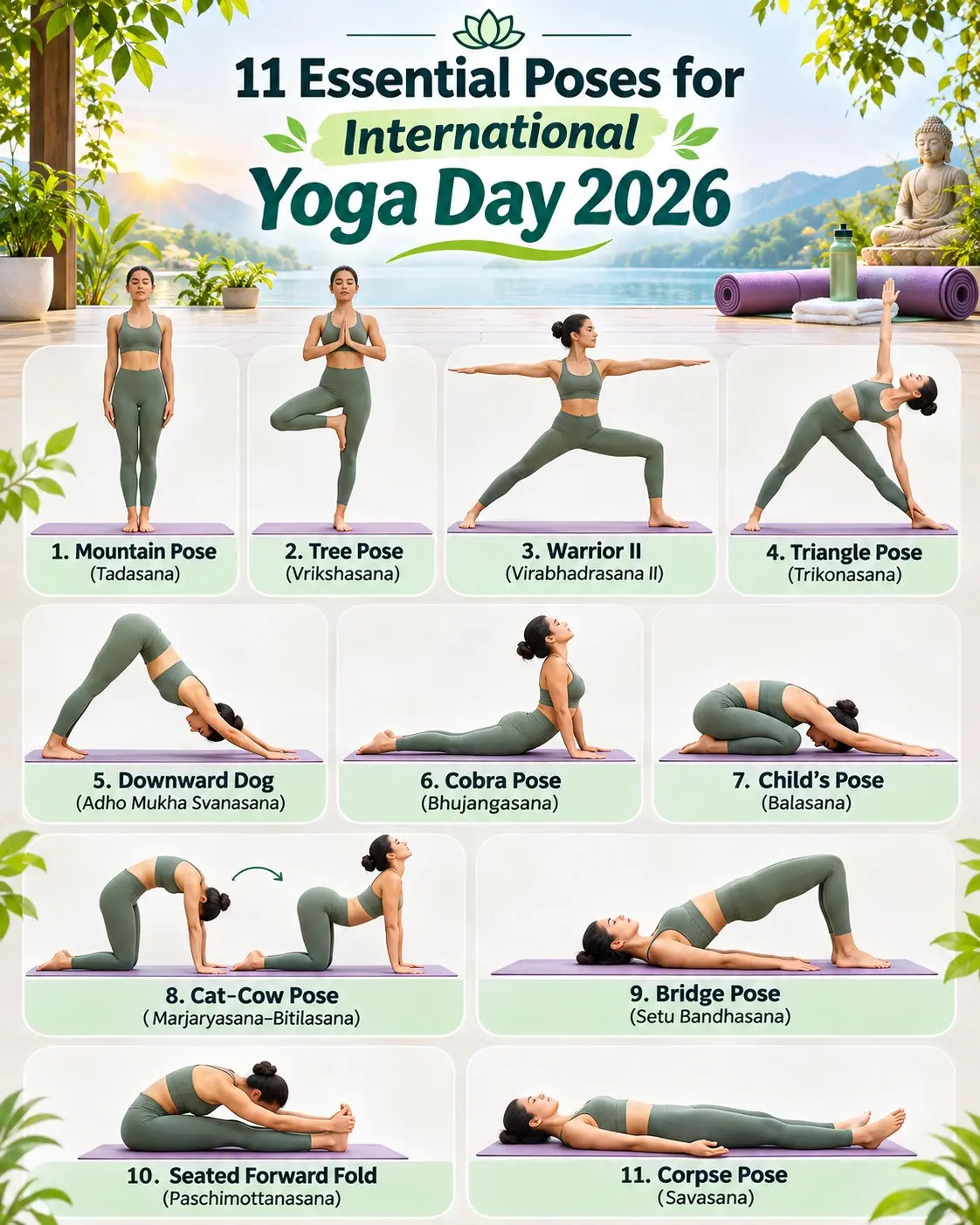
International Yoga Day 2026 celebrates Yoga for Healthy Ageing with adaptable movement, breathing, balance, and mindful practice.
1. Mountain Pose
Mountain Pose, or Tadasana, looks simple because you are standing still.
Yet it is a useful place to practice posture, breathing, and body awareness.
How to do it:
- Stand with your feet comfortable and steady.
- Spread your weight across both feet.
- Keep the knees soft rather than locked.
- Let your shoulders relax.
- Look forward and breathe slowly.
Beginner option: stand near a wall or chair.
Try: 5 to 8 slow breaths.
2. Chair Pose
Chair Pose adds gentle leg work.
It can train the thighs and hips while you practice keeping your trunk controlled.
How to do it:
- Stand tall.
- Move your hips backward as if sitting toward a chair.
- Bend your knees through a comfortable range.
- Keep your feet grounded.
- Reach your arms forward or keep your hands at your chest.
Easier option: practice sitting down to and standing up from a real chair.
Try: 3 to 5 breaths.
3. Tree Pose
Tree Pose is a simple way to practice yoga for balance.
You do not need to put your foot high on your thigh.
How to do it:
- Stand near a wall.
- Shift your weight onto one foot.
- Place the other toes on the floor, ankle, or calf.
- Avoid pressing directly into the side of the knee.
- Focus on one steady point.
Easier option: keep one hand on a chair.
Try: 10 to 30 seconds each side.
4. Warrior II
Warrior II can train the legs while opening the stance and asking the trunk to remain tall.
How to do it:
- Take a comfortable wide stance.
- Turn the front foot outward.
- Bend the front knee only as far as feels comfortable.
- Keep the back leg steady.
- Reach the arms gently to each side.
- Look forward over the front hand.
Easier option: shorten the stance or hold a wall.
5. Cat Cow
Cat Cow moves the spine through gentle flexion and extension.
It can feel useful after long periods of sitting.
How to do it:
- Start on your hands and knees.
- Slowly round your back.
- Then gently move in the opposite direction.
- Stay within a comfortable range.
- Move with your breathing.
Wrist sensitive option: perform a similar gentle spinal movement while seated.
6. Downward Facing Dog
Downward Facing Dog involves the shoulders, arms, hips, calves, and hamstrings.
Your heels do not need to reach the floor.
How to do it:
- Start on hands and knees.
- Press through your hands.
- Lift your hips up and back.
- Keep your knees bent if needed.
- Let your head stay comfortable between your arms.
Easier option: place your hands on a wall or sturdy counter and hinge your hips backward.
This standing version is often more comfortable for beginners.
7. Low Lunge
A Low Lunge can gently work on hip mobility.
How to do it:
- Place one foot forward.
- Lower the opposite knee to a padded surface if comfortable.
- Keep the front foot stable.
- Move your hips forward only until you feel a gentle stretch.
- Stay tall rather than forcing depth.
Easier option: use blocks or a chair for hand support.
8. Sphinx Pose
Sphinx Pose is a gentler back extension than a high Cobra Pose.
That makes it a useful choice for many beginners.
How to do it:
- Lie on your stomach.
- Place your forearms on the mat.
- Keep your elbows around shoulder level.
- Lift your chest gently.
- Stop if the lower back feels pinched or painful.
Avoid forcing the chest high.
9. Bridge Pose
Bridge Pose uses the hips and back of the legs.
How to do it:
- Lie on your back with knees bent.
- Place your feet on the floor.
- Press through the feet.
- Lift the hips to a comfortable height.
- Lower slowly.
Try: 5 to 8 controlled repetitions or a short hold.
You do not need to push into a large back arch.
10. Child’s Pose
Child’s Pose can provide a quiet rest between movements.
However, it is not comfortable for everyone.
How to do it:
- Kneel if comfortable.
- Move the hips toward the heels.
- Reach the arms forward or rest them beside you.
- Support your forehead if needed.
Knee sensitive option: sit in a chair and fold gently forward with your forearms resting on your thighs or a table.
11. Savasana
Savasana is commonly used at the end of a yoga practice.
Lie comfortably and allow your breathing to settle.
You do not need to empty your mind.
Simply notice your breath and let your body rest.
Comfort option: place a pillow beneath the knees or lie on your side if lying flat is uncomfortable.
Try: 2 to 5 minutes.
The 11 Poses at a Glance
| Pose | Main Focus | Easy Option |
|---|---|---|
| Mountain | Awareness and posture | Wall support |
| Chair | Leg strength | Real chair |
| Tree | Balance | Hold wall |
| Warrior II | Legs and stance | Shorter stance |
| Cat Cow | Spinal movement | Seated version |
| Downward Dog | Whole body mobility | Wall version |
| Low Lunge | Hip mobility | Chair support |
| Sphinx | Gentle extension | Smaller lift |
| Bridge | Hips and legs | Small lift |
| Child’s Pose | Rest | Chair fold |
| Savasana | Relaxation | Side lying |
A Simple 20 Minute International Yoga Day Routine
You do not need the 45 minute practice suggested in the old article.
Twenty minutes is enough to explore all the main movement types.
| Stage | Movement | Time |
|---|---|---|
| 1 | Mountain and breathing | 2 min |
| 2 | Chair Pose | 1 min |
| 3 | Tree Pose both sides | 2 min |
| 4 | Warrior II both sides | 2 min |
| 5 | Cat Cow | 2 min |
| 6 | Downward Dog | 1 min |
| 7 | Low Lunge both sides | 2 min |
| 8 | Sphinx | 1 min |
| 9 | Bridge | 2 min |
| 10 | Child’s Pose | 1 min |
| 11 | Savasana | 4 min |
Move slowly between poses.
Add extra rest whenever you need it.
A 10 Minute Beginner Version
If 20 minutes feels too long, try this:
- Mountain Pose: 1 minute
- Chair Pose: 1 minute
- Tree Pose: 1 minute each side
- Cat Cow: 1 minute
- Wall Downward Dog: 1 minute
- Bridge: 1 minute
- Savasana: 3 minutes
A shorter routine you repeat is more useful than a complex routine you avoid.
You can also explore Best Yoga Moves for Beginners.
Yoga for Healthy Ageing
The 2026 theme deserves careful wording.
Yoga may help older adults stay active, but we should not claim that yoga alone prevents ageing or guarantees independence.
A 2026 systematic review and meta analysis examined yoga for lower body strength, balance, and quality of life in older adults.
The initial results suggested possible benefits for some outcomes, but several findings became weaker after statistical adjustment.
Quality of life showed the most stable benefit.
This is a good example of why health claims should stay measured.
How Older Adults Can Modify Yoga
Yoga does not have to happen entirely on the floor.
Older adults and people with limited mobility can use:
- A sturdy chair
- A wall
- Yoga blocks
- A strap
- Extra cushions
- A wider stance
- Shorter holds
Standing next to support is especially useful during balance poses.
If getting to the floor is difficult, choose standing and seated variations.
For additional strength ideas, see Strength Training Exercises for Seniors.
Can Yoga Improve Flexibility?
Yoga can help improve flexibility when practiced consistently.
A 2026 study of adults with moderate stress found improvements in flexibility and balance after eight weeks of yoga performed twice weekly.
That does not mean everyone needs an eight week program or the same frequency.
Flexibility also does not mean forcing yourself into the deepest possible pose.
Useful mobility is enough.
Can Yoga Improve Balance?
Yoga contains many opportunities to practice balance.
Tree Pose is an obvious example, but lunges and standing transitions also challenge stability.
Research suggests yoga may help some aspects of balance, although newer reviews show that results are not equally strong across every population or balance measure.
Use support when you need it.
Can Yoga Build Strength?
Some poses make your muscles work.
Chair Pose, Warrior II, Bridge, plank variations, and Downward Dog can provide muscular effort.
But yoga is not automatically a replacement for progressive resistance training.
If building maximal strength or muscle is your main goal, combine yoga with suitable resistance exercise.
See the NextFitLife Fitness Program Guide for a broader approach.
Does Yoga Reduce Stress?
Yoga may help some people manage stress.
A 2025 meta analysis found evidence that yoga can reduce perceived stress, although results vary between studies and types of yoga.
A separate systematic review of stressed adults also found possible short term benefits, but rated much of the evidence as low quality.
That means the right message is:
Yoga may help with stress.
It should not be sold as a guaranteed treatment for anxiety, depression, or other mental health conditions.
Does Yoga Help With Sleep?
NCCIH notes that research suggests yoga may support sleep and general wellness.
A relaxing evening practice may feel useful for some people.
But poor sleep can also be caused by sleep apnea, pain, medicines, depression, anxiety, shift work, and other conditions.
Yoga should not delay proper assessment when sleep problems persist.
Does Yoga Help Back Pain?
Yoga may offer a small benefit for some people with chronic low back pain.
NCCIH reviews suggest that yoga can improve pain and function compared with no exercise, but the difference may be small.
It is not clear that yoga is better than other appropriate forms of exercise.
If back pain is severe, follows an injury, causes leg weakness or numbness, or affects bladder or bowel control, seek medical care rather than trying to stretch through it.
Does Yoga Help You Lose Weight?
Yoga can contribute to physical activity, but most gentle yoga classes do not burn as much energy as vigorous aerobic exercise.
Yoga may still support weight management by helping some people move more, manage stress, sleep better, or build healthier routines.
Weight loss still depends mainly on your overall energy balance over time.
For evidence based weight guidance, visit the NextFitLife Weight Loss Guide.
Do You Have to Be Flexible to Start Yoga?
No.
Flexibility is not an entry requirement.
You can shorten your stance, bend your knees, use blocks, hold a wall, or stop before a full range.
The goal is to find a version of the pose that works for your body.
Do You Need a Yoga Mat?
A yoga mat can improve comfort and grip, but expensive equipment is not required.
You may also use:
- A stable chair
- A wall
- Yoga blocks
- A folded blanket
- A strap
A slippery towel on a smooth floor is not a good replacement for a grippy mat.
Do You Need to Hold Every Pose for One Minute?
No.
The old article often recommended holds of 30 seconds to several minutes.
That can be unnecessary for a beginner.
Start with a few comfortable breaths.
Leave the pose if your form becomes unstable or you feel pain.
Should Yoga Hurt?
No.
You may feel muscular effort or a gentle stretch.
Sharp pain, pinching, tingling, numbness, or severe joint discomfort is a reason to stop.
More stretch is not automatically better.
Should You Force Your Heels Down in Downward Dog?
No.
Your heels do not need to touch the floor.
Bend your knees if that helps you keep the pose comfortable.
Anatomy differs between people.
Should You Look Up in Warrior Pose?
Not if it strains your neck.
You can keep your gaze forward or slightly down.
Yoga poses should adapt to your body rather than forcing your body to match a photo.
Breathing During Yoga
Use comfortable breathing.
Try not to hold your breath through a difficult pose unless you are doing a specific breathing practice under appropriate instruction.
For beginners, a simple approach works well:
- Breathe in gently through your nose if comfortable.
- Breathe out without forcing.
- Let the breath stay smooth.
Can You Practice Yoga Every Day?
You can practice gentle yoga often if your body tolerates it.
But daily practice is not required.
More demanding yoga sessions also need recovery.
Your week can include yoga alongside walking, strength training, cycling, swimming, or other activities you enjoy.
WHO emphasizes that a broad pattern of regular physical activity supports physical and mental health.
Yoga Does Not Replace All Exercise
Yoga can cover flexibility, balance, body awareness, and some muscular work.
Depending on your yoga style, you may still benefit from:
- Aerobic activity
- Progressive strength training
- Walking
- Sport
- Other movement you enjoy
Your exercise plan does not need to choose between yoga and everything else.
Common Yoga Mistakes to Avoid
1. Forcing Flexibility
A deeper stretch is not always a better stretch.
2. Copying Advanced Poses Too Soon
You do not need headstands or deep backbends to benefit from yoga.
3. Locking the Knees
Keep a little softness when that feels more comfortable.
4. Ignoring Balance Support
A wall or chair is a smart tool, not a failure.
5. Holding Your Breath
Keep breathing unless a trained teacher is guiding a specific practice.
6. Chasing Pain
Pain is not proof that a pose is working.
7. Assuming Every Pose Fits Everyone
Body shape, mobility, injuries, pregnancy, and health conditions all matter.
8. Treating Yoga as Medical Care
Yoga may support health but does not replace appropriate diagnosis or treatment.
International Yoga Day 2026 Beginner Checklist
- Choose a clear space.
- Use a stable mat or surface.
- Keep a wall or chair nearby.
- Start with easy poses.
- Use a comfortable range of motion.
- Breathe normally.
- Do not force flexibility.
- Use modifications freely.
- Stop for sharp pain or dizziness.
- Include balance, mobility, and rest.
- Finish with a few quiet breaths.
Conclusion
International Yoga Day 2026 is a useful reminder that yoga does not need to be extreme to be meaningful.
The official theme, Yoga for Healthy Ageing, fits a practice built around mobility, balance, gentle strength, breathing, and awareness.
Start with Mountain Pose, Chair Pose, Tree Pose, Warrior II, Cat Cow, and other simple movements from this guide. Use a wall or chair whenever it makes the practice safer.
Most of all, do not chase perfect poses.
Your next step: choose five of these 11 poses and practice them for 10 minutes today. If that feels good, repeat the routine later this week.
References and Sources
- United Nations. International Day of Yoga, including the official 2026 theme Yoga for Healthy Ageing.
https://www.un.org/en/observances/yoga-day - United Nations Secretary General. Message on International Day of Yoga, June 21, 2026.
https://www.un.org/sg/en/content/sg/statements/2026-06-21/secretary-generals-message-international-day-of-yoga - National Center for Complementary and Integrative Health. Yoga: Effectiveness and Safety.
https://www.nccih.nih.gov/health/yoga-effectiveness-and-safety - World Health Organization. Physical Activity Fact Sheet.
https://www.who.int/news-room/fact-sheets/detail/physical-activity/ - Rhoads MC, et al. Yoga as an Intervention for Stress: A Meta Analysis.
https://pubmed.ncbi.nlm.nih.gov/39511914/ - Effects of Yoga on Stress in Stressed Adults. Systematic Review and Meta Analysis.
https://pubmed.ncbi.nlm.nih.gov/39553891/ - Effects of Yoga on Lower Extremity Muscle Strength, Balance, and Quality of Life Across Diverse Older Adult Populations. Systematic Review and Meta Analysis, 2026.
https://pubmed.ncbi.nlm.nih.gov/42700826/ - Effects of an 8 Week Yoga Intervention on Flexibility, Balance, and Mental Health in Adults With Stress. 2026.
https://pubmed.ncbi.nlm.nih.gov/42438844/
Internal Links + Hub
- NextFitLife Fitness Hub
- Yoga and Flexibility Hub
- Best Yoga Moves for Beginners
- Fitness Program Guide
- Getting Fit at 60
- Strength Training Exercises for Seniors
- Simple Strength Training Exercises at Home
- Strength Training at Home for Beginners
- Quick Effective Workout Routines
- Fitness Journey
- Healthy Eating Lifestyle
About the Author
Adel Galal is the founder and lead writer of NextFitLife.com and the founder of Parnthub.com.
He is a father of four, three sons and a daughter, and a grandfather of four, with more than 33 years of hands on family experience. Adel is based in Cairo, Egypt.
He has maintained a personal interest in health, fitness, nutrition, sleep, wellness, and healthy ageing for more than 30 years and has more than 15 years of health and wellness writing experience.
His work focuses on reviewing trusted sources, separating practical wellness guidance from exaggerated claims, and turning health and fitness research into steps readers can understand and use.
Adel is not a doctor, physical therapist, certified yoga therapist, yoga instructor, exercise physiologist, or other licensed healthcare professional. NextFitLife content is for general information and education and does not replace individual medical or exercise advice.
Learn more about Adel and NextFitLife on the About Us page.
Frequently Asked Questions
When is International Yoga Day 2026?
International Yoga Day is observed every year on June 21. In 2026, it was observed on June 21, 2026.
What is the International Yoga Day 2026 theme?
The official United Nations theme for 2026 is Yoga for Healthy Ageing.
Is World Yoga Day the same as International Yoga Day?
People often say World Yoga Day, but the official United Nations name is the International Day of Yoga.
Why is Yoga Day celebrated on June 21?
The United Nations designated June 21 as the annual International Day of Yoga after adopting resolution 69/131 in December 2014.
When was the first International Day of Yoga?
The first International Day of Yoga was observed in 2015.
What are good beginner yoga poses?
Mountain Pose, Chair Pose, Tree Pose with support, Warrior II, Cat Cow, Bridge, Child’s Pose, and Savasana are useful beginner choices.
How many yoga poses should a beginner do?
There is no required number. Five to eight simple poses can be enough for a short beginner session.
Do I need to be flexible to start yoga?
No. Yoga poses can be adapted with bent knees, shorter ranges, chairs, walls, straps, and blocks.
Can older adults do yoga?
Many older adults can practice adapted yoga. Chair and wall support can make poses more accessible, but individual health and balance need to be considered.
Is chair yoga real yoga?
Yes. A chair can be used to modify movement, balance, and breathing practices when standing or floor poses are difficult.
Can yoga improve balance?
Yoga may improve some aspects of balance, although research results differ by population, yoga program, and balance measure.
Can yoga improve flexibility?
Yes. Regular yoga practice can improve flexibility and mobility for many people.
Can yoga make you stronger?
Some poses challenge the muscles and can improve strength, especially in beginners. Yoga does not necessarily replace progressive resistance training for people whose main goal is maximal strength or muscle growth.
Does yoga reduce stress?
Research suggests yoga may help reduce perceived stress for some people, but it is not a guaranteed treatment for mental health conditions.
Can yoga help anxiety?
Yoga may help some people manage anxiety symptoms, but persistent or severe anxiety deserves appropriate professional care.
Can yoga improve sleep?
Research suggests yoga may support sleep and general well-being for some people, although ongoing sleep problems can have many causes.
Can yoga help back pain?
Yoga may offer a small benefit for some people with chronic low back pain, but it is not a cure and may not be suitable for every back condition.
Does yoga help with weight loss?
Yoga can contribute to activity and healthy routines, but weight loss still depends largely on overall energy balance over time.
Is yoga enough exercise?
It depends on the yoga style and your goals. Many people benefit from combining yoga with aerobic activity and progressive strength training.
Can I practice yoga every day?
Gentle yoga may be practiced often when it feels comfortable, but daily practice is not required and demanding sessions still need recovery.
How long should a beginner yoga session be?
Ten to twenty minutes can be enough to start. Increase time only if you enjoy the practice and recover well.
How long should I hold a yoga pose?
Beginners can start with a few comfortable breaths. You do not need to force long holds.
Should yoga hurt?
No. Mild muscle effort or a gentle stretch can be normal, but sharp pain, numbness, tingling, or severe joint discomfort is a reason to stop.
Should my heels touch the floor in Downward Dog?
No. Your heels do not need to touch the floor. Bend your knees if that makes the pose more comfortable.
Do I need a yoga mat?
A grippy mat is useful, but you can also use a stable chair, wall, blocks, cushions, and other safe supports.
What is the best way to celebrate International Yoga Day?
Try a short accessible yoga practice, learn about yoga’s history, practice with a qualified teacher, or invite friends and family to join a simple session.

Health & wellness writer with 30+ years of experience in nutrition, fitness, and healthy aging. Founder of NextFitLife.com — evidence-based health guidance.

