Last Updated: January 13, 2026 Published: January 13, 2026
Yoga exercises can transform your body and mind right in your living room. I started my journey five years ago with just a borrowed mat and a YouTube video. Today, I’m stronger, more flexible, and honestly, way calmer than I ever thought possible. The best part? You don’t need fancy equipment or expensive classes to begin.
This guide shows you exactly how to build strength through yoga workout at home routines that work. Whether you’re completely new or looking to deepen your practice, I’ve got you covered with real techniques I’ve tested myself.
Key Takeaways
Let me summarize the most important points:
✅ Start Simple – Master basic poses before advancing
✅ Consistency Wins – 10 minutes daily beats 1 hour weekly
✅ Breathe Properly – This isn’t optional—it’s essential
✅ Listen to Your Body – Discomfort is okay, pain means stop
✅ No Equipment Needed: Just a mat and your body weight
✅ Progress Takes Time – Give it 4-6 weeks to see actual changes
✅ Morning Practice –Sets positive tone for entire day
✅ Modify Everything – Adapt poses to YOUR current ability
What Are Yoga Exercises? (And Why They Matter)
Let me break this down simply.
Yoga exercises are specific body movements combined with controlled breathing. They’re not just stretching—though that’s part of it.
Here’s what makes them different:
- They work multiple muscle groups at once
- You hold positions that build actual strength
- Breathing patterns calm your nervous system
- Balance challenges improve coordination
I like this because you get a complete workout without jumping around or heavy weights. Your own body weight becomes your gym.
Why I Started Doing Yoga Exercises at Home
My Story –
Three years ago, I couldn’t touch my toes. Seriously. I worked at a desk job, my back hurt constantly, and I felt stiff every morning. One day, my friend dragged me to a yoga class. I felt awkward, couldn’t do half the poses, and left thinking it wasn’t for me.
But something changed two weeks later. My back pain came back worse than ever. Desperate, I searched for “easy yoga movements” on YouTube and found a 10-minute beginner video. I rolled out a towel (didn’t even have a mat yet) and gave it another shot.
That single session made my back feel 50% better. I was hooked. Not because I suddenly became flexible, but because I felt something shift inside me. Within three months of daily practice, I could touch my toes, my back pain disappeared, and
The Real Benefits of Yoga Exercises
Let me share what happens when you practice regularly.
Physical Benefits
Strength Building – Your body weight creates resistance. Holding a plank for 30 seconds? That’s serious core work. I’ve seen people develop defined arms and shoulders just from doing yoga for strength and balance poses three times weekly.
Flexibility Gains This one’s obvious but worth mentioning. After just two weeks of yoga stretches for flexibility, most people notice they can reach farther, bend easier, and move without that tight, restricted feeling.
Better Posture Desk workers, listen up. Yoga fixed my rounded shoulders in about six weeks. The poses naturally pull your spine into alignment.
Weight Management – While it’s not cardio, yoga burns calories and builds lean muscle. I maintained my weight loss better with yoga than with any diet I tried.
Mental Benefits
Stress Relief – The breathing techniques in relaxation yoga actually trigger your parasympathetic nervous system. That’s the “calm down” system in your body.
I use yoga exercises for stress relief every time work gets overwhelming. Five minutes of deep breathing in Child’s Pose? Total significant change.
Better Sleep Since starting my morning yoga exercises routine, I fall asleep faster and sleep more deeply. There’s science behind this—yoga reduces cortisol, your stress hormone.
Improved Focus Holding challenging poses requires mental concentration. This carries over into daily life. I’m way more focused at work now.
Essential Yoga Exercises for Beginners
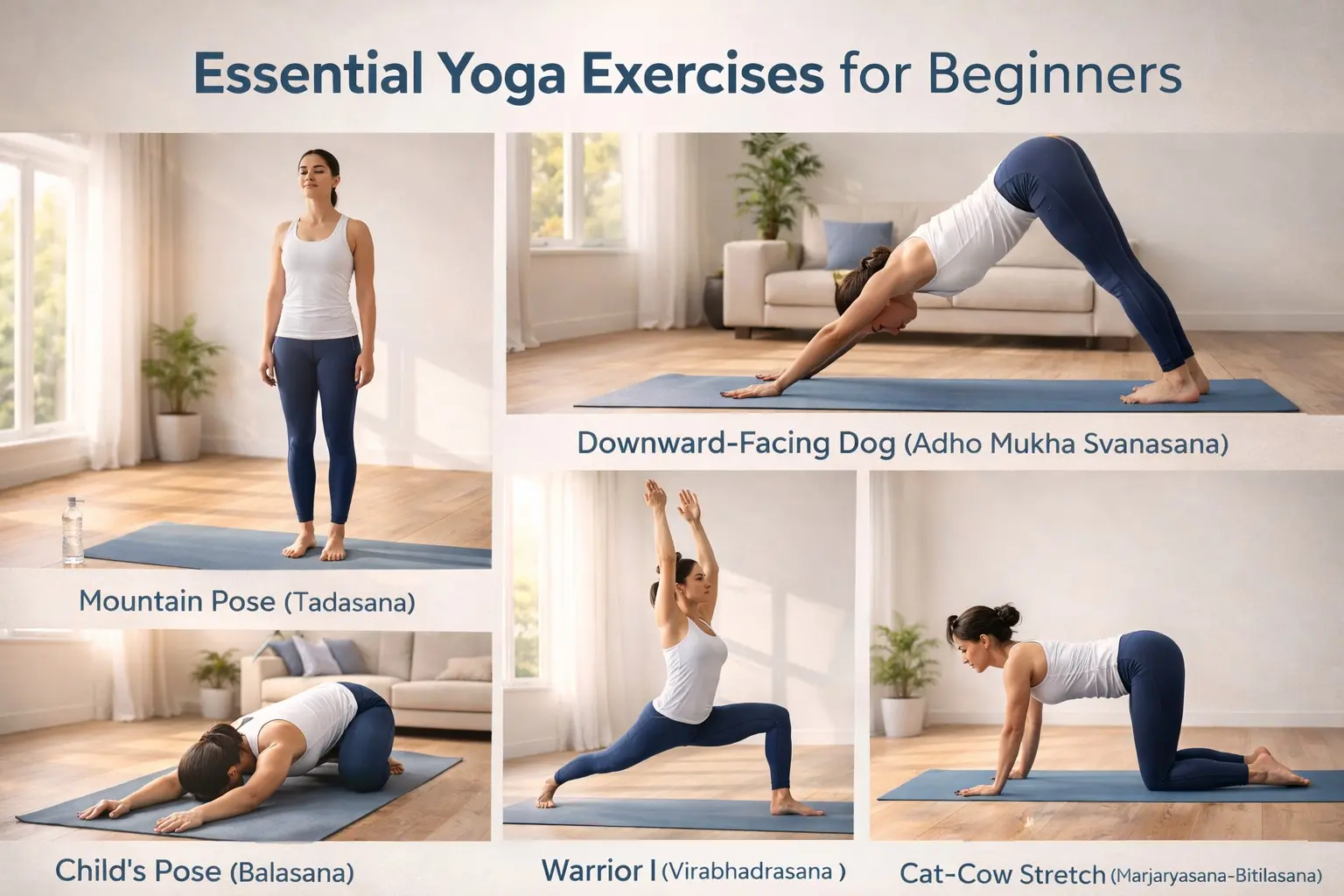
Let me walk you through the poses I started with. These are the foundations of any daily yoga routine.
1. Mountain Pose (Tadasana)
Why I Love It: This looks simple, but it teaches you proper alignment for everything else.
How to Do It
- Stand with feet hip-width apart
- Ground the heels, toes, and sides of your feet evenly into the surface.
- Engage your thighs slightly
- Pull your belly button toward your spine
- Roll your shoulders back and down
- Arms hang naturally at the sides
- Hold for 5-10 breaths
Common Mistake I Made – I used to lock my knees. Keep them soft—slightly bent, not rigid.
2. Downward-Facing Dog (Adho Mukha Svanasana)
This is the most famous yoga pose for a reason.
Benefits –
- Strengthens arms and shoulders
- Stretches hamstrings and calves
- Energizes the whole body
Step-by-Step –
- Start on hands and knees
- Spread fingers wide, press palms down
- Tuck toes and lift hips toward the ceiling
- Push the chest toward the thighs
- Heels reach toward the floor (they don’t have to touch!)
- Hold for 5-10 breaths
My Tip – Bend your knees slightly if your hamstrings are tight. This isn’t a flexibility contest—it’s about finding the right position for YOUR body.
3. Warrior I (Virabhadrasana I)
This pose builds serious leg strength.
How to Practice:
- Step right foot forward into a lunge
- Back foot turns out 45 degrees
- Bend the front knee to 90 degrees
- Raise arms overhead
- Square hips to front
- Hold for 5 breaths
- Switch sides
What It Builds –
- Quad and glute strength
- Hip flexibility
- Balance and focus
4. Child’s Pose (Balasana)
My favourite resting pose.
Instructions –
- Kneel on the floor
- Sit back on heels
- Fold forward, forehead to ground
- Arms extend forward or rest alongside the body
- Breathe deeply for 1-2 minutes
Why I Use It – Whenever I need a break during practice, I come here. It gently stretches your back and instantly calms your mind.
5. Cat-Cow Stretch (Marjaryasana-Bitilasana)
Perfect for spinal health.
The Movement:
- Start on hands and knees
- Inhale: arch back, lift chest (Cow)
- Exhale: round spine, tuck chin (Cat)
- Flow between these for 10 rounds
I Have Seen – People with chronic back pain find relief after just one week of daily Cat-Cow stretches.
Intermediate Yoga Exercises to Build Strength
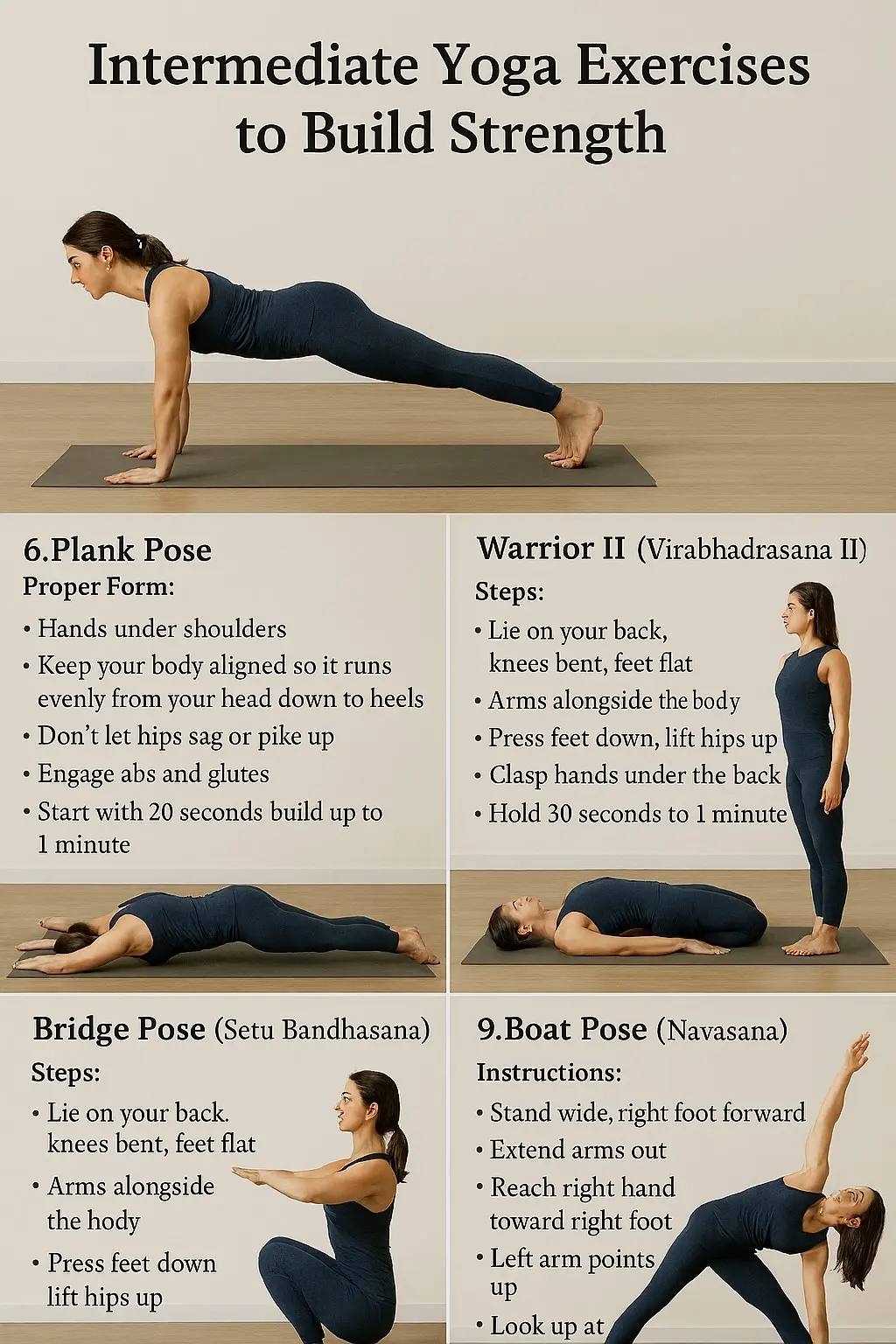
Once you master the basics, try these yoga postures and benefit-focused poses.
6. Plank Pose
The ultimate core builder.
Proper Form –
- Hands under shoulders
- Keep your body aligned, so it runs evenly from your head down to your heels.
- Don’t let hips sag or pike up
- Engage abs and glutes
- Start with 20 seconds, build up to 1 minute
My Challenge to You – Hold a plank for 30 seconds every morning. Watch your core transform in 30 days.
7. Warrior II (Virabhadrasana II)
Like Warrior I, but with a twist.
Setup –
- Feet wide apart
- Turn the right foot out 90 degrees
- Bend the right knee over the ankle
- Arms extend to the sides at shoulder height
- Gaze over the front fingers
- Hold 30 seconds on each side
Builds –
- Leg endurance
- Shoulder strength
- Mental stamina
8. Bridge Pose (Setu Bandhasana)
Fantastic for glutes and lower back.
Steps –
- Lie on your back, knees bent, feet flat
- Arms alongside the body
- Press feet down, lift hips up
- Clasp hands under the back
- Hold 30 seconds to 1 minute
I Like This Because – It counteracts all the sitting we do. Plus, you feel an immediate opening in your hip flexors.
9. Boat Pose (Navasana)
Core challenge accepted.
How to Practice:
- Sit with knees bent, feet on the floor
- Lean back slightly
- Lift feet off the ground
- Extend legs (or keep bent for easier version)
- Arms reach forward
- Hold 10-30 seconds
Tip: If you can’t straighten your legs, don’t worry. Bent knees still give you a solid core workout.
10. Triangle Pose (Trikonasana)
Incredible for full body stretching.
Instructions –
- Stand wide, right foot forward
- Extend arms out
- Reach right hand toward right foot
- Left arm points up
- Look up at the top hand
- Hold 30 seconds, switch sides
Creating Your Daily Yoga Routine at Home
Here’s where theory meets practice.
Morning Yoga Exercises (10-15 Minutes)
I do this sequence every morning. It takes 12 minutes.
The Flow –
- Mountain Pose – 1 minute
- Cat-Cow Stretch – 2 minutes
- Downward Dog – 1 minute
- Plank – 30 seconds
- Child’s Pose – 2 minutes
- Warrior I – 1 minute each side
- Forward Fold – 1 minute
- Mountain Pose – 30 seconds
Why This Works – It wakes up your body, gets blood flowing, and sets a positive tone for the day.
Evening Relaxation Routine (15-20 Minutes)
Perfect for winding down.
The Sequence –
- Child’s Pose – 3 minutes
- Cat-Cow – 2 minutes
- Downward Dog – 1 minute
- Forward Fold – 2 minutes
- Bridge Pose – 1 minute (3 rounds)
- Supine Twist – 2 minutes each side
- Savasana (Final Relaxation) – 5-10 minutes
I Have Tested This – For three months straight. My sleep quality improved dramatically, and I stopped waking up with a stiff neck.
Complete 30-Day Beginner Program
Here’s your roadmap to building a solid yoga workout at home practice.
Week 1-2: Foundation Building
Focus: Learn proper form
| Day | Routine | Duration |
| Monday | Basic poses practice | 15 min |
| Tuesday | Morning flow | 10 min |
| Wednesday | Rest or gentle stretching | 5 min |
| Thursday | Repeat Monday | 15 min |
| Friday | Morning flow | 10 min |
| Saturday | Longer practice | 20 min |
| Sunday | Rest | — |
Week 3-4: Building Strength
Focus: Hold poses longer, add variations
| Day | Routine | Duration |
| Monday | Strength-focused flow | 20 min |
| Tuesday | Balance poses | 15 min |
| Wednesday | Gentle stretching | 10 min |
| Thursday | Full-body flow | 25 min |
| Friday | Core-focused practice | 15 min |
| Saturday | Complete routine | 30 min |
| Sunday | Restorative yoga | 20 min |
Track Your Progress –
- Can you hold the plank 10 seconds longer?
- Are your hamstrings less tight?
- Do you feel calmer overall?
Common Mistakes (And How I Fixed Them)
Mistake #1- Holding Your Breath
What happened – I used to focus so hard on the pose that I forgot to breathe. This made everything harder and defeated the entire purpose.
The Fix – Set a reminder on your phone that says “BREATHE.” Sounds silly, but it worked for me. Now I count breaths—inhale for 4, exhale for 4.
Mistake #2 – Comparing Yourself to Others
My Experience – I watched Instagram yogis doing impossible poses and felt inadequate. Total waste of mental energy.
The Solution – Cover your mirror if you have one. Focus on how YOUR body feels, not how it looks or compares to others.
Mistake #3 – Skipping Warm-Up
The Problem: I jumped straight into deep stretches and pulled a hamstring. Not fun.
Now I always – Do 5 minutes of gentle movement first—Cat-Cow, neck rolls, shoulder circles. Your muscles need preparation.
Mistake #4 – Pushing Through Pain
Important Distinction –
- Discomfort = okay (that’s muscles working)
- Pain = stop immediately
I Learned This the Hard Way – pushed myself into a deep twist despite sharp pain. Ended up with a sore back for a week. Listen to your body’s signals.
Equipment You Actually Need
Let’s keep it real. You don’t need much.
Essential Items
Yoga Mat
- Why: Provides cushioning and grip
- My recommendation: Start with a basic $20 mat
Comfortable Clothes
- Stretchy leggings or shorts
- Fitted top (loose shirts fall over your head in downward dog)
- No shoes needed
Nice-to-have Items
Yoga Blocks (Set of 2)
- Purpose: Helps you reach the ground in poses
- I use mine in Triangle Pose
Strap or Belt
- Purpose: Assists in stretches where you can’t reach
- Successful for hamstring stretches
Bolster or Pillow
- Purpose: Support in restorative poses
- Just use your couch cushion initially
Breathing Techniques That Changed Everything
Yoga isn’t just physical. The breathing patterns make it work.
Ujjayi Breath (Ocean Breath)
How to Do It –
- Inhale through the nose
- Slightly constrict the throat
- Exhale through the nose, making an “ocean wave” sound
- Keep breathing audibly but smoothly
Why It Works – Creates internal heat, improves focus, and calms your mind instantly.
Box Breathing for Stress Relief
The Pattern –
- Inhale: 4 counts
- Hold: 4 counts
- Exhale: 4 counts
- Hold: 4 counts
- Repeat 5-10 times
I Use This – Before important meetings, during traffic, or when my anxiety spikes. Works every single time.
Yoga for Specific Goals
Building Muscle Strength
Best Poses –
- Plank variations
- Warrior sequences
- Chair Pose
- Boat Pose
My Routine – Hold each pose for 30-60 seconds, repeat 3 times. Do this 4 times weekly, and you’ll see muscle definition within 6 weeks.
Improving Flexibility
Focus On –
- Forward folds
- Hip openers (Pigeon Pose)
- Shoulder stretches
- Spinal twists
Timeline- Most people notice significant flexibility gains in 2-3 weeks with daily practice.
Stress and Anxiety Relief
Calming Poses –
- Child’s Pose
- Legs-Up-the-Wall
- Corpse Pose (Savasana)
- Gentle twists
Combine with: Deep breathing and meditation. Spend 15 minutes in the evening doing these poses while practicing Ujjayi breath.
Troubleshooting Common Challenges
“I’m Not Flexible Enough”
Reality Check – That’s exactly WHY you should do yoga. Flexibility comes WITH practice, not before it.
Start Here – Use blocks, bend your knees, and modify everything. I couldn’t touch my toes for three months. Now I can place my palm flat on the floor.
“I Don’t Have Time”
Truth – You have 10 minutes. Everyone does.
My Solution – Do yoga while coffee brews, during TV commercials, or right before bed. It doesn’t need to be a full hour to be effective.
“It’s Too Easy/Boring”
Then Level Up –
- Hold poses longer
- Add challenging variations
- Try power yoga or even flows
- Incorporate arm balances
Or – You might not be engaging your muscles properly. A “simple” downward dog becomes incredibly challenging when you fully activate every muscle.
Frequently Asked Questions About Yoga Exercises
What is the best yoga exercise?
The most effective exercise isn’t the same for everyone—it changes based on what you want to achieve. However, Downward-Facing Dog is often called the most complete pose because it strengthens arms, stretches hamstrings, energizes the body, and can be both a resting pose and an active strengthener. I consider it essential in any practice.
For overall body transformation, I’d say Sun Salutations (a flowing sequence of 12 poses) gives you the most complete workout in the shortest time.
What are the 5 basic yoga poses?
The five foundational yoga poses for beginners that every new practitioner should learn are:
- Mountain Pose (Tadasana) – Teaches proper alignment
- Downward-Facing Dog (Adho Mukha Svanasana) – Full-body strengthener
- Warrior I (Virabhadrasana I) – Builds leg strength and balance
- Child’s Pose (Balasana) – Essential resting position
- Cat-Cow Stretch (Marjaryasana-Bitilasana) – Spinal mobility
Master these five, and you have the foundation for any yoga practice.
What are the 12 basic yoga postures?
The traditional 12 basic asanas (from Sivananda yoga) are:
- Headstand (Sirsasana)
- Shoulderstand (Sarvangasana)
- Plow (Halasana)
- Fish (Matsyasana)
- Sitting Forward Bend (Paschimottanasana)
- Cobra (Bhujangasana)
- Locust (Salabhasana)
- Bow (Dhanurasana)
- Spinal Twist (Ardha Matsyendrasana)
- Crow/Peacock (Kakasana/Mayurasana)
- Standing Forward Bend (Pada Hastasana)
- Triangle (Trikonasana)
For beginners, I recommend starting with safer alternatives to inversions like the headstand. Focus on the basics I outlined in this article first.
Is 30 minutes of yoga a day enough exercise?
Yes, absolutely. Thirty minutes of daily yoga routine provides excellent health benefits, especially when combined with mindful breathing and proper form.
Research from Harvard Medical School shows that 30 minutes of yoga daily can:
- Improve cardiovascular health
- Build and maintain muscle strength
- Increase flexibility and balance
- Reduce stress and anxiety
- Support healthy weight management
However, for optimal fitness, consider adding:
- 2-3 days of cardiovascular exercise (walking, cycling)
- Strength training if building significant muscle if your goal
I personally do 30 minutes of yoga 5 days a week and feel strong, flexible, and healthy. The key is consistency.
Can yoga flatten your belly?
Yes, but with realistic expectations. Yoga can contribute to a flatter belly through:
- Core Strengthening: Poses like Plank, Boat, and various balances engage abdominal muscles deeply
- Stress Reduction: Yoga lowers cortisol (stress hormone), which is linked to belly fat storage
- Improved Digestion: Twists and forward folds massage internal organs and improve digestive function
- Calorie Burning: Active yoga styles burn 200-400 calories per hour
The Honest Truth: Yoga alone won’t give you six-pack abs if you’re eating poorly. I’ve seen the best belly-flattening results when people combine:
- Regular yoga for strength and balance practice (4-5 times weekly)
- Mindful eating habits
- Adequate sleep (yoga helps with this!)
- Stress management (yoga excels here)
It took me about 3 months of consistent practice plus dietary awareness to see visible changes in my midsection. But the belly fat I lost stayed off—unlike with crash diets.
My Final Thoughts
Five years into my yoga journey, I’m still learning. Still discovering new poses, still working on flexibility, still using it as my go-to stress management tool.
What is a beautiful thing about yoga exercises? They meet you exactly where you are.
You don’t need to be flexible to start. You don’t need expensive equipment or a perfect body. You just need a little space, a few minutes, and the willingness to try.
Start with the basic routine I shared. Do it for two weeks. I promise you’ll feel different—physically, mentally, maybe even emotionally.
Your body can amaze you. Give it a chance to show you.
References
Harvard Medical School – “Yoga for Health Benefits and Cardiovascular Fitness”
https://www.health.harvard.edu/staying-healthy/yoga-benefits-beyond-the-mat
National Center for Complementary and Integrative Health – Yoga
https://www.nccih.nih.gov/health/yoga
Important Note: This article is for informational purposes only. I’m not a medical doctor, and this content doesn’t replace professional medical advice. Always consult your healthcare provider before starting any new exercise program, especially if you have existing health conditions or injuries. What I’ve shared comes from my personal experience and research, not medical training.
Ready to start your yoga journey? Grab a mat, clear some space, and try the 10-minute morning routine today. Your future self will thank you. 🧘♀️

Adel Galal is a health and wellness writer with over 30 years of experience studying and writing about health, fitness, nutrition, and healthy living. He is the founder of NextFitLife.com, where he shares practical, evidence-based guidance to support long-term health at any age. Adel’s mission is simple:
to help people make smarter health choices that fit real life, at any age.