Published on: Jul 26, 2022
Last updated: September 16, 2026
Next review: September 2027, or sooner if major weight management or exercise guidance changes
Written and source checked by: Adel Galal, Founder and Lead Writer at NextFitLife
Review status: This article is educational and source checked. It has not been medically reviewed by a doctor, registered dietitian, physiotherapist, yoga therapist, or certified fitness professional.
Health and Exercise Notice
This content is for general educational purposes and does not replace professional medical advice, diagnosis, or treatment. Consult an appropriately qualified healthcare professional for personal medical concerns. This article explains published guidance and does not provide a personal clinical assessment. Always consult qualified medical professionals for diagnosis and treatment of any health condition.
I am also not a registered dietitian, physiotherapist, yoga therapist, or certified personal trainer.
Talk with a qualified professional before starting a new exercise or weight loss plan if you are pregnant, recovering from surgery or injury, have severe obesity, heart disease, uncontrolled high blood pressure, glaucoma, osteoporosis, chronic joint pain, severe dizziness, an eating disorder history, or another condition that affects safe exercise.
Stop exercising if you develop chest pain, fainting, severe shortness of breath, sudden weakness, severe dizziness, or sharp pain.
Quick Answer: Can Beginners Lose Weight With Yoga?
Yoga for beginners weight loss can help when yoga becomes part of a sustainable lifestyle. Research suggests yoga may support modest reductions in body weight, body fat, BMI, and waist size in people with overweight or obesity. For stronger results, combine yoga with walking, strength activity, balanced eating, sleep, and a realistic calorie deficit.1
Yoga is useful.
It is not magic.
What Does Research Say About Yoga and Weight Loss?
The evidence is more encouraging than “yoga does nothing,” but less dramatic than many fitness blogs claim.
The National Center for Complementary and Integrative Health reports that a 2022 review of 22 studies involving 1,178 people with overweight or obesity found reductions in body weight, BMI, body fat, and waist size after yoga programs.1
That does not prove every yoga class causes weight loss.
The programs differed.
The people differed.
The yoga styles differed.
Some programs also included food changes or other parts of a weight management program.
One NCCIH supported trial used yoga inside a six month behavioral weight loss program. Both restorative hatha yoga and more active vinyasa yoga were practical additions, but the program also included dietary changes and behavioral support.2
That distinction matters.
Yoga for weight loss works best as one part of the plan, not as a replacement for the whole plan.
How Can Yoga Help With Weight Management?
Yoga can support weight management in several ways.
It Adds Physical Activity
Moving through poses uses energy.
A gentle class may be light activity.
A faster vinyasa yoga session may feel much more demanding.
NCCIH notes that yoga styles range from gentle to physically demanding, which is why one fixed calorie number for “an hour of yoga” is not reliable.1
It Can Build Some Strength
Chair pose, planks, lunges, and standing poses make your muscles work against gravity.
Yoga is not identical to progressive resistance training, but some forms can support strength and muscular endurance.
It May Support Stress Management
NCCIH reports evidence that yoga may help with stress management and mental wellbeing.1
Less stress does not automatically equal fat loss.
But feeling calmer can make it easier for some people to follow regular meals, sleep routines, and exercise habits.
It May Support Better Health Habits
Research summarized by NCCIH suggests regular yoga practice may be linked with healthier eating and activity habits.
This may help explain part of yoga's value in a long-term weight plan.1
Yoga Does Not Override Energy Balance
Body fat decreases over time when energy intake is lower than energy use.
Yoga can help increase activity.
It cannot cancel an eating pattern that consistently provides more energy than your body uses.
NIDDK recommends that safe weight loss programs include a reduced calorie eating plan, physical activity, behavior support, realistic goals, and a plan for keeping weight off.4
This is where yoga and calorie deficit fit together.
Yoga supports the activity side.
Your overall eating pattern still matters.
For a deeper explanation, read How Weight Loss Works.
5 Yoga Weight Loss Claims I Would Ignore
1. One Pose Burns Belly Fat
No pose removes fat only from your stomach.
You can strengthen abdominal muscles.
You cannot choose the exact place your body removes fat first.
NIDDK warns against weight loss programs that promise fat loss from one specific body part.4
2. Sweating Means You Burned More Fat
Sweat cools your body.
A temporary drop on the scale after a sweaty class is mainly fluid loss.
It is not the same as losing body fat.
3. Hot Yoga Melts More Fat
A hotter room makes you sweat more.
That does not turn sweat into extra fat loss.
Choose hot yoga because you enjoy the style and can practice it safely, not because you think heat melts body fat.
4. Advanced Poses Burn Fat Faster
A beginner does not need crow pose, handstands, chin stands, or difficult arm balances to lose weight.
Those poses add skill and injury risk before you have built the basics.
5. You Must Practice on an Empty Stomach to Burn More Fat
You do not need to fast before yoga for weight loss.
If a full meal makes movement uncomfortable, leave time for digestion.
If you become dizzy when exercising without food, eat appropriately before training.
There is no special one-hour fasting window that turns yoga into a fat-burning shortcut.
8 Beginner Yoga Moves to Learn First
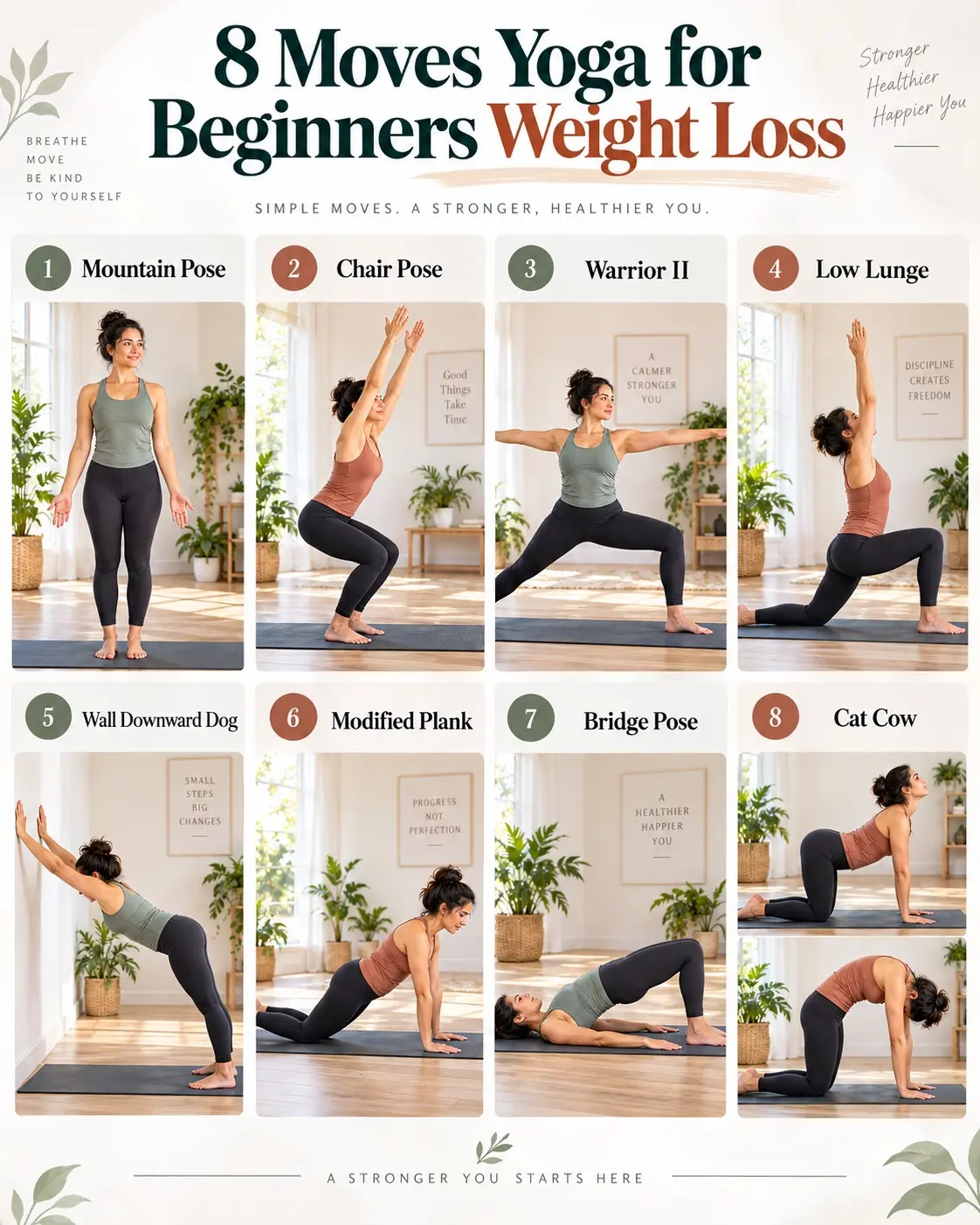
Use a wall, chair, yoga blocks, or a smaller range when needed.
| Move | Main focus | Beginner option |
|---|---|---|
| Mountain Pose | Posture and breathing | Stand near a wall for confidence |
| Chair Pose | Legs and trunk control | Use a real chair behind you |
| Warrior II | Leg strength and balance | Shorten your stance |
| Low Lunge | Hip mobility and leg control | Place your back knee on padding |
| Wall Downward Dog | Shoulders, back, and hips | Use a wall instead of the floor |
| Modified Plank | Core and upper body strength | Use knees or a wall |
| Bridge Pose | Glutes and posterior chain | Use a small comfortable lift |
| Cat Cow | Spinal movement and breathing | Move through a small range |
These yoga poses for beginners can be combined into a short home practice.
1. Start With Mountain Pose
Mountain pose looks simple.
That is useful.
Stand tall.
Keep your feet comfortable.
Relax your shoulders.
Breathe normally.
Notice where your weight sits on your feet.
This teaches you to pay attention before adding harder movement.
2. Use Chair Pose for Leg Strength
Stand with your feet in a comfortable position.
Move your hips back as if you are sitting toward a chair.
Keep your chest comfortable.
Use a real chair behind you if balance is uncertain.
Do not force a deep position.
A smaller controlled chair pose is more useful than a deep pose you cannot control.
3. Learn Warrior II Without Making the Stance Huge
Warrior II builds lower body endurance and balance.
Beginners often make the stance too long.
Shorten it.
Keep the front knee comfortable.
Keep your torso tall.
Use a wall or chair if needed.
4. Use a Low Lunge for Controlled Hip Movement
Step one foot forward.
Lower the back knee onto a padded surface.
Keep your front foot stable.
Stay tall instead of forcing the hips down.
You should feel controlled movement.
You should not feel sharp hip or knee pain.
5. Try Downward Dog at the Wall First
Full downward dog puts weight through the hands and shoulders.
That can be too much for some beginners.
Start at a wall.
Place your hands against it.
Step back.
Move your hips away until your arms and back feel comfortably long.
This keeps the movement easier to control.
6. Build a Modified Plank
You do not need a hard floor plank on day one.
Try a wall plank.
Then try an elevated plank using a stable surface.
Later, you can use your knees on the floor.
Keep breathing.
Stop before your lower back begins to sag.
This supports core control without turning the exercise into a contest.
For more beginner core work, see Core Workouts at Home.
7. Use Bridge Pose for Glutes and Hip Strength
Lie on your back with your knees bent.
Keep your feet comfortable.
Press through your feet and lift your hips a small amount.
Do not force your back into a large arch.
Lower slowly.
If floor exercise is uncomfortable or medically inappropriate for you, choose a standing alternative.
8. Finish With Slow Cat Cow Movement
Start on your hands and knees if that position is comfortable.
Move your spine gently as you breathe.
Do not push into the largest possible range.
Move slowly.
This is a good reminder that a yoga session does not need to end with exhaustion.
A Simple 20 Minute Beginner Yoga Flow
This yoga routine for beginners is a starting example.
It is not a medical prescription.
| Time | Movement | Focus |
|---|---|---|
| 3 minutes | Mountain pose and easy breathing | Warm up and posture |
| 4 minutes | Chair pose and Warrior II | Leg strength |
| 4 minutes | Low lunge and wall downward dog | Mobility and control |
| 4 minutes | Modified plank and bridge pose | Core and hip strength |
| 3 minutes | Cat cow and gentle movement | Mobility |
| 2 minutes | Quiet breathing or seated rest | Cool down |
Rest whenever you need to.
There is no prize for finishing faster.
How Often Should a Beginner Do Yoga for Weight Loss?
There is no magic weekly number.
If you are new, two or three short sessions can be a practical place to start.
Build duration only when the current routine feels manageable.
NCCIH notes that weight control programs with more frequent practice and longer duration tended to report better results, but the research programs varied widely.1
Do not turn that into “more yoga is always better.”
Your week needs recovery and other types of movement too.
Pair Yoga With Walking
Yoga and walking fit together very well.
Yoga gives you movement, mobility, balance, and some strength.
Brisk walking adds simple aerobic activity.
WHO recommends adults aim for 150 to 300 minutes of moderate aerobic physical activity each week, or 75 to 150 minutes of vigorous activity, plus muscle strengthening activity on two or more days.5
Not every yoga class reaches moderate aerobic intensity.
That is why walking is useful.
A simple week could look like this:
| Day | Activity |
|---|---|
| Monday | 20-minute beginner yoga |
| Tuesday | Brisk walk |
| Wednesday | Strength activity |
| Thursday | 20 to 30 minute yoga |
| Friday | Brisk walk |
| Saturday | Strength activity or longer walk |
| Sunday | Rest or gentle movement |
Change the days to suit your life.
For more options, read Best Exercises for Weight Loss.
Do Not Let Yoga Replace All Strength Training
Yoga can challenge muscles.
But if your goal includes maintaining or building muscle, dedicated strength training can still be useful.
WHO recommends muscle strengthening activity for all major muscle groups on two or more days each week.5
Strength work can include:
- Dumbbells
- Resistance bands
- Weight machines
- Bodyweight exercises
You do not need a bodybuilding program.
Two simple sessions can fit beside yoga and walking.
Use the NextFitLife Home Workouts and Equipment Guide for beginner options.
What Should You Eat if Weight Loss Is the Goal?
Do not turn yoga into permission to starve.
A good weight loss eating plan should still look like real meals.
NIDDK recommends a healthy reduced calorie eating pattern that fits your health, preferences, and life.4
A simple meal can include:
- A protein food
- Vegetables or fruit
- A suitable carbohydrate
- A source of healthy fat
Examples include eggs, fish, chicken, beans, lentils, tofu, yogurt, vegetables, fruit, oats, potatoes, rice, whole grains, nuts, seeds, and olive oil.
You do not need special “yoga foods.”
You do not need detox juice.
You do not need to stop eating after a certain clock time.
For a broader plan, visit the Weight Loss and Metabolism Hub.
Can Yoga Help With Mindful Eating?
Possibly.
NCCIH reports that some research links yoga with healthier eating and activity habits.1
Mindful eating does not mean eating perfectly.
It means paying attention.
Are you hungry?
Are you eating because you are stressed?
Are you already full?
Did you rush through the meal without noticing it?
Yoga may help some people become more aware of these signals.
That can support a weight management plan.
Can Yoga Reduce Belly Fat?
Yoga cannot choose where your body loses fat.
This is true even if a pose makes your abdominal muscles burn.
Yoga for belly fat is a misleading idea if it means spot reduction.
Planks and boat-type movements can strengthen abdominal muscles.
Overall body fat loss depends on the wider energy balance and weight management plan.
If body fat decreases, your waist may also change over time.
But no specific pose can guarantee that result.
Hatha or Vinyasa: Which Is Better for Beginners?
Start with the style you can perform safely and repeat.
Hatha Yoga
Hatha yoga is often slower.
That can make it easier to learn basic positions and breathing.
Vinyasa Yoga
Vinyasa yoga links movements together more continuously.
It can feel more physically demanding.
The NCCIH supported weight management trial found that both restorative hatha and vinyasa could be incorporated into a behavioral weight loss program.2
You do not need the harder style to make progress.
Do You Need Hot Yoga for Weight Loss?
No.
A hot room is not required for fat loss.
You may sweat more.
That does not mean you lost more body fat.
Hot yoga can also make hydration and heat tolerance more important.
If you are a beginner, a normal temperature class is usually easier for learning form and noticing how your body feels.
A Simple 4 Week Beginner Plan
This plan is deliberately easy.
It gives you room to learn before adding more.
| Week | Yoga | Other movement |
|---|---|---|
| Week 1 | Two sessions of 15 to 20 minutes | Easy walking |
| Week 2 | Two or three sessions of about 20 minutes | Walking plus one strength session |
| Week 3 | Three sessions of 20 to 30 minutes | Walking plus one or two strength sessions |
| Week 4 | Keep the amount you can repeat comfortably | Build toward a balanced weekly activity plan |
You do not have to increase every week.
Repeat a week when needed.
Do Not Judge Yoga Only by the Scale
You may notice progress before body weight changes much.
Useful signs include:
- Better balance
- Improved mobility
- More control in poses
- Better exercise consistency
- Improved sleep
- Less stress
- Longer walks
- Greater strength
NCCIH reports evidence that yoga can support balance, stress management, sleep, and general wellbeing.1
Those benefits matter even if weight loss is slow.
For more on movement and wellbeing, see Physical Fitness and Mental Health.
How Can Beginners Practice Yoga More Safely?
NCCIH describes yoga as generally safe for healthy people when practiced appropriately, but injuries can occur.1
Beginners should make safety boring.
- Use a stable nonslip surface.
- Start with simple movements.
- Use blocks, walls, or a chair when useful.
- Do not force flexibility.
- Keep breathing.
- Stop before sharp pain.
- Do not copy advanced social media poses.
- Use a qualified instructor if you are unsure about form.
Learning yoga alone without supervision has been linked with greater injury risk in research summarized by NCCIH.1
When Should You Get Professional Advice First?
Ask a healthcare professional or suitably qualified instructor before beginning if you have:
- Pregnancy
- Recent surgery
- Severe back or neck pain
- Glaucoma or another eye condition affected by pressure
- Osteoporosis
- Balance problems
- Severe joint disease
- Uncontrolled blood pressure
- Heart disease
- Frequent dizziness or fainting
- A history of serious injury
- An eating disorder or history of disordered eating
Yoga can be modified.
But the right modification depends on the person.
8 Beginner Yoga Mistakes I Would Avoid
1. Starting With Advanced Poses
Build basics first.
2. Thinking Sweat Equals Fat Loss
Sweat is mainly about temperature control.
3. Chasing Pain in a Stretch
More range is not always better.
4. Holding Your Breath
Keep breathing during normal practice.
5. Doing Yoga but Ignoring Food
Weight loss still depends on the wider eating pattern.
6. Doing Only Yoga When You Need More Cardio
Gentle yoga may not meet your aerobic activity goal.
7. Skipping Strength Work Forever
Dedicated resistance exercise can support muscle and physical function.
8. Changing the Routine Every Few Days
Repeat simple movements long enough to learn them.
How I Would Judge a Beginner Yoga Weight Loss Plan
I would not ask which pose burns the most calories.
I would ask:
Can you do the routine without pain?
Can you repeat it next week?
Are you also walking or getting other aerobic activity?
Are you eating normal balanced meals?
Are you sleeping?
Are you building strength?
Does the routine make you feel more capable rather than punished?
That is a much better test than how much you sweat.
Conclusion: Use Yoga as Part of the Plan
Yoga for beginners weight loss works best when you stop asking yoga to do everything.
Use yoga for movement, control, balance, some strength, stress support, and a routine you enjoy.
Add walking for aerobic activity.
Add strength work.
Eat in a way that supports a realistic calorie deficit if weight loss is appropriate for you.
Sleep.
Give the plan time.
Your next step: choose four of the eight beginner moves above and complete one 15 to 20 minute session this week. Then add a walk on another day.
References and Sources
- National Center for Complementary and Integrative Health. Yoga: Effectiveness and Safety.NCCIH Yoga Effectiveness and SafetyUsed for yoga safety, yoga styles, weight control evidence, stress, sleep, balance, wellbeing, and healthy behaviour research.
- National Center for Complementary and Integrative Health. Study Sees Beneficial Role of Yoga in Weight Loss Program for Adults With Obesity or Overweight.NCCIH Yoga and Weight Loss Study SummaryUsed for the role of restorative hatha and vinyasa yoga inside a six month behavioral weight management program.
- Centers for Disease Control and Prevention. Steps for Losing Weight.CDC Steps for Losing WeightUsed for gradual weight management, food, physical activity, sleep, stress, and realistic planning.
- National Institute of Diabetes and Digestive and Kidney Diseases. Choosing a Safe and Successful Weight Loss Program.NIDDK Safe Weight Loss Program GuideUsed for realistic goals, reduced calorie eating plans, physical activity, tracking, long term support, and warnings about unrealistic or targeted fat loss promises.
- World Health Organization. Physical Activity Recommendations.WHO Physical Activity GuidanceUsed for adult aerobic activity and muscle strengthening recommendations.
Continue Reading on NextFitLife
Use these guides to build the rest of your yoga, fitness, and weight management plan.
- Weight Loss and Metabolism Hub for food, portions, activity, sleep, tracking, and safe progress.
- Home Workouts and Equipment Guide for bodyweight exercise, strength, yoga mats, dumbbells, bands, and home training.
- How Weight Loss Works for energy balance and body fat basics.
- Healthy Rate of Weight Loss for realistic pacing and safer expectations.
- Best Exercises for Weight Loss for walking, cardio, resistance exercise, and exercise planning.
- Core Workouts at Home for beginner core control and simple home exercises.
- Physical Fitness and Mental Health for exercise, stress, sleep, mood, and wellbeing.
About the Author
Adel Galal is the founder and lead writer of NextFitLife.
He has maintained a personal interest in health, fitness, nutrition, sleep, wellness, and healthy aging for more than 30 years.
His health and wellness writing and research communication experience spans more than 15 years.
Adel is not a physician, registered dietitian, physiotherapist, yoga therapist, psychologist, pharmacist, certified personal trainer, or other licensed healthcare professional.
His role is research communication.
He compares reputable sources, checks important claims, separates stronger evidence from uncertain claims, and explains health and fitness topics in clear language.
Before founding NextFitLife, Adel spent 29 years working as an IT Manager for the Nestlé Egypt Region. His background in data, information systems, planning, structured review, and problem-solving supports his research process. These are not medical or fitness credentials.
For this article, the main claims about yoga, weight management, exercise safety, physical activity, and realistic fat loss were checked against NIH, CDC, NIDDK, and WHO sources.
Learn more about Adel, NextFitLife's research process, editorial standards, medical review policy, and corrections process on the About NextFitLife page.
Frequently Asked Questions About Yoga for Beginners Weight Loss
Can beginners lose weight with yoga?
Yoga can support weight loss as part of a broader plan. Research suggests yoga programs can help reduce body weight, BMI, body fat, and waist size in some people with overweight or obesity. Food, total activity, sleep, and long-term habits still matter.
How many days a week should I do yoga for weight loss?
There is no magic number. Beginners can start with two or three short sessions and build gradually. Your total weekly movement and ability to stay consistent matter more than forcing daily yoga.
Is 20 minutes of yoga enough for a beginner?
Yes. Twenty minutes is enough to learn basic movements and build a regular habit. You can increase time later if you enjoy it and recover well.
Which yoga is best for weight loss beginners?
Slower hatha classes can make basic poses easier to learn. Vinyasa is more continuous and can feel more demanding. Choose the style you can practice safely and consistently.
Does yoga burn belly fat?
No exercise can choose where your body loses fat. Yoga can strengthen your abdominal muscles, but overall fat loss depends on your broader weight management plan.
Does hot yoga burn more fat?
Hot yoga increases sweating, but extra sweat is not the same as extra body fat loss. A hot room is not required for weight loss.
Should I do yoga on an empty stomach?
You do not need to fast for yoga to burn fat. Avoid a very heavy meal immediately before practice if it makes movement uncomfortable. Eat if training without food causes dizziness or weakness.
Is yoga better than walking for weight loss?
They do different things. Walking is an easy way to add aerobic activity. Yoga can support mobility, balance, strength, stress management, and activity habits. Many beginners benefit from using both.
Do I still need strength training if I do yoga?
Yoga can challenge muscles, but dedicated resistance training can help build strength and preserve muscle. WHO recommends muscle strengthening activity for major muscle groups on at least two days each week.
Can I do yoga every day?
Some people enjoy daily gentle yoga. Hard sessions do not need to happen every day. Adjust intensity and rest if muscles or joints feel sore.
How long does yoga take to cause weight loss?
There is no reliable fixed timeline. Weight change depends on food intake, total activity, starting weight, health, sleep, medicine, and how consistently the plan is followed.
What should I do if yoga hurts?
Stop the painful movement. Reduce the range or use an easier option. Sharp or persistent pain is not something to push through. Seek qualified advice if pain continues.

Health & wellness writer with 30+ years of experience in nutrition, fitness, and healthy aging. Founder of NextFitLife.com — evidence-based health guidance.