
Published on: January 5, 2024
Updated on: October 24, 2026
A good abs workout at home does more than make your stomach burn. It should teach your trunk to bend, resist unwanted movement, control your pelvis, and keep your body stable while your arms and legs move.
You can train all of those skills on the floor with little or no equipment.
For most people, a simple routine built around crunches, planks, dead bugs, bird dogs, side planks, and controlled leg movements is more useful than racing through dozens of random ab exercises.
This article is for general information and education. It does not replace medical advice, diagnosis, or treatment.
I am not a dermatologist or a doctor, and this content does not replace professional medical advice. What I share comes from real life experience, extensive research, and consultation with healthcare providers. Always consult qualified medical professionals for diagnosis and treatment of any health condition.
For a wider fitness plan, visit the NextFitLife Fitness Hub, Home Workout Guide, and Healthy and Active Lifestyle Guide.
Table of Contents
- Quick Answer
- What Your Core Actually Does
- Can Ab Exercises Burn Belly Fat?
- 21 Home Core Exercises
- Flexion exercises
- Anti-extension exercises
- Side stability exercises
- Anti-rotation exercises
- Dynamic core exercises
- Best Exercises by Goal
- Beginner Workout
- 10 Minute Home Workout
- Sets, Reps, and Progression
- How Often to Train Abs
- Common Mistakes
- When to Stop
- Frequently Asked Questions
- References and Sources
Abs Workout at Home: Quick Answer
If you want one simple home routine, use these five movements:
- Dead bug
- Reverse crunch
- Forearm plank
- Side plank
- Bird dog
These exercises train different jobs instead of repeating the same crunch motion.
Start with two sets of each exercise. Use controlled repetitions or short holds, then make the movement harder as your strength improves.
What Does Your Core Actually Include?
Your core is more than the visible six pack.
It includes muscles that help control your ribs, pelvis, spine, and hips.
Important muscles include:
- Rectus abdominis
- Internal and external obliques
- Transverse abdominis
- Spinal muscles
- Diaphragm
- Pelvic floor
- Several muscles around the hips
They work together rather than switching on one at a time.
A Complete Core Workout Needs More Than Crunches
I like to think about core exercises by what your trunk has to do.
Flexion
Your trunk bends forward. Crunches and reverse crunches fit here.
Anti Extension
Your core resists excessive arching. Planks, dead bugs, and hollow hold progressions fit here.
Side Stability
Your trunk resists falling or bending sideways. Side planks fit here.
Anti Rotation
Your trunk resists twisting while your limbs move. Bird dogs and slow shoulder taps are useful home examples.
Controlled Rotation
Your torso rotates with control. Some twist variations can fit here, although they are not required for every routine.
Can an Abs Workout at Home Burn Belly Fat?
It can strengthen your abs. That part is clear.
But doing more crunches does not reliably remove the layer of fat sitting directly above those muscles.
A controlled study in which participants performed abdominal exercises five days per week for six weeks improved abdominal endurance but did not significantly reduce abdominal fat or waist measurements.
A small 2023 randomized trial produced a more interesting result. It found somewhat greater trunk fat loss in men who added high volume abdominal endurance work to treadmill training compared with treadmill training alone.
That study suggests local fat use may be more complex than the old “spot reduction is impossible” slogan.
But it does not mean 100 crunches will reliably burn stomach fat.
For visible abs, total body fat, genetics, muscle size, age, and where your body tends to store fat all matter.
If fat loss is one of your goals, see Weight Loss Immediately: What Actually Works.
1. Basic Crunch
The crunch trains spinal flexion and the rectus abdominis.
How to Do It
- Lie on your back with your knees bent.
- Place your hands across your chest or lightly beside your head.
- Brace your stomach.
- Lift your shoulders a short distance from the floor.
- Lower with control.
Do not pull your head forward with your hands.
2. Reverse Crunch
A reverse crunch moves the pelvis toward the rib cage.
- Lie on your back with your hips and knees bent.
- Bring your knees toward your chest.
- Gently curl your pelvis off the floor.
- Lower slowly.
This is not a separate “lower abs” muscle exercise. The rectus abdominis is one continuous muscle, although different movements can change where you feel the work.
For more variations, see the Lower Abs Workout Guide.
3. Dead Bug
The dead bug is one of the best beginner exercises for learning to control your trunk while your arms and legs move.
- Lie on your back.
- Bring your hips and knees to about 90 degrees.
- Raise your arms toward the ceiling.
- Brace your abdomen.
- Slowly extend the opposite arm and leg.
- Return and switch sides.
Only extend as far as you can without losing control of your trunk.
4. Heel Tap Dead Bug
This is an easier dead bug variation.
Keep both arms pointing upward while you lower one heel toward the floor at a time.
It works well when the full opposite arm and leg version is too difficult.
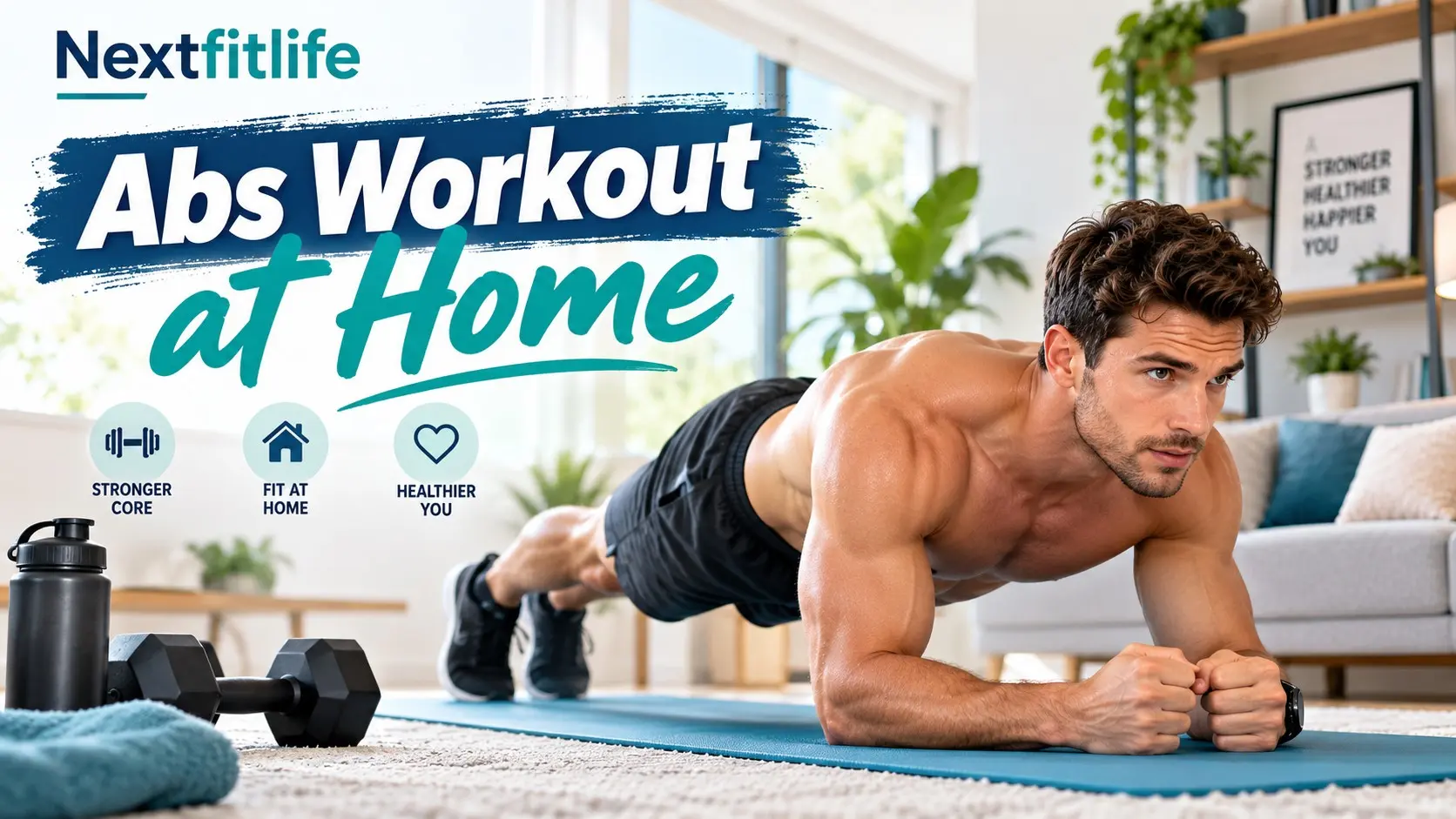
5. Forearm Plank
The plank teaches your core to resist extension.
- Place your forearms on the floor.
- Extend your legs behind you.
- Keep your ribs and pelvis controlled.
- Breathe normally.
Stop the hold when your hips begin sagging or you can no longer breathe comfortably.
You do not need to hold a plank for several minutes.
6. High Plank
This variation uses your hands rather than your forearms.
Keep your shoulders over your hands and your body controlled from head to heels.
If your wrists dislike the position, use the forearm plank instead.
7. Knee Plank
This is a useful beginner progression.
Place your knees on the floor while keeping the trunk controlled from the knees to the shoulders.
Do not treat an easier variation as a failure. A movement you can perform correctly is the right place to start.
8. Side Plank
The side plank trains lateral trunk stability.
- Lie on one side.
- Place your elbow below your shoulder.
- Stack or stagger your feet.
- Lift your hips.
- Keep the ribs and pelvis controlled.
Hold for a short period, then change sides.
9. Bent Knee Side Plank
If a full side plank is too difficult, keep your knees bent and support yourself from the forearm and knees.
This reduces the lever length while keeping the same basic side stability challenge.
10. Bird Dog
The bird dog combines trunk stability with opposite arm and leg movement.
- Start on your hands and knees.
- Reach one arm forward.
- Extend the opposite leg backward.
- Keep your hips facing the floor.
- Return slowly and switch sides.
Do not lift your leg so high that your lower back twists.
11. Bear Plank
Start on hands and knees, then lift your knees a few centimeters from the floor.
Keep your back controlled and breathe normally.
This creates a compact core stability challenge without needing any equipment.
12. Slow Shoulder Tap
Begin in a high plank.
Lift one hand and touch the opposite shoulder.
Your goal is to stop the pelvis from twisting rather than to tap as fast as possible.
Widen your feet if you need more stability.
13. Plank Reach
From a plank position, slowly reach one arm forward.
Keep the rest of your body as still as you reasonably can.
This increases the anti rotation and anti extension challenge.
14. Hollow Tuck Hold
This is a more accessible version of a full hollow body hold.
Lie on your back, bend your knees, lift your shoulders slightly, and keep your trunk controlled.
If your lower back arches strongly, make the exercise easier.
15. Hollow Body Hold
The full hollow hold is more advanced.
Extend your arms and legs farther from the body while maintaining trunk control.
Your arms and legs do not need to hover one centimeter above the floor. Use a position you can actually control.
16. Bent Knee Leg Lower
Lie on your back with your hips and knees bent.
Lower one foot toward the floor while keeping the pelvis controlled, then return.
This is often a better starting point than straight leg raises.
17. Straight Leg Lower
Straightening the legs creates a longer lever and makes the movement harder.
Lower only as far as you can without losing trunk control.
Your hip flexors will work too. That is normal.
18. Bicycle Crunch
The bicycle crunch combines flexion and rotation.
Move slowly enough to control the torso rather than racing your elbows toward your knees.
A smaller controlled movement is usually better than a large twisting motion driven by momentum.
19. Heel Reach
Lie on your back with knees bent and shoulders slightly raised.
Reach one hand toward the heel on the same side, return, and switch sides.
This is a simple dynamic exercise for the abdominal wall and obliques.
20. Slow Mountain Climber
Start in a high plank and bring one knee forward at a time.
Move slowly enough to keep your pelvis controlled.
Fast mountain climbers are useful for conditioning, but slow repetitions usually make more sense when the main goal is trunk control.
21. Bear Crawl
A bear crawl turns core stability into movement.
Start in a bear plank, then move the opposite hand and foot forward in small steps.
Keep the hips low and controlled.
You only need a few meters of space.
Which Ab Exercise Is Best for Each Goal?
| Goal | Good Starting Exercise | Why |
|---|---|---|
| Beginner control | Dead bug | Teaches trunk control while the limbs move |
| Ab flexion | Crunch | Simple rectus abdominis training |
| Anti extension | Forearm plank | Trains resistance to excessive trunk extension |
| Side stability | Side plank | Challenges lateral trunk control |
| Anti rotation | Slow shoulder tap | Makes the trunk resist twisting |
| Dynamic control | Bear crawl | Combines stability with coordinated movement |
| Home conditioning | Mountain climber | Combines trunk work with whole body movement |
Beginner Abs Workout at Home
You do not need all 21 exercises.
Start with five.
| Exercise | Sets | Target |
|---|---|---|
| Dead bug | 2 | 6 to 10 each side |
| Reverse crunch | 2 | 8 to 15 |
| Knee or forearm plank | 2 | 15 to 30 seconds |
| Bent knee side plank | 2 | 10 to 25 seconds each side |
| Bird dog | 2 | 6 to 10 each side |
Rest long enough to keep the next set controlled.
There is no prize for making your rest periods so short that your technique falls apart.
10 Minute Abs Workout at Home
Use this when time is short.
| Time | Exercise |
|---|---|
| Minute 1 | Easy warm up and breathing |
| Minutes 2 and 3 | Dead bugs |
| Minutes 4 and 5 | Reverse crunches |
| Minute 6 | Forearm plank |
| Minutes 7 and 8 | Side plank, one side each minute |
| Minute 9 | Bird dogs |
| Minute 10 | Slow mountain climbers or easy cool down |
You can divide the minute into work and rest as needed.
How Often Should You Train Your Abs?
You do not have to train them every day.
For most people, two or three focused sessions each week fit easily alongside a normal full body program.
Your core also works during squats, rows, presses, carries, walking, running, and many other activities.
Current CDC guidance recommends muscle strengthening activity for all major muscle groups on at least two days each week.
For a broader program, see How to Stay Fit.
Do You Need 20 Reps of Every Exercise?
No.
The best number depends on the exercise and your current strength.
A plank may be measured in seconds. A dead bug may use controlled repetitions on each side. A harder crunch variation may need fewer repetitions than a simple heel tap.
The important part is making the exercise gradually more challenging as you improve.
How to Make Home Ab Exercises Harder
You can use progressive overload without buying gym equipment.
Try one change at a time:
- Add controlled repetitions
- Add a little holding time
- Use a longer lever
- Move more slowly
- Use a harder exercise variation
- Add a light dumbbell when appropriate
- Add another set when recovery is good
You do not need “muscle confusion.”
Your muscles need a reason to adapt, followed by enough recovery to do so.
Do Abs Need to Be Trained First?
No.
If core strength is your main priority, doing it early can make sense because you are fresh.
But if you are about to perform heavy squats, deadlifts, or another exercise that needs strong trunk stability, exhausting your abs first may make the rest of the session worse.
Place core training where it fits your main goal.
Do Short Rest Periods Burn More Belly Fat?
There is no need to turn every ab session into a breathless circuit.
Short rest makes a workout feel harder, but feeling exhausted is not the same as building more core strength or losing more abdominal fat.
Rest long enough to perform the next set well.
Do You Need Unstable Surfaces?
No.
Balls, suspension trainers, and unstable surfaces can change the challenge, and research in athletes suggests some instability training can improve trunk strength.
But a stable floor is enough to build a strong core.
The best equipment is not automatically the least stable equipment.
Can Core Training Help Low Back Pain?
Core training can be useful for some people with chronic nonspecific low back pain.
Recent systematic reviews found improvements in pain and function from several forms of core training.
That does not mean every person with back pain should copy a generic ab circuit from the internet.
Back pain has many causes and presentations.
If pain is persistent, severe, or associated with leg weakness, numbness, bowel or bladder changes, fever, unexplained weight loss, or significant trauma, seek medical assessment.
What About Pregnancy and Postpartum Training?
Pregnancy and postpartum exercise deserve individual adjustments.
A movement that was comfortable before pregnancy may not feel right later.
If you have pelvic heaviness, leaking, pain, a significant abdominal bulge, or concerns about diastasis recti, ask a qualified healthcare professional or pelvic health physical therapist for guidance.
If you are returning to running after pregnancy, see the Postpartum Running Plan.
10 Common Home Ab Workout Mistakes
1. Pulling on Your Neck
Your hands should not drag your head through a crunch.
2. Holding Your Breath
Breathe through controlled repetitions and holds.
3. Chasing Huge Plank Times
A shorter strong plank is more useful than several minutes with sagging hips.
4. Doing Only Crunches
Add anti extension, side stability, and anti rotation work.
5. Racing Through Bicycle Crunches
Slow the movement so your torso controls the rotation.
6. Lowering Your Legs Too Far
Use the range you can control rather than forcing the heels close to the floor.
7. Thinking More Burn Means More Fat Loss
A burning muscle tells you it is working. It does not prove fat above that muscle is disappearing.
8. Changing the Routine Every Session
Keep key exercises long enough to improve them.
9. Ignoring Full Body Training
Your core is one part of a complete fitness program.
10. Training Through Sharp Pain
Hard work and sharp pain are not the same thing.
When Should You Stop an Ab Exercise?
Stop and seek appropriate advice if exercise causes:
- Sharp or severe abdominal pain
- Chest pain
- Fainting
- Severe shortness of breath
- New numbness or weakness
- Persistent pain shooting into a leg
- A new painful abdominal bulge
- Loss of bowel or bladder control
Exercise should challenge you, not make you ignore warning signs.
Conclusion
A strong abs workout at home does not need dozens of crunches or fancy equipment.
Train several core functions, progress the exercises gradually, and combine your ab work with full body strength, regular movement, and sensible nutrition.
Start today with dead bugs, reverse crunches, a plank, side planks, and bird dogs. Keep the session short enough that you can repeat it consistently.
References and Sources
- American College of Sports Medicine. Resistance Training Guidelines Update. 2026.
https://acsm.org/resistance-training-guidelines-update-2026/ - Centers for Disease Control and Prevention. Physical Activity Guidelines for Adults.
https://www.cdc.gov/physical-activity-basics/guidelines/adults.html - World Health Organization. Physical Activity Recommendations.
https://www.who.int/europe/news-room/fact-sheets/item/physical-activity - Reed CA, et al. Core Training and Performance: A Systematic Review With Meta Analysis.
https://pubmed.ncbi.nlm.nih.gov/37867742/ - Vispute SS, et al. The Effect of Abdominal Exercise on Abdominal Fat.
https://pubmed.ncbi.nlm.nih.gov/21804427/ - Brobakken MF, et al. Abdominal Aerobic Endurance Exercise Reveals Spot Reduction Exists: A Randomized Controlled Trial.
https://pubmed.ncbi.nlm.nih.gov/38010201/ - Igarashi Y, et al. Exercise Programs to Reduce Abdominal Visceral and Subcutaneous Fat. Systematic Review and Meta Analysis. 2025.
https://pubmed.ncbi.nlm.nih.gov/41109785/ - Guo Y, et al. Effects of Different Types of Core Training on Chronic Nonspecific Low Back Pain. 2025.
https://pubmed.ncbi.nlm.nih.gov/41178988/
Internal Links + Hub
- NextFitLife Fitness Hub for strength, cardio, mobility, and home workout guidance.
- Lower Abs Workout for more abdominal exercise variations and core training ideas.
- Effective Workout Routines at Home for simple full body home programs.
- Home Workouts and Equipment for exercise ideas with little or no equipment.
- Dumbbell Workouts at Home for resistance training when you want to progress beyond bodyweight exercises.
- Weight Loss Immediately for realistic guidance on fat loss and early scale changes.
- How to Stay Fit for creating a sustainable weekly fitness routine.
- Healthy and Active Lifestyle for exercise, food, sleep, and recovery habits.
- Physical Fitness and Mental Health for the wider benefits of regular movement.
- Postpartum Running Plan for a gradual return to running after pregnancy.
About the Author
Adel Galal is a father of four, three sons and a daughter, and a grandfather of four, with 33 years of hands on parenting experience. He is the founder of Parnthub.com, based in Cairo, Egypt, where he shares practical guidance on feeding, development and family life from newborns to teenagers.
Adel is not a medical professional. Health articles cite trusted sources and are for general information only.
On NextFitLife, Adel researches and writes about fitness, strength training, home workouts, healthy aging, nutrition, and practical wellness habits with a focus on current evidence, realistic progression, and avoiding exaggerated exercise claims.
Learn more about Adel and NextFitLife on the About Us page.
Frequently Asked Questions
What is the best abs workout at home?
A simple routine can include dead bugs, reverse crunches, a forearm plank, side planks, and bird dogs. Together they train several core functions instead of repeating one movement.
How often should I do an abs workout at home?
Two or three focused core sessions each week are enough for many people. Your abs also work during full body resistance exercises and daily movement.
Can I train abs every day?
You can perform some light core work frequently, but daily hard abdominal training is not necessary. Core muscles also need recovery when the exercises are challenging.
Do ab exercises burn belly fat?
Ab exercises strengthen the abdominal muscles but are not a dependable way to selectively remove belly fat. Overall activity, nutrition, body fat, genetics, and other factors determine how visible the abs become.
Does spot reduction exist?
The evidence is mixed. An older abdominal exercise study found no local fat loss, while a small 2023 trial found greater trunk fat loss under a specific high volume abdominal endurance protocol. This does not make spot reduction a reliable weight loss strategy.
How long should a home ab workout last?
It does not need to be long. A focused 10 to 20 minute session can provide useful training when the exercises are challenging and performed consistently.
Are planks better than crunches?
They train different functions. Crunches train trunk flexion, while planks train the ability to resist extension. A complete program can include both.
What is the best beginner ab exercise?
The dead bug is a strong beginner option because it teaches trunk control while the arms and legs move. Knee planks and bent knee side planks are also useful starting exercises.
Are lower abs a separate muscle?
No. The rectus abdominis is one continuous muscle. Different movements can change where you feel tension, but there is not a separate lower abdominal muscle that can be isolated completely.
Do I need equipment for a home ab workout?
No. Dead bugs, planks, side planks, crunches, bird dogs, bear crawls, and many other effective core exercises need only floor space.
Do I need to hold a plank for several minutes?
No. Use a hold length that lets you maintain good trunk control and normal breathing. When a plank becomes easy, a harder variation can be more useful than simply extending the hold indefinitely.
Do unstable surfaces build a stronger core?
They can increase the stability challenge in some exercises, but they are optional. A stable floor is enough to build substantial core strength.
Can core exercises help low back pain?
Core training can improve pain and function for some people with chronic nonspecific low back pain, but back pain should not be self diagnosed. Persistent or concerning symptoms deserve professional assessment.
When should I stop an ab exercise?
Stop for sharp or severe pain, chest pain, fainting, new weakness or numbness, a painful abdominal bulge, severe shortness of breath, or loss of bowel or bladder control.

Health & wellness writer with 30+ years of experience in nutrition, fitness, and healthy aging. Founder of NextFitLife.com — evidence-based health guidance.

