
Published on: November 19, 2026
If your shoulders feel stiff, start with gentle movement instead of forcing your arms into deep stretches.
A useful yoga for stiff shoulders routine should make reaching, dressing, sitting, and everyday movement feel easier. It should not leave the joint sore or pinched.
Quick answer: Yoga for stiff shoulders works best when it combines gentle shoulder movement, upper back motion, breathing, and light control. Start with shoulder circles, Cat Cow, Thread the Needle, supported Puppy Pose, Eagle Arms, supported Cow Face Arms, Child’s Pose side reach, and a gentle chest opener. Stop if you feel sharp pain, numbness, weakness, or worsening symptoms.
This article is for general information and education. It does not replace medical advice, diagnosis, or treatment.
Get medical advice instead of stretching harder if you have sudden severe shoulder pain, cannot move your arm, have major swelling or deformity, persistent numbness or pins and needles, unexplained weakness, fever, or pain after a fall or injury. :chatgpt-content-reference{index="1"}
If you are preparing for exercise rather than treating simple stiffness, start with the NextFitLife Shoulder Mobility Routine. It combines upper back movement, shoulder blade control, and light shoulder work before lifting.
Table of Contents
- What stiff shoulders really mean
- 8 gentle yoga moves
- A simple 10 minute routine
- How hard a stretch should feel
- How long to hold shoulder stretches
- Why the upper back matters
- Why strength matters too
- Desk work and shoulder stiffness
- Frozen shoulder warning signs
- A four week progression
- Common mistakes
- References and Sources
- Internal Links and NextFitLife Hubs
- About the Author
- Frequently Asked Questions
What Do Stiff Shoulders Really Mean?
A shoulder can feel stiff for several reasons.
You may have spent a long time sitting, used the arm less than usual, trained hard, slept in an awkward position, or simply stopped moving through much range during the day.
But stiffness is not always just a tight muscle.
Persistent shoulder stiffness can also occur with frozen shoulder, arthritis, tendon problems, injury, or other conditions. NHS guidance advises assessment when pain is getting worse, movement becomes very difficult, or symptoms do not begin to improve after about two weeks. :chatgpt-content-reference{index="2"}
The better goal is not to force the shoulder farther.
The better goal is to move with less pain and more control.
8 Gentle Yoga Moves for Stiff Shoulders
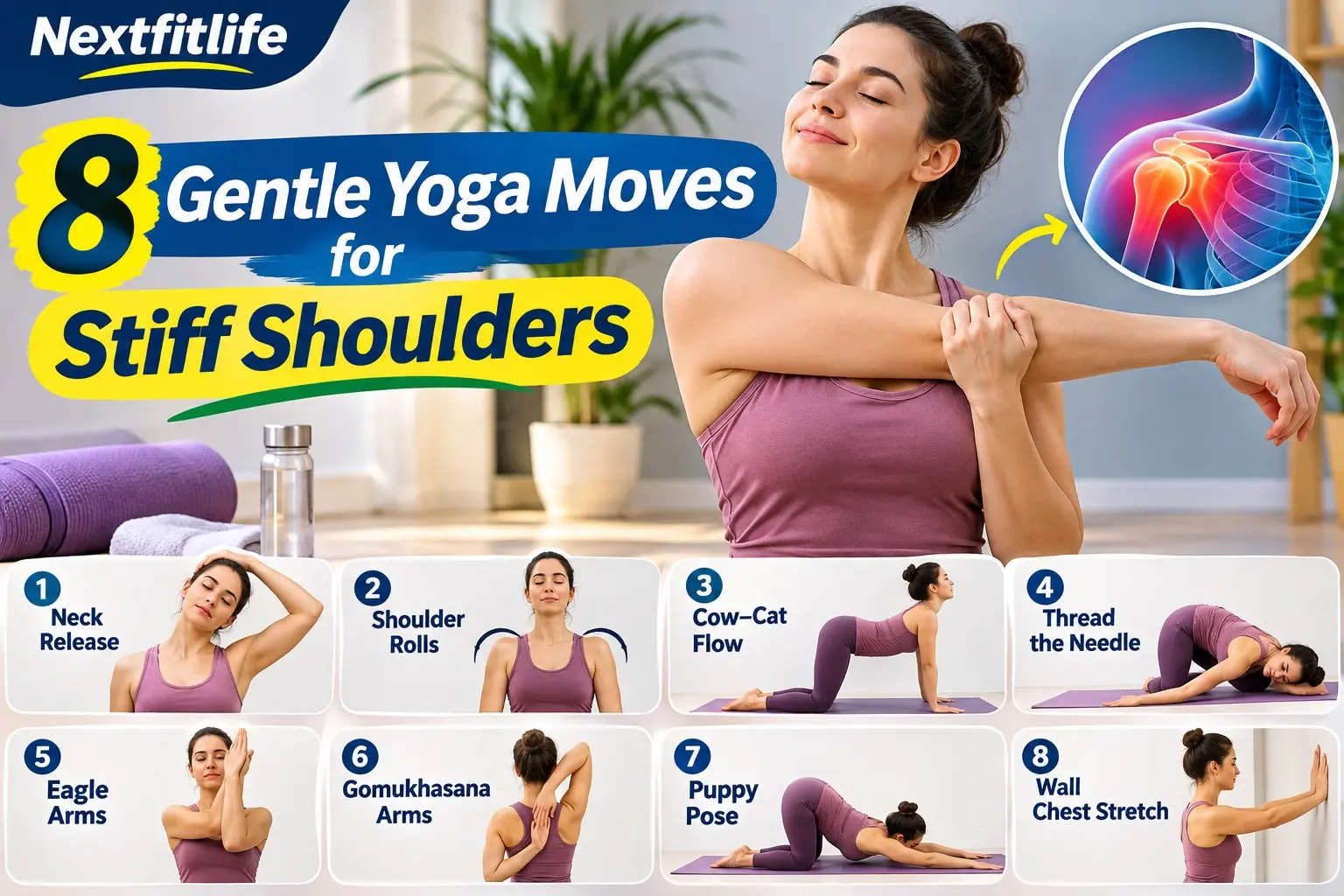
1. Shoulder Circles
Start with the simplest movement.
Sit or stand tall with your arms relaxed.
Slowly move the shoulders up toward the ears, back, down, and forward.
Do 5 to 8 smooth circles, then reverse direction.
Shoulder circles should feel easy. Do not make them huge if that creates pain or pinching.
Current shoulder rehabilitation guidance also uses gentle shoulder rolls as an early movement option. :chatgpt-content-reference{index="3"}
2. Cat Cow
Come onto your hands and knees.
As you inhale, gently lift the chest and let the upper back extend.
As you exhale, round through the upper back.
Keep the elbows soft.
Try 6 to 10 slow repetitions.
This move helps because shoulder movement is linked with the rib cage and upper back.
If putting weight through the hands hurts, do the same spinal movement while sitting on a chair.
3. Thread the Needle
Start on hands and knees.
Slide one arm underneath the other arm and let the upper back rotate gently.
Return slowly, then repeat.
Try 5 to 8 repetitions per side.
Thread the Needle is useful because it combines upper back rotation with shoulder movement.
Do not force the shoulder into the floor.
For more upper back work, see the NextFitLife Thoracic Mobility Exercises Guide.
4. Supported Puppy Pose
Full Puppy Pose can be too much when overhead range is limited.
Use a chair, bench, wall, or yoga blocks instead.
Place your hands on the support, step back, and gently move your chest downward.
Stop when you feel a mild stretch through the shoulders, chest, or upper back.
Keep your lower back comfortable.
Take 3 to 5 slow breaths.
A supported version gives you the same movement idea without forcing the shoulder into a deep position.
5. Eagle Arms
Sit or stand comfortably.
Reach both arms forward and cross one arm over the other.
Bend the elbows.
If your palms meet comfortably, bring them together.
If they do not, hold opposite shoulders instead.
You may feel the stretch between the shoulder blades and across the back of the shoulders.
Hold for 3 to 5 calm breaths, then switch sides.
Eagle Arms works better when you stop trying to make the pose look perfect.
6. Supported Cow Face Arms
Cow Face Arms can be useful, but it asks for a lot of shoulder motion at once.
Use a strap or towel.
Reach one arm overhead and bend the elbow so the hand moves behind your head.
Bring the other arm behind your back.
Hold the strap between your hands instead of forcing your fingers to touch.
Keep enough space between the hands that you can breathe and relax.
Hold for 15 to 30 seconds, then change sides.
A 2025 review of yoga and musculoskeletal conditions describes Cow Face Pose as combining several demanding shoulder motions, which is one reason modification makes sense when range is limited. :chatgpt-content-reference{index="4"}
7. Child’s Pose With Side Reach
Start in Child’s Pose.
If sitting toward the heels bothers your knees, place a cushion between the hips and heels.
Reach your arms forward.
Then walk both hands a little to the right.
You may feel a gentle stretch along the left side of the upper back and shoulder.
Return to the middle, then repeat on the other side.
Take 2 to 4 breaths per side.
8. Gentle Chest Opener With a Strap
Stand tall.
Hold a strap or towel behind your back with both hands.
Keep the hands wider than shoulder width.
Move the hands slightly away from your body until you feel a mild opening across the chest and front of the shoulders.
Do not pull the arms high behind you.
Hold for 15 to 30 seconds, then release.
A Simple 10 Minute Shoulder Yoga Routine
| Time | Movement | Main Goal |
|---|---|---|
| Minute 1 | Shoulder circles | Easy shoulder movement |
| Minutes 2 to 3 | Cat Cow | Upper back movement |
| Minutes 4 to 5 | Thread the Needle | Rotation |
| Minutes 6 to 7 | Supported Puppy Pose | Overhead range |
| Minute 8 | Eagle Arms | Back of shoulders |
| Minute 9 | Supported Cow Face Arms | Rotation |
| Minute 10 | Child’s Pose side reach | Side body and upper back |
The routine should leave your shoulders feeling easier to use.
If you finish with more pain than you started with, reduce the range or remove the movement that caused it.
How Hard Should a Shoulder Stretch Feel?
Mild tension is fine.
Sharp pain is not.
A comfortable shoulder stretch may feel like:
- Gentle pulling
- Mild tension
- Warmth
- A gradual sense of more space
Stop if you feel:
- Sharp pain
- Catching
- A deep joint pinch
- Numbness
- Tingling
- Sudden weakness
- A feeling that the shoulder is unstable
Current NHS shoulder exercise guidance repeatedly uses a pain guided approach rather than forcing range. :chatgpt-content-reference{index="5"}
How Long Should You Hold Shoulder Stretches?
For a gentle static shoulder stretch, about 10 to 30 seconds is a useful starting point for many adults.
You do not have to hold every stretch for a full minute.
If the stretch feels easier over time, you can increase the range a little or add controlled movement.
For a full guide, read 5 Smart Rules for How Long to Hold a Stretch.
Should You Stretch Before or After Exercise?
Before exercise, use more movement and fewer long passive stretches.
Good shoulder warm up options include:
- Shoulder circles
- Arm reaches
- Wall slides
- Cat Cow
- Light band work
Longer static holds usually fit better after training or during a separate flexibility session.
The Stretching Before or After Workout Guide explains why dynamic movement works well before most workouts.
Your Upper Back May Be Part of the Problem
The shoulder does not work alone.
Reaching overhead depends on the upper arm, shoulder blade, rib cage, collarbone, and upper back working together.
If the upper back barely moves, the shoulder may have to work harder.
Useful upper back drills include:
- Open Book rotations
- Thread the Needle
- Cat Cow
- Seated thoracic rotation
- Wall reach with rotation
For a full routine, use the 8 Smart Thoracic Mobility Exercises Guide.
More Stretching Is Not Always the Answer
A shoulder can have enough passive range but still feel weak or uncomfortable because you do not control that range well.
This is where shoulder strength matters.
Once gentle movement feels comfortable, useful options include:
- Wall push ups
- Light rows
- Wall slides
- Supported external rotation
- Assisted shoulder flexion
Recent NHS rehabilitation guidance combines mobility with progressive strengthening rather than treating stiffness with stretching alone. :chatgpt-content-reference{index="6"}
The broader research also suggests that specific shoulder exercise can improve pain and function in some shoulder conditions, although the best program depends on the diagnosis and individual. :chatgpt-content-reference{index="7"}
Can Yoga Improve Shoulder Mobility?
There is some supporting evidence, but it should not be oversold.
A 2024 systematic review found that yoga may improve shoulder flexion, although the evidence for shoulder mobility was limited. :chatgpt-content-reference{index="8"}
A broader 2025 review of yoga for musculoskeletal conditions also found improvements in some shoulder pain, mobility, strength, and disability outcomes, but the studies used different yoga styles and protocols. :chatgpt-content-reference{index="9"}
So the practical message is simple.
Yoga can be a useful movement tool, but it is not a cure for every shoulder problem.
What About Downward Facing Dog?
Downward Facing Dog can be useful if overhead shoulder movement is comfortable.
If reaching overhead already hurts, use a gentler version.
Try:
- Hands on a wall
- Hands on a chair
- A shorter stance
- Supported Puppy Pose instead
A wall version reduces body weight through the shoulders while keeping the reaching pattern.
What About Cow Face Pose?
The full arm position is not a flexibility test you need to pass.
Cow Face Arms combine several large shoulder movements at once.
Use a strap.
If the lower hand cannot move comfortably behind your back, stop earlier.
A wider gap between the hands is still useful.
What if Desk Work Makes Your Shoulders Feel Stiff?
Long periods in one position can leave your shoulders and upper back feeling stiff.
A short movement break may help more than one deep stretch.
Try this:
- Stand up.
- Roll your shoulders slowly.
- Reach overhead if comfortable.
- Rotate your upper back.
- Walk for one minute.
Then reassess.
Your body may simply need more movement variety.
Can Yoga Help Frozen Shoulder?
Frozen shoulder is different from ordinary stiffness.
It causes pain and loss of movement that can last for months and sometimes much longer. :chatgpt-content-reference{index="10"}
If you suspect frozen shoulder, work with a clinician or physiotherapist.
Gentle movement may be part of treatment, but aggressive stretching is not a good starting point.
NHS physiotherapy resources recommend gentle, comfortable movement and advise stopping or reducing exercises that make symptoms significantly worse. :chatgpt-content-reference{index="11"}
How Often Should You Do Yoga for Stiff Shoulders?
For simple stiffness without injury, a short routine can be used on most days if it feels comfortable.
You do not need a long session.
Five to ten minutes is enough to build consistency.
A simple weekly pattern could be:
- Three to five short mobility sessions
- Easy movement during desk breaks
- Light shoulder strength two or more days per week if appropriate
If the shoulder feels clearly worse the next day, reduce the range or the total amount.
A Simple Four Week Shoulder Progression
| Week | Focus | Main Goal |
|---|---|---|
| Week 1 | Shoulder circles, Cat Cow, Thread the Needle | Comfortable movement |
| Week 2 | Add supported Puppy Pose and Eagle Arms | Gentle range |
| Week 3 | Add supported Cow Face Arms and wall slides | Controlled range |
| Week 4 | Add light rows, wall push ups, or external rotation | Strength and control |
Progress only when the current level feels comfortable.
Common Mistakes With Yoga for Stiff Shoulders
Forcing the Hands Together Behind the Back
Use a strap.
Your shoulders do not need your fingertips to touch.
Pushing Too Deep Into Puppy Pose
A deeper stretch is not automatically better.
Use a wall or chair if the floor version pinches.
Ignoring the Upper Back
Shoulder and thoracic movement work together.
Train both.
Stretching Through Sharp Pain
Stop the movement instead of forcing it.
Doing Only Passive Stretching
Once movement feels comfortable, add light strength and control.
Holding Your Breath
If the position makes you brace and hold your breath, reduce the range.
When Should You See a Clinician?
Get medical advice if:
- Pain is getting worse
- It does not begin to improve after about two weeks
- It becomes very difficult to move the arm
- You have persistent night pain
- Stiffness keeps increasing
- You have unexplained weakness
- You have persistent numbness or pins and needles
Seek urgent care for sudden severe pain, major swelling, deformity, inability to move the arm, loss of feeling, severe pain after injury, or fever with a painful shoulder. :chatgpt-content-reference{index="12"}
Conclusion
Yoga for stiff shoulders works best when it is gentle, progressive, and paired with controlled movement.
Start with shoulder circles, Cat Cow, Thread the Needle, and supported Puppy Pose. Use straps and chairs instead of forcing deep shoulder positions, and add light strength once your range feels easier to control.
Your next step: try the 10 minute routine three times this week. If any movement causes sharp pain, numbness, weakness, or a deep joint pinch, stop that movement instead of trying to stretch through it.
References and Sources
- NHS. Shoulder Pain.
https://www.nhs.uk/symptoms/shoulder-pain/ - NHS. Frozen Shoulder.
https://www.nhs.uk/conditions/frozen-shoulder/ - Leeds Teaching Hospitals NHS Trust. Shoulder Exercises.
https://www.leedsth.nhs.uk/patients/resources/shoulder-exercises/ - Berkshire Healthcare NHS Foundation Trust. Physiotherapy Advice for Frozen Shoulder.
https://www.berkshirehealthcare.nhs.uk/advice/frozen-shoulder - PubMed. Exploring the Therapeutic Effects of Yoga on Spine and Shoulder Mobility: A Systematic Review.
https://pubmed.ncbi.nlm.nih.gov/39593648/ - PubMed Central. Yoga for Musculoskeletal Disorders: A Review of Prospective Clinical Studies.
https://pmc.ncbi.nlm.nih.gov/articles/PMC12638676/ - PubMed. Specific Modes of Exercise to Improve Rotator Cuff Related Shoulder Pain: Systematic Review and Meta Analysis.
https://pubmed.ncbi.nlm.nih.gov/40264916/
Internal Links and NextFitLife Hubs
- Shoulder Mobility Routine
- Thoracic Mobility Exercises
- How Long to Hold a Stretch
- Stretching Before or After Workout
- Morning Exercise Routine for Beginners
- Yoga for Tight Hips
- NextFitLife Health and Fitness Guides
- About NextFitLife
Frequently Asked Questions
What is the best yoga for stiff shoulders?
A gentle routine can include shoulder circles, Cat Cow, Thread the Needle, supported Puppy Pose, Eagle Arms, supported Cow Face Arms, Child’s Pose side reach, and a gentle chest opener. Use a comfortable range instead of forcing the shoulder.
How often should I do yoga for stiff shoulders?
For simple stiffness without injury, a short routine can be used on most days if it feels comfortable. Three to five short sessions per week is a practical starting point.
How long should I hold a shoulder stretch?
About 10 to 30 seconds is a useful starting point for many adults. Mild tension is fine, but sharp pain, numbness, weakness, or a deep joint pinch are reasons to stop.
Can yoga improve shoulder mobility?
Yoga may help shoulder mobility by combining movement, stretching, upper back motion, and control. Research is promising, but the evidence for shoulder mobility is still limited and depends on the specific condition and yoga program.
Should shoulder stretches hurt?
No. Mild pulling or tension is acceptable, but sharp pain, catching, numbness, tingling, weakness, or instability are reasons to stop and modify the movement.
Can yoga help frozen shoulder?
Gentle movement can be part of frozen shoulder care, but frozen shoulder is a medical condition rather than ordinary stiffness. Work with a clinician or physiotherapist instead of forcing deep stretches.
Is Puppy Pose good for stiff shoulders?
It can be useful, but the floor version may be too intense. A supported version with the hands on a wall, chair, bench, or blocks is often easier to control.
Do I need to stretch if my shoulders feel stiff from desk work?
Not always. A short movement break with shoulder rolls, easy reaching, upper back rotation, and walking may help more than one deep stretch.
Should I strengthen stiff shoulders too?
Yes, once movement feels comfortable. Light rows, wall push ups, wall slides, and supported external rotation can help you control the range you have.
When should shoulder stiffness be checked by a clinician?
Get medical advice if stiffness keeps worsening, movement becomes very difficult, pain does not begin to improve after about two weeks, or you develop weakness, persistent numbness, severe night pain, fever, or symptoms after injury.

