
Published on: October 22, 2023
Updated on: October 23, 2026
This 20 minute yoga workout gives you enough time to move your spine and hips, challenge your balance, use your legs and core, breathe more slowly, and finish with a short period of relaxation.
You do not need advanced flexibility. You do not need to touch your toes, stand on your head, or force yourself into painful positions.
Twenty minutes can be a useful yoga session, especially when you repeat it consistently. It should not be sold as a complete replacement for cardio and strength training, though. Think of it as one useful piece of a broader fitness routine.
Important: This article is for general information and education. It does not replace medical advice, diagnosis, or treatment.
I am not a dermatologist or a doctor, and this content does not replace professional medical advice. What I share comes from real life experience, extensive research, and consultation with healthcare providers. Always consult qualified medical professionals for diagnosis and treatment of any health condition.
For a broader approach to exercise, visit the NextFitLife Fitness Hub. You can also read Physical Fitness and Mental Health for more on the connection between regular movement and emotional wellbeing.
Table of Contents
- Quick Answer
- What 20 Minutes of Yoga Can Do
- Your Exact 20 Minute Routine
- Mountain Pose and breathing
- Cat Cow
- Half Sun Salutation
- Low Lunge
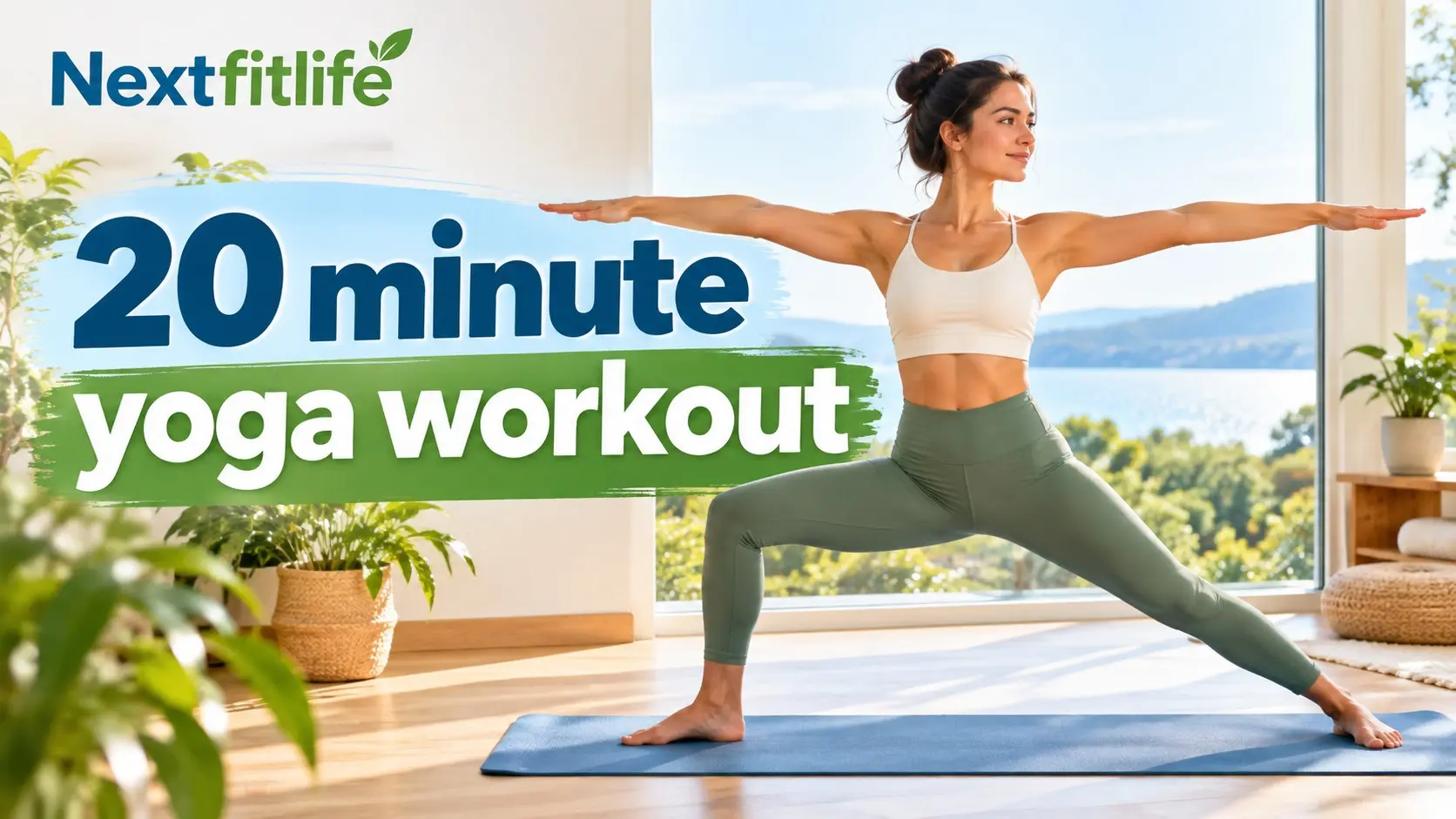
- Warrior II
- Chair Pose
- Tree Pose
- Bridge Pose
- Final Relaxation
- Beginner Modifications
- Morning or Evening Yoga
- Yoga and Weight Loss
- Yoga and Back Pain
- Yoga and Stress
- How Often to Practice
- Safety and Warning Signs
- Frequently Asked Questions
- References and Sources
Is a 20 Minute Yoga Workout Worth Doing?
Yes.
A short yoga routine can be useful when the alternative is doing nothing because you do not have an hour available.
Yoga combines physical postures, breathing, and sometimes meditation or focused attention. Depending on the style, it can challenge mobility, muscular endurance, balance, coordination, and concentration.
The National Center for Complementary and Integrative Health reports that yoga may support general wellness, stress management, emotional health, sleep, and balance.
That does not mean 20 minutes does everything.
CDC currently recommends adults accumulate at least 150 minutes of moderate intensity aerobic activity per week or 75 minutes of vigorous activity, plus muscle strengthening on at least two days each week.
A gentle 20 minute yoga session does not automatically meet those aerobic or strength goals.
For an all around lifestyle approach, see Healthy and Active Lifestyle.
What Can 20 Minutes of Yoga Actually Do?
I would describe the benefits in practical terms rather than promising a transformation.
A regular 20 minute yoga routine can give you time to:
- Move joints through comfortable ranges
- Practice balance
- Use your legs and trunk
- Work on body awareness
- Slow your breathing
- Take a mental break
- Practice gentle flexibility
The benefit you get depends on which poses you choose and how you practice them.
Holding Warrior II is different from lying in a relaxation pose. A flowing sequence is different from a gentle restorative session.
Your Complete 20 Minute Yoga Workout
This routine uses nine movements and positions. The timing adds up to exactly 20 minutes.
| Move | Time | Main Focus |
|---|---|---|
| Mountain Pose and Breathing | 2 minutes | Posture and breathing |
| Cat Cow | 2 minutes | Spinal movement |
| Half Sun Salutation | 3 minutes | Whole body movement |
| Low Lunge | 3 minutes | Hips and legs |
| Warrior II | 3 minutes | Legs, balance, shoulders |
| Chair Pose | 1.5 minutes | Leg strength |
| Tree Pose | 2 minutes | Balance |
| Bridge Pose | 1.5 minutes | Hips and trunk |
| Final Relaxation | 2 minutes | Breathing and relaxation |
1. Mountain Pose and Slow Breathing: 2 Minutes
Start standing in a comfortable position.
Your feet can be together or slightly apart. There is no prize for forcing them into one exact position.
How to Do It
- Stand tall without locking your knees.
- Let your arms rest beside your body.
- Relax your shoulders.
- Breathe in comfortably through your nose if that feels natural.
- Exhale slowly without forcing the breath.
Do not try to take the biggest breath possible.
Use calm, comfortable breathing.
This first two minutes gives you time to notice how your body feels before you start moving.
2. Cat Cow: 2 Minutes
Move onto your hands and knees.
Place your hands under or near your shoulders and your knees under your hips.
How to Do It
- Slowly lift your chest and allow your spine to extend comfortably.
- Then gently round your back.
- Move between the two positions without forcing either end.
- Continue with slow breathing.
The movement should feel smooth.
If putting weight through your wrists hurts, place your forearms on a firm raised surface or skip this pose and use gentle seated spinal movement instead.
3. Half Sun Salutation: 3 Minutes
A full Sun Salutation can include planks, downward dogs, and lower pushup positions. Those are not necessary for this beginner friendly routine.
Use a simpler version.
How to Do It
- Stand tall.
- Inhale and reach your arms upward within a comfortable range.
- Exhale and hinge forward from the hips.
- Bend your knees as much as needed.
- Place your hands on your thighs or shins and lengthen your spine halfway up.
- Fold comfortably again.
- Return to standing.
Move slowly for several rounds.
You do not need straight knees in a forward fold.
Bending them often makes the movement more comfortable.
4. Low Lunge: 3 Minutes
A low lunge works the hips and legs while challenging control.
How to Do It
- Step one foot forward.
- Place the opposite knee gently on a mat or folded towel.
- Keep the front foot flat.
- Let your hips move forward only as far as comfortable.
- Keep your hands on your thigh or blocks if needed.
Spend about 90 seconds on each side, including the transition.
You should feel a mild stretch or muscular effort, not sharp pain.
5. Warrior II: 3 Minutes
Warrior II combines leg work, shoulder endurance, balance, and attention.
How to Do It
- Stand with your feet apart.
- Turn one foot outward comfortably.
- Bend that knee over the same general direction as the toes.
- Extend your arms out to the sides.
- Keep your shoulders relaxed.
- Look forward or toward the front hand.
Spend about 90 seconds on each side, allowing time to change position.
The front knee does not need to form an exact 90 degree angle.
Choose a depth you can control.
6. Chair Pose: 90 Seconds
Chair Pose gives this routine a little more leg work.
How to Do It
- Stand with your feet in a comfortable position.
- Bend your knees and send your hips slightly backward.
- Keep your chest comfortably lifted.
- Reach your arms forward or upward if your shoulders allow.
- Stand up when you need a break, then repeat.
You do not have to hold Chair Pose for 90 seconds without stopping.
Try several shorter holds.
If your knees hurt, reduce the depth or use controlled chair stands instead.
7. Tree Pose: 2 Minutes
Tree Pose turns the session toward balance.
Stand near a wall, counter, or sturdy chair.
How to Do It
- Shift your weight onto one foot.
- Place the other heel near your ankle or the sole against the lower leg.
- Avoid pressing your foot directly into the side of the knee.
- Use one hand for support if needed.
- Focus on one stable point in front of you.
Practice for about one minute per side.
Holding the wall does not make the pose a failure.
It lets you practice balance with less fall risk.
8. Bridge Pose: 90 Seconds
Lie on your back with your knees bent and feet on the floor.
How to Do It
- Keep your feet comfortably apart.
- Press into the floor.
- Lift your hips to a comfortable height.
- Pause briefly.
- Lower slowly.
Repeat several controlled times rather than holding one long bridge.
You should mainly feel your hips and legs working.
If lying on the floor is not comfortable or practical, replace Bridge Pose with several slow chair stands.
9. Final Relaxation: 2 Minutes
Finish by lying comfortably, sitting in a chair, or resting in another position that feels safe.
Let your breathing settle.
There is no need to force your thoughts away.
Notice the floor or chair supporting you, relax unnecessary tension, and allow the final two minutes to be quiet.
This is not wasted workout time.
The calming side of yoga is part of the practice.
What If You Are a Complete Beginner?
Use fewer poses and more support.
A beginner yoga workout does not need to look like a social media yoga video.
Modify the routine like this:
- Place a folded towel under sensitive knees.
- Use a chair or wall for balance.
- Bend your knees during forward folds.
- Keep lunges shallow.
- Use a shorter stance in Warrior II.
- Perform Chair Pose as chair stands.
- Skip any movement that causes sharp pain.
Comfortable effort is fine.
Pain is not a flexibility test you need to pass.
Do You Need to Be Flexible Before Starting Yoga?
No.
Saying you are too inflexible for yoga is a little like saying you are too weak to begin strength training.
You start where you are.
Flexibility can improve with regular stretching and movement practice. A 2024 systematic review involving 189 studies and more than 6,600 adults found that static stretching improved flexibility both after individual sessions and over repeated training.
Yoga is more complex than static stretching alone, but flexibility work is one part of many yoga practices.
Your goal is not to copy the deepest position another person can reach.
Is Morning the Best Time for a 20 Minute Yoga Workout?
Morning is convenient, not magical.
A morning routine can help you create a consistent habit before the day gets busy.
The gentle movement may also feel good after spending hours in bed.
But evening yoga can work just as well if that is when you have time.
If a relaxing evening session helps you slow down before bed, use it then.
The best time is the time you can practice consistently.
Can Yoga Reduce Stress?
There is reasonable evidence that yoga can help some people manage stress, although research quality varies.
A 2024 systematic review included 13 randomized controlled trials with 1,026 stressed adults.
The researchers found evidence of reduced perceived stress compared with passive controls, but they rated the evidence for that main outcome as low quality.
That wording matters.
Yoga can be a useful stress management tool. It should not be presented as a guaranteed treatment for anxiety, depression, trauma, or another mental health condition.
For more on activity and mental wellbeing, see Physical Fitness and Mental Health.
Can One Yoga Session Help You Feel Calmer?
Possibly.
A systematic review looking at single sessions of yoga, meditation, or breathing practices included 28 studies and more than 2,500 participants.
Many of the included studies reported improvements in measures of acute stress reactivity.
That does not mean every person will feel calm after every session.
Some people feel relaxed. Others mainly notice that their body feels less stiff or that they enjoyed taking a break from their normal routine.
Can Yoga Help With Sleep?
Research suggests yoga may help sleep in some groups, but the evidence does not support promising that 20 minutes before bed will cure insomnia.
Recent reviews have reported improvements in some sleep outcomes with yoga and other mind body practices.
Programs vary widely, though. Some involve movement based yoga, while others include breathing, meditation, or Yoga Nidra.
Chronic insomnia deserves proper assessment. Cognitive behavioral therapy for insomnia remains a well established treatment and should not be replaced by a generic yoga video when significant insomnia is present.
Can a 20 Minute Yoga Workout Help Back Pain?
Yoga may help some people with chronic low back pain.
NCCIH summarizes evidence showing a small benefit compared with no exercise, while benefits may be similar to some other exercise approaches.
That does not mean every pose is appropriate for every back problem.
If you have severe pain, pain after trauma, new leg weakness, numbness around the groin, loss of bladder or bowel control, or another concerning neurological symptom, seek medical care rather than stretching through it.
If your back is simply stiff, keep movements comfortable and avoid chasing the deepest possible forward fold.
Is Yoga Enough Exercise by Itself?
Sometimes people ask whether doing 20 minutes of yoga every day means they can forget about cardio and strength work.
I would not assume that.
CDC recommends adults get at least 150 minutes of moderate aerobic activity or 75 minutes vigorous each week, plus muscle strengthening on at least two days.
Some demanding yoga styles may provide meaningful muscular work or raise the heart rate.
A gentle routine like this one is better viewed as mobility, balance, light muscular work, and mind body practice.
Pair it with:
- Brisk walking
- Cycling
- Swimming
- Resistance training
- Other aerobic and strength activities you enjoy
Visit the NextFitLife Fitness Hub to build the rest of your weekly plan.
Does 20 Minutes of Yoga Burn Many Calories?
There is no useful universal calorie number.
Calorie expenditure depends on:
- Body size
- Yoga style
- Movement speed
- How much of the session is spent moving
- Fitness level
- Individual physiology
A gentle 20 minute routine should not be chosen mainly because of calorie burn.
Use it for movement, mobility, balance, body awareness, and relaxation.
Can a 20 Minute Yoga Workout Help With Weight Loss?
It can contribute to an active lifestyle, but yoga does not bypass energy balance.
Weight loss usually requires a sustained pattern in which energy intake is lower than energy expenditure over time.
Yoga may support the process indirectly by adding movement and helping some people build better stress management or health habits.
It should not be described as a special fat burning workout.
Does Yoga Boost Metabolism?
The old version of this article claimed that a 20 minute yoga workout could accelerate metabolism long after the session.
That is too strong.
Movement requires energy while you are doing it, and more demanding activity uses more energy than quiet rest.
But there is no good reason to promise a large, lasting metabolic boost from this gentle 20 minute sequence.
Choose yoga because the practice itself is useful, not because of an exaggerated calorie burning claim.
Does Yoga Detox the Body?
No special yoga pose or breathing pattern is needed to remove toxins from your body.
Your liver, kidneys, lungs, digestive system, and other organs handle normal waste processing and elimination.
Breathing slowly may help you relax and focus.
That is a good enough reason to practice it.
There is no need to attach a detox claim.
How Often Should You Do This Routine?
You can use this routine several times per week if it feels comfortable.
Some people will enjoy gentle yoga daily.
Others may prefer two or three sessions alongside walking and strength training.
There is no proven perfect yoga frequency for every goal.
A recent 2026 meta analysis in older adults found that available studies did not provide enough evidence to recommend one ideal weekly frequency, session length, or program duration for balance and strength outcomes.
Consistency matters more than chasing a magic schedule.
Should You Practice the Same Nine Poses Every Day?
You can repeat them while you are learning.
Repetition makes it easier to notice progress.
Over time, vary the routine if you want more challenge or comfort.
You might swap:
- Chair Pose for supported squats
- Tree Pose for another supported balance exercise
- Bridge Pose for gentle bird dog work
- Warrior II for Warrior I
- Low Lunge for a gentler standing hip stretch
The routine serves you. You do not serve the routine.
Do You Need Yoga Equipment?
No expensive equipment is required.
A few items can make practice easier:
- A nonslip yoga mat
- A sturdy chair
- Yoga blocks
- A folded blanket or towel
- A yoga strap
If you do not own blocks, a sturdy raised support may sometimes work, but avoid unstable stacks of books or objects that can slide.
Safety matters more than improvising the perfect yoga setup.
Who Should Modify Yoga?
Yoga is generally considered safe for healthy people when practiced appropriately, but some people need modifications.
NCCIH specifically notes that individual precautions may be needed for:
- Pregnancy
- Older adults
- Balance problems
- Existing knee or hip injuries
- Lumbar spine disease
- Severe high blood pressure
- Glaucoma
If one of these applies to you, discuss appropriate modifications with your healthcare professional and a qualified yoga instructor.
What About Yoga During Pregnancy?
Physical activity is safe and beneficial for most healthy pregnancies, but yoga may need to change as pregnancy progresses.
NCCIH advises pregnant people to discuss exercise with their healthcare provider.
Hot yoga should be avoided because of overheating risk.
Some positions that involve staying flat on the back for long periods may also need modification.
A prenatal yoga class taught by someone qualified to work with pregnancy is a better choice than copying an advanced general class.
Is Hot Yoga Better?
Not for this routine.
You do not need heat to gain the normal benefits of yoga.
Hot environments increase heat stress and dehydration risk.
Practice this 20 minute session in a comfortable room where you can move and breathe normally.
What Should Yoga Feel Like?
You may feel:
- Muscular effort
- Mild stretching
- Warmth
- A gentle challenge to balance
- Calmer breathing
You should not treat sharp pain, numbness, dizziness, or joint pain as signs that the yoga is “working.”
Back out of the pose.
You can always use a smaller range.
When Should You Stop?
Stop exercising and seek medical attention for serious symptoms such as:
- Chest pain or pressure
- Fainting
- Severe unusual shortness of breath
- Sudden weakness
- New severe neurological symptoms
Also stop a particular pose if it causes sharp or worsening pain.
A yoga posture is optional. Your safety is not.
7 Mistakes That Make a Short Yoga Session Worse
1. Trying to Copy the Deepest Pose
Your range of motion does not need to look like someone else's.
2. Holding Your Breath
Keep breathing comfortably rather than bracing through the whole pose.
3. Treating Pain as Progress
A stretch can create mild tension. Sharp pain is a different signal.
4. Rushing the Transitions
Slower transitions make a short routine feel more controlled and reduce unnecessary slips.
5. Skipping Balance Because It Feels Hard
Use a wall rather than avoiding balance work altogether.
6. Expecting Yoga to Replace Every Other Exercise
Keep aerobic and strength training in your weekly plan.
7. Believing More Flexible Always Means Healthier
Useful mobility is the goal. Extreme range of motion is not required for health.
A Simple Weekly Fitness Plan With Yoga
| Day | Activity | Main Focus |
|---|---|---|
| Monday | 20 minute yoga plus walking | Mobility and aerobic activity |
| Tuesday | Strength training | Muscle and strength |
| Wednesday | Brisk walk or other cardio | Aerobic fitness |
| Thursday | 20 minute yoga | Mobility, balance, relaxation |
| Friday | Strength training | Muscle and strength |
| Saturday | Walking, cycling, swimming, or another activity | Aerobic fitness and enjoyment |
| Sunday | Gentle yoga or rest | Recovery |
Conclusion
A 20 minute yoga workout is long enough to create a useful movement habit without turning your morning into a major training project.
Use these nine movements to practice mobility, balance, light strength, breathing, and relaxation. Keep the range comfortable, use support whenever you need it, and do not measure success by how deep you can stretch.
Your next step is simple: put a mat or sturdy chair somewhere easy to reach, set a 20 minute timer tomorrow, and complete the routine once. Then decide where yoga fits beside your walking, cardio, and strength training.
References and Sources
- National Center for Complementary and Integrative Health. Yoga: Effectiveness and Safety.
https://www.nccih.nih.gov/health/yoga-effectiveness-and-safety - National Center for Complementary and Integrative Health. 5 Things You Should Know About Yoga.
https://www.nccih.nih.gov/health/tips/things-you-should-know-about-yoga - Centers for Disease Control and Prevention. Adult Activity: An Overview.
https://www.cdc.gov/physical-activity-basics/guidelines/adults.html - Schleinzer A, et al. Effects of Yoga on Stress in Stressed Adults: Systematic Review and Meta Analysis. 2024.
https://pubmed.ncbi.nlm.nih.gov/39553891/ - Effect of a Single Session of Yoga and Meditation on Stress Reactivity: A Systematic Review.
https://pubmed.ncbi.nlm.nih.gov/37822096/ - National Center for Complementary and Integrative Health. Low Back Pain and Complementary Health Approaches.
https://www.nccih.nih.gov/health/low-back-pain-and-complementary-health-approaches-what-you-need-to-know - Effects of Yoga on Lower Extremity Muscle Strength, Balance, and Quality of Life Across Diverse Older Adult Populations: Systematic Review and Meta Analysis. 2026.
https://pubmed.ncbi.nlm.nih.gov/42700826/
Internal Links + Hub
- NextFitLife Fitness Hub for strength, cardio, walking, mobility, and exercise guidance.
- Yoga Benefits for Men for a deeper look at yoga, mobility, balance, strength, and stress management.
- Healthy and Active Lifestyle for combining daily movement, exercise, food, sleep, and recovery.
- Physical Fitness and Mental Health for the connection between regular movement and mental wellbeing.
- NextFitLife Foods and Nutrition Hub for healthy meals, protein, hydration, and nutrition guidance that supports an active lifestyle.
About the Author
Adel Galal is a father of four, three sons and a daughter, and a grandfather of four, with 33 years of hands on parenting experience. He is the founder of Parnthub.com, based in Cairo, Egypt, where he shares practical guidance on feeding, development and family life from newborns to teenagers.
Adel is not a medical professional. Health articles cite trusted sources and are for general information only.
On NextFitLife, Adel researches and writes about fitness, nutrition, wellness, healthy aging, and practical exercise with a focus on realistic claims and routines that ordinary people can actually use.
Learn more about Adel and NextFitLife on the About Us page.
Frequently Asked Questions
Is 20 minutes of yoga a day enough?
Twenty minutes is enough for a useful yoga practice that can work on mobility, balance, body awareness, light muscular effort, breathing, and relaxation. It does not automatically replace the full weekly aerobic and strength exercise recommendations.
Is a 20 minute yoga workout good for beginners?
Yes. Beginners can use shorter ranges, bend the knees, use a wall or chair for balance, and skip any pose that causes pain. The nine move routine in this guide is designed to be easy to modify.
Can 20 minutes of yoga improve flexibility?
Regular yoga can include useful flexibility work. Flexibility improves through repeated movement and stretching over time, but you do not need extreme flexibility to benefit from yoga.
Does yoga count as strength training?
Some yoga poses challenge muscles and can improve muscular endurance or strength, but a gentle session should not automatically be counted as complete resistance training for all major muscle groups. Dedicated strength training can still be useful.
Does yoga count as cardio?
It depends on the style and intensity. A gentle yoga routine may not raise the heart rate enough to count as moderate aerobic activity, while faster or more demanding styles may provide more cardiovascular effort.
Can 20 minutes of yoga help with weight loss?
Yoga adds physical activity and may support healthy habits, but it is not a special fat burning method. Long term weight loss depends largely on overall energy intake, activity, and other lifestyle factors.
Does yoga boost metabolism?
Physical activity uses energy, but there is no good basis for promising a large lasting metabolic boost from a gentle 20 minute yoga session. Yoga has other useful benefits without needing this claim.
Is morning yoga better than evening yoga?
No single time is best for everyone. Morning yoga can create a useful routine before the day becomes busy, while evening yoga may help some people slow down. Choose the time you can practice consistently.
Can yoga reduce stress?
Research suggests yoga can help some people manage perceived stress. A 2024 systematic review found benefits in stressed adults, although the certainty of evidence for the main stress outcome was low.
Can yoga help lower back pain?
Yoga may provide a small benefit for some people with chronic low back pain. It is not appropriate for every back condition, and serious or neurological symptoms require medical assessment.
Can I do this yoga workout every day?
A gentle routine can be practiced frequently if it feels comfortable and you recover well. You can also use it two or three times each week while including cardio and strength training on other days.
Who should modify yoga poses?
Pregnant people, older adults, people with balance problems, severe high blood pressure, glaucoma, existing knee or hip injuries, lumbar spine disease, or other medical conditions may need individualized modifications.

Health & wellness writer with 30+ years of experience in nutrition, fitness, and healthy aging. Founder of NextFitLife.com — evidence-based health guidance.

