Medical review status: Editorially reviewed and source checked against current cancer and public-health guidance. This article has not been medically reviewed by a licensed oncologist, gastroenterologist, pancreatic surgeon, radiologist, pathologist, oncology nurse specialist, or other clinician.
What symptoms can pancreatic cancer cause?
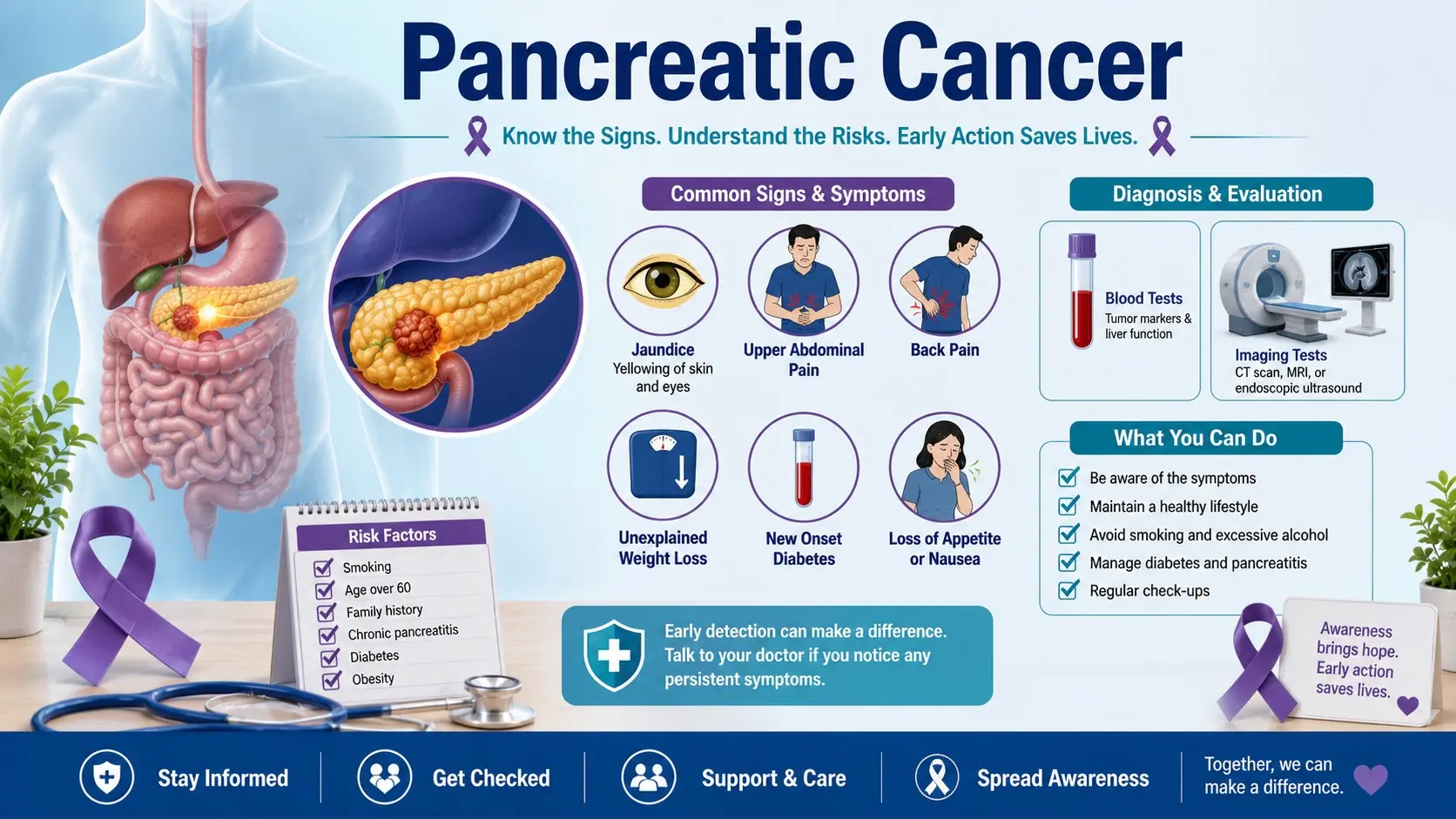
Pancreatic cancer may cause no noticeable symptoms early. When symptoms develop, important changes can include jaundice, dark urine, light-colored stools, upper-abdominal or back pain, unexplained weight loss, loss of appetite, and fatigue.
These symptoms are not specific to pancreatic cancer. Gallstones, liver disease, pancreatitis, ulcers, digestive disorders, diabetes, medicines, and many other conditions can cause overlapping symptoms.
New jaundice or persistent unexplained symptoms deserve medical assessment rather than self-diagnosis. For broader context, visit the Cancer Awareness & Prevention Hub and the Digestive Health & Gut Hub.
When symptoms need urgent medical care
Arrange prompt medical assessment for new jaundice, especially when yellow skin or eyes occur with dark urine, pale stools, itching, unexplained weight loss, or persistent upper-abdominal pain.
Seek emergency care for severe or rapidly worsening abdominal pain, persistent vomiting with inability to keep fluids down, vomiting blood, black or bloody stools, fainting, confusion, severe weakness, chest pain, sudden shortness of breath, or another life-threatening symptom.
Jaundice has many possible causes and is not automatically pancreatic cancer. The Liver Health Hub explains other liver and bile-flow problems, but a healthcare professional should determine the cause of new jaundice.
Medical and editorial notice
This article is not a personal pancreatic cancer story. NextFitLife does not use first-person diagnosis framing unless it represents a genuine, clearly disclosed personal experience.
Adel Galal is a consumer health and wellness writer and editor. He is not a physician, oncologist, gastroenterologist, pancreatic surgeon, radiologist, pathologist, nurse, genetic counsellor, or licensed healthcare professional.
This page cannot diagnose pancreatic cancer, interpret CA 19-9, decide whether you need CT, MRI, endoscopic ultrasound, or biopsy, or recommend an individual treatment plan.
What is pancreatic cancer?
The pancreas is a gland deep in the abdomen near the stomach, small intestine, liver, gallbladder, spleen, and bile ducts. It produces digestive juices and hormones such as insulin and glucagon that help regulate blood sugar.
Most pancreatic cancers begin in the exocrine cells that produce digestive juices. Because the pancreas lies deep inside the body and early pancreatic cancer often causes no distinctive symptoms, the disease can be difficult to detect at an early stage.
What are the main pancreatic cancer symptoms?
The National Cancer Institute lists important symptoms that include:
- jaundice, meaning yellowing of the skin or whites of the eyes
- light-colored stools
- dark urine
- pain in the upper or middle abdomen and back
- unexplained weight loss
- loss of appetite
- fatigue
Bloating, nausea, indigestion, constipation, diarrhea, and stool changes are less specific and occur with many common digestive conditions. Use the Digestive Health & Gut Hub for broader symptom context instead of assuming cancer.
Why can pancreatic cancer cause jaundice?
A tumour in the head of the pancreas can block the common bile duct. When bile cannot drain normally, bilirubin can build up and cause yellow skin or eyes, dark urine, light or clay-colored stools, and itching.
Jaundice can also result from gallstones, hepatitis, other liver disease, bile-duct disorders, medicines, and blood disorders. If you are learning about bilirubin and bile flow, the Liver Health Hub provides background information, but new jaundice needs clinical assessment.
Can pancreatic cancer cause abdominal or back pain?
Yes. Pancreatic cancer can cause upper- or middle-abdominal pain that may extend into the back. Pain can occur when a tumour affects nearby tissues or nerves.
However, abdominal and back pain are common and usually have causes other than pancreatic cancer. Reflux, ulcers, gallbladder disease, pancreatitis, muscle strain, spinal problems, and kidney stones can cause similar symptoms.
Arrange evaluation when pain is persistent, worsening, unexplained, or occurs with jaundice, substantial unintentional weight loss, appetite loss, or other significant changes.
Why can pancreatic cancer cause weight loss?
Unintentional weight loss can result from reduced appetite, illness-related metabolic changes, nausea or pain that makes eating difficult, and problems digesting or absorbing nutrients.
Weight loss alone is not specific to cancer. Diabetes, thyroid disorders, digestive disease, depression, medicines, infections, and other conditions can also cause it.
What is the connection between diabetes and pancreatic cancer?
The pancreas produces insulin, so pancreatic disease can affect blood-sugar control. Diabetes is also listed by NCI as a pancreatic-cancer risk factor.
Most people who develop diabetes do not have pancreatic cancer. New diabetes or a change in glucose control should not be treated as a cancer diagnosis.
If new or unexpectedly changing diabetes occurs with unexplained weight loss, jaundice, or persistent abdominal pain, discuss the full pattern with a healthcare professional. For ordinary glucose testing and diabetes care, see the Diabetes & Blood Sugar Management Hub.
What increases pancreatic cancer risk?
NCI lists risk factors that include smoking, excess body weight, diabetes, chronic pancreatitis, family history of pancreatic cancer or pancreatitis, and certain inherited cancer syndromes.
Inherited conditions associated with higher risk can include Lynch syndrome, Peutz-Jeghers syndrome, hereditary breast and ovarian cancer syndromes, familial atypical multiple mole melanoma syndrome, and other pathogenic variants.
A risk factor does not mean a person has cancer. For broader evidence-based risk reduction, see Cancer Prevention: Risk Factors, Screening, and Safer Choices.
When should family history prompt genetic counselling?
Ask about genetic counselling when pancreatic cancer occurs repeatedly on one side of a family, when a close relative was diagnosed unusually young, or when the family carries a known cancer-predisposition variant.
Is there a routine screening test for pancreatic cancer?
No routine population screening is recommended for asymptomatic adults at average risk. The U.S. Preventive Services Task Force recommends against screening people who are not known to be at high inherited or familial risk.
This differs from high-risk surveillance. People with certain pathogenic genetic variants or strong family histories may be offered specialist surveillance, often using MRI/MRCP and/or endoscopic ultrasound at experienced centers.
NCI research has found that surveillance of carefully selected high-risk people can detect a larger proportion of cancers at earlier stages. To understand the difference between screening, diagnostic testing, and surveillance, see the Medical Tests & Screenings Hub.
2026 update: promising blood markers are not yet a screening test
In January 2026, NCI reported research on a blood-marker panel combining ANPEP, PIGR, CA 19-9, and THBS2 for earlier detection of pancreatic ductal adenocarcinoma.
The results were promising, but the study was retrospective and needs validation in larger prediagnostic populations before the panel could be used as a screening tool.
As of August 2026, there is still no established blood screening test for the general population.
How is pancreatic cancer investigated?
Evaluation depends on symptoms, examination findings, laboratory results, and imaging. Tests may include:
- blood chemistry tests, including bilirubin and liver-related tests
- CT scanning
- MRI or MRCP
- abdominal ultrasound in selected situations
- endoscopic ultrasound, or EUS
- ERCP when bile-duct evaluation or drainage is needed
- CA 19-9 in the appropriate clinical setting
- biopsy when tissue confirmation is needed
CT is commonly important for evaluating the pancreas and surrounding structures. MRI can provide additional detail, while EUS can examine the pancreas closely and can also help obtain tissue. The Medical Tests & Screenings Hub explains why diagnostic tests should not be confused with population screening.
Can CA 19-9 diagnose or screen for pancreatic cancer?
No. CA 19-9 can be useful as part of pancreatic-cancer evaluation or follow-up, but it cannot diagnose cancer by itself and is not suitable as a general screening test.
CA 19-9 can rise with benign conditions such as pancreatitis and bile-duct obstruction. Some people also do not produce CA 19-9 because of genetic factors.
NCI's January 2026 early-detection report also noted that CA 19-9 alone did not perform well as a screening marker. Do not interpret one high or normal CA 19-9 result as proof that pancreatic cancer is present or absent.
When is biopsy used?
A biopsy removes cells or tissue so a pathologist can look for cancer. Tissue may be obtained with a fine or core needle, often with endoscopic-ultrasound guidance, or during another procedure.
Whether biopsy is needed before treatment depends on the clinical situation and treatment plan. That decision belongs to the pancreatic-cancer team rather than an online checklist.
How is pancreatic cancer treated?
Treatment depends on the cancer type, stage, whether the tumour can be removed surgically, molecular findings, overall health, and personal priorities.
- surgery for selected respectable cancers
- chemotherapy
- chemoradiation or radiation in selected situations
- targeted therapy for selected molecular alterations
- procedures or stents to relieve bile-duct or digestive obstruction
- pain management
- pancreatic enzyme replacement when needed
- nutrition and diabetes support
- palliative and supportive care when useful
This treatment section is intentionally brief because a symptom article should not select chemotherapy, surgery, or targeted treatment for an individual reader.
What should you do if you are worried about pancreatic cancer?
- Do not diagnose yourself from one symptom. Most abdominal pain, back pain, fatigue, and diabetes are not pancreatic cancer.
- Arrange prompt care for new jaundice.
- Document persistent changes. Note weight loss, pain, appetite, stool colour, urine colour, and when symptoms began.
- Share your family history. Mention pancreatic cancer and known hereditary cancer variants.
- Do not order repeated CA 19-9 tests as a home screening strategy.
- Do not use someone else's cancer story as a diagnostic template.
Questions to ask your healthcare professional
- What are the most likely causes of my symptoms?
- Does my jaundice suggest a bile-duct blockage?
- Do I need bilirubin, liver tests, glucose testing, or other blood work?
- Would CT, MRI/MRCP, or endoscopic ultrasound be useful?
- If CA 19-9 is checked, how should it be interpreted in my situation?
- Would I need a biopsy if imaging shows a pancreatic mass?
- Does my family history justify genetic counselling?
- Am I considered high risk enough for a pancreatic surveillance program?
Key takeaway
Pancreatic cancer may cause no obvious symptoms early. Important warning signs can include jaundice, dark urine, light-colored stools, abdominal or back pain, unexplained weight loss, appetite loss, and fatigue.
These symptoms have many causes, so they should lead to medical evaluation rather than a cancer conclusion.
There is no routine pancreatic-cancer screening test for average-risk asymptomatic adults, and CA 19-9 cannot diagnose or rule out pancreatic cancer by itself. High-risk people with certain inherited variants or a strong family history may qualify for specialist surveillance.
For broader navigation, return to the NextFitLife Health Hub.
Authoritative references
- National Cancer Institute: Pancreatic Cancer Treatment — Patient Version
- USPSTF: Screening for Pancreatic Cancer
- NCI: Surveillance for People at High Risk of Pancreatic Cancer
- NCI: 2026 Early Pancreatic Cancer Blood-Marker Research
- NCI: Genetic Testing for Inherited Cancer Risk
Source review date: August 7, 2026
Editorial policies
Frequently asked questions
What are the major symptoms of pancreatic cancer?
Important symptoms can include jaundice, light-colored stools, dark urine, upper- or middle-abdominal and back pain, unexplained weight loss, appetite loss, and fatigue. Early disease may cause no noticeable symptoms.
Is jaundice always pancreatic cancer?
No. Gallstones, liver disease, bile-duct disease, medicines, blood disorders, and other conditions can cause jaundice. New jaundice still needs prompt medical assessment.
Can pancreatic cancer cause back pain?
Yes, but most back pain is not cancer. Persistent unexplained pain with jaundice or weight loss deserves evaluation.
Does new diabetes mean pancreatic cancer?
No. Diabetes is common, and most cases are unrelated to pancreatic cancer. New or changing diabetes should be interpreted with other symptoms and risk factors.
Can CA 19-9 detect pancreatic cancer early?
CA 19-9 is not an effective general screening test. Benign conditions can raise it, and some people with pancreatic cancer do not have an elevated result.
Is there a pancreatic-cancer screening test for everyone?
No. Routine screening is not recommended for asymptomatic average-risk adults. Certain high-risk people may be offered specialist surveillance.
Is this a personal cancer story?
No. This is general educational content and does not claim that the author personally had pancreatic cancer.
Is this article medically reviewed?
No. It has been source-checked against current authoritative guidance but has not been reviewed by a licensed clinician.
Medical disclaimer
NextFitLife provides general educational information and does not diagnose pancreatic cancer, interpret personal CA 19-9 or imaging results, select screening or surveillance schedules, or recommend treatment. Discuss jaundice, unexplained weight loss, persistent abdominal or back pain, abnormal tests, and inherited risk with an appropriately qualified healthcare professional.

Health & wellness writer with 30+ years of experience in nutrition, fitness, and healthy aging. Founder of NextFitLife.com — evidence-based health guidance.