Last Updated:
August 20, 2026
Next Review:
August 2027, or sooner if important piercing infection, wound care, antibiotic, or tetanus guidance changes
Written and Source Checked by:
Adel Galal, Founder and Lead Writer of NextFitLife
Medical Review Status:
This article has not been formally reviewed by a physician, dermatologist, nurse, pharmacist, ear specialist, or another licensed healthcare professional.
Maybe it feels warm.
You may see fluid or pus.
Now you are wondering if you have an infected ear piercing.
A little tenderness can be normal after a new piercing.
A little swelling can also happen.
But pain that gets worse is different.
Heat is different.
Increasing swelling is different.
Pus is different.
Fever or feeling ill is different.
The piercing location also matters.
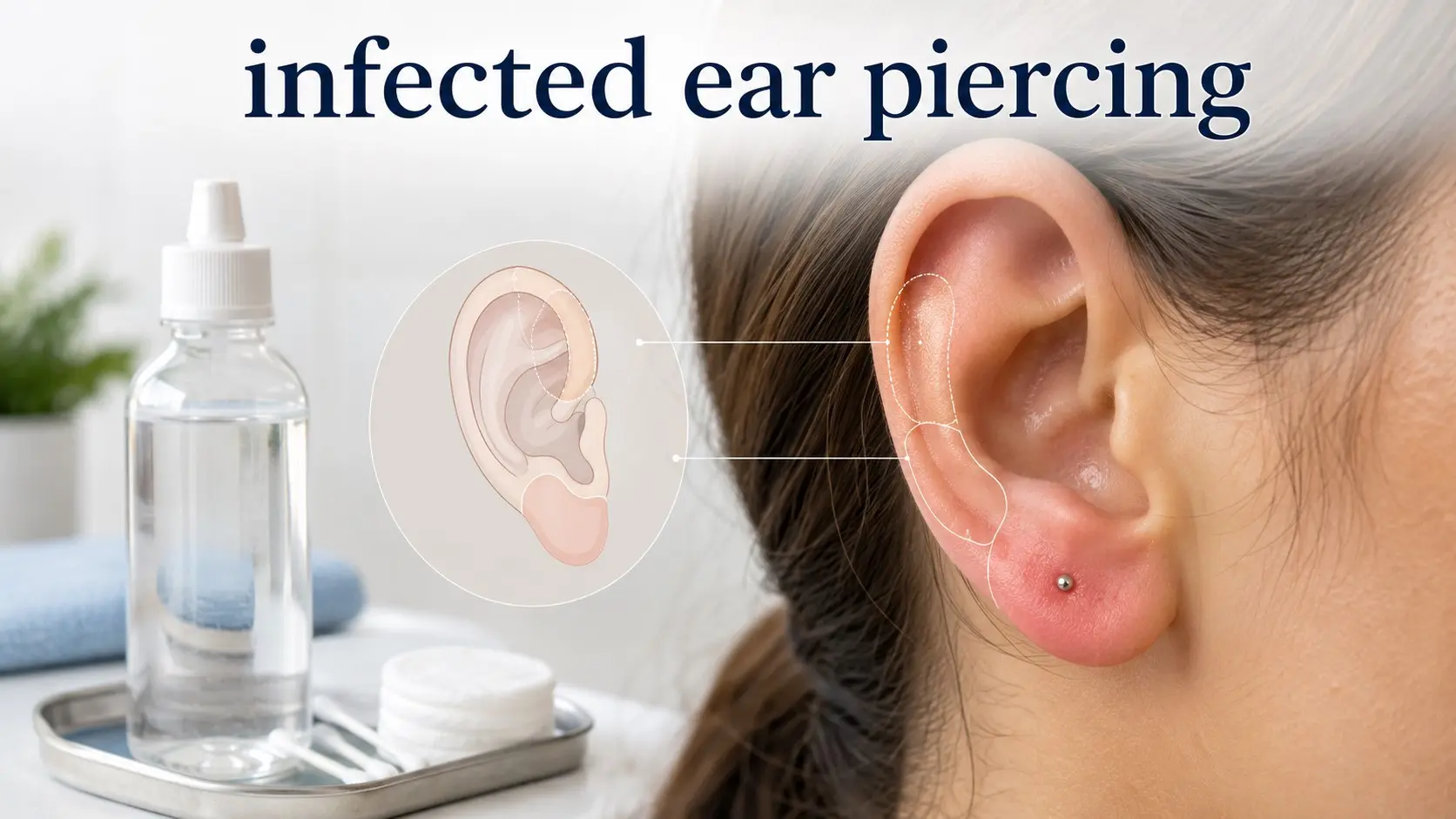
An infected earlobe piercing is not the same as an infection through the upper ear cartilage.
Cartilage has a weaker blood supply.
A cartilage piercing infection can become serious and may damage the shape of the ear if treatment is delayed.
This guide explains what normal healing looks like, the signs of infection, safer cleaning, what not to put on the ear, and when you need medical care.
Quick Answer: How Do You Treat an Infected Ear Piercing?
If you think you have an infected ear piercing, medical advice is the safest choice.
While arranging care:
- Wash your hands before touching the piercing.
- Keep the jewelry in unless a healthcare professional tells you to remove it.
- Gently clean the area with sterile saline made for wound care or mild fragrance-free cleanser and water.
- Do not squeeze the piercing.
- Do not use hydrogen peroxide, rubbing alcohol, iodine, essential oils, or other harsh products.
- Avoid unnecessary twisting and touching.
Get prompt medical care for an infected cartilage piercing, fever, spreading redness, worsening swelling, severe pain, an embedded earring, or feeling generally unwell.
Medical note:
This content is for general educational purposes and does not replace professional medical advice, diagnosis, or treatment. Consult an appropriately qualified healthcare professional for personal medical concerns. This article explains published guidance and does not provide a personal clinical assessment. Always consult qualified medical professionals for diagnosis and treatment of any health condition.
When an Ear Piercing Infection Needs Fast Medical Care
Seek prompt medical care if:
- The piercing goes through upper ear cartilage and looks infected
- Pain is getting worse
- Swelling is increasing
- The ear feels very hot
- Redness or darker skin colour is spreading
- There is thick white, yellow, or green pus
- You have fever or chills
- You feel generally unwell
- The earring or backing is stuck inside the ear
- A pocket of pus or abscess seems to be forming
- The ear begins changing shape
Do not wait for essential oils, home mixtures, or harsh cleaners to fix these signs.
Cartilage infection can need antibiotic treatment.
Is My Ear Piercing Infected or Just Healing?
This is one of the most common questions after a new piercing.
Some early symptoms can be normal.
Normal Early Healing May Include
- Mild tenderness
- Mild itching
- A little redness
- A little swelling
- A small amount of pale fluid
- Light crusting
These symptoms should gradually improve.
Possible Infection Looks Different
An ear piercing infection may cause symptoms that become stronger instead of better.
Look for:
- Increasing pain
- Increasing swelling
- Heat
- Strong redness or darker skin around the piercing
- Thick discharge
- White, yellow, or green pus
- Bad smell
- Fever
- Chills
- Feeling sick
When you are unsure, ask a healthcare professional.
What Does an Infected Ear Piercing Look Like?
Common piercing infection symptoms include:
- Red or darker skin around the hole
- Swollen tissue
- Pain or tenderness
- Warm or hot skin
- Pus
- Blood mixed with discharge
The area may also become more painful each day instead of less painful.
What Colour Is Infected Piercing Pus?
Pus may be:
- White
- Yellow
- Green
Thick pus is different from a small amount of pale healing fluid.
Colour alone cannot diagnose an infection.
Look at the whole pattern.
Earlobe Infection Versus Cartilage Piercing Infection
Earlobe Piercing
The earlobe is soft tissue.
It has better blood flow than cartilage.
A mild local infected earlobe piercing is usually less concerning than an upper ear cartilage infection.
It can still need medical treatment if symptoms worsen.
Cartilage Piercing
The upper ear is made of cartilage.
Cartilage has less blood flow.
Infection there may spread into the tissue around the cartilage.
This is why a painful, swollen, red, or hot cartilage piercing needs prompt medical assessment.
What Causes an Infected Ear Piercing?
A fresh piercing creates an opening in the skin.
Bacteria can enter that opening.
Risk can increase when:
- The piercing is done with unclean equipment
- You touch it with dirty hands
- The jewelry is removed too early
- The piercing is not cleaned properly
- You swim before it has healed
- The jewelry rubs or catches repeatedly
- You sleep directly on a healing cartilage piercing
- Unclean headphones or phones touch the area
Some health conditions may also make infection harder to fight.
Examples include diabetes and conditions that weaken the immune system.
How to Clean an Ear Piercing Safely
Simple care is usually better than strong chemicals.
Step 1: Wash Your Hands
Use soap and water.
Dry your hands.
Do this before touching the jewelry or skin.
Step 2: Use Gentle Cleaning
A practical option is sterile saline sold for wound care.
You can also follow professional advice to gently wash the surrounding skin with a mild fragrance-free cleanser and water.
Rinse away cleanser carefully.
Step 3: Dry Gently
Use clean disposable material to gently pat the outside dry.
Do not scrub.
Step 4: Leave It Alone
Do not keep touching the piercing to check it.
Do not twist dry jewelry.
Do not pick crust from the wound.
Repeated movement can irritate healing skin.
Can I Use a Warm Compress?
A clean warm compress may feel soothing.
It may help with mild local discomfort.
Use a clean cloth.
Make sure the temperature is comfortable.
Do not use heat that can burn the skin.
A warm compress does not replace antibiotics or medical assessment when infection is present.
Should You Remove Jewelry From an Infected Piercing?
Usually, do not remove it on your own.
NHS guidance says to leave the jewelry in unless a doctor tells you to remove it.
Removing jewelry may allow the surface opening to close.
That may trap infection inside.
There are situations where a healthcare professional may decide removal or replacement is needed.
Examples include:
- Embedded jewelry
- Severe swelling
- An allergic reaction
- A serious cartilage infection
- Another complication
Let the clinician decide.
What if the Earring Is Stuck Inside the Ear?
An embedded earring needs medical attention.
Do not dig it out with:
- Tweezers
- Needles
- Pins
- Scissors
Trying to remove it yourself can cause more tissue damage and infection.
How Is an Infected Ear Piercing Treated?
Treatment depends on where the piercing is and how severe the infection is.
A healthcare professional may recommend:
- Local wound care
- Sterile saline cleaning
- A prescribed antibiotic cream or ointment in selected cases
- Oral antibiotics for more serious infections
- Drainage of an abscess when needed
- Care for embedded jewelry
Do not use leftover antibiotics from an old infection.
Do not use another person's antibiotics.
The medicine needed can depend on the bacteria and the piercing location.
Does Every Infected Piercing Need Antibiotics?
Not every irritated piercing needs an antibiotic.
But a true infection may need one.
NHS guidance says infected piercings may require antibiotic cream, ointment, or tablets.
Cartilage infections are more likely to need prompt medical treatment.
A clinician should make that decision.
Why Is an Infected Cartilage Piercing More Serious?
This is one of the most important parts of the guide.
The cartilage of the outer ear does not have the same blood supply as the earlobe.
An infection can spread into the tissue around the cartilage.
This condition is called perichondritis.
Symptoms can include:
- Pain
- Redness
- Swelling
- Tenderness
- Warm skin
Without proper treatment, cartilage damage can occur.
This may change the shape of the ear.
Do not try to treat a worsening cartilage infection only at home.
Can a Daith Piercing Become Infected?
Yes.
A daith piercing passes through cartilage.
That means infection should be taken seriously.
Watch for:
- Increasing pain
- Heat
- Swelling
- Pus
- Fever
For evidence about daith piercing and migraine, read:
Migraine Piercing
.
Is It an Infection or a Metal Allergy?
Not every red piercing is infected.
Jewelry can cause an allergic reaction.
Nickel is a common trigger.
Possible Nickel Allergy Signs
A nickel allergy may cause:
- Itching
- Dry skin
- A rash
- Red or darker irritated skin
- Small bumps
Possible Infection Signs
Infection is more likely with:
- Increasing pain
- Heat
- Pus
- Increasing swelling
- Fever
- Feeling unwell
The two problems can sometimes look similar.
Get medical advice if you are unsure.
Is a Piercing Bump Always an Infection?
No.
A piercing bump can have several causes.
It may be:
- Irritation
- A granuloma
- Scar tissue
- A keloid
- An infection
Do not squeeze the bump.
Do not cut it.
Do not try to drain it with a needle.
If it keeps growing, hurts, drains pus, or worries you, get it checked.
Is a Keloid the Same as an Infection?
No.
A keloid scar is extra scar tissue.
It can grow beyond the original wound.
It may feel firm.
It may itch.
A keloid does not mean bacteria are present.
Some people are much more likely to develop keloids than others.
A dermatologist can help if a scar keeps growing.
What Should You Not Put on an Infected Ear Piercing?
Avoid harsh or unproven products.
Do not use:
- Hydrogen peroxide
- Rubbing alcohol
- Iodine
- Tea tree oil
- Lavender oil
- Other essential oils
- Strong antibacterial soap
- Toothpaste
- Aspirin paste
- Random herbal mixtures
These products can irritate healing tissue.
Some can cause burns or allergic reactions.
They can also make it harder to tell whether the infection is getting better.
Does Tea Tree Oil Treat an Infected Ear Piercing?
Tea tree oil should not replace proper medical assessment or infection treatment.
It can irritate skin.
It can also cause allergic reactions.
Use simple evidence-based wound care instead.
Should You Use Hydrogen Peroxide?
No.
Mayo Clinic and the American Academy of Dermatology advise against hydrogen peroxide for healing piercings.
It can damage healing skin.
Strong cleaning does not mean better healing.
Should You Use Rubbing Alcohol?
Avoid routine rubbing alcohol on a healing piercing.
It can be harsh and drying.
Sterile saline made for wound care or a gentle cleanser and water are safer routine options.
Can You Use Homemade Salt Water?
Some public guidance mentions salt water.
But homemade mixtures can be made too strong, too weak, or with contaminated water.
A simple option is a packaged sterile saline product made for wound care.
Follow medical or professional piercing instructions for your specific situation.
Do You Need a Tetanus Shot After an Ear Piercing?
A piercing creates a puncture wound.
Tetanus vaccination needs depend on:
- Your vaccination history
- Whether the wound is clean
- Whether equipment was sterile
- Whether the wound was contaminated
CDC recommends keeping tetanus vaccination up to date.
If your piercing was done with questionable equipment or your vaccination history is uncertain, ask a healthcare professional whether you need a tetanus vaccine.
Do not take antibiotics just to prevent tetanus.
Vaccination and proper wound care are the main prevention tools.
Can You Swim With a New or Infected Ear Piercing?
Avoid swimming while a piercing is healing.
Pools, hot tubs, lakes, rivers, and other water can expose the wound to bacteria.
If the piercing is already infected, ask your healthcare professional when swimming is safe again.
Can You Sleep on an Infected Piercing?
Try to avoid direct pressure on a painful or healing piercing.
Pressure and friction can irritate the area.
Keep pillowcases clean.
If the ear is very painful, swollen, or hot, do not rely on changing your sleep position alone.
Get medical advice.
Can Headphones Make an Ear Piercing Worse?
Yes.
Headphones and earbuds can:
- Rub the piercing
- Add pressure
- Trap moisture
- Carry germs
Keep devices clean.
Avoid pressure on the healing site.
How Long Does an Ear Piercing Infection Take to Heal?
There is no single timeline.
It depends on:
- Where the piercing is
- How severe the infection is
- How quickly treatment begins
- Which bacteria are involved
- Your general health
A mild earlobe problem may improve quickly with correct care.
A cartilage infection can take longer and may need stronger treatment.
If symptoms are not clearly improving, contact a healthcare professional.
How to Prevent an Ear Piercing Infection
Choose a Qualified Piercer
Use a trained and experienced professional.
Follow local licensing rules where they apply.
Look for Sterile Equipment
The piercer should:
- Wash their hands
- Use fresh gloves
- Use sterile equipment
- Use a fresh sterile needle when appropriate
Choose Suitable Jewelry
Some people react to nickel.
Lower allergy risk materials can include suitable titanium and other high-quality piercing jewelry.
Keep Your Hands Off
Touch the piercing only when needed for cleaning.
Wash your hands first.
Keep It Clean
Follow proper piercing aftercare.
Use gentle cleaning.
Do not use harsh chemicals.
Avoid Water Exposure
Avoid pools, hot tubs, lakes, and rivers while the piercing heals.
Reduce Friction
Be careful with:
- Headphones
- Hairbrushes
- Phones
- Hats
- Pillows
- Clothing
Common Myths About Infected Ear Piercings
Myth: Every Red Piercing Is Infected
False.
Mild redness can occur during normal healing.
Allergy and irritation can also cause redness.
Myth: Pus Should Be Squeezed Out
False.
Squeezing can injure the tissue and spread infection.
Myth: Strong Alcohol Cleans an Infection Better
False.
Harsh products can damage healing skin.
Myth: Tea Tree Oil Is a Natural Antibiotic for Piercings
Do not rely on tea tree oil to treat a piercing infection.
It can irritate the skin.
Myth: You Should Remove the Earring as Soon as Infection Starts
False.
Do not remove jewelry unless a healthcare professional tells you to do so.
Myth: Cartilage and Earlobe Infections Are the Same
False.
Cartilage infection can be more serious.
Myth: If You Have No Fever, It Cannot Be Infected
False.
A local infection may occur without fever.
A Simple Piercing Infection Checklist
Write down:
- When the piercing was done
- Where it is located
- When symptoms started
- Whether pain is getting better or worse
- Whether swelling is spreading
- Whether the skin feels hot
- Whether there is pus
- Whether you have fever or chills
- What metal the jewelry contains
- What products you used on the piercing
- Whether you recently swam
- Whether the jewelry is stuck
- Your tetanus vaccination history
This information can help a healthcare professional assess the infected ear piercing.
Questions to Ask a Healthcare Professional
- Is this infection or normal healing?
- Is the cartilage involved?
- Do I need an antibiotic?
- Should the jewelry stay in?
- Is the jewelry embedded?
- Could this be a nickel allergy?
- Could this bump be a keloid?
- How should I clean the area?
- When can I swim again?
- Do I need a tetanus vaccine?
- What signs mean I need urgent care?
Key Takeaway
An infected piercing can start with pain, swelling, heat, redness, or pus.
Do not attack the skin with strong chemicals.
Keep your hands clean.
Use gentle wound care.
Keep the jewelry in unless a healthcare professional tells you otherwise.
Take cartilage symptoms seriously.
Get medical care when infection seems likely.
How I Research Ear Piercing Infection Care
I have spent more than fifteen years researching and writing about health and wellness.
I also bring more than thirty years of personal experience with fitness, nutrition, sleep habits, and everyday wellness.
Piercing care is a topic where simple advice can become unsafe very quickly.
A product may sound natural.
That does not mean it belongs on a wound.
A strong cleaner may sound powerful.
That does not mean it helps healing skin.
My approach is to separate four questions.
First, is this normal healing or possible infection?
Second, is the piercing in the soft earlobe or in cartilage?
Third, what cleaning methods are supported by reliable wound care guidance?
Fourth, which signs mean home care is no longer enough?
This is especially important with cartilage.
An upper ear infection has different risks from mild earlobe irritation.
Before focusing on NextFitLife, I spent twenty-nine years in information technology management.
That work strengthened my skills in research, troubleshooting, data review, systems thinking, and comparing conflicting information.
I use the same process with health content.
For this guide, I compared current guidance from the NHS, Mayo Clinic, the American Academy of Dermatology, Cleveland Clinic, and CDC.
My goal is to remove unsafe home remedy claims and give readers a simple path from symptom to safer action.
References and High Authority Sources
This article was checked against these five public and accessible sources.
NHS
Infected Piercings.This public health guide explains normal early healing, infection symptoms, urgent medical advice, antibiotics, and why jewelry should stay in unless a doctor tells you to remove it.
Mayo Clinic
Piercings: How to Prevent Complications.This resource explains infection, nickel allergy, keloids, sterile piercing practices, saline wound cleaning, swimming precautions, and why peroxide and iodine should be avoided.
American Academy of Dermatology
Caring for New Piercings.This dermatologist guidance covers clean hands, gentle cleansing, jewelry care, infection signs, keloids, and avoiding hydrogen peroxide and harsh antibacterial cleansers.
Cleveland Clinic
Infected Ear Piercing.This resource explains symptoms, earlobe versus cartilage infection, complications, sterile saline, antibiotics, embedded jewelry, and when to contact a healthcare professional.
Centers for Disease Control and Prevention
Clinical Guidance for Wound Management to Prevent Tetanus.This CDC guidance explains wound cleaning, tetanus vaccination decisions, wound risk, and why antibiotics are not used simply to prevent tetanus.
Source Review Date:
August 20, 2026
These organizations do not endorse NextFitLife.
Conclusion
An infected ear piercing needs careful attention.
Mild tenderness can be part of healing.
Worsening pain, heat, swelling, or pus can point to infection.
Wash your hands.
Use gentle cleaning.
Avoid peroxide, alcohol, essential oils, and other harsh products.
Do not squeeze the piercing.
Do not remove the jewelry unless a healthcare professional tells you to.
Most importantly, do not delay care for a painful, infected cartilage piercing, fever, spreading redness, an embedded earring, or worsening symptoms.
Your next step:
If you think you have an infected ear piercing, check whether it is in the earlobe or cartilage, note your symptoms, stop using irritating products, and contact a qualified healthcare professional when infection is suspected.
Editorial Policies and Trust
Frequently Asked Questions About Infected Ear Piercings
How do I know if my ear piercing is infected?
Worsening pain, heat, swelling, strong redness or darker skin, pus, fever, or feeling unwell can suggest infection.
Is redness normal after an ear piercing?
A small amount of redness can be normal early in healing. Redness that gets worse, spreads, or comes with heat, pain, swelling, or pus is more concerning.
Is swelling normal after an ear piercing?
Mild early swelling can occur. Increasing or severe swelling may mean irritation, allergy, or infection.
Is crust around a piercing normal?
A small amount of pale fluid that dries into a light crust can occur during healing. Thick pus or worsening symptoms need assessment.
What colour is pus from an infected piercing?
Pus may be white, yellow, or green. Colour alone cannot confirm infection, so consider pain, heat, swelling, and other symptoms too.
How should I clean an infected ear piercing?
Wash your hands first. Gently clean with sterile saline made for wound care or follow professional advice to use a mild fragrance-free cleanser and water.
Should I use hydrogen peroxide on an infected piercing?
No. Hydrogen peroxide can damage healing skin and is not recommended for routine piercing care.
Should I use rubbing alcohol?
Avoid routine rubbing alcohol on a healing piercing because it can irritate and dry the skin.
Can tea tree oil treat an infected piercing?
Do not rely on tea tree oil to treat a piercing infection. It can irritate skin and does not replace medical treatment.
Can I use essential oils on an ear piercing?
Essential oils are not needed for piercing infection care and may irritate the skin or cause an allergic reaction.
Can I use salt water?
Some guidance uses salt water, but a packaged sterile saline wound product avoids mistakes in concentration and contamination from homemade mixtures.
Should I remove the earring if the piercing is infected?
Do not remove the jewelry unless a healthcare professional tells you to do so.
What if my earring is stuck inside my ear?
An embedded earring needs medical care. Do not dig it out with needles, pins, scissors, or tweezers.
Does an infected piercing need antibiotics?
Some infections need antibiotic cream, ointment, or tablets. A healthcare professional should decide what treatment is appropriate.
Is an infected cartilage piercing serious?
Yes. Cartilage infection can progress to perichondritis and may damage the ear if treatment is delayed.
What is perichondritis?
Perichondritis is an infection of the tissue around the outer ear cartilage. Pain, redness, and swelling are common symptoms.
Can a daith piercing get infected?
Yes. A daith piercing passes through cartilage, so signs of infection need prompt medical attention.
Is a piercing bump always an infection?
No. A bump may come from irritation, trapped fluid, scar tissue, a keloid, or infection.
Is a keloid an infection?
No. A keloid is excess scar tissue. It does not mean that bacteria are present.
Can nickel cause a piercing rash?
Yes. Nickel can cause allergic contact dermatitis with itching, rash, and irritated skin.
Can I swim with an infected piercing?
Avoid swimming while the piercing is healing or infected. Water can expose the wound to more bacteria.
Can I sleep on an infected ear piercing?
Try to avoid pressure and friction on the affected ear. Severe pain, swelling, heat, or pus still needs medical assessment.
Do I need a tetanus shot after a piercing?
It depends on your vaccination history and the wound. Ask a healthcare professional if the equipment may not have been sterile or your vaccination history is uncertain.
How long does an infected piercing take to heal?
Healing time depends on the location and severity. Cartilage infections may need more treatment and can take longer than mild earlobe problems.
When should I see a doctor for an infected ear piercing?
Get medical advice for suspected infection, especially with worsening pain, heat, swelling, pus, fever, spreading redness, embedded jewelry, or cartilage involvement.
When is an infected ear piercing urgent?
Prompt care is important for an infected cartilage piercing, fever, chills, rapidly worsening swelling, severe pain, spreading redness, an abscess, or feeling very unwell.
Medical Disclaimer
NextFitLife provides general educational and informational health content.
This article cannot diagnose a piercing infection, cartilage infection, perichondritis, abscess, allergic reaction, keloid, or another medical condition.
Do not use essential oils, peroxide, alcohol, iodine, or other harsh products as substitutes for proper wound care.
Do not remove jewelry from a suspected infected piercing unless a healthcare professional tells you to do so.
A suspected cartilage infection needs prompt medical assessment.
Seek medical care for fever, chills, worsening pain, spreading redness, pus, severe swelling, embedded jewelry, an abscess, or feeling generally unwell.

Health & wellness writer with 30+ years of experience in nutrition, fitness, and healthy aging. Founder of NextFitLife.com — evidence-based health guidance.