Published:
Aug 20, 2024
Last Updated:
August 19, 2026
Next Review:
August 2027, or sooner if major hearing care guidance changes
Written and source checked by:
Adel Galal
,
Founder and Lead Writer of NextFitLife
Medical Review Status:
This article has not been formally reviewed by an audiologist, ear specialist, physician, or another licensed healthcare professional.
But the words are hard to understand.
A busy restaurant makes it even harder.
These can be signs of hearing loss.
Hearing loss can be mild or severe.
It can affect one ear.
It can affect both ears.
It can happen slowly.
It can also happen suddenly.
There is no single cause.
Earwax can block sound.
Fluid can affect the middle ear.
Loud sounds can damage the inner ear.
Aging can slowly change hearing.
Some medicines, infections, injuries, and genetic conditions can also play a role.
The right next step depends on the type and cause.
Some causes can be treated.
Other types are permanent but can often be managed with hearing aids, implants, communication tools, and hearing rehabilitation.
This guide explains the common causes, early symptoms, three main types, hearing tests, prevention, treatment options, and warning signs that need fast medical care.
Quick Answer: What Is Hearing Loss?
Hearing loss means you cannot hear as well as a person with typical hearing.
It may affect one or both ears.
It may make speech sound soft or unclear.
Common signs include:
- Asking people to repeat themselves
- Turning up the TV or phone volume
- Difficulty hearing speech in noisy places
- Thinking that people are mumbling
- Missing high sounds
- Trouble hearing on the phone
- Tinnitus or ringing in the ears
The three main types are conductive hearing loss, sensorineural hearing loss, and mixed hearing loss.
A hearing test can show how much hearing has changed and help identify the type.
Sudden unexplained hearing loss needs urgent medical assessment.
Medical note:
This content is for general educational purposes and does not replace professional medical advice, diagnosis, or treatment. Consult an appropriately qualified healthcare professional for personal medical concerns. This article explains published guidance and does not provide a personal clinical assessment. Always consult qualified medical professionals for diagnosis and treatment of any health condition.
Hearing Loss at a Glance
- Hearing loss can affect one ear or both ears.
- It can be gradual or sudden.
- Earwax and middle ear fluid can cause treatable hearing problems.
- Aging is a common cause of gradual inner ear hearing loss.
- Loud sound can permanently damage hearing.
- Some medicines can damage hearing.
- A hearing test helps show the type and degree of hearing loss.
- Hearing aids can help many people.
- Some people with severe hearing loss may benefit from cochlear implants.
- Noise related hearing damage can often be prevented.
- Sudden unexplained hearing loss is a medical emergency.
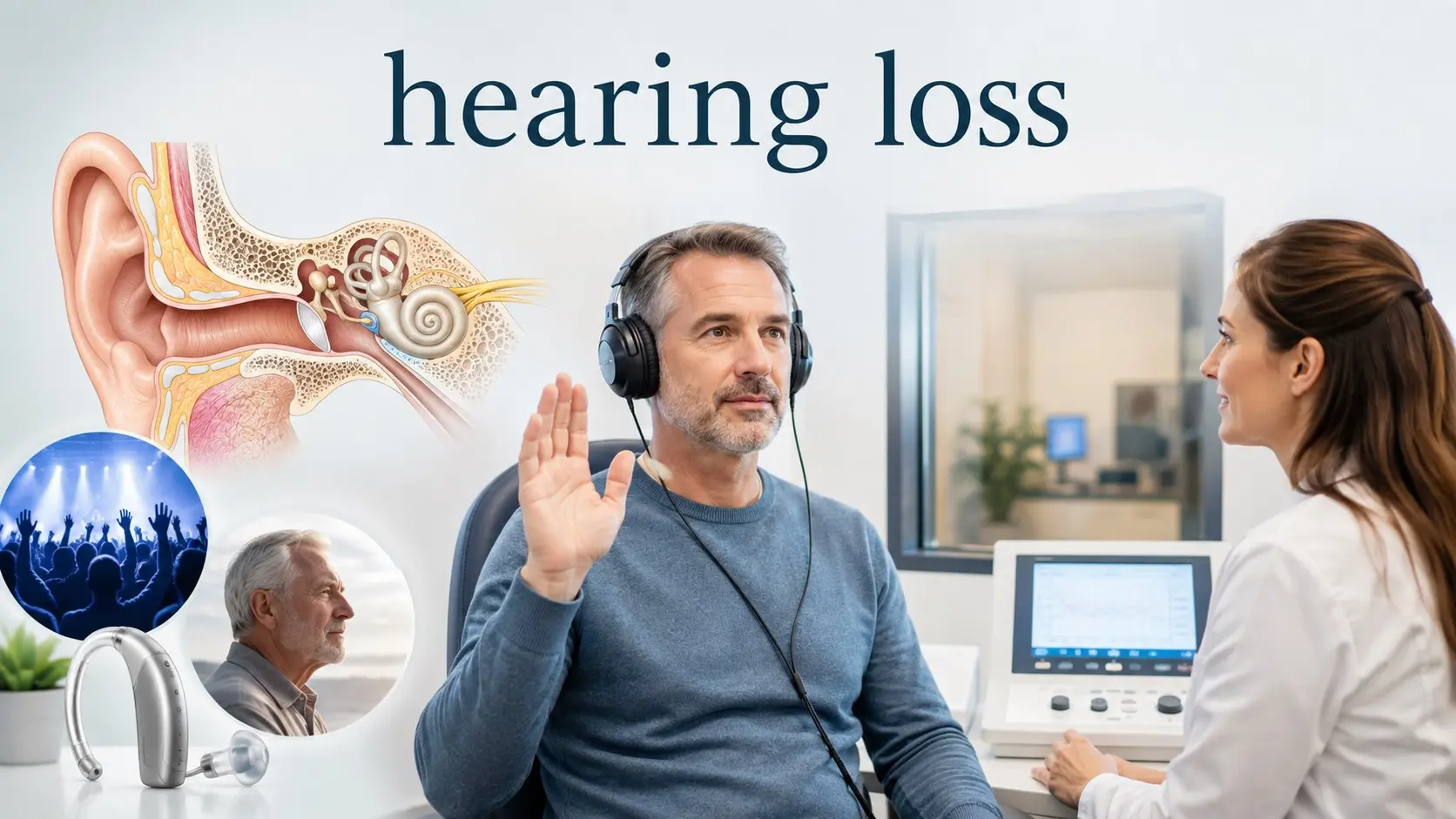
How Does Hearing Work?
Hearing happens in several steps.
Sound first enters the outer ear.
It travels down the ear canal.
The sound reaches the eardrum.
The eardrum moves.
Three tiny bones in the middle ear move with it.
These bones send the vibration into the inner ear.
Inside the inner ear is the cochlea.
The cochlea contains sensory cells.
These cells help turn sound vibrations into electrical signals.
The auditory nerve carries the signals to the brain.
The brain then understands them as sound.
A problem at any part of this path can affect hearing.
What Are the 3 Main Types of Hearing Loss?
1. Conductive Hearing Loss
Conductive hearing loss happens when sound cannot move normally through the outer or middle ear.
The inner ear may still work.
But sound has trouble reaching it.
Possible causes include:
- Earwax blockage
- Fluid behind the eardrum
- Ear infection
- A hole in the eardrum
- A foreign object in the ear
- Problems with the small middle ear bones
Some conductive hearing loss can improve when the cause is treated.
2. Sensorineural Hearing Loss
Sensorineural hearing loss happens when the inner ear sensory cells or hearing nerve are damaged.
Common causes include:
- Aging
- Long term loud sound exposure
- A very loud blast
- Some infections
- Certain medicines
- Head injury
- Some genetic conditions
This type is often permanent.
It may be managed with hearing technology and rehabilitation.
3. Mixed Hearing Loss
Mixed hearing loss means a person has both conductive and sensorineural hearing loss.
For example, a person may have permanent inner ear hearing loss plus a temporary earwax blockage.
Treatment depends on both parts of the problem.
What Are the Early Symptoms of Hearing Loss?
Hearing loss can begin slowly.
You may not notice it at first.
Family members sometimes notice before the person does.
Common hearing loss symptoms include:
- People sound as if they are mumbling
- You often ask people to repeat words
- Speech is hard to understand in restaurants
- You turn the television louder than other people prefer
- You have trouble hearing on the phone
- You miss doorbells or alarms
- You have trouble hearing higher voices
- You have trouble hearing birds or other high sounds
- You hear ringing or buzzing
- You feel left out of conversations
Do not wait until hearing becomes very poor before asking for a test.
Why Can I Hear People Talking but Not Understand the Words?
This is a common hearing complaint.
Volume is only one part of hearing.
Speech contains many pitches.
Some consonants are higher in pitch than vowels.
If those sounds become harder to hear, you may hear that someone is talking but miss parts of the words.
The problem is often worse when there is background noise.
A formal hearing test can show which pitches are affected.
Why Is It Hard to Hear in a Noisy Room?
Background noise makes speech harder to separate.
This can be one of the first places a person notices a hearing problem.
You may hear well in a quiet room.
Then conversation becomes hard in:
- Restaurants
- Parties
- Busy offices
- Family gatherings
- Shopping centers
Difficulty hearing speech in noise is a good reason to arrange a hearing check.
10 Common Causes of Hearing Loss
1. Aging
Age related hearing loss often develops slowly.
It usually affects both ears.
Higher sounds are often affected first.
A person may find it harder to understand speech.
The change can happen so slowly that it is easy to miss.
2. Loud Noise
Loud sound can damage the sensory structures of the inner ear.
Noise induced hearing loss can happen after:
- Years of loud workplace noise
- Frequent loud music
- Power tools
- Motor sports
- Firearms
- Explosions
- A single extreme sound close to the ear
The louder the sound, the less time it may take to cause damage.
Noise damage is often permanent.
3. Earwax Blockage
Earwax protects the ear canal.
But too much wax can block sound.
Symptoms may include:
- A blocked feeling
- Muffled hearing
- Tinnitus
- Ear discomfort
Do not push cotton swabs deep into the ear.
They can push wax farther inside.
4. Ear Infection
Ear infections can affect hearing.
Fluid may build behind the eardrum.
This can reduce how well sound moves through the middle ear.
Hearing may improve as the infection and fluid resolve.
Repeated or chronic infection needs medical care.
5. Perforated Eardrum
A hole in the eardrum can affect hearing.
Possible causes include:
- Infection
- Pressure injury
- A very loud blast
- Objects pushed into the ear
- Trauma
Some perforations heal.
Others need treatment.
6. Medicines That Can Damage Hearing
Some medicines can affect the inner ear.
These are sometimes called ototoxic medicines.
Examples can include some medicines used for:
- Serious infections
- Cancer
- Other major medical conditions
Do not stop a medicine because you read that it may affect hearing.
Talk with the healthcare professional who prescribed it.
7. Genetic Causes
Some hearing loss is linked to genes.
It may be present at birth.
It may also appear later.
A family history can be important when a healthcare professional looks for the cause.
8. Infections
Some infections can affect hearing.
WHO lists infections such as meningitis among causes that can lead to hearing loss.
Chronic middle ear infections can also cause problems.
9. Head or Ear Injury
A major injury can damage the:
- Eardrum
- Middle ear bones
- Inner ear
- Hearing nerve
New hearing loss after an injury should be medically assessed.
10. Inner Ear Disorders
Some inner ear conditions can affect hearing and balance.
Symptoms may include:
- Hearing changes
- Tinnitus
- Dizziness
- Vertigo
- Ear fullness
The pattern of symptoms helps guide further testing.
What Causes Hearing Loss in One Ear?
One sided hearing loss can have several causes.
Examples include:
- Earwax
- An ear infection
- A perforated eardrum
- Sudden inner ear hearing loss
- Trauma
- Some inner ear disorders
- Less common nerve related causes
Do not ignore a clear difference between your ears.
One sided hearing loss should be assessed, especially if it is new or worsening.
Sudden Hearing Loss Is a Medical Emergency
This is the most important warning in this guide.
Sudden hearing loss should not be treated as simple earwax or congestion until it has been properly assessed.
Sudden sensorineural hearing loss usually develops quickly.
It may happen all at once.
It may also develop over a few days.
It often affects one ear.
You may notice:
- A sudden drop in hearing
- A pop before the hearing changes
- Ear fullness
- Tinnitus
- Dizziness
NIDCD advises treating sudden unexplained hearing loss as a medical emergency.
Early diagnosis matters.
Treatment becomes less likely to reverse permanent loss when it is delayed.
If your hearing suddenly drops, seek medical care immediately.
Are Hearing Loss and Tinnitus Connected?
They can be.
Tinnitus means hearing a sound that does not come from an outside source.
It may sound like:
- Ringing
- Buzzing
- Hissing
- Roaring
- Clicking
Tinnitus can occur with hearing loss.
It does not always mean hearing is damaged.
A hearing test can help identify whether both are present.
Read more in
Tinnitus Causes
.
Can Earwax Cause Hearing Loss?
Yes.
A plug of earwax can block sound from reaching the eardrum.
This is a form of conductive hearing loss.
Hearing may improve when the blockage is safely removed.
Do not use sharp tools.
Do not push cotton swabs into the ear canal.
Ask a healthcare professional or pharmacist about safe wax care if your ear feels blocked.
Can Ear Pressure and Crackling Affect Hearing?
Yes.
Pressure problems in the middle ear can make hearing sound dull or muffled.
You may also notice popping or crackling.
Colds, allergies, flying, and Eustachian tube problems can play a role.
Learn more in
Ear Crackling
.
What If Hearing Loss Comes With Ear Drainage?
Drainage changes the picture.
Possible causes include:
- An outer ear infection
- A middle ear infection
- A perforated eardrum
- Another ear condition
Seek medical advice for hearing changes with persistent ear drainage.
Read
Wet Ears in the Morning
for more information about ear moisture and discharge.
What If Hearing Loss Comes With Ear Bleeding?
Blood coming from inside the ear should not be ignored.
It may occur with:
- Ear canal injury
- Eardrum injury
- Pressure injury
- Infection
- Head trauma
Do not put objects or random drops into a bleeding ear.
Read more in
Ear Bleeding
.
How Is Hearing Loss Tested?
A professional hearing assessment can tell you much more than an online sound check.
It can show:
- Whether hearing loss is present
- Which ear is affected
- Which sound pitches are affected
- How severe the hearing loss is
- Whether the problem may involve the outer, middle, or inner ear
1. Ear Examination
A healthcare professional may first look inside your ears.
They may look for:
- Earwax
- Infection
- Fluid
- Eardrum problems
- A foreign object
This matters because a simple blockage can sometimes explain the hearing change.
2. Pure Tone Hearing Test
A pure tone test is a common part of a formal hearing assessment.
You wear headphones.
You hear tones at different pitches and volumes.
You respond when you hear each sound.
The results are placed on a chart called an audiogram.
The audiogram helps show which sounds you hear and which sounds you miss.
3. Speech Testing
Hearing tones is not the same as understanding words.
Speech tests can measure how well you hear and understand spoken words.
Some testing may also look at speech in background noise.
4. Tympanometry
Tympanometry checks how the eardrum and middle ear respond to changes in air pressure.
It can help identify some problems involving:
- Middle ear fluid
- The eardrum
- Middle ear movement
Who Can Test Your Hearing?
Several professionals may be involved.
Audiologist
An audiologist is trained to test hearing and help manage hearing problems.
Audiologists can perform detailed hearing tests and help with hearing devices and rehabilitation.
Ear, Nose and Throat Doctor
An ear, nose and throat doctor can diagnose and treat diseases that affect the ears.
Medical assessment may be especially important for:
- Sudden hearing loss
- One sided hearing loss
- Pain
- Drainage
- Repeated infections
- Dizziness
Primary Care Professional
A primary care professional can examine the ear and decide whether you need specialist testing.
Can an Online Hearing Test Diagnose Hearing Loss?
An online screening tool may help you notice that hearing needs checking.
It does not replace a formal assessment.
WHO provides hearing screening tools for public awareness.
But WHO also explains that these do not replace professional hearing care.
If you notice real hearing difficulty, arrange a proper hearing test.
Can Hearing Loss Be Treated?
Sometimes.
The answer depends on the cause.
Some conductive problems can improve.
Examples include:
- Earwax blockage
- Some middle ear fluid
- Some infections
- Certain eardrum problems
Many types of inner ear hearing loss cannot currently be restored to normal hearing with medicine or surgery.
But hearing technology and rehabilitation can help people hear, communicate, and participate more fully.
How Do Hearing Aids Help?
Hearing aids make sounds easier to hear.
They contain:
- A microphone
- An amplifier
- A speaker
They are commonly used for sensorineural hearing loss.
Modern hearing aids can be programmed for a person's hearing pattern.
They do not restore natural hearing.
But they can make speech and other sounds easier to detect and understand.
What Is a Cochlear Implant?
A cochlear implant is different from a hearing aid.
A hearing aid makes sound louder.
A cochlear implant bypasses damaged parts of the inner ear and sends signals to the hearing nerve.
It may help selected children and adults with severe or profound hearing loss.
It does not restore normal hearing.
A specialist team decides whether someone is a suitable candidate.
What Other Hearing Support Is Available?
Hearing care is not only about devices.
WHO includes several forms of hearing rehabilitation.
Support may include:
- Communication training
- Speech and language support
- Assistive listening devices
- Captioning
- Alerting devices
- Sign language
- Counselling
- Family support
The right choice depends on the person's hearing, communication needs, preferences, age, and daily life.
How Can You Prevent Hearing Loss?
Not every cause can be prevented.
But many hearing risks can be reduced.
1. Turn Down the Volume
Keep music and entertainment at a comfortable level.
If the sound is painful or leaves your ears ringing, it is too loud.
2. Move Away From Loud Sound
Distance matters.
Moving away from speakers, machinery, fireworks, and other loud sources reduces sound exposure.
3. Take Quiet Breaks
Long exposure adds risk.
Give your ears breaks from loud environments.
4. Use Hearing Protection
Use properly fitted:
- Earplugs
- Protective earmuffs
- Other suitable hearing protection
Use protection when loud sound cannot be avoided.
5. Protect Hearing at Work
Some jobs involve repeated loud sound.
Follow workplace hearing safety rules.
Use the hearing protection provided.
Attend hearing checks when they are part of workplace health programs.
6. Treat Ear Problems
Do not ignore repeated ear infections or drainage.
Early assessment may help protect hearing.
7. Do Not Put Objects in Your Ears
Avoid pushing cotton swabs, hairpins, or tools into the canal.
These can cause injury or push wax deeper.
8. Review Medicines When Needed
If you take a medicine that can affect hearing, follow the monitoring plan from your healthcare team.
Never stop an important medicine on your own.
9. Get Your Hearing Checked
Testing is especially useful if you:
- Notice hearing changes
- Are older
- Work around loud noise
- Frequently attend loud events
- Use medicines that may affect hearing
- Have repeated ear disease
How Loud Is Too Loud?
There is no single safe listening time for every sound.
Risk depends on both volume and time.
A louder sound becomes risky faster.
CDC offers a simple clue.
If you need to shout to be heard by someone nearby, the environment may be too loud.
Reduce the sound.
Move farther away.
Take a break.
Or use proper hearing protection.
Can Headphones Cause Hearing Loss?
Headphones themselves are not the main problem.
Volume and listening time matter.
Listening too loudly for too long can damage hearing.
Safer habits include:
- Keep the volume lower
- Take listening breaks
- Avoid turning up music to cover loud background noise
- Pay attention to ringing or muffled hearing after listening
If your ears ring after listening, give them a break and reduce future exposure.
How Can You Protect Your Hearing at Concerts?
Concerts can be very loud.
You can reduce risk by:
- Using good hearing protection
- Moving away from speakers
- Taking breaks in quieter areas
- Limiting total exposure time
Do not wait until your ears hurt.
What Are Signs of Hearing Loss in Children?
Hearing is important for speech, language, learning, and communication.
Signs can vary with age.
Possible clues include:
- Not reacting to sounds as expected
- Speech or language delay
- Turning the television very loud
- Frequently misunderstanding instructions
- Difficulty at school
- Repeated ear infections
- Asking people to repeat themselves
Do not wait for a child to say, “I cannot hear.”
If you have concerns, ask for a hearing assessment.
Is Hearing Loss a Normal Part of Aging?
Hearing loss becomes more common with age.
That does not mean it should be ignored.
Age-related changes can make conversation harder.
They can also make it harder to hear:
- Alarms
- Doorbells
- Medical instructions
- Family conversations
Hearing support can make daily communication easier.
If hearing is affecting life, arrange a test.
When Should You Get a Hearing Test?
Arrange a hearing test if:
- You often ask people to repeat themselves
- Speech sounds unclear
- You struggle in noisy rooms
- You keep increasing the TV volume
- One ear seems worse
- You have ongoing tinnitus
- You have a history of loud noise exposure
- Your family notices a change
- Hearing problems affect your work or social life
You do not need to wait until the problem becomes severe.
When Should You See a Doctor for Hearing Loss?
Arrange medical assessment when:
- Hearing has gradually become worse
- One ear is clearly worse than the other
- You have persistent ear pain
- You have ear drainage
- You have repeated ear infections
- You have persistent dizziness
- You have new tinnitus
- You recently injured your ear or head
- You think a medicine is affecting your hearing
Do not stop prescribed medicine without medical advice.
When Is Hearing Loss Urgent?
Seek urgent medical care for:
- Sudden hearing loss in one or both ears
- Rapid hearing loss over a few days
- Hearing loss after serious head injury
- New hearing loss with severe dizziness
- Hearing loss with new weakness or numbness
- Severe ear pain with serious illness
- Heavy bleeding from the ear
Sudden hearing loss should never be assumed to be simple congestion without proper evaluation.
How Can You Make Conversations Easier With Hearing Loss?
Small changes can help.
- Face the person who is speaking
- Reduce background noise
- Ask people to speak clearly
- Use good lighting
- Move closer to the speaker
- Use captions when helpful
- Tell people which communication method works best for you
Do not feel embarrassed to ask someone to repeat or rephrase something.
Common Myths About Hearing Loss
Myth: Hearing Loss Only Happens to Older People
No.
Children and younger adults can also have hearing loss.
Myth: If I Can Hear Some Sounds, My Hearing Is Fine
No.
Hearing loss may affect only certain pitches or situations.
Myth: Everyone Who Has Hearing Loss Needs a Hearing Aid
No.
Treatment depends on the cause and type.
Wax or fluid may need a different solution.
Myth: Hearing Aids Restore Normal Hearing
No.
Hearing aids can improve access to sound and speech.
They do not recreate natural hearing perfectly.
Myth: Loud Sound Only Damages Hearing if It Hurts
No.
Harmful sound does not always cause pain.
Myth: Hearing Damage From Noise Always Goes Away
No.
Noise induced inner ear damage can be permanent.
Myth: Cotton Swabs Prevent Hearing Loss
No.
They can push wax deeper and injure the ear.
Myth: Sudden Hearing Loss Can Wait
No.
Sudden unexplained hearing loss is a medical emergency.
A Simple Hearing Health Action Plan
Step 1: Notice the Pattern
Ask:
- Is it one ear or both?
- Was the change sudden or slow?
- Is speech hard to understand?
- Is there ringing?
- Is there pain or drainage?
Step 2: Protect Your Ears
Reduce loud sound exposure now.
Step 3: Do Not Put Objects in the Ear
Do not try to dig out wax.
Step 4: Get a Hearing Test
Arrange testing if hearing difficulty keeps happening.
Step 5: Treat the Cause
Follow professional advice if wax, infection, middle ear disease, or another cause is found.
Step 6: Use Hearing Support When Needed
Hearing aids, assistive devices, rehabilitation, or implants may help depending on the type and severity.
Step 7: Act Fast if Hearing Drops Suddenly
Do not wait.
Seek urgent medical assessment.
How I Approach Hearing Loss Research
I have spent more than fifteen years researching and writing about health, fitness, nutrition, sleep, hearing, infections, and everyday wellness.
I also bring more than thirty years of personal experience with fitness, nutrition, sleep habits, and general wellness.
A topic like hearing loss needs careful separation of causes.
Not every hearing problem is permanent.
Wax may block sound.
Fluid may affect the middle ear.
But inner ear damage from aging or loud sound can be permanent.
A sudden change is also very different from a hearing problem that has developed over years.
That distinction matters.
Before focusing on NextFitLife, I spent twenty-nine years in information technology management.
That work trained me to examine systems, look for the source of a problem, compare evidence, and avoid assuming that one symptom has one cause.
I use the same process when I research hearing health.
I compare information from public health agencies, government medical resources, hearing institutes, and national health organizations.
I also pay close attention to unsafe advice.
For example, I do not recommend digging inside the ear.
I do not suggest stopping important medicine without a doctor.
And I do not treat sudden hearing loss as something to watch at home.
My goal is to make the next safe step clear.
References and Sources
The medical and hearing information in this article was checked against these five high authority and publicly accessible sources.
- World Health Organization.
Deafness and Hearing Loss.
Updated March 3, 2026.This global health resource explains hearing loss, common causes across the life span, prevention, early identification, hearing technology, communication support, and rehabilitation.
Open WHO Hearing Loss Guidance
. - Centers for Disease Control and Prevention.
About Noise-Induced Hearing Loss.
Updated April 13, 2026. This CDC resource explains how loud sound damages hearing, common noise exposures, early detection, and why noise prevention is important.
Open CDC Noise and Hearing Loss Guidance
. - MedlinePlus, U.S. National Library of Medicine.
Hearing Tests for Adults. This resource explains conductive, sensorineural, and mixed hearing loss, hearing symptoms, pure tone testing, speech testing, bone conduction testing, tympanometry, and professional hearing assessment.
Open MedlinePlus Hearing Test Guidance
. - National Institute on Deafness and Other Communication Disorders.
Sudden Sensorineural Hearing Loss.This NIH resource explains sudden hearing loss, warning symptoms, diagnosis, treatment timing, hearing testing, and why sudden unexplained hearing loss should be treated as a medical emergency.
Open NIDCD Sudden Hearing Loss Guidance
. - National Institute on Deafness and Other Communication Disorders.
Hearing Aids.This NIH resource explains how hearing aids work, which types of hearing loss may benefit, hearing aid components, fitting, and realistic expectations.
Open NIDCD Hearing Aid Guidance
.
These organizations do not endorse NextFitLife.
Conclusion
Hearing loss can happen for many reasons.
Some causes are simple.
Wax may block the ear.
Fluid may affect sound.
Other causes involve permanent inner ear damage from aging, loud noise, illness, injury, or medicines.
The key is not to guess.
Notice the symptoms.
Protect your ears from loud sound.
Get a hearing test when hearing difficulty affects daily life.
And never wait on sudden unexplained hearing loss.
Your next step:
If you think you have hearing loss, arrange a professional hearing check and start protecting your ears from loud sound today.
Editorial Policies and Trust
About the Author

Frequently Asked Questions About Hearing Loss
What is hearing loss?
Hearing loss means a person cannot hear as well as someone with typical hearing.
It may affect one ear or both ears and may range from mild to profound.
What are the first signs of hearing loss?
Early signs can include asking people to repeat themselves, difficulty hearing speech in noisy rooms, turning up the television, trouble hearing on the phone, and thinking that people mumble.
What are the three main types of hearing loss?
The three main types are conductive hearing loss, sensorineural hearing loss, and mixed hearing loss.
What is conductive hearing loss?
Conductive hearing loss happens when sound cannot move normally through the outer or middle ear.
Causes can include earwax, fluid, infection, a perforated eardrum, or middle ear problems.
What is sensorineural hearing loss?
Sensorineural hearing loss happens when sensory cells in the inner ear or hearing nerve are damaged.
Common causes include aging, loud noise, illness, injury, and some medicines.
What is mixed hearing loss?
Mixed hearing loss means a person has both conductive and sensorineural hearing loss.
Can earwax cause hearing loss?
Yes.
A plug of earwax can block sound from reaching the eardrum.
Hearing may improve after the blockage is safely removed.
Can an ear infection cause hearing loss?
Yes.
Fluid and inflammation from an ear infection can reduce how well sound moves through the middle ear.
Some hearing changes improve after the infection clears.
Can hearing loss be caused by loud music?
Yes.
Very loud music or repeated loud listening can damage the inner ear and cause permanent noise-induced hearing loss.
Can headphones cause hearing loss?
Listening through headphones at high volume for long periods can damage hearing.
Lower the volume and take listening breaks.
Can hearing loss be reversed?
It depends on the cause.
Hearing loss from wax, fluid, or some middle ear problems may improve.
Many forms of sensorineural hearing loss are permanent.
How is hearing loss diagnosed?
Diagnosis may include an ear examination, pure tone hearing test, speech testing, bone conduction testing, and tympanometry.
What is an audiogram?
An audiogram is a chart showing the softest sounds a person can hear at different pitches.
It is created during a formal hearing test.
Who should test my hearing?
An audiologist can perform detailed hearing testing.
A primary care professional or ear specialist may also examine the ears and help determine the cause.
Can an online hearing test replace an audiologist?
No.
An online test can be useful for screening, but it cannot replace a professional hearing assessment.
Do hearing aids cure hearing loss?
No.
Hearing aids do not cure inner ear damage.
They make sounds easier to hear and can improve speech understanding for many people.
What is the difference between a hearing aid and a cochlear implant?
A hearing aid makes sounds louder.
A cochlear implant bypasses damaged parts of the inner ear and sends signals to the hearing nerve.
Can hearing loss cause tinnitus?
Hearing loss and tinnitus often occur together.
Tinnitus can also occur without measurable hearing loss.
Can aging cause hearing loss?
Yes.
Age-related hearing loss is common and usually develops slowly in both ears.
How can I prevent hearing loss?
Turn down loud sound, move away from noise, take quiet breaks, use hearing protection, treat ear disease, avoid putting objects inside the ears, and get hearing checks when needed.
When should I get my hearing tested?
Get tested if you frequently miss speech, ask people to repeat themselves, struggle in noisy places, notice one ear is worse, have tinnitus, or have regular loud noise exposure.
Is sudden hearing loss serious?
Yes.
Sudden unexplained hearing loss is a medical emergency and needs immediate medical assessment.
Can sudden hearing loss feel like a blocked ear?
Yes.
Some people with sudden inner ear hearing loss notice fullness or think the ear is blocked.
Do not assume a sudden hearing change is only wax or congestion.
When should I see a doctor about hearing loss?
See a healthcare professional when hearing keeps getting worse, one ear is worse than the other, or hearing changes occur with pain, drainage, tinnitus, dizziness, injury, or other symptoms.
Medical Disclaimer
NextFitLife provides general educational information.
It does not provide medical advice, diagnosis, treatment, emergency care, or personal medical recommendations.
Always speak with an appropriately qualified healthcare professional about hearing loss, sudden hearing changes, ear pain, drainage, dizziness, tinnitus, medicines, hearing devices, or treatment decisions.
Do not delay medical or emergency care because of information you read online.

Health & wellness writer with 30+ years of experience in nutrition, fitness, and healthy aging. Founder of NextFitLife.com — evidence-based health guidance.