Last updated: October 6, 2026
Written by: Adel Galal, Founder and Lead Writer at NextFitLife
Medical review status: This article has not been medically reviewed by a physician, registered dietitian, pharmacist, or other licensed healthcare professional.
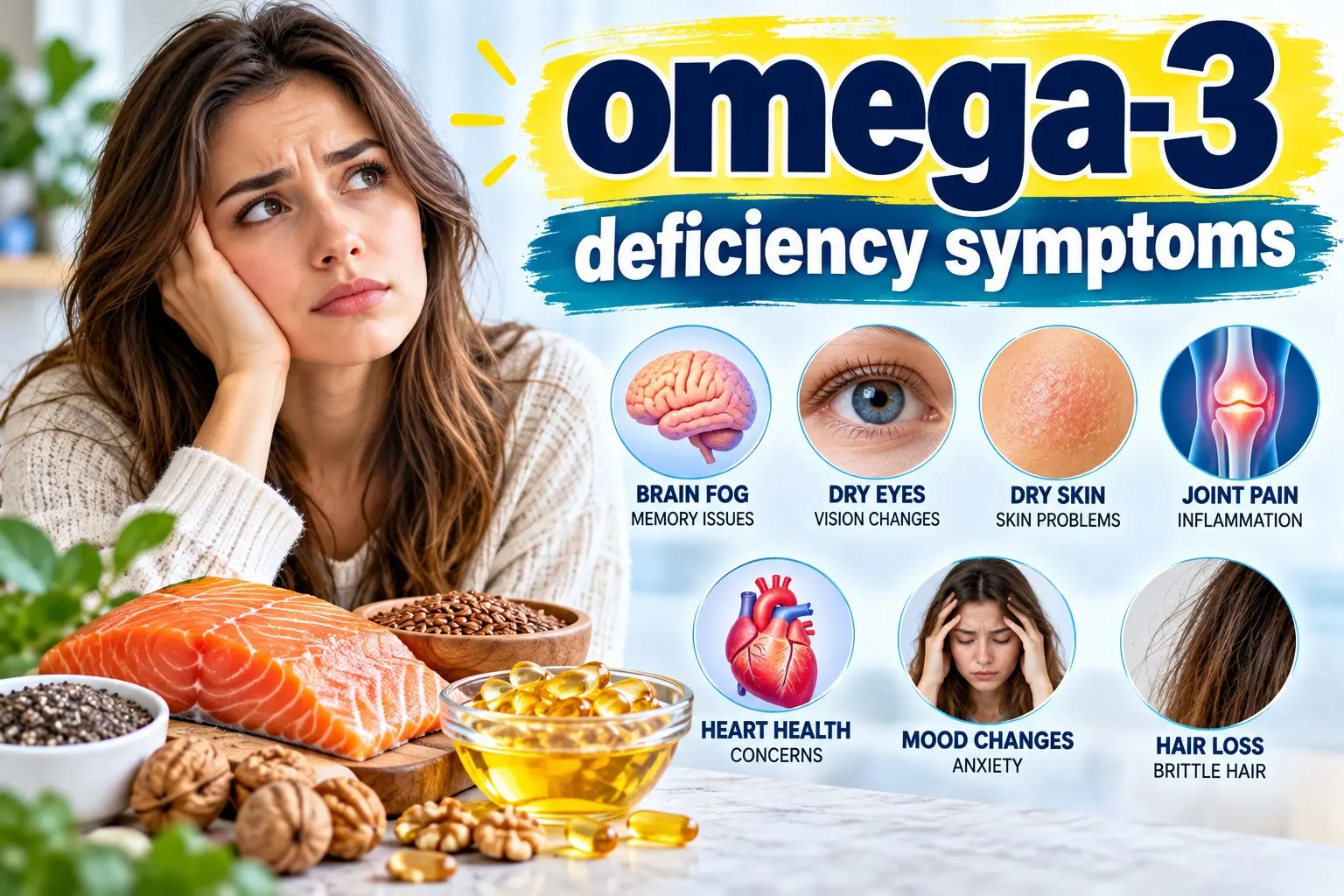
Omega-3 deficiency symptoms are often described too broadly online. True deficiency is rare. The clearest established signs are rough, scaly skin and dermatitis. Fatigue, poor focus, hair loss, brittle nails, joint pain, dry eyes, and low mood can have many causes and should not be used to diagnose an omega-3 deficiency.
That distinction matters because a symptom list can make almost anyone think they are deficient.
The better question is not, “Do I have three symptoms from a list?” It is, “Am I getting enough omega 3 from food, do I have a reason to be at risk, and is there evidence that testing or treatment is needed?”
This article is for general information and education. It does not replace medical advice, diagnosis, or treatment.
Get medical advice for unexplained symptoms. Do not assume persistent fatigue, hair loss, vision changes, severe skin problems, numbness, joint swelling, major mood changes, unexplained weight loss, or other new symptoms are caused by omega 3 intake. These problems can have many nutritional and medical causes.
Table of Contents
- What Omega 3 Deficiency Really Means
- 7 Critical Truths
- True deficiency is rare
- The proven symptom list is short
- Common online symptoms are not diagnostic
- ALA, EPA, and DHA are different
- Blood testing has limits
- Food comes first for most people
- Supplements are not automatically better
- Who May Be at Higher Risk
- How Much Omega 3 You Need
- Best Food Sources
- Vegetarian and Vegan Options
- Pregnancy and Breastfeeding
- Omega 3 Testing
- Supplement Safety
- Frequently Asked Questions
What does omega 3 deficiency really mean?
Omega 3 fatty acids are a family of polyunsaturated fats.
The three forms discussed most often are:
- ALA, or alpha linolenic acid
- EPA, or eicosapentaenoic acid
- DHA, or docosahexaenoic acid
Alpha linolenic acid is essential because your body cannot make it.
You must get it from food.
Your body can turn some ALA into EPA and DHA, but the conversion is limited. NIH reports that conversion to EPA and DHA is very small, with reported total conversion rates below 15 percent.
This is why flaxseed and salmon are both called omega 3 foods, yet they do not provide the same forms.
Flaxseed mainly provides ALA.
Salmon provides preformed EPA and DHA.
For a broader look at nutrients, deficiency questions, and supplement safety, visit the NextFitLife Nutrition and Vitamins Guide.
1. True omega 3 deficiency is rare
This is the first fact that many symptom lists miss.
NIH states that classical essential fatty acid deficiency is virtually nonexistent in healthy people in the United States.
The body also stores essential fatty acids in body fat. Those stores can help protect against deficiency when dietary intake drops for a short time.
Historically, clinical deficiency was seen in people receiving specialized nutrition that did not contain enough polyunsaturated fat.
Modern enteral and parenteral nutrition formulas are designed to provide essential fats, so this problem is now uncommon.
That does not mean everybody eats an ideal amount of EPA and DHA.
Low seafood intake and true clinical deficiency are different ideas.
| Term | What It Means | What It Does Not Mean |
|---|---|---|
| Low intake | You eat few foods that contain omega 3 fats | It does not prove a clinical deficiency |
| Low blood level | A laboratory result shows lower omega 3 status by that test | There is no universally accepted EPA or DHA deficiency cutoff |
| Clinical deficiency | Essential fatty acid shortage is producing clinical signs | It is not diagnosed from fatigue or dry skin alone |
2. The proven omega 3 deficiency symptom list is short
NIH gives a much shorter answer than most online lists.
Established omega-3 deficiency symptoms include:
- Rough, scaly skin
- Dermatitis
- A red, swollen, itchy rash
That does not mean every dry patch of skin points to omega 3 deficiency.
Dry or irritated skin can also come from eczema, psoriasis, weather, harsh cleansers, allergies, medicines, dehydration of the outer skin layer, or many other causes.
The symptom has to be interpreted in context.
3. Fatigue, hair loss, brain fog, and joint pain do not diagnose omega 3 deficiency
This is the biggest correction to the old version of this article.
Many websites list long groups of supposed symptoms:
- Fatigue
- Brain fog
- Poor memory
- Low mood
- Hair loss
- Brittle nails
- Dry eyes
- Joint pain
- Poor sleep
These symptoms are real.
The problem is the diagnosis attached to them.
None of these symptoms is specific enough to tell you that omega 3 intake is the cause.
For example, fatigue can relate to poor sleep, anemia, thyroid disease, infection, stress, depression, medicine effects, low calorie intake, or many other causes.
Hair loss can relate to genetics, iron deficiency, thyroid disease, hormones, recent illness, scalp disease, or physical stress.
Joint pain has an even wider list of possible causes.
That is why a good nutrition guide should not turn common symptoms into a self diagnosis.
| Symptom | Can It Occur? | Can It Diagnose Omega 3 Deficiency? |
|---|---|---|
| Rough scaly skin | Yes, this is a recognized deficiency sign | No, other skin conditions can look similar |
| Dermatitis | Yes, this is recognized in essential fatty acid deficiency | No, dermatitis has many causes |
| Fatigue | It can occur for many reasons | No |
| Hair loss | It can occur in broader severe essential fatty acid deficiency | No, it is not a specific omega 3 test |
| Joint pain | Joint symptoms have many possible causes | No |
| Low mood | Mood and omega 3 status are areas of research | No |
| Brain fog | This is a nonspecific complaint | No |
The practical lesson is simple.
Do not start high dose fish oil because you feel tired and have dry skin.
Look at your diet, your medical history, and the full symptom pattern first.
4. ALA, EPA, and DHA are not interchangeable
Omega 3 is not one single fat.
| Omega 3 | Main Sources | Key Point |
|---|---|---|
| ALA | Flaxseed, chia seeds, walnuts, canola oil, soybean oil | The essential omega 3 with an official Adequate Intake |
| EPA | Fatty fish, seafood, fish oil, some algae products | No U.S. RDA or AI has been set specifically for EPA |
| DHA | Fatty fish, seafood, fish oil, algal oil | Highly concentrated in the brain and retina, but no separate U.S. RDA exists |
Your body can convert ALA into EPA and then DHA, but that conversion is limited.
This does not make flaxseed, chia seeds, or walnuts poor foods.
They are useful sources of ALA and can be part of a healthy diet.
It simply means a tablespoon of chia seed is not nutritionally identical to a serving of salmon.
For ideas on fitting healthy fats into a balanced diet, see the NextFitLife Healthy Foods Guide.
5. There is no simple blood cutoff that proves omega 3 deficiency
This is another place where online advice becomes too certain.
Blood tests can measure fatty acids in plasma or red blood cells.
They can tell you something about omega 3 status.
What they cannot currently do is provide one universally accepted number that proves clinical EPA or DHA deficiency.
NIH states that there are no known cutoff concentrations of DHA or EPA below which specific problems with vision, nerve function, or immune function are known to occur.
What about the omega 3 index?
The omega 3 index measures EPA and DHA in red blood cell membranes.
It is used in research and is available through some laboratories.
That can make it useful for assessing fatty acid status.
It is not the same thing as a universally accepted diagnostic test for “omega 3 deficiency.”
Be careful with websites that present one commercial laboratory cutoff as if every major medical body uses it to diagnose deficiency.
6. Food is the best starting point for most people
You do not need a supplement simply because omega 3 fats are important.
Start with your normal eating pattern.
Good ALA sources include:
- Flaxseed
- Chia seeds
- Walnuts
- Canola oil
- Soybean oil
Foods rich in EPA and DHA include:
- Salmon
- Sardines
- Mackerel
- Herring
- Trout
- Tuna
- Some shellfish
The American Heart Association recommends eating two servings of fish each week, especially fatty fish, as part of a heart healthy eating pattern.
That recommendation is about overall cardiovascular health.
It is not a treatment protocol for a diagnosed omega 3 deficiency.
For more everyday meal ideas, see Nutrition Tips for Improving Your Health and the main Foods and Nutrition Hub.
7. Omega 3 supplements are not automatically better
Fish oil and algal oil can be useful tools.
They are not required for everybody.
Supplement needs depend on diet, health conditions, pregnancy, medicines, triglyceride treatment, and individual clinical advice.
A supplement should answer a clear question.
For example:
- Do you rarely eat seafood?
- Do you follow a vegan diet and want a direct source of DHA or EPA?
- Has your clinician advised an omega 3 product for a specific reason?
- Are you pregnant and reviewing DHA intake with your maternity care team?
Those are more useful questions than “Does everybody need fish oil?”
How much omega 3 do adults need?
U.S. dietary reference values set an Adequate Intake for ALA.
They do not set an RDA for EPA or DHA.
| Life Stage | ALA Adequate Intake |
|---|---|
| Adult men | 1.6 g per day |
| Adult women | 1.1 g per day |
| Pregnancy | 1.4 g per day |
| Breastfeeding | 1.3 g per day |
These numbers apply to ALA.
They should not be mistaken for EPA plus DHA targets.
NIH states that the Food and Nutrition Board has not established separate intake recommendations for EPA or DHA.
Who is actually at higher risk of essential fatty acid deficiency?
A healthy person eating a varied diet is unlikely to develop classical deficiency.
Risk becomes more relevant in unusual situations where fat intake or fat absorption is severely impaired.
Examples can include:
- Severe fat malabsorption
- Major intestinal disease that causes marked malabsorption
- Very restrictive nutrition with inadequate essential fat
- Specialized nutrition that does not provide enough polyunsaturated fat
- Some severe forms of undernutrition
Merck Manual describes essential fatty acid deficiency as rare and notes that it can cause scaly dermatitis and other systemic signs.
The key word is “essential fatty acid.”
This condition can involve both omega 3 and omega 6 essential fats, so it should not be reduced to a casual list of “low omega 3 symptoms.”
Does eating little fish mean you are deficient?
No.
Someone who rarely eats fish may have low EPA and DHA intake.
That does not automatically mean they have a clinical deficiency.
They may still get ALA through seeds, nuts, oils, and other foods.
The distinction matters because “low intake” and “deficiency disease” are not the same diagnosis.
What if you are vegetarian or vegan?
Plant based diets can provide ALA through flaxseed, chia seeds, walnuts, canola oil, and soybean foods or oils.
Those are worthwhile foods.
If you avoid fish but want a direct source of DHA or EPA, algal oil is an option.
Algae are the original source of long chain omega 3 fats in the marine food chain.
Check the supplement label because products vary in how much DHA and EPA they provide.
Do not assume every vegan needs a high dose supplement.
Diet, pregnancy, medical history, and individual goals still matter.
What about omega 3 during pregnancy?
Pregnancy deserves separate advice because DHA is involved in fetal brain and eye development.
The U.S. ALA Adequate Intake rises to 1.4 g per day during pregnancy.
NIH also summarizes expert guidance supporting seafood and long chain omega 3 intake during pregnancy.
FDA and EPA advise people who are pregnant or breastfeeding to eat 2 to 3 servings of lower mercury fish per week, about 8 to 12 ounces in total.
Examples from the FDA “Best Choices” list include several fish that also provide omega 3 fats.
Pregnancy is not a good time to pick fish solely by omega 3 content while ignoring mercury guidance.
Use the current FDA fish advice and discuss supplements with your maternity care team.
Can dry eyes prove omega 3 deficiency?
No.
DHA is highly concentrated in the retina, so omega 3 and eye health are valid areas of nutrition research.
But dry eye symptoms have many causes.
Screen use, tear gland problems, medicines, autoimmune disease, age, contact lenses, and environmental conditions can all play a role.
Do not diagnose an omega 3 deficiency because your eyes feel gritty.
You can learn more about nutrition for vision in the NextFitLife Foods for Eye Health Guide.
Can joint pain prove low omega 3?
No.
EPA and DHA are involved in pathways related to inflammation, and omega 3 supplements have been studied in inflammatory joint conditions.
That does not make joint pain a deficiency test.
Joint pain can come from injury, osteoarthritis, inflammatory arthritis, gout, infection, overuse, and many other causes.
Persistent swelling, redness, warmth, severe pain, or reduced movement deserves proper assessment.
For nutrition topics related to bones and joints, see the NextFitLife Bone and Joint Nutrition Hub.
Can low mood mean you need fish oil?
No.
Mental health research has studied EPA and DHA, including their possible role alongside standard treatment for some people.
That is different from saying low mood proves omega 3 deficiency.
Depression and persistent mood changes deserve proper assessment.
Do not replace mental health treatment with a supplement.
Seek urgent help if you have thoughts of harming yourself or feel unable to stay safe.
Can brittle nails or hair loss be omega 3 deficiency symptoms?
They are not reliable standalone signs.
Brittle nails can result from repeated water exposure, nail products, iron problems, thyroid disease, aging, trauma, and other causes.
Hair loss can follow illness, stress, hormone changes, thyroid disease, iron deficiency, genetics, scalp disease, and many other problems.
Broader severe essential fatty acid deficiency can include hair changes, but that is very different from assuming everyday hair shedding means low omega 3.
Should you get an omega 3 blood test?
For most healthy people, the first step is usually simpler.
Look at what you eat.
Ask:
- Do I eat fish or seafood?
- Do I regularly eat flax, chia, walnuts, or other ALA foods?
- Do I avoid whole food groups?
- Do I have a condition that affects fat absorption?
- Am I pregnant or breastfeeding?
- Am I considering a supplement because of a vague symptom rather than a known dietary need?
Blood fatty acid testing can be useful in selected clinical or research settings.
But there is no single accepted DHA or EPA concentration below which NIH says normal visual, nerve, or immune function becomes impaired.
That is why the laboratory number should be interpreted with context rather than treated as a diagnosis by itself.
How can you increase omega 3 intake through food?
Start with foods you can actually keep eating.
| Food | Main Omega 3 Type | Easy Use |
|---|---|---|
| Salmon | EPA and DHA | Bake with vegetables or add to salad |
| Sardines | EPA and DHA | Serve on toast or with rice and salad |
| Trout | EPA and DHA | Bake or grill for dinner |
| Chia seeds | ALA | Add to oats or yogurt |
| Ground flaxseed | ALA | Stir into oats, yogurt, or smoothies |
| Walnuts | ALA | Use as a snack or salad topping |
Should you take an omega 3 supplement?
Maybe, but not because a generic symptom list told you to.
Supplements can make sense when food intake is low, seafood is avoided, pregnancy needs are being reviewed, or a clinician has recommended a specific product for a medical reason.
Read the label carefully.
“1,000 mg fish oil” does not necessarily mean 1,000 mg EPA plus DHA.
The EPA and DHA amounts are listed separately on many labels.
Algal products also vary.
Is high dose fish oil safe?
Do not turn a safety limit into a target dose.
NIH notes that FDA has concluded that dietary supplements providing no more than 5 g per day of combined EPA and DHA are safe when used as recommended.
That does not mean everyone should take 5 g per day.
High dose omega 3 therapy can be used medically for specific conditions such as very high triglycerides, but those doses belong in clinician directed treatment.
Two large trials also found a small increase in atrial fibrillation risk in people with cardiovascular disease or high cardiovascular risk who took 4 g per day for several years.
That is another reason high dose use should not be casual.
What side effects can omega 3 supplements cause?
Common side effects are usually mild.
NIH lists problems such as:
- Unpleasant taste
- Bad breath
- Heartburn
- Nausea
- Stomach discomfort
- Diarrhea
- Headache
If a supplement makes you feel unwell, do not assume the reaction means it is “working.”
Can fish oil interact with blood thinners?
Yes, interactions are possible.
High doses of fish oil have antiplatelet effects and may affect clotting.
Most research has not shown a major increase in clinically significant bleeding at commonly studied doses, but people taking warfarin or other anticoagulants should still discuss omega 3 supplements with the clinician or pharmacist managing their medicine.
Do not change a blood thinner dose based on a supplement label.
What should you do if you think your omega 3 intake is low?
Use this order.
- Check your diet. Look for fish, seafood, flaxseed, chia seeds, walnuts, canola oil, soybean foods, and other omega 3 sources.
- Separate symptoms from diagnosis. Fatigue or joint pain does not prove an omega 3 problem.
- Look for real risk factors. Severe malabsorption or unusual restrictive nutrition changes the picture.
- Improve food intake where practical. Build regular sources into meals.
- Discuss testing or supplements when needed. This is especially useful during pregnancy, with major digestive disease, or when medicines complicate supplement use.
That approach is slower than diagnosing yourself from a symptom checklist, but it is much more reliable.
What the old omega 3 deficiency lists get wrong
The biggest problem is not that omega 3 fats are unimportant.
They are important nutrients.
The problem is turning every possible effect of omega 3 biology into a deficiency symptom.
A nutrient can play a role in the brain without “brain fog” becoming a diagnostic symptom.
A nutrient can be present in the eye without dry eyes proving deficiency.
A nutrient can influence inflammatory pathways without every sore joint showing low intake.
This distinction protects readers from two problems:
- Missing another medical cause because they blamed omega 3
- Taking supplements they may not need
Conclusion
The strongest evidence on omega-3 deficiency symptoms is much narrower than many online lists suggest. True deficiency is rare, and the most clearly established signs involve rough scaly skin and dermatitis.
Your next step should be practical. Review your normal food intake, add reliable omega 3 foods if your diet is low in them, and get professional advice when symptoms are persistent, severe, or difficult to explain.
Do not let a vague symptom checklist make the diagnosis for you.
Internal Links and NextFitLife Nutrition Hub
Nutrition and Vitamins Guide
for nutrient sources, suspected deficiencies, testing limits, supplements, and safety.
Foods and Nutrition Hub
for healthy eating, nutrients, meal planning, special diets, and food based health guides.
Healthy Foods Guide
for salmon, walnuts, chia seeds, vegetables, whole grains, and other nutrient dense foods.
Nutrition Tips for Improving Your Health
for practical ways to improve food quality without rigid diet rules.
Foods for Eye Health
for DHA, oily fish, vitamins, minerals, and a wider look at nutrition and vision.
Bone and Joint Nutrition Hub
for healthy fats, calcium, vitamin D, protein, and nutrition questions related to joint health.
References and Sources
- National Institutes of Health Office of Dietary Supplements. Omega 3 Fatty Acids: Consumer Fact Sheet.
https://ods.od.nih.gov/factsheets/Omega3FattyAcids-Consumer/
- National Institutes of Health Office of Dietary Supplements. Omega 3 Fatty Acids: Health Professional Fact Sheet.
https://ods.od.nih.gov/factsheets/Omega3FattyAcids-HealthProfessional/
- Merck Manual Professional Edition. Essential Fatty Acid Deficiency.
https://www.merckmanuals.com/professional/nutritional-disorders/undernutrition/essential-fatty-acid-deficiency
- American Heart Association. Fish and Omega 3 Fatty Acids.
https://www.heart.org/en/healthy-living/healthy-eating/eat-smart/fats/fish-and-omega-3-fatty-acids
- U.S. Food and Drug Administration. FDA and EPA Advice About Eating Fish During Pregnancy, Breastfeeding, and Childhood.
https://www.fda.gov/food/consumers/questions-answers-fdaepa-advice-about-eating-fish-those-who-might-become-or-are-pregnant-or
About the Author
Adel Galal is the Founder and Lead Writer at NextFitLife. He researches health, nutrition, fitness, healthy aging, and consumer wellness topics using recognized medical, government, nutrition, and academic sources.
His approach to nutrition content is to separate established deficiency signs from broad symptom claims, compare food based guidance with supplement claims, and explain where laboratory testing or professional assessment has limits.
Adel is not a physician, registered dietitian, pharmacist, or other licensed healthcare professional. This article has not been independently medically reviewed by a licensed clinician.
Learn more about Adel Galal and NextFitLife on the About Us page.
Medical Disclaimer: I am not a doctor or other licensed healthcare professional, and this content is for educational purposes only. It does not replace professional medical advice, diagnosis, or treatment. This article explains published guidance and does not provide a personal clinical assessment. Always consult qualified medical professionals for diagnosis and treatment of any health condition.
Frequently Asked Questions
What are the main omega 3 deficiency symptoms?
The clearest established symptoms are rough, scaly skin and dermatitis, including a red, swollen, itchy rash. These signs are still not unique to omega 3 deficiency, so medical context matters.
Is fatigue a sign of omega 3 deficiency?
Fatigue does not diagnose omega 3 deficiency. It has many possible causes, including poor sleep, anemia, thyroid problems, illness, stress, medicines, depression, and low calorie intake.
Can omega 3 deficiency cause hair loss?
Severe essential fatty acid deficiency can include hair changes, but ordinary hair loss is not a specific sign of omega 3 deficiency. Hair loss has many other common causes.
Can low omega 3 cause joint pain?
Joint pain is not a reliable test for low omega 3 intake. Omega 3 fats are involved in inflammatory pathways, but joint pain can come from many injuries and medical conditions.
Can low mood or brain fog prove omega 3 deficiency?
No. Omega 3 fats are studied in brain and mental health research, but low mood, memory problems, or brain fog cannot diagnose a deficiency.
How common is true omega 3 deficiency?
True clinical essential fatty acid deficiency is rare in otherwise healthy people who eat a varied diet. Risk is greater in unusual situations involving severe fat malabsorption, undernutrition, or inadequate specialized nutrition.
How much ALA do adults need each day?
The Adequate Intake for ALA is 1.6 g per day for adult men and 1.1 g per day for adult women. Pregnancy raises the amount to 1.4 g, while breastfeeding has an Adequate Intake of 1.3 g per day.
Is there a recommended daily amount for EPA and DHA?
The U.S. Food and Nutrition Board has not established a separate RDA or Adequate Intake for EPA or DHA. Its formal omega 3 intake values for people age one and older apply to ALA.
What foods contain omega 3?
Fatty fish such as salmon, sardines, mackerel, herring, and trout provide EPA and DHA. Flaxseed, chia seeds, walnuts, canola oil, and soybean oil provide ALA.
Can vegans get enough omega 3?
Vegans can obtain ALA from seeds, walnuts, and plant oils. Algal oil provides a direct vegan source of DHA and, in some products, EPA. Supplement needs depend on the individual.
Can a blood test diagnose omega 3 deficiency?
Blood tests can measure fatty acid status, but NIH states that there are no known EPA or DHA cutoff concentrations that clearly define functional deficiency. Test results should be interpreted in context.
What is the omega 3 index?
The omega 3 index measures EPA and DHA in red blood cell membranes. It is used in research and some clinical testing, but it is not a universally accepted standalone diagnostic test for omega 3 deficiency.
Should everyone take fish oil?
No. Many people can obtain omega 3 fats through food. Supplements can be useful in selected situations, but they should meet a real dietary or medical need rather than replace a balanced diet.
Can omega 3 supplements interact with blood thinners?
Yes. High doses can have antiplatelet effects. People taking warfarin or other anticoagulants should discuss fish oil or other omega 3 supplements with their clinician or pharmacist.
Is 5 g of EPA and DHA per day a recommended dose?
No. The 5 g figure cited by FDA and NIH is a safety level for supplements used as recommended, not a daily target. High dose omega 3 treatment should be used for a clear medical reason and with professional guidance.
How can I improve my omega 3 intake safely?
Start with regular food sources such as fatty fish, flaxseed, chia seeds, walnuts, and suitable plant oils. Consider a supplement only when your diet, life stage, or medical care makes one useful.

Health & wellness writer with 30+ years of experience in nutrition, fitness, and healthy aging. Founder of NextFitLife.com — evidence-based health guidance.