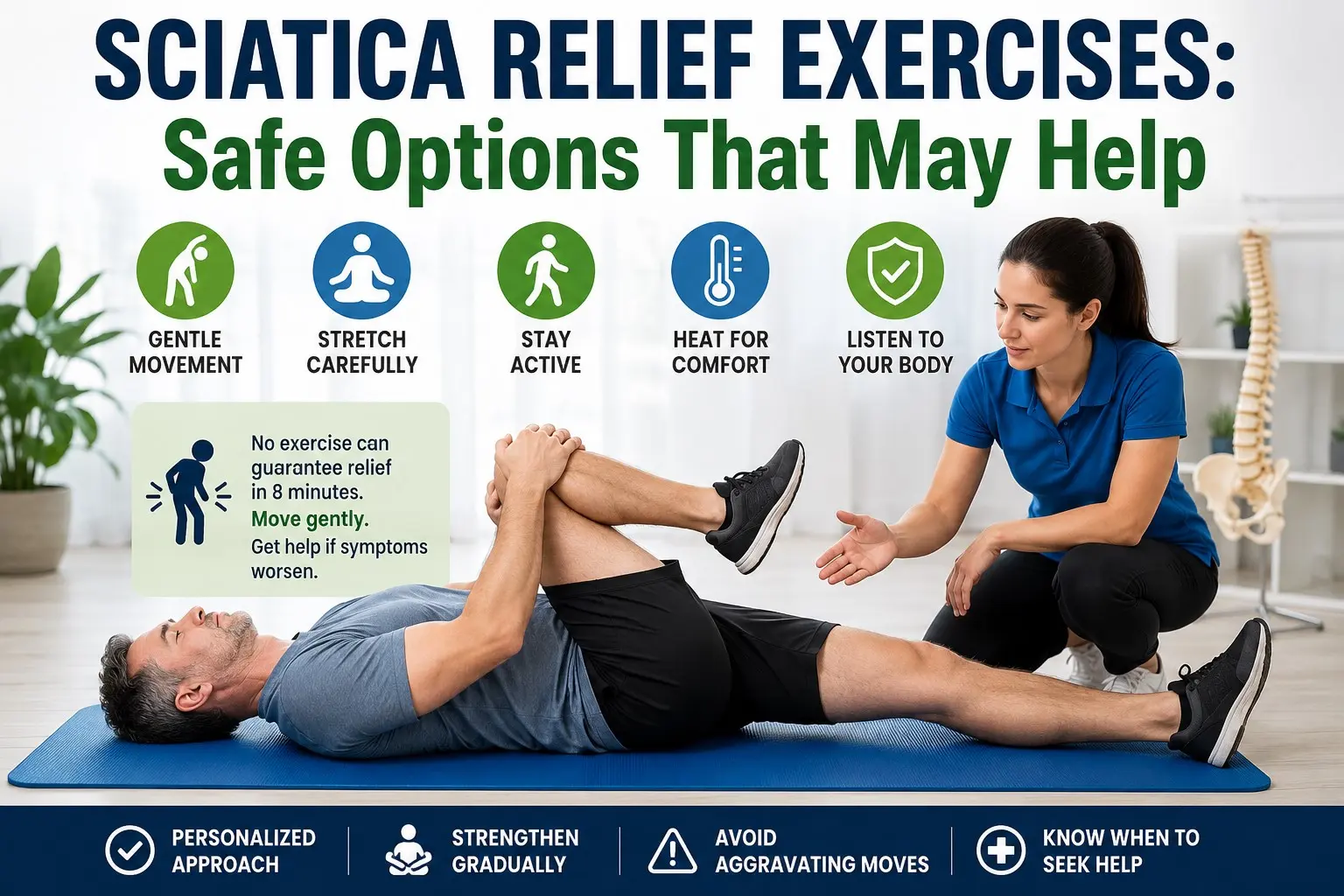
Quick Answer: Which Sciatica Relief Exercises May Help?
There is no evidence-based exercise that can guarantee sciatica relief in eight minutes. For many uncomplicated cases, staying gently active is usually more helpful than prolonged bed rest, but the best movement depends on the cause of the symptoms and how your leg responds.
NHS guidance encourages people with sciatica to continue normal activities as much as possible and to begin gentle exercise as soon as they can. NICE also recommends self-management and considering an exercise programme chosen around the person's needs, preferences, and capabilities.
Safer exercise options often begin with short walks, frequent position changes, comfortable daily movement, and an individualized physiotherapy programme when symptoms are persistent, severe, or difficult to manage.
For broader musculoskeletal guidance, visit the Bone & Joint Health Hub.
Do Not Exercise Through These Sciatica Red Flags
Seek emergency assessment if sciatica occurs with:
- sciatica on both sides
- severe or worsening weakness or numbness in both legs
- new numbness around the genitals, inner thighs, or anus
- new difficulty starting urination, inability to urinate, or loss of bladder control
- new loss of bowel sensation or bowel control
- new sexual dysfunction together with severe low-back pain radiating into the leg
These may indicate cauda equina syndrome, a serious compression of the nerves at the bottom of the spinal canal.
Also seek prompt medical assessment for rapidly progressive weakness, severe symptoms after significant trauma, fever or systemic illness, or new severe back pain in someone with a history of cancer.
Medical and Editorial Notice
This article provides general education. It cannot confirm that your symptoms are sciatica, identify the exact nerve root or spinal structure involved, or prescribe an exercise programme.
A movement that reduces symptoms for one person may worsen symptoms for another. Exercise should be adapted to your diagnosis, symptoms, mobility, balance, age, and other health conditions.
What Is Sciatica?
Sciatica happens when the sciatic nerve roots are irritated or compressed. Common causes include a slipped or herniated disc, spinal stenosis, spondylolisthesis, and back injury.
Typical symptoms affect the buttock and the back of one leg and may include:
- sharp or burning pain
- pins and needles
- numbness
- weakness
- pain aggravated by some movements, coughing, or sneezing
Back pain may also occur, but leg symptoms are often more prominent.
Why Can Movement Help Sciatica?
Long periods of bed rest or inactivity can increase stiffness, reduce confidence in movement, and make it harder to return to normal activity.
NHS guidance specifically advises people with sciatica not to sit or lie down for long periods, even when movement is uncomfortable. NICE also recommends giving advice that helps people continue normal activities and considering exercise programmes appropriate to the individual.
Exercise does not instantly “push a disc back in” or “release” every sciatic nerve. Its role is more practical: maintain movement, rebuild strength and confidence, improve function, and support recovery while the irritated nerve settles or the underlying condition is treated.
Safer Sciatica Relief Exercise Options
The safest starting point is usually gentle, tolerable movement rather than a rigid online routine.
| Movement option | How to approach it | When to stop |
|---|---|---|
| Short walks | Walk at a comfortable pace for a short period and build gradually if symptoms remain manageable. | Stop for rapidly increasing leg pain, weakness, numbness, dizziness, or loss of balance. |
| Frequent position changes | Alternate between sitting, standing, and walking instead of remaining in one posture for long periods. | Stop a position that clearly and repeatedly worsens leg symptoms. |
| Comfortable daily activity | Continue light household and personal activities as tolerated rather than defaulting to bed rest. | Avoid tasks that involve heavy lifting, repeated twisting, or movements that sharply aggravate symptoms. |
| Individualized mobility exercises | Use movements recommended by a physiotherapist or clinician when you need a more specific programme. | Stop for progressive neurological symptoms or severe pain that does not settle after stopping. |
| Gradual strengthening | Build trunk, hip, and general strength progressively after symptoms and movement tolerance are assessed. | Do not force heavy resistance through worsening radiating leg pain. |
Is Walking Good for Sciatica?
Walking is a simple way to stay active and is often easier to adjust than a complex stretching routine.
Start with a duration you can tolerate. That might be a few minutes around the home or a short outdoor walk. You do not need to reach a particular number of steps or minutes on the first day.
If symptoms remain manageable, gradually increase the duration or frequency. If walking repeatedly causes marked worsening of leg pain, numbness, weakness, or balance problems, seek professional advice rather than simply pushing through.
What About Gentle Mobility Exercises?
Some people benefit from gentle spinal or hip movement, but the direction that feels helpful varies.
For example, one person with disc-related symptoms may prefer a different movement direction from someone with spinal stenosis. That is why a universal prescription such as repeated pigeon pose, deep spinal twists, or aggressive hamstring stretching is not appropriate for every reader.
A safer rule is to keep movements small and comfortable and to stop if they clearly increase radiating leg symptoms or produce new neurological changes.
Should You Strengthen Your Core and Hips?
Strengthening may form part of a longer-term rehabilitation programme, especially when the goal is to return to work, lifting, sport, or regular exercise.
NICE does not prescribe one universal core routine. It recommends considering exercise programmes based on the person's needs, preferences, and capabilities.
A physiotherapist may select trunk, hip, leg, balance, or general conditioning exercises depending on the assessment. Progression should be gradual rather than built around a promise of immediate pain relief.
Do Piriformis, Pigeon, or Hamstring Stretches Cure Sciatica?
No single stretch can be expected to cure sciatica.
The older idea that most sciatica is caused by a tight piriformis muscle is too simplistic. NHS guidance identifies spinal causes such as a slipped disc, spinal stenosis, spondylolisthesis, and injury as common causes of sciatica.
Pigeon pose, deep hamstring stretching, spinal twisting, and other intense stretches may feel helpful for some people but can aggravate symptoms in others.
If you want to use stretching, keep it gentle and symptom guided. Do not force a stretch because an online routine says it should “release the nerve.”
When Should You Stop a Sciatica Exercise?
Stop the exercise and reassess if it causes:
- new or clearly worsening leg weakness
- rapidly increasing numbness
- loss of balance or coordination
- severe pain that does not settle after stopping
- pain that becomes progressively more intense with each repetition
- new bladder, bowel, genital, or saddle-area symptoms
Normal exercise effort and mild temporary discomfort are different from progressive neurological symptoms.
Which “Quick Fixes” Should Not Be Presented as Proven Sciatica Treatments?
The original version of this article promoted several methods as rapid treatments. Current NICE guidance does not support those claims.
| Treatment | Current guidance |
|---|---|
| TENS | NICE says not to offer TENS for low back pain with or without sciatica. |
| Acupuncture | NICE says not to offer acupuncture for low back pain with or without sciatica. |
| Traction | NICE says not to offer traction. |
| Belts or corsets | NICE says not to offer belts or corsets for low back pain with or without sciatica. |
| Ultrasound therapy | NICE says not to offer therapeutic ultrasound. |
| Massage alone | Manual therapy may be considered only as part of a package that includes exercise. |
This does not mean that every person who has previously used one of these methods was harmed. It means they should not be promoted as proven rapid solutions based on current NICE guidance.
What About Heat, Ice, and Pain Medicine?
NHS guidance includes heat packs as a self-care option for painful areas. Heat may improve comfort but does not remove nerve compression.
A cold pack may feel soothing for some people, but it should be treated as a comfort measure rather than a proven anti-inflammatory cure for sciatica. Never apply extreme heat or cold directly to numb skin.
Medication advice also needs caution. NHS notes that paracetamol is unlikely to help and that it is unclear how much NSAIDs such as ibuprofen help sciatica. NICE highlights limited evidence of benefit and potential harms from NSAIDs.
Ask a pharmacist or clinician which medicine is appropriate if you have kidney disease, heart disease, stomach-ulcer or bleeding history, pregnancy, blood-thinning medication, or multiple medicines.
When Can Physiotherapy Help?
Physiotherapy can be useful when you need an exercise programme based on your actual symptoms rather than a generic internet routine.
A physiotherapist may assess:
- strength
- sensation
- mobility
- balance
- which movements ease or worsen symptoms
- work and daily activity demands
NICE says manual therapy, including soft-tissue techniques or mobilisation, may be considered only as part of a treatment package that includes exercise.
If your sciatica has not improved after a few weeks of appropriate self-care, is worsening, or is stopping normal activities, NHS guidance recommends seeking medical or musculoskeletal assessment.
How Quickly Can Sciatica Improve?
NHS guidance says sciatica usually improves in a few weeks to a few months, although it can last longer and may recur.
That is why a fixed promise such as “sciatica relief in 8 minutes” is not medically reliable. A brief movement session may make some people temporarily more comfortable, but it cannot guarantee that the irritated nerve has recovered.
Recovery depends on the cause, severity, neurological findings, general health, activity level, and response to treatment.
Key Takeaway
Sciatica relief exercises can be helpful, but there is no universal eight-minute cure.
For uncomplicated sciatica, current guidance supports staying active, avoiding prolonged bed rest, beginning gentle exercise, and using an individualized programme when needed.
Short walks, frequent position changes, and tolerable movement are safer starting points than aggressive stretching or forcing the same routine on every person.
Stop and seek medical assessment if you develop progressive weakness, severe numbness, bilateral symptoms, bladder or bowel changes, saddle numbness, or another neurological red flag.
References and Authoritative Sources
- NHS: Sciatica
- NICE NG59: Low Back Pain and Sciatica in Over 16s — Recommendations
- NICE NG59: Current Low Back Pain and Sciatica Guideline
- NICE NG127: Suspected Neurological Conditions — Cauda Equina Referral
- NICE NG234: Spinal Metastases and Metastatic Spinal Cord Compression
Source review date: August 8, 2026
These organizations do not endorse NextFitLife.
Frequently Asked Questions About Sciatica Relief Exercises
Can exercise relieve sciatica in 8 minutes?
There is no reliable evidence that a specific exercise routine can guarantee sciatica relief in eight minutes. Some gentle movement may improve comfort temporarily, but recovery usually takes longer.
What exercise is safest for sciatica?
There is no single safest exercise for everyone. Short walks, frequent position changes, and comfortable movement are reasonable starting points for many uncomplicated cases, while persistent or severe symptoms may need individualized physiotherapy.
Should I walk with sciatica?
NHS guidance encourages staying active and beginning gentle exercise. Walking can be a practical option if it does not cause rapidly worsening leg symptoms.
Should I stretch my piriformis for sciatica?
Not automatically. Sciatica is commonly caused by spinal nerve-root irritation rather than a tight piriformis muscle. A piriformis stretch may help some people and aggravate others.
Is pigeon pose good for sciatica?
It is not appropriate for everyone. Deep hip or spinal stretches should not be forced through radiating leg pain, numbness, or weakness.
Should I stay in bed during a sciatica flare?
NHS guidance advises against sitting or lying down for long periods and encourages normal activity and gentle exercise as much as possible.
Does TENS help sciatica?
NICE recommends not offering TENS for low back pain with or without sciatica.
Does acupuncture help sciatica?
NICE recommends not offering acupuncture for low back pain with or without sciatica.
When should I stop exercising?
Stop and seek advice if an exercise causes new or progressive weakness, rapidly increasing numbness, loss of balance, severe pain that does not settle, or new bladder, bowel, or saddle-area symptoms.
How long does sciatica usually take to improve?
NHS guidance says sciatica usually improves in a few weeks to a few months, although it may last longer or recur.
When should I see a physiotherapist?
Consider assessment when symptoms have not improved after a few weeks, are worsening, limit normal activity, or when you need help choosing exercises that fit your symptoms.
Is this article medically reviewed?
No. It was source checked against current NHS and NICE guidance but has not been medically reviewed by a licensed healthcare professional.
Medical Disclaimer
NextFitLife provides general educational information. This page cannot diagnose the cause of radiating leg pain, prescribe an exercise programme, or replace medical, physiotherapy, emergency, or specialist care.

Health & wellness writer with 30+ years of experience in nutrition, fitness, and healthy aging. Founder of NextFitLife.com — evidence-based health guidance.