
Published on: February 3, 2024
Updated on: October 25, 2026
Bodyweight CrossFit Workouts can build conditioning, muscular endurance, movement skill, and useful strength without dumbbells, barbells, or machines. The trick is not doing random exercises as fast as possible. A good workout has a clear structure, movements you can control, and an intensity that lets you finish with sound form.
This guide gives you 24 complete no-gear workouts rather than 24 isolated exercises. You will find short AMRAPs, EMOMs, rounds for time, beginner sessions, longer endurance WODs, and low-impact options.
You can train hard without equipment. You do not need to train recklessly.
This article is for general information and education. It does not replace medical advice, diagnosis, or treatment.
For more training guidance, visit the NextFitLife Fitness Hub, CrossFit Workouts for Beginners, and Home Workouts and Equipment Guide.
Table of Contents
- Bodyweight CrossFit Workouts: Quick Answer
- What Makes a Workout CrossFit Style?
- AMRAP, EMOM, and For Time Explained
- 24 Bodyweight CrossFit Workouts
- Beginner WODs
- Short conditioning WODs
- Strength endurance WODs
- Longer challenge WODs
- Best Workout by Goal
- How to Scale
- How Often to Train
- How to Progress Without Weights
- Can Bodyweight CrossFit Build Muscle?
- Fat Loss Reality Check
- Recovery
- Common Mistakes
- Frequently Asked Questions
- References and Sources
Bodyweight CrossFit Workouts: Quick Answer
Bodyweight CrossFit Workouts combine simple movements such as squats, push ups, lunges, burpees, planks, sit-ups, mountain climbers, and jumps into structured conditioning sessions.
Common workout formats include:
- AMRAP: complete as many quality rounds or repetitions as you can within a fixed time.
- EMOM: begin a prescribed amount of work at the start of each minute, then rest for whatever time remains.
- For Time: complete the listed work with good form and record how long it takes.
- Intervals: alternate planned work and recovery periods.
The word that matters most is quality.
Finishing one minute faster does not improve the workout if your push-ups become half repetitions and every squat turns into a collapse.
What Makes Bodyweight CrossFit Different From a Random Circuit?
CrossFit training is built around varied functional movements performed at meaningful intensity.
A random list such as 20 squats, 20 jumping jacks, and 20 sit ups is not automatically a smart program simply because you perform it quickly.
A useful high intensity functional training session considers:
- Movement quality
- Exercise order
- Training duration
- Work-to-rest balance
- Current fitness
- Scaling
- Recovery
A 2025 systematic review and meta-analysis of 19 studies involving 911 healthy adults found that high-intensity functional training produced positive effects on strength, power, speed, endurance, and agility.
A 2026 systematic review of CrossFit research also reported improvements in aerobic capacity, strength, muscle size, and muscular endurance while noting the substantial physiological stress these sessions can create.
Hard training works because it is dosed well, not simply because it hurts.
AMRAP, EMOM, and For Time Explained
| Format | Meaning | Best Use |
|---|---|---|
| AMRAP | As many quality rounds or reps as possible in a fixed time | Work capacity and pacing |
| EMOM | Start work at the beginning of each minute | Controlled intervals and built in rest |
| For Time | Complete a fixed workload and record the time | Pacing and repeatable benchmarks |
| Intervals | Planned work followed by recovery | Beginners and harder conditioning |
The official CrossFit benchmark Cindy is a good example of an AMRAP. The prescribed workout uses pull-ups, push-ups, and squats for 20 minutes. CrossFit also publishes a shorter scaled beginner version, which shows an important principle: workouts should be adjusted to the athlete.
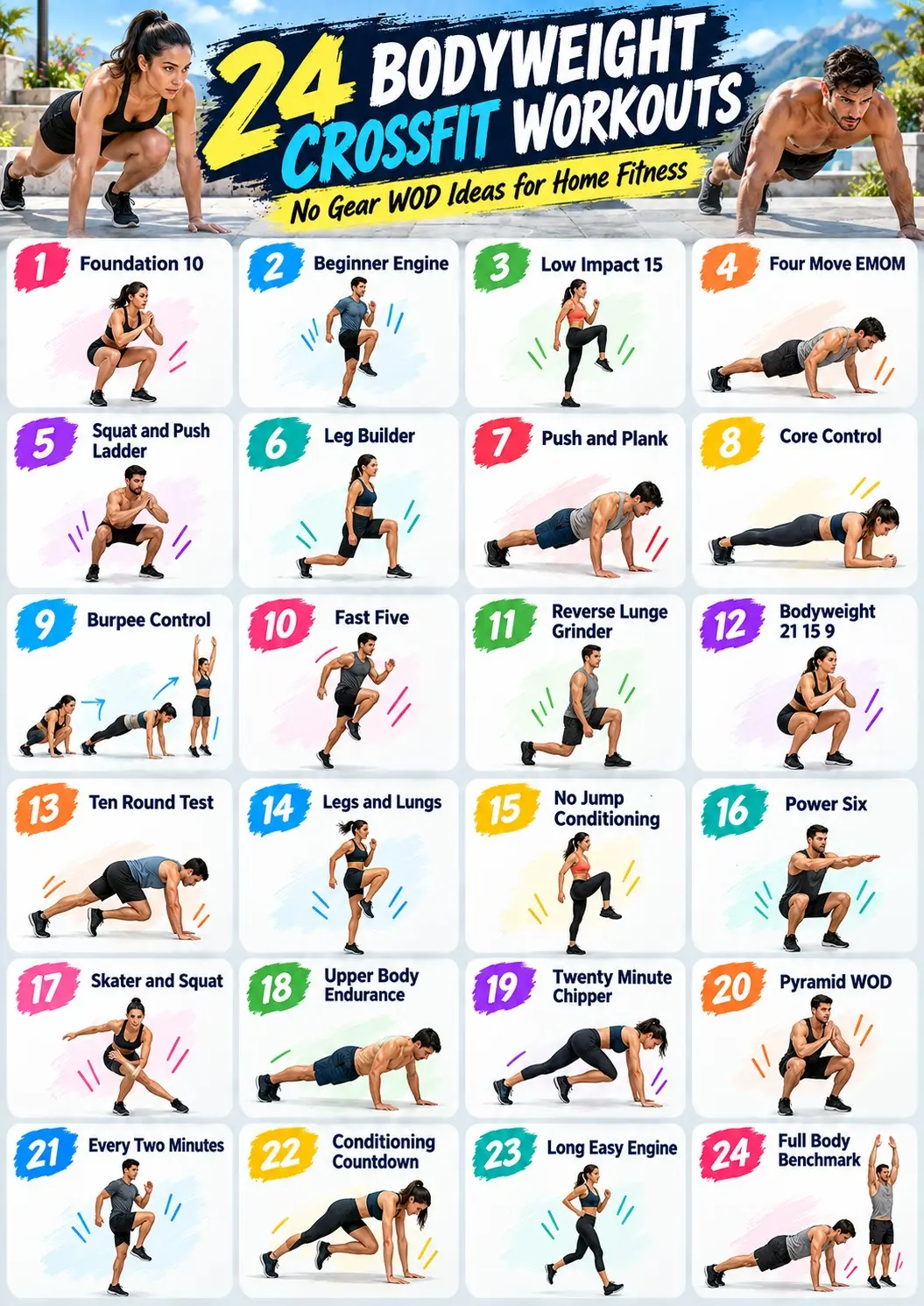
1. Foundation 10
10-minute AMRAP
- 5 incline or regular push ups
- 10 air squats
- 10 alternating reverse lunges
This is where I would start if you are new to Bodyweight CrossFit Workouts.
Use a wall or stable elevated surface for push ups if needed.
2. Beginner Engine
12 minute AMRAP
- 8 air squats
- 6 incline push ups
- 10 mountain climbers total
- 8 alternating reverse lunges
Move continuously without racing the first few minutes.
3. Low Impact 15
15 minute AMRAP
- 10 chair or air squats
- 8 wall push ups
- 10 alternating step back lunges
- 20 marching knee drives
No jumping is required.
This is a better option when high impact work is inappropriate or simply unnecessary.
4. Four Move EMOM
12 minutes
Repeat this three minute cycle four times:
- Minute 1: 10 air squats
- Minute 2: 6 to 10 push ups
- Minute 3: 20 mountain climbers total
Rest for the remaining part of each minute.
If you cannot finish the work with at least a little rest left, reduce the repetitions.
5. Squat and Push Ladder
For Time
- 2 push ups and 4 squats
- 4 push ups and 8 squats
- 6 push ups and 12 squats
- 8 push ups and 16 squats
- 10 push ups and 20 squats
Scale the push ups before your range of motion falls apart.
6. Leg Builder
4 rounds for quality
- 15 air squats
- 10 reverse lunges each side
- 12 glute bridges
- 20 second wall sit
Rest 45 to 90 seconds between rounds.
This session has less cardio pressure and more local leg endurance.
7. Push and Plank
10 minute AMRAP
- 6 push ups
- 10 shoulder taps total
- 20 second forearm plank
- 8 slow mountain climbers total
Keep the pelvis quiet during the shoulder taps.
8. Core Control
4 rounds
- 8 dead bugs each side
- 10 reverse crunches
- 20 second side plank each side
- 10 slow mountain climbers each side
This is intentionally slower than a classic conditioning WOD.
For more core work, see Lower Ab Exercises.
9. Burpee Control
8 minute EMOM
- Perform 5 to 8 burpees at the start of each minute.
- Rest for the remaining time.
Beginners can step back and step forward rather than jumping.
A burpee does not need a push up or vertical jump unless the workout specifically calls for those additions.
10. Fast Five
5 rounds for time
- 5 burpees
- 10 air squats
- 15 mountain climbers total
Use this only after you can perform each movement cleanly while breathing hard.
11. Reverse Lunge Grinder
12 minute AMRAP
- 12 reverse lunges total
- 8 push ups
- 12 sit ups or dead bugs
Choose dead bugs if sit ups bother your back or you prefer a more controlled core movement.
12. Bodyweight 21 15 9
For Time
Complete 21 reps, then 15, then 9 of:
- Air squats
- Push ups
This uses the familiar 21, 15, 9 structure without claiming that it is one of the official named CrossFit benchmark workouts.
13. Ten Round Test
10 rounds for time
- 5 push ups
- 10 squats
Simple does not mean easy.
Break the push ups early if needed rather than waiting until every repetition becomes a grind.
14. Legs and Lungs
15 minute AMRAP
- 12 air squats
- 10 alternating lunges
- 8 squat thrusts
- 20 high knees total
A squat thrust is a burpee without the jump.
15. No Jump Conditioning
5 rounds
- 12 squats
- 10 step back burpees
- 12 alternating reverse lunges
- 20 slow mountain climbers
This keeps the conditioning element while removing repeated jumping.
16. Power Six
6 rounds for quality
- 5 squat jumps
- 6 push ups
- 8 reverse lunges total
- 20 second rest
Jumping is optional.
If landing quality starts to fade, return to ordinary squats.
17. Skater and Squat
10 minute AMRAP
- 10 lateral skater steps or hops total
- 10 squats
- 6 push ups
- 10 mountain climbers total
Use lateral steps instead of hops if you want a lower impact version.
18. Upper Body Endurance
12 minute AMRAP
- 8 push ups
- 12 shoulder taps total
- 8 plank up downs total
- 20 second plank
This workout is limited by shoulder and pressing endurance, so scale early rather than turning every repetition into poor form.
19. Twenty Minute Chipper
Complete at a steady pace
- 50 air squats
- 40 mountain climbers total
- 30 alternating lunges total
- 20 push ups
- 10 burpees
Rest whenever you need it.
If you finish comfortably, repeat from the top until 20 minutes ends.
20. Pyramid WOD
For Time
Perform 2, 4, 6, 8, 10, then 8, 6, 4, 2 repetitions of:
- Push ups
- Air squats
- Reverse lunges each side
Use an elevated push up if needed.
21. Every Two Minutes
16 minute workout
At the start of every two minute block, complete:
- 8 push ups
- 12 air squats
- 10 reverse lunges total
Rest for whatever time remains before the next two minute block begins.
If you regularly need more than 90 seconds to finish, reduce the reps.
22. Conditioning Countdown
For Time
Complete 10 reps of each movement, then 9, then 8, continuing down to 1:
- Air squats
- Mountain climbers each side
Perform 3 push ups after every completed round.
23. Long Easy Engine
24 minute AMRAP at a controlled pace
- 10 squats
- 8 incline or regular push ups
- 12 alternating reverse lunges
- 20 marching knee drives
This should not feel like a sprint.
The goal is sustainable work capacity.
24. Full Body Benchmark
18 minute AMRAP
- 8 push ups
- 12 air squats
- 10 reverse lunges total
- 6 burpees
- 20 mountain climbers total
Record your rounds and repetitions.
Repeat the workout several weeks later under similar conditions. A higher score with equally good form is useful evidence that your work capacity has improved.
Which Bodyweight CrossFit Workout Should You Choose?
| Goal | Good Starting WOD | Why |
|---|---|---|
| Beginner | Foundation 10 | Simple movements and short duration |
| Low impact | Low Impact 15 | No jumping required |
| Core | Core Control | Slower trunk focused training |
| Short workout | Fast Five | Simple high density format |
| Upper body | Upper Body Endurance | More pressing and plank work |
| Leg endurance | Leg Builder | Squats, lunges, and bridges |
| Long conditioning | Long Easy Engine | Sustainable pacing |
| Progress test | Full Body Benchmark | Easy to repeat and compare |
How Should Beginners Scale Bodyweight CrossFit Workouts?
Scaling is part of good training, not evidence that you failed the workout.
CrossFit itself publishes scaled versions of benchmark workouts. For example, its beginner version of Cindy shortens the workout and replaces the harder pulling and pushing movements with more accessible variations.
You can scale these no gear workouts by:
- Reducing total repetitions
- Shortening an AMRAP
- Adding planned rest
- Doing push ups against a wall or countertop
- Replacing jump squats with air squats
- Replacing jump lunges with reverse lunges
- Stepping through burpees
- Using slower mountain climbers
Your scaled version should still feel like training.
It should simply match your current ability.
For beginner programming, see CrossFit Workouts for Beginners.
Should Every CrossFit Workout Be All Out?
No.
This is one of the easiest mistakes to make with timed training.
If every session becomes a maximal test, fatigue can rise faster than fitness.
Some workouts should feel challenging. Others should be steady enough that you could maintain the pace for the planned duration.
A 2026 systematic review found that CrossFit sessions can create substantial physiological stress even while improving several fitness qualities.
That makes pacing and recovery part of the program, not an optional extra.
Can Bodyweight CrossFit Build Strength?
Yes, especially if you are new to training.
Push ups, squats, lunges, planks, and harder bodyweight variations provide real resistance.
The 2026 American College of Sports Medicine update specifically states that bodyweight training and home based resistance exercise can improve strength, muscle growth, and physical function.
But there is a limit.
If your goal is maximal strength, external resistance eventually makes progression easier because you can add load in small measured steps.
Doing 100 easy squats is not the same training stimulus as progressively loading a squat for strength.
For a more complete strength plan, see Strength Training and Muscle Building.
How Do You Progress Without Equipment?
You still have several useful options.
Try:
- Adding a few repetitions
- Adding one round
- Extending the workout slightly
- Reducing unnecessary rest
- Using a harder exercise variation
- Increasing movement range
- Slowing the lowering phase
- Improving the same score with cleaner form
Do not change all of these at once.
Progressive overload should be gradual enough that you can tell what actually improved.
Can Bodyweight CrossFit Build Muscle?
Yes.
Bodyweight exercises can create enough resistance to build muscle, especially for beginners and intermediate trainees.
The problem is not whether a push up counts as resistance.
It does.
The problem is whether the exercise remains challenging enough as you become stronger.
That is why a beginner might grow from ordinary push ups while an experienced athlete may need harder push up variations or external resistance.
Do not confuse exhaustion with muscle hypertrophy. A workout can make you extremely tired without being the best muscle building session.
Can These Workouts Get You Ripped?
No workout can promise that outcome.
The appearance people call “ripped” usually requires enough muscle development combined with a low enough body fat level for muscle definition to show.
Bodyweight CrossFit Workouts can contribute to fitness, muscle endurance, strength, and energy expenditure.
Body composition also depends on food intake, overall activity, genetics, sleep, recovery, and time.
For wider lifestyle guidance, see Healthy and Active Lifestyle.
Are Bodyweight CrossFit Workouts Good for Fat Loss?
They can contribute to a fat loss plan because physical activity uses energy.
They do not guarantee fat loss by themselves.
The CDC explains that weight loss occurs when energy use combined with reduced calorie intake creates an energy deficit. Regular physical activity is also useful for maintaining lost weight.
Do not turn every workout into punishment for eating.
Train to become fitter. Manage body weight with the complete plan.
How Often Should You Do Bodyweight CrossFit?
If you are new, two or three sessions each week is a reasonable place to begin.
You can place easy activity, walking, mobility, or strength work between harder conditioning days.
Current CDC guidance recommends at least 150 minutes of moderate aerobic activity or 75 minutes of vigorous activity per week, plus muscle strengthening work on at least two days.
You do not need to turn all of those minutes into high intensity CrossFit workouts.
Some hard work plus plenty of normal movement is often a better balance.
A Simple Beginner Week
| Day | Training |
|---|---|
| Monday | Foundation 10 |
| Tuesday | Easy walk or rest |
| Wednesday | Strength or mobility work |
| Thursday | Beginner Engine |
| Friday | Easy activity |
| Saturday | Low Impact 15 or Core Control |
| Sunday | Rest |
The exact days are not special. The balance between work and recovery is what matters.
Warm Up Before the Clock Starts
Do not use the first round of a hard WOD as your warm up.
Spend a few minutes increasing body temperature and rehearsing the movements you will use.
Before a workout with squats, push ups, and burpees, you might perform:
- Easy marching
- Slow squats
- Incline push ups
- Gentle lunges
- Slow plank steps
- A few easy burpees
The warm up should leave you ready to train, not tired before the workout begins.
12 Common Bodyweight CrossFit Mistakes
1. Treating Every Exercise as a Workout
A squat is an exercise. A structured combination of movements, work, and time is a workout.
2. Racing Before Learning the Movement
Speed magnifies mistakes. Learn the squat, push up, lunge, and plank before trying to win the clock.
3. Starting Too Fast
An AMRAP can feel easy for the first two minutes. Pace for the entire workout.
4. Refusing to Scale Push Ups
An elevated full range push up is more useful than repeated half reps performed from the floor.
5. Adding Jumps to Everything
Jumping raises impact and fatigue. Use it when it serves the workout rather than as decoration.
6. Ignoring Landing Quality
Stop jump variations when you can no longer land with control.
7. Training to Exhaustion Every Day
Hard sessions require recovery.
8. Confusing Sweat With Progress
Sweating tells you that your body is cooling itself. It does not prove strength or fat loss.
9. Using Only Cardio Style Movements
Push ups, lunges, controlled squats, planks, and harder bodyweight progressions help preserve the strength element.
10. Never Repeating a Workout
Constant variation is useful, but occasionally repeating a benchmark lets you measure progress.
11. Changing the Standard Mid Workout
Decide what counts as one clean rep before starting, especially if you want to compare scores later.
12. Ignoring Pain
Training discomfort and sharp pain are not the same thing. Stop when pain changes your movement.
When Should You Stop the Workout?
Heavy breathing and muscle fatigue are normal during hard conditioning.
Stop and seek appropriate medical help if you develop:
- Chest pain or pressure
- Fainting
- Severe dizziness
- Unusual or severe shortness of breath
- Sudden weakness
- Severe joint pain
- New loss of coordination
- Another concerning symptom that feels different from normal exercise fatigue
If you are inactive or have heart disease, diabetes, arthritis, another chronic condition, or a disability, discuss vigorous exercise with an appropriate healthcare professional before jumping into high intensity training.
Conclusion: Bodyweight CrossFit Workouts
Bodyweight CrossFit Workouts do not need equipment, but they still need a plan.
Start with movements you can control, choose a workout format that matches your level, scale before your technique fails, and keep enough recovery between hard sessions.
Your next step is simple: try Foundation 10 this week, record how many clean rounds you complete, and repeat it in several weeks to see whether your fitness has genuinely improved.
References and Sources
- CrossFit. Official FAQ and Benchmark Workouts.
https://www.crossfit.com/faq - CrossFit. The Cindy Workout and Scaling Guidance.
https://www.crossfit.com/benchmark/cindy - Effects of High Intensity Functional Training on Physical Fitness in Healthy Individuals: A Systematic Review With Meta Analysis. 2025.
https://pubmed.ncbi.nlm.nih.gov/39930392/ - Biomechanical and Physiological Demands of CrossFit: A Systematic Review. 2026.
https://pubmed.ncbi.nlm.nih.gov/42713109/ - American College of Sports Medicine. Updated Resistance Training Guidelines. 2026.
https://acsm.org/resistance-training-guidelines-update-2026/ - Centers for Disease Control and Prevention. Physical Activity Guidelines for Adults.
https://www.cdc.gov/physical-activity-basics/guidelines/adults.html - Centers for Disease Control and Prevention. Physical Activity and Your Weight and Health.
https://www.cdc.gov/healthy-weight-growth/physical-activity/index.html
Internal Links + Hub
- NextFitLife Fitness Hub for cardio, strength, mobility, and workout guidance.
- CrossFit Workouts for Beginners for scaled beginner friendly WODs.
- Strength Training and Muscle Building Guide for progressive resistance training.
- Home Workouts and Equipment Guide for training outside a commercial gym.
- Fitness for Beginners for a simple starting point.
- Effective Workout Routines at Home for structured home sessions.
- Lower Ab Exercises for core control and abdominal training.
- Single Leg Exercises for unilateral strength and stability.
- Leg Workouts at Home for equipment light lower body training.
- Arm Workouts for upper body strength ideas.
- Benefits of Exercise for broader health effects of regular physical activity.
- Healthy and Active Lifestyle for sustainable training, nutrition, sleep, and recovery habits.
- Physical Fitness and Mental Health for the wider relationship between movement and wellbeing.
About the Author
Adel Galal is a father of four, three sons and a daughter, and a grandfather of four, with 33 years of hands on parenting experience. He is the founder of Parnthub.com, based in Cairo, Egypt, where he shares practical guidance on feeding, development and family life from newborns to teenagers.
Adel is not a medical professional. Health articles cite trusted sources and are for general information only.
On NextFitLife, Adel researches and writes about fitness, strength training, CrossFit style conditioning, home workouts, nutrition, healthy aging, and practical wellness habits with a focus on current evidence, realistic expectations, and sustainable progress.
Learn more about Adel and NextFitLife on the About Us page.
Bodyweight CrossFit Workouts: Frequently Asked Questions
What are Bodyweight CrossFit Workouts?
Bodyweight CrossFit Workouts combine movements such as squats, push ups, lunges, burpees, planks, and mountain climbers in structured formats such as AMRAP, EMOM, intervals, or rounds for time.
Can I do CrossFit workouts without equipment?
Yes. You can build complete conditioning sessions with bodyweight movements alone. Equipment expands your exercise choices but is not required for every workout.
What does AMRAP mean?
AMRAP means completing as many quality rounds or repetitions as possible within a fixed time. Movement standards and good technique still matter.
What does EMOM mean?
EMOM means starting a prescribed amount of work at the beginning of each minute. The time remaining after you finish becomes your rest period.
What does For Time mean?
A For Time workout gives you a fixed amount of work to complete. You record how long the workout takes while maintaining the planned movement standards.
What is the official Cindy CrossFit workout?
The prescribed Cindy benchmark is a 20 minute AMRAP using 5 pull ups, 10 push ups, and 15 squats. CrossFit also publishes scaled versions for athletes who need them.
Is there an official 5 10 15 burpee push up squat workout?
There is no reason to label every 5, 10, 15 circuit as an official CrossFit benchmark. The well known Cindy benchmark uses 5 pull ups, 10 push ups, and 15 squats in a 20 minute AMRAP.
What is a 21 15 9 workout?
Twenty one, fifteen, nine is a repetition structure used in several CrossFit workouts, but the exercises vary. Fran, Diane, and Elizabeth are examples of official benchmarks that use that structure with different movements.
Can Bodyweight CrossFit Workouts build muscle?
Yes. Bodyweight resistance can build muscle when the exercises provide enough challenge. As you become stronger, harder variations or external resistance can make progression easier.
Can bodyweight workouts build strength?
Yes, especially for beginners. Current ACSM guidance supports bodyweight and home based resistance training for improving strength and physical function.
Can I get ripped with Bodyweight CrossFit Workouts?
No workout can guarantee a ripped appearance. Bodyweight training can support muscle development and fitness, while visible muscle definition also depends on body fat level, nutrition, genetics, recovery, and time.
Are 30 minutes of CrossFit enough?
A workout does not need to last 30 minutes to be useful. Training effect depends on intensity, volume, movement choice, fitness level, and your wider weekly program. Short sessions can be challenging when programmed well.
Should beginners do burpees?
Beginners can use a scaled burpee by stepping back and forward and removing the jump or push up. There is no need to use the hardest variation immediately.
Should every CrossFit workout be high intensity?
No. Some sessions can be harder while others should use a sustainable pace. Constant maximal effort can create more fatigue than useful training.
How often should beginners do Bodyweight CrossFit Workouts?
Two or three sessions each week is a reasonable starting point for many beginners, with easier activity and recovery between harder sessions.
Are Bodyweight CrossFit Workouts good for weight loss?
They can increase physical activity and energy expenditure, but they do not guarantee weight loss. Long term body weight change depends on overall energy balance and sustainable habits.
How do I make a bodyweight workout harder?
You can add repetitions, add a round, use a harder exercise variation, increase movement range, slow the lowering phase, or gradually reduce unnecessary rest.
How do I make Bodyweight CrossFit Workouts easier?
Reduce repetitions, shorten the workout, use easier movement variations, remove jumping, elevate push ups, and add planned rest.
Is bodyweight CrossFit safe for beginners?
It can be appropriate when exercises are scaled to the person's ability and movement quality comes before speed. People with medical conditions, significant injuries, or long periods of inactivity may need professional guidance before vigorous training.
When should I stop a Bodyweight CrossFit workout?
Stop if you develop chest pain, fainting, severe dizziness, unusual severe shortness of breath, sudden weakness, severe joint pain, loss of coordination, or another concerning symptom that feels different from normal exercise fatigue.

Health & wellness writer with 30+ years of experience in nutrition, fitness, and healthy aging. Founder of NextFitLife.com — evidence-based health guidance.

