Published: September 12, 2026
Last updated: September 12, 2026
Next review: September 2027, or sooner if important mental health or nutrition guidance changes
Written and source-checked by: Adel Galal, Founder and Lead Writer at NextFitLife
Medical review status: This article has not been medically reviewed by a doctor, psychiatrist, psychologist, therapist, or registered dietitian.
Food can support your health.
It cannot cure anxiety or depression.
That difference matters.
Mindful Eating for Mental Health means paying attention to food, hunger, fullness, emotions, and eating habits without turning every meal into another test you must pass.
It can help you slow down.
It can help you notice patterns.
It can help you build more regular meals.
And it may help make eating feel less automatic or chaotic.
But mindful eating is not psychotherapy.
And an Anxiety and Depression Diet is not a replacement for treatment.
Depression and anxiety are real health conditions.
The National Institute of Mental Health states that treatment commonly includes psychotherapy, medication, or both.
Food can support the bigger picture.
It should not carry the whole burden.
Important medical note: I am not a dermatologist or a doctor, and this content does not replace professional medical advice. What I share comes from real-life experience, extensive research, and consultation with healthcare providers. Always consult qualified medical professionals for diagnosis and treatment of any health condition.
I am also not a psychiatrist, psychologist, therapist, counsellor, or registered dietitian. Do not stop, start, reduce, or change mental health medication because of information in this article.
Urgent mental health safety: If you may harm yourself, cannot keep yourself safe, or someone else is in immediate danger, contact local emergency services or go to the nearest emergency department now. In the United States and its territories, you can call or text 988 for the Suicide and Crisis Lifeline.
What Is Mindful Eating for Mental Health?
Quick answer: Mindful eating means bringing attention to eating without harsh judgment.
You notice:
- Physical hunger
- Fullness
- Taste
- Texture
- Speed of eating
- Stress
- Emotions
- Eating environment
The goal is not perfect eating.
The goal is awareness.
This can be useful because anxiety and depression may change appetite, energy, motivation, sleep, and normal routines.
Depression can involve eating more or less than usual.
Anxiety can also affect appetite and digestion.
Sometimes simply keeping meals regular is a meaningful first step.
Can Diet Treat Anxiety or Depression?
No diet is an established stand-alone treatment for anxiety or depression.
This is important because online nutrition advice often goes too far.
You may see claims that one diet can:
- Cure depression
- Reset brain chemistry
- Remove anxiety
- Fix serotonin
- Heal trauma
- Replace medication
Those claims are not supported.
A 2025 systematic review of randomized trials looked at dietary patterns in people with depressive disorders.
The studies mainly tested the Mediterranean diet.
The review found no clear significant reduction in depression severity compared with control groups.
The certainty of much of the evidence was very low.
That does not mean nutrition is useless.
It means we should be careful.
Healthy eating can support physical health, energy, normal nutrient intake, and daily routines.
It should be used beside appropriate mental health care when treatment is needed.
What Does the Research Say About Food and Mood?
There is a growing field sometimes called nutritional psychiatry.
Researchers study links between eating patterns and mental health.
Some observational studies find that healthier eating patterns are associated with lower rates of depressive symptoms.
But an association does not prove that food caused the difference.
Depression can also change diet.
A person with severe depression may:
- Lose their appetite
- Eat for comfort
- Have little energy to cook
- Rely on easy foods
- Skip meals
- Have sleep problems
That makes the food mood connection complex.
It can work in both directions.
13 Mindful Eating Habits for Mental Health
| Habit | Why It May Help | Simple First Step |
|---|---|---|
| Eat regular meals | Supports routine and consistent nourishment | Choose a simple breakfast, lunch, and dinner pattern |
| Build balanced plates | Provides protein, carbohydrate, fat, fibre, and nutrients | Add three useful food groups to a meal |
| Eat more plants | Adds fibre, vitamins, minerals, and variety | Add one vegetable or fruit |
| Include protein | Supports normal body function and more complete meals | Add eggs, yogurt, fish, beans, lentils, tofu, or another protein food |
| Choose fiber rich foods | Supports digestion and food quality | Try oats, beans, lentils, fruit, vegetables, or whole grains |
| Notice caffeine | Some people feel more jittery after caffeine | Track how you feel after coffee or energy drinks |
| Limit alcohol | Alcohol can affect sleep, mood, judgment, and medicine safety | Choose a nonalcoholic drink more often |
| Drink enough fluid | Supports normal physical function | Keep water nearby |
| Slow down | Makes hunger, taste, and fullness easier to notice | Pause once during the meal |
| Name the emotion | Helps separate physical hunger from emotional needs | Ask what you feel before eating |
| Avoid food guilt | Reduces rigid thinking around food | Stop labeling normal foods as moral failures |
| Make food easier | Low energy can make cooking difficult | Keep simple foods available |
| Ask for help | Mental health conditions may need professional treatment | Contact a qualified mental health professional when symptoms persist |
1. Eat Regular Meals
Depression can make eating feel like work.
Anxiety can make appetite unpredictable.
Some people skip food for hours.
Then they become very hungry later.
Others graze all day without eating a complete meal.
Regular meals can create a simple routine.
You do not need an exact clock schedule.
Try to avoid going through most of the day without eating if that leaves you weak, dizzy, irritable, or extremely hungry.
A simple day could look like:
- Breakfast after waking
- Lunch around the middle of the day
- Dinner later
- A snack if hunger appears between meals
If depression makes eating very difficult, simple food is better than no food.
2. Build a Balanced Plate
You do not need a special mental health plate.
Use basic nutrition.
A simple meal can contain:
- Vegetables or fruit
- Protein
- A fiber rich carbohydrate
- A suitable fat
For example:
Chicken, brown rice, and vegetables.
Or lentils, potatoes, salad, and olive oil.
Or yogurt, oats, berries, and walnuts.
This is more useful than chasing one so-called mood food.
3. Follow a Varied Healthy Eating Pattern
WHO updated its healthy diet guidance in January 2026.
It describes four main principles:
- Adequacy
- Balance
- Moderation
- Diversity
These principles also work well when thinking about mental health nutrition.
You do not need to copy one exact diet.
You can build meals from foods that fit your culture, budget, health, and preferences.
4. Use Mediterranean Style Foods Without Calling Them a Cure
The Mediterranean diet gets a lot of attention in mental health research.
It often includes:
- Vegetables
- Fruit
- Beans
- Lentils
- Whole grains
- Nuts
- Seeds
- Olive oil
- Fish
This is a nutritious way to eat.
But current clinical evidence does not justify telling people that a Mediterranean diet treats major depressive disorder by itself.
Use the food pattern because it provides varied, nutritious foods.
Do not use it instead of therapy or medication when those treatments are needed.
5. Include Protein in Your Meals
Protein is needed throughout the body.
Good options include:
- Fish
- Eggs
- Chicken
- Plain yogurt
- Beans
- Lentils
- Tofu
- Tempeh
- Nuts
- Seeds
You do not need huge amounts.
A normal protein source in each main meal is a practical starting point.
6. Eat More Fiber-Rich Foods
Dietary fibre matters for digestion and general health.
Foods rich in fibre include:
- Vegetables
- Fruit
- Beans
- Lentils
- Oats
- Whole grains
- Nuts
- Seeds
The relationship between the gut and brain is an active area of research.
You may hear this called the gut-brain connection.
It is real biology.
But that does not mean probiotics or fibre cure anxiety or depression.
The science is more complex.
For more practical digestive nutrition guidance, visit the NextFitLife Gut Health and Digestion Foods Hub.
7. Include Healthy Fat Sources
Fat is part of a healthy diet.
Useful foods include:
- Olive oil
- Avocado
- Walnuts
- Seeds
- Fish
Fish such as salmon, sardines, and trout provide omega-3 fatty acids.
Walnuts, chia seeds, and flaxseed provide plant-based omega-3 fats.
These foods are nutritious.
Do not treat them as antidepressant medicine.
8. Notice How Caffeine Affects Anxiety
Coffee does not cause an anxiety disorder.
But caffeine can feel uncomfortable for some people.
You may notice:
- Jitteriness
- Fast heartbeat
- Restlessness
- Trouble sleeping
- Feeling more alert than you want
This can resemble some anxiety symptoms.
If you notice a clear pattern between caffeine and anxiety, try reducing the amount.
You can also avoid caffeine later in the day.
Energy drinks can contain large amounts of caffeine and other stimulants.
They may be a poor choice for someone who already feels very anxious or has trouble sleeping.
9. Be Careful With Alcohol
Alcohol can feel relaxing for a short time.
That does not make it a mental health treatment.
Alcohol can affect:
- Sleep
- Judgment
- Mood
- Medication safety
- Anxiety after drinking
Some people with anxiety or depression may also struggle with alcohol misuse.
If alcohol is becoming hard to control, speak with a qualified healthcare professional.
10. Use a Simple Mindful Eating Pause
Mindful eating does not require meditation music or a perfect quiet room.
Try this simple pause.
Before Eating
Ask:
- Am I physically hungry?
- How hungry am I?
- What emotion am I feeling?
- Have I eaten enough today?
During the Meal
Notice:
- Taste
- Smell
- Texture
- Temperature
- How fast you are eating
Halfway Through
Pause.
Ask:
Do I want more?
You are allowed to keep eating.
The pause is information.
It is not a rule.
11. Understand Emotional Eating Without Shame
Emotional eating is eating in response to emotions rather than physical hunger.
That can include:
- Stress
- Loneliness
- Sadness
- Boredom
- Anxiety
- Anger
Eating for comfort sometimes is normal.
It does not mean you failed.
The goal is to notice the pattern.
Ask what else might help.
Maybe you need food.
Maybe you need rest.
Maybe you need company.
Maybe you need support.
Maybe you need both food and emotional care.
12. Stop Labeling Food as Good or Bad
Rigid food rules can create more stress.
A cookie is not a moral failure.
A salad does not make someone a better person.
Your full eating pattern matters.
One meal does not define your health.
One snack does not ruin your diet.
This flexible approach can be especially important for people who have a history of restrictive eating or disordered eating.
13. Make Healthy Food Easier When Motivation Is Low
Depression can make simple jobs feel difficult.
Cooking a complex meal may feel impossible.
Use easier food.
Try:
- Frozen vegetables
- Canned beans
- Microwave brown rice
- Whole grain bread
- Plain yogurt
- Prewashed salad
- Fruit
- Eggs
- Canned fish
- Oats
- Nut butter
- Soup
A simple meal still counts.
Nutrition does not have to look beautiful.
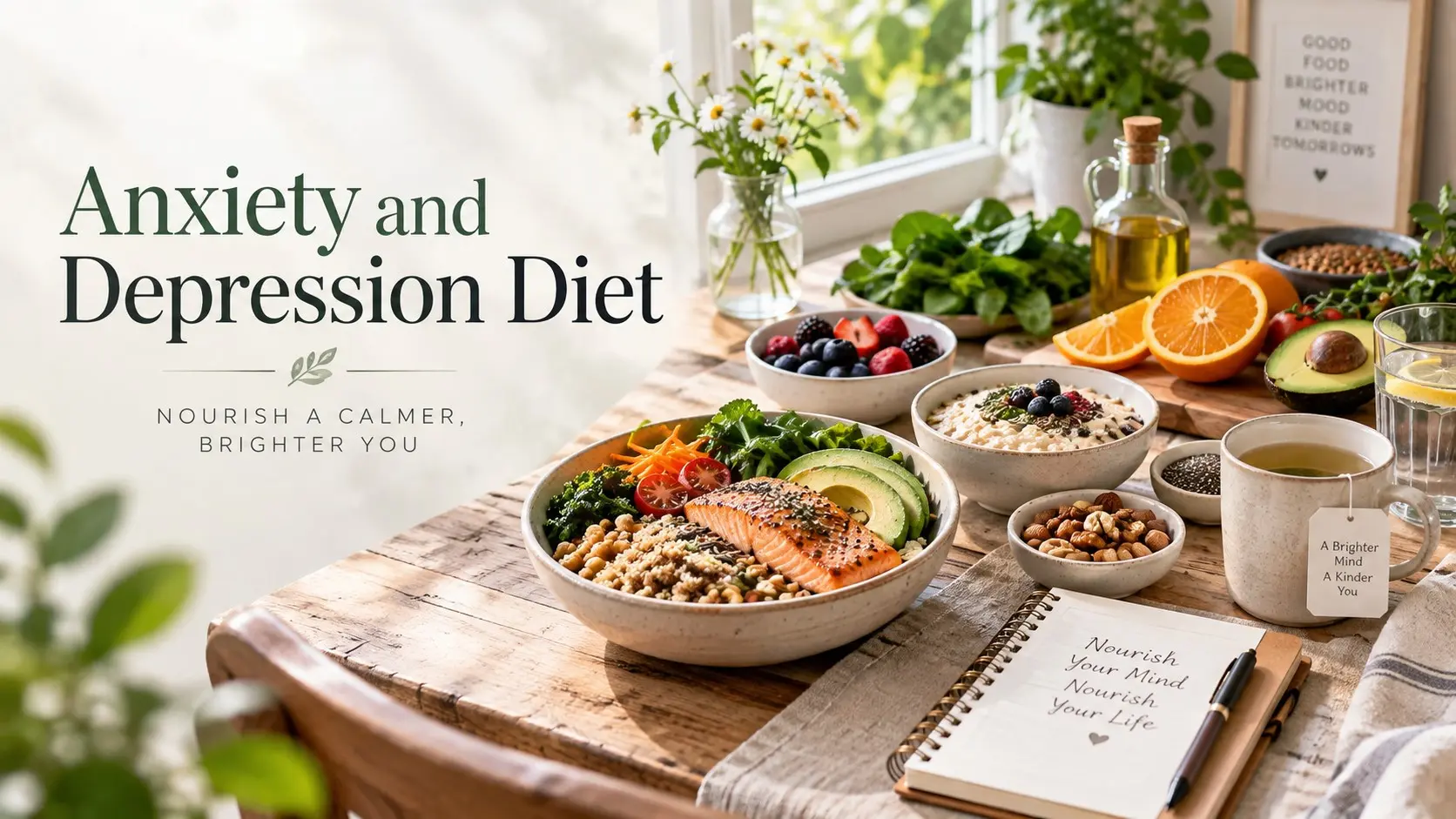
A Simple Anxiety and Depression Diet Pattern
The phrase Anxiety and Depression Diet can be misleading.
There is no official medical diet that cures these conditions.
A better approach is a flexible eating pattern that supports overall health.
| Meal | Simple Example | What It Adds |
|---|---|---|
| Breakfast | Oats, yogurt, berries, walnuts | Protein, fibre, fruit, healthy fat |
| Lunch | Lentils, whole grains, salad, olive oil | Protein, fibre, vegetables, carbohydrate |
| Snack | Fruit and nuts | Fruit, fibre, fats, minerals |
| Dinner | Salmon or beans, potatoes, vegetables | Protein, carbohydrate, vegetables, fats |
| Drinks | Water most often | Hydration |
This is only an example.
Vegetarian, vegan, halal, Mediterranean style, and many cultural eating patterns can all be nutritious when planned well.
Foods to Include More Often
Think about adding foods instead of only removing them.
Vegetables
Try spinach, broccoli, tomatoes, carrots, peppers, leafy greens, and frozen vegetables.
Fruit
Try berries, oranges, apples, bananas, kiwi, grapes, and seasonal fruit.
Beans and Lentils
These provide plant protein, fibre, iron, and useful carbohydrates.
Whole Grains
Try oats, brown rice, barley, quinoa, or whole-grain bread.
Protein Foods
Use eggs, fish, poultry, beans, lentils, yogurt, tofu, or other suitable protein foods.
Nuts and Seeds
Try walnuts, almonds, chia seeds, flaxseed, or pumpkin seeds.
Suitable Healthy Fats
Olive oil, avocado, nuts, seeds, and fish can fit.
For more everyday food choices, visit our Top Healthy Foods guide.
What About Sugar and Processed Foods?
You do not need to fear every processed food.
Processing is not one thing.
Frozen vegetables are processed.
Plain yogurt is processed.
Canned beans are processed.
These can still be useful foods.
Try to build most meals around nourishing foods while keeping foods high in free sugar, sodium, and saturated fat as smaller parts of the diet.
Do not turn this into another source of anxiety.
Can Low Blood Sugar Feel Like Anxiety?
Feeling hungry after going a long time without food can sometimes come with physical sensations.
These may include:
- Shaking
- Sweating
- Weakness
- Irritability
- A fast heartbeat
These feelings can resemble anxiety.
But you cannot diagnose low blood sugar from symptoms alone.
People with diabetes or medicines that lower glucose need individual medical advice.
If you repeatedly feel shaky, faint, confused, or very unwell, speak with a healthcare professional.
Can the Gut Microbiome Affect Mental Health?
The gut-brain connection is an important research area.
The gut, nervous system, immune system, hormones, and microorganisms can communicate through several pathways.
This does not mean a probiotic cures depression.
It does not mean fermented food cures anxiety.
Human mental health is much more complex.
You can still support normal gut health with:
- Fibre-rich foods
- Vegetables
- Fruit
- Beans
- Whole grains
- Foods you tolerate well
What About Supplements for Anxiety and Depression?
Be careful.
Natural does not automatically mean safe.
NIMH states that the FDA has not approved natural products for treating depression.
Some supplements can interact with prescription medicines.
St. John's wort is one important example.
Do not start supplements because a social media post says they raise serotonin.
A doctor may check nutrients such as:
- Vitamin B12
- Iron
- Folate
- Vitamin D
When symptoms or medical history suggest a possible problem.
Treat a real deficiency when one is identified.
Do not assume every case of low mood is a vitamin deficiency.
Visit the NextFitLife Nutrition and Vitamins Hub for safer nutrient guidance.
Mindful Eating and Mindfulness Are Not the Same Thing
They overlap.
But they are not identical.
Mindfulness means paying attention to the present experience with less judgment.
Mindful eating applies some of those ideas to eating.
NCCIH reports that mindfulness approaches have been studied for anxiety and depression.
Some results are encouraging.
But research quality varies.
NCCIH also warns that findings are sometimes interpreted too positively.
Mindfulness can support care.
It should not automatically replace established treatment.
A Two-Minute Mindful Eating Exercise
Try this with one meal.
Step 1
Put the food in front of you.
Take one slow breath.
Step 2
Notice how hungry you feel.
No judgment.
Step 3
Look at the food.
Notice color and smell.
Step 4
Take your first few bites slowly.
Notice taste and texture.
Step 5
Continue eating normally.
There is no need to make every bite a meditation exercise.
Step 6
Pause once.
Ask whether you are still hungry.
Then continue based on what your body tells you.
When Mindful Eating May Not Be Enough
Mindful eating is not the right answer to every eating problem.
Get professional help if you have:
- Frequent binge eating
- Purging
- Intentional starvation
- Severe food restriction
- Rapid unexplained weight change
- Fear of normal foods
- Obsessive calorie counting
- Frequent fainting
- An eating disorder or history of one
For some people with eating disorders, being told to focus intensely on hunger or food can actually be unhelpful.
A qualified eating disorder professional can guide the right approach.
When to Seek Professional Help for Depression
Talk with a qualified healthcare or mental health professional when low mood:
- Persists
- Interferes with daily life
- Affects sleep
- Changes appetite significantly
- Makes work or school difficult
- Causes withdrawal from other people
- Comes with hopelessness
NIMH describes depression as more than normal sadness.
It can cause symptoms that affect thinking, sleep, appetite, work, and daily activities.
Treatment commonly includes psychotherapy, medication, or both.
When to Seek Professional Help for Anxiety
Occasional worry is normal.
Anxiety disorders are different.
Seek help when anxiety:
- Feels hard to control
- Persists for months
- Causes significant distress
- Affects work or school
- Affects sleep
- Interferes with relationships
- Stops you from normal activities
NIMH states that generalized anxiety disorder is commonly treated with psychotherapy, medication, or both.
Cognitive behavioural therapy is one established therapy.
Food Cannot Replace Mental Health Treatment
This point deserves its own section.
Do not stop therapy because your diet improved.
Do not stop antidepressants because you started eating more vegetables.
Do not stop anxiety medicine because you started meditation.
Do not change medication without speaking with the professional managing your treatment.
Nutrition is support.
It is not a substitute for diagnosis or treatment.
Simple Meals for Low Energy Days
When depression makes cooking difficult, lower the standard.
| Meal | Very Simple Option |
|---|---|
| Breakfast | Plain yogurt, banana, oats |
| Lunch | Canned beans, microwave rice, frozen vegetables |
| Snack | Apple and nuts |
| Dinner | Soup, whole grain bread, fruit |
| No-cook option | Whole grain toast, nut butter, banana, suitable milk |
Simple nutrition is still nutrition.
Other Habits That Matter for Mental Health
Food is one part of the picture.
Other areas matter too.
Sleep
Sleep and mental health can affect each other.
Movement
Regular activity can support physical and mental health.
Explore our Physical Fitness and Mental Health guide.
Connection
Talking with trusted people can be part of support.
Professional Care
Therapy and medication are established treatments for many mental health conditions.
Explore the NextFitLife Mental Health and Wellness Hub for more guides about depression, stress, sleep, emotional health, and professional support.
My Approach to Mental Health Nutrition
At NextFitLife, I do not believe food should carry responsibility for a mental health condition.
I look at mental health claims differently from ordinary recipe advice.
I ask what the research actually tested.
I separate observational links from clinical treatment evidence.
I check recognized mental health and public health sources.
I also look for harm.
That includes supplement interactions, restrictive eating, food guilt, medication changes, and delayed professional care.
My goal is practical.
Use good nutrition to support the person.
Do not turn nutrition into another source of fear.
Conclusion
Mindful Eating for Mental Health can help you bring more awareness, regularity, flexibility, and care to meals.
Eat regularly when you can.
Choose varied foods.
Add vegetables, fruit, protein, fibre, and suitable fats.
Notice how caffeine and alcohol affect you.
Pay attention to hunger and emotions without judging yourself.
Most importantly, remember that food supports mental health care.
It does not replace it.
Your next step: Choose one meal tomorrow. Put distractions aside for the first few minutes. Notice your hunger, taste the food, and eat without trying to make the meal perfect.
References and Sources
The following medical, public health, and peer-reviewed sources were used to research and fact-check this article:
- National Institute of Mental Health. Depression.Evidence-based information about depression symptoms, diagnosis, psychotherapy, medication, self-care, crisis support, and when to seek professional help.
- National Institute of Mental Health. Generalized Anxiety Disorder: What You Need to Know.Official guidance covering anxiety symptoms, diagnosis, psychotherapy, medication, daily functioning, and professional treatment.
- National Center for Complementary and Integrative Health. Meditation and Mindfulness: Effectiveness and Safety.A research-based overview of mindfulness and meditation, including evidence involving anxiety, depression, stress, effectiveness, limitations, and safety.
- World Health Organization. Healthy Diet. Updated January 26, 2026.Current international nutrition guidance covering adequacy, balance, moderation, diversity, minimally processed foods, fruit, vegetables, fibre, free sugars, sodium, and dietary fats.
- Tavakoly R, Moosburner A, Anheyer D, Cramer H. Effect of Different Dietary Patterns on Patients with Depressive Disorders: A Systematic Review and Meta-Analysis of Randomized Controlled Trials. Nutrients. 2025;17(3):563.This open-access systematic review analyzed randomized controlled trials of dietary interventions in adults with depressive disorders. The included trials primarily studied Mediterranean diet interventions and found no clear significant reduction in depression severity, with very low certainty for much of the evidence.
Explore More NextFitLife Guides
Continue with these related NextFitLife resources:
- Mental Health and Wellness Hub: Explore depression, stress, emotional health, sleep, brain fog, self-care, and when professional support is important.
- Nutrition and Vitamins Hub: Learn about B12, vitamin D, iron, folate, magnesium, food sources, deficiencies, testing, and supplement safety.
- Gut Health and Digestion Foods Hub: Explore fibre, digestion, fermented foods, gut health, and the limits of gut health claims.
- Top Healthy Foods Guide: Find simple vegetables, fruit, beans, whole grains, protein foods, nuts, seeds, and healthy fats for everyday meals.
- Physical Fitness and Mental Health: Learn how movement can support mood, sleep, brain health, and daily function without replacing mental health treatment.
- Nutrition Tips for Improving Your Health: Use simple nutrition habits for balanced meals, fibre, protein, hydration, healthy fats, and sustainable eating.
About the Author
Adel Galal is the Founder and Lead Writer at NextFitLife.
He focuses on making health, nutrition, fitness, and wellness information easier to understand and use in everyday life.
His work combines real-life experience, extensive research, and consultation with healthcare providers.
For mental health articles, he checks recognized government, clinical, public health, and academic sources and clearly separates supportive lifestyle habits from professional mental health treatment.
Adel is not a doctor, psychiatrist, psychologist, therapist, counsellor, registered dietitian, or other licensed healthcare professional.
NextFitLife content is educational and does not provide diagnosis, psychotherapy, medication management, or emergency mental health care.
Learn more about Adel, NextFitLife, and the site's editorial approach on the About Us page.
Frequently Asked Questions
What is Mindful Eating for Mental Health?
Mindful eating means paying attention to hunger, fullness, taste, emotions, and eating habits without harsh judgment. It can support healthier routines but does not replace treatment for anxiety or depression.
Can food cure anxiety or depression?
No. No food or diet has been proven to cure anxiety or depression. Healthy eating can support general health, but established mental health treatment may include psychotherapy, medication, or both.
What is the best diet for anxiety and depression?
There is no official Anxiety and Depression Diet that treats these disorders. A varied eating pattern with vegetables, fruit, whole grains, beans, suitable protein foods, nuts, seeds, and healthy fats can support overall health.
Does the Mediterranean diet help depression?
The Mediterranean diet is nutritious and has been widely studied. However, a 2025 review of randomized trials in people with depressive disorders found no clear significant improvement in depression severity, and the certainty of much of the evidence was very low.
Can mindful eating reduce anxiety?
Mindful eating may help some people slow down and notice eating patterns, hunger, emotions, and physical sensations. It is not an established treatment for an anxiety disorder.
Can caffeine make anxiety feel worse?
Some people feel jittery, restless, or notice a faster heartbeat after caffeine. If caffeine seems to increase uncomfortable symptoms, reducing the amount may help.
Should I stop coffee if I have anxiety?
Not everyone needs to avoid coffee. Pay attention to your response. Smaller portions, less caffeine, or avoiding caffeine late in the day may be useful if it worsens symptoms or sleep.
Can skipping meals affect how I feel?
Going a long time without food can leave some people hungry, weak, irritable, or shaky. Regular meals can provide a more consistent eating routine, but persistent symptoms need medical assessment.
What foods are good for mental health?
There is no single mental health food. Build a varied diet with vegetables, fruit, whole grains, beans, lentils, suitable protein foods, nuts, seeds, and healthy fats.
Do omega 3 foods treat depression?
Fish, walnuts, chia seeds, and flaxseed can be nutritious sources of fats. They should not be used as replacements for depression treatment.
Do probiotics cure anxiety or depression?
No. The gut brain connection is an important research area, but probiotics and fermented foods have not been proven to cure anxiety or depression.
Can vitamins treat depression?
A nutrient deficiency should be treated when it is identified, but depression should not automatically be assumed to come from a vitamin deficiency. Speak with a healthcare professional before using supplements as treatment.
Is emotional eating bad?
Eating for comfort sometimes is common. It becomes more concerning when it feels out of control, causes distress, or is part of binge eating, purging, severe restriction, or another eating disorder pattern.
When should I get professional help for depression?
Seek professional help when low mood persists, affects daily function, changes sleep or appetite, causes withdrawal, or comes with hopelessness. Thoughts of suicide or inability to stay safe require urgent help.
When should I get help for anxiety?
Seek professional help when anxiety is difficult to control, lasts, causes major distress, interferes with sleep, work, school, relationships, or normal activities.

Health & wellness writer with 30+ years of experience in nutrition, fitness, and healthy aging. Founder of NextFitLife.com — evidence-based health guidance.