
Published on: August 21, 2024
Updated on: November 3, 2026
If you want to know how to get rid of hip dips, there is one important fact to understand first. Hip dips are normal. They are natural inward curves between the upper hip and thigh, and their shape is influenced mainly by your bones, muscle, and natural fat distribution.
You cannot exercise your pelvis into a new shape. You can, however, build the muscles around your hips and glutes. Over time, stronger muscles may make the area look fuller while improving balance, movement, and lower body strength.
This guide explains what really causes hip dips, what exercise can change, which muscles matter most, and how to use 15 practical exercises to build stronger hips and glutes.
Important: This article is for general information and education. It does not replace medical advice, diagnosis, or treatment.
Table of Contents
- Quick Answer
- What Hip Dips Are
- Can You Really Get Rid of Hip Dips?
- What Exercise Can Change
- Muscles That Shape the Hips
- 15 Smart Exercises for Hip Dips
- Beginner Workout Plan
- How Often to Train
- How to Get Better Results
- Common Mistakes
- Cardio and Fat Loss
- Nutrition and Hip Dips
- When Hip Pain Needs Attention
- How Long Results May Take
- Conclusion
- References and Sources
- Internal Links and Fitness Hub
- About the Author
- Frequently Asked Questions
Quick Answer: Can You Get Rid of Hip Dips?
No workout can guarantee that hip dips will completely disappear. Their basic shape comes largely from your hip anatomy, including the shape of your pelvis and the position of your thigh bones.
What you can change is muscle. Strengthening your gluteus medius, gluteus maximus, hip abductors, and other lower body muscles may make the area around your hips look fuller and stronger.
That is a more realistic and useful goal than trying to change your skeleton.
For a deeper explanation, read our complete guide to hip dips.
What Are Hip Dips?
Hip dips, sometimes called violin hips, are inward curves on the outer side of the hips. They usually appear between the upper pelvis and the top of the thigh.
They are not a disease or a sign that something is wrong with your body. People of many sizes and fitness levels can have them.
The appearance of hip dips depends on several factors:
- The shape of your pelvis
- The position and shape of your femur
- The size of the greater trochanter
- Your natural fat distribution
- Your muscle mass
- Your skin and connective tissue
This explains why two people with similar body weight can have very different hip shapes.
Can You Really Get Rid of Hip Dips?
The phrase “get rid of hip dips” is popular online, but it can create unrealistic expectations. Exercise cannot change the shape of your pelvis or move your thigh bones.
What exercise can do is build muscle around the hips. For some people, that extra muscle can make the transition between the waist, hips, and thighs look smoother or fuller.
The result varies from person to person because genetics still play a large role.
A good program should therefore focus on hip strength, movement, and fitness first.
What Exercise Can and Cannot Change
| Exercise Can Help With | Exercise Cannot Do |
|---|---|
| Build glute muscle | Change pelvic bone shape |
| Improve hip strength | Move the thigh bones |
| Improve balance and control | Burn fat only from the hip area |
| Strengthen the outer hips | Guarantee perfectly round hips |
| Improve lower body fitness | Override your genetics |
Which Muscles Matter Most?
A good routine should train more than one small part of the hip. Your hips work as a system.
Gluteus Medius
The gluteus medius sits along the upper outer hip. It helps move your leg away from the center of your body and helps stabilize the pelvis when you walk or stand on one leg.
Gluteus Maximus
The gluteus maximus is the largest glute muscle. It helps extend the hip and provides much of the size and shape of the buttocks.
Gluteus Minimus
The gluteus minimus sits deeper. It works with the gluteus medius to support the hip and control the leg.
Hip Abductors
Your hip abductors help move the leg outward and keep the pelvis stable. Side leg raises, lateral walks, and several single leg exercises train this function.
You can find more lower body training ideas in our Strength Training and Muscle Building Guide.
15 Smart Exercises for Hip Dips
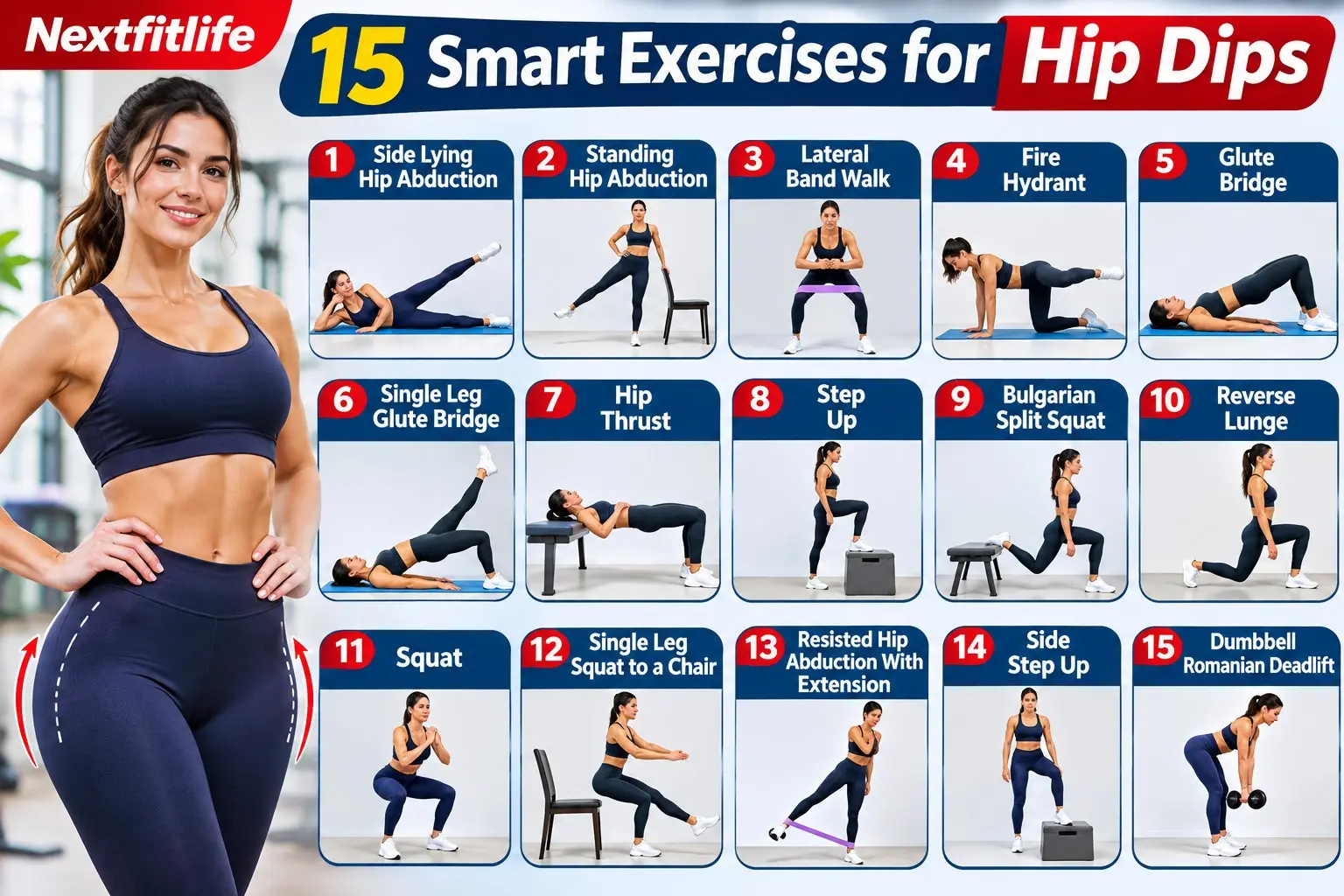
You do not need to perform all 15 exercises in one workout. Choose five or six that match your current fitness level and equipment.
1. Side Lying Hip Abduction
This is one of the simplest ways to train the outer hip muscles.
- Lie on one side.
- Keep your body in a straight line.
- Bend the lower knee if needed.
- Keep the upper leg straight.
- Lift the upper leg slowly.
- Lower with control.
Start with: 10 to 15 reps on each side for 2 sets.
2. Standing Hip Abduction
This exercise works your outer hips while also training balance.
- Stand beside a wall or chair.
- Keep your chest tall.
- Move one leg out to the side.
- Keep your toes facing mostly forward.
- Pause briefly.
- Return slowly.
Start with: 10 to 15 reps per side.
3. Lateral Band Walk
Lateral band walks help develop hip stability and side to side control.
- Place a resistance band above your knees.
- Bend your knees slightly.
- Keep your chest tall.
- Step sideways.
- Keep tension on the band.
- Repeat in both directions.
Start with: 8 to 12 steps each way for 2 rounds.
4. Fire Hydrant
The fire hydrant works your outer glutes while your core keeps your pelvis stable.
- Start on your hands and knees.
- Brace your core gently.
- Keep one knee bent.
- Lift that knee out to the side.
- Stop before your torso twists.
- Lower slowly.
Start with: 8 to 12 reps per side.
5. Glute Bridge
The glute bridge trains the gluteus maximus and teaches strong hip extension.
- Lie on your back.
- Bend your knees.
- Keep both feet flat.
- Press through your feet.
- Lift your hips.
- Squeeze your glutes gently.
- Lower slowly.
Start with: 10 to 15 reps for 2 sets.
You can also explore our Core Workouts at Home guide.
6. Single Leg Glute Bridge
This version makes each side work harder.
- Begin in a normal bridge position.
- Lift one foot slightly.
- Keep your pelvis level.
- Push through the planted foot.
- Lift your hips.
- Lower slowly.
Start with: 6 to 10 reps per side.
7. Hip Thrust
Hip thrusts allow you to add more resistance as your glutes become stronger.
- Rest your upper back against a stable bench.
- Keep your feet planted.
- Lower your hips slowly.
- Push through your feet.
- Lift your hips.
- Lower with control.
Start with: 8 to 12 reps for 2 sets.
8. Step Up
Step ups work your glutes, thighs, and stabilizing muscles.
- Use a stable step.
- Place one foot fully on it.
- Push through that foot.
- Rise onto the step.
- Stand tall.
- Lower slowly.
Start with: 8 to 12 reps per leg.
9. Bulgarian Split Squat
This exercise trains the glutes and thighs while challenging each side separately.
- Stand in front of a bench.
- Place your rear foot on it if comfortable.
- Keep the front foot planted.
- Lower slowly.
- Push through the front leg to stand.
Start with: 6 to 10 reps per side.
10. Reverse Lunge
A reverse lunge trains the legs and glutes while allowing each side to work on its own.
- Stand tall.
- Step one foot backward.
- Bend both knees.
- Keep the front foot planted.
- Push through the front foot.
- Return to standing.
Start with: 6 to 10 reps per side.
11. Squat
Squats do not directly remove hip dips, but they are excellent for lower body strength.
- Stand with your feet in a comfortable position.
- Push your hips back slightly.
- Bend your knees.
- Lower only as far as you can control.
- Push through your feet to stand.
Start with: 8 to 12 reps for 2 sets.
If you are new to fitness, read our Fitness Program Guide.
12. Single Leg Squat to a Chair
This exercise adds balance and makes one hip work harder.
- Stand in front of a sturdy chair.
- Shift most of your weight to one leg.
- Lower toward the chair.
- Touch down gently.
- Stand again with control.
Start with: 5 to 8 reps per side.
13. Resisted Hip Abduction With Extension
This movement takes your leg outward and slightly backward, which challenges several glute muscles.
- Place a light band around your ankles or thighs.
- Stand beside a sturdy support.
- Keep your torso still.
- Move one leg out and slightly back.
- Pause briefly.
- Return slowly.
Start with: 8 to 12 reps per side.
14. Side Step Up
A side step up trains the hips from a different angle.
- Stand sideways beside a low step.
- Place the nearest foot on top.
- Push through that leg.
- Rise under control.
- Lower slowly.
Start with: 6 to 10 reps per side.
15. Dumbbell Romanian Deadlift
This hip hinge trains the glutes and hamstrings and develops strong hip extension.
- Stand tall with light dumbbells.
- Bend your knees slightly.
- Push your hips backward.
- Keep the weights close to your legs.
- Stop when you feel a comfortable stretch.
- Push your hips forward to stand.
Start with: 8 to 12 reps for 2 sets.
For more leg training ideas, visit our Leg Exercises With Dumbbells guide.
Beginner Hip Dip Workout
You do not need a long workout. Six controlled exercises can be enough to get started.
| Exercise | Sets | Reps | Focus |
|---|---|---|---|
| Glute Bridge | 2 | 10 to 15 | Glutes |
| Side Lying Hip Abduction | 2 | 10 to 15 each side | Outer hips |
| Squat | 2 | 8 to 12 | Legs and glutes |
| Step Up | 2 | 8 each side | Glutes and balance |
| Lateral Band Walk | 2 | 8 steps each way | Hip stability |
| Reverse Lunge | 2 | 6 to 10 each side | Glutes and thighs |
How Often Should You Train?
For many adults, two or three strength sessions each week can be a practical starting point. You do not need to train the same muscles every day.
Recovery matters because your muscles adapt between workouts.
A simple schedule could look like this:
| Day | Activity |
|---|---|
| Monday | Hip and glute strength |
| Tuesday | Walking or light activity |
| Wednesday | Rest or upper body |
| Thursday | Hip and glute strength |
| Friday | Easy cardio or rest |
| Weekend | Normal activity and recovery |
You can also explore the Home Workouts and Equipment Hub.
How to Get Better Results
Use Progressive Overload
Progressive overload means gradually making an exercise harder as your body adapts.
You can add reps, use a slightly stronger band, add a small amount of weight, improve your range of motion, or add another set.
Small improvements add up over time.
Control Every Rep
Fast swinging can make an exercise easier without making it better. Move slowly enough to keep your trunk and pelvis steady.
Train Your Whole Lower Body
Do not rely only on tiny side leg movements. Squats, lunges, hinges, bridges, step ups, and hip abduction exercises train the hips from different directions.
Give Your Body Time
You may feel stronger before you see a visible change. Muscle growth takes time, and genetics still affect the shape of your hips.
Common Hip Dip Workout Mistakes
Trying to Spot Reduce Fat
You cannot force your body to burn fat from one small area by exercising that muscle.
If overall body fat reduction is part of your goal, read our guide on how to lose fat from hips safely.
Doing Hundreds of Easy Reps
More reps are not always better. Controlled resistance training that slowly becomes harder is usually more useful than endless easy movements.
Training Only the Outer Hip
Your glutes perform several jobs, so your routine should include different movement patterns.
Expecting Your Bones to Change
This is the biggest mistake. Training can change muscle size and strength, but it cannot change the basic structure of your pelvis.
Comparing Yourself With Edited Photos
Lighting, clothing, posing, camera angle, and editing can make hips look very different in pictures. One photo is not a fair measure of fitness progress.
Are Clamshells Good for Hip Dips?
Clamshells can be useful for beginners because they are simple and help teach hip control.
They should not be your only exercise. A complete program should also include bridges, step ups, squats, hip abduction, and other movements.
Do You Need Cardio?
Cardio is good for heart health and overall fitness, but it does not directly remove hip dips.
Walking, swimming, cycling, jogging, and similar activities can support overall health. Strength training has a different job because it helps build and maintain muscle.
Can Losing Weight Remove Hip Dips?
Not reliably.
Your body composition can change the way hip dips look, but weight loss does not change the shape of your pelvis.
For some people, losing fat may make the dips look smaller. For others, they may become more visible or change very little.
Can Food Fill Hip Dips?
No food can send fat or muscle to one exact area of your hips.
If your goal is muscle growth, eating enough total food and protein can support training. If your goal is fat loss, a sensible calorie deficit can reduce body fat over time.
Neither method allows you to choose exactly where your body changes.
When Hip Pain Needs Attention
Hip dips themselves should not normally cause pain.
If you have pain around your hip, groin, thigh, or lower back, do not assume the visible shape of your hip is the cause.
Stop exercising and seek medical advice if you develop:
- Severe or sudden hip pain
- Major swelling
- Difficulty putting weight on one leg
- Numbness or weakness
- Major loss of movement
- Pain after a fall or injury
- Pain that keeps getting worse
How Long Does It Take to See Results?
There is no fixed timeline.
You may feel stronger within several weeks. Visible muscle growth usually takes longer and depends on training effort, food intake, recovery, genetics, and consistency.
Some people will still have clear hip dips after building strong glutes. That is normal because their natural bone structure has not changed.
A Better Goal Than Erasing Hip Dips
A better goal is to build strong hips that move well.
Strong glutes help with walking, climbing stairs, lifting, running, balance, and many sports. Those benefits matter whether your hip dips become softer or remain visible.
For a complete fitness plan, visit the NextFitLife Fitness Hub.
Conclusion
If you want to know how to get rid of hip dips, the most useful answer is that no exercise can guarantee their removal because your bone structure plays a major role.
What you can do is build stronger glutes, improve hip stability, train your lower body, and support your overall health with a balanced routine.
Your next step: choose five or six exercises from this guide and complete two controlled hip and glute workouts this week. Track your strength and form instead of judging progress from one mirror check.
References and Sources
- Cleveland Clinic. Hip Dips: What They Are and Can You Get Rid of Them.
https://health.clevelandclinic.org/hip-dips - American College of Sports Medicine. Resistance Training Guidance and Exercise Recommendations.
https://acsm.org/ - Centers for Disease Control and Prevention. Adult Physical Activity Guidelines.
https://www.cdc.gov/physical-activity-basics/guidelines/adults.html - American Council on Exercise. Exercise Library and Glute Training Resources.
https://www.acefitness.org/resources/everyone/exercise-library/ - Macadam P, Cronin J, Contreras B. An Examination of Gluteal Muscle Activity Associated With Hip Abduction and External Rotation Exercise.
https://pmc.ncbi.nlm.nih.gov/articles/PMC4595911/
Internal Links + Hub
- NextFitLife Fitness Hub
- Strength Training and Muscle Building Guide
- Home Workouts and Equipment Hub
- Hip Dips Guide
- How to Lose Fat From Hips
- Core Workouts at Home
- Fitness Program Guide
- Leg Exercises With Dumbbells
About the Author
Adel Galal is a father of four, three sons and a daughter, and a grandfather of four, with 33 years of hands on parenting experience. He is the founder of Parnthub.com, based in Cairo, Egypt, where he shares practical guidance on feeding, development, and family life from newborns to teenagers.
Adel is not a medical professional. Health articles cite trusted sources and are for general information only.
Learn more on the NextFitLife About Us page.
Frequently Asked Questions
Can you completely get rid of hip dips with exercise?
No. Exercise cannot change the shape of your pelvis or the position of your thigh bones. It can build muscle around the hips and glutes, which may make hip dips look softer in some people.
What is the best exercise for hip dips?
There is no single best exercise. Side lying hip abduction, hip thrusts, bridges, step ups, squats, lateral band walks, and single leg exercises all train useful hip and glute muscles.
Can glute exercises make hip dips less noticeable?
They may. Building your glute muscles can add muscle around the hips, but the visible result depends on your natural anatomy and genetics.
Are hip dips caused by being overweight?
No. People of many body sizes have hip dips. Their appearance is influenced mainly by bone structure, muscle, and natural fat distribution.
Can losing weight remove hip dips?
Not reliably. Weight loss cannot change your bone structure, and fat loss may make hip dips look smaller, larger, or almost unchanged.
How often should I do hip dip exercises?
Two or three strength sessions each week can work well for many adults. Your full routine should also train other major muscle groups and include enough recovery.
How long does it take to see results?
There is no fixed timeline. Strength may improve within several weeks, while visible muscle changes usually take longer and depend on training, nutrition, recovery, genetics, and consistency.
Are hip dips unhealthy?
No. Hip dips are a normal body shape variation and are not a measure of health, fitness, or body fat.

Health & wellness writer with 30+ years of experience in nutrition, fitness, and healthy aging. Founder of NextFitLife.com — evidence-based health guidance.

