Published: March 2026 Last Updated: April 2026
How Weight Loss Works Is Simpler Than the Industry Wants You to Think
The weight loss industry earns billions every year by making fat loss sound complicated. New hormones to target. Ancient eating windows to follow. Forbidden food combinations to avoid.
Strip all of that away, and the science of how weight loss works comes down to a handful of biological principles that have not changed since the first nutrition study was published.
Understanding these principles does not just help you lose weight. It helps you recognize which products are wasting your time and which strategies will always work, regardless of the trend cycle.
This article is part of our complete weight loss guide, the evidence-based resource covering every aspect of sustainable fat loss.
The Science of How Weight Loss Works - Energy Balance
Every credible nutrition scientist agrees with this:
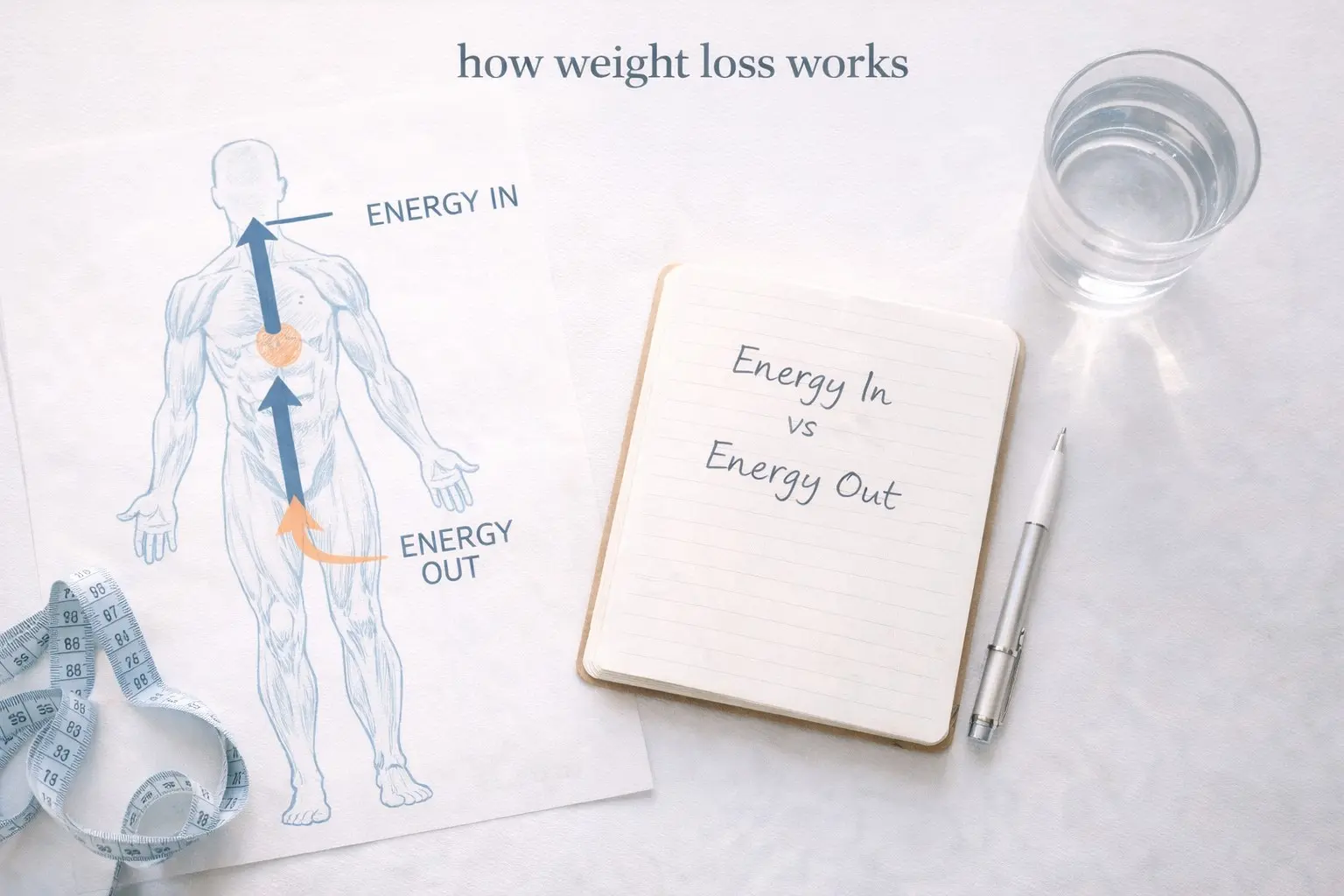
Weight loss requires a sustained energy deficit - consuming fewer calories than your body expends.
This is not a theory. It is thermodynamics applied to human biology. A landmark 2009 study in the New England Journal of Medicine compared four diets with different macronutrient compositions: low-fat, low-carb, high-protein, and average mix. All four groups lost similar amounts of weight. The one shared factor was calorie deficit.
The diet changed. Biology did not.
What Is a Calorie and why does it matter?
A calorie is a unit of energy. Your body uses energy continuously to breathe, circulate blood, digest food, regulate temperature, and move.
The total energy your body uses each day is your Total Daily Energy Expenditure (TDEE). Eat more than your TDEE, and your body stores the excess as fat. Eat less, and it draws on stored fat for fuel.
To calculate your personal TDEE and set your daily calorie target, see our calorie deficit calculator guide.
Where does fat actually go when you lose weight?
Most people assume fat turns into heat or muscle. It does not.
When your body burns fat for fuel, it breaks triglycerides down through a process called lipolysis. The carbon atoms in fat convert to carbon dioxide,, which you breathe out, and water, which you excrete.
Literally, you breathe most of your lost fat out through your lungs.
This is not a fun fact. It is a useful one. It explains why rest and sleep matter; your body continues oxidizing fat even when you are completely still.
Your Metabolism and How Weight Loss Science Explains It
Metabolism is one of the most misunderstood terms in weight loss. People blame slow metabolism for everything. Sometimes they are right. Often, they are not.
BMR - The Foundation of Your Metabolism
Your Basal Metabolic Rate (BMR) is the number of calories your body burns at complete rest — no movement, no digestion, just staying alive.
BMR accounts for approximately 60–75% of all the calories you burn each day. That means most of your daily calorie expenditure happens whether you exercise.
Factors that influence BMR
| Factor | Effect on BMR |
| Body weight | Higher weight = higher BMR |
| Muscle mass | More muscle = higher BMR |
| Age | BMR drops ~2% per decade after 20 |
| Sex | Men typically have higher BMR than women |
| Genetics | Accounts for ~40–70% of metabolic variation |
| Thyroid function | Hypothyroidism significantly lowers BMR |
Can you speed up your metabolism for weight loss?
Yes, but the effect is smaller than most people hope.
What genuinely raises metabolic rate
- Resistance training - building muscle is the most effective long-term metabolic strategy. Each kilogram of muscle burns approximately 10–15 extra calories per day at rest.
- High protein intake - protein has a thermic effect of 25–30%, meaning your body burns a quarter of protein calories just digesting it.
- NEAT (Non-Exercise Activity Thermogenesis) includes fidgeting, standing, walking, and everyday movement. This varies by up to 2,000 calories per day between individuals and is vastly underestimated.
What does not significantly raise metabolic rate
- Green tea (marginal effect ~3–4%)
- Cold water (burns negligible extra calories)
- "Metabolism-boosting" supplements (largely ineffective)
Hormones That Control How Weight Loss Works
Calorie balance drives fat loss. Hormones determine how hard or easy it feels.
Insulin and Fat Storage
Insulin is released when you eat carbohydrates and protein. Its job is to move glucose from your blood into cells for energy or storage.
High insulin levels signal fat storage mode. Low insulin levels open the door for fat release.
This is why diets that reduce refined carbohydrates, keto and low-carb, often produce rapid early results. Lower carbohydrate intake = lower insulin = easier access to stored fat.
However, research makes clear that when total calories are matched, low-carb diets do not produce significantly more fat loss than higher-carb diets. Insulin management helps. It is not magic.
For practical strategies on reducing the foods that spike insulin hardest, see our guide on how to stop eating sugar to lose weight.
Leptin - The Satiety Signal That Fights You During Weight Loss
Leptin is produced by fat cells and signals fullness to your brain. More body fat means more leptin and less hunger.
Here is the frustrating part: as you lose weight and fat cells shrink, leptin levels fall. Your brain interprets this as a threat to survival and responds by increasing hunger and reducing energy expenditure.
This hormonal adaptation, sometimes called the "weight loss opposition response," is one of the primary biological reasons people regain weight after dieting.
What helps maintain leptin sensitivity:
- Eating adequate calories - extreme restriction accelerates leptin decline
- Quality sleep - sleep deprivation lowers leptin significantly
- Regular exercise - physical activity improves leptin receptor sensitivity
Ghrelin -The Hunger Hormone That Increases When You Diet
Ghrelin rises before meals and falls after eating. It directly signals hunger to your brain.
During a calorie deficit, ghrelin levels increase. Your body produces more hunger signals precisely because you are eating less. This is not a character flaw. It is biology working as designed.
What reduces ghrelin?
- High-protein meals suppress ghrelin more effectively than carbohydrates or fat
- Adequate sleep deprivation raises ghrelin by up to 28%
- Eating at consistent times — irregular meal patterns disrupt ghrelin rhythms
Cortisol - The Stress Hormone and Belly Fat
Cortisol is produced when the body experiences physical or emotional stress. In the short term, it is useful. Chronically elevated, it drives fat storage - particularly around the abdomen.
Cortisol can heighten hunger and spark cravings for sugary, calorie-dense foods. Chronic stress is a genuine physiological barrier to fat loss, not just an excuse.
Managing stress actively is not optional for people struggling to lose weight despite doing everything else right.
Why Most Diets Fail - The Science of Metabolic Adaptation?
Understanding this one mechanism explains most diet failures.
When you significantly restrict calories, your body does something elegant and extremely inconvenient: it adapts.
Adaptive thermogenesis describes how your body reduces its calorie expenditure in response to sustained restriction. Your BMR drops. NEAT decreases the amount you unconsciously move. Hormones shift to conserve energy. The same deficit that produced weight loss in week one produced less in week eight.
This is not failure. It is biology. But it has a practical implication:
You must progressively manage your deficit as your body adapts.
This means
- Recalculating your calories as your weight drops
- Incorporating diet breaks to reset hormonal signals
- Varying your exercise stimulus to prevent adaptation
- Never staying at an extreme deficit for extended periods
For strategies specifically designed around breaking through metabolic adaptation, see our guide on how to break a weight loss plateau.
The Science of How Weight Loss Works with Exercise
Exercise contributes to fat loss primarily by increasing your total daily energy expenditure — widening the gap between calories in and calories out.
H3: Cardio vs. Resistance Training — What Science Shows?
| Exercise Type | Calories Burned | Long-term metabolic effect |
| Cardio (moderate) | High during the session | Minimal lasting effect |
| HIIT | High during + Afterburn (EPOC) | Moderate lasting effect |
| Resistance training | Lower during the session | High-lasting effect via muscle mass |
| Combination | Highest overall | Best long-term outcome |
A 2012 study in the Journal of Applied Physiology found that combining cardio and resistance training produced superior fat loss results compared to either approach alone.
For a full breakdown of which exercises deliver the most calorie burn per session, see our guide on the best exercises for weight loss.
NEAT - The Underestimated Weight Loss Factor
Non-Exercise Activity Thermogenesis is the energy you burn through everyday movement, walking, fidgeting, standing, and taking stairs.
Research shows NEAT varies by up to 2,000 calories per day between individuals of the same size. This explains why two people eating identically can have very different weight loss results.
Increasing NEAT through walking more, standing more, and taking stairs is one of the most underutilized fat loss strategies available. It requires no gym, no equipment, and no structured workout.
What Science of Weight Loss Means for Your Approach
Understanding how weight loss works changes how you approach it.
Five principles that always apply
- A calorie deficit is non-negotiable - no approach works without it
- Protein protects your muscles - prioritize it at every meal during a deficit
- Hormones make deficits feel hard - this is biology, not weakness
- Metabolic adaptation is real - recalibrate regularly and do not stay extreme
- Consistency beats intensity - a moderate deficit held for six months outperforms an aggressive one held for three weeks
Science does not care about the name of the diet. It responds to the fundamentals.
If you are ready to put these principles into action with a clear step-by-step plan, start with our complete guide to weight loss for beginners.
FAQs About How Weight Loss Works
Q: Is weight loss just about calories?
Calories are the primary driver; no credible evidence contradicts this. However, hormones, sleep, stress, and muscle mass all affect how difficult maintaining a deficit feels and how much of the weight lost comes from fat versus muscle.
Q: Why do some people lose weight faster than others?
Genetics account for 40–70% of metabolic variation between individuals. Muscle mass, age, thyroid function, NEAT levels, and hormonal profiles all influence how quickly fat loss occurs at the same calorie deficit.
Q: Does your metabolism remain permanently slow after dieting?
Temporarily, yes. Metabolic adaptation during a deficit is real and well-documented. However, most of this reduction is proportional to lower body weight rather than permanent damage. Returning to maintenance calories, building muscle, and eating adequate protein help restore normal metabolic function.
Q: Does it matter what time of day you eat?
Primarily, no total calorie intake across the day is the dominant factor. However, research suggests front-loading calories earlier in the day may modestly improve weight loss outcomes, and late-night eating can disrupt sleep hormones, which indirectly affect fat loss.
Q: Why does weight loss slow down after the first week?
The first week often produces larger losses because of water and glycogen depletion, not fat. From week two onwards, true fat loss begins, which is slower. This is normal.
Sources and References
- Sacks FM et al. — Comparison of Weight-Loss Diets with Different Compositions — New England Journal of Medicine, 2009 https://pubmed.ncbi.nlm.nih.gov/19246357/
- Harvard Health — Understanding metabolism https://www.health.harvard.edu/staying-healthy/the-truth-about-metabolism
- Cummings DE et al. — Plasma ghrelin levels after diet-induced weight loss — New England Journal of Medicine, 2002 https://pubmed.ncbi.nlm.nih.gov/12136951/
- CDC — Healthy Weight https://www.cdc.gov/healthy-weight-growth/losing-weight/index.html
- How fat loss works, diets, timelines, and more https://www.medicalnewstoday.com/articles/when-you-lose-weight-where-does-it-go#how-fat-loss-works

Health & wellness writer with 30+ years of experience in nutrition, fitness, and healthy aging. Founder of NextFitLife.com — evidence-based health guidance.