
Published: March 2026 Last Updated: April 2026
Your Calorie Deficit Is the Only Number That Drives Fat Loss
People obsess over which diet to follow. Low Carb. Intermittent fasting. Mediterranean. Vegan.
Here is the truth: every single diet that produces weight loss works because it creates a calorie deficit. The diet is just the vehicle. The deficit is the engine.
Without a calorie deficit, fat loss does not happen. With a calorie deficit, fat loss is inevitable — regardless of which foods you eat. This guide shows you exactly how to calorie deficit calculator in three steps. No guesswork. No generic targets. Your number, based on your body.
This guide shows you exactly how to calculate your personal calorie deficit in three steps. This article is part of our complete weight loss guide, the evidence-based resource covering every aspect of sustainable fat loss.
How to Calculate a Calorie Deficit (Quick Answer)
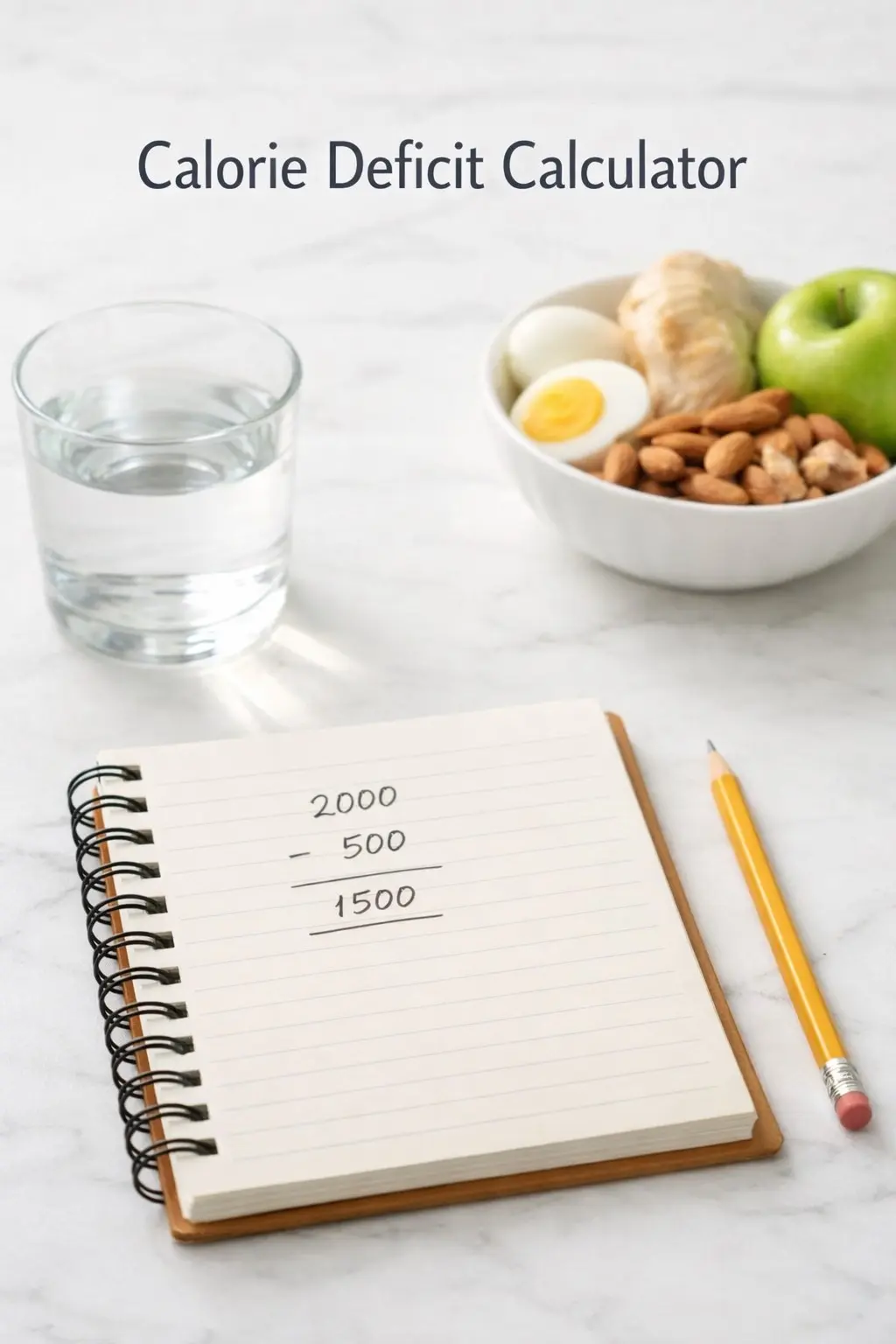
To calculate a calorie deficit, first estimate your maintenance calories (TDEE), then subtract 300–500 calories per day for sustainable fat loss.
The easiest way to do this is by using a calorie deficit calculator based on your weight, height, age, and activity level.
What Is a Calorie Deficit and Why Does It Matter?
A calorie deficit means eating fewer calories than your body uses throughout the day
Your body needs energy to survive — breathing, heartbeat, digestion, and movement. This total daily energy need is called your Total Daily Energy Expenditure (TDEE).
When you eat less than your TDEE, your body turns to stored fat for fuel. That is fat loss.
How Much Fat Does a Calorie Deficit Actually Burn?
One kilogram of body fat contains approximately 7,700 calories.
| Daily Deficit | Weekly Deficit | Fat Lost Per Week |
| 200 calories | 1,400 calories | ~0.18 kg |
| 300 calories | 2,100 calories | ~0.27 kg |
| 500 calories | 3,500 calories | ~0.45 kg |
| 750 calories | 5,250 calories | ~0.68 kg |
For most people, a 300–500 calorie daily deficit is the sweet spot enough to see consistent results without losing muscle or tanking your energy.
Step 1 - Calculate Your BMR (Basal Metabolic Rate)
Your BMR is the number of calories your body burns at complete rest just to keep you alive.
The most accurate formula for general use is the Mifflin-St Jeor Equation, introduced in 1990 and validated as the most precise BMR prediction method for healthy adults.
The Mifflin-St Jeor Formula
For Women
To calculate BMR: (10 × body weight in kg) + (6.25 × height in cm) − (5 × age in years) − 161.
For Men
BMR = (10 × weight in kg) + (6.25 × height in cm) − (5 × age) + 5
BMR Calculation Examples
Example 1 - Woman, 35 years old, 70 kg, 165 cm:
- BMR = (10 × 70) + (6.25 × 165) − (5 × 35) − 161
- BMR = 700 + 1,031 − 175 − 161
- BMR = 1,395 calories
Example 2 - Man, 40 years old, 85 kg, 178 cm:
- BMR = (10 × 85) + (6.25 × 178) − (5 × 40) + 5
- BMR = 850 + 1,112 − 200 + 5
- BMR = 1,767 calories
Important - BMR is not your calorie target. It is just step one. You need to account for activity before setting your deficit.
Step 2 - Calculate Your TDEE (Total Daily Energy Expenditure)
Your TDEE is your BMR multiplied by an activity factor. This gives you the calories your body burns in a normal day, including movement, exercise, and daily tasks.
Activity Level Multipliers
| Activity Level | Description | Multiplier |
| Sedentary | Desk job, little to no exercise | × 1.2 |
| Lightly Active | Light exercise 1–3 days per week | × 1.375 |
| Moderately Active | Exercise 3–5 days per week | × 1.55 |
| Very Active | Hard exercise 6–7 days per week | × 1.725 |
| Extra Active | Physical job plus daily training | × 1.9 |
TDEE Calculation Examples
Example 1 - Woman from above (BMR = 1,395), lightly active:
- TDEE = 1,395 × 1.375
- TDEE = 1,918 calories (maintenance)
Example 2 - Man from above (BMR = 1,767), moderately active:
- TDEE = 1,767 × 1.55
- TDEE = 2,739 calories (maintenance)
Your TDEE is the number of calories you need each day to stay the same weight. Eat more than this, and you gain. Eat less, and you lose.
Common mistake - Most people overestimate their activity level. If you exercise 5 days per week but sit at a desk all day, you are likely lightly active — not moderately active. Be honest. Overestimating leads to a smaller real deficit than you think.
Step 3 — Set Your Calorie Deficit Target Using a Calorie Deficit Calculator
Free Calorie Deficit Calculator
Use this simple calculator to find your daily calories for fat loss based on your body and activity level.
Now subtract your deficit from your TDEE. This is exactly what a calorie deficit calculator does automatically. This gives you your daily calorie intake for fat loss.
Choosing the Right Deficit Size
| Goal | Daily Deficit | Daily Calories | Weekly Loss |
| Slow and steady | 200–300 cal | TDEE − 250 | ~0.2 kg/week |
| Recommendation for most | 300–500 cal | TDEE − 400 | ~0.4 kg/week |
| Faster but harder | 500–750 cal | TDEE − 600 | ~0.6 kg/week |
| Maximum (short term only) | 750–1,000 cal | TDEE − 900 | ~0.8 kg/week |
Continuing the examples -
Woman - TDEE 1,918 - moderate deficit of 400 calories:
- Daily calorie target = 1,518 calories
Man - TDEE 2,739 - moderate deficit of 500 calories:
- Daily calorie target = 2,239 calories
The Minimum Calorie Floor - Do Not Go Below This
Eating too little backfires. Your body adapts by slowing metabolism, burning muscle, and increasing hunger hormones.
Absolute minimums
- Women: no lower than 1,200 calories per day
- Men: no lower than 1,500 calories per day
Going below these thresholds consistently causes nutrient deficiencies, muscle loss, and metabolic adaptation, all of which make fat loss harder, not easier.
How Macros Fit into Your Calorie Deficit
Hitting your calorie target matters most. But the composition of those calories matters for muscle preservation and hunger management.
Protein - The Priority Macro During a Deficit
Research consistently shows that higher protein intake during a calorie deficit preserves muscle mass and improves fat loss outcomes.
Aim for 1.2 to 1.6 grams of protein per kilogram of body weight
For the full list of best protein sources ranked by content, see our guide to high-protein foods for weight loss.
H3: Suggested Macro Split for Fat Loss
| Macronutrient | Suggested % of Calories | Per 1,600 cal target |
| Protein | 30–35% | 120–140g |
| Carbohydrates | 35–40% | 140–160g |
| Fat | 25–30% | 44–53g |
These are guidelines, not rules. Adjust based on food preferences and what you can sustain long-term.
What Affects Your Calorie Deficit Results Over Time?
Metabolic Adaptation
As you lose weight, your TDEE decreases. A lighter body burns fewer calories. After every 5–10 kg of weight loss, recalculate your TDEE and adjust your calorie target downward.
Failing to do this is the most common reason weight loss slows and stops, often being misidentified as a plateau when it is just an uncalibrated target.
Exercise Changes Your TDEE
Adding exercise increases your TDEE — meaning you can eat slightly more and still maintain the same deficit. This is one reason combining diet and exercise produces better results than diet alone.
See our guide on the best exercises for weight loss to understand which exercise types contribute most to your calorie burn.
Accuracy Has Limits
The Mifflin-St Jeor equation predicts BMR within ±10% for most people. That means your calculated number might be 150–200 calories off in either direction.
The solution: Use your calculated deficit as a starting point. Track for 3–4 weeks. If weight is not moving, reduce calories by 100–150. If you are losing too fast and feeling weak, add 100–150 calories. Adjust based on real results.
Calorie Deficit Common Mistakes to Avoid
Mistake 1 - Eating Back All Exercise Calories
Apps like MyFitnessPal add exercise calories back and encourage you to eat them. Most people overconsume when they do this because calorie burn estimates for exercise are notoriously inaccurate.
Better approach - Ignore the exercise calories added by the app. "Your TDEE calculation already factors in how active you are.
Mistake 2 - Not accounting for liquid calories
A latte, a glass of orange juice, and two glasses of wine. That can easily add 500–600 calories without a single bite of food.
Liquid calories are the most underestimated source of hidden energy intake. Track everything you drink, not just what you eat.
Mistake 3 - Using the Same Target for Months Without Recalculating
"As your body weight decreases, so do your daily calorie requirements." Recalculate every 5–8 kg of weight lost to keep the deficit accurate.
Mistake 4 - Eyeballing Portions.
Research shows people consistently underestimate portion sizes by 20–40%. [⁵] Use a kitchen scale for the first 4–6 weeks. It calibrates your visual judgment and typically reveals surprising discrepancies.
Your Calorie Deficit Calculator- Summary and Next Steps
Here is your three-step process:
- Calculate your BMR using the Mifflin-St Jeor formula
- Multiply by your activity factor to get your TDEE
- Subtract 300–500 calories to set your daily fat loss target
Then:
- Set protein at 1.2–1.6g per kg of body weight
- Track everything you eat and drink for the first 4–6 weeks
- Recalculate when your weight drops by 5–10 kg
- Adjust based on real results — not the formula alone
Understanding your calorie deficit - whether manually or using a calorie deficit calculator — is the single most important step you can take before starting any weight loss plan. Everything else, meal plans, exercise programs, diet choices — works because it supports this one number.
For the complete foundation of what is happening inside your body during fat loss, read our guide on how weight loss actually works.
Steps to Calculate Your Calorie Deficit
- Calculate your BMR using the Mifflin-St Jeor formula
- Multiply by your activity level to get TDEE
- Subtract 300–500 calories for fat loss
FAQs About Calorie Deficit for Weight Loss
Q: How do I know if my calorie deficit is working?
Track your weekly average body weight over 3–4 weeks. If the trend is not downward, either your deficit is smaller than calculated, or your calorie tracking has gaps. Audit liquid calories first, then portion sizes.
Q: Is a 500-calorie deficit safe every day?
Yes, for most healthy adults. The CDC and major dietary guidelines support a 500-calorie daily deficit as producing approximately 0.45 kg of fat loss per week at a safe and sustainable rate.
Q: Can I lose weight without tracking calories?
Yes. Many people use the plate method or food quality rules to create a natural deficit. Calorie tracking is not mandatory, but it dramatically improves accuracy, especially in the early stages when you are building awareness of your habits.
Q: Why am I not losing weight on a calorie deficit?
The most common reasons are underestimated portion sizes, untracked liquid calories, overestimated activity level, or a TDEE that needs recalculating after weight loss. See our guide on why you are not losing weight for a full diagnostic checklist.
Q: Should I eat more on days I exercise?
Only if you did not account for that exercise in your activity multiplier. If you used a sedentary multiplier but then exercise heavily, you may need to add 100–200 calories on training days. Otherwise, stick to your target.
Sources and References
- Hall KD — What is the required energy deficit per unit weight loss? — International Journal of Obesity, 2008 https://pubmed.ncbi.nlm.nih.gov/18025815/
- Mifflin MD et al. — A new predictive equation for resting energy expenditure in healthy Longland TM et al. — Higher compared with lower dietary protein during an energy deficit — American Journal of Clinical Nutrition, 2016 https://pubmed.ncbi.nlm.nih.gov/26817506/
- Dhurandhar NV et al. — Energy balance measurement — International Journal of Obesity, 2015 https://pubmed.ncbi.nlm.nih.gov/25394308/
- CDC — Losing Weight https://www.cdc.gov/healthy-weight-growth/losing-weight/index.html
- Mayo Clinic — Counting Calories: Get Back to Weight Loss Basics https://www.mayoclinic.org/healthy-lifestyle/weight-loss/in-depth/calories/art-20048065


Health & wellness writer with 30+ years of experience in nutrition, fitness, and healthy aging. Founder of NextFitLife.com — evidence-based health guidance.