Last Updated: August 5, 2026
Next Review: August 2027, or sooner if major fasting, diabetes, nutrition, or weight care guidance changes
Review Status: Fully rewritten and checked against current systematic reviews, randomized trials, NIH guidance, diabetes safety information, and physical activity guidance
Intermittent fasting for belly fat is popular because it sounds simple.
Choose an eating window.
Stop eating outside that window.
Wait for the waist to shrink.
The real answer is more careful.
Intermittent fasting may help some adults lose weight.
It may help reduce waist size over time.
But it does not target belly fat.
It is not a special switch that forces the body to burn visceral fat first.
It is a meal timing tool.
The tool works when it helps you eat in a way that supports your health.
You still need balanced meals.
You still need enough protein and fiber.
You still need movement, sleep, and recovery.
You still need medical advice when diabetes, medicine, pregnancy, eating disorders, or another health condition changes safety.
This complete guide explains the latest evidence, the safest fasting schedules, what to eat, how to exercise, what to avoid, and how to judge progress without falling for fixed promises.
Quick answer
Intermittent fasting can help some adults lose weight when it reduces total food intake or makes healthy habits easier. Current high quality reviews do not show that it is clearly better than regular dietary advice for most people. Start with a gentle 12 hour overnight fast. Use balanced meals. Stop when fasting causes dizziness, weakness, poor sleep, binge eating, or food obsession.
Medical warning
Get medical advice before fasting if you have diabetes, kidney disease, liver disease, heart disease, low blood sugar, pregnancy, breastfeeding, an eating disorder history, underweight status, recent surgery, unexplained weight loss, or medicine that must be taken with food. Seek urgent help for fainting, confusion, severe weakness, chest pain, severe shortness of breath, or signs of dangerously low blood sugar.
Medical note: I am not a dermatologist or a doctor, and this content does not replace professional medical advice. What I share comes from real-life experience, extensive research, and consultation with healthcare providers. Always consult qualified medical professionals for diagnosis and treatment of any health condition.
What you will learn
- What intermittent fasting means
- What the latest evidence says
- Why fasting does not target belly fat
- How different fasting schedules compare
- How to choose an eating window
- What to eat during the eating window
- How to exercise while fasting
- How diabetes and medicine change safety
- How to fast more carefully after age 50
- When to stop and get medical help
What Is Intermittent Fasting?
Intermittent fasting is a group of eating patterns.
These patterns alternate between eating and fasting periods.
They focus on when you eat.
They do not automatically decide what you eat.
Common forms include:
- Time restricted eating
- Alternate day fasting
- The 5 to 2 method
- Longer supervised fasts
Time restricted eating is the most common form.
A person eats within a set daily window.
Examples include 12 hours, 10 hours, or 8 hours.
Food quality still matters.
A short eating window filled with large portions, sugary drinks, and low protein meals may not support fat loss.
What Belly Fat Means
Belly fat is not one tissue.
Subcutaneous fat sits under the skin.
This is the soft fat you can pinch.
Visceral fat sits deeper around organs.
Higher visceral fat is linked with health risks such as type 2 diabetes and heart disease.
Waist size can help estimate risk.
It cannot measure visceral fat exactly.
The meaning of a waist number also differs by sex, ethnicity, age, and health history.
Read the Complete Belly Fat Loss Guide for the full explanation.
Does Intermittent Fasting Target Belly Fat?
No.
Fasting can support overall fat loss.
It cannot command the body to use belly fat first.
Genes, hormones, age, sex, and starting body shape affect where fat leaves first.
You may notice changes in the face, arms, waist, hips, or legs at different times.
This is why spot reduction is not a reliable plan.
The useful question is not whether fasting targets one area.
The useful question is whether the schedule helps you maintain a healthy food pattern and a suitable calorie deficit.
What the Latest Evidence Says in 2026
The latest research does not support extreme promises.
A 2025 BMJ network review compared several intermittent fasting methods with continuous calorie restriction and unrestricted eating.
Most fasting methods and continuous calorie restriction reduced weight compared with unrestricted eating.
The fasting methods were generally similar to continuous calorie restriction.
Alternate day fasting showed a small weight advantage in some comparisons.
The difference was not large enough to make it the best plan for everyone.
A 2026 Cochrane review reached a cautious conclusion.
It found that intermittent fasting may result in little or no meaningful difference in weight loss compared with regular dietary advice.
The evidence for unwanted effects was uncertain.
This means the honest message is simple.
Fasting can work.
A regular healthy diet can also work.
The best choice is the one you can follow safely and consistently.
Why Fasting Can Help Some People
It may reduce late eating
Some people snack for hours after dinner.
A clear closing time may remove those calories.
It may simplify decisions
A set eating window may feel easier than counting every calorie.
It may reduce total food intake
A shorter window gives less time to eat.
This may create a calorie deficit.
It may improve meal planning
Some people prepare better meals when they know when they will eat.
It may fit natural hunger
Some adults are not hungry early in the day.
Others prefer breakfast and an early dinner.
Preference affects consistency.
Why Fasting Can Fail
Fasting can fail when it causes:
- Strong hunger
- Large evening meals
- Binge eating
- Poor sleep
- Headaches
- Low energy
- Food obsession
- Skipped medicine
- Poor training recovery
- Low protein intake
Longer fasting is not always better.
A plan that makes you feel unwell is not a successful plan.
Does Fasting Lower Insulin?
Insulin normally rises after eating.
It falls between meals.
Fasting extends the time without food.
This may lower average insulin exposure in some people.
That does not mean insulin is a simple fat storage switch.
Fat loss still depends on the full energy balance over time.
It is inaccurate to say that fat burning stops completely whenever insulin rises.
It is also inaccurate to claim that fasting automatically removes visceral fat even when total food intake remains too high.
Does Growth Hormone Protect All Muscle During Fasting?
Fasting can change growth hormone levels.
This does not guarantee muscle protection.
Weight loss can include lean tissue.
A narrow eating window can make protein intake harder.
Protect muscle with:
- Protein at each meal
- Full body strength training
- A gradual rate of weight loss
- Enough total food
- Sleep and recovery
Older adults need extra care because age-related muscle loss is already a concern.
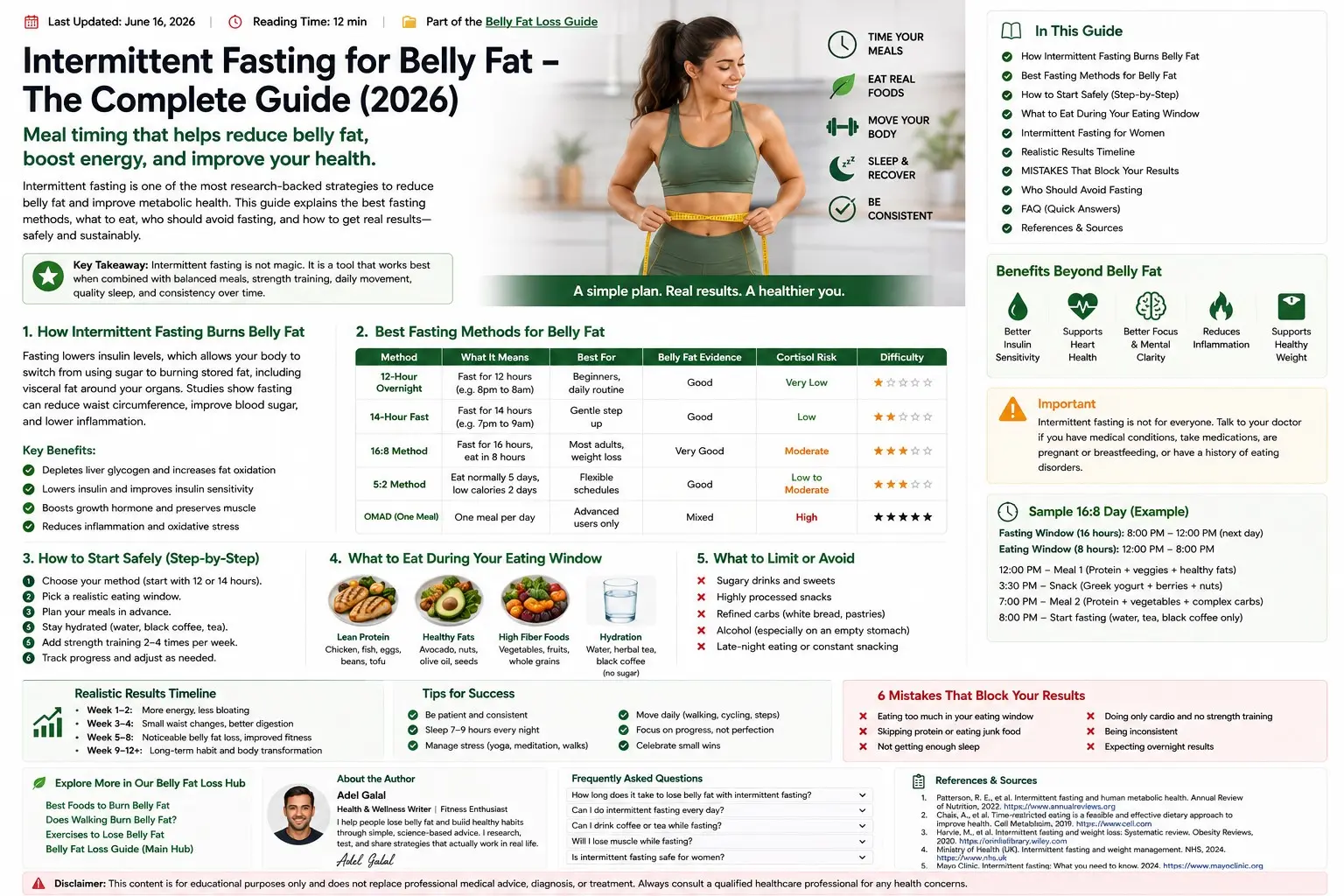
Six Common Fasting Methods
1. A 12 hour overnight fast
This is a gentle starting point.
Finish dinner at 8 pm.
Eat breakfast at 8 am.
This may reduce late snacks without removing a normal meal.
2. A 14 hour fast
Finish dinner at 7 pm.
Eat breakfast at 9 am.
This gives more structure.
It may still allow three meals.
3. The 16 to 8 method
Fast for 16 hours.
Eat within 8 hours.
An example is 10 am to 6 pm.
This can fit some adults.
It is not required.
4. The 5 to 2 method
Eat normally on five days.
Use a much lower calorie intake on two separate days.
The low intake days can be difficult.
This method needs more care with medicine, hunger, and exercise.
5. Alternate day fasting
This method alternates fasting days with eating days.
It may reduce weight.
It can be difficult to maintain.
6. One meal a day
This method uses a very short eating window.
It can make protein, fiber, calcium, vitamins, and total food intake difficult.
It is not a good general beginner recommendation.
Fasting Method Comparison
| Method | Difficulty | Possible use | Main concern |
|---|---|---|---|
| 12-hour overnight | Low | Beginner routine | May not change total intake |
| 14 hour fast | Moderate | More meal structure | Morning hunger |
| 16 to 8 | Moderate | Adults who prefer fewer eating hours | Low protein or overeating |
| 5 to 2 | High | Weekly structure | Very low intake days |
| Alternate day | High | Selected adults with guidance | Hunger and adherence |
| One meal a day | Very high | Not a general beginner plan | Nutrient and muscle risk |
Is the 16 to 8 Method Best for Belly Fat?
No schedule has been proven best for belly fat.
A 2025 randomized trial compared morning, afternoon, and self-selected 8-hour eating windows.
All three time-restricted eating groups lost more weight than the control group.
The groups did not differ in visceral fat reduction.
This means the exact 8-hour window may matter less than consistency and total food intake.
The 16 to 8 method can work.
It is not a required target.
A 12 or 14 hour schedule may be easier and safer.
Is an Early Eating Window Better?
The body follows a daily rhythm.
Blood sugar control may differ across the day.
Some research suggests that earlier eating may support certain metabolic measures.
Other research shows that the exact 8-hour window may not change weight or visceral fat very much.
An early schedule is not useful if it harms family meals, work, sleep, or adherence.
A practical rule is to avoid making most food very late at night.
Choose the schedule that supports balanced meals and good sleep.
How to Choose an Eating Window
For early workers
An earlier first meal may feel better.
You may eat breakfast after starting work and finish dinner earlier.
For evening workers
A later window may fit better.
Do not force an early closing time when it causes severe hunger during a shift.
For families
Keep the family meal when possible.
A simple overnight fast may be easier than skipping dinner.
For social events
One late meal does not ruin the plan.
Return to the normal schedule the next day.
Do not use a longer fast as punishment.
What Breaks a Fast?
For weight management, calories break the fasting period.
Water does not.
Plain tea usually does not.
Black coffee usually does not.
Milk, cream, sugar, juice, snacks, and meals add calories.
Do not become obsessed with a tiny splash or a perfect fasting score.
The primary goal is better health and a repeatable schedule.
What to Drink During a Fast
- Water
- Sparkling water without calories
- Plain tea
- Black coffee when tolerated
Caffeine can cause anxiety, reflux, palpitations, or poor sleep.
Move coffee earlier or reduce it when needed.
There is no universal fluid amount.
People with heart failure, kidney disease, or a fluid limit need personal advice.
What to Eat During the Eating Window
Fasting controls time.
Food controls nutrition.
Use a simple plate.
- Half vegetables or fruit
- One quarter protein
- One quarter beans, potatoes, oats, rice, or whole grains
- A small amount of olive oil, nuts, seeds, or avocado
Protein
Protein-rich meals support fullness and muscle.
Choose eggs, fish, chicken, yogurt, cottage cheese, beans, lentils, tofu, or tempeh.
There is no universal gram target.
Needs depend on body size, activity, age, health, and kidney function.
Fiber
Fibre-rich foods support fullness and bowel health.
Choose vegetables, fruit, beans, lentils, oats, nuts, seeds, and whole grains.
Increase fibre slowly.
Healthy fats
Olive oil, nuts, seeds, avocado, and fish can fit.
Use useful portions.
How to Break a Fast Without Overeating
The first meal does not need to be large.
Use protein, fiber, and fluid.
Eat slowly.
Pause before taking more food.
Useful first meals include:
- Eggs with vegetables and whole grain toast
- Greek yogurt with fruit, oats, and seeds
- Beans with vegetables and a small potato
- Chicken or tofu salad with whole grain bread
A meal made only from sweets or refined snacks may leave you hungry again soon.
Seven Day Meal Timing Example
This example uses a 12 to 14 hour overnight fast.
Move the times to fit your life.
Day 1
First meal: Greek yogurt, oats, berries, and seeds.
Lunch: Chicken or chickpea salad with whole grain bread.
Dinner: Fish or tofu with potato and green beans.
Day 2
First meal: Eggs, vegetables, and whole grain toast.
Lunch: Lentil soup with salad and yogurt.
Dinner: Chicken, beans, or tofu with brown rice and vegetables.
Day 3
First meal: Oats with milk or fortified soy milk, fruit, and nuts.
Lunch: Tuna or bean wrap with salad.
Dinner: Turkey, tofu, or lentil chili with vegetables.
Day 4
First meal: Cottage cheese or soy yogurt with fruit and oats.
Lunch: Salmon, tofu, or bean grain bowl.
Dinner: Chicken or tempeh with sweet potato and broccoli.
Day 5
First meal: Vegetable omelet with whole grain bread.
Lunch: Hummus and chicken or tofu wrap with salad.
Dinner: Fish tacos with cabbage, tomato, and avocado.
Day 6
First meal: Greek yogurt smoothie with fruit and fortified soy milk.
Lunch: Bean and vegetable soup.
Dinner: Lean meat, tofu, or lentil patties with roasted vegetables.
Day 7
First meal: Overnight oats with yogurt, chia seeds, and fruit.
Lunch: Leftover protein with salad and whole grain bread.
Dinner: Baked chicken, salmon, or tofu with vegetables and a small potato.
Add a snack when hunger, activity, and health needs support it.
A Four Week Beginner Plan
Week 1
- Use a 12-hour overnight fast
- Eat three balanced meals
- Stop eating after the planned evening meal
- Track hunger, sleep, and energy
Week 2
- Stay at 12 hours or try 13 hours
- Add protein to the first meal
- Walk for ten minutes after one meal
- Stop if the schedule harms sleep or mood
Week 3
- Try 14 hours only when the earlier plan feels easy
- Complete two strength sessions
- Add vegetables to two meals
- Review evening hunger
Week 4
- Choose 12, 13, or 14 hours
- Do not lengthen the fast only for pride
- Review weight, waist, hunger, sleep, and training
- Plan the next month
You do not need to reach 16 hours.
Exercise While Fasting
Some healthy adults can walk or perform light exercise while fasting.
Hard training may feel better closer to the eating window.
Strength training helps protect muscle during weight loss.
Adults should work toward at least 150 minutes of moderate activity and two strength days each week.
Use walking, cycling, swimming, chair squats, wall push-ups, rows, bridges, step-ups, and carries.
Read Exercises to Lose Belly Fat.
When to Eat Around Exercise
There is no single rule.
Some adults feel well walking before breakfast.
Others need food first.
For strength training, eating protein and a balanced meal within the eating window can support recovery.
Stop exercise when you feel:
- Dizzy
- Shaky
- Confused
- Very weak
- Nauseated
- Unable to recover
Intermittent Fasting and Diabetes
Diabetes changes fasting safety.
Blood sugar can fall too low.
Blood sugar can also rise when diabetes is not controlled.
Insulin and sulfonylurea medicine may need adjustment.
NIDDK advises close work with the treating clinician when a person with type 2 diabetes uses intermittent fasting.
Do not change medicine on your own.
People with type 1 diabetes need specialist guidance.
Intermittent Fasting After Age 50
Muscle matters more with age.
A narrow eating window can make it harder to eat enough protein and total food.
Older adults may also use more medicine.
A gentle 12-hour overnight fast may be a better starting point than one meal a day.
Use:
- Protein at each meal
- Strength work twice each week
- Adequate calcium and vitamin D care
- Medical guidance for medicine and health conditions
- A schedule that does not cause weakness
Read How to Get Fit at 50.
Intermittent Fasting and Menopause
Menopause can change sleep, appetite, activity, and fat distribution.
Fasting does not correct menopause hormones.
It may help some women structure meals.
It may make hot flashes, sleep, or hunger worse for others.
Protect protein, bone health, and strength training.
Read the Belly Fat Diet Plan for Women Over 50.
Intermittent Fasting and Menstrual Health
There is no rule that every woman must use a shorter fasting window than every man.
Individual response matters.
A very low food intake, low body weight, heavy exercise, stress, and long fasting can affect menstrual health.
Stop and seek medical advice for missed periods, severe fatigue, hair loss, or rapid weight loss.
Do not assume cortisol is the only cause.
Who Should Avoid Fasting or Get Specialist Advice?
- Children and teenagers
- Pregnant people
- Breastfeeding people
- Underweight people
- People with active eating disorder symptoms
- People with a history of severe disordered eating
- People with frequent low blood sugar
- People with serious kidney or liver disease
- People recovering from major surgery or illness
- People taking medicine affected by food timing
Common Side Effects
Possible early effects include:
- Hunger
- Headache
- Irritability
- Low energy
- Constipation
- Poor concentration
- Sleep changes
Mild hunger may settle.
Severe symptoms are not a normal success sign.
Fasting and Constipation
Some people eat less fiber or drink less during fasting.
This can cause constipation.
Helpful steps include:
- Vegetables and whole fruit
- Beans and lentils
- Oats and whole grains
- Enough fluid for your health needs
- Daily walking
Increase fiber slowly.
See a clinician for severe pain, vomiting, blood in stool, or constipation that does not improve.
Sleep, Stress, and Meal Timing
Late eating can affect sleep for some people.
Going to bed very hungry can also affect sleep.
Stress can increase snacking or reduce appetite.
Choose a meal schedule that supports a calm evening.
Read Cortisol and Belly Fat.
How to Track Progress
Track more than the scale.
- Fasting schedule
- Meal quality
- Hunger
- Sleep
- Exercise
- Weight trend
- Monthly waist measurement
- Energy
- Mood
Do not measure the waist every day.
Look at several weeks.
How Long Does It Take?
There is no honest fixed timeline.
Some people lose weight during the first month.
Others do not.
Water, salt, bowel changes, medicine, sleep, and the menstrual cycle can affect the scale and waist.
Do not expect guaranteed waist loss at week four, week eight, or week twelve.
Look for a gradual trend.
What to Do When Progress Stops
Do not make the fast longer first.
Review:
- Drink calories
- Portions in the eating window
- Protein and fibre
- Weekend eating
- Daily movement
- Sleep
- Medicine
Change one item.
Keep the change for two weeks.
Signs to Stop
- Fainting
- Confusion
- Shaking
- Severe weakness
- Repeated binge eating
- Food obsession
- Worsening depression or anxiety
- Poor sleep that continues
- Loss of menstrual periods
- Unexplained rapid weight loss
Speak with a qualified professional.
Common Mistakes
Starting with 16 or 18 hours
A gentle start is easier to assess.
Eating too little protein
This can make muscle care harder.
Overeating in the eating window
The schedule does not cancel large portions.
Using fasting as punishment
Food and exercise should not be punishment.
Ignoring medicine
Meal timing can change medicine safety.
Expecting belly fat to leave first
The body chooses the order.
Common Myths
Myth: Fasting is always better than calorie restriction
False.
Current reviews show broadly similar weight results.
Myth: A 16-hour fast creates special belly fat burning
False.
It does not target one area.
Myth: Every woman must use a shorter fast than every man
False.
Individual health and response matter.
Myth: Hunger proves the plan is working
False.
Severe hunger may cause overeating or poor sleep.
Myth: Longer fasting always brings faster results
False.
Longer fasting can increase risk and reduce adherence.
Myth: Fasting protects all muscle
False.
Protein, strength training, and enough food still matter.
My Research and Experience
I have studied health, fitness, nutrition, weight management, and healthy aging for more than thirty years.
At 59, I value plans that fit real life.
For this update, I reviewed the attached article and kept its focus on practical meal timing.
I removed claims that fasting targets visceral fat better than an equal calorie diet.
I removed fixed promises of 4 to 7 centimeters of waist loss.
I removed the claim that the 16 to 8 method is the best method for everyone.
I removed fixed growth hormone and insulin percentage claims.
I corrected the idea that all women need a different fasting rule because of cortisol.
I also added the 2025 BMJ review, the 2026 Cochrane conclusion, the 2025 eating window trial, diabetes medicine safety, muscle protection, and clear stop signs.
Conclusion
Intermittent fasting for belly fat can be useful when it makes meals simpler and supports a healthy calorie intake.
It does not target belly fat.
It is not clearly better than every other healthy diet.
Start gently.
Eat balanced meals.
Protect protein and muscle.
Walk and strength train.
Stop when fasting harms your health or relationship with food.
Choose one action today. Try a 12 hour overnight fast, plan a protein rich first meal, or ask your clinician whether fasting is safe with your medicine.
Explore Related NextFitLife Guides
- Weight Management and Metabolism Health Hub
- Fitness Nutrition and Supplements Guide
- Cardio and Endurance Guide
- Fitness for Beginners Guide
- Complete Belly Fat Loss Guide
- Complete Weight Loss Guide
- Simple Meal Plan for Weight Loss
- Walking for Weight Loss
- Exercises to Lose Belly Fat
- Do Situps Burn Belly Fat?
- Cortisol and Belly Fat
- Belly Fat Diet Plan for Women Over 50
- How to Get Fit Fast
- How to Get Fit at 50
- Healthy Lifestyle Roadmap
References and Sources
- The BMJ: 2025 systematic review and network meta-analysis of intermittent fasting strategies, body weight, and cardiometabolic risk. Open source
- Cochrane: 2026 review comparing intermittent fasting with regular dietary advice and no treatment for adults with overweight or obesity. Open source
- National Institute on Aging: 2025 randomized trial summary comparing morning, afternoon, and self-selected 8-hour eating windows. Open source
- National Institute of Diabetes and Digestive and Kidney Diseases: Fasting safety, low blood sugar risk, and diabetes medicine guidance. Open source
- Centers for Disease Control and Prevention: Current adult aerobic and muscle strengthening activity guidance. Open source

Adel Galal has more than thirty years of personal experience with health, fitness, nutrition, weight management, and healthy aging. At 59, he writes from lived experience, extensive research, and consultation with qualified healthcare providers.
He is not a doctor, dermatologist, registered dietitian, endocrinologist, diabetes specialist, or licensed weight management professional. This article was source-checked against current fasting, diabetes, nutrition, physical activity, and weight management evidence. It was not medically reviewed by a named clinician.
Frequently Asked Questions About Intermittent Fasting for Belly Fat
Does intermittent fasting burn belly fat?
Intermittent fasting does not target belly fat. It may help reduce overall body fat when the eating schedule helps a person eat less or follow a healthy plan more consistently. Belly fat may fall as total body fat falls.
Is intermittent fasting better than a normal calorie controlled diet?
Current reviews suggest that intermittent fasting usually produces weight loss similar to regular dietary advice or continuous calorie restriction. It can be a useful option, but it is not clearly superior for most adults.
What fasting schedule is best for beginners?
A 12 hour overnight fast is a practical starting point. Some adults may later try 13 or 14 hours. A 16 hour fast is optional and may not fit every person.
Is the 16 to 8 method best for visceral fat?
No single eating window has been proven best for visceral fat. A 2025 trial found similar visceral fat changes across morning, afternoon, and self selected 8 hour windows. Choose a schedule that supports sleep, balanced meals, and consistency.
Can women use intermittent fasting?
Some women can use a gentle overnight fasting schedule. Pregnancy, breastfeeding, active eating disorder symptoms, low body weight, menstrual disruption, menopause symptoms, medicine, and health conditions may change safety. Medical advice is important when concerns are present.
Can people with diabetes fast?
People with diabetes need medical guidance because fasting can change blood glucose and medicine needs. Insulin, sulfonylureas, and other medicines may raise the risk of low blood sugar. Do not change medicine without the prescribing clinician.
Can I drink coffee while fasting?
Water, plain tea, and black coffee are commonly used during a fasting period. Coffee can worsen reflux, anxiety, palpitations, or poor sleep in some people. Milk, cream, sugar, and juice add calories.
Can I exercise during a fast?
Light or moderate activity may feel comfortable for some adults. Hard exercise may feel better near the eating window. Stop if you become dizzy, shaky, confused, weak, or unwell.
How long does it take to lose belly fat with fasting?
There is no fixed timeline. Progress depends on food intake, starting weight, activity, sleep, health, medicine, and consistency. Track weight and waist trends over several weeks rather than expecting a guaranteed result.
Who should avoid intermittent fasting?
Fasting is not suitable without specialist advice during pregnancy, breastfeeding, childhood, adolescence, underweight status, active eating disorder symptoms, serious illness, or when medicine and health conditions are affected by meal timing.

Health & wellness writer with 30+ years of experience in nutrition, fitness, and healthy aging. Founder of NextFitLife.com — evidence-based health guidance.