Written and Source Checked by: Adel Galal
Clinical Review Status: This article has not been reviewed by a dermatologist or doctor.
Reading Time: About 17 minutes
Content Purpose: General education about sensitive skin, fragrance, contact dermatitis, gentle cleansing, moisturizing, sunscreen, and safer product selection.
Your skin should not burn every time you apply moisturizer.
It should not become itchy after every new serum.
It should not feel tight after washing.
If this happens often, simplifying your routine may help.
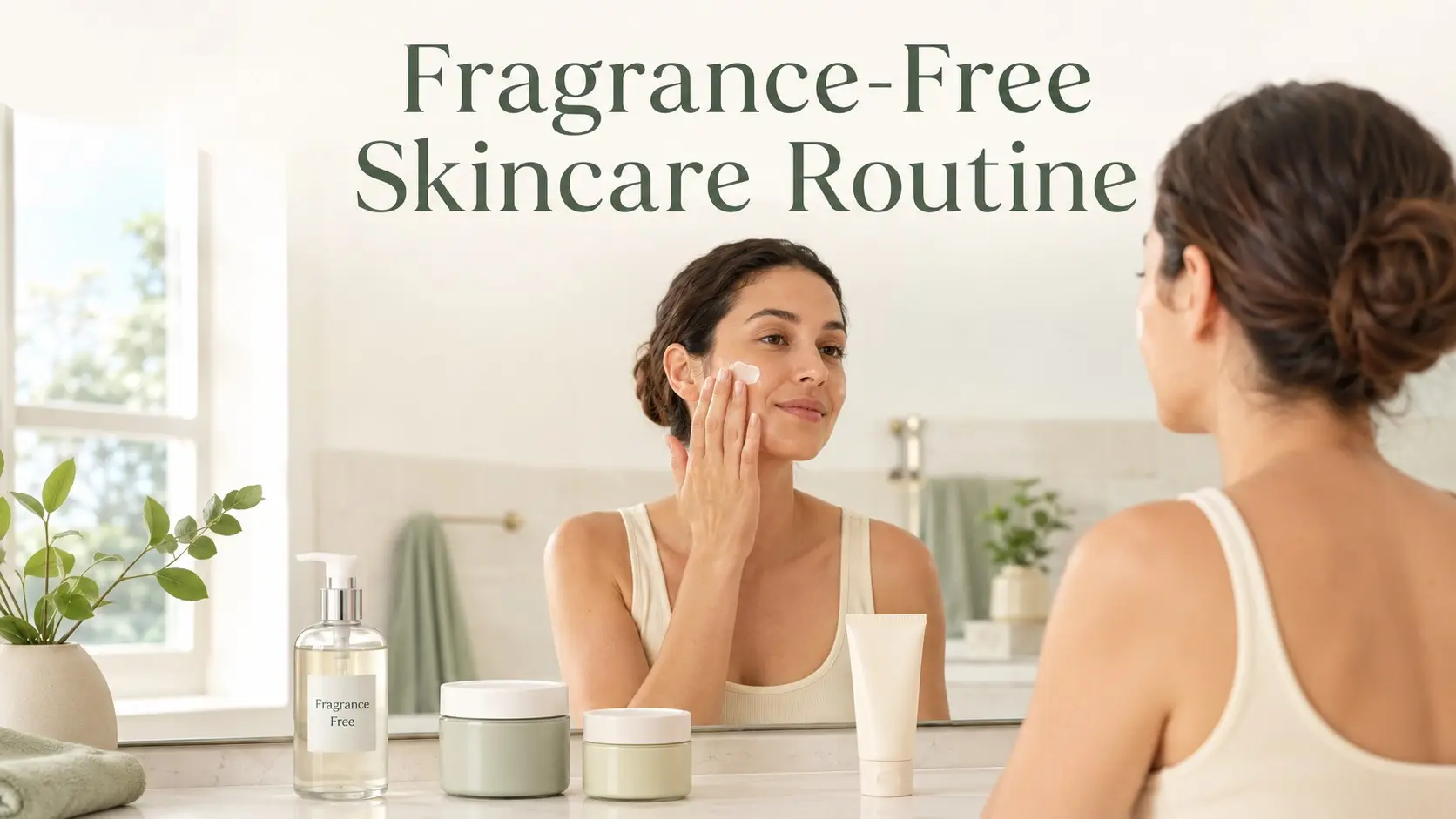
A good fragrance-free skincare routine removes one common source of skin irritation while keeping the routine easy to follow.
Fragrance can come from synthetic ingredients.
It can also come from natural ingredients.
Essential oils can contain fragrant compounds too.
This does not mean fragrance is unsafe for everyone.
Many people use scented products without a problem.
But fragrance is a common cause of contact dermatitis and may trigger symptoms in people with reactive or eczema-prone skin.
The solution is not to buy ten products labelled for sensitive skin.
The solution is usually to simplify.
Start with a mild cleanser.
Add a simple moisturizer.
Protect your skin from the sun.
Then add treatments only when you need them.
This guide explains how to create a simple routine, how to read labels, how to test new products, and when a reaction needs medical care.
For a complete introduction to daily skin care, visit the NextFitLife Skincare Basics and Routines Guide.
Quick Answer: What Is the Best Fragrance-Free Routine?
A simple morning routine is:
- Rinse or wash with a mild fragrance-free cleanser.
- Apply a fragrance-free moisturizer.
- Apply broad spectrum SPF 30 or higher sunscreen.
A simple evening routine is:
- Wash with a mild fragrance free cleanser.
- Apply any needed treatment that your skin tolerates.
- Apply a fragrance free cream or ointment.
If your skin is very irritated, skip optional treatments until it becomes comfortable again.
Choose products labeled fragrance free rather than unscented.
Still read the ingredient list because sensitive skin can react to ingredients other than fragrance.
Key Takeaways
- Fragrance is a common cosmetic allergen.
- Fragrance free and unscented do not mean the same thing.
- An unscented product may contain masking fragrance.
- Fragrance-free is useful label guidance but does not guarantee that a product will suit everyone.
- Sensitive skin often does better with fewer products.
- A cream or ointment may protect very dry skin better than a light lotion.
- Apply moisturizer while skin is still slightly damp.
- Test new products before using them across your entire face.
- Essential oils can still cause irritation or allergy.
- Persistent reactions may need medical patch testing.
What Does Fragrance Free Really Mean?
This sounds simple.
It is not always simple.
A product may have no noticeable smell and still contain fragrance ingredients.
This is why the words on the label matter.
Fragrance Free
A product labelled fragrance free is intended not to contain fragrance added to create a scent.
This is usually the better starting point for people with fragrance sensitivity, eczema, or known fragrance allergy.
However, United States cosmetic labelling does not give you a perfect guarantee that every product using a sensitive skin claim will suit you.
You still need to read the ingredient list.
You may also need to contact the manufacturer when you have a known allergy.
Unscented
Unscented is different.
An unscented product may contain fragrance that masks the natural smell of other ingredients.
You may not smell it.
Your skin can still react to it.
This is why dermatologists often advise people with eczema or fragrance allergy to choose fragrance-free instead of unscented products.
Hypoallergenic
Hypoallergenic skincare sounds reassuring.
It does not mean that a product cannot cause an allergy.
People can react to preservatives, dyes, botanical ingredients, metals, fragrance compounds, or other ingredients.
Treat the word as marketing information.
Do not treat it as a medical guarantee.
Why Can Fragrance Irritate Sensitive Skin?
Two main types of reaction matter.
Irritant Contact Dermatitis
Irritant contact dermatitis happens when a substance directly damages or irritates the outer skin.
The immune system does not need to be allergic to the ingredient.
Common signs include:
- Burning
- Dryness
- Tightness
- Cracking
- Redness
- Rough skin
Soap, detergent, acids, alcohol, repeated washing, and other strong products may cause this type of irritation.
Allergic Contact Dermatitis
Allergic contact dermatitis is different.
Your immune system reacts to an ingredient.
The reaction may not happen the first time you use the product.
You can use something for months or years before developing an allergy.
The rash may also appear hours or days after exposure.
Signs may include:
- Strong itching
- Red or darkened skin
- Swelling
- Small bumps
- Blisters
- Dry patches
- Cracking
Fragrance is one common cause.
Preservatives, dyes, and other ingredients can also cause allergy.
What Does Sensitive Skin Mean?
Sensitive skin is a broad term.
It is not one disease.
Some people naturally react more easily to products.
Others develop sensitivity because their skin barrier is damaged.
Some people have eczema.
Others have rosacea.
Some have contact dermatitis.
A person may notice:
- Burning after products
- Stinging after washing
- Redness
- Dry patches
- Itching
- Fast reactions to new products
- Flaking
- Tight skin
If your skin suddenly becomes sensitive after tolerating everything before, look at what changed.
You may have added too many active ingredients.
You may have changed cleanser.
You may have started retinol.
You may also have developed dermatitis.
Read the NextFitLife Damaged Skin Barrier Guide if your skin suddenly burns, flakes, or stings.
Who May Benefit From Fragrance-Free Skincare?
A fragrance-free routine may be especially useful if you have:
- Sensitive skin
- Atopic eczema
- Contact dermatitis
- A diagnosed fragrance allergy
- A damaged skin barrier
- Very dry skin
- Skin that burns after many products
- A history of cosmetic reactions
- Skin recovering from strong treatment
You do not need to have a diagnosed allergy to choose fragrance-free products.
A simpler formula may simply feel better.
The Basic Fragrance Free Skincare Routine
| Step | Morning | Evening |
|---|---|---|
| 1 | Gentle cleanser or water rinse | Gentle cleanser |
| 2 | Optional treatment | Optional treatment |
| 3 | Fragrance free moisturizer | Fragrance free moisturizer |
| 4 | SPF 30 or higher sunscreen | Optional ointment on very dry areas |
Morning Fragrance Free Skincare Routine
Step 1: Cleanse Gently
Your face does not always need a strong morning wash.
Dry or sensitive skin may need only lukewarm water.
If you need cleanser, choose a gentle cleanser.
Look for:
- Fragrance free
- Mild
- Made for sensitive skin
- Cream or lotion texture for dry skin
- Simple ingredient list
Use your fingertips.
Do not use a rough washcloth.
Do not scrub until the skin feels squeaky.
Rinse with lukewarm water.
Very hot water may add dryness.
Step 2: Use Treatment Only If Needed
This step is optional.
Many sensitive skin routines fail because too many treatments are added.
You do not need vitamin C, niacinamide, peptides, acids, toner, and retinol in one routine.
Choose one treatment for one clear concern.
Examples may include:
- Azelaic acid for some acne or redness concerns
- Niacinamide when your skin tolerates it
- A prescribed treatment for eczema or rosacea
Do not use a strong product simply because it is popular.
Step 3: Apply Moisturizer
A fragrance-free moisturizer is the main product in a sensitive skin routine.
Apply it after washing.
Skin can still be slightly damp.
This can help trap water.
For very dry skin, a cream or ointment often gives more protection than a thin lotion.
Useful moisturizing ingredients may include:
- Ceramides
- Glycerin
- Petrolatum
- Dimethicone
- Hyaluronic acid
- Colloidal oatmeal
- Squalane
You do not need all of them.
A plain product that feels comfortable is enough.
For more dry skin help, visit the NextFitLife Face Care Routine for Dry Skin.
Step 4: Use Sunscreen
Sensitive skin still needs sun protection.
Use broad-spectrum SPF 30 or higher on exposed skin.
Look for a fragrance-free formula.
If one sunscreen burns, try another.
Some people prefer zinc oxide or titanium dioxide.
Others tolerate modern organic sunscreen filters well.
There is no single sunscreen type that is perfect for every sensitive person.
Patch test when possible.
Use hats, shade, and protective clothing too.
Evening Fragrance-Free Skincare Routine
Step 1: Remove Makeup and Sunscreen
You may need a first cleansing step if you wear heavy makeup or water-resistant sunscreen.
Choose a fragrance-free cleansing balm, oil, or micellar product if needed.
Do not rub hard.
One gentle cleanser may be enough for lighter products.
Step 2: Cleanse
Use the same mild cleanser as the morning.
You do not need a different night cleanser.
Consistency can make reactions easier to track.
Step 3: Use Treatment Carefully
Retinol and exfoliating acids can irritate sensitive skin.
This does not mean everyone with sensitive skin must avoid them forever.
It means you should start slowly.
Do not introduce an active ingredient while your face is burning or peeling.
Start with the lowest practical strength.
Use it less often.
Stop if irritation becomes strong.
Follow prescription instructions when using prescription medicine.
Step 4: Moisturize
Apply your fragrance-free cream.
Use enough to make your skin comfortable.
Do not keep adding products if your skin already feels good.
Step 5: Protect Very Dry Areas
A small amount of petroleum jelly may help very dry areas.
Apply it over moisturizer.
This reduces water loss.
Do not apply it over infected or weeping skin without medical advice.
How to Read a Skincare Ingredient List
Reading the front label is not enough.
Turn the bottle around.
Check the ingredient list.
Look for the Word Fragrance
It may appear as:
- Fragrance
- Parfum
- Perfume
- Aroma
A formula may also contain individual fragrance ingredients.
People with a diagnosed fragrance allergy may need more detailed ingredient avoidance.
A dermatologist or allergist may provide a safe product list after patch testing.
Be Careful With Essential Oils
Essential oils are natural.
Natural does not mean allergy-free.
Lavender oil has a smell.
Citrus oil has a smell.
Peppermint oil has a smell.
Tea tree oil has a smell.
Some people tolerate them.
Others develop irritation or allergy.
If fragrance is your trigger, an essential oil skin product may not be a suitable replacement for perfume.
Botanical Does Not Always Mean Gentle
Plant extracts can be useful.
They can also cause reactions.
Your skin does not know whether an allergen came from a laboratory or a flower.
Judge products by how your skin responds.
Fragrance Free vs Unscented
| Label | What it may mean | Better choice for fragrance-sensitive skin? |
|---|---|---|
| Fragrance free | No fragrance intended to create a scent | Usually the better starting point |
| Unscented | May contain masking fragrance so you cannot smell the formula | Not always |
| Hypoallergenic | Marketing term suggesting lower allergy risk | Not a guarantee |
| For sensitive skin | Marketing description of the target consumer | Read the ingredients too |
| Natural fragrance | Fragrance from natural sources | Can still trigger reactions |
Is Fragrance Bad for Everyone?
No.
This point matters.
Fragrance is not automatically dangerous.
Most people can use many scented cosmetic products without developing a reaction.
The problem is personal sensitivity.
A person with eczema or known fragrance allergy may have a very different experience from a person with healthy, tolerant skin.
Skin care should match the person.
It should not be based on fear.
Can You Suddenly Become Allergic to Fragrance?
Yes.
An allergy can develop after repeated exposure.
You may use a product for years.
Then one day you develop an itchy rash.
This is called skin sensitization.
The rash may also appear after a delay.
This can make the cause difficult to identify.
A dermatologist may use medical patch testing when contact allergy is suspected.
How to Test a New Skincare Product
Do not test five new products together.
You will not know which one caused the problem.
The American Academy of Dermatology suggests testing a product on a small area before using it widely.
Simple Home Product Test
- Choose a small area on the inside of your arm or bend of your elbow.
- Use the normal amount of product.
- Use it the way you normally would.
- Repeat the test for seven to ten days.
- Watch for itching, redness, swelling, burning, or bumps.
If you test a rinse-off cleanser, leave it on only as long as you normally would.
Wash the product off if a reaction develops.
Do not continue testing through a painful rash.
This home test is not the same as medical patch testing.
Dermatologists use medical patch testing to identify specific allergens.
What Should You Do If a Product Burns?
A mild, brief tingle can occur with some treatment products.
Strong or lasting burning is different.
Wash the product off.
Stop using it.
Use a cool compress if needed.
Apply a simple fragrance-free moisturizer or petroleum jelly if the skin tolerates it.
Do not apply acid or retinol over the reaction.
Read the NextFitLife Skin Irritation Guide if your skin is red, itchy, or sore.
What Ingredients Are Good for Sensitive Skin?
No ingredient works for everyone.
Some simple ingredients are commonly used in sensitive skin formulas.
Ceramides
Ceramides are fats found naturally in the outer skin.
They can be included in moisturizers designed to support the barrier.
Glycerin
Glycerin attracts water.
It is common in simple moisturizers and cleansers.
Petrolatum
Petrolatum reduces water loss.
It can protect very dry skin.
Colloidal Oatmeal
Colloidal oatmeal is used in products for dry and itchy skin.
It may be soothing for some people.
Hyaluronic Acid
Hyaluronic acid attracts water.
It is not required if your moisturizer already hydrates well.
Some complete formulas containing it may still irritate because of other ingredients.
Ingredients That May Irritate Sensitive Skin
These ingredients are not automatically bad.
They simply need more care.
- Fragrance
- Essential oils
- Strong alcohol formulas
- Retinol
- Prescription retinoids
- Glycolic acid
- Salicylic acid
- Strong vitamin C formulas
- Benzoyl peroxide
- Harsh physical scrubs
Many of these ingredients have useful roles.
A person with acne may benefit from adapalene or benzoyl peroxide.
A person with sensitive skin may simply need a slower schedule and more moisturizer.
Should Sensitive Skin Exfoliate?
Exfoliation is optional.
You do not need to exfoliate to have healthy skin.
Sensitive skin often needs less exfoliation.
Do not exfoliate when the skin:
- Burns
- Stings
- Peels
- Feels raw
- Has an active rash
If you choose to exfoliate, start gently.
Use one product.
Do not combine several acids with retinol.
Do You Need Fragrance-Free Makeup?
Not everyone does.
People with known fragrance allergy or repeated facial reactions may benefit from fragrance-free makeup too.
Look beyond foundation.
Fragrance may also appear in:
- Primer
- Setting spray
- Lip products
- Makeup remover
- Hair spray
A hair product can also touch your forehead, cheeks, neck, and pillow.
Do You Need Fragrance Free Hair Products?
If your reaction appears around the hairline, ears, neck, or scalp, hair products may matter.
Shampoo runs across the face and body in the shower.
Conditioner can remain on the neck and back.
Styling products can touch facial skin.
A dermatologist may ask about all products that touch your skin, not only facial products.
Do You Need Fragrance-Free Laundry Products?
Sometimes.
Laundry detergent and fabric products touch clothing, bedding, and towels.
People with eczema or fragrance sensitivity may prefer fragrance-free laundry products.
Wash new clothing before wearing it.
This can remove some dyes and manufacturing residue that may irritate sensitive skin.
Fragrance Free Routine for Dry Sensitive Skin
Morning
- Rinse with lukewarm water.
- Apply a rich fragrance-free cream.
- Apply SPF 30 or higher sunscreen.
Evening
- Use a mild cream cleanser.
- Apply a rich moisturizer.
- Use petroleum jelly on very dry areas if needed.
Keep showers short.
Use warm rather than very hot water.
Apply moisturizer soon after bathing.
Fragrance Free Routine for Oily Sensitive Skin
Oily skin can still be sensitive.
Do not try to remove every trace of oil.
Morning
- Use a gentle fragrance-free cleanser.
- Apply a light moisturizer.
- Use a light sunscreen.
Evening
- Cleanse gently.
- Use one acne treatment if needed.
- Apply a light moisturizer.
Choose noncomedogenic skincare when acne is a concern.
Do not introduce several acne treatments at once.
Fragrance-Free Routine for Acne-Prone Sensitive Skin
This combination can be difficult.
You need to treat acne without damaging the barrier.
Morning
- Gentle cleanser
- Prescribed or chosen acne treatment if directed
- Fragrance-free moisturizer
- Noncomedogenic sunscreen
Evening
- Gentle cleanser
- Retinoid or acne treatment as directed
- Fragrance-free moisturizer
If your treatment suddenly causes major peeling and burning, do not call every reaction purging.
Read the NextFitLife Skin Purging vs Breakout Guide.
Fragrance Free Routine With Eczema
People with eczema often have a weaker skin barrier.
Fragrance may trigger a flare for some people.
A routine should usually focus on moisture.
- Use a mild fragrance-free cleanser.
- Keep baths and showers short.
- Use warm water.
- Apply cream or ointment after bathing.
- Moisturize whenever skin feels dry.
- Avoid known triggers.
Prescription treatment may be needed during an eczema flare.
Do not rely only on cosmetics when the skin is severely inflamed.
Fragrance-Free Routine With Rosacea
Rosacea can cause burning, flushing, redness, and bumps.
Fragrance may irritate some people with rosacea.
Keep care simple.
Use a gentle cleanser.
Use moisturizer.
Use sunscreen.
Avoid rubbing and harsh exfoliation.
Rosacea is a medical condition.
Get a diagnosis if redness, flushing, or facial bumps keep returning.
Can Fragrance Cause Acne?
Fragrance is better known for causing irritation or allergy than acne.
However, an irritated skin routine may make acne care harder.
The complete formula matters.
Another ingredient in a scented product may clog pores.
If pimples appear after a new product, stop it and watch the pattern.
Does Fragrance Damage the Skin Barrier?
Not in every person.
If fragrance irritates your skin, repeated exposure can cause inflammation and worsen barrier symptoms.
You may notice:
- Dryness
- Stinging
- Flaking
- Redness
- Itching
Removing the trigger and simplifying care can help the skin settle.
How Long Should You Try a Fragrance-Free Routine?
Do not expect years of irritation to disappear overnight.
Give your simple routine time.
For basic product irritation, you may notice better comfort within days or weeks after removing the trigger.
Allergic contact dermatitis may take longer.
A continuing rash may mean you have not identified the true cause.
Keep a list of products you use.
Take photos in the same lighting.
See a dermatologist if symptoms continue.
A Simple 14 Day Sensitive Skin Reset
Days 1 to 3
- Stop new cosmetic products.
- Stop exfoliation.
- Stop optional fragrance.
- Use only cleanser, moisturizer, and sunscreen.
- Do not pick flaky skin.
Days 4 to 7
- Continue the same routine.
- Apply moisturizer when skin feels dry.
- Watch for less burning.
- Watch for less itching.
- Do not add a serum yet.
Days 8 to 14
- Continue fragrance-free care.
- Review your skin photos.
- Check whether simple moisturizer still stings.
- Seek professional advice if the rash remains.
This is a general routine for mild irritation.
It does not replace treatment for eczema, infection, rosacea, or allergy.
Common Fragrance Free Skincare Mistakes
- Choosing unscented instead of fragrance-free
- Assuming natural fragrance cannot cause allergy
- Using essential oils instead of perfume
- Adding five products at once
- Using acids on already irritated skin
- Scrubbing away flakes
- Skipping moisturizer because skin is oily
- Believing hypoallergenic means allergy proof
- Ignoring hair and laundry products
- Continuing a product through severe burning
- Using a steroid cream on the face without medical advice
- Assuming every facial rash is sensitive skin
When Should You See a Dermatologist?
Book professional care for:
- A rash that keeps returning
- Severe itching
- A reaction around the eyes
- Strong facial swelling
- Blisters
- Cracked or bleeding skin
- Oozing or crusting
- Repeated reactions to many products
- Possible eczema
- Possible rosacea
- Possible contact allergy
- Skin that does not improve after removing suspected triggers
A dermatologist may recommend medical patch testing.
This can help identify specific allergens.
Get Urgent Medical Help For
- Trouble breathing
- Swelling of the tongue
- Swelling of the throat
- Severe facial swelling
- Fast-spreading blisters
- Fever with painful skin
Conclusion
A fragrance-free skincare routine does not need to be complicated.
Choose a mild cleanser.
Use a simple moisturizer.
Protect your skin from the sun.
Add treatment only when you need it.
Choose fragrance-free rather than unscented when fragrance is a concern.
Read ingredient lists.
Test new products.
Most importantly, listen to your skin.
Call to Action: Put every product you use on a table today. Remove optional scented products for two weeks. Keep only a mild cleanser, moisturizer, and sunscreen. Take a clear photo now and compare your skin after 14 days. Contact a qualified professional if your rash, itching, swelling, or burning continues.
References and Sources
Frequently Asked Questions
What is a fragrance-free skincare routine?
It is a routine that avoids products with fragrance added for scent. A simple routine usually includes a mild cleanser, moisturizer, and sunscreen.
Is fragrance-free better for sensitive skin?
It may be. Fragrance is a common cosmetic allergen and can irritate some sensitive skin. Other ingredients can still cause reactions, so fragrance-free does not guarantee perfect tolerance.
Is unscented the same as fragrance free?
No. Unscented products may contain masking fragrance. Fragrance free is usually the better choice when you are trying to avoid fragrance.
Can natural fragrance irritate skin?
Yes. Natural fragrance and essential oils can contain compounds that irritate skin or cause allergy in some people.
Can essential oils be used in fragrance-free skincare?
They are not ideal when your goal is to avoid fragrance. Many essential oils contain fragrant compounds and can cause irritation or allergy.
Does fragrance cause acne?
Fragrance is more strongly linked with irritation and allergy than acne. However, a complete scented formula may contain other ingredients that do not suit acne-prone skin.
How do I patch test skincare?
Apply the normal amount to a small area of your inner arm or elbow and repeat use for seven to ten days. Stop if redness, itching, swelling, or burning develops.
What moisturizer is best for sensitive skin?
Choose a fragrance-free cream or ointment that feels comfortable. Useful ingredients may include glycerin, ceramides, petrolatum, simethicone, or colloidal oatmeal.
Should sensitive skin use toner?
Toner is optional. Sensitive skin often does better with fewer products. You do not need toner for healthy skin.
Can sensitive skin use retinol?
Some people can use retinol carefully. Start slowly and stop if strong burning or peeling develops. Do not use retinoids during pregnancy.
How long should I try fragrance-free skincare?
Give a simple routine at least several days to weeks when treating mild irritation. Persistent or worsening symptoms need professional assessment.
When should I see a dermatologist?
See a dermatologist for repeated rashes, severe itching, swelling, blisters, cracked skin, eye involvement, or reactions that continue after suspected products are stopped.

Health & wellness writer with 30+ years of experience in nutrition, fitness, and healthy aging. Founder of NextFitLife.com — evidence-based health guidance.