Published: August 29, 2026
Last Updated: August 29, 2026
Next Review: August 2027, or sooner if major blood pressure guidance changes
Written and Source Checked by: Adel Galal, Founder of NextFitLife
Review Status: Fully updated using current American Heart Association, Mayo Clinic, Cleveland Clinic, NHLBI, and National Library of Medicine guidance
Low diastolic blood pressure means the bottom number on your blood pressure reading is lower than expected.
A reading below about 60 mm Hg is often labelled low.
But one number does not tell the whole story.
A healthy person with 112/58 and no symptoms is very different from someone with 88/58 who feels faint.
And 145/55 is different again because the top number is high and the gap between the two numbers is wide.
Quick Answer: What Does Low Diastolic Blood Pressure Mean?
Low diastolic blood pressure usually means the bottom blood pressure number is below about 60 mm Hg. It is not automatically dangerous. Your systolic pressure, symptoms, age, medicines, hydration, pulse pressure, and whether the reading stays low all help determine whether you need medical care.
Medical note: I am not a dermatologist or A doctor, and this content does not replace professional medical advice. What I share comes from real-life experience, extensive research, and consultation with healthcare providers. Always consult qualified medical professionals for diagnosis and treatment of any health condition.
What Does the Bottom Blood Pressure Number Measure?
Blood pressure has two numbers.
Take 120/80.
The top number is the systolic blood pressure.
It shows the pressure in your arteries when the heart pumps.
The bottom number is the diastolic blood pressure.
It shows the pressure in your arteries while the heart relaxes between beats.
The pressure does not fall to zero between heartbeats.
Your organs still need blood flow.
Your heart muscle also receives much of its own blood supply during this resting phase.
That is one reason a very low diastolic number can deserve attention in the right person.
Is a Diastolic Pressure Below 60 Too Low?
Below 60 mm Hg is a common reference for a low bottom number.
But it is not a universal danger line.
The American Heart Association and NHLBI usually define overall low blood pressure, or hypotension, as a reading below 90/60 mm Hg.
That means a person with 88/58 has low overall blood pressure.
A person with 118/58 has a different pattern.
Only the bottom number is low.
Some people naturally live at lower blood pressure levels and feel completely well.
Symptoms and repeated readings matter.
Low Diastolic Pressure Is Not Always the Same as Hypotension
| Blood Pressure | Diastolic Number | What Stands Out |
|---|---|---|
| 112/58 | 58 | Low bottom number with a normal systolic reading |
| 88/58 | 58 | Both numbers are low |
| 138/58 | 58 | Low bottom number with a higher systolic reading |
| 105/62 | 62 | Neither number meets the usual hypotension definition |
Same bottom number.
Different situation.
This is why I would never interpret the diastolic reading alone.
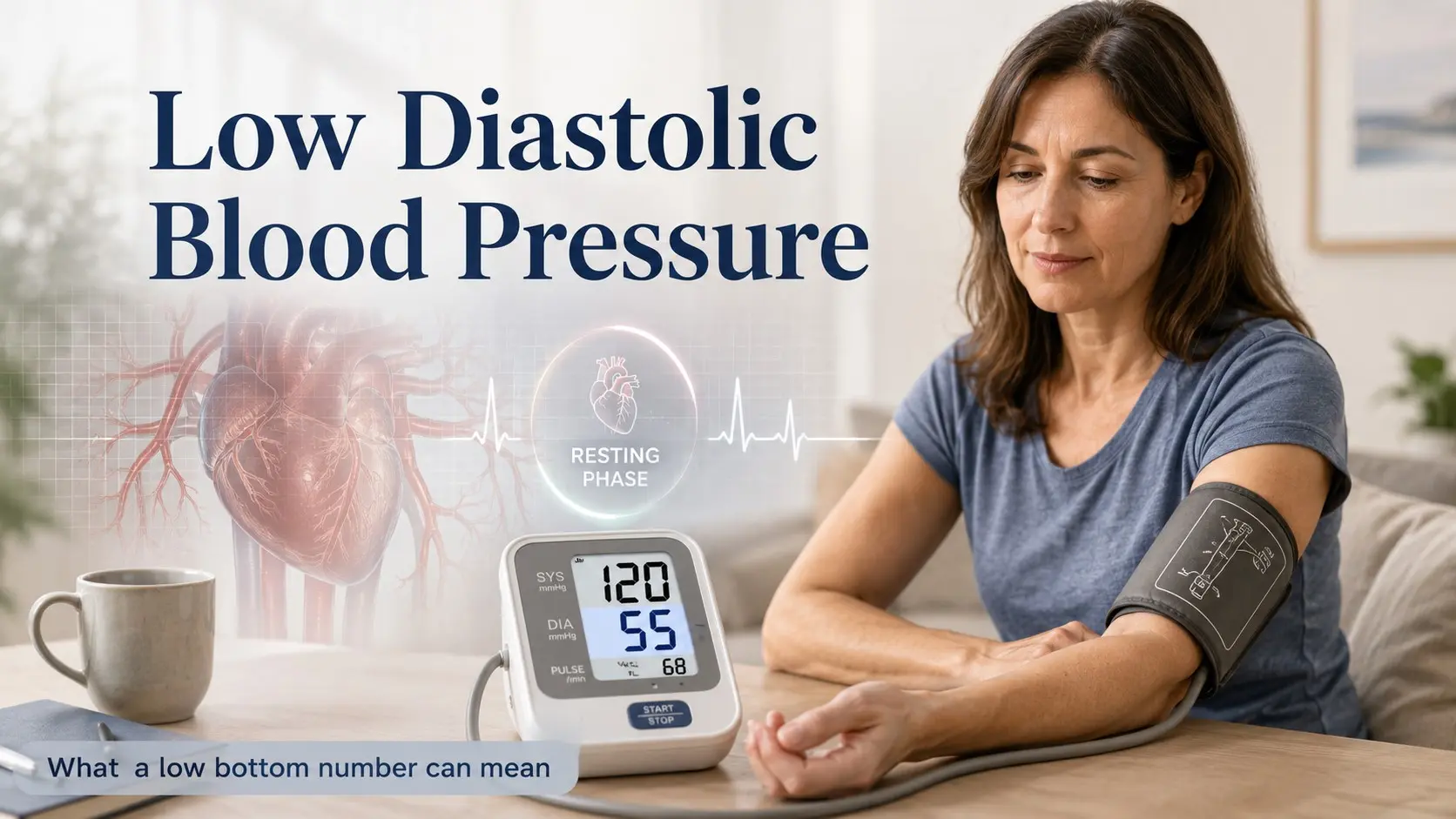
What Does a Blood Pressure of 120/55 Mean?
A reading of 120/55 gives you:
Systolic pressure: 120
Diastolic pressure: 55
The bottom number is below the common 60 mm Hg reference.
There is another useful calculation.
Your pulse pressure is the difference between the two numbers.
120 minus 55 equals 65 mm Hg.
If this happened once and you feel well, repeat the measurement properly.
If readings around 120/55 keep appearing, mention the pattern at your next medical appointment.
If you also feel dizzy, faint, weak, or short of breath, get it assessed sooner.
For more on the gap between the two numbers, read Pulse Pressure Meaning.
What Does 140/55 Mean?
This is more interesting.
The bottom number is still 55.
But the systolic pressure is now 140.
The pulse pressure is 85 mm Hg.
That is a wide gap.
This pattern becomes more common with age as large arteries become stiffer.
The systolic pressure may rise while the diastolic pressure falls.
Do not try to solve this by eating more salt to raise the bottom number.
The whole blood pressure pattern needs to be reviewed.
This is especially true in older adults.
For age-related cardiovascular guidance, read Heart Health After 50.
Why Can Diastolic Blood Pressure Fall With Age?
Healthy large arteries stretch when the heart pumps.
Then they recoil.
This recoil helps maintain pressure between beats.
With age, the arteries can become less flexible.
This is called arterial stiffness.
Systolic pressure can rise.
Diastolic pressure can eventually fall.
The result is a wider pulse pressure.
That does not mean every older person with a diastolic reading below 60 is in danger.
It means age changes how the number should be interpreted.
Can Low Diastolic Blood Pressure Affect Heart Blood Flow?
This question needs careful wording.
The heart muscle receives much of its coronary blood flow during diastole.
The pressure driving that flow depends partly on pressure in the aorta during diastole.
This is called coronary perfusion.
A very low diastolic pressure can therefore matter more in someone who already has coronary artery disease.
But a reading of 58 does not mean your heart is being starved of blood.
That claim would go too far.
The concern depends on:
- Your age
- Your systolic pressure
- Your symptoms
- Whether you have coronary artery disease
- How low the number is
- Whether it stays low
Context matters more than the cutoff.
What Symptoms Make Low Blood Pressure More Important?
The American Heart Association, Mayo Clinic, and NHLBI all emphasize symptoms.
Possible hypotension symptoms include:
- Dizziness
- Lightheadedness
- Fainting
- Blurred vision
- Weakness
- Fatigue
- Nausea
- Confusion
- Heart palpitations
A person with 110/58 who feels fine is different from a person with 110/58 who nearly faints every time they stand.
The second person needs the cause investigated.
Dehydration Is a Common Cause
Blood contains fluid.
Lose enough fluid and blood volume falls.
That can lower blood pressure.
Possible causes include:
- Vomiting
- Diarrhea
- Fever
- Heavy sweating
- Not drinking enough
- Excess use of some diuretic medicines
If your usual blood pressure is 118/72 and it becomes 92/58 during a stomach illness, dehydration deserves attention.
But not every diastolic reading of 58 means you need more water.
Medicines Can Lower the Bottom Number
Medication is another common reason blood pressure falls.
Mayo Clinic lists medicines that can contribute to hypotension, including some:
- Blood pressure medicines
- Diuretics
- Alpha blockers
- Beta blockers
- Medicines used for Parkinson disease
- Some antidepressants
- Some medicines used for erectile dysfunction
This matters when someone is being treated for high systolic blood pressure.
Imagine your blood pressure changes from 165/78 to 125/55 after treatment.
The systolic improvement may be useful.
The low diastolic pressure still deserves context.
Do not stop or reduce medicine on your own.
Show the readings to the clinician who prescribed it.
Can Heart Problems Cause Low Blood Pressure?
Yes.
Mayo Clinic lists several heart related causes of low blood pressure.
They include:
- Very slow heart rate
- Heart attack
- Heart failure
- Heart valve disease
That does not mean a bottom number of 55 proves you have heart disease.
A blood pressure monitor cannot diagnose a valve problem or heart failure.
Can a Leaking Aortic Valve Cause a Wide Pulse Pressure?
Yes.
Aortic regurgitation is a heart valve condition in which some blood leaks backward through the aortic valve while the heart relaxes.
A significant case can produce a high systolic pressure, lower diastolic pressure, and a wide pulse pressure.
But 145/55 does not diagnose aortic regurgitation.
A doctor may hear clues during an examination.
An echocardiogram is commonly used to assess the valve.
Do not diagnose heart valve disease from a home blood pressure result.
What If the Pressure Drops When You Stand?
That is a different pattern called orthostatic hypotension.
It happens when blood pressure drops after you move from lying or sitting to standing.
Cleveland Clinic describes it as a drop of more than 20 mm Hg in systolic pressure or 10 mm Hg in diastolic pressure after standing.
Common symptoms include:
- Dizziness
- Lightheadedness
- Blurred vision
- Weakness
- Fainting
- Confusion
Frequent symptoms deserve medical assessment.
This condition becomes more common with age.
Why Does Standing Make Blood Pressure Fall?
Gravity moves blood toward your legs when you stand.
For a moment, less blood returns to the heart.
Your body normally corrects this quickly.
Special pressure sensors help trigger changes in heart rate and blood vessel tone.
Orthostatic hypotension happens when that response does not work fast enough.
Possible causes include:
- Dehydration
- Medicines
- Diabetes
- Parkinson disease
- Heart conditions
- Autonomic nervous system disorders
The cause determines the treatment.
Can Blood Pressure Drop After Eating?
Yes.
This is called postprandial hypotension.
It usually happens after a meal.
More blood moves toward the digestive system.
The body normally adjusts.
In some people, especially older adults, the adjustment is not enough.
They may feel weak, dizzy, or faint after eating.
If this happens repeatedly, tell your healthcare professional when the symptoms occur.
Timing can help identify the pattern.
Can Anemia Lower Blood Pressure?
Significant anemia can contribute to low blood pressure.
Mayo Clinic also notes that low iron, vitamin B12, or folate can lead to anemia.
But a low bottom number does not diagnose iron deficiency.
Blood testing does that.
If you have low blood pressure with:
- Unusual fatigue
- Pale skin
- Shortness of breath
- Heavy bleeding
- Black stool
get medical advice.
Can Hormone Problems Cause Low Blood Pressure?
They can.
Possible endocrine causes include:
- Adrenal insufficiency
- Some thyroid disorders
- Low blood sugar
- Diabetes related nerve problems
You would not test for every hormone disorder because of one reading of 58.
Persistent low blood pressure plus other symptoms may give a clinician a reason to investigate further.
Is Low Blood Pressure Normal During Pregnancy?
Blood pressure often falls during pregnancy.
Blood vessels expand as circulation changes.
Mayo Clinic notes that low blood pressure is common during the first part of pregnancy.
Pregnancy still needs separate medical guidance.
Report repeated dizziness or fainting.
Get urgent help for serious symptoms such as:
- Heavy bleeding
- Severe abdominal pain
- Chest pain
- Severe shortness of breath
- Collapse
When Low Blood Pressure Becomes an Emergency
There is no single diastolic number that defines shock.
The whole situation matters.
Dangerous low blood pressure can occur with:
- Major blood loss
- Severe dehydration
- Severe infection
- Anaphylaxis
- Serious heart problems
Signs of shock can include:
- Confusion
- Cold and clammy skin
- Rapid breathing
- Weak rapid pulse
- Collapse
Call emergency services if someone appears seriously ill or has signs of shock.
Do not try to treat shock by eating salty food.
Before You Worry About 58, Measure Again Properly
A poor measurement can create a misleading number.
Before checking blood pressure:
- Sit quietly for several minutes
- Keep your back supported
- Keep both feet flat
- Keep your legs uncrossed
- Support your arm at heart level
- Put the cuff on bare skin
- Use the right cuff size
- Do not talk during the reading
Take another reading after a short pause.
Write both numbers down.
Patterns matter more than one result.
Why Pulse Pressure Matters With a Low Bottom Number
This is one of the most useful ways to interpret a low diastolic value.
Compare:
105/55
Pulse pressure = 50.
150/55
Pulse pressure = 95.
The bottom number is identical.
The overall blood pressure pattern is completely different.
A very wide pulse pressure can occur with arterial stiffness and certain cardiovascular conditions.
This is why you should always look at both blood pressure numbers.
Read Pulse Pressure Meaning: What the Gap Between Your Blood Pressure Numbers Tells You.
Should You Try to Raise a Diastolic Pressure of 55?
Not automatically.
If you feel well and lower blood pressure is normal for you, no treatment may be needed.
If dehydration is the cause, correcting dehydration makes sense.
If a medicine is responsible, the medicine may need review.
If orthostatic hypotension is causing symptoms, treat that problem.
If heart disease is involved, treat the heart condition.
The goal is not simply to force the bottom number above 60.
The goal is to find out whether the low number represents a problem.
Should You Eat More Salt?
Do not do this automatically.
Salt can raise blood pressure.
That can help selected people with symptomatic hypotension.
It can also cause problems.
Extra sodium may be inappropriate if you have:
- Heart failure
- Kidney disease
- High systolic blood pressure
- Other conditions affected by sodium
Mayo Clinic specifically recommends speaking with a healthcare professional before deliberately increasing salt intake.
A reading of 118/58 is not permission to start eating heavily salted food.
Can Drinking More Water Help?
Yes, when dehydration is part of the problem.
Fluids can increase circulating blood volume.
This can improve some forms of hypotension.
But water does not treat every cause.
It will not correct serious blood loss.
It will not repair a heart valve.
It will not fix sepsis.
Cause first.
Do Compression Stockings Help?
They can help some people with orthostatic hypotension.
Compression reduces blood pooling in the legs.
This can help more blood return to the heart.
But compression stockings are not a treatment for every person whose diastolic number is below 60.
Use them when the underlying blood pressure problem fits.
When Should You See a Doctor?
I would bring repeated low diastolic readings to a healthcare professional when:
- The bottom number stays below 60
- The pattern is new
- You feel dizzy
- You faint
- You have repeated falls
- You have chest discomfort
- You have unexplained shortness of breath
- Your systolic pressure is high while the diastolic pressure is low
- You take blood pressure medicine
- You have coronary artery disease
- You have known heart valve disease
- Your blood pressure falls when you stand
Not every person needs urgent testing.
But persistent changes deserve context.
What Tests Might a Doctor Use?
There is no single test for low diastolic pressure.
The evaluation follows the suspected cause.
Possible checks include:
- Repeat blood pressure measurements
- Blood pressure while lying and standing
- Medication review
- Blood tests
- Urine tests
- ECG
- Echocardiogram when heart disease is suspected
- 24-hour blood pressure monitoring
- Tilt table testing in selected people
A healthy young adult with 112/58 and no symptoms does not need the same evaluation as an older adult who faints with 145/52.
Five Low Diastolic Readings and What They Can Mean
| Reading | What Stands Out | Practical Next Step |
|---|---|---|
| 112/58 | Low diastolic number with normal systolic pressure | Repeat correctly and watch the pattern if you feel well |
| 112/58 with dizziness | Symptoms make the low reading more important | Discuss repeated episodes with a healthcare professional |
| 88/55 | Both numbers are low | Consider overall hypotension and look for symptoms or causes |
| 145/55 | High systolic pressure with low diastolic pressure and wide pulse pressure | Arrange cardiovascular review if this pattern persists |
| 125/48 with chest pain | Very low bottom number plus concerning symptoms | Seek urgent medical assessment |
Common Low Diastolic Blood Pressure Myths
Myth: Every Diastolic Reading Below 60 Is Dangerous
False.
Some healthy people naturally have lower readings without symptoms.
Myth: A Normal Top Number Means the Bottom Number Does Not Matter
False.
A persistent low diastolic number still deserves context.
Myth: You Should Always Eat More Salt
False.
Extra sodium can be harmful in some people.
Myth: Water Fixes Every Low Reading
False.
Water helps when dehydration contributes to the problem.
Myth: A Low Bottom Number Means You Have Heart Disease
False.
Many causes are possible, including normal variation.
Myth: Low Blood Pressure Is Always Healthier Than High Blood Pressure
False.
Blood pressure that is too low to supply organs properly can become dangerous.
My Approach to Low Diastolic Blood Pressure
I do not think people should be frightened by one number on a home monitor.
I also do not think a repeated low value should be dismissed because the top number looks normal.
Both mistakes are easy to make.
My background in information technology management taught me to review data, compare patterns, check assumptions, and avoid large conclusions from one measurement.
I now use those same skills when researching health information for NextFitLife.
For this guide, I compared current guidance from the American Heart Association, Mayo Clinic, Cleveland Clinic, NHLBI, and the National Library of Medicine.
The useful questions are simple.
Is the reading repeated?
What is the systolic pressure?
Are there symptoms?
What could be causing the change?
Conclusion: Low Diastolic Blood Pressure Needs Context, Not Panic
Low diastolic blood pressure is not automatically dangerous just because the bottom number falls below 60.
Look at the systolic pressure too.
Repeat the measurement correctly.
Pay attention to dizziness, fainting, chest symptoms, or shortness of breath.
Review medicines, hydration, age, and pulse pressure.
Your next step: Take two careful resting blood pressure readings, record both numbers and any symptoms, and show repeated low diastolic readings to your healthcare professional.
References and High Authority Sources
This article was checked against the following publicly accessible medical sources.
- American Heart Association. Low Blood Pressure: When Blood Pressure Is Too Low.The American Heart Association explains that hypotension is generally below 90/60 mm Hg, that low readings are not always harmful, and that symptoms such as dizziness, fainting, confusion, fatigue, blurred vision, and palpitations deserve attention.
Read the American Heart Association Low Blood Pressure Guide
- Mayo Clinic. Low Blood Pressure: Symptoms and Causes.Mayo Clinic reviews the usual 90/60 mm Hg hypotension definition, symptoms, dehydration, heart conditions, pregnancy, endocrine causes, blood loss, severe infection, allergy, anemia, and medicines that can lower blood pressure.
- Cleveland Clinic. Orthostatic Hypotension.Updated in February 2026, this medically reviewed guide explains blood pressure drops after standing, common symptoms, dehydration, medical causes, and the commonly used systolic and diastolic change criteria.
- National Heart, Lung, and Blood Institute. Low Blood Pressure.NHLBI explains that low blood pressure can be normal for some people but can also result from dehydration, blood loss, diabetes, heart rhythm problems, medicines, pregnancy, and autonomic nervous system disorders.
- National Library of Medicine. Coronary Perfusion Pressure.This open StatPearls reference explains that coronary perfusion depends partly on aortic diastolic pressure and the pressure inside the left ventricle during diastole. It provides the physiology behind why very low diastolic pressure can matter in selected cardiovascular settings.
Source Review Date: August 29, 2026
Continue Reading on NextFitLife
Heart and Cardiovascular Health Hub: Heart and Cardiovascular Health
Main Health Hub: NextFitLife Health
About the Author
Adel Galal is the founder and health and wellness writer at NextFitLife.
Before focusing on NextFitLife, Adel spent 29 years working in information technology management.
That background developed his skills in data review, structured analysis, source comparison, problem-solving, and clear communication.
He now uses those skills to compare public health guidance, review medical sources, challenge exaggerated claims, and explain health numbers in simple language.
For this article, his focus is on separating an isolated low bottom blood pressure number from overall hypotension and showing why symptoms, systolic pressure, age, medicines, and pulse pressure change the interpretation.
I am not a dermatologist or A doctor, and this content does not replace professional medical advice. What I share comes from real-life experience, extensive research, and consultation with healthcare providers. Always consult qualified medical professionals for diagnosis and treatment of any health condition.
Read the full Adel Galal author profile and NextFitLife editorial approach.
Frequently Asked Questions About Low Diastolic Blood Pressure
What does low diastolic blood pressure mean?
It means the bottom number of your blood pressure is lower than expected. A diastolic reading below about 60 mm Hg is commonly described as low, but symptoms and the systolic number matter too.
Is a diastolic pressure of 60 too low?
Not automatically. Around 60 is commonly used as a lower reference point. A reading near this level may be normal for some people if they feel well.
Is a diastolic pressure of 55 dangerous?
Not always. A repeated reading of 55 deserves more attention if you have dizziness, fainting, heart disease, a high systolic number, or other concerning symptoms.
What does 120/55 mean?
The systolic pressure is 120, and the diastolic pressure is 55. The bottom number is low, while the pulse pressure is 65 mm Hg. Repeated readings should be interpreted with symptoms and health history.
What does 140/55 mean?
This combines high systolic pressure with low diastolic pressure and creates a wide pulse pressure. If this pattern persists, especially in an older adult, it deserves medical review.
What causes low diastolic blood pressure?
Possible causes include dehydration, medicines, heart conditions, pregnancy, blood loss, anemia, endocrine problems, orthostatic hypotension, and age-related changes in blood vessels.
Can dehydration cause low diastolic pressure?
Yes. Dehydration lowers circulating blood volume and can reduce blood pressure.
Can blood pressure medicine make the diastolic number too low?
Yes. Blood pressure medicines can lower both systolic and diastolic pressure. Do not change your dose without speaking with the prescribing clinician.
Can low diastolic pressure affect the heart?
Very low diastolic pressure deserves more attention in people with coronary artery disease because coronary blood flow depends partly on aortic pressure during diastole. A low reading alone does not prove poor heart blood flow.
What is orthostatic hypotension?
Orthostatic hypotension is a significant blood pressure drop after standing. It can cause dizziness, blurred vision, weakness, or fainting.
Should I eat more salt if my diastolic pressure is low?
Not without guidance. Extra sodium can help selected cases of symptomatic low blood pressure but can be harmful in people with heart failure, kidney disease, or high systolic pressure.
Does drinking water raise low blood pressure?
Water can help when dehydration contributes to low blood pressure. It does not treat every cause of a low diastolic reading.
When should I see a doctor about a low bottom number?
Seek medical advice if readings repeatedly stay below 60, the change is new, or you have dizziness, fainting, falls, chest discomfort, shortness of breath, heart disease, or a wide pulse pressure.
When is low blood pressure an emergency?
Emergency care is needed when very low blood pressure occurs with collapse, severe confusion, chest pain, serious breathing problems, major bleeding, severe infection, or signs of shock.
Can a low diastolic number be normal?
Yes. Some healthy people naturally have low blood pressure and no symptoms. A stable low reading may require no treatment if a healthcare professional considers it normal for you.
```

Health & wellness writer with 30+ years of experience in nutrition, fitness, and healthy aging. Founder of NextFitLife.com — evidence-based health guidance.